



Treaty, the next generation of user generated logical link games
Next Gen Onchain Gaming with User-Generated Logic
Source: CURIO RESEARCH blog
Original author:Modeo
Kxp, BlockBeats
A new era of blockchain gaming is upon us, and in this article, I will discuss the significance of Treaty from a game design perspective. With on-chain social contracts, we can expand the dimensions of user-generated content and unlock new possibilities such as user-generated logic (UGL). Previously, many thought that the design of blockchain games would only help monetize game assets. Therefore, the Treaty is designed to demonstrate that online gaming has a wide range of applications beyond asset financialization.
At its core,The game is based on a set of rules that all players agree on. Even the simplest games, like rock-paper-scissors, need rules that define how the game is played. More complex games, such as PUBG, contain thousands of rules that determine how the player interacts with the game. These rules are designed to simulate real-world situations, such as head shots that do more damage than chest shots, and are generally accepted by players. In addition, the game includes other features such as blue zones, all of which have made PUBG one of the most popular escape games.
User-generated content (UGC) has long been a mainstay of the gaming industry, with games such as The SIMS, Civilization and Football Manager capitalising on it to great success. However, due to the laws of game physics, UGC's potential has not been fully realized because it needs to be universally accepted by players. In the Civilization series of games, players are very interested in creating mods such asHarmony in DiversityTo improve the rules of game physics. Unfortunately, these mods are only available on local machines and require all players to use the same set of mods simultaneously in multiplayer. This limitation makes it difficult to incorporate mods directly into real games, so native mods are not a scalable scheme to reach the widest audience. While this situation is understandable,After all, not all players want to experience the new physics rules, but it has limited the potential of UGC in games.
Since players may not fully grasp the game's mechanics, it's not surprising that mods rarely exist in the global game state. For example, in the Wake of Nations, while players worked together to uncover the battle logic behind the game, they didn't reach a consensus on how different classes of soldiers would play against each other under different conditions. The ability to adjust the rules of physics based on incomplete or incorrect information can have disastrous consequences. As a result, most mods that change physics rules only run locally on the player's computer, while those that are integrated into a global state are mostly used for decoration.
While the rules of game physics may be difficult to design, the player has always been an active participant in game design. It's not just about following the rules, players are constantly building on existing game mechanics. In Civilization, for example, while there is no formal alliance system to coordinate relations between countries, players can make verbal agreements for each other's benefit. When two weaker states are located near a stronger civilization, they may cooperate informally. Many other 4x games (CoC, LoK, RoK, etc.) have established an alliance structure, but those players who are unhappy with the existing framework have developed their own internal management systems, such groups are often referred to as "councils".These social contracts based on the rules of game physics are common in all types of gamesEspecially in 4x/MMO games. We often don't realize this because before on-chain smart contracts, there wasn't a popular consensus machine that allowed players to visualize their work.
We see Treaty as ushering in a new era of game design, allowing players to build on top of game rules and mechanics through user-generated logic (UGL) in smart contracts. In this way, players can deploy consensus models and social contracts that do not need to be universally agreed upon.These new modes transcend the constraints of traditional game physics, allowing players to record their agreements on a blockchain and collaborate on each other's logic.Although they do not need to be universally agreed upon, these pieces of logic are integrated directly into the core game logic and executed without permission, creating a completely decentralized and player-led gaming experience.
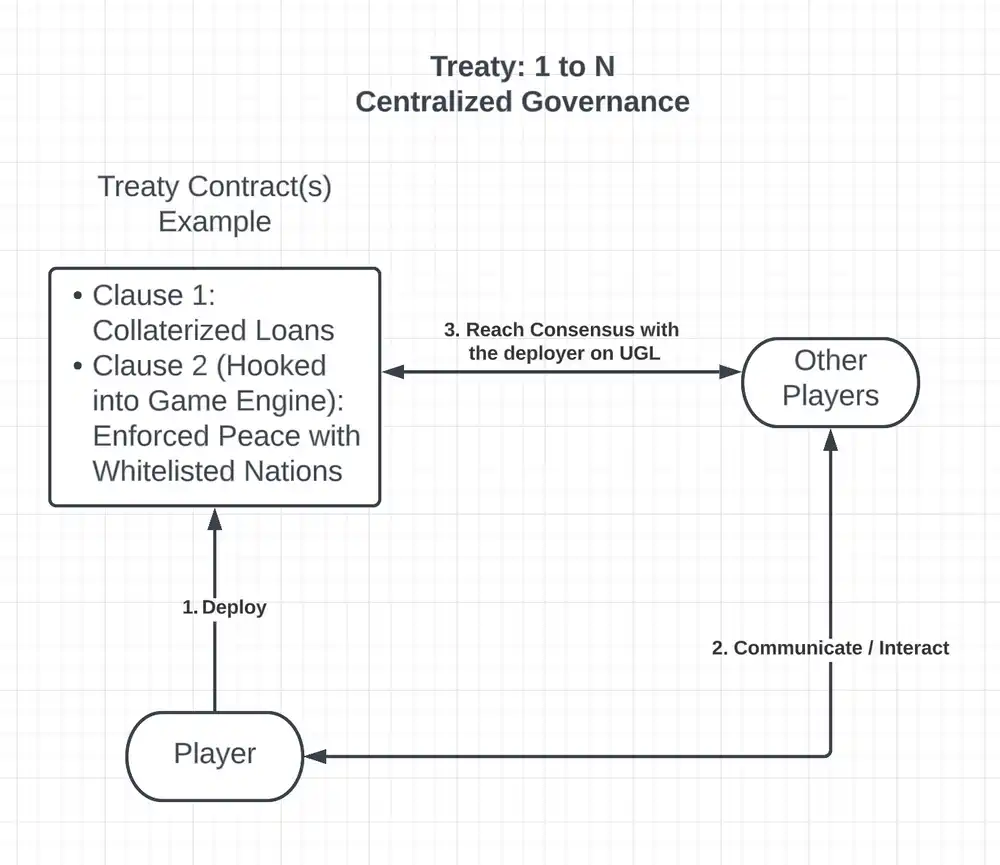
Game design has entered a new realm where the player can assume new roles and responsibilities, such as being the central figure in a 1-N centralized governance model. Alternatively, players can deploy a treaty and use it to offer mortgages to other players, and then both parties can negotiate the terms of the loan asynchronously. In addition, by incorporating logic into the core features of the game, lenders can also whitelist certain players for peace terms to prevent them from attacking the lender's country.This feature allows players to expand the meta-game in creative ways without interfering with other players or the basic rules of game physics.
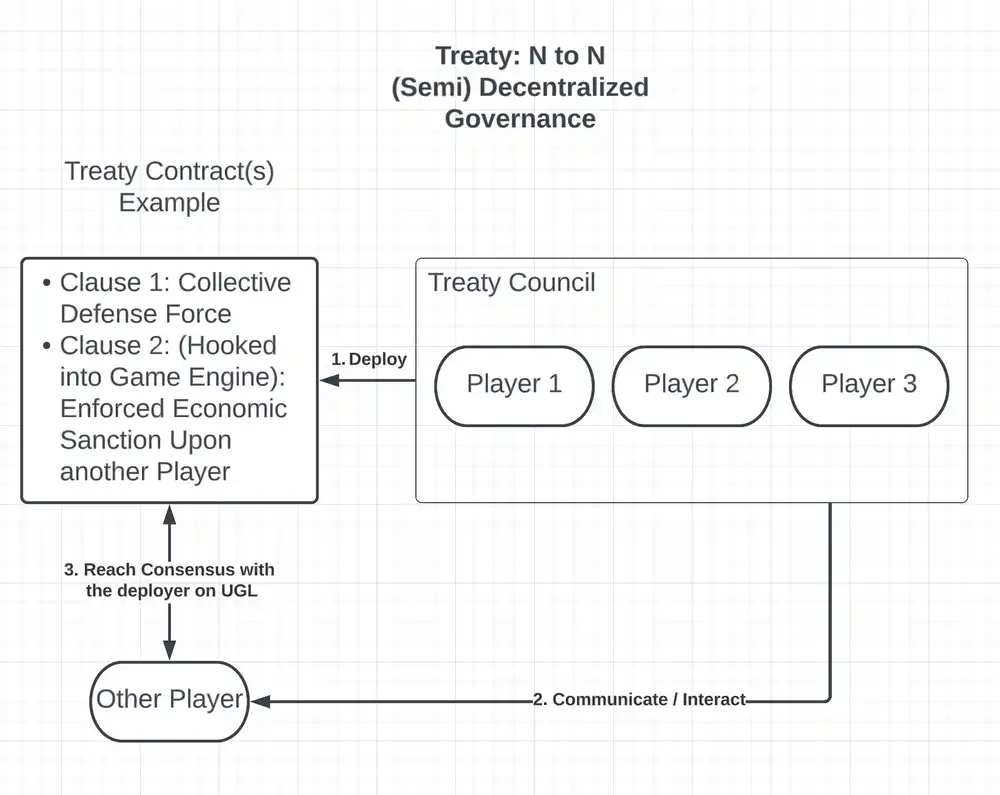
Players can also build a vote-based DAO in their UGL. When setting up an economic sanctions treaty, players in the treaty Council can agree on rules for sanctions, such as which countries to target, and vote on them. These treaty rules are then enforced in the transfer function of the core game.As with the 1-N model, this approach will only affect those involved, thus ensuring maximum treaty flexibility.
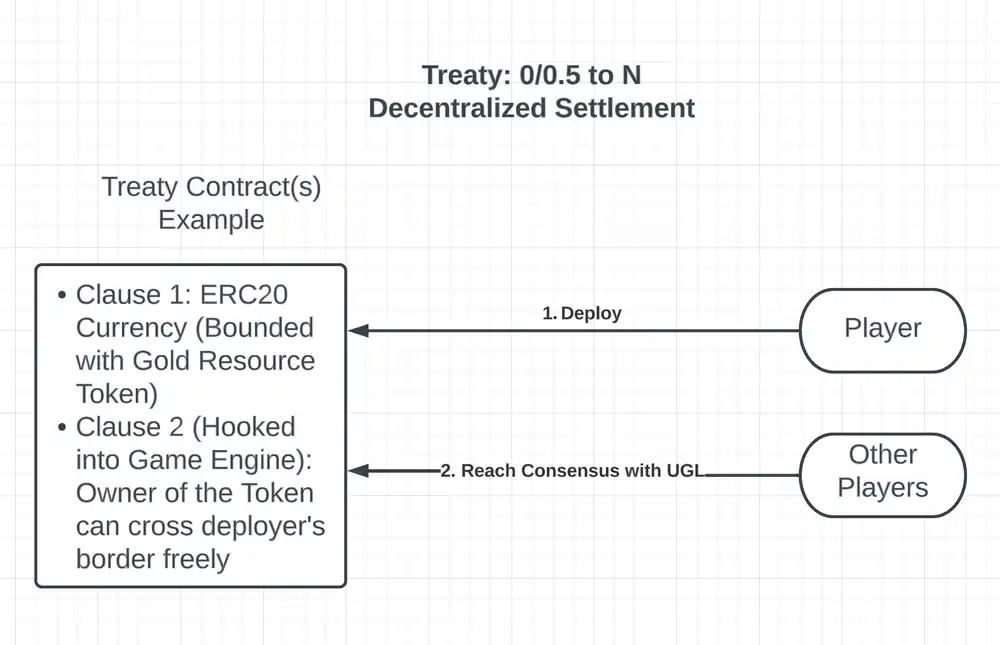
Both the 1-N and N-N structures in the game reflect the social contracts and laws of human society. With the advent of smart contracts, we've devised a completely different consensus structure, called the 0/0.5 structure. When a contract is deployed globally, anyone interacting with it is only in agreement with the contract itself. For example, a contract could stipulate that anyone with a specific ERC20 currency could cross a country's borders. Then, this condition is enforced in the core game feature move.This flurry of action takes place without permission, and never before has a traditional game allowed players to establish their own set of rules like this.
The use of on-chain social contracts in game design is significant because it expands the scope of user-generated content and enables new forms of player interaction and collaboration. We believe that the next phase of gaming will revolve around how players shape rules and mechanics through user-generated logic (UGL) within smart contracts. By breaking free from the constraints of traditional user-generated content and the rules of game physics, UGL will usher in a new era of gaming in which players will be able to collaborate, innovate and create in ways that have never been possible before.
Welcome to join the official BlockBeats community:
Telegram Subscription Group: https://t.me/theblockbeats
Telegram Discussion Group: https://t.me/BlockBeats_App
Official Twitter Account: https://twitter.com/BlockBeatsAsia

 Related Articles







