New Bitcoin NFT project Chainspace: Tim Shel's latest work on Loot core.

Author: LeftOfCenter
The NFT protocol Ordinals, based on the Bitcoin network, has given Bitcoin the possibility of financial use cases for the first time. Although in the eyes of Bitcoin purists, NFTs violate the "peer-to-peer electronic cash" original vision, there is no doubt that issuing one's own NFT on Bitcoin has become a desire for many creators, and collectors seeking new narratives will not give up this investment opportunity. According to Dune Analytics data, the Ordinals protocol has minted over 200,000 NFTs since its release.

The strongest IP creator in the NFT field, Yuga Labs, will also enter the Bitcoin blockchain and launch the Bitcoin NFT series TwelveFold.
On the other hand, the flip side of the coin is that there is a lack of corresponding NFT infrastructure in the Bitcoin ecosystem. Whether it is for creators who want to try to issue NFTs on the Bitcoin network or for investors who want to buy and trade them, the Bitcoin network is at least unable to meet their needs in the short term.
The birth of the experimental NFT project Chainspace, initiated by Loot core backbone Tim Shel and Zora engineer Iain, provides us with another solution, which is to store NFT in the Bitcoin network and issue the corresponding mirror NFT on the Ethereum chain, so that holders can obtain a Bitcoin NFT without owning a Bitcoin wallet. In addition, the mirror NFT on Ethereum is compatible with EVM, which can solve the problem that Bitcoin NFT cannot be traded and circulated due to the lack of infrastructure.
Through this approach, not only can the threshold for casting be lowered to achieve smooth project initiation, but it can also fully utilize the rich infrastructure of the NFT secondary market and market-making platforms in the Ethereum ecosystem, creating the basic conditions for the liquidity and price discovery of NFT projects. The 800 application ontologies of the Chainspace project will be permanently stored in the Bitcoin network, even without Ethereum, and will always exist.
The 780 NFTs initially issued by Chainspace were sold out within a minute, and the trading volume has exceeded 600ETH since its launch 10 days ago. For a somewhat experimental Bitcoin NFT project, Chainspace can be considered a success. Chainspace plans to open source the contract code of this dual-chain structure for more creators to use, which means that ordinary creators can easily issue their own NFT projects on NFT through simple forks without the need for a dedicated development team. And this is the bigger goal behind the project - to introduce more new users to the new ecosystem of Bitcoin.
As an experimental project, the exploration of Chainspace is of significant importance.
It is the first dual-chain project that spans Ethereum and Bitcoin. In Tim Shel's words, it is a 200% pure on-chain project.
Beyond the narrative, Chainspace is actually a compromise solution to address practical issues in the current Bitcoin ecosystem where there is a general lack of infrastructure for NFT use cases. The core elements are permanently stored on the BTC network and can operate independently (even without ETH access), while fully utilizing available Ethereum ecosystem resources to improve user experience and address subsequent liquidity issues through mirrored NFTs on Ethereum.
Once Chainspace open sources the contract code for this dual-chain structure, more NFT projects and applications are expected to grow in the Bitcoin ecosystem, and may even flourish. As the Bitcoin NFT ecosystem and infrastructure continue to grow and improve, there may be an urgent need for tools that automate the transfer of NFTs from Ethereum to Bitcoin, which could attract more developers to create "middleware" tools that connect the two chains.
The following is a brief introduction to Chainspace and an interview with its founder, Tim Shel, to understand its use cases, future plans, and narrative potential.
What is Chainspace?
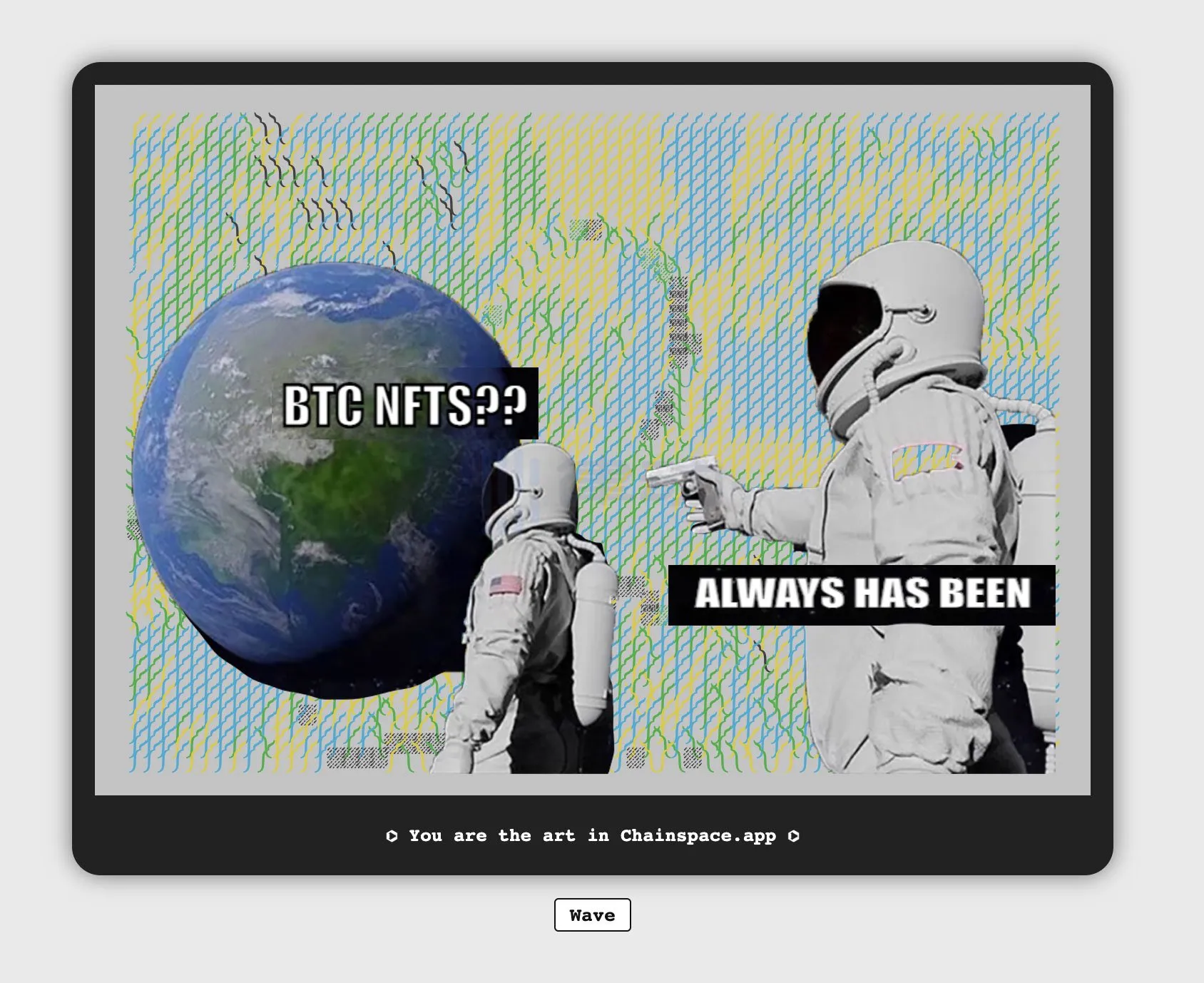
Chainspace is an NFT project based on the Ordinals protocol of the Bitcoin network. It includes 800 video rendering applications stored in the Bitcoin network, which can be used for selfies. You can use preset filters that represent different aesthetic styles of the encryption community to generate a selfie version of the gm emoticon for identity expression and community interaction.
However, it is not entirely accurate to say that Chainspace is an NFT project on the Bitcoin network. In fact, Chainspace also exists on the Ethereum network. Specifically, 800 Chainspace portals are inscribed on the Bitcoin network, starting with Inscription 10,004, and then mapped from BTC to ETH through tokenURI. This project does not involve AWS, IPFS, or Arweave. As developer Tim Shel puts it, this is a 200% pure on-chain project that spans both the Ethereum and Bitcoin networks and can be transferred between them.
The reason for choosing to create mirrored NFTs on Ethereum is entirely based on the consideration of collector experience. On February 17th, Chainspace conducted its initial release on Ethereum, with 780 Chainspace NFTs selling out in less than a minute. The remaining 20 NFTs, called X-Portals, will be distributed in the future through auctions (18 will be used for auctions) and gifts (2 will be given as gifts to Dom, the initiator of Loot).
As the first double-chain structure NFT, Chainspace stands out by fully utilizing the available resources and infrastructure at the current stage, achieving good results in initial issuance and transaction growth. It was first launched on Ethereum and gained early growth through Ethereum's rich NFT infrastructure, and will later guide collectors to host NFTs in Bitcoin wallets through manual operations and automated tools. Tim Shel said that this is a strategic consideration to explore how to maximize the use of available resources when the early NFT infrastructure on the Bitcoin network is not perfect.
专为加密原住民打造的数字链空间
A digital chain space designed specifically for the indigenous people of encryption
If you still don't fully understand what this project is about after reading the introduction, you can try manually operating it on the official website. You will immediately understand that this is a native encryption application for the crypto community, by the crypto community.
Open the official website and select (tune to) to enter any encrypted community channel to access the corresponding community portal.
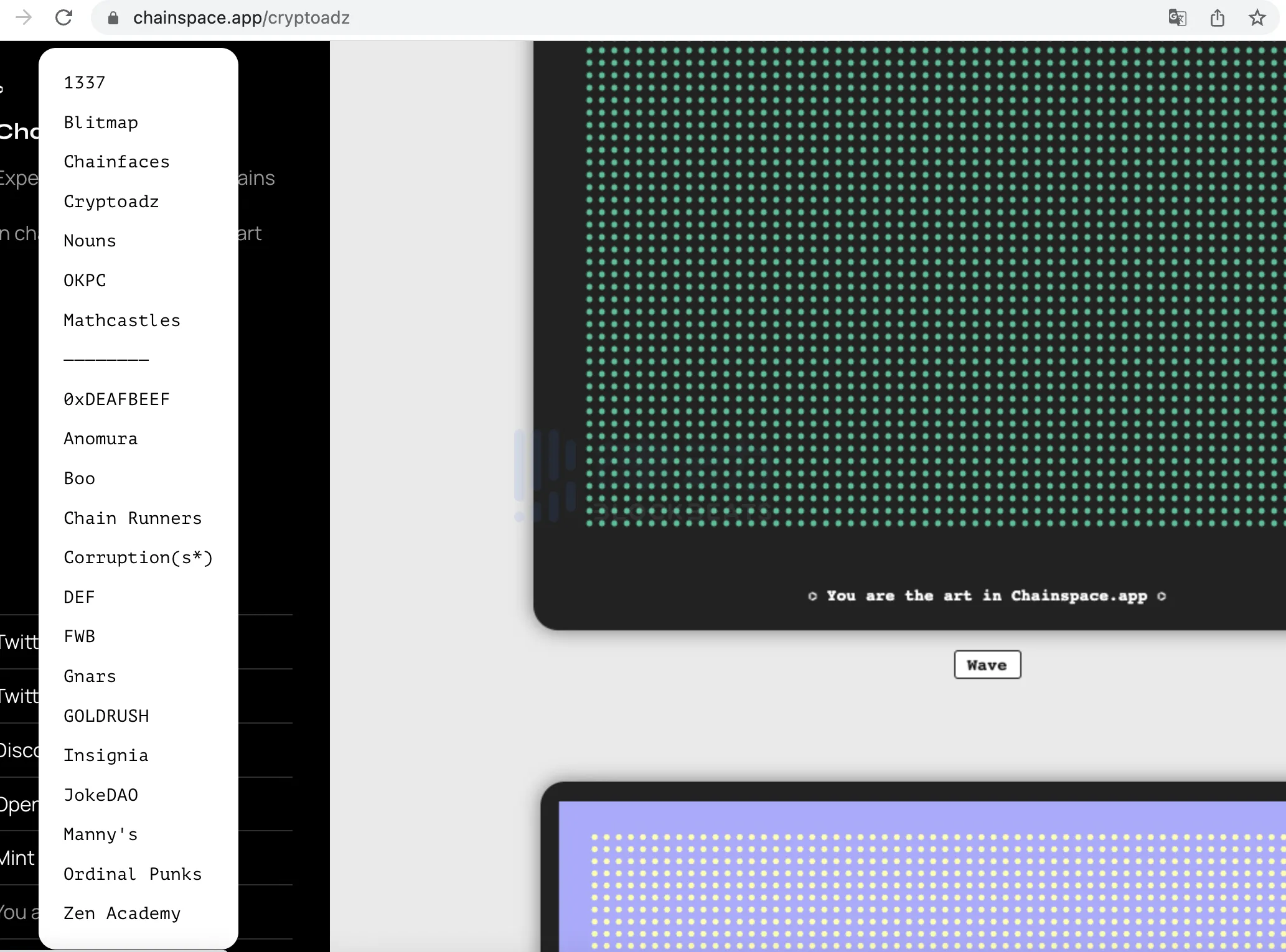
A list of filter frequencies from various encryption communities in Chainspace
Essentially, each entry is a web-based HTML application that will activate your phone/computer camera. You can use it to take selfies or photos of you and the background, and then use it to pixelate the captured photos.
Each entrance corresponds to a specific encrypted community style filter, usually composed of characters, emoji symbols, etc., belonging to the old-school ASCII art style. Choosing one of these communities is equivalent to selecting a rendering filter for the community style. You can use this specific filter to render selfies and do whatever you want with it, such as sending a "gm" greeting to your community in this way.
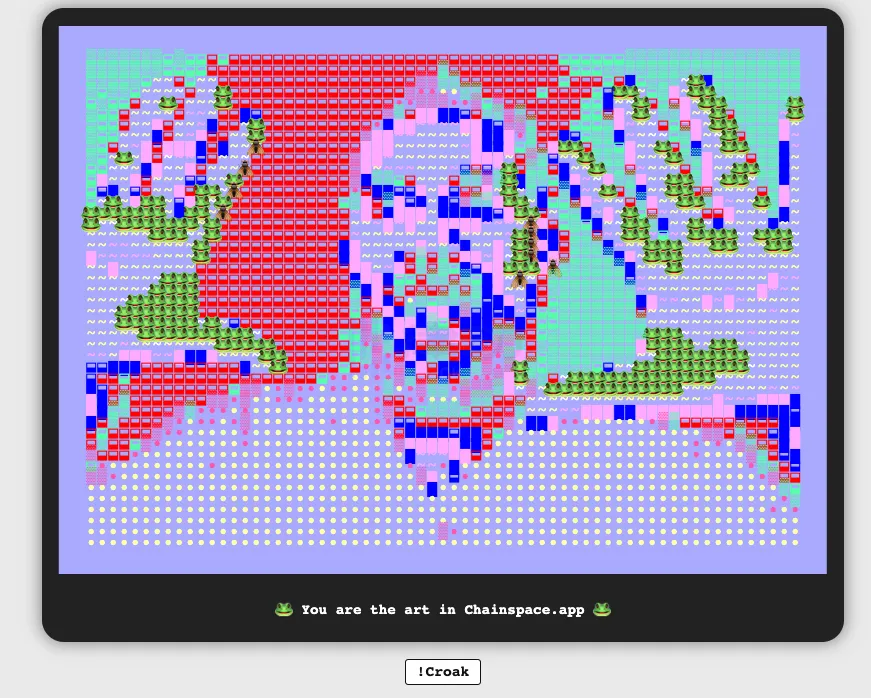
GM from the toadz community
If you are a cryptocurrency user, you must understand the meaning of "gm". "Gm" stands for "good morning" and is a commonly used meme symbol in the cryptocurrency community. It is also a unique way of greeting within the cryptocurrency community. When you say "gm" (fam) to the cryptocurrency community, it is similar to a programmer outputting "hello world".
Chainspace can be said to be a version of the GM generation application with real emoticons. Community members can use such a shooting application to take selfies, add specific style filters to render and send them to the community GM. To some extent, this way of image selfies is more rich and personalized than single GM text expression, and can better achieve self-expression, especially when you use filters of the community style, it is a fun that only community members can understand, representing a certain degree of identity recognition.
Tim Shel believes that this selfie-style GM approach is more relatable and human than a random emoji. It also allows for more imagination, envisioning people sharing their feelings, their bookshelves, and their faces through selfies.
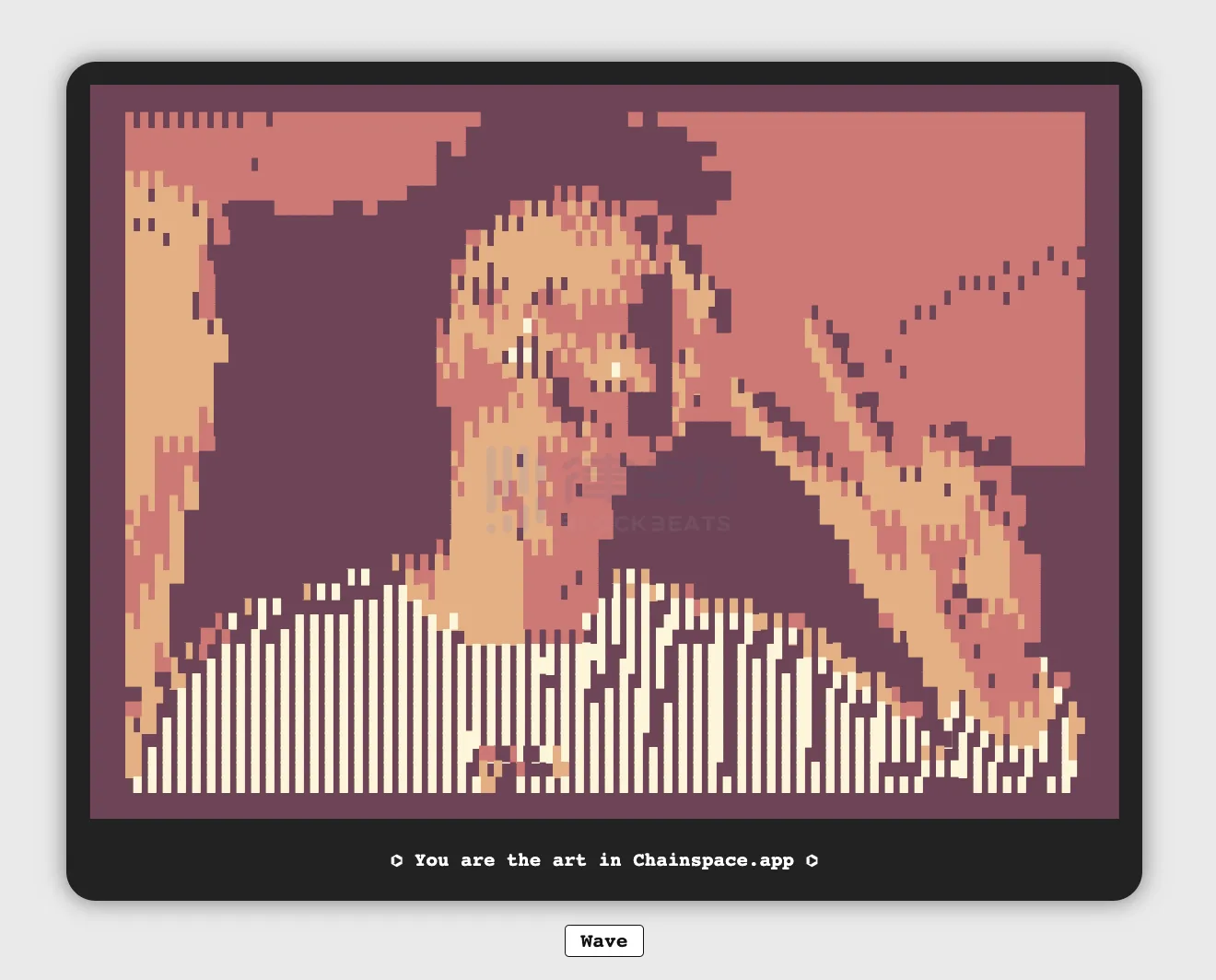
Chainspace initially had a whitelist mechanism. It is worth noting that one of the conditions for obtaining the whitelist is to use the Chainspace application to take a selfie and greet the community. The above picture is shared by a user from the wave-to-enter channel in the official Chainspace discord.
It can be said that Chainspace is a selfie booth in the encrypted digital space. Unlike real-life selfie booths, it is free and available to everyone, and comes with pre-set community-style filters.
In addition, maintaining anonymity is another important use case for Chainspace. When encrypted users add some kind of old-school ASCII filter to their faces, not only do they achieve self-expression, but they also cover their faces with an abstract overlay, which allows encrypted users to keep their true identities from being exposed.
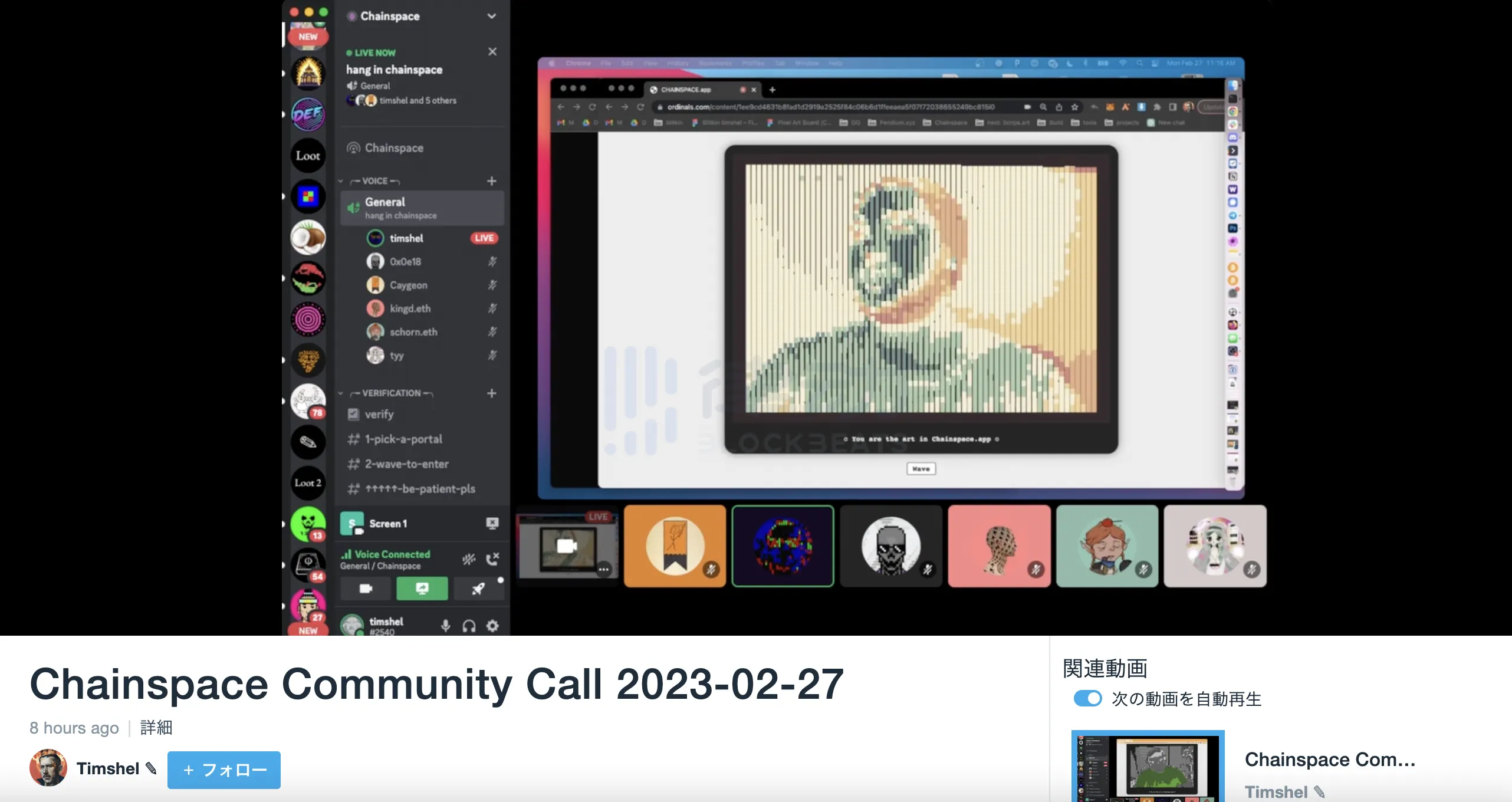
Tim Shel held an "anonymous" community meeting using Chainspace
Tim Shel referred to Chainspace as an experimental project, which means it is immature, uncertain, and highly likely to fail. However, being experimental also means exploring possibilities and vitality, and from visible human history, we can find that experimental projects are the most likely places to give birth to groundbreaking things.
So, for a project like Chainspace, what possibilities does it explore? What makes it unique? And what potential does it hold in the visible future?
The first cross-chain pure on-chain NFT project
Chainspace has invented a brand new way of issuing NFTs, which is the first cross-chain pure on-chain NFT project. It spans across the Bitcoin and Ethereum networks, making it possible for a Chainspace NFT to exist in two places at the same time. The application used for taking pictures exists on the Bitcoin network, which means that as long as Bitcoin exists, it will exist forever. In this sense, its permanent storage is much larger than that of Arweave. The mirrored NFT exists on Ethereum, corresponding to the ownership of all 800 Chainspace entrances stored on the Bitcoin network, and is rendered through the corresponding NFT data on the BTC network.
The 800 Chainspace NFTs stored in the Bitcoin network are like digital selfie booths with different filter styles. As a type of digital artifact existing in virtual space, each Chainspace's geographic location is determined by two coordinates: one is the transaction hash of Bitcoin, and the other is the tokenURI on Ethereum.

Chainspace generated user selfies
Minimal Viable Issuance
Beyond the narrative, fundamentally, Chainspace's invention of the dual-chain structure NFT contract model is the result of considering the collector's experience, and by adopting a minimum viable launch mode, fully utilizing the infrastructure currently available on Ethereum, the barriers to BTC NFT minting experience are minimized as much as possible, thus creating the necessary foundation for the growth of the project.
The emergence of NFT protocol Ordinals in the Bitcoin network allows the Bitcoin network to carry larger on-chain data as content than Ethereum, which means that NFTs as a type of art carrier can be engraved on a single Satoshi in the Bitcoin network in the form of inscriptions, with a much higher degree of authenticity than Ethereum, and can also be traded and owned.
Larger data capacity means that the BTC network can be used for secure storage, which brings huge imagination space. However, currently, the Bitcoin NFT infrastructure is not perfect, lacking corresponding user applications and secondary markets. Considering this, Chainspace chose to issue 800 mirrored NFTs on Ethereum, corresponding to the ownership of all 800 Chainspace entrances stored on the Bitcoin network. Afterwards, the holder can claim the corresponding Chainspace NFT in their Bitcoin wallet through other operations.
Tim Shel has released a tweet with an early access step-by-step guide to guide holders in swapping their Chainspace NFTs in ETH version to Bitcoin wallets. Users will need to provide their Bitcoin wallet address. It is important to note that once the swap is completed, the original ETH version will be destroyed and cannot be traded on the Ethereum network. However, it can still be displayed on the OpenSea marketplace. Of course, you can use emblem.finance to swap it back to the Ethereum version.
This greatly simplifies the threshold for users to own BTC NFTs. For NFT collectors who are familiar with Ethereum, they can mint their own BTC NFTs without needing a Bitcoin wallet. After minting, the rich secondary market and various NFT-related applications and tools in the Ethereum ecosystem also create conditions for the circulation of this NFT in the secondary market.
Currently, Tim Shel is developing a solution for automated exchange of NFTs from Bitcoin to Ethereum. The solution is not yet fully determined, but it is confirmed that it will be "trustless, on-chain, permissionless, permanent, and asynchronous".
Without a doubt, the experimental exploration of Chainspace has been successful. Data shows that since its release on February 17th, the total transaction volume of Chainspace has been 601ETH.
Introducing more new users to the Bitcoin ecosystem
Chainspace's own practical exploration has proven that this simplest feasible issuance model is feasible. Next, as developers, Tim Shel and Iain plan to open source the contract code of this dual-chain structure model to allow more creators and developers to use it.
The Chainspace contract itself is a superstructure that includes both the Ethereum and Bitcoin chains, which means that both blockchains can be fully utilized for their respective advantages. BTC is used for reliable eternal storage, while ETH can be used for interoperability and compatibility with EVM chain applications.
Obviously, Tim Shel is not the only creator who wants to issue NFTs on BTC. For more creators who want to try issuing NFTs on the BTC network, they can directly use the dual-chain structured contract code that Chainspace will soon open source, and launch their own projects on Ethereum in the minimum viable issuance mode. This is the most effective way to maximize the use of available resources under existing infrastructure.
"The advantage of this model is that the core elements exist independently on BTC, so even without ETH, they can be accessed and will always run. The mirrored NFT on Ethereum is compatible with EVM, making it easier to hold, circulate, and trade NFTs," said Tim Shel.
"Chainspace aims to explore how to bring more new users into a brand new BTC world." This is the true purpose behind the project, as stated by Tim Shel.
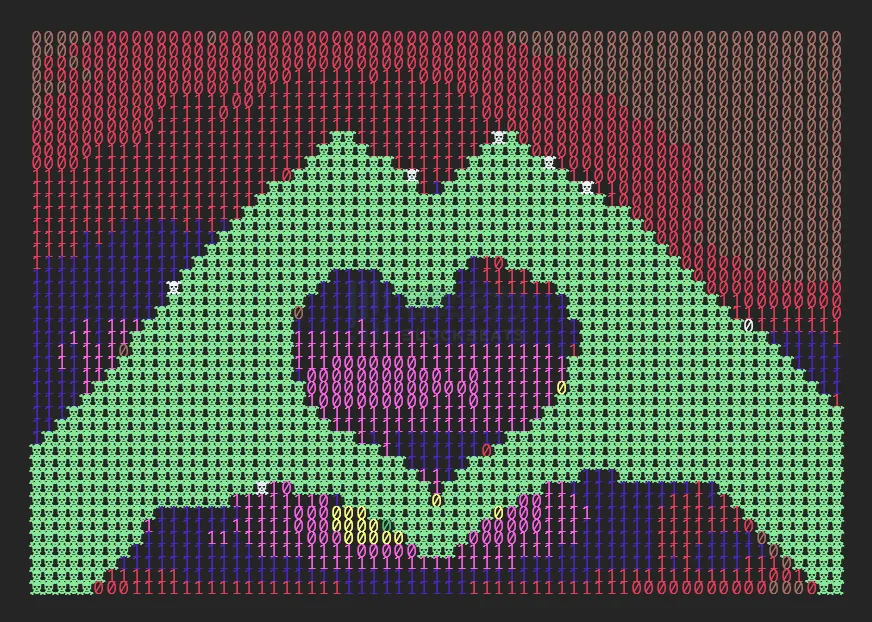
Chainspace community user-generated gm emoticons
With the maturity of BTC infrastructure, we look forward to seeing the rise of more applications. For example, for applications like Chainspace, an imaginative infrastructure could be a middleware application that bridges Bitcoin and Ethereum NFTs, an automated solution that enables the transfer of NFTs from Ethereum to Bitcoin.
Public Goods in the Digital World
One debate surrounding NFTs is that they can only be accessed by their owners and typically come with some sort of unique rights that only the holder can enjoy. However, the existence of Chainspace breaks our singular perception of NFTs.
Chainspace is an 800-video rendering application stored in the Bitcoin network, which can be used by anyone to take photos without payment. It is a public facility. Anyone can use any of the entrances to take pictures, and then use these generated works for anything, whether it is sharing in the community, casting on the chain as NFT, or generating derivative art. Although the right to use is open to everyone, these 800 self-portrait applications are owned in the form of NFT, which makes it a digital asset.
Since every entrance is accessible for free and there is no special privilege for the owner, why do people want to pay for such a thing?
Timshel states that Chainspace can be compared to a real-life art installation, which is a public object open to everyone but still owned by specific sponsors. As a native digital public space for cryptography, Chainspace will become an increasingly significant force with the trend of Ordinals and early BTC on-chain engraving. The emergence of more on-chain media and Web3 experiments will make people want to have access to a Chainspace entrance.
Welcome to join the official BlockBeats community:
Telegram Subscription Group: https://t.me/theblockbeats
Telegram Discussion Group: https://t.me/BlockBeats_App
Official Twitter Account: https://twitter.com/BlockBeatsAsia
 Related Articles