A discussion on the possible emergence of application chains in 2023.
Original Title: "Talking about the Application Chains that I Think Will Be Popular This Year"
Original Author: Jason Chen, Do You Understand This World a Little Better Today?
Let's talk about application chains. In fact, this concept is quite old, but recently I have noticed that the voice of application chains in the market has become louder again. From dydx's announcement to migrate to Cosmos, to the defi chain Canto, to Sequoia Capital's L2 application chain solution Caldera, and Polygon's own Polygon Edge, projects, capital, and public chains are all taking action in the field of application chains. Therefore, there are signs of a systematic trend emerging.
Actually, the difference between application chains and public chains is like the difference between private and public clouds in SaaS. If customers don't care about performance, they will use public clouds and share service resources with others. However, if they have high requirements for performance or customization, such as state-owned enterprises or governments, they will require private clouds or even local deployment to have a whole set of service resources exclusively. Friends who have experience in SaaS or toB may immediately understand the value of application chains when hearing this.
Application chain is a proprietary blockchain that serves specific applications, rather than running multiple applications like Ethereum and other public chains. This allows an application to have exclusive access to the entire chain without competing with third parties for resources. Additionally, developers have greater freedom in consensus algorithms and governance mechanisms, rather than being limited to the main chain itself. This makes it more customizable and better suited to support the development of the application itself.
First of all, the application chain can be said to have created a completely different technical system from the common single-layer or multi-layer chain. I have previously written two articles explaining the understanding and evolutionary development process of Layer0, 1, 2, and sidechains, all of which are under the technical system of public chains. I suggest that you first read these two articles to supplement your background knowledge: "From Layer1, sidechains, Plasma to Layer2, let's talk about their concepts, definitions, evolutionary processes, and future trends" and "What are Layer0, 1, and 2 layers that I understand?"
In addition to the perspective of the actual value of the application chain, it is important to know that the chain is the biggest story of web3 and the ceiling of storytelling. Therefore, whether it is elite chains like aptos and sui from Wall Street + Silicon Valley, or projects like dydx that have developed their own ecosystem and even their own application chains, they have fully leveraged their storytelling to stimulate the market's imagination.
Therefore, the demand of the project for the application chain lies in two aspects. Firstly, when it develops to a certain extent, it does not want to compete with other projects for resources and wait in line, so it wants to create its own chain. Secondly, when it needs to tell a bigger story and expand its ecological boundary, there are solutions providers such as Cosmos and Caldera that offer one-click chain deployment solutions.
Secondly, the ecology is most afraid of a project dominating the market and affecting the ecological balance. For example, Solana was largely driven by stepn, but after stepn declined, Solana also fell. Later, Solana's NFT gave it a feeling of revival, but then a certain NFT project appeared and extorted 5 million US dollars from Solana, threatening to move to other chains if not paid.
So for public chains, it is also necessary to take care of projects that may need to run, which has led to application chain solutions such as Polygon. If one day you really want to run your own chain, Polygon can also provide you with this capability. This is the tension relationship between project parties, public chains, and application chains, supplemented by the push of capital. Therefore, we can see that there has been a lot of market activity during this period.
This is an article from dydx half a year ago announcing their plan to develop their own chain based on Cosmos. The chain is claimed to be completely decentralized, scalable, customizable, and composable, with throughput several orders of magnitude higher than any other blockchain. Therefore, customization and performance are the core reasons for choosing to launch their own chain. They also mentioned that even Ethereum Layer2 cannot meet their needs. https://dydx.exchange/blog/dydx-chain
Canto is an EVM-compatible chain designed specifically for DeFi based on Cosmos. Therefore, Canto can no longer be called an application chain but an industry chain in terms of category. Recently, its TVL has surpassed Solana. Its advantage in building its own chain lies not only in performance but also in customizability. It believes that exchanges, lending, and stablecoins are the three pillars of DeFi. Since it wants to build a DeFi chain, it should directly incorporate them as free public facilities within the chain.
The following article elaborates on Canto's specific ideas. Canto believes that existing defi protocols are like hourly parking lots in shopping malls, while Canto believes that they should be open and free parking lots for shopping malls, so that more people are willing to drive to the mall to play and shop, thus promoting the prosperity of the entire defi ecosystem. If I feel pain every time I park in a mall, then there is no fun in going there.
https://canto.mirror.xyz/STFv6-ZnOrsR6pJ7_JyFPt5JuhBXGQ3_lHNVEZAgUW8
Therefore, in Canto, the basic infrastructure such as exchanges is built-in and contracts cannot be upgraded. They will run permanently and will not issue their own tokens to "collect rent". The concept of strong control over the three basic elements of defi through the chain is indeed novel, but some people also think that if they do everything themselves, which are the "most profitable" things in defi, will there be any shadow of luna. If we follow the statement in the document that it is free, non-upgradable, and tokenless, then the risk should be manageable.
It also launched the CSR Contract Security Revenue Plan, which is developed directly at the consensus layer and EVM layer. CSR is a fee allocation model of the Canto network, which enables smart contract developers to profit from their original works by requesting a certain percentage of transaction fees paid to the network when users interact with their smart contracts.
https://canto.mirror.xyz/HvJHkX-2eDqHwdDlskCDnp7cpKtk_u-xgvCgj1FzG6E
This is somewhat similar to "contract mining". For example, in Ethereum, a portion of the gas fee paid to the network is given to miners. Canto will also give a portion of the fee to smart contract developers. Perhaps Canto wants to encourage defi developers to focus less on profit and instead ensure that users smoothly use their products, as the defi chain is full of risks. After all, this stuff is all about money.
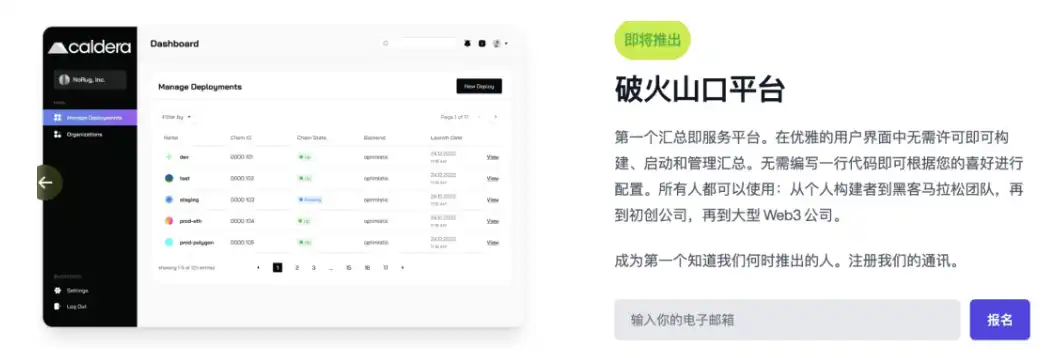
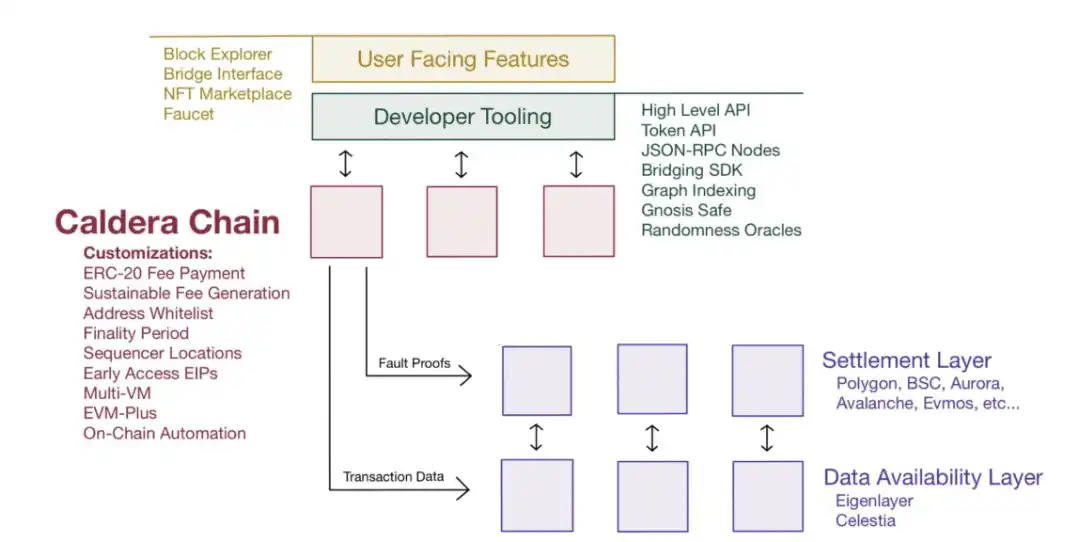
Canto incentivizes developers through CSR allocation to develop applications and earn money as long as there are users, rather than blowing bubbles to rug users' money through nesting and other forms. In addition, as a new chain compatible with EVM, Canto must compete for developer resources. Through CSR, it can also attract developers to migrate EVM-built chains. After all, Cosmos is a Layer1 solution, while Caldera is a Layer2 solution. Through the official website, it can be seen that Caldera is also focused on high performance and customization, with the added feature of zero code. Through visual configuration in the background, one can launch a Layer2 that is exclusive to oneself. However, I believe that the problem with zero code is that it will greatly reduce customization, as everything is standardized by Caldera.
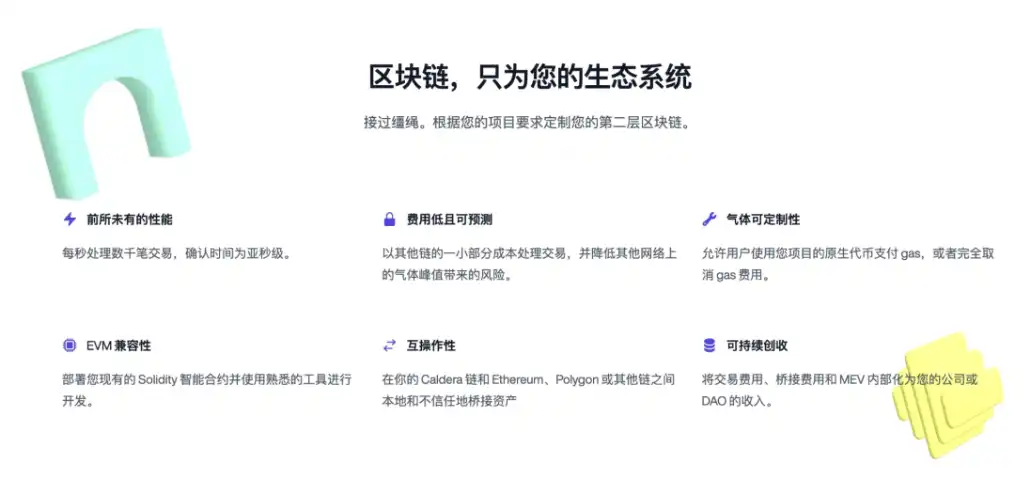
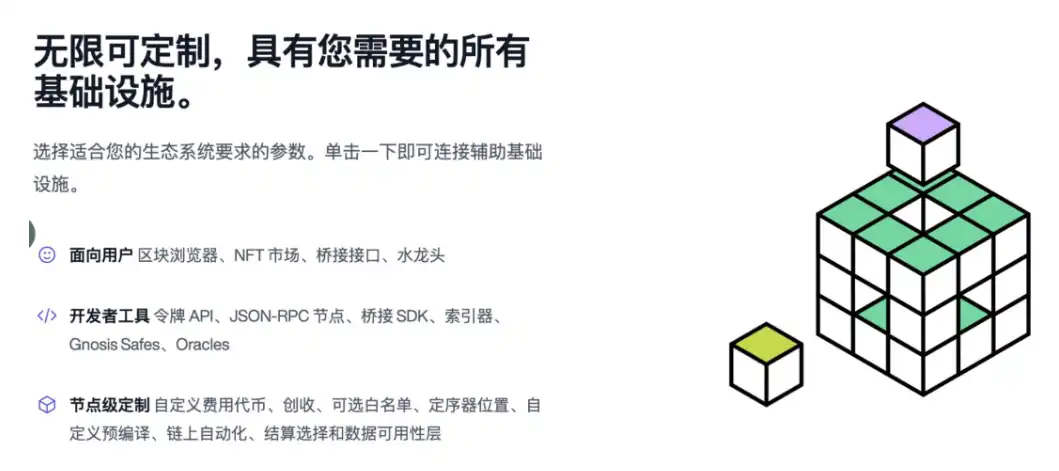
As a Layer2 scaling solution, it primarily considers the security of Ethereum, so it mainly uses Ethereum as its layer one chain. It also takes into account the large number of projects that are heavily dependent on the Ethereum ecosystem. It separates the execution layer from the data availability layer, allowing for flexible decisions on whether to send data to EVM settlement or Celestia or other layer one chains.
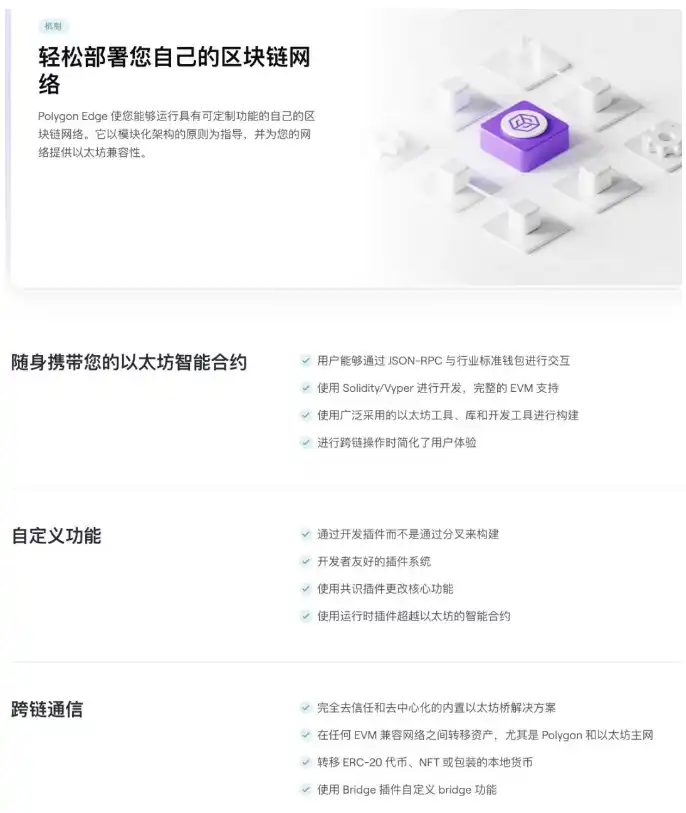
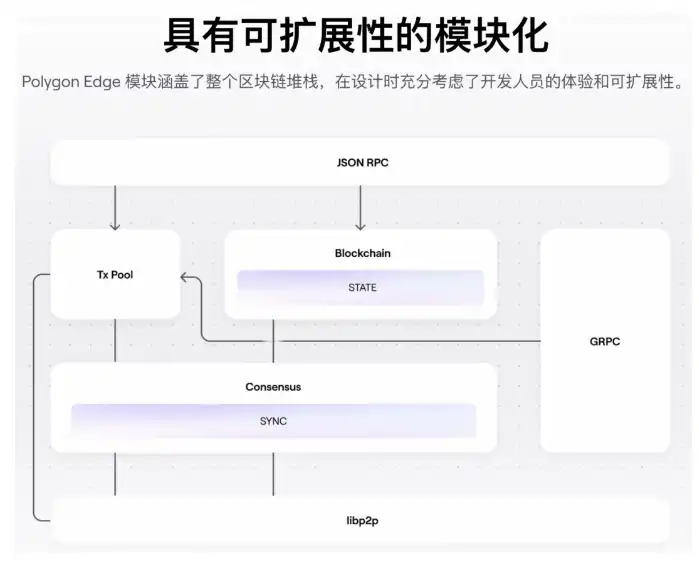
Polygon Edge focuses on modularity to achieve customizability, while providing full compatibility with Ethereum smart contracts and transactions. It supports both POA and POS consensus mechanisms, as well as cross-chain communication for multiple blockchain networks. However, cross-chain capability should be a necessary feature for one-click chain deployment solutions to achieve blockchain interconnectivity, which is also what Cosmos has been striving for since its inception.
The veteran application chain solutions are mainly Polkadot and Cosmos. Polkadot is a network composed of L1 blockchains, called parallel chains, which are all connected to a central blockchain called the relay chain. The relay chain is the 0th layer blockchain that can verify all transactions from parallel chains. The relay chain uses the POS mechanism, where validators stake Polkadot's native token DOT. Validator groups are responsible for a specific parallel chain.
Currently, Polkadot can accommodate up to 100 parallel chains, and developers need to obtain parallel chains through auctions. This quantity limit and corresponding cost are still a high threshold. I won't go into too much detail about Polkadot, as it is already a well-established player in the industry. Some of my friends have profited from it, while others have suffered losses.
Currently, from the voices in the market, I feel that Cosmos is gaining momentum, especially with projects like dydx migrating over, and my previous project, Greenfield, which was launched by Binance, also uses Cosmos as its underlying development. After reading its white paper and development documentation, Cosmos gives me a feeling of "stable and robust". Its native token is ATOM, and I will configure it myself. This is not investment advice, so please do your own research (DYOR).
The story of Cosmos from its birth to the present day is about the blockchain internet, so launching a chain is only a part of its value. The core punch lies in cross-chain communication IBC. After all, although having its own chain gives more freedom, there will also be more isolated islands in the blockchain world. Therefore, communication between chains is necessary to promote the prosperity of the entire ecosystem. Otherwise, it will be like playing with oneself, and eventually return to the dead cycle of separation and reunion.
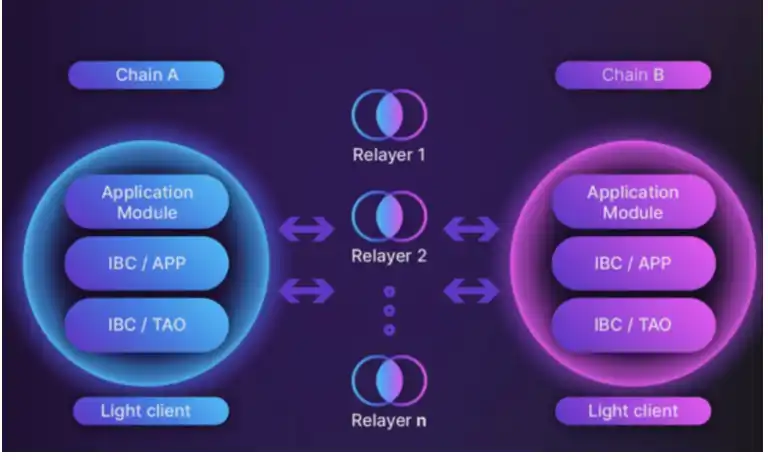
IBC provides a universal communication protocol framework for chains to achieve standardized inter-blockchain communication. It can be directly used for chains developed using Cosmos, which is the biggest advantage of using Cosmos. However, the IBC protocol itself is also open, so even non-Cosmos chains can use it, although it may not be as convenient. As shown in the figure, data communication between chains relies on the relay Relayer.
Some friends have also asked whether there is still room for survival for application chains with the emergence of high-performance chains such as aptos and the maturity of Layer2. I believe there is, after all, performance is only part of the value of application chains, and there is also the existence of value such as customizability.
Due to my limited knowledge and experience, there may be deficiencies or errors in the above content. Corrections and discussions are welcome. Please note that this article does not provide any investment advice. Please do your own research (DYOR).
Original article link
Welcome to join the official BlockBeats community:
Telegram Subscription Group: https://t.me/theblockbeats
Telegram Discussion Group: https://t.me/BlockBeats_App
Official Twitter Account: https://twitter.com/BlockBeatsAsia

 Related Articles