As important as L2 application chain, who can be the front-runner?
Title: "As important as L2, Who can be the front runner?"
Source: Bai Ze Research Institute
Web3 has grown rapidly in recent years, and the need for scalable solutions has become more urgent.
The "dApp Chain" narrative is emerging: a use-case-focused, interoperable blockchain network that can provide a more scalable, efficient and flexible infrastructure for Dapps.
In this article, we explore the advantages of app chains and compare the four leading app chain ecosystems: Avalanche, Polkadot, Celestia, and Cosmos. Which of them will be the most marketable product and most capable of leading the app chain in the coming years?
Why do you need application chains?
The blockchain Trilemma has long been a thorn in the side of developers. It has proven impossible to create a blockchain that excelses all three attributes: security, decentralization, and scalability.
Many have seen application chains as saviors because they allow multiple chains to interoperate and allow scalability by reducing the transaction load on each chain without compromising security and decentralization. However, the application chain is increasingly overshadowed by another solution: Layer-2. Recently, there has been a lot of discussion around L2, and rollups is expected to be the preferred solution for achieving scalability while maintaining security and decentralization.
You might think the app chain is dead, but it's not. Developers who prefer app chains believe that app chains can create new value propositions, that using dApp's native tokens as payment means can enhance user experience, and that app chains allow the internalization of MEVs, thus generating revenue for Dapps themselves. So while L2 has become a hot topic, the app chain isn't going anywhere.
What is MEV?
MEV stands for maximum extractable value. In short, MEVs allow miners and verifiers to extract more value from the blockchain by manipulating the transaction's location in the block. Historically, this has been associated with negative behavior such as front-running trading and sandwich attacks, but it also has some advantages. Good MEVs, such as arbitrage and clearing, are essential to make DeFi more efficient.
For dApp developers, having their own blockchain gives them better control over MEVs and the ability to minimize bad behavior. This means that internalizing MEVs can generate revenue for Dapps themselves, and as the crypto industry matures, businesses that generate profits sustainably will become increasingly important.
Mevs are likely to be the driving force behind more app chains in the future.
Who benefits from MEVs?
While additional revenue from MEVs sounds exciting, not every crypto project will benefit.
The ones that can really take full advantage of MEVs are the defIs of clearing and arbitrage supremacy, such as loan agreements, AMMs and perpetual DEX. If these projects start only on L1 or L2, they will lose a lot of revenue. So, for them, launching their own app chain could be a smart business decision that sets them apart from the competition. dYdX, for example, said goodbye to Ethereum and opted to build its own app chain on Cosmos.
However, if you are building a decentralized service application, NFT, or GameFi, MEV is not something you should consider. It's more cost effective and easier to launch on L1, which may be one reason why Helium recently switched from having its own blockchain to launching on Solana.
Other reasons to build application chains
Mevs aside, there are other reasons for developers to launch their own app chains.
For example, L1's transaction fees may be a major barrier to attracting non-encrypted native users. Each transaction requires the user to pay L1's original token payment, which can cause confusion. With app chains, developers can solve this problem by allowing users to pay with dApp's native tokens, or by offering completely gas-free transactions. Therefore, app chain is also a solution to simplify the user experience.
Although L2 steals the show in terms of scalability, app chains can still provide a great solution for scalability. Some DApps, especially in the gaming space, require high transaction throughput and low latency the most. For example, with a game like FIFA Ultimate Team generating thousands of transactions per second, even L2 might be difficult to handle. As a result, such games are likely to be the main adopters of the app chain.
In addition, launching app chains allows dApp developers to fully customize the network's design, consensus mechanism, governance structure, and economic model. While L1 is designed to meet the requirements of most general-purpose DApps, some niche applications may require specific changes at the protocol level. Therefore, through the application chain, developers can customize the network design.
Four application chain networks
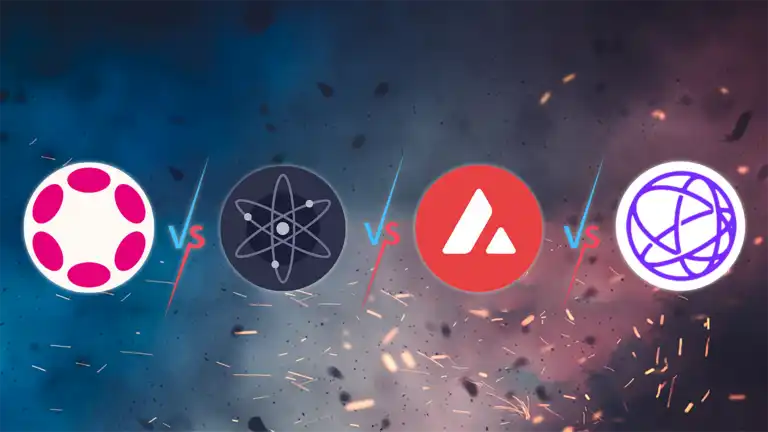
It can be said that there are currently four blockchain networks that are following the app chain narrative and looking to create an ecosystem of independent and sovereign blockchains.
Polkadot is a blockchain network for inter-chain interoperability and shared security launched by Ethereum co-founder Gavin Wood in 2016. itEnables developers to create their own dedicated blockchains, known as "parallel chains," which can interact with each other - this is achieved by using a relay chain (central chain) that acts as a central hub for communication between different parallel chains.
Each parallel chain can have its own consensus mechanism, virtual machine, and governance structure, providing developers with a high degree of flexibility and customization. Polkadot also provides a shared security model that allows smaller parallel chains to benefit from the security of larger networks.
To get the parallel chain slot, the developer and community must lock in the Polkadot native token $DOT to win the parallel chain auction. That can cost a lot of money, and the average winning bid in the first five Polkadot parallel chain slot auctions in 2021 was about $100,000 per slot. This drives demand for $DOT in the short term, but may limit adoption in the long run as developers and their communities have to invest a lot of money to get a seat at the table.
Despite these challenges, Polkadot has received support from many organizations, a passionate community, and a large number of active developers on a daily basis.
Avalanche, a blockchain network, offers developers two options for launching Dapps.
Developers can quickly deploy Dapps on Avalanche C-Chain, a license-free, Ethereum-like environment. Alternatively, developers can customize their own dedicated blockchains of Dapps, known as "subnets," which can operate independently or interact with other subnets.
Subnets are highly customizable, allowing developers to select parameters such as consensus mechanism, virtual machine, and smart contract language based on their needs and preferences.
One of the key advantages of Avalanche is its Consensus mechanism, called Avalanche Consensus, which aims to achieve high throughput, low latency, and low transaction fees. This appeals to developers who value speed and efficiency.

Cosmos is a blockchain ecosystem known for its interblockchain Communication Protocol (IBC), which allows authentication and data transfer between two different blockchains. This means that users can send money between different IBC-enabled blockchains without having to bridge the chain.
In the Cosmos ecosystem, there are two different shared security solutions.
Interchain security (ICS)
While IBC has created a lot of value for Cosmos, the Cosmos Hub, the main hub of the Cosmos ecosystem, has struggled to find its own value. However, the introduction of Interchain Security (ICS) is expected to change this.
Developing and maintaining IBC-enabled blockchains can be complex and expensive, as these chains cannot rely on Cosmos Hub to keep them secure. Instead, they need to find their own set of validators and motivate them to continue verifying transactions.
With ICS, IBC-enabled chains will be able to secure their chains with Cosmos Hub validators after they are approved by the Cosmos Hub governance vote, rather than having to build their own set of validators.
While this eliminates the process of finding and maintaining a large number of validators, the cost of setting up ICS is still high. While Cosmos SDK simplifies the process of starting a blockchain, it still requires professional engineers, in other words, adding to the already high staffing costs faced by Web3 companies. In addition, additional costs are incurred even after a successful startup, as the chain must continue to reward Cosmos Hub validators and proxies in exchange for security protection.
Mesh Security
In the Cosmos ecosystem, Mesh Security is a novel approach to enhance the security of decentralized networks through a shared security model. Osmosis and Juno, specifically, are working on creating two-way Bridges between their respective blockchain networks to take advantage of the security of each network's native tokens. The bridge allows tokens from one network to be pledged and used as collateral to protect transactions on the other network, creating a feedback loop in which the security of each network reinforces the security of the other.
However, implementing Mesh Security introduces some complexity and costs. For example, even after a fully independent IBC blockchain is established, integrating Mesh Security requires the adoption of governance proposals on each of the chains involved. Developers who want to build Mesh Security relationships with multiple chains need to submit governance proposals and implement code on each chain to make it work.
Despite these challenges, Mesh Security offers the greatest independence and economic promise among shared security models.
Celestia is a project that has recently garnered a lot of attention for introducing a new approach -- "modularity" -- that promises to revolutionize the app chain landscape. The project has raised up to $56.5 million in two rounds of private funding, making its release even more highly anticipated.
What makes Celestia stand out is that it is a "tiny" blockchain that can only publish transactions, while actual execution takes place on separate rollups that developers deploy on the Celestia chain. By separating the consensus layer from the application execution layer, Celestia offers developers similar benefits to the app chain ecosystem without them having to build their own blockchain. Each dApp launched with Celestia has its own separate rollups, allowing developers to define their own virtual machines and get their own execution space, ensuring scalability while benefiting from the security of the Celestia Consensus layer.
Although the Celestia method reduces development costs and makes it easier for less-funded projects to get off the app chain, it comes at the price of autonomy and sovereignty. With Celestia rollup, developers have less choice in product and economic design and less opportunity to take advantage of MEVs compared to sovereign app chains.
Product market fit
Polkadot
Polkadot has tremendous potential with its experienced and reputable development team and active developer community. However, in the long run, it may be difficult to attract developers due to the higher capital requirements for obtaining parallel chain slots compared to other solutions. With no additional benefits over other competitors, it may be difficult to convince developers to start app chains with Polkadot.
Avalanche
I believe Avalanche is well suited to the blockchain gaming market and has already made impressive progress in this direction. Avalanche also offers two ways to grow. Developers can either build proprietary app chains or deploy Dapps directly on the C-Chain.
Despite its incredible technology, Avalanche still faces other strong competitors. Ethereum and its L2s, such as Arbitrum, Polygon, Optimism, and the game-specific Immutable X, benefit from the larger community and branding of Ethereum.
While I think Avalanche is the pre-eminent blockchain gaming solution, especially for big game studios, it remains to be seen if it can beat Ethereum.
Celestia
Despite its recent buzz, Celestia's narrative seems to be stuck on scalability. Ethereum L2 offers all the scalability needed for most projects, and I'm not sure there's a clear niche for Celestia. Still, we could see smaller dApp developers adopting Celestia as their app chain solution because they may lack the resources to build sovereign blockchains. Still, I'm not entirely convinced that this is enough to make Celestia a winner in the app chain space.
It's important to remember that Ethereum's mission is to become more user-friendly and allow more projects to create their own Dapp-specific rollup. But while Ethereum is the main leader in the blockchain space, Celestia's focus on being a Dapp-specific rollup platform has significant advantages in terms of scalability and cost-effectiveness. Still, Ethereum's massive brand and large community mean that once Dapp-specific rollup becomes more mainstream on Ethereum, then most developers are still likely to choose Ethereum over Celestia. Celestia will need to move quickly and capitalise on its early advantages if it is to succeed.
Cosmos
Cosmos's interblockchain Communication Protocol (IBC) provides a fully open and independent application chain from Cosmos Hub and its native token, $ATOM, differentiating it from its competitors Polkadot and Ethereum. But this is both positive and negative for the Cosmos ecosystem. On the one hand, it promotes ecosystem growth, while on the other, it is detrimental to Cosmos Hub's value proposition.
"The flexibility offered by Cosmos for developers to create their own chains (custom inflation schedules, transaction fees, transaction types, security models, coding languages, etc.) and the value accumulation mechanism offered by IBC for application chains (MEVs, transaction costs, etc.) enable the ecosystem to attract those with the technical ability to vertically integrate their DApps. Look at dYdX, arguably the biggest app in encryption, which migrated from ZK-rollup to app chain this year."
- & have spent Messari Encryption paper in 2023.
In evaluating the Cosmos ecosystem as a whole, the IBC protocol is expected to be a major player in interoperability by connecting application chains and different L2. Its license-free nature and free model make creating IBC chains attractive to developers who want to start an application chain.
In addition, Cosmos consistently leads the way in innovation when comparing ecosystems. Other competitors focused solely on app chains as a scalable solution, but Cosmos has moved beyond that stage and skilled developers are now exploring how app chains can improve the product and economic design of their Dapps. The Cosmos ecosystem is expected to be at the forefront of innovation at DeFi, as evidenced by dYdX and SushiSwap's shift to Cosmos.
However, the outlook for Cosmos Hub itself, which is the main hub, is less certain. The largest and most successful Dapps are likely to take full advantage of autonomy in designing their economic models to exclude hubs while finding enough validators to protect their chains. While ICS aims to make it easier and cheaper to start application chains by eliminating the process of finding validators, professional blockchain developers are still needed for projects. Thus, even with ICS, major costs and complexity remain.
Moreover, even if smaller projects choose to go the ICS route, it is not clear that this would benefit Cosmos Hub. Smaller chains generate limited volumes and have little value to the Hub and its validators and stakeholders. As a result, the Hub may protect such chains at a loss. Without DApps that add significant value, ICS could be a disappointment.
For Mesh Security, if IBC fulfills its potential to become a major communications standard, I expect Mesh Security to be the most successful shared security concept in the entire blockchain ecosystem. Because Mesh Security is a two-way shared security solution, it not only incurs the cost of renting security, but also generates revenue by providing security, offsetting some of the cost.
conclusion
Despite having a strong community, team, and huge institutional support, I struggle to see how Polkadot will find a good fit in the product market due to its expensive and complex developer onboarding process.
For Avalanche, I think it's a great fit for blockchain gaming and offers the best solution for the field. However, I'm not sure if it will be able to beat competitors that are leveraging the Ethereum brand.
At the same time, I foresee the Cosmos ecosystem becoming a major player in the app chain space, especially in the DeFi space, thanks to its innovative revenue mechanism. While I predict the Cosmos ecosystem will thrive, I worry about Cosmos Hub because ICS may struggle to find a market-appropriate product.
For developers looking for an app chain but without the resources to develop their own blockchain, Celestia offers a cheaper and easier solution.
Despite the intense competition in the app chain space, it is not a winner-takes-all arena. Different architectures and missions allow them to serve different niches and even operate together.
One thing I'm sure of, though: app chains are here to stay.
Original link
Welcome to join the official BlockBeats community:
Telegram Subscription Group: https://t.me/theblockbeats
Telegram Discussion Group: https://t.me/BlockBeats_App
Official Twitter Account: https://twitter.com/BlockBeatsAsia

 Related Articles