Parsing the GNS design Mechanism: Probably the most complex DeFi derivative protocol ever

原文标题:《 GNS - 看懂它就能一眼看穿 DEX PERP 赛道 》
Original source: CapitalismLab
The new versions of GMX and SNX Perp both draw on a project -- GNS. GNS has increased by more than 10 times since the Luna crisis last year, and the transaction volume and fee income have also reached new highs repeatedly, which is inseparable from its continuous innovation in the mechanism. This article will give you a detailed introduction to the mechanism, development history and competitive advantages of GNS. It can be said that if you understand GNS, you can see through a lot of DEX PERP at a glance.
The mechanism of GNS
If you don't have a basic understanding of GNS, it is simply a decentralized perpetual-contract platform:
Prediction machine pricing, LP and Trader bet against
LP is a pure stablecoin that supports FX/stock/cryptocurrency trading
Two-way capital rate, like CEX Perp, where one party pays the other
On the other hand, you can read the following GNS Chinese encyclopedia I wrote before, the content other than LP (DAI Vault) is still meaningful:
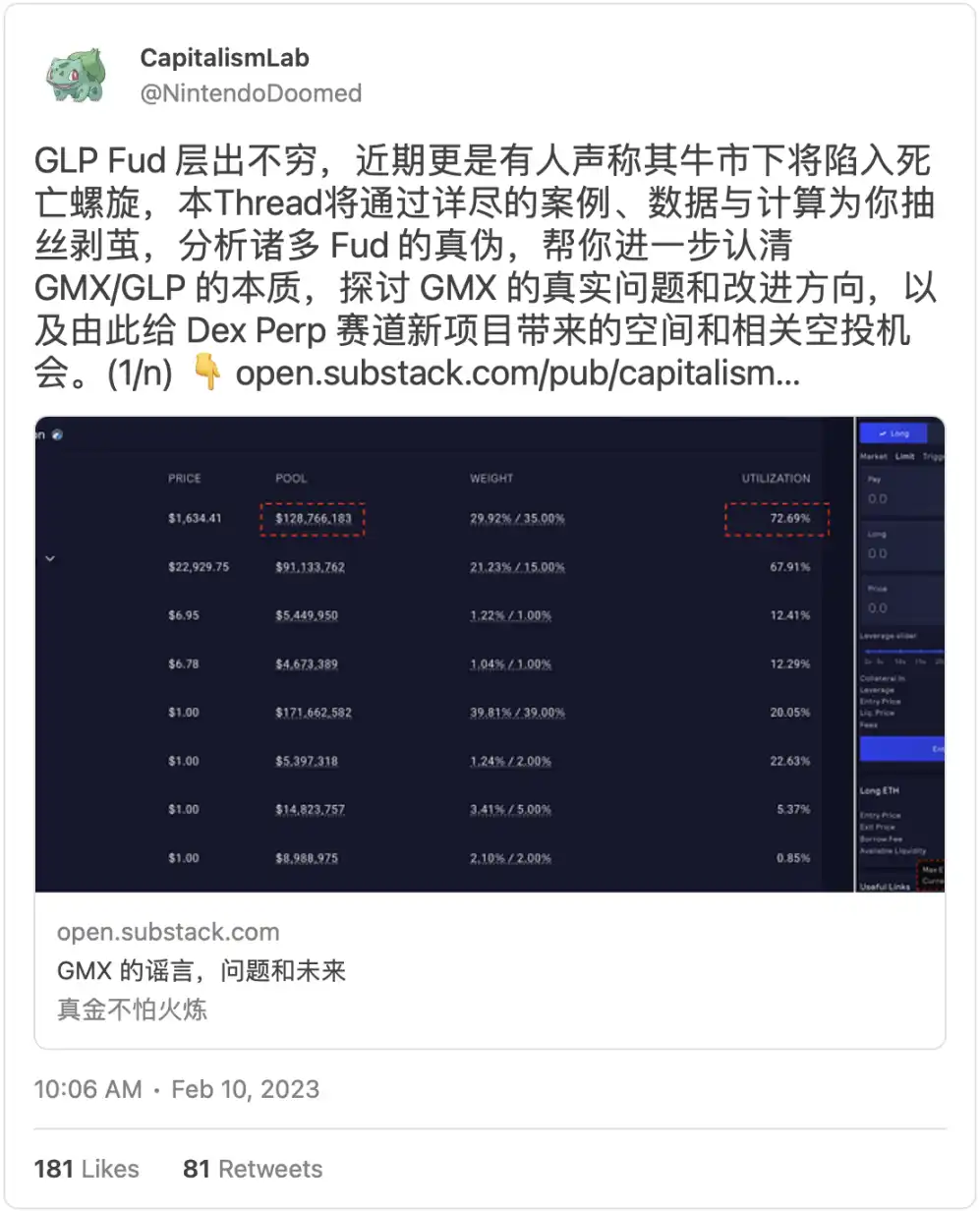
We have discussed before that GMX is fully covered, meaning that every 1ETH of multi-position GLP has 1ETH of spot support at the bottom, allowing GMX to ride out the raging bull market. So how do GNS with only stablecoins at the bottom deal with risk?
GNS has a triple mechanism to control risks on the trading side and LP side, and its core is:
- The spot liquidity of assets determines the sliding point of floor trading to prevent price manipulation
- Asset price volatility and long/short ratio determine the cost of continuing to hold positions in response to one-sided market movements
- Net worth model plus liquidity adjustment and cash flow cycle to build robust LP
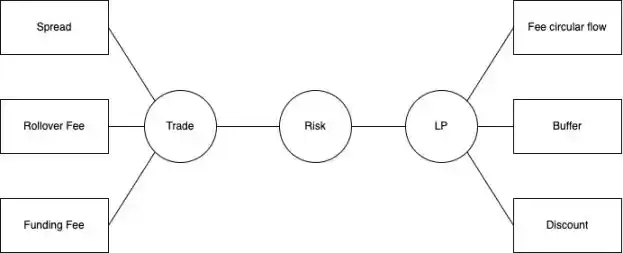
GNS used Spread, Rollover Fee and Funding Fee to control the risk on the trading side.
Spread: Extra opening charge. The larger the opening position, the less liquid the asset, the higher the charge. Used to prevent price attacks, easy to put small coins.
The Rollover Fee is set at the spot volatility rate and is used to control a trader's leverage and risk.
Funding Fee: Pricing by the difference between long and short positions and spot volatility, long/short > When 1, the bulls pay the bears and vice versa, which is used to balance the long-short ratio and avoid excessive one-sided exposure.
For details see:gTrade v6.1: indicates In-depth
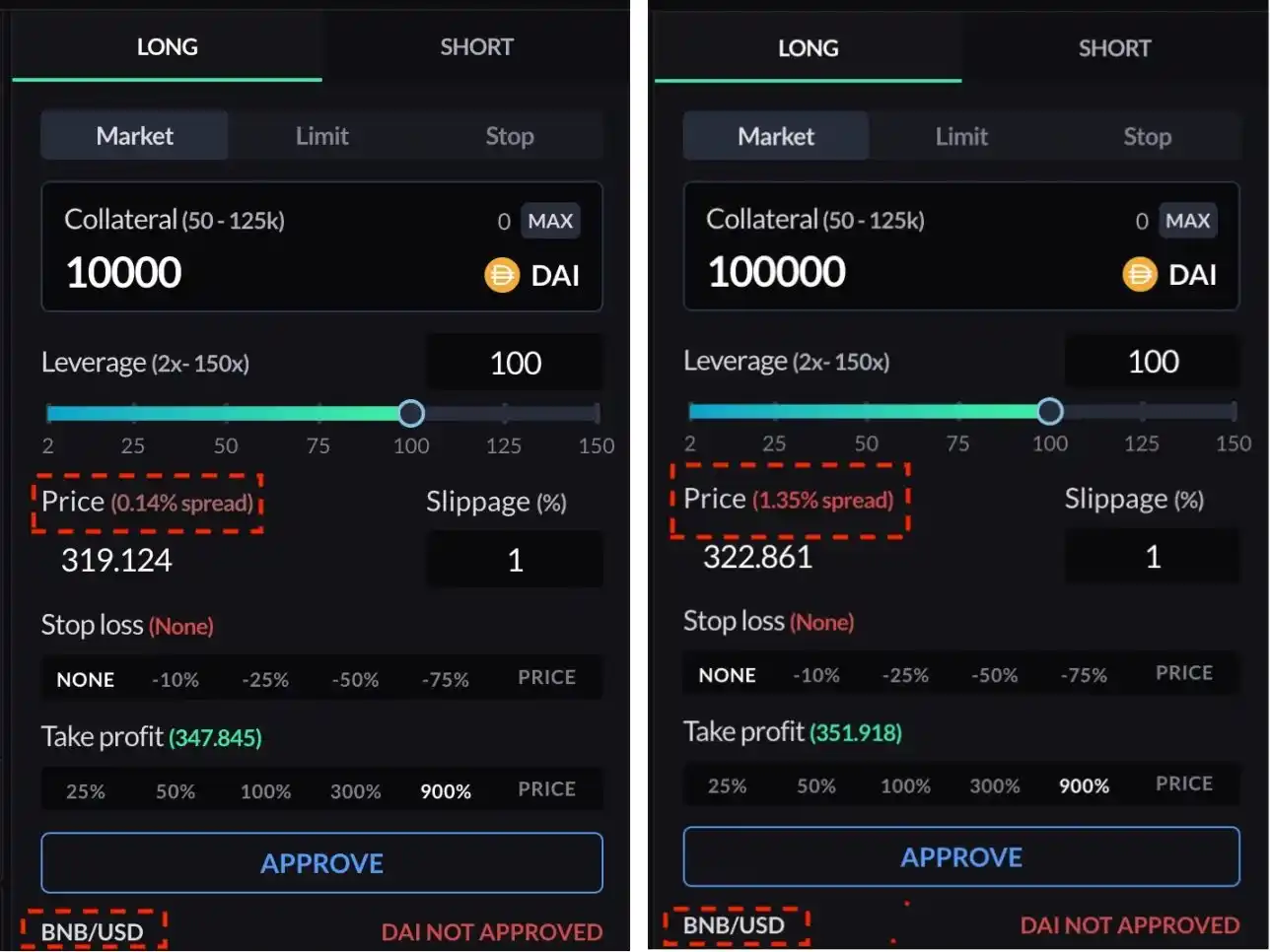
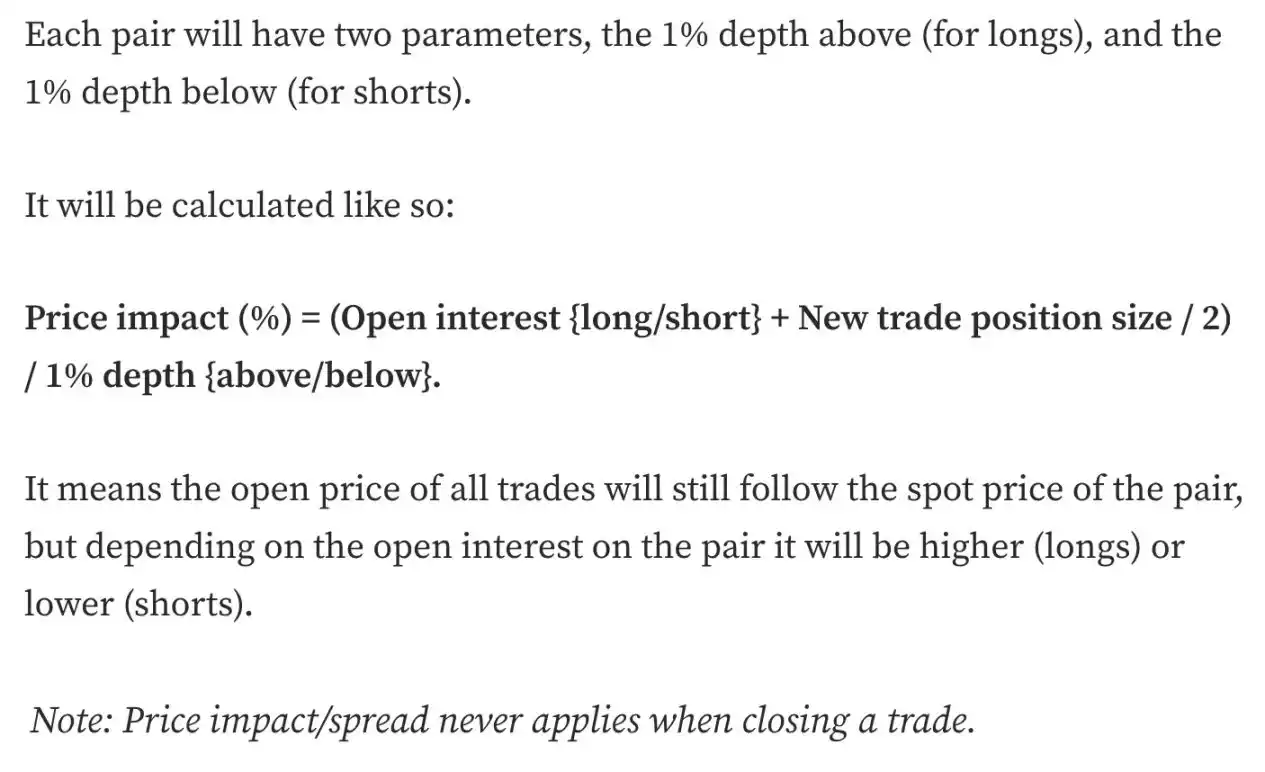
Spread is the extra slip you have to pay to open a position. For predictor pricing, the slip point should be dynamically adjusted according to the depth of trading pairs at the predictor source (CEX), so that the cost of manipulating prices outside the market is always higher than the profit on the market. Therefore, Spread is positively correlated with open position size and the influence of floor OI, and negatively correlated with the depth of over-the-counter spot. See the following figure for the formula
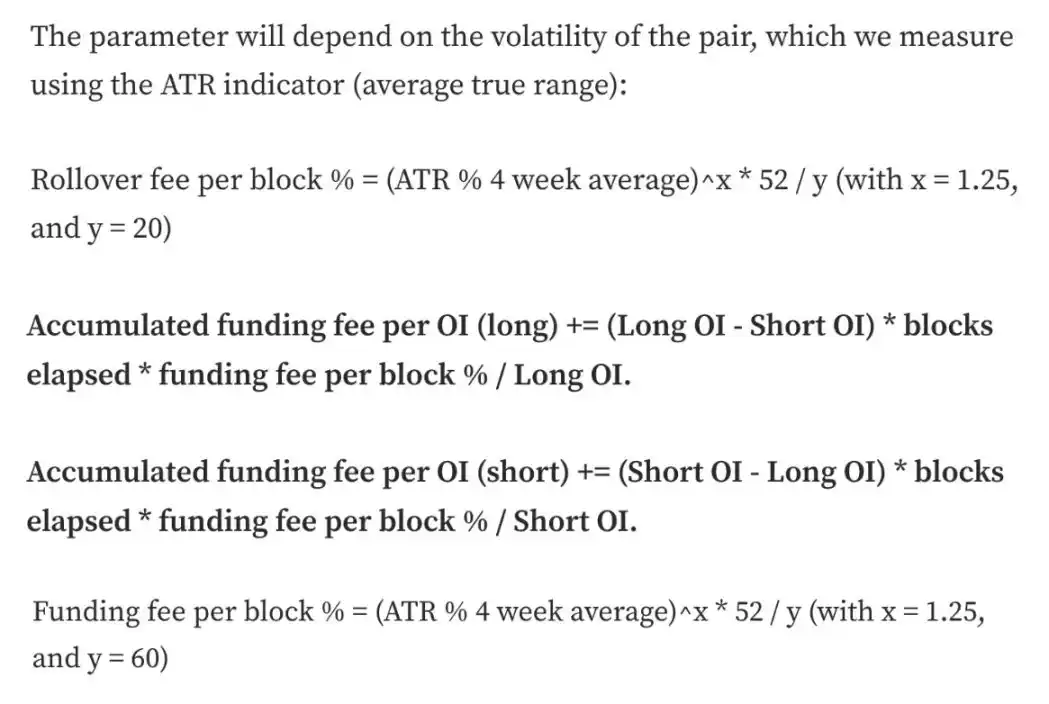
The Rollover Fee/Funding Fee is calculated according to the recent volatility. The Rollover Fee shall be paid for both short and long, while the Fung Fee shall be paid by one party to the other party determined by the long and short ratio. See the following figure for the specific formula. In a wild bull market, volatility and increased long-short ratios cause the fees paid by multiple parties to cover losses on the counterparty side and control the long-short ratio. Of course, these also cause its high transaction costs, so in the crypto, which can be used as an Index Asset LP asset class, the size of the asset class will be less than GMX.
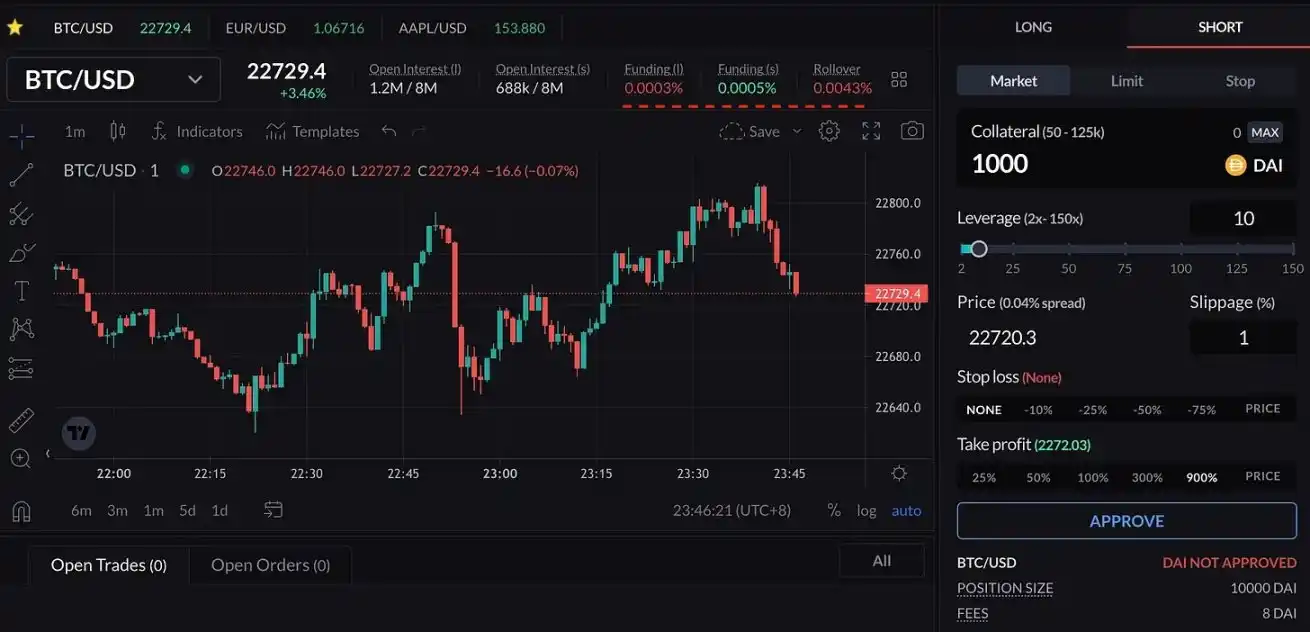
The so-called Rollover Fee only acts on the collateral, that is, you take $1k to open a $10k position and only charge interest according to your $1k, while the Funding Fee acts on the position and charges 41% according to $10k. For example, in the figure below, $1k is open $10k BTC, Funding Fee (s) = -0.0005%, Rollover Fee = 0.0043%. Then the final Fee to be paid is ($1k *0.0043% - $10k 0.0005%)/$10k = -0.00007%. At this time, interest can still be earned by opening short.
LP side - gDAI also has a threefold mechanism to make it run robustly:
- Similar to GLP net worth products, no break-even
- Fee income/Trader profit/loss creates a buffer for gDAI to avoid price falls
- Encourage long-term lock-in funds, dynamically adjust the time of entry and exit, and avoid liquidity problems in extreme cases
The advantage of the so-called net worth products is that they treat all the pledgees fairly and share the burden in extreme cases. While the old LP model is so-called break-even, but under the deficit, the last one to run away won't get a penny, yes, just like FTX, so it is naturally more prone to panic in the crisis.
The most difficult to understand here is the mechanism of Buffer. Part of the fee income of GNS will Mint new GNS to be paid to users, while DAI originally used as income will enter gDAI to form the Buffer of excess mortgage. The Trader's profit and loss will also enter the Buffer in the case of excess collateral, which makes gDAI not break even on paper, but in fact the price will not fall most of the time, which shows that it is well aware of the public's "loss aversion" psychology.
At the same time, GNS will draw part of the profit brought by Trader's loss to repurchase GNS in the case of excess mortgage, so as to keep the excess mortgage rate fluctuating within a safe range, so that GNS will not be in a large number of additional issues in the long run.
LP long-term lock-in will give it a certain discount, and the fund source of discount is also paid from this Buffer. The so-called dynamic regulation is that the lower the excess mortgage rate, the slower the withdrawal, increasing the ability to resist risks. It may seem odd, but the rules are transparent in advance.
Yes, you may not understand the above paragraph, which is normal, otherwise I would call it the most sophisticated complex in history. If you really want to know, you can read the original article on gDAI first. I'd like to introduce gToken Vaults. And then I'd like to introduce gtoken vaults. I'm sure you'll get some answers.
Development history
In the crash brought on by Luna, GNS LP was at one point stuck in a deficit impasse and was forced to sell GNS for DAI to cover the gap. GNS has since improved in many ways and has fared well in the wake of the FTX scare.
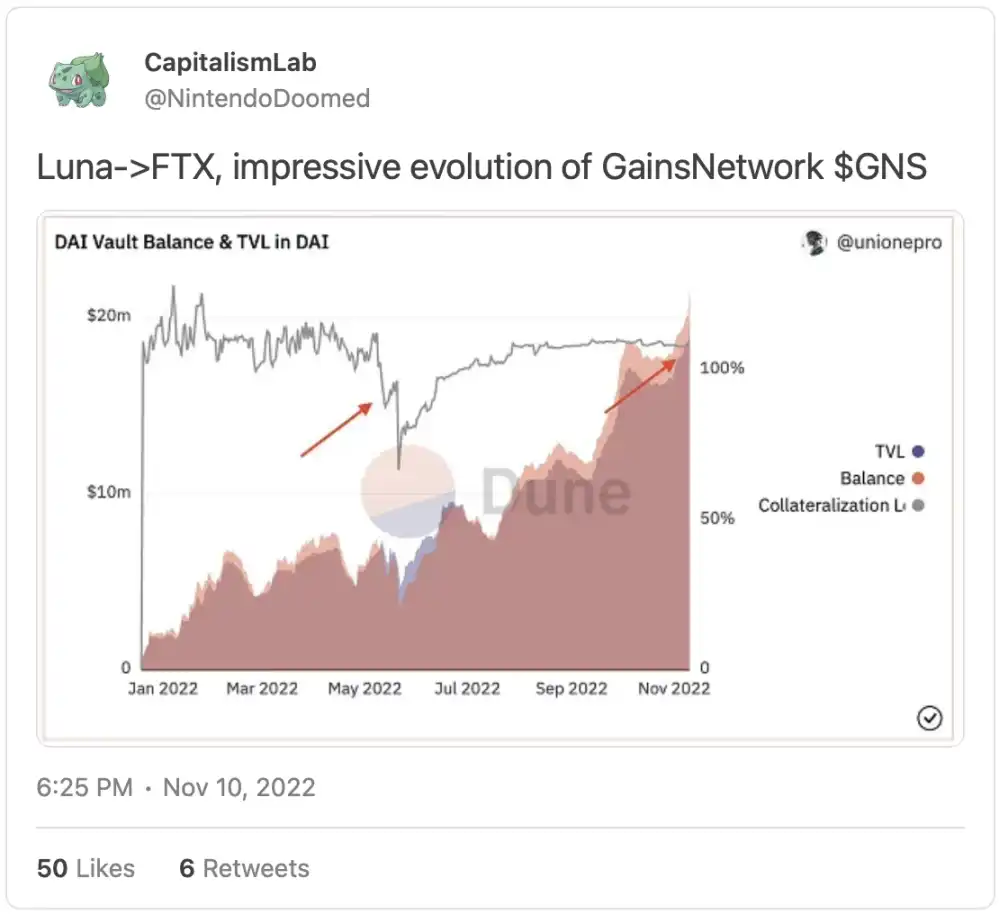
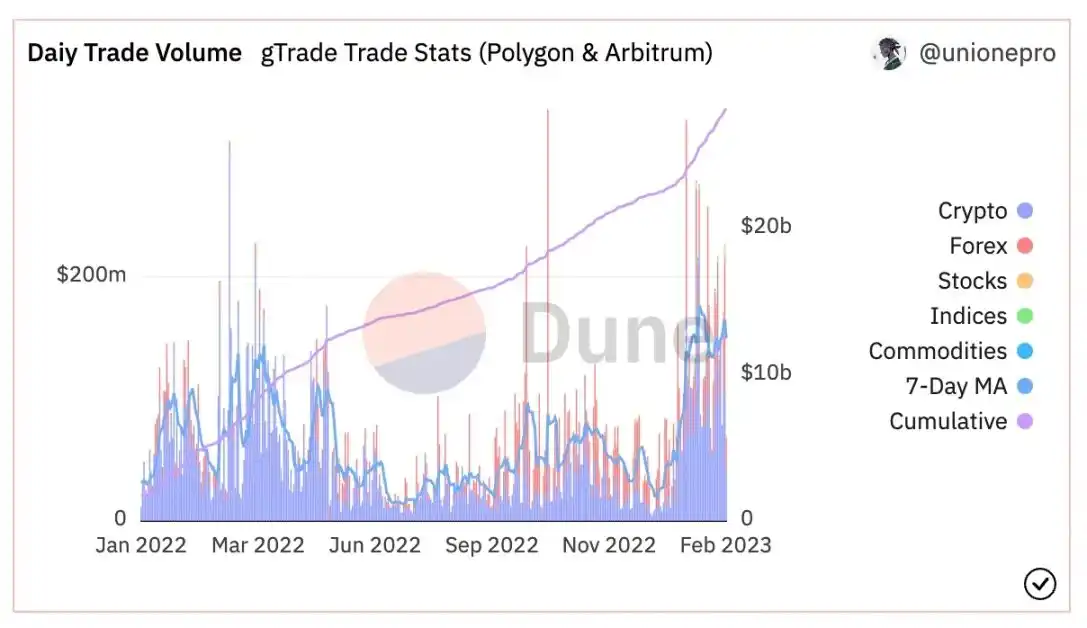
In fact, in June after getting into trouble, the triple risk control mechanism on the trading side described above had been fully capped, which enabled it to resume normal operation. In September, it began to capture the hot spot of the large depreciation of foreign currencies against the US dollar, which brought it back to the public's attention. At the beginning of December, gDAI ceiling, and at the end of the month is deployed to Arbitrum, which brought the outbreak of both currency price and business data at the beginning of this year. Efficient teams allow GNS to evolve to create this phoenix-like rise.
Competitive advantage
The core advantage is that through its sophisticated risk control mechanism, it provides a qualified FX/equity derivatives trading venue, leading the way in trading experience on these assets, allowing its products to stand. On the other hand, the two-way capital rate and other factors allow it to achieve differentiated competition with GMX, and it has successfully acquired some customers in cryptocurrency. This can't be achieved without the excellence of the GNS team, which is the most valuable asset of this growth project.
Staking staking is the staking staking figure below. Given that market staking staking is 70%, then GNS Staking is somewhere between 0.07/0.16x70%+0.03/0.16x70% = 36.25%, and gDAI staking is somewhere between 0.03/0.16 = 18.75%. The part of the limit order paid to NFT Bots is the part that went into gDAI's Buffer in the previous tweet.
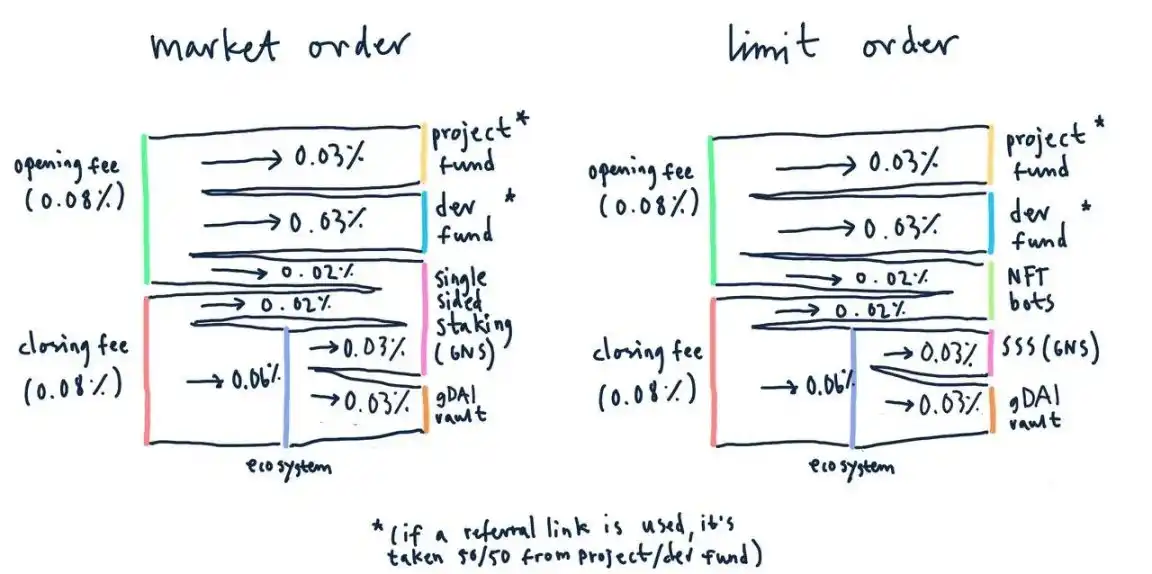
Yes, GNS pays an unusually low percentage of its revenue to LP, so how can it do this?
- To avoid Fork, GNS is audited but not fully open source.
- As stated in the previous tweet, the mechanics are extremely complex and hard to copy, because if you don't copy it well, you'll flip over
- LP with non-full mortgage mode, allowing it to operate under high capital efficiency
Although GNS seems to share a large part of the team's income, in fact, most of the current projects, such as UNI, Maker, Lido, etc., cannot or can barely cover the team's expenses from the Treasury revenue, so they still need to sell coins continuously. However, it is quite good that GNS can live on the revenue sharing. After all, you can't ask every team to be like a charity like GMX.
summarize
Read here, think you will also sigh, in fact, the so-called DEX Perp, is far from a Trader and LP counterparty so simple. So it wasn't until GMX used the low-risk Index Asset full-mortgage model, and the team did some excellent detail polishing, that they finally had a product that anyone could use. However, in order to trade the unlinked assets such as foreign exchange/stocks and further expand the pie, it is necessary to use the synthetic asset model of GNS, which is also iterative until today we finally see the dawn. Salute the Builder.
Original link
Welcome to join the official BlockBeats community:
Telegram Subscription Group: https://t.me/theblockbeats
Telegram Discussion Group: https://t.me/BlockBeats_App
Official Twitter Account: https://twitter.com/BlockBeatsAsia

 Related Articles