DWF Labs: In-depth economic model of on-chain derivative trading platform.
Original Title: "Diving Deep into Decentralised Perpetual Exchanges: Tokenomics Unveiled"
Original Source: DWF Labs Research
Original Translation: Deep Tide TechFlow
Introduction
In our previous article, we discussed the continuous evolution of decentralized derivative exchanges (or derivative Dex) and the evolution and potential development of existing derivative Dex. This article will delve into the current token economics of decentralized derivative exchanges, analyze the different mechanisms adopted by various protocols, and discuss potential future development directions.
Why is Token Economics Important?
The token economics is crucial for the growth and stability of protocols. After experiencing the "DeFi Summer", liquidity mining successfully provided start-up capital for protocols in the early stages, but in the long run, this mechanism is ultimately unsustainable. This mechanism attracts profit-seeking capital and promotes a vicious cycle of "mining and dumping", where investors providing funds constantly look for the next protocol offering higher returns, while abandoned protocols suffer damage.
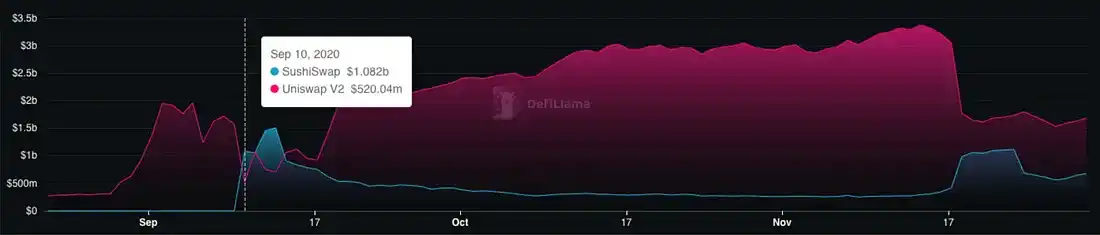
One example is the vampire attack of Sushiswap on Uniswap, which initially attracted a large amount of TVL but ultimately could not sustain it. Meanwhile, protocols such as Aave and Uniswap prioritize product development and have successfully attracted and retained users. Their sustainable token economies have helped solidify their position as market leaders, which they still maintain to this day.
Although product-oriented growth is important, token economics is also a factor that sets derivative DEX apart in a competitive market. Tokens represent users' value judgments of the protocol based on their activities, similar to the way stocks reflect predictions of company performance. Unlike traditional markets, token prices often precede widespread awareness and growth of crypto projects.
Therefore, it is important to have a token economy that can accumulate value from protocol growth. Ensuring a sustainable token economy and providing sufficient incentives for new user adoption are also important. Overall, a good token economy is key to achieving long-term growth and preserving protocol value.
Derivative DEX Status
In our previous Hindsight Series articles, we extensively covered the evolution and mechanisms of derivative DEXs. Now, we delve into the token economics of these protocols. dYdX was one of the first projects to launch perpetual contracts on-chain in 2020 and introduced its token in September 2021. Despite not providing much utility for its holders other than trading fee discounts, the token is often considered highly inflationary due to releases from staking, liquidity providers (LPs), and trading rewards.
GMX entered the market in September 2021 with the aim of addressing the issue of unsustainable emissions. GMX is one of the first companies to introduce the Peer-to-Pool model and user fee-sharing mechanism, which generates revenue from transaction fees and pays out in major cryptocurrencies and native project tokens. Its success has also led to the creation of more Peer-to-Pool model systems, such as Gains Network. It differs in its staking model and revenue-sharing parameters, with lower risks to users but also lower returns.
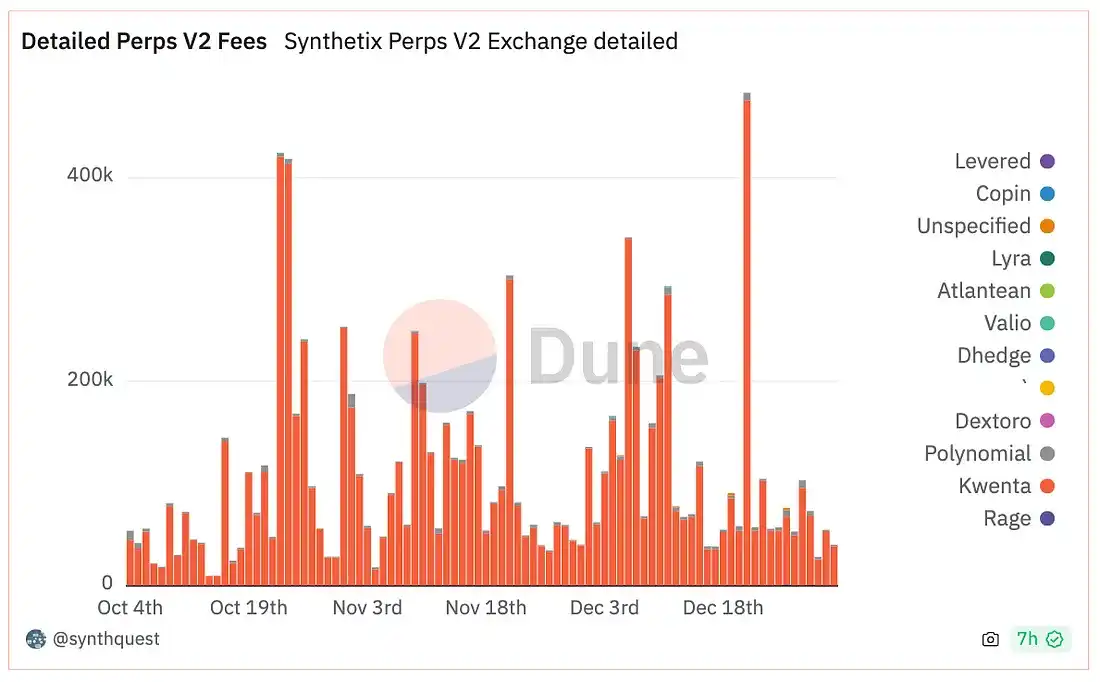
Synthetix is another DeFi protocol in the industry. It supports multiple perpetual contract exchanges and options exchanges such as Kwenta, Polynomial, Lyra, dHEDGE, etc. It adopts a synthetic model, where users must pledge their SNX tokens as collateral and borrow sUSD for trading. Users receive sUSD fees from all front-end transactions.
Comparison of Derivative DEX Token Economics
The following table shows a comparison of different protocols in terms of token economics:
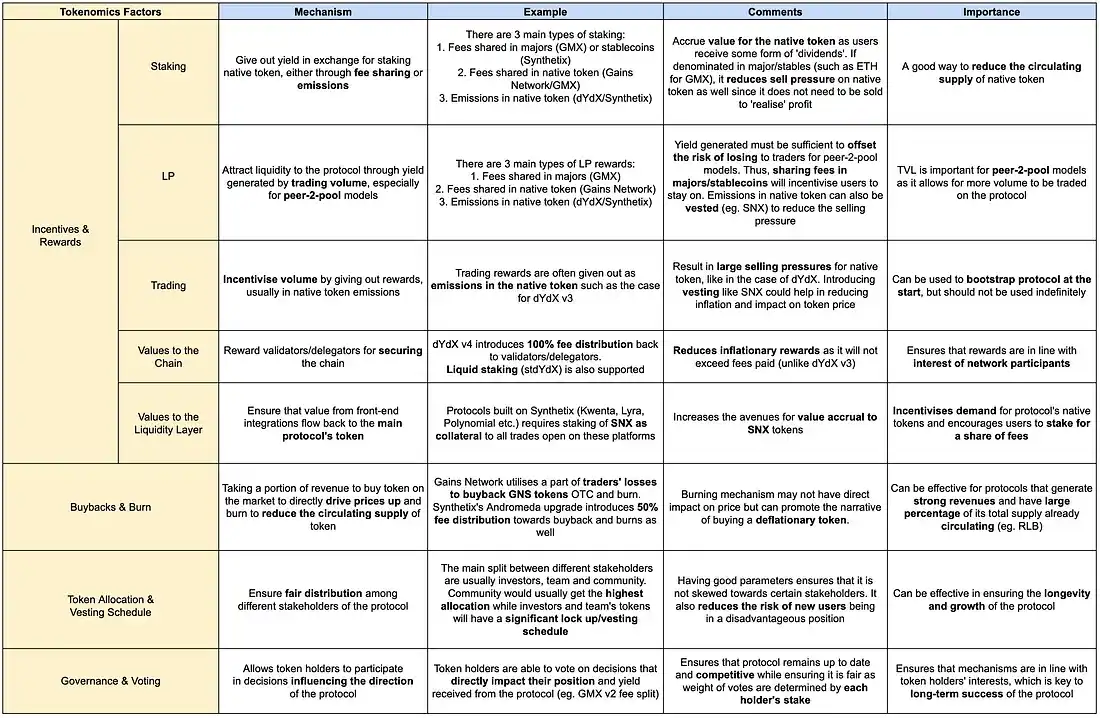
Designing a well-functioning token economy: factors to consider
A well-designed token economy requires careful consideration of various factors to create a system that aligns incentives for participants and ensures the long-term sustainability of the token. We will discuss various factors based on the current pattern of derivative DEX token economics.
1. Incentives and Rewards
Incentives and rewards play an important role in encouraging user behavior. This includes mechanisms such as staking, trading, or other incentives for users to contribute to the protocol.
Pledge
Pledge is a mechanism that allows users to earn profits by depositing native tokens into a protocol. The profits received by users are either obtained through sharing transaction fees (which may be mainstream or stable coins in the market) or through the issuance of native tokens. In the protocol we analyzed, there are three main types of pledge:
Divide transaction fees in mainstream coins or stablecoins.
In native tokens, fees are divided.
The release of native token inflation.
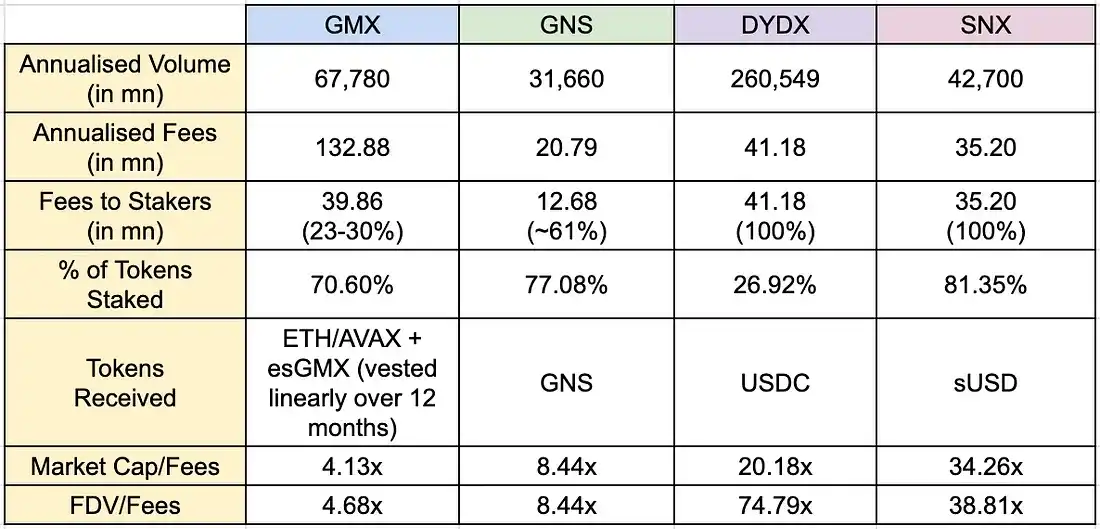
As shown in the table, it has been proven effective to incentivize users to stake their tokens through fee splitting. The table reflects recent changes in token economics for dYdX and Synthetix, including the introduction of 100% fee splitting for dYdX v4 and the elimination of inflationary SNX distribution.
Previously, dYdX v3 had a security and liquidity staking pool that issued inflationary DYDX rewards, as these pools did not directly benefit from the trading volume on the platform. After a community vote in September/November 2022, these two pools were abandoned as they did not truly achieve their purpose and were not efficient for the DYDX token. With v4, the fees generated by trading volume are returned to the stakers, incentivizing users to stake for profits.
GMX uses two types of staking to distribute its rewards, both allocating fees from the primary tokens (ETH/AVAX) and distributing its native token. The high staking rates for GMX, Gains Network, and Synthetix tokens indicate that the rewards are sufficient to incentivize users to provide early capital and maintain their staking within the protocol. It is difficult to determine what the ideal incentive mechanism is, but so far, partially paying fees in primary tokens/stablecoins and introducing inflationary release rewards for native tokens has proven to be effective.
Overall, pledging has the following benefits:
(1) Reduce the circulation supply of tokens (and selling pressure)
Only when the generated revenue is not purely distributed to ensure sustainability, this approach is effective.
If the generated revenue is in the main token or stablecoin, it will reduce selling pressure because users do not need to sell tokens to realize their profits.
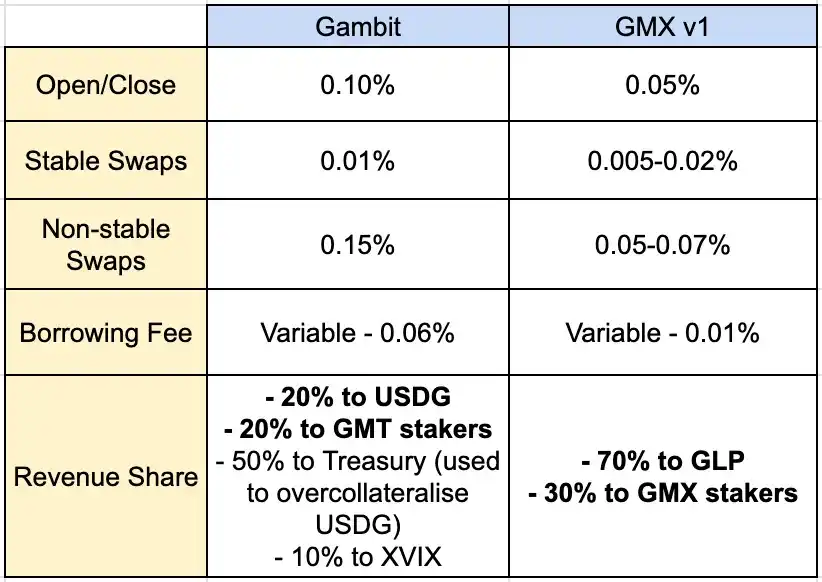
GMX V1: 30% is allocated to GMX stakers, and 70% is allocated to GLP providers.
GMX V2: 27% is allocated to GMX stakers, 63% is allocated to GLP providers, 8.2% is allocated to the protocol treasury, and 1.2% is allocated to Chainlink. The protocol has been approved by community vote.
The community members mostly expressed their support for voting and the continuous growth of TVL in GMX v2, indicating that this change is positive for the protocol.
Rewarding LP has many benefits, especially for the Peer-to-Pool model, as they are one of the key stakeholders:
(1) Enhancing loyalty to the protocol through stable returns
For dYdX v3, this mechanism is not applicable because the volatility of its native token will be generated upon issuance.
For GMX, the growth of GLP and the increase in trading volume on the platform indirectly increase the value of GMX, which is the fee generated by each token and also a huge driving force for token demand.
(1) Adjusting the risk of LP to the agreement
If parameters are not adjusted according to risk and market conditions, LP may face risks of Peer-to-Pool and order book models.
Recently, SNX stakers lost $2 million due to market manipulation on TRB, because the OI limit was set in terms of the number of TRB tokens rather than the USD amount.
Our idea: This mechanism is crucial for the Peer-to-Pool model, as growth requires incentivizing user liquidity. Over time, GMX has effectively achieved this through high revenue sharing ratios and increasing trader losses. While winning traders pose a risk to LPs, we believe that the returns of a mid-sized protocol can greatly offset this risk. Therefore, we believe that fully incentivizing LPs is essential for building a strong user base.
The transaction rewards are mainly used to incentivize trading volume, and they are usually distributed in the protocol's native token. The rewards are typically calculated as a percentage of the total reward planned for a specific period based on the transaction volume/fee.
Kwenta also provides trading rewards for traders on the platform, limited to 5% of the total supply. Users are required to stake KWENTA and trade on the platform to be eligible. The reward is determined by multiplying the percentage of staked KWENTA and paid trading fees, which means the reward will not exceed the user's upfront cost (staked capital + trading fees). The reward requires a 12-month lock-up period, and if users want to cash out the reward early, the reward can be reduced by up to 90%.
Overall, the obvious benefits of introducing transaction rewards include:
Encouraging trading volume in the short term: Through the rewards of dYdX v3, traders essentially receive compensation when trading, which helps to drive growth in trading volume.
Here are the factors that need to be considered:
Protocol wants to attract user types.
For dYdX, it is easy to qualify for rewards and there are no locking conditions, which may attract many short-term users and dilute the rewards for true users.
For Kwenta, upfront capital and locking conditions are required, which may not be attractive to short-term users and could potentially dilute rewards for long-term users.
Our idea: Transaction rewards may be an effective way to guide the protocol at the beginning, but should not be used indefinitely as continuous token issuance will lower the value of the token. It should also not occupy a large proportion in monthly supply and inflation. For the protocol, locking is important for dispersing sales pressure.
Value Accumulation on the Chain
Case Study: dYdX
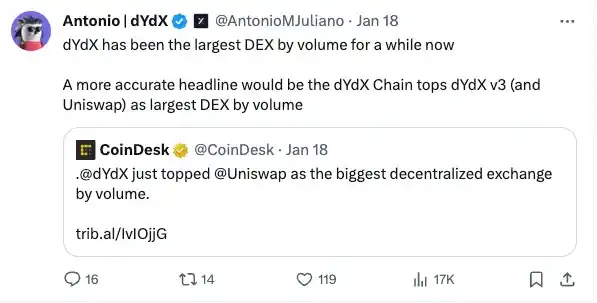
The launch of the dYdX chain marks a new milestone for the protocol. On January 18th, the dYdX chain even surpassed Uniswap and became the DEX with the highest trading volume.
In the future, we may see more derivative DEXs following in these footsteps. The main changes to the token economics of the dYdX chain update include:
Pledge is to support the security of the chain, not just to generate revenue.
In v3: Rewards in the security pool are distributed in DYDX tokens, but after community voting in favor of DIP 17, they were ultimately disabled.
In version 4, all fees, including transaction fees and gas fees, will be distributed to delegators (stakers) and validators. This new mechanism is more decentralized and aligned with the interests of network participants.
Proof of Stake (PoS) stakers (delegators) can choose validators to stake their dYdX tokens and receive a share of the income from their validators. The commission range for delegators (stakers) ranges from a minimum of 5% to a maximum of 100%. Currently, according to Mintscan data, the average validator commission rate on the dYdX chain is 6.82%.
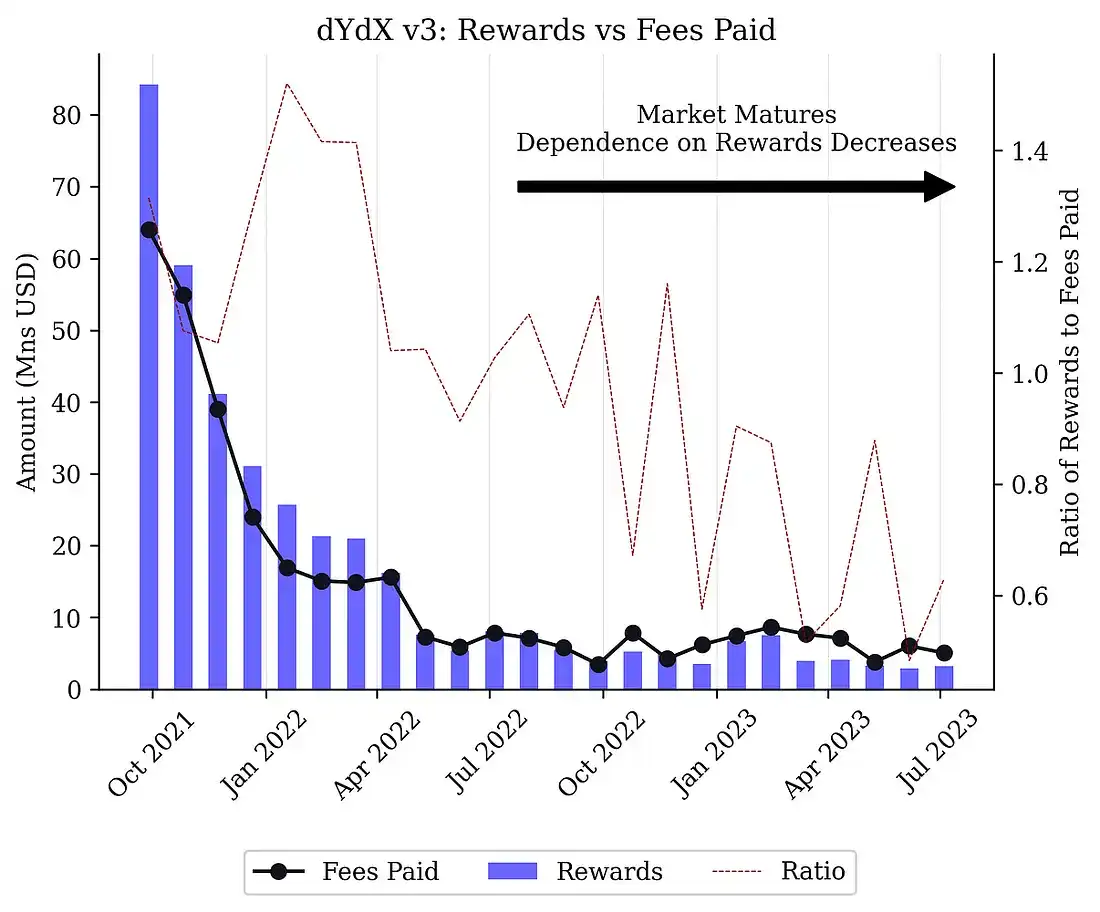
Aside from these changes, the new transaction incentive measures also ensure that rewards do not exceed the cost of payment. This is an important factor because many concerns about v3 have focused on inflation and an unsustainable token economic model, although updates have since been made with little impact on token performance. Xenophon Labs and other community members have raised questions about whether rewards can be "manipulated," a topic that has been discussed multiple times in the past.
In version 4, users can only receive transaction rewards equivalent to 90% of the net transaction fees, similar to online payments. This will improve the balance between demand (fees) and supply (rewards) and control token inflation. The reward cap is 50,000 DYDX per day for 6 months, ensuring that inflation remains insignificant.
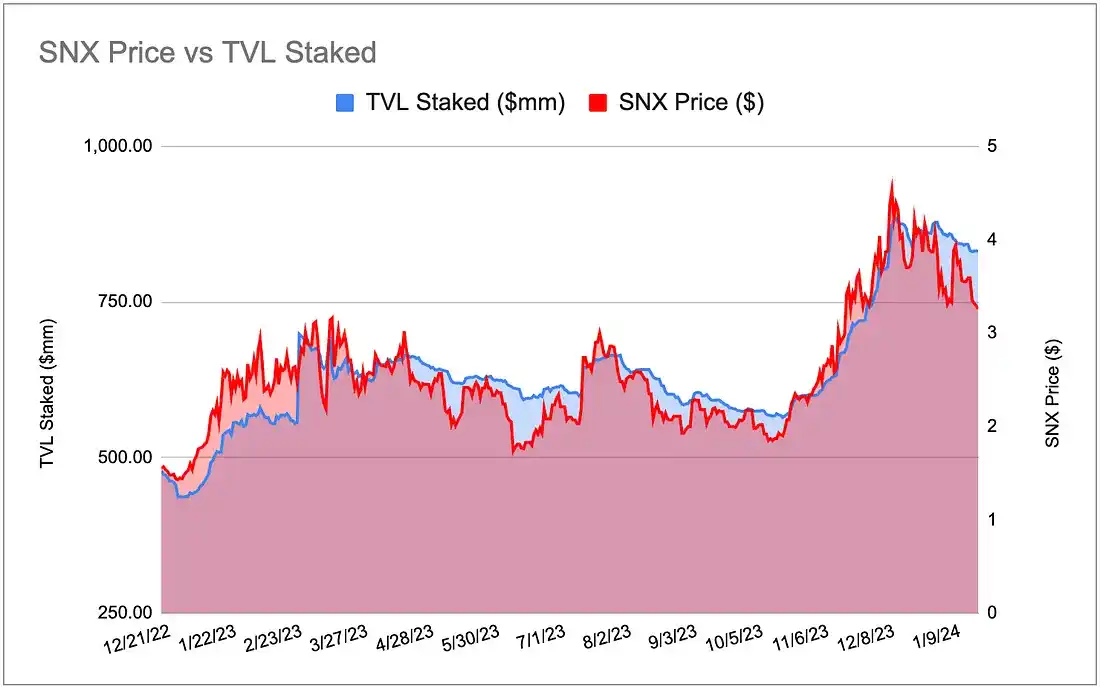
However, the effectiveness of buybacks also depends to a large extent on:
Our idea: The destruction mechanism may not directly affect the price, but it can promote the concept of purchasing deflationary tokens. This is particularly effective for protocols that generate strong revenue and have a large portion of their total supply already in circulation, such as RLB. Therefore, it is applicable to protocols like Synthetix that have already been established and have a relatively low supply inflation.
3. Token Distribution and Unlock Plan
It is important to record the token allocation and ownership schedule of different stakeholders to ensure that the parameters are not biased towards certain stakeholders. For most protocols, the main holders include investors, teams, and communities. For community tokens, this includes airdrops, public sales, rewards, and DAO tokens, among others.

The distribution of SNX is calculated based on the increase in token supply from the rewards issued in the monetary policy change in February 2019.
When reviewing the allocation and unlocking plans for these agreements, we have drawn some conclusions:
dYdX and Synthetix have reserved a large supply for investors, 27.7% and 50% respectively (before supply changes). However, dYdX has a long lock-up period of approximately 2 years, while Synthetix has a lock-up period of 3 months after TGE, followed by quarterly unlocks.
dYdX and Synthetix have both reserved a large supply of rewards (>=50%). However, dYdX rewards are purely issuance, while Synthetix distributes a portion of fees+rewards, which unlock within 12 months. Compared to dYdX, this reduces the inflation of SNX.
Due to the significant differences in the holders and mechanisms of different protocols, there is no clear formula for token distribution or unlocking. Nevertheless, we believe that the following factors generally benefit the token economy of all holders:
The community should be allocated the most tokens.
The token allocation of the team should not be too much, and the unlocking plan should be longer than that of most holders, as this may indicate their belief in the project.
4. Governance and Voting
Derivative DEX often needs to be upgraded and improved to enhance functionality, scalability, and growth. This ensures that the protocol remains up-to-date and competitive.
Token holders can collectively decide on staking requirements, liquidation mechanisms, bug bounties, or emergency measures to be taken in the event of violations or exploits. This helps protect user funds and establish trust in the protocol.
Recently, Synthetix suffered a loss of $2 million due to TRB price fluctuations. This highlights the importance of continuously reviewing parameters - adding volatility circuit breakers and increasing sensitivity to peak pricing volatility bias parameters.
Liquidity and User Incentives
Token holders can propose and vote to support strategies that incentivize liquidity providers, adjust fee structures, or introduce mechanisms to enhance liquidity provision.
For example, the governance of dYdX has passed the v4 launch incentive proposal.
Decentralized community of transparency
Governance should establish decentralized communities with transparency and accountability. The open and accessible governance process and on-chain voting mechanism provide transparency in the decision-making process.
For example, DEXs like dYdX, Synthetix, and GMX adopt on-chain voting mechanisms to promote decentralization.
Our view: Through governance, it can help create a strong and inclusive community for stakeholders participating in derivative DEX. Having on-chain voting mechanisms and decision transparency can establish trust between stakeholders and protocols, as this process is fair and accountable to the public. Therefore, governance is a key feature of most cryptocurrency protocols.
Try a new mechanism
除了上述因素外,我们认为还有许多创新的方式来引入额外的效用并激励对代币的需求。协议需要根据其针对的利益相关者以及对他们最重要的因素来优先引入新机制。下表显示了关键利益相关者及其主要关注点:
Aside from the aforementioned factors, we believe there are many innovative ways to introduce additional utility and incentivize demand for the token. The protocol needs to prioritize the introduction of new mechanisms based on its stakeholders and the factors that are most important to them. The table below shows the key stakeholders and their main concerns:
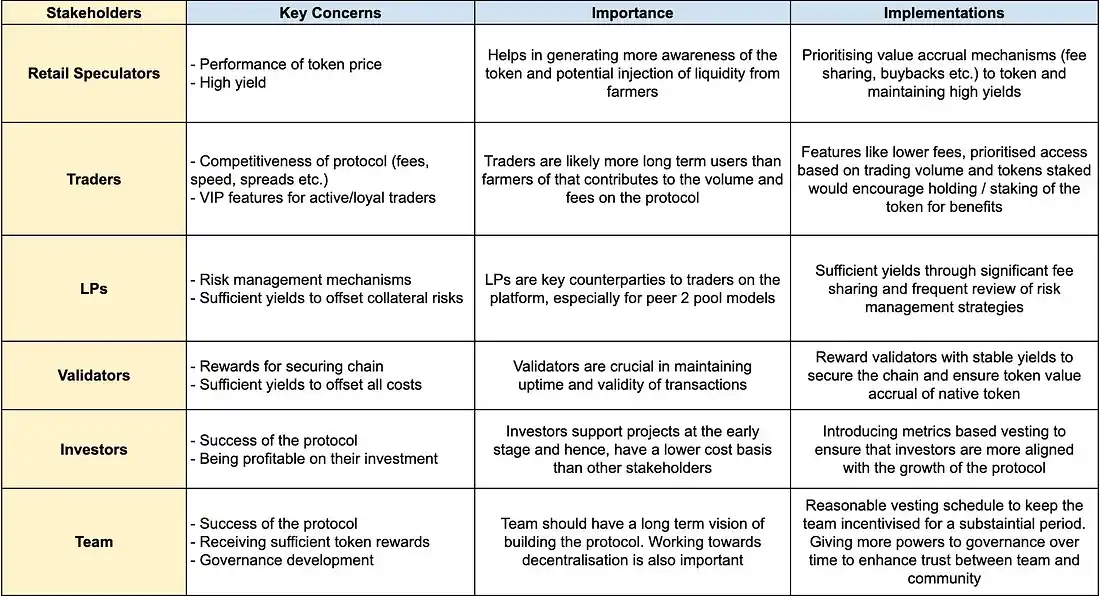
Given various concerns, it is impossible to cater to all stakeholders. Therefore, for a protocol, it is crucial to reward the correct user group to ensure sustainable growth. We believe there is room to introduce new mechanisms that can better balance the interests of different stakeholders.
Conclusion
In short, token economics is a core part of the cryptocurrency protocol. There is no clear formula for determining successful token economics as there are many factors that can affect performance, including factors that projects cannot control. Nevertheless, the rapidly changing cryptocurrency market highlights the importance of flexibility and adjusting according to market conditions. From the examples above, it can be seen that attempting new mechanisms can be very effective in achieving exponential growth.
Original article link
Welcome to join the official BlockBeats community:
Telegram Subscription Group: https://t.me/theblockbeats
Telegram Discussion Group: https://t.me/BlockBeats_App
Official Twitter Account: https://twitter.com/BlockBeatsAsia