'GMX Lego' at a glance: 28 projects built on GMX
Original title: GMX Lego
Source: TokenInsight
Composability is a core feature of DeFi, enabling developers to quickly create new projects by integrating existing protocols. One existing deal is GMX, which had a great year in 2022. Its LP token, GLP, has steadily delivered returns of more than 20 per cent denominated in $ETH, giving rise to the popular "real yield" narrative.
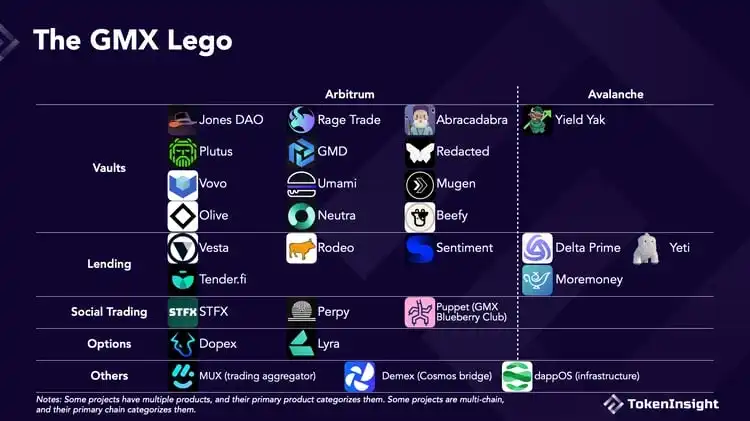
As a result, developers began building new projects on top of GMX, and there have been 28 to date. This paper introduces all the projects and analyzes the key ones. They can be divided into five categories: Treasury, lending, social trading, options and others.
The Vaults and vaults
The vault is the largest category, with 13 projects ranging from basic auto-compounding pools to complex structured financial products designed to boost GLP returns.
auto-compounding
Einstein thought compound interest was the eighth wonder of the world. If you're like me and keep forgetting to put GLP revenue back into the GLP pool, we're all missing out on some good money.
If you don't roll on interest, $100 invested at the beginning of the year will only turn into $120 at the end of the year, assuming a 20% return. . However, if you operate twice a day and put the proceeds back into the GLP pool, your $100 would become $122.14 at the end of the year. If you factor in the multiplier points, the payoff is even higher. Multiplier points is a unique feature of GLP to reward long-term users.
Quite a few products offer automatic compounding for GLP holders so they don't miss out on potential roll-on benefits.
Abracadabra
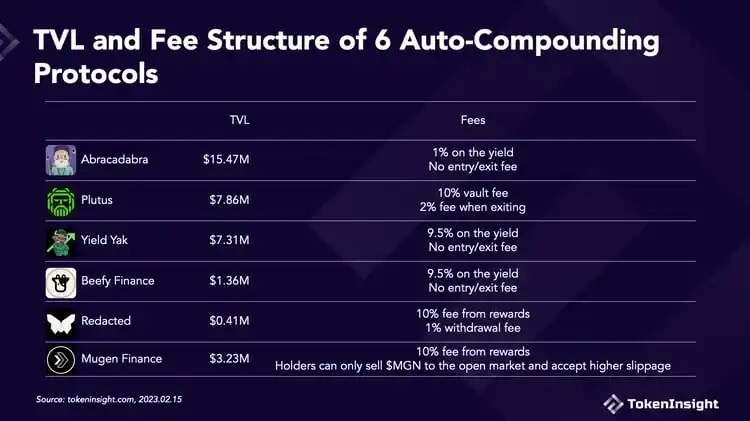
Abracadabra is the largest GLP pool with TVL of 1, $5.47 million. Users deposit GLPS to receive MagicglPs, which automatically reinvest the proceeds into the GLP pool twice a day to maximize returns. As with other Treasury tokens, magicGLP increases in value over time, causing the ratio of magicGLP to GLP to rise.
Abracadabra charges a 1% fee on the proceeds of the service and has no entry/exit fee, which is the lowest price in the automatic roll-on pool.
Plutus
Plutus is the second largest roll-on pool, with a TVL of $7.86 million, and users can deposit GLP and get plvGLP. It automatically compounds every 8 hours and charges a 2 percent exit fee and 10 percent vault fee.
In exchange, plvGLP holders receive a 15% liquidity mining incentive of $PLS, equating to a distribution of $2.25 million PLS to plvGLP holders over 2 years. Rewards are weighted in the first few months, meaning they are highest in the first few months. $PLS can be locked in to receive a portion of the proceeds generated by the Plutus agreement and gain control over veTokens locked within Plutus. In addition to plvGLP, Plutus There is also a range of governance rights aggregation and liquidity-related products.
Yield Yak
Yield Yak, a GLP farm on Avax, has a TVL of $7.31 million. Similar to Abracadabra and Plutus, Yield Yak automatically puts the $AVAX reward into GLP and receives esGMX to increase the reward. Yield Yak charges a management fee of 9.5% of earnings and has no entry/exit fee.
Beefy Finance
Beefy Finance's TVL was $1.36 million. Its coffers roll at least once a day and on each deposit. As a result, compound interest operations occur 10-20 times a day. It also charges a management fee of 9.5% of revenue and has no entry/exit fee, which is identical to Yield Yak.
Redacted
Redacted has added some variety to the vault product. Pirex issued by Redacted provides liquidity to pledged GMX and GLPS on an automatic compounding basis. It has two modes, simple mode and standard mode.
The simple model is the same as the other roll-on pools mentioned above. It's cool that they also offer a GMX vault. The user deposits GMX or GLP to get apxGMX or apxGLP. The simple model charges a 1% withdrawal fee, which is fed back to the holder of the vault token. In addition, it charges a platform fee of 10 percent of revenue and a benefit bonus fee of 0.3 percent.
The standard model provides liquidity for GXS and GLPS in pledge. Users store GMX and GLP to get pxGMX and pxGLP. Deposited GMX and GLP are the same as the original pledge on the GMX.
The difference is that pxGMX and pxGLP are negotiable, users can sell at any time, pxGMX is in. Arbitrum Camelot has a pool. Trader Joe's on Avax has a pool.
When pledged through the GMX Agreement, the esGMX obtained is not transferable. By Pirex deposit, the esGMX obtained is marked as pxGMX and can be transferred. In addition, the multiplier points gained are never lost because when the user sells the pxGMX on the open market, the underlying GMX is still pledged. As a result, users are not penalized for lacking multiplier points or for selling pledged GMX.
The standard model charges a 1% conversion fee and 10% of the proceeds. .
Pirex's GMX vault is an interesting innovation, while the GLP vault is similar to other interest-interest vaults, but with higher fees. Therefore, Pirex GMX Vault has a TVL of 404, $555, while GLP Vault's TVL is only 38. 557 dollars.
Mugen Finance
Mugen Finance's GLP vault, TVL, is $3.23 million. It claims to be a multi-chain aggregator that uses sustainable agreement revenue to generate revenue. However, Mugen currently supports only one protocol on one chain, GMX.
Mugen's mechanism is different from the GLP vault mentioned above. $MGN is a protocol token. The user deposits $USDC into the Mugen vault to mint $MGN, and Mugen uses its vault to buy GLPS. The user pledges $MGN to receive the revenue generated by GLP.
What's the difference between buying $MGN and buying GLP outright? Buying $MGN is 3 times worse.
When you buy for $MGN, the Mugen team takes 10% off your GLP return. .
While you can burn GLPS to redeem assets from the GLP pool, you cannot withdraw assets from the Mugen Vault. You can only sell $MGN on the open market. Currently, the market price of $MGN is $81, and its corresponding vault value is $126, which means early adopters must accept a 35% loss if they want to exit.
Mugen also has a special design to "prevent users from opening and releasing pledges before and after revenue distribution." This design allows the agreement to defer payment of GLP awards for 30 days. For example, if Mugen receives 100 $ETH from today's GLP proceeds, then each Mugen pledge will receive 1/30 of their share of the 100 $ETH per day for the next 30 days. . If you want to quit early, you lose the rest of your reward.
So why would anyone buy $MGN? They can benefit from the loss of early adopters. Because early adopters can only sell $MGN on the open market, the price of $MGN is lower than its actual value. If you buy $MGN today, you can buy $126 worth of GLP for only $81.
In addition, only 84 percent of MGNS were pledged. As a result, the proceeds to the mortgagor are higher, as 16% of MGN holders are willing to give up their GLP proceeds (although, it should be noted that GLPS are automatically pledged).
Using any roll-on pool comes with additional smart contract risk. Mugen had previously suspended revenue distribution without explanation when users thought it should be automated via smart contracts.
Finally, the project relies on a community-developed front end for users to interact with their contracts. The project has its own website link, but its functionality is very limited.
The following table summarizes the basic information of the six interest pools mentioned above.
High-level strategy
In addition to the basic interest, many projects have designed more complex GLP strategies.
The most common is the Delta Neutral strategy. Since GLPS consist of 50% stablecoin and 50% $BTC+$ETH, GLP holders are equivalent to holding a long position in Crypto with 0.5 times leverage and are therefore exposed to price changes in BTC and ETH (plus slight exposure to some of the other small coins in the GLP pool, Such as $UNI and $LINK). That's fine in a bull market. But in a bear market it becomes problematic. So Delta Neutral vaults have been created to hedge against these risks.
Rage Trade
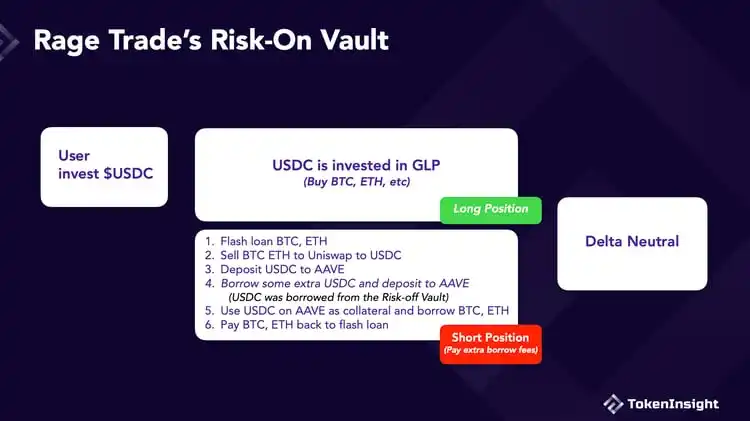
Rage Trade's Delta Neutral Vault is the most popular, it's called Risk On Vault. Rage Trade's Risk On Vault puts users in $USDC Invest in the GLP pool while taking short positions in $ETH and $BTC through flash loans. Our previous article explained the mechanism of Rage Trade in more detail. The net result is that Rage Trade automatically hedges your long exposure when you own GLPS.
Rage Trade has also designed a Risk Off Vault to go along with the Risk On Vault. Risk Off Vault lent USDC to Risk On Vault to take a short position. Risk Off Vault for Aave lending rates and Risk On Vault for a portion of GLP rewards.
The TVL of Risk On Vault is 7, 330, For $180, Risk Off Vault's TVL is 3. 799, 645 dollars. The total TVL is 1, $1.13 million.
Neutra Finance
Neutra Finance is Delta Neutral by another route. It hedged its long exposure to GLP by taking a leveraged short position in GMX. It maintains Delta Neutral through a unique rebalancing mechanism. Its current TVL is $1.16 million.
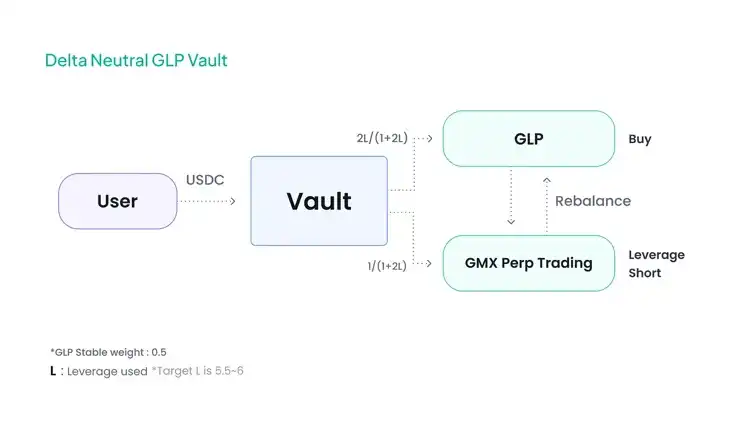
Source: Neutra Finance
Umami
Like Neutra, Umami's Delta neutral strategy involved hedging on GMX. It has also implemented an internal netting strategy, which redistributes the Delta among Umami vaults to minimize hedging costs. The amount of hedging is periodically rebalanced by the algorithm.
Umami was scheduled to launch Beta in March. However, its CEO recently fled and dumped all of his tokens. Although the rest of the team decided to go ahead with the decision. DAO The form continues to develop Umami, but this unfortunate episode may cause product delays.
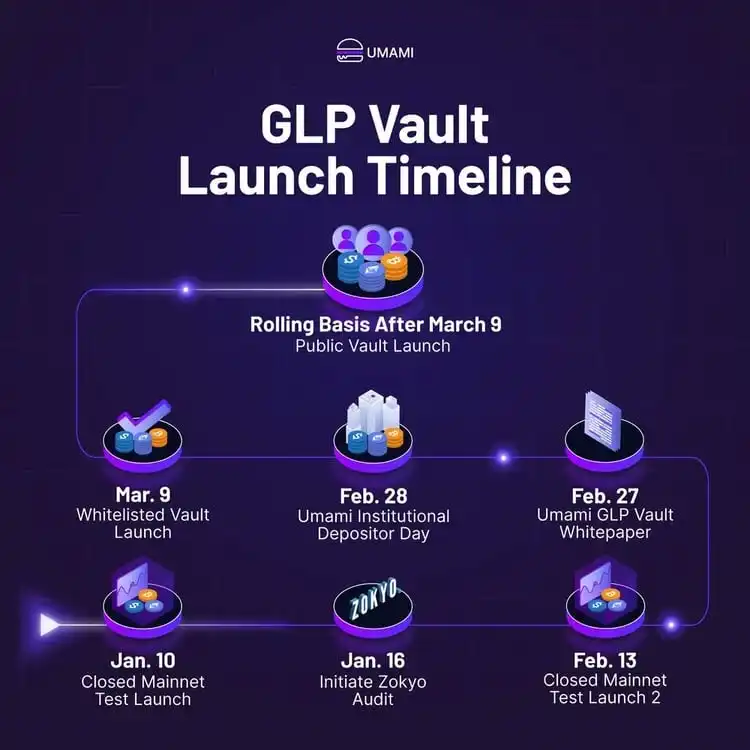
Source: Umami
Vovo Finance
Vovo Finance is another interesting Delta Neutral solution. Vovo allows users to hedge manually, rather than automatically.
Each week, the vault collects the proceeds of the pledged GLPS and uses them to open a 10x leveraged position on the GMX. The user can access Choose the assets and direction they prefer between ETH rise, ETH fall, BTC rise and BTC fall. After a week, the vault automatically closes the leveraged position and reinvests the profits to buy and pledge more GLPS.
The total TVL of Vovo in the four vaults is 66. It's $013.
GMD
GMDS offer a variation of the Delta Neutral strategy. Rather than hedge directly against price movements in the underlying GLP assets, GMDS allow users to have exposure to only one asset, rather than all the assets in the GLP pool, by creating three separate vaults. For example, hold GLPS mean both BTCS and ETH, but GMDS allow users to have only one of the BTCS, ETH, or USdcs. It also uses agreement revenue to protect users from trader PnL. However, as discussed in my previous post, in most cases GMX traders are losing money.
GMD's GLP TVL is $4.27 million.
Olive
Olive adds more financial alchemy to the competition. It offers principal protection vaults that increase yields without putting users' principal at risk by combining composability and structured products. Olive deposits the weekly GLP proceeds through a variety of complex strategic transactions. It trades on a weekly basis, charging a pro rata 2 per cent management fee and a 10 per cent performance fee if returns are positive for the period.
Its TVL is currently $299,000.
Jones DAO
The final participant in the GMX Wars was Jones DAO, with TVL 1. $075 million.
This is a leveraged roll-on pool consisting of two vaults, a GLP vault and a USDC vault. Our previous article discussed its mechanics in great detail. In simple terms, the Jones DAO GLP Vault buys GLPS and mints JGLPS, then borrows $USDC from the USDC Vault to buy more GLPS. The amount of leverage is dynamic and determined according to market trends.
The depositor of the USDC vault earns interest and a portion of the GLP reward as a credit.
jGLP can be used to provide liquidity on the Jones DAO platform and throughout the Arbitrum ecosystem. For example, users can provide liquidity in the jGLP-USDC pool on Camelot.
GMX War
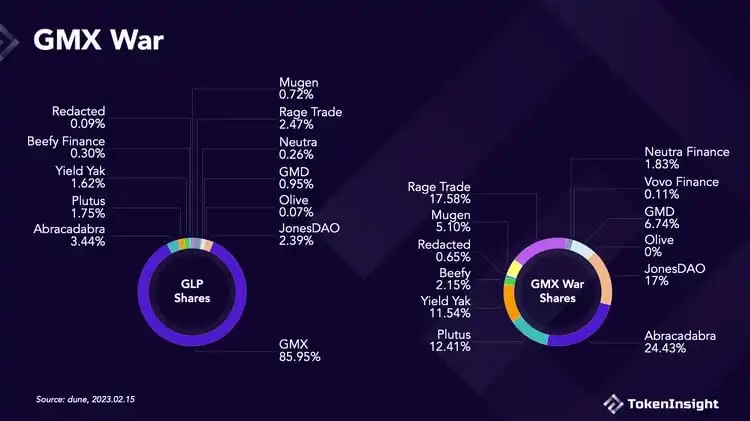
The GMX War has begun, and the vault players built on top of the GMX are fighting each other for more of the GLP. While basic roll-on features are already attractive, further innovation could boost GLP yields even further.
I'm very bullish on vault products. GLP AUM currently stands at $443 million, and all Vault products combined represent only a small fraction of total GLP (15% ). . Most GLPS remain idle in the holder's wallet, waiting to be captured by the vault provider.
In addition, GLP has enormous potential as a revenue-generating product in its own right. Anchor, which promised a 20% return on a Ponzi scheme. That) has managed to amass more than $17 billion in AUM. GLPS have consistently outperformed the 20 per cent benchmark, and their earnings come from real transaction fees. There is a big difference between $443 million and $17 billion, and a better vault product will also attract more people to mint GLPS.
But there is one caveat. We are at or near the bottom of a crypto cycle. While Delta Neutral has been a good strategy on GLPS over the past year, we are coming off all-time highs. But when we go up, it's a side-effect, because all of the gains from rising prices are hedged by this strategy.
Borrowing and borrowing
Beyond Vault products, lending is the second largest ecosystem on GMX, enabling users to borrow against their GLP assets to leverage yield farming. The Jones DAO Vault is also a revenue product with built-in lending.
The main players in the lending space are Vesta, Sentiment, Rodeo and tenant.fi, as well as Delta Prime, Yeti and Moremoney on Avax. All of this allows users to borrow against their GLPS. Sentiment also allows the use of GMX as collateral, and Rodeo has its own GLP interest vault.
option
perp trading on GMX also works well with options exchanges.
Lyra
Lyra trades options. DEX. The agreement is designed to keep the exposure of liquidity providers close to Delta Neutral, which is achieved by opening long or short positions in GMX or Synthetix.
Dopex
Dopex is also an option DEX that integrates with GMX in two ways.
Their Atlantic Perp Protection protects traders on GMX from liquidation risk. After the option is purchased, the stabecoin collateral of the option on Dopex is automatically transferred from the Dopex contract to the trader's GMX collateral account when a trade is close to clearing.
Dopex also helps users hedge against GLP price changes. If the GLP price falls below the option strike price, the user receives a settlement gain. If GLP prices rise, users can maintain their GLP holdings and reap the benefits of the price increase.
Social Trading
Social Trading has gained momentum recently with the launch of STFX and Perpy. It allows users to replicate the trades of highly profitable traders.
STFX
STFX stands for Single Trade Finance Exchange. It provides short-term, unmanaged, active asset management vaults dedicated to a single transaction. STFX traders use GMX to execute their trades. The platform charges a flat 20 per cent performance fee.
Perpy Finance
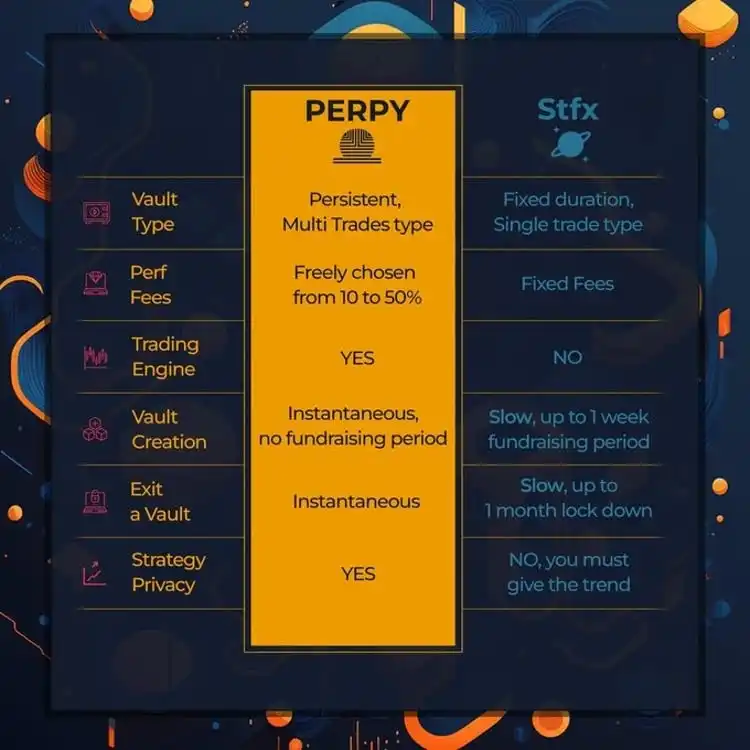
Perpy Finance is similar in concept to STFX, but differs in setup. The main difference, according to Perpy, is that Perpy Vault is continuous, charges variable fees, has no fundraising period, and protects privacy.
Source: Perpy Finance
Puppet Finance (GMX Blueberry Club)
Puppet Finance is an upcoming replication trading feature from GMX Blueberry Club. Users can deposit funds in different pools depending on their intent. For example, store ETH in the ETH bullish pool or USDC in the ETH bearish pool. Puppet tracks the performance of each registered trader, and users can match their trades to it. The product is still in development, and more details will be announced when the GMX synthetics product launches.
other
DappsOS
DappOS is an operational protocol designed to reduce barriers to interacting with cryptographic infrastructure. On GMX, DappsOS allows users to access GMX directly through the BSC wallet. It's very cool and will bring more users to GMX.
Demex
Demex Bridges GLPS to smart contracts. Cosmos, and offers an automatic compounding service that allows Cosmos users to access GMX and benefit from GLPS.
MUX
MUX, renamed from MCDEX, is an independent perp DEX and trade aggregator. MUX perp DEX and GMX Same. It also allows MUX traders to open positions directly on the GMX if the fee is lower.
Write at the end
The synergies provided by the GMX ecosystem benefit all of its projects. Vault products, for example, could work with lending agreements, allowing degens to add leverage to its GLP farm. Social trading products can drive GMX volumes and generate greater returns for GLPS through increased fees.
In addition, to arbitrate; The airdrop can happen at any time, and I expect most of the airdrop proceeds to be reinvested into the Arbitrum project. The GMX ecosystem is currently the most vibrant in Arbitrum. One or more of the above projects will benefit from the Arbitrum airdrop.
Moreover, I believe the "real gains" narrative will sweep through DeFi despite regulatory risks. Like Uniswap Such an existing head item would be replaced by a revenue-sharing agreement. As Bezos famously said, "Your draw is my chance." Uniswap presumably couldn't compete with a similar agreement that shared revenue with users if their product experience was as good. GMX will also get more attention as a leader in the "real revenue" narrative, and its ecosystem projects will flourish.
So the items mentioned in this article are worth keeping an eye on, including perhaps a hundredfold during the next bull market.
Original link
Welcome to join the official BlockBeats community:
Telegram Subscription Group: https://t.me/theblockbeats
Telegram Discussion Group: https://t.me/BlockBeats_App
Official Twitter Account: https://twitter.com/BlockBeatsAsia

 Related Articles