GMX: Retail Robinhood, LP's Citadel Securities
Original article by Alex
0x711, BlockBeats
GMX is a DeFi protocol on Arbitrum that allows liquidity providers (LP) to deposit funds and provide leverage for perpetual contract traders. GMX's LP makes money by collecting transaction fees and providing leverage as a counterparty to each trade. ByteTrade Lab doesAn article describes the mechanism in detail.
Revenue from the agreement will be split 70/30 between LPs and GMX Token holders.According to https://stats.gmx.io, the agreement has generated nearly $100 million in net income since it began operation in August 2021.
How can LPs in license-free agreements achieve such high passive returns in the current market environment?

This paper analyzes the "markouts" of all GMX transactions since December 2021 (Markouts are unrealized gains and losses on transactions using future prices) to measure order flow toxicity. (Toxic order flow refers to informed trading, which can be interpreted as an informed trader having an advantage over the market maker in price prediction and order operation, thus causing the market maker to have a negative short-term profit expectation after trading with the market maker.) The results showed that GMX traders were very harmless, losing as much as 11 basis points in a one-minute markup after fees.
GMX has 60,000 unique users with a median account transaction value of $350 and an average account transaction value of $1 million. As the chart shows, toxicity increases with the size of the transaction, but only slightly. Moreover, large transactions before fees are eliminated are not toxic to the agreement.


GMX has clearly found a balance between passive retail LP and retail trader, resulting in a steady stream of income.Until then, the passive retail LP in the AMM in DeFi was almost never able to win on a large scale. So how does GMX do it?
GMX relies on price predictors to guide price discovery, which improves the efficiency of price discovery.This is different from Uniswap compromising with EV in order to keep the transaction price and fair price in line.
The GMX trade is split into two transfers, which act as a five-second buffer to mitigate the impact of arbitrageurs jumping the cat before the prediction machine is updated.The change, introduced in April, significantly reduced the amount of direct arbitrage activity. It's a simple but effective change. As shown in the figure, carry trade was effectively curbed after this setting took effect.

GMX transaction fees are quite high, the agreement captures 10 basis points, known as the slip point cost. LP with sufficient book liquidity, such as BTC/ETH, can obtain large returns for smaller orders. At the same time, penetrating marketing campaigns and effective referral programs have attracted a steady stream of retail traders. These mechanisms help LP by separating retail investors from arbitrageurs. Prophecy machines, buffer zones, large transaction costs and effective marketing campaigns filter retail traders from the sharks.
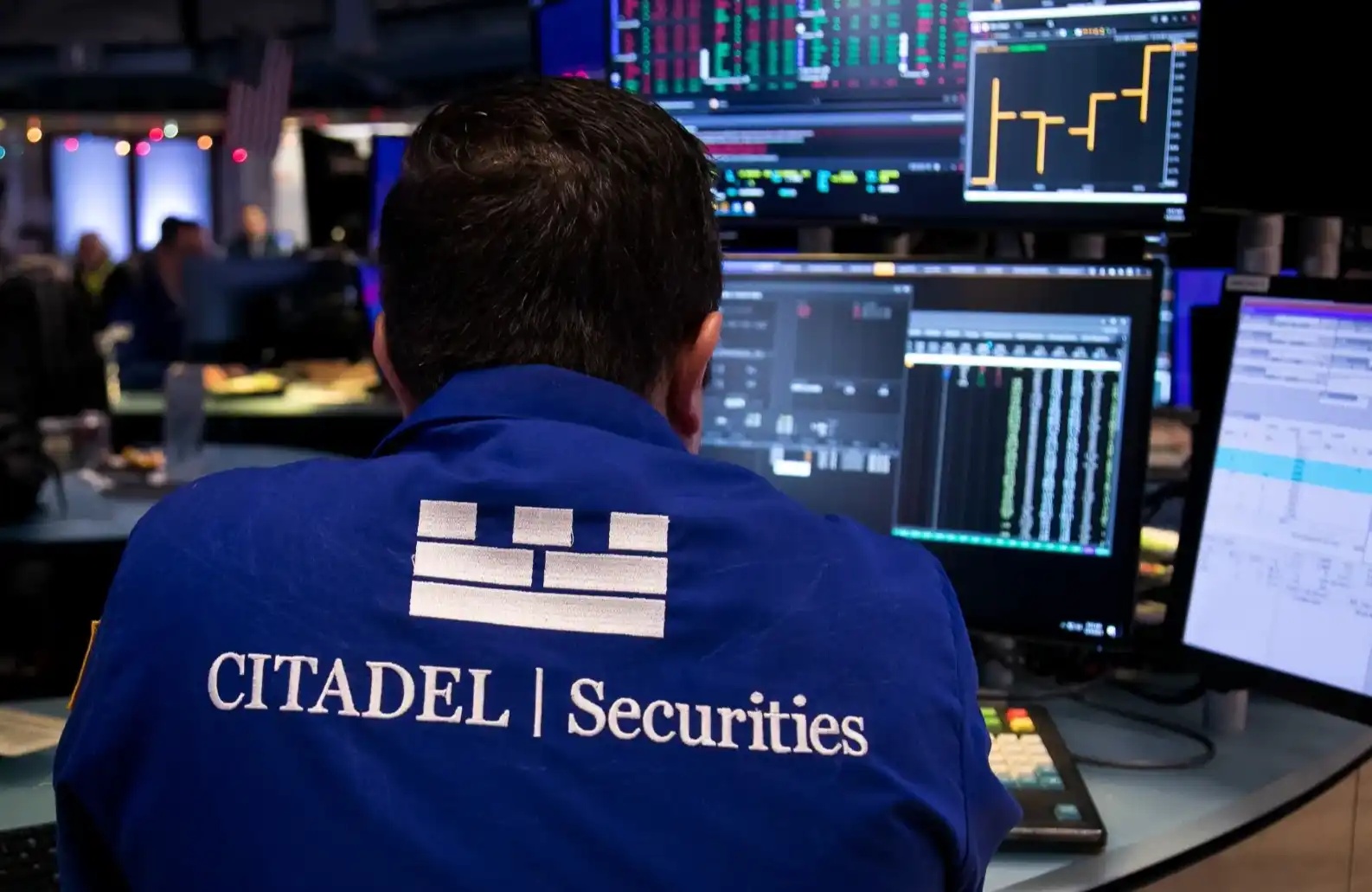
GMX's business model is similar to the full-stack retail trading business that encapsulates US stocks. He is on the one hand getting retail traders on board, like Robinhood (zero slip is the new zero-commission trade), and on the other providing liquidity to the market, like Citadel Securities.
GMX has a beautiful business model. The agreement democratizes the flow of retail trading, allowing LP and GMX holders to reap the same profits as high-frequency market makers and Ken Griffin, founder of Citadel Investment Group.
So should you be bullish and participate in GMX
The current revenue from the agreement is approximately $40 million, while its FDV is $450 million. The FDV to income ratio is 11 times.
You might want to consider the following factors:
1. The prosperity of the retail trading market
Using Virtu as a benchmark, the world's largest high-frequency market maker accounts for about 25 per cent of US retail trading volumes. Its P/E ratio is low (around 5-6) as the volatile retail trading and competitive market increases the risk of structural alpha decay. Retail trading volumes have been volatile as narratives and incentives have changed. Copycats and competitors steal market share and lead to liquidity oversupply, which is common in the DeFi sector.
Moreover, marketing campaigns and promotions to keep retail traders interested are notoriously expensive. This is evident from Robinhood.
2. Vulnerability attack and scalability issues
Price prognosticators are a double-edged sword. They are good at guiding efficient in-market price discovery, but they also have the possibility of growth capacity ceilings and potential loopholes.
It is worth pointing out here that the cost of manipulating the seer price through CEX to attack GMX is prohibitively high. During an attack against Avalanche in September, counting transaction fees and slippage points,Hackers may lose money.
Through a simple market simulation model, the author calculates that a 20 basis point price manipulation of ETH (including GMX arbitrage) would cost about $20 million.
Institutional participants can use their volume to attack the GMX while trading.
Suppose: ZhuSu wants to buy $100 million ETH in its new fund. He is 0 slip long ETH on GMX ahead of time and then goes to Binance to buy. In this case, ZhuSu can make a profit of 1-2% on GMX.
GMX addresses this issue by introducing stricter OI limits. This does not fully solve the problem and tradeoffs scalability. An OI limit of 30-40% of AUM implies capital inefficiency. Marginal GLP casting does not increase liquidity and dilute the yield of existing LP.
3.Arbitrum Air drop
The ARB is one of the most anticipated airdrops of the year. GMX as the main agreement on Arbitrum, deep participation in GMX on the future airdrop impact is self-evident. A 2% airdrop by Arbitrum at a $10 billion valuation would mean Arbitrum traders could make $200 million, which would be enough to cover their trading losses. This is only speculation, of course.
GMX found a clear PMF (Product Market Fit) and built an enviable revenue model. Its success raises some existential questions about what DeFi should be and where we should be heading as a community.
Welcome to join the official BlockBeats community:
Telegram Subscription Group: https://t.me/theblockbeats
Telegram Discussion Group: https://t.me/BlockBeats_App
Official Twitter Account: https://twitter.com/BlockBeatsAsia

 Related Articles