Web3 VC Status in 2023: How does the current environment compare to the 2018 bear market?
原文标题:《 Web3 风险投资死了吗? 》
Original article by Joel John
This is a Block unicorn
Over the past year, I've been hearing from multiple founders that it's gotten harder to raise money, and I want to know why. Having spent most of the past two years in venture capital, I found it hard to measure the sentiment objectively, so I conducted a poll on Twitter (n = 101 ). To understand the situation.
While my voting method is definitely a bit crude, the consensus is clear: Seed funding has been terrible this year. This makes sense if you consider how long it takes to close a round of funding. Or so the logic goes -- venture capital activity is often closely correlated with major stock indexes, and we are in a bear market. So this should be a bad time for founder funding.
I looked at about six years of data to see if this was true. This article explores the present. 2023 The Blockchain Fundraising Environment in 2010 2018 And lays a framework for what founders need to know to survive this year.
Overall view
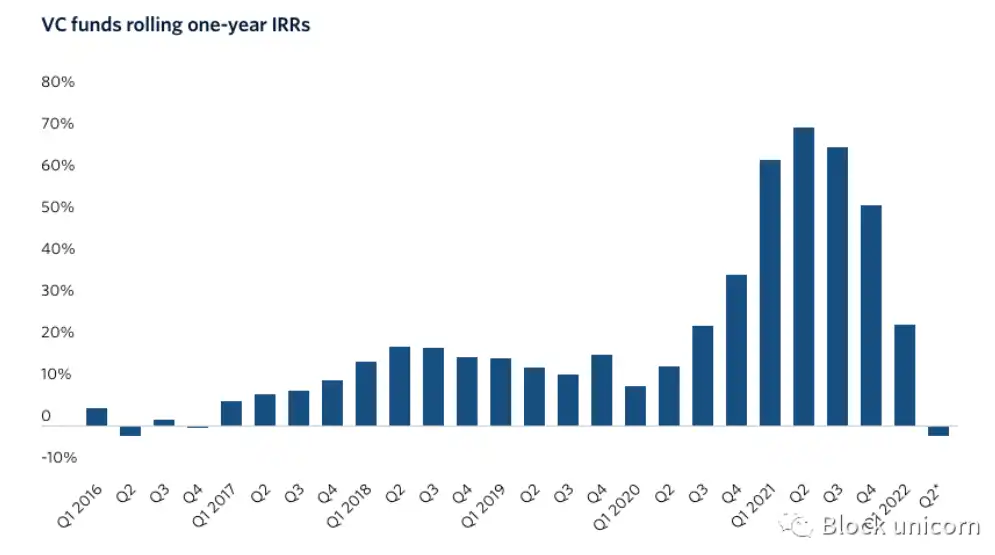
Before delving into the challenges Web3 faces with its bankrupt trading platform and dysfunctional Stablecoin, let's first clarify the state of venture capital itself. We are in this strange phase where the IRR in risk markets has flipped negative for the first time in six years. This measure is an average of funds, so venture capital as an asset class is arguably in disarray from the point of view of those who put their money to work, typically pension funds or funds of funds.
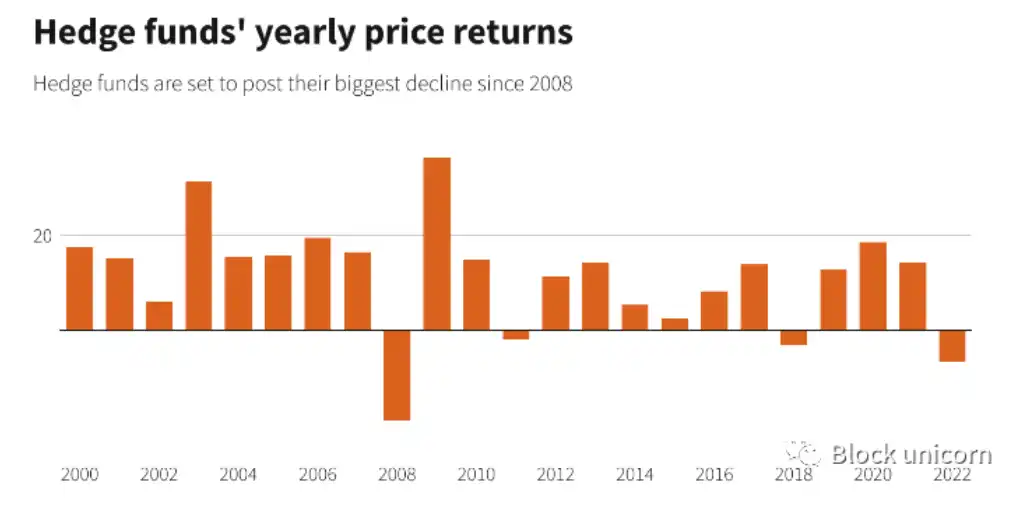
It doesn't make sense to just look at digital assets in isolated risk-reward sectors, and I'm curious about what's going on with hedge funds. There are a few that actively trade these liquid instruments, and they don't seem to be doing very well either. By some estimates, hedge funds are coming to an end. 2008 The average crypto-related hedge fund saw its assets under management decline in its worst year since 2010. 55% .
In theory, this should lead to less funding for startups. Right? That was my assumption when I started this article, but look at the chart below.
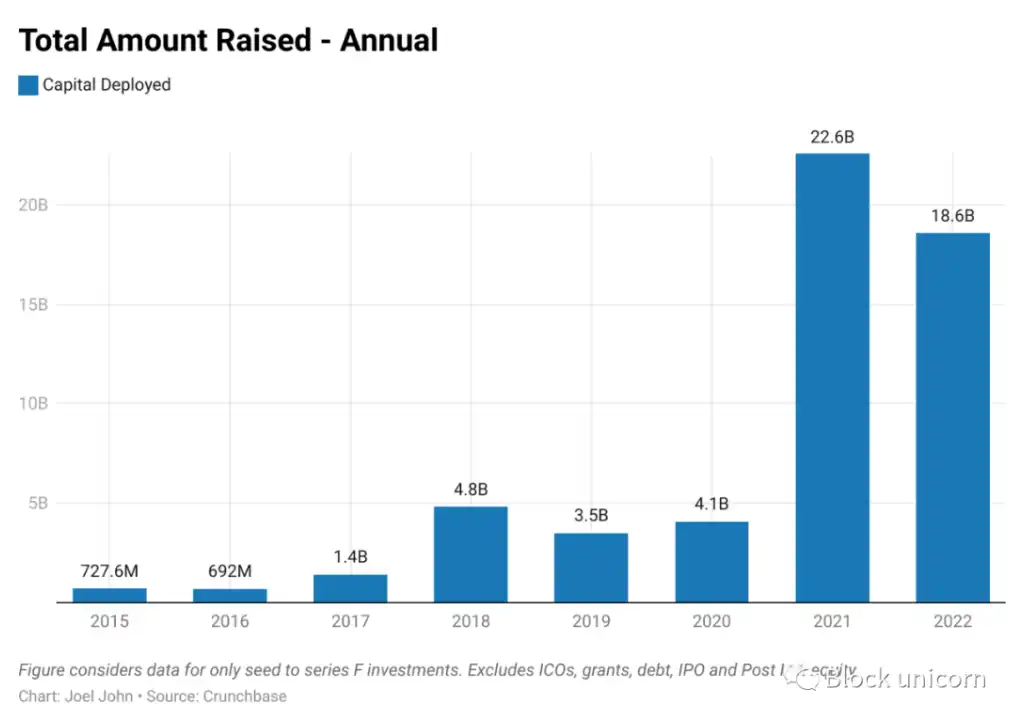
We just had our second big crypto bull year in terms of total capital allocation. Investment funds were down about a year on year. 20% But still less than the overall venture capital market. 35% The decline of
magnification
Does this mean the cryptocurrency venture is intact? Probably not. 2022 Eg. Most of the financing that took place in 2005 took place in China. 1 In January, when founders and investors return from the cold winter to kick off the New Year by announcing their funding. That's why you see a seasonal uptick in the amount of money raised and the frequency of deals that month. Throughout the year, we've seen leading companies raise significant funding and pay raises for crypto circuits. Do Kwon, Three Arrows Capital Su Zhu, FTX CEO & SBF They have done great harm to the industry.
The trend becomes even more pronounced once you look at the number of deals that take place during the year. I've scaled it up to last year to show what might have happened.
Note 2 A "crash" around the month? That's where the partners and analysts at the venture capital fund 1 The month after the rise of respite, you can also in. 2021 And you see that in the numbers for the year.
But here's the key to the data we've recovered. 2020 Year 1 Last seen around the month of venture capital frequency.
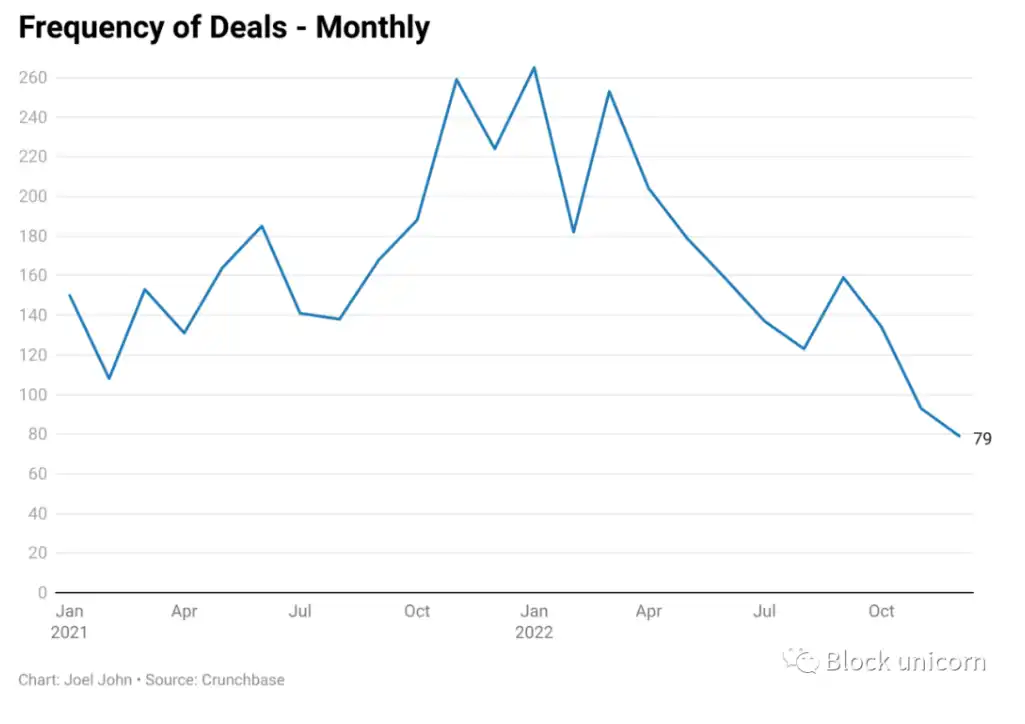
This reversion to the mean can also be seen in capital. Given the macroeconomic correction in Q1 / Q2 (higher energy prices, possibly inflation), we see a rapid decline in the prices of digital assets. Typically, when liquid markets are doing well, the appetite to invest tends to reach new highs; This suggests that Web3 investors could see an exit in the form of liquid tokens.
随着市场恶化,公司开始越来越多地推迟 Token 的发布。因为没有人想在崩盘的熊市上发行 Token ,这意味着投资者持有的现有头寸需要更长的时间才能产生回报。
In such circumstances, the rational response is to hold unspent dollars rather than make multiple rounds of investments. This becomes very clear when we look at the amount of money being deployed.
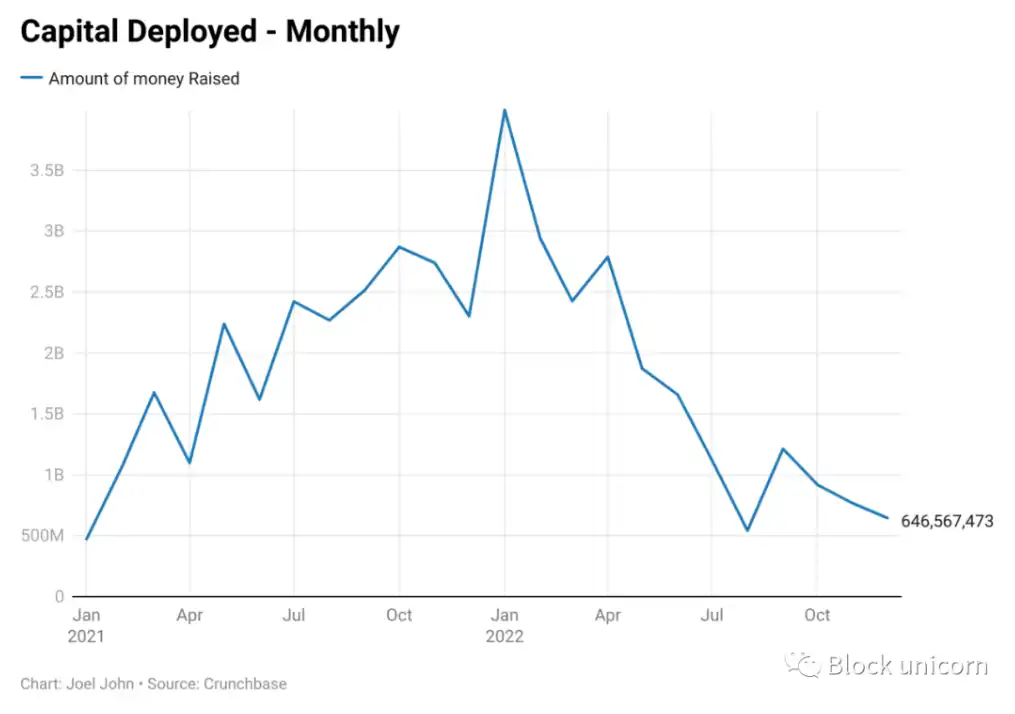
The figure above sums it up. 2021 The wave of venture capital that entered the ecosystem at the end of the year, the tide slowly subsided throughout the year. I find it fascinating that even now it's monthly. 6.5 & have spent The "low level" of $100 million, the amount of funding that the blockchain ecosystem attracts every month today, is the same. 2016 Annual financing scale.
And, with the number of companies in the crypto space growing exponentially, it would be a mistake to assume that we're in a giant funding freeze without considering how fundraising activity in the space has evolved over the past few years.
To do this, I analyzed the trace back. 2017 Year of data. If our decline were like this. 2018 As severe as the winter crash of 2000, we should see a drop in frequency in sync with what we saw then.
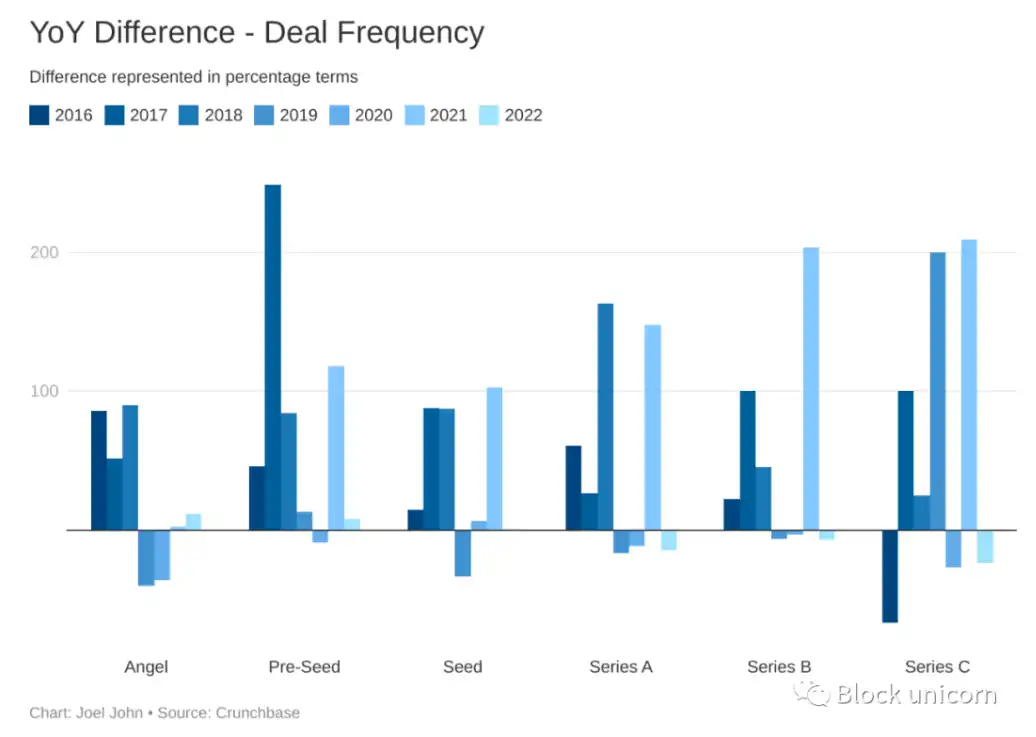
When we consider the frequency of transactions over the years, we see two separate trends. First, the pre-seed and seed stages are still better than each other. 2019 Years are more flexible. In 2019 The frequency of seed financing decreased in 2010. 33% . On a year-by-year basis, we envision the field in 2022 The years remain positive. Founders have been raising more money in the seed stage to build through a bear market. Self 2020 The median seed funding has more than quadrupled since 2010. The amount of each financing is now. 450 Ten thousand dollars.
If you look at the right-hand side of the chart. A, B And C Series, you will see a completely different trend, A Series in 2019 The annual rate is -17%. . We're in. 2022 The annual rate is -15%. , B Series and C The series also began to imitate. 2019 Years of peer. Founders can complete a round of funding at an early stage between friends, family and angels, and seed stage funding has gone from a few days in the bull market to more than two quarters in the current environment.
For growth-stage companies, it's almost impossible to get financing unless they're very attractive, but it can still happen. This becomes apparent if you look at the same numbers through the lens of annual capital deployment.
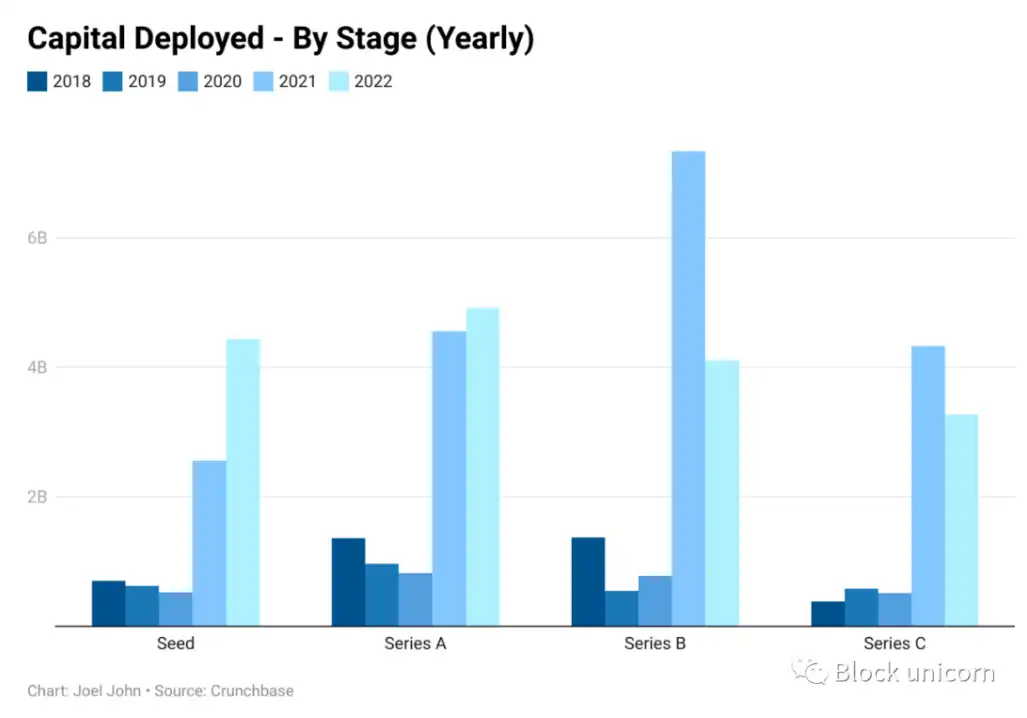
The amount of money going into the seed stage has doubled. Although nbsp; A The wheel has maintained the same speed, but we have only seen severe contraction during the growth phase. That could be because companies are trying to stay lean early, and having a big enough funding war chest to keep in their pockets could mean they have plenty of time to get through the next big bull market.
In the later stages, companies usually have raised a lot of money and hired a lot of people. In the case of high fever rate, survival. 36 To 48 A month to respond to changes in market sentiment is relatively unlikely.
If you are a growth investor and find that the valuation of the stock you are betting on has fallen sharply, you usually have two options. The first is to enter an earlier stage (seed, A Round) and join an earlier round. This explains why we are seeing companies that used to participate only in the late stage now participate in the early stage. From a portfolio building perspective, it lowers the valuation you deploy and increases your stakes in different companies.
The second option is to invest more in businesses that are already doing well, which is why attractive companies often get amazing investments.
What you need to know
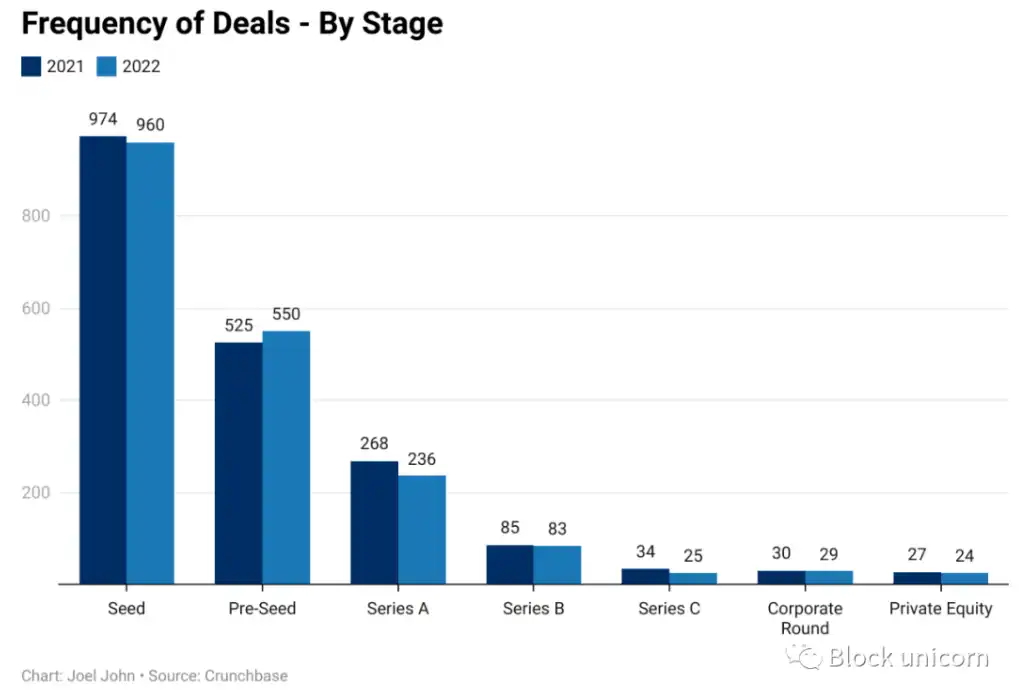
What does all this mean for entrepreneurs in today's marketplace? It's worth remembering that, contrary to public opinion, more capital and transactions take place in the crypto space today than ever before. 2020 More years. The chart below shows the frequency of transactions by stage over the past two years.
If you are in seed or pre-seed, then your fears are unfounded. There are just as many deals happening and twice as much capital going into the ecosystem.
It is in the interest of those who deploy the money to convince those raising it (you or the other founders) that the sky is falling. This allows them to push for more favorable valuations while giving them ample time to consider other risks they can deploy. There was no coordinated conspiracy to convince founders that venture capital was about to freeze. Rather, it is the invisible hand of the market, as Adam Smith put it: a series of forces that come together to convince you that there are no more buyers in the market.
That's how it works. In a bear market, venture capitalists with money to deploy can choose to sit back and wait for the "perfect" opportunity to arise. As the saying goes, the market pendulum swings in their direction and each company takes longer to do due diligence and return to its founder.
What takes days in a bull market often takes months in a bear market. VC Partners at big institutions start conversations with founders with metrics of attractiveness, rather than asking who else joined the round. Founders interpret this apathy among venture capitalists as a lack of money in the market. It's not a lack of money that causes this behavior, it's a lack of conviction.
But there's another reason for this madness. We think it's the worst thing in the world for a startup to fail to raise follow-on funding. In our opinion, in nbsp; 2023 The annual cost of failure has fallen to zero in a market where failure is an unacceptable outcome.
Until... 20 Century 90 Back then, entrepreneurship was rarely seen as a viable career path for young professionals. You either had debt or were born into a wealthy family, a trend that venture capital reversed during the dotcom boom.
What is happening now is best explained by Ramana Nanda, a visiting scholar at Harvard. Titled "The Cost of Experimentation and the Evolution of Venture Capital," the report explores how the falling cost of starting a business has affected the quality of founders and the investing styles of their backers:
"The falling cost of starting a new business has led to early stage financing for some entrepreneurs who could not get financing in the past. While the expected value of these marginal ventures that have just become viable is lower, they appear to consist mainly of ventures that have a lower probability of success but a higher return on success (what we call "high risk investments"), rather than "poor" ventures that have a lower total return on success. We found that in industries affected by technology shocks, VCS increased their investments in startups run by younger, less experienced founding teams.
While these features are similar to those of Google, Facebook, and Airbnb. And Dropbox Such as "risky bets" created by young, inexperienced founders, but of course also fits with broader alternative mechanisms that suggest fringe companies are just a worse investment."
Ramana Nanda at 2015 I wrote this article in 2005, nearly a decade after Amazon Web Services (AWS) launched. Why is this important? Because AWS And Google ads have changed the economics of entrepreneurship. They enable anyone to start a server and sell it to someone halfway around the world.
For example, Y Combinator Relying on a growing number of young people who often don't know better than to go out and make the original devices we use on the Internet every day today. Of course, the failure rate of these businesses was -- and is -- quite high. But by and large, the world's startups are better off getting venture capital than not getting it.
Cold winters and reserves
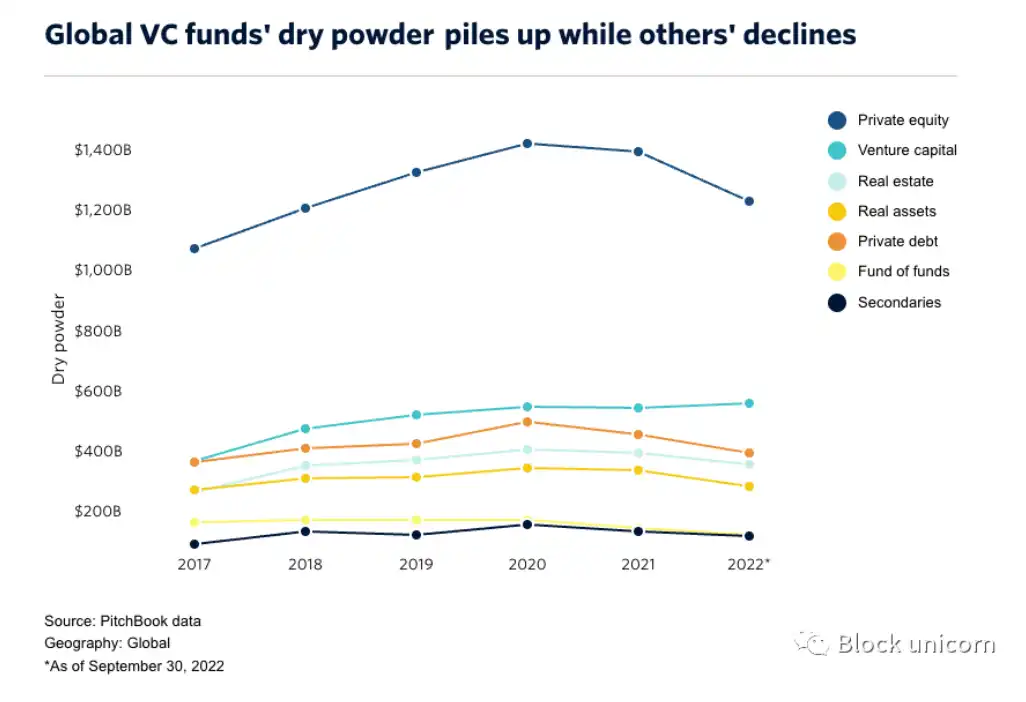
Venture capital is one of the only private instruments, its market volume ratio. 2022 There has been an increase in the past year. According to different sources, 3000 100 million to nbsp; 6000 $100 million of accumulated capital has yet to be deployed. A large part of the capital is just "commitment" if we turn up like. 2008 The money raised by venture-capital firms is likely to shrink in a full-blown recession like last year's. 2008 There are precedents during the financial crisis and dotcom bubble in 2005.
Many founders operate on the assumption that at some point venture capital firms will have to continue to deploy capital. And that's certainly true, but if the data tells us anything, it's these two things:
1. Venture capital in the early stage occurs frequently and the amount of capital keeps increasing. A large proportion of these start-ups are likely to fail, and failing quickly is a desirable outcome because it saves time and effort for everyone involved. Venture capital firms often set valuations to optimize ownership of these start-ups as they take off.
2. There is too much capital piling up in growth-stage companies that can demonstrate meaningful traction. These companies will raise money at higher prices than their peers, and it's a seller's market. Founders get the valuations they ask for because there is too much money chasing too few deals.
The mess in the middle is something most founders want to avoid. This is an area where you've raised enough money to grab the headlines and the best talent, but have no clear direction to get the product to market fit. The worst thing that can happen to a business is that it does not fail. It's apathy from customers, teams and investors. The slow bleeding, the scars, the reminder that no one cares about what you put your heart and soul into.
This "mess in the middle" I mean is usually found in. A Round around, because at this stage, you "validate" your risk externally through a VC or media company, rather than through a paying client. That's why the conversation around fundraisers at these stages starts with identifying the key metrics of the business. If that number does not exist, subsequent funding will not be forthcoming.
我并不想在这里制造恐惧。但值得承认的是,在这条路上会有失败。DAO 不再像过去那样配置资金,生态系统拨款是该行业的命脉,但却减少了部署资金。在科技公司裁员之际,从 IPO 和高估值的 Token 上市中获得财富的天使投资者正在争夺工作。
Will there be only good days in the coming months? Probably not. Especially if the macroeconomic environment remains as it is. But the situation is not as bad as we think in the private market, and seed stage activity remains high. Late-stage deals have raised just as much. If you're building and have data to test your hypothesis, there's not much to worry about.
Original link
Welcome to join the official BlockBeats community:
Telegram Subscription Group: https://t.me/theblockbeats
Telegram Discussion Group: https://t.me/BlockBeats_App
Official Twitter Account: https://twitter.com/BlockBeatsAsia

 Related Articles