Wombat Exchange: indicates the stablecoin DEX on the BSC

原文标题:《 [TokenMore] 币萌投研 - Wombat Exchange (WOM) 》
原文作者: TokenMore 币萌
Updated date: 2023/02/14
01 Project description
Wombat is a DEX running on BSC, dedicated to stablecoin/synthetic asset trading with low slip point, which is equivalent to Curve on BSC. Wombat has economic model/governance model/income model design similar to Curve, and has incubated three meta-governance protocols. Wombat launched on September 5, 2022. It has passed security audits by PeckShield, Hacken and Zokyo, and will expand to multiple chains in the future.
02 Technical background
Stablecoins are one of the infrastructure of the crypto industry. At present, there are many kinds of stablecoins circulating in the market, such as USDC/USDT issued by centralized over-mortgage, DAI issued by decentralized over-mortgage, FRAX and so on. After entering the DeFi era, people's demand for stablecoin trading gradually increased, especially for the whales keen to dig everywhere, to carry out large stablecoin exchange became a necessity.
Stablecoin trading is similar to traditional foreign exchange trading, with low price fluctuations and high volume of trading. Early stablecoin transactions tended to take place in AMM DEX such as CEX, which supported fewer stablecoin trading pairs, or Uniswap, which was heavily limited by the liquidity (amount of money) of the pool. According to the traditional AMM algorithm, large stablecoin transactions are prone to trigger a high slip point, for example, 10 million USDC can only be exchanged for 9.5 million USDT.
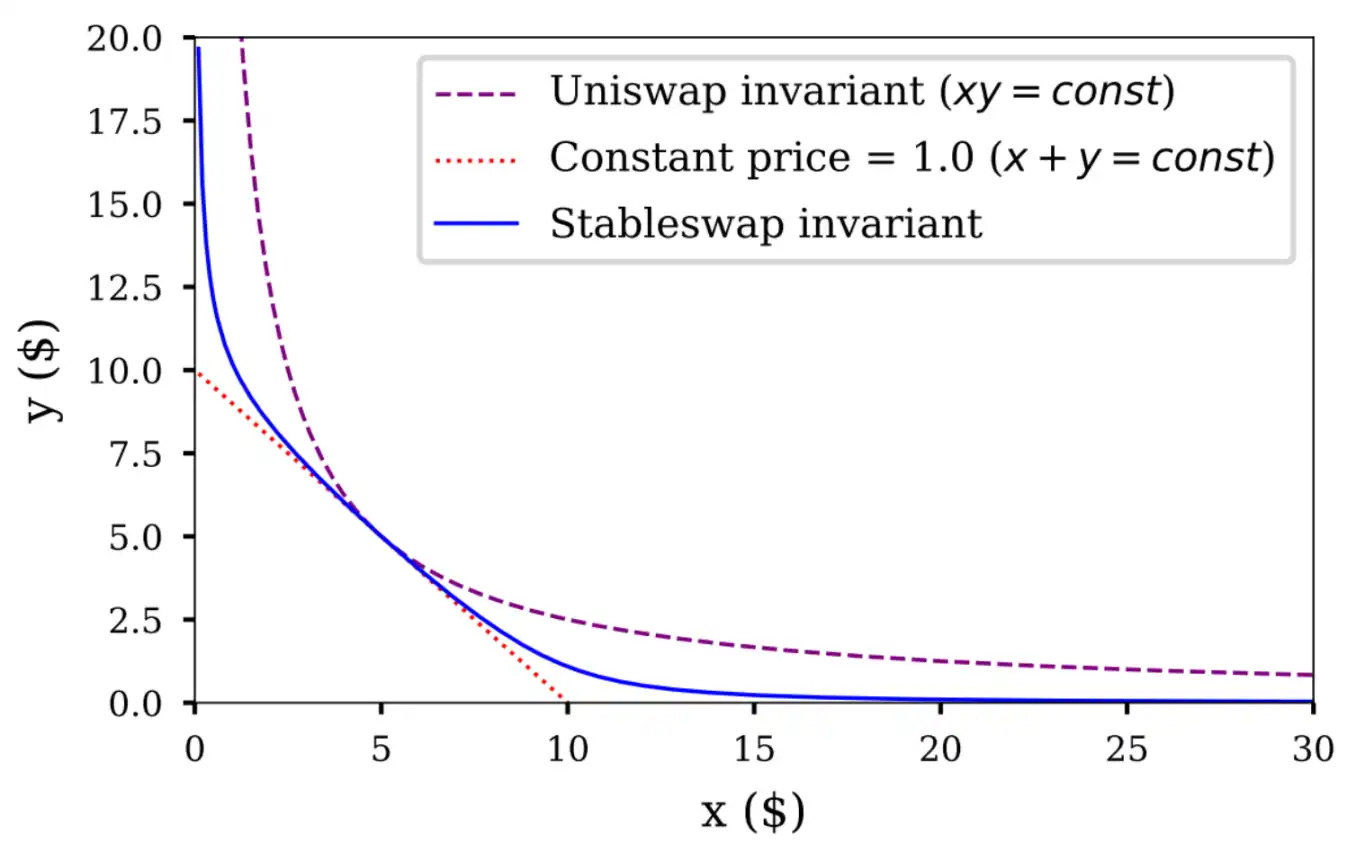
Subsequently, DEX protocol Curve focused on StableSwap was introduced based on AMM algorithm improvement (later improved to dynamic anchoring algorithm). The complicated formula is omitted here, and the following figure is referred to. The general meaning is to concentrate the main liquidity in the liquidity pool in a price range (for example, the price range of stablecoin trading pairs is concentrated around 1:1), reduce the slip point within this price range, and reduce the slip point loss of traders and the volatility loss of liquidity providers. Simply put, it can support large trades without large amounts of liquidity, increasing the utilization rate of funds in the pool.
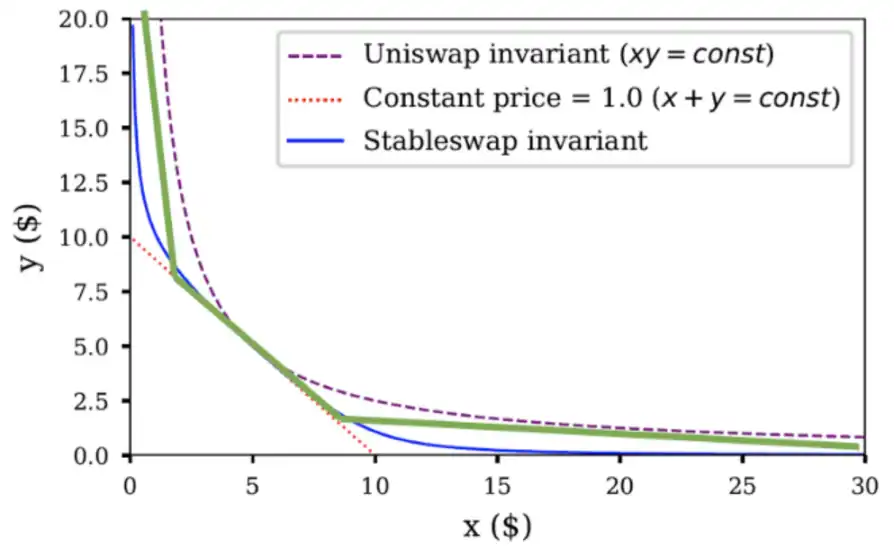
Wombat, as the Stableswap on BSC, uses a similar algorithm to Cruve's Stableswap (officially called Stableswap 2.0). The green line below shows Wombat's algorithm.
In addition to the trading of various stablecoins, the trading between many synthetic assets with the same underlying assets also requires a large amount of low-slip trading experience, such as wBTC/renBTC, stETH/ETH, etc. Traders related to them are also the main audiences of stablecoin DEX like Curve.
Uniswap has adopted a centralized liquidity algorithm since launching version V3, and many AMM DEX are following suit. Although they gradually approach DEX like Curve in the transaction slip point of stablecoin/synthetic asset, relevant traders and liquidity providers still tend to use Curve. Besides the usage habit, more importantly, the economic model/governance model/income model design of Curve can attract a large amount of capital participation. It also created a thriving ecosystem through CRV Wars (wars over native Token CRV chips for yield and governance rights). Wombat took the same essence and tried to create WOM War.
03 Asset Liability Management Model
3.1 Single currency capital pool
In a traditional DEX such as Uniswap, providing liquidity for a trading pair typically requires the simultaneous deposit of two or more assets into the corresponding pool (for a pool containing more assets). For example, to provide liquidity to the pool for Uniswap's ETH/USDT transactions, equivalent ETH and USDT deposits are required at the same time, which not only requires the liquidity provider to hold both assets, but also incurs the consequent uncertainty of losses.
Wombat is different. It supports deposit-only unilateral assets. It sets up a separate single-currency pool for each currency included in the transaction. And can significantly reduce or even eliminate volatile losses (although in most cases, volatile losses in stablecoin trading pairs are negligible).
In order to prevent bad debts (that is, the amount of money in the single currency pool < the amount of money deposited by all liquidity providers), Wombat introduces an Asset-liability Management model.
3.2 Coverage Rate
The core of this model lies in the concept of Coverage Ratio, which refers to the ability of a single currency capital pool to repay debts. Its formula can be simplified as: coverage = assets/liabilities. When the liquidity provider deposits funds, the deposited funds are both assets and liabilities of the pool (the creditor is the liquidity provider). When transactions occur, the increase or decrease of funds in the pool will result in the fluctuation of the output value of the capital in the pool, but the value of liabilities will not be affected, so the coverage ratio will change, as illustrated in the following examples.
If in Wombat's main pool (the capital pool of BUSD/USDC/USDT/DAI trading pair, detailed in Section 4.1 below), the BUSD single currency pool has an initial asset of 1000 BUSD, that is, the current asset value and liability value of the pool are both 1000, and the coverage rate is 1.0. This is the ideal situation. When a liquidity provider deposits 200 busds, the assets in the pool become 1200 busds and the asset value becomes 1200. Since the 200 busds are owed to the liquidity provider (i.e. liabilities), the liability value also becomes 1200 and the coverage ratio is still 1.0.
Then there was a transaction, a trader used 400 USDT to buy 400 busDs, only 800 busds remained in the pool, the asset value became 800, the liability value did not change is still 1200, the debt ratio became about 0.67, and the asset value and coverage rate of the next USDT single currency pool increased.
At this time, if a liquidity provider draws BUSDs from the pool, the output value of capital in the pool/liability value will decrease simultaneously, but the coverage rate will further decrease. If the liquidity provider deposits more BUSDs, the pool output/liability value will increase simultaneously, but the coverage ratio will increase.
As a result, Wombat needed some means to attract more capital when the coverage rate of a single currency pool was below 1.0 (insolvency), and to avoid the outflow of capital, in case the pool was at risk of default.
3.3 Rate Regulation
Wombat 使用的方法是通过费率调控,如下图所示,覆盖率低于 1.0 时,存款收益增加(以给予更多 LP Token 的方式),提款则需要收取费用,以吸引用户存入更多资金。
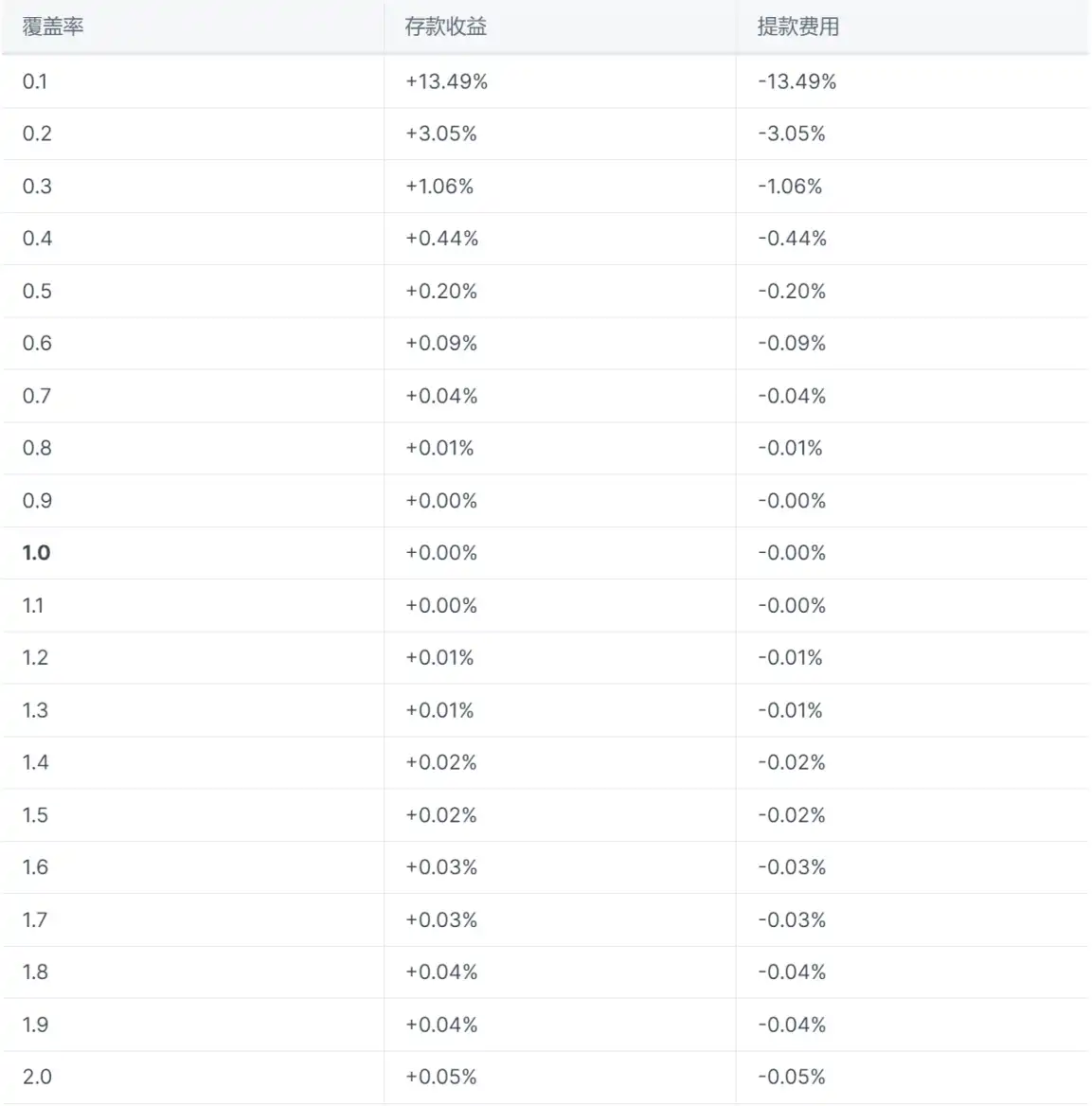
In another case, if BUSD is bearish and leads to oversold (such as in the past two days), users will exchange BUSD into USDT one after another, so that the asset value of BUSD single coin pool will rise significantly, and the coverage rate will rise accordingly (greater than 1.0), while the asset value and coverage rate of the corresponding USDT single coin pool will fall. In other words, under the same trading pair, the increase of coverage rate of one single currency pool will lead to the decrease of coverage rate of other single currency pools, resulting in bad debt risk.
To avoid this, as shown in the chart above, Wombat also regulates single-currency pools with coverage of more than 1.2, also attracting deposits/reducing withdrawals. Of course, in truly extreme cases, all of this is futile, and you need to trigger the ECR in Section 3.4 below to unplug the cable. In addition, Wombat has added a "high coverage transaction fee" rule for some illiquid currencies, as detailed in Section 4.4 below.
3.4 Balanced Coverage rate
In addition to rate regulation, Wombat protects user assets through balanced coverage (ECR). The equalization coverage ratio is the total coverage ratio of all single-currency pools, and is responsible for monitoring the operation of the agreement and controlling risk (taking the initiative in extreme cases). In the event of a black swan event affecting the ECR, the system will immediately terminate all exchange transactions and allow users to reclaim their assets.
04 Trading capital pool
Wombat currently has 11 trading pools, including one primary pool and 10 sub-pools.
4.1 Main Pool
The main pool includes BUSD/USDC/USDT/DAI, both of which are mainstream stablecoins and each has its own single currency capital pool.

4.2 Subpool
Currently, there are 10 sub-pools, which are mainly stablecoins and synthetic assets, which are relatively minority. They can be roughly divided into the following four categories.
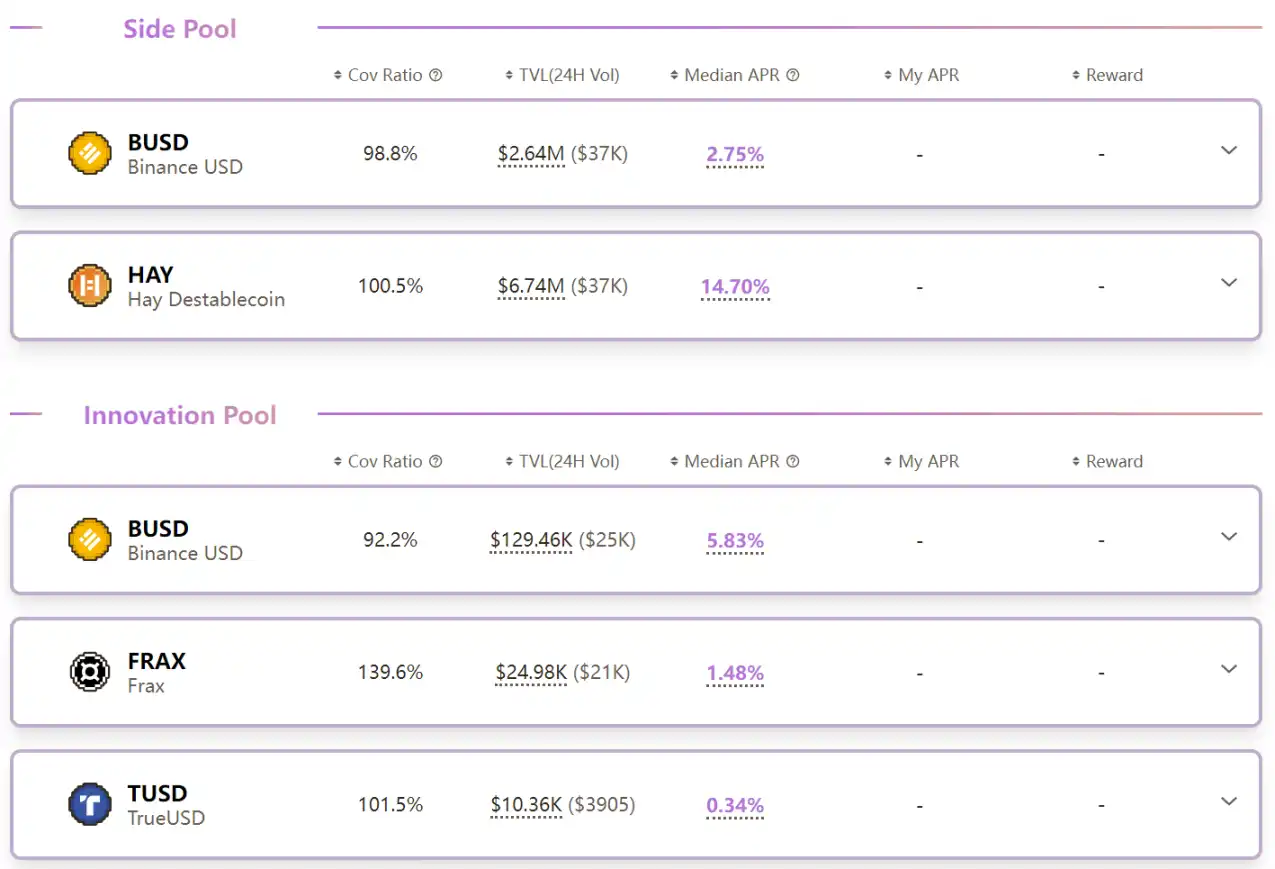
Side pool and innovation pool: Innovative, high volatility stablecoin and BUSD pool.
Side pool: BUSD/HAY, a decentralized stablecoin launched by HAY for Helio.
Innovation pool: BUSD/FRAX/TUSD, FRAX's algorithm Stablecoin for Frax, TUSD is a regulated dollar stablecoin from the TrustToken team.
For example, if a trader wants to use USDC to buy FRAX, the smart contract will first exchange USDC for BUSD in the primary pool, and then exchange BUSD for FRAX in the innovation pool.
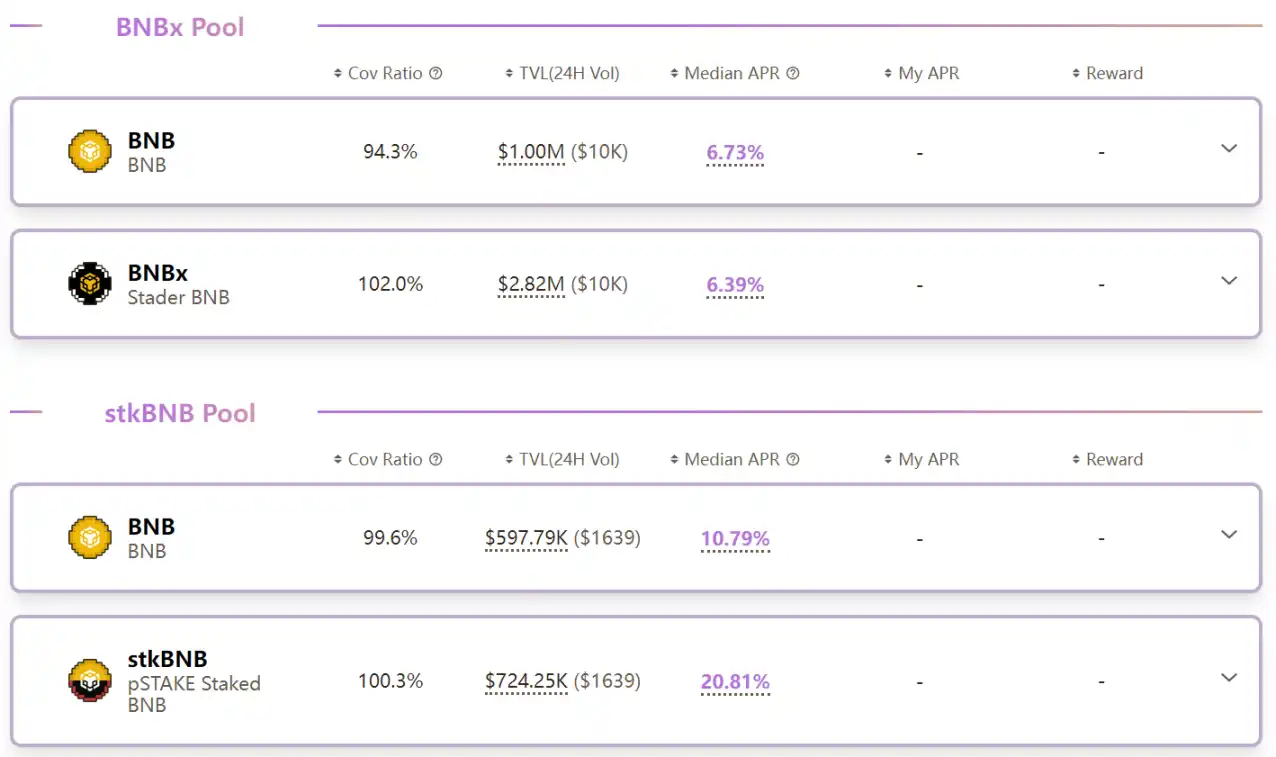
Liquidity pledge Pool: A pool of BNB synthetic assets and BNB.
BNBx Pool: BNB/BNBx, BNBx is the synthetic asset generated by pledging BNB in Stader Labs.
stkBNB Pool: BNB/stkBNB, stkBNB is the synthetic asset generated by pledging BNB on the pSTAKE Finance platform.
Factory Pool: Stablecoin/BUSD pool with higher risk than side pool/innovation pool.
axlUSD Pool: BUSD/axlUSDC, where axlUSDC is a synthetic asset generated by pledging USDC on Ethereum in Axelar.
CUSD Pool: HAY/CUSD, CUSD's decentralized Stablecoin for Coin98.
iUSD pool: BUSD/iUSD, a bond issued by iZUMi that is pegged at 1:1 to the US dollar.

WOM 合成资产池:分别为在 Wombex、Magpie 和 Quoll 锁仓获得的 WOM 合成资产与原生 Token WOM 组成的池子,下文 7.1 部分详述。
4.3 Transaction costs
The above 11 transactions have different transaction fees for the capital pool, which are as follows:
Main pool: 0.01%
Side pool: 0.04%
Innovation pool: 0.1%
Liquidity pledge pool: 0.1%
Factory pool: axlUSDC/BUSD trading pair is 0.02%, others 0.04%
WOM synthetic asset Pool: 0.4%
All transaction expenses will be retained as reserves in the capital pool and will not be distributed to LP.
4.4 High coverage transaction costs
Assets in the subpool are more volatile than those in the main pool and are more likely to be oversold due to bearish/market sentiment and other factors. As mentioned in Section 3.3 above, oversold of an asset will not only reduce the price, but also lead to an increase in the coverage rate of its single currency pool, and lead to a decrease in the coverage rate of other single currency pools within the transaction, leading to default risk. At this time, in addition to attracting deposits/reducing withdrawals through the reward and punishment mechanism, it is more important for traders not to follow the trend and break orders.
To this end, Wombat adds a "high coverage transaction fee" rule to the sub-pools. In each sub-pool transaction pair, the single currency capital pool corresponding to the riskier assets (such as HAY single currency pool in the side pool transaction pair) will charge an additional transaction commission (the maximum charge is 100%, that is, the transaction will be stopped) when the coverage reaches a certain level. Only transactions are affected, not deposits/withdrawals in the pool. The details are as follows:
Side pool/innovation pool: Single currency pool coverage over 1.5 triggers additional transaction fees, over 1.8 stops trading.
Factory pool/liquidity pledge pool: Single currency pool coverage over 1.2 triggers additional transaction fees, over 1.5 stops trading.
WOM Synthetic Asset Pool: Single currency pool coverage over 2 triggers additional transaction fees, over 2.5 stops trading.
4.5 Service Data
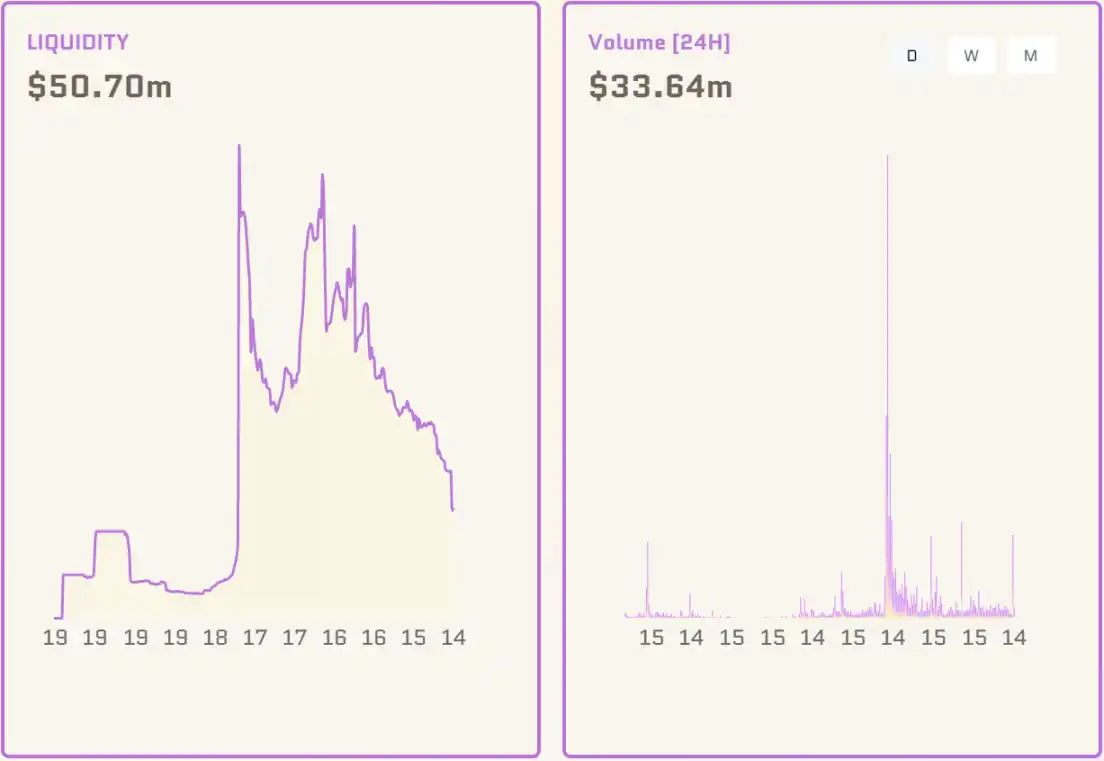
As shown in the chart below, Wombat's total platform liquidity (TVL) is approximately $50.7 million as of 2023/2/14 and is in a continuous decline. TVL has reached two peaks before, respectively:
On the day of its release on September 15, 2022/15, TVL reached $218 million.
TVL reached $204 million on 2022/11/7, when three officially incubated revenue enhancement agreements (detailed below in 07) came online and provided additional liquidity incentives in the short term. High APY attracted liquidity inflows.
The current 24-hour trading volume is about US $33.64 million, ranking second only to Pancakeswap in the BSC chain. The 24-hour trading volume has been in the US $1 million level for a month, and the surge in trading volume in the last 24 hours is mainly due to the bearish BUSD. The highest trading volume was 213 million yuan on Nov. 10, also related to the launch of three revenue-boosting agreements.
05 Economic Model
5.1 Token 分配
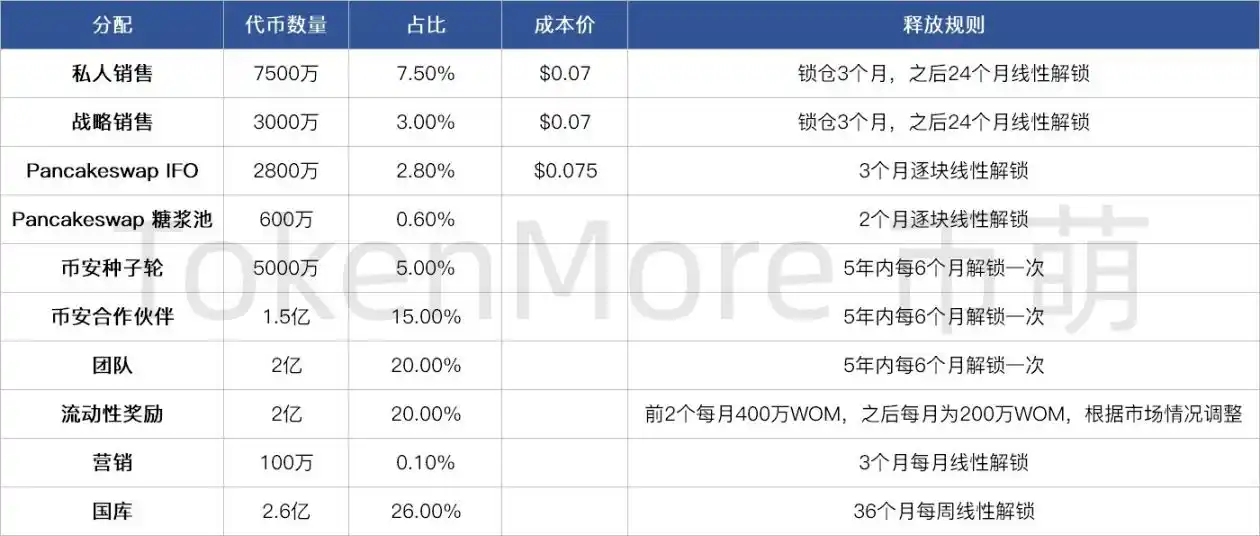
Wombat 的原生 Token 为 WOM,总供应量为 10 亿,具体分配如下图所示,TGE 时间为 2022/8/30。
5.2 Token 释放
Token 释放如下图所示。
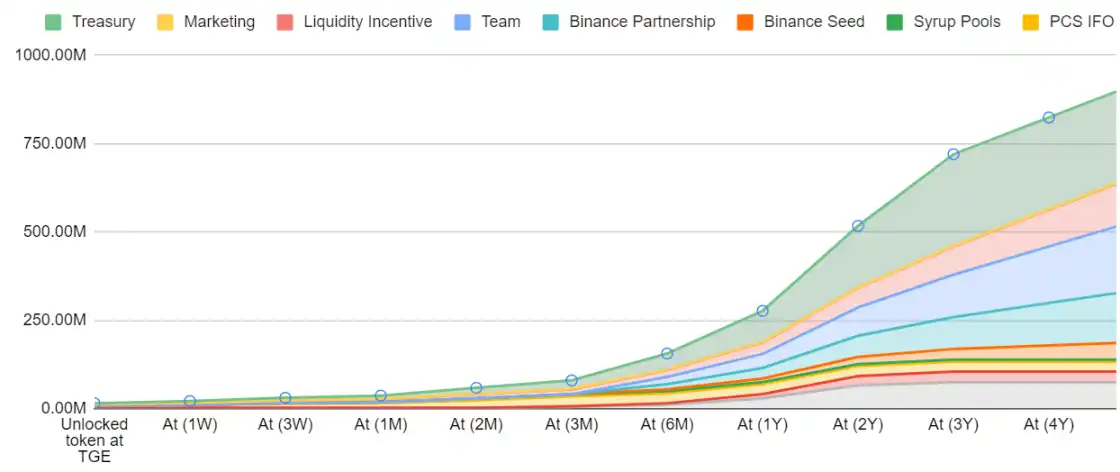
Near-term release: Currently, the main release is the liquidity incentive component, which releases approximately 2 million WOM per month (approximately 66,700 WOM per day), which can be adjusted at any time according to market conditions. Note that according to the release rules, the Binance Seed Round/Binance co-op/team sections will be unlocked for the first time at the end of this month. These three alone will unlock 4% of the total supply, or about 40 million WOM.
5.3 Market value Information
The current price of WOM coin is about US $0.14, and about 85.02 million WOM has been issued and circulated. After deducting the part of users' active locking up (detailed in Section 06 below), the actual circulation is about 38.53 million WOM, the market value in circulation is about US $5.42 million, and the FDV is about US $140 million.
5.4 Token 效用
WOM Token 主要有以下三个用途:
Voting governance: Lock warehouse WOM, can vote to participate in platform governance.
流动性奖励:用户为单币资金池提供流动性并质押 LP,能够获得 WOM Token 奖励。每个池的奖励分配权重不同,部分权重的分配由投票决定。
流动性奖励加成:锁仓 WOM 可提升流动性奖励,让 LP 赚取更多的 WOM Token 。
From this can be seen, locked warehouse after the WOM is the core of Wombat.
06 veWOM
6.1 Warehouse locking mechanism
WOM Token 的持有者可以选择锁仓 7 天 - 4 年,锁仓将获得 veWOM,根据锁仓时间加权。如果按最长时间 4 年锁定 WOM,则 1:1 获得 veWOM,如果锁仓时间短,则会减少 veWOM 的数量,具体如下图所示,横轴为锁仓年数,纵轴为锁定 1 WOM 可获得的 veWOM 数量。
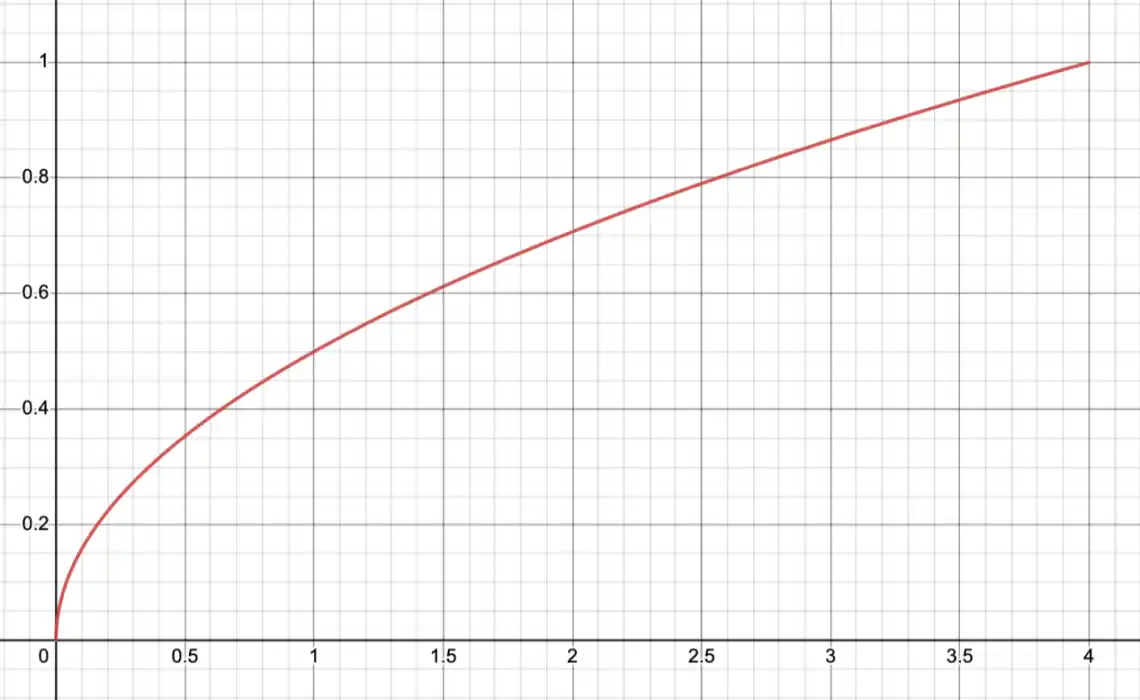
Like VecrVs in Curve, veWOM cannot be transferred or traded and can be used to participate in governance and obtain liquidity bonus.
6.2 veWOM Governance
The main governance of veWOM is the allocation weight of liquidity rewards. Currently, there are 25 single currency pools under the Wombat platform's 11 trading pairs (main pool + sub-pool), which release liquidity rewards of about 66,700 WOM per day.
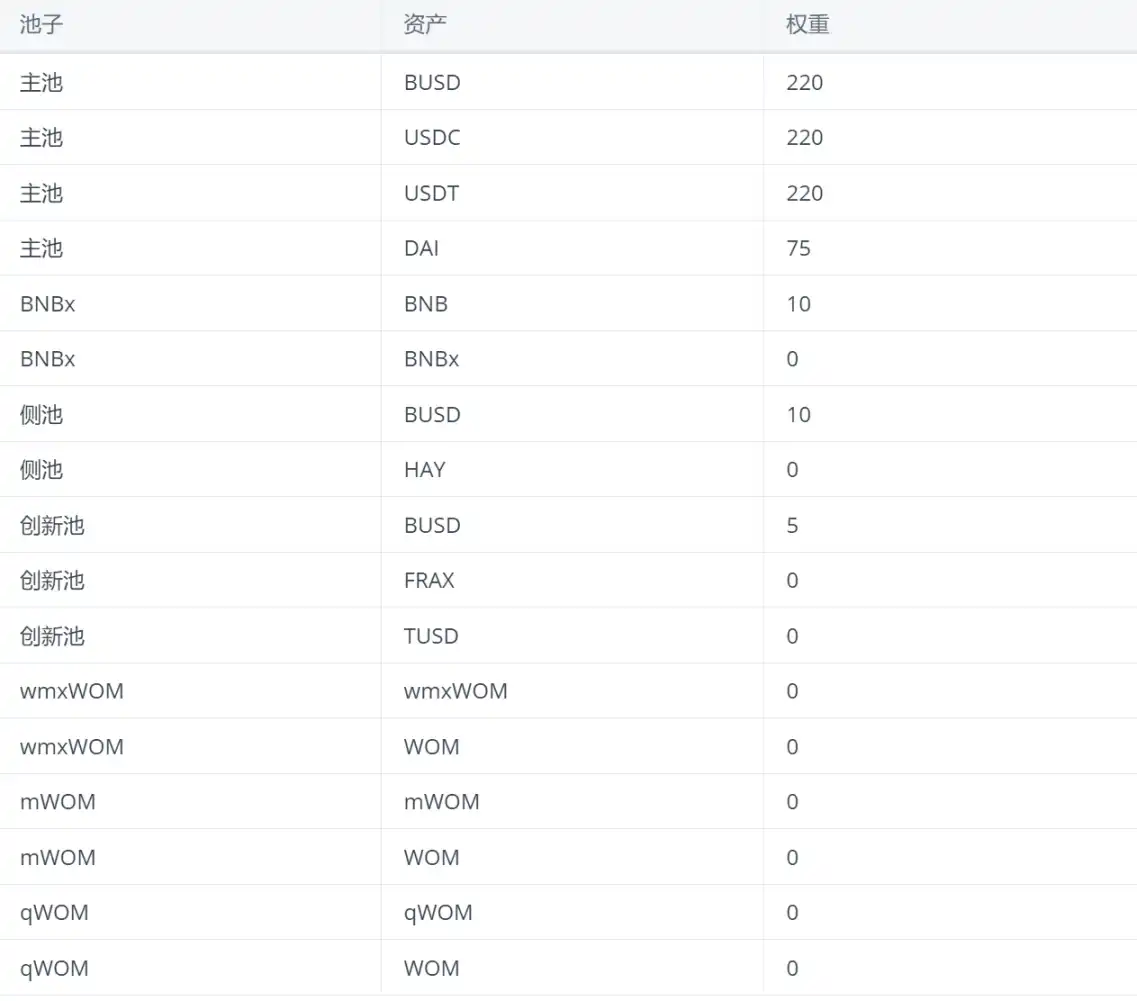
75% of these rewards are officially weighted (what percentage of WOM rewards each single coin pool gets per day) and only allocated to some whitelist pools; The remaining 25% of the distribution weight is determined by veWOM holders' voting, who can vote for 21 single currency pools under 10 subpools. The more veWOM votes, the higher the liquidity reward distribution weight of the pool. Every 7 days for a voting era, determine the weight distribution of the next era.
The figure below shows the allocation weight of the current official determination of 75% of the liquidity award, which is allocated to a total of seven pools, mainly concentrated in the main pool.
The following chart shows the veWOM votes (weight distribution) received by each single currency pool during the current voting cycle.

6.3 veWOM Liquidity Bonus
As mentioned above, users can get WOM rewards for providing liquidity and pledging LP for the single currency capital pool. The reward is divided into two parts: base reward and bonus.
Base reward: 37.5% of the total reward, based on the number of LPS held by the user.
Bonus: 62.5% of the total bonus, distributed according to the number of veWOM held by the user.
In other words, users can get more liquidity rewards by locking up WOM while providing liquidity to the single currency pool.
6.4 Warehouse Locking Data
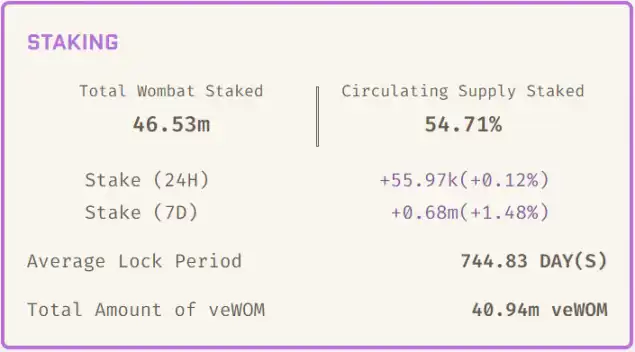
As shown in the figure below, as of 2023/2/14, about 46.53 million WOM has been locked up, accounting for 54.71% of the current total circulation. The average lockup time is 744.83 days (about 2 years), and the total veWOM is about 40.93 million.
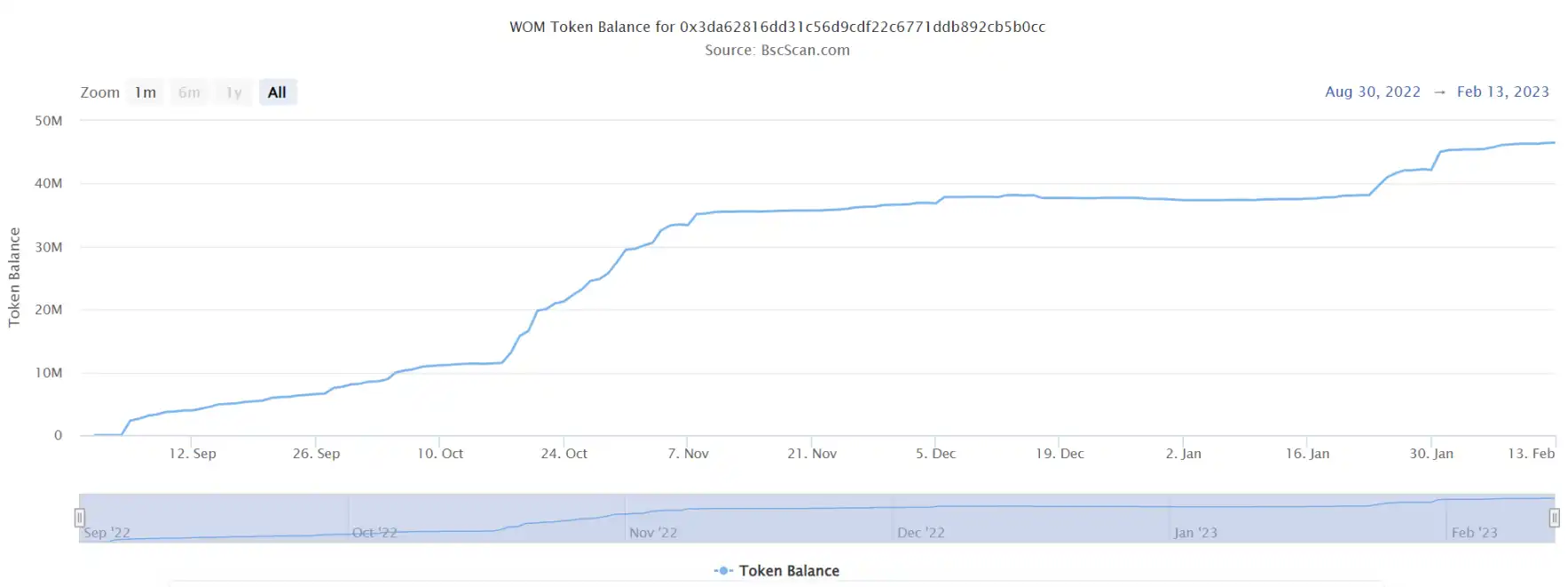
As can be seen from the lock-in trend in the following figure, after the veWOM voting governance was started in January this year, the volume of WOM lock-in increased significantly, from about 37 million to about 45 million.
6.5 veWOM Summary
In conclusion, veWOM not only determines the total amount of WOM rewards for each single currency capital pool through governance, but also controls the returns of individual liquidity providers. There are some problems with this model in the long run (refer to the history of the Curve) :
veWOM cannot be transferred or traded, and large amounts of WOM are locked up in liquidity for long periods of time.
Lock-in WOM can increase LP returns, and the more lock-in the longer the return will be higher. When most LP is in volume, in order to maintain or improve returns, liquidity providers need to continue to increase lock-in positions, triggering a scramble for WOM.
For stablecoin or synthetic asset projects that set up trading pairs on Wombat, they need to keep their pools liquid if they want to stay viable in the long term, especially for stable projects that need a lot of liquidity to reduce the risk of unanchoring. Liquidity tends to be high yield, the best way to attract liquidity is to increase the liquidity reward allocation weight of the pool, the only way is to vote, in addition to trying to let veWOM holders vote, the project side will also lock up a large number of WOM in exchange for voting rights, will also trigger the fight for WOM, but also the fight for governance rights.
07 WOM War
The mechanics of Wombat are similar to those of the Curve, as are the model problems mentioned in the previous section. In the Curve ecology, what has Convex Convex, supplemented and upgraded the model of Curve, separated the earnings rights from the governance rights of CRV, and improved the benefits for Curve users. Wombat has also incubated three similar platforms, all of which are extensions of Convex, with the addition of the bribe feature. They are:
Wombex:原生 Token WMX
Magpie:原生 Token MGP
Quoll:原生 Token QUO
Since the three functions are basically the same, the following only describes Wombex, which has the largest number of lock-ups.
7.1 wmxWOM
Locking WOM in Wombex gives you 1:1 access to wmxWOM, which has the following characteristics compared to veWOM:
Permanent lock: wmxWOM cannot be unlocked as WOM, which is equivalent to permanent lock WOM, or the WOM is permanently handed to Wombex in exchange for wmxWOM.
Separation of revenue and governance: wmxWOM has more revenue attributes than veWOM, but no governance attributes. It is equivalent to giving WOM to Wombex, Wombex goes to Wombat lockers to acquire veWOM, whose governance rights are acquired by Wombex and otherwise distributed, as detailed in section 7.3 below.
Exit at any time: wmxWOM can be transferred and traded, can be sold at any time in the secondary market for WOM (the price is often lower than WOM), equivalent to exit the lock position at any time. To lock up WOM for wmxWOM, you can also buy wmxWOM directly on the secondary market at a discounted price.
wmxWOM's revenue is divided into the following three categories:
WMX Token 奖励:获得 Wombex 原生 Token WMX 的奖励,WMX 总量的 2% 将分配给 wmxWOM 质押者。
Liquidity Bonus: Wombat has wmxWOM/WOM trading pairs, pledging wmxWOM to its single currency pool (providing liquidity) to earn liquidity bonus.
Platformwide Liquidity Bonus allocation: Pledging wmxWOM can earn 5% of all Wombex platformwide liquidity bonus allocations (detailed in section 7.2 below).
7.2 Liquidity bonus
After providing liquidity to Wombat's single currency pool, users can pledge their LP to Wombex for WMX bonuses in addition to the base WOM liquidity bonus, in addition to the liquidity bonus bonus without locking up the WOM.
As mentioned in section 6.3 above, holding veWOM (lock WOM) while Wombat is providing liquidity to the single currency pool gives you a liquidity bonus. The more locks you have, the more bonuses you get. This is a binding relationship.
In Wombex, the user locks WOM back to wmxWOM without veWOM, so the amount of WOM a user locks in Wombex is not tied to the liquidity bonus. Instead, the Wombex protocol takes the platform user lock-in WOM to Wombat unified lock-in, and then uniformly gives a markup to all Wombex LP pledges.
This means that after Wombat provides liquidity for the single currency pool, users can directly pledge LP to Wombex, and can enjoy the liquidity bonus without locking up WOM. There is no need to frequently manually increase the amount of WOM locking up to guarantee the bonus. Wombat unified allocation is equal.
Of all Wombex platform-wide liquidity bonuses, up to 25% (currently 15.1%) will be allocated as platform fees to the following parties:
0.01%-0.2% : Gas fee allocated to Harvest caller to cover protocol operations, currently 0.1%.
0%-3% : Allocated to Wombex platform, currently 0%.
3%-10%:分配给 wmxWOM 质押者,当前 5%,以 WOM Token 形式分配。Wombex 上流动性奖励加成的幅度与进入 Wombex 锁仓的 WOM 数量相关,该项激励利于提升锁仓量。
5-15%:分配给 vlWMX 质押者(下文 7.3 部分详述),当前 10%,以 wmxWOM Token 形式分配。
7.3 vlWMX
锁仓 Wombex 的原生 Token WMX 可以获得 vlWMX,锁仓时间为 16 周,除了上文 7.2 部分提到的能捕获平台费用外,持有 vlWMX 还将获得治理权,不仅包含 Wombex 平台事务的治理权,还有 Wombex 所持 veWMX 的治理权。
To outline Wombex's logic:
Users permanently lock warehouse WOM to Wombex, obtain wmxWOM, and enjoy the right to profit.
Wombex takes the user's locked WOM to the Wombat lock bin to get the veWOM.
The liquidity bonus generated by veWOM is distributed to all platform users and governance rights are given to WMX lockers (vlWMX holders), meaning vlWMX can meta-govern Wombat.
If enough Woms are permanently locked in Wombex so that most of the voting rights (veWOM) are controlled by Wombex, vlWMX will be able to control Wombat, the underlying protocol.
7.4 Bribery
As mentioned in section 6.5 above, project parties building pools on Wombat need to increase the liquidity incentive allocation weight of their pools in order to attract more liquidity. It is expensive for them to lock up large quantities of WOM to gain voting rights. It is more cost-effective to bribe users who are entitled to vote.
On Wombex, vlWMX holders with voting rights are the subject of bribes offered by projects on Wombex, which are distributed among vlWMX holders who vote.
According to Wombat's official statistics, the cumulative amount of bribes across the three platforms is now about $55,000.
7.5 WOM War
WOM War 和 CRV War 一样,本质上都是对于治理权的争夺。目前有 Wombex、Magpie、Quoll 这三个平台可以对 Wombat 进行元治理,他们都在争取更多的 WOM 锁仓量(更多的 veWOM 份额),以在 Wombat 的治理(WOM War)中获得更多的话语权,让自家的原生 Token 更具价值。
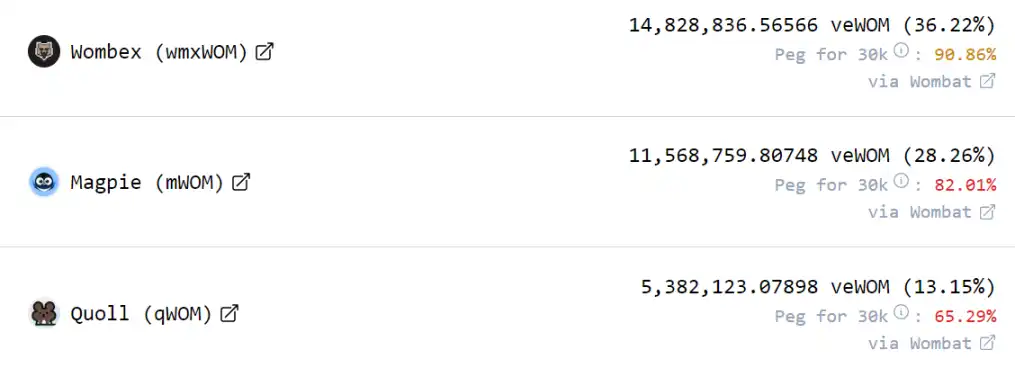
The current veWOM holdings (i.e., governance rights shares) of the three platforms are shown in the figure below. The three platforms account for 77.63% of the total veWOM, among which Wombex dominates, accounting for 36.22%. It can also be seen from the data in the figure that the negative premium rate of WOM synthetic assets on all platforms is high, among which the negative premium rate of qWOM issued by Quoll is as high as 35%, that is, one qWOM can only be exchanged for 0.65 WOM.
08 Team/Financing
8.1 Core Team
Founder: Alex Lee: Trader and blockchain engineer with extensive experience in cryptocurrencies, project management, and portfolio management.
Twitter: https://twitter.com/definidude
Chief Technology Officer: Daniel Chan: Early crypto backer and blockchain engineer with an entrepreneurial background in DeFi, banking and social enterprise.
On Twitter: https://twitter.com/dna_clan2
Cmo: Raymond Wong: A marketing expert with years of experience in cryptocurrency and traditional finance, specializing in project operation and expansion.
Twitter: https://twitter.com/Raywombatx
8.2 Consultants
Mr. Duckbill:Platypus Finance 创始人,加密货币领域的早期支持者,专注设计创新的 Token 经济模型。
Twitter: https://twitter.com/MrDuckbill
0xjun: PhD in Computer Science from Cornell University, author of the Stablecoin 2.0 research paper specializing in cryptography and security.
8.3 Financing
In November 2021, received a strategic investment from Binance Labs.
In February 2022, Wombat was listed in the BSC Most Valuable Developer Incubation Program (MVB IV) and received MVB Monthly Star.
In March 2022, it completed $5.25 million Series A financing led by Animoca Brands and Hailstone Ventures. Participants include BNB Chain, TPS Capital, GSR, Zokyo, Lunar Station, Eureka Trading, Silverstone, Unanimous Capital and YEN per day.
In April 2022, completed a new round of strategic financing, led by Shima Capital and participated by Jump Crypto and Wormhole.
09 Project Summary
9.1 Track
First of all, the object that Wombat imitates is Curve. As a multi-chain stabecoin/synthetic asset DEX, Curve's biggest highlight lies in its complex economic model, which has attracted a large amount of liquidity through its income and governance mechanism, and built a huge empire together with its subordinate projects within the ecosystem. Curve, the lifeblood of DeFi, supports a large number of machine gun tanks. Most of the liquidity added by users at gun tanks, such as Yearn, flows into Curve, where people yearn to supercharge and magnify the earnings of Curve.
Wombat has attempted to replicate a Curve on BSC (which will also expand to multi-chain in the future), and has incubated three revenue enhancement protocols (also called meta-governance protocols and bribery protocols) to evaluate how to Convex, which has a relatively mature ecological framework. Now we need to see if it can attract a large amount of liquidity. Make all kinds of stablecoin projects choose to build pools in Wombat, so as to drive the governance value of the whole ecology and make WOM War really happen.
At present, Wombat's TVL is about $50.7 million, trading volume is in the millions of dollars, the volume is very small, of course, the actual circulation market value is also very small, only $5.42 million.
From the perspective of competitors, Curve has not expanded to BSC at present, but there is an authorized forking project Ellipsis on BSC. The current TVL is about $23.6 million, about half of Wombat. At present, the two are like chicken and chicken, neither of which pose much threat to each other.
关于授权分叉的解释:Curve 使用 Viper 语言而非 Solidity 构建,且协议复杂难以分叉,Curve 授权 Ellipsis 使用其代码进行分叉,Ellipsis 的原生 Token 将有一部分空投给 veCRV 的持有者。
9.2 Binance Background
Wombat 得到了Binance的投资,从 Token 分配上看,Binance占据了 Token 总供应量的 5%,另外Binance合作伙伴(用于营销)占据 15%,团队占据 20%,这三项均在本月底进行第一次解锁,解锁数量为 4000 万 WOM,约为当前总流通量(8502 万 WOM,含锁仓)的一半,实际流通量(3853 万 WOM)的一倍。
Compared with Ethereum ecology, BSC is like a relatively closed kingdom. Mainstream protocols such as Aave and Curve have not entered BSC. As a result, the DeFi infrastructure of BSC has only Pancakeswap, which is not perfect in aspects such as stablecoin/lending/machine gun pool. Especially with the recent SEC attack on BUSD, Binance needs to work on BSC's infrastructure (especially stablecoin), and Wombat, as a parent project, may have a chance to become one of Binance's main support projects.
All in all, Wombat deserves long-term attention.
Follow MOE on Twitter @TokenMore @ETH28888 , capture more value.
Original link
Welcome to join the official BlockBeats community:
Telegram Subscription Group: https://t.me/theblockbeats
Telegram Discussion Group: https://t.me/BlockBeats_App
Official Twitter Account: https://twitter.com/BlockBeatsAsia