Analyze the technical principles and ecological implications of Bitcoin NFT
原文标题:《 一文了解比特币 NFT 的技术原理和生态影响 》
原文作者:alertcat.eth,ChainCatcher
To assess the recent tipping point, the Ordinal protocol on Bitcoin's main network has generated a surge in NFT activity. Although the Bitcoin network currently has no mature trading platform, everything depends on a spreadsheet as the basis of the order and offer, but recently the Ordinal protocol transactions are still very active, even causing congestion in the Bitcoin network.
The launch of Bitcoin NFT brings the number of non-zero bitcoin addresses to an all-time high of 44 million, according to Glassnode, a crypto analytics platform, "a new and unique moment in Bitcoin history where an innovation is generating network activity without the need for classic Token transaction transfers for monetary purposes."
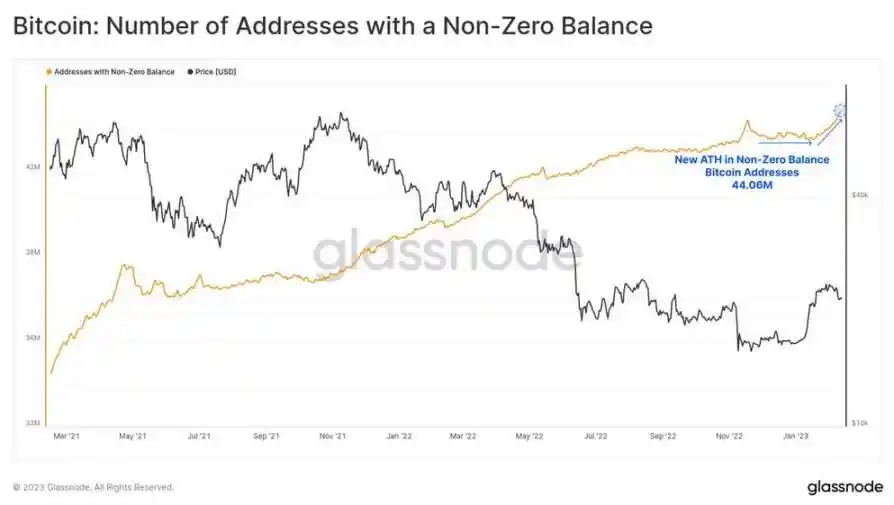
Given its significant impact, this article will analyze the development status of Bitcoin NFT from two aspects: the technical rationale of the Ordinal protocol and its ecological impact.
Let's start with bitcoin itself. The smallest unit of bitcoin is called Cong. One bitcoin is equivalent to 100 million cong. The Ordinal theory gave them financial value, allowing them to be collected and traded as collectibles. A single Cong can be engraved with any content, creating unique Bitcoin native digital artifacts that can be saved in a Bitcoin wallet and transmitted using Bitcoin transactions. The inscription is as durable, immutable, secure and decentralized as bitcoin itself.
In a February 2 BIP created by Casey, a core Bitcoin contributor, the technical rationale for Ordinal Numbers is described as follows: "Each cong is consecutively numbered, starting at zero, in the order in which it was mined. These numbers are called ordinals because they are ordinals in the mathematical sense, giving the order in which each cong is placed in the total supply. The term" ordinal "is very explicit because it is not used elsewhere in the Bitcoin protocol. Transfer the serial number Cong in the transaction input to the output Cong in FIFO order based on the size and order of the transaction input and output."
Each block on the Bitcoin blockchain contains one or more transactions, the first of which is called a coinbase transaction. In ordinal protocols, coinbase transactions are considered to have an implicit input equal to the size of the subsidy for the purposes of the allocation algorithm. Then the principle of transfer is: in accordance with the order of first in first out transfer. Treat the input of the transaction as a list of clicks and the output as a list of slots, waiting to receive clicks. To assign input Cong to a slot, examine each Cong in the input in order and assign each Cong to the first available slot in the output. Transaction fees are treated as additional input to coinbase transactions and sorted according to how their corresponding transactions are sorted in the block.
In ordinal protocols, inscriptions are inscribed with arbitrary content, creating Bitcoin's native digital artefact, often referred to as NFT. Inscriptions do not require side chains or separate tokens. These inscriptions can then be transmitted using Bitcoin transactions, sent to a Bitcoin address, and saved in a Bitcoin UTXO. These transactions, addresses, and UTXOs are normal bitcoin transactions, addresses, and UTXOs in all respects, except that in order to send a single coin, the transaction must control the order and value of inputs and outputs according to ordinal theory. The content model of the inscription complies with the Web protocol that an inscription consists of a content type (also known as a MIME type) and the content itself, the latter being a string, which allows the inscription content to be returned from the web server and used to create HTML inscriptions that use and remix the content of other inscriptions.
This is the same data model used by the Internet, allowing inscription content to evolve with the web and support any type of content supported by the web browser without changing the underlying protocol. The inscription content is entirely on the chain, stored in the taproot script-path cost script. Taproot scripts have few restrictions on their content and receive an additional witness discount, making inscription content storage relatively economical.
Since taproot spend scripts can only be produced from existing taproot output, a two-phase commit/display process is used for the inscription. First, in a commit transaction, a primary root output is created to commit to the script containing the inscription content. Secondly, in the reveal transaction, the output produced by the submission transaction is used to reveal the content of the inscription on the chain. The inscription content is serialized using a push of data in an unexecuted condition, called an "envelope."
The envelope consists of OP_FALSE OP_IF... OP_ENDIF wraps any number of push data components. Because envelopes are actually empty operations, they do not change the semantics of the script that contains them and can be used in conjunction with any other locking script. According to the protocol, contains the string "Hello, world! The text of the inscription serialized as follows:
OP_FALSE
OP_IF
OP_PUSH "ord"
OP_1
OP_PUSH "text/plain; charset=utf-8"
OP_0
OP_PUSH "Hello, world!"
OP_ENDIF
First the string ord was pressed in to disambiguation the inscription from the envelope's other uses. OP_1 indicates the type of the next push to include content, and OP_0 indicates the subsequent push to include content itself. Large inscriptions must use multiple data drives, as one of taproot's few limitations is that a single data drive cannot be larger than 520 bytes. The inscription content is contained in the input that reveals the transaction, and the inscription is performed on the first sound of its first output. This Cong can then be tracked using the familiar rules of ordinal theory, allowing it to be transferred, bought, sold, lost and recovered. This is how Bitcoin NFT writes data to Cong.
The founder defined the properties of inscriptions as follows, and that's why he created this protocol:
For a digital thing to be a digital artifact, it has to be like your coin:
Digital artifacts can have owners. A number is not a digital artifact because no one can own it.
Digital artifacts are complete. The NFT that points to the content up and down the chain of IPFS or Arweave is incomplete and therefore not a digital artifact.
Digital artifacts do not require a license. NFT, which cannot be sold without paying royalties, is not unlicensed and therefore not a digital artifact.
Digital artifacts are not censorable. Maybe you can change a database entry in a centralized ledger today, but maybe not tomorrow, so it can't be a digital artifact.
Digital artifacts are immutable. An NFT with an upgrade key is not a digital artifact.
The definition of a digital artefact is intended to reflect what the NFT should be, and sometimes is, and what the inscription has always been, by its very nature. The founders saw the Ordinal protocol and inscription as a love letter to Bitcoin, the Internet, programming and the World Wide Web. In summary: the authors of the protocol created Ordinal protocol because they needed an on-chain, unchanging, bitcoin-based network security, non-mandatory royalty support, NFT protocol for Bitcoin-Maxi to open new markets, with the same data model as the Internet.
The authors of the protocol have also completed a block browser, a smart wallet that can be sent manually, called the ord wallet, and an index. If you wish to create the inscription, you will need to download both the Bitcoin Core wallet and the ord wallet to complete the control and selection of the hearing. An inscription is a type of NFT, but the founders prefer the term digital artifact because it is simple, suggestive, and familiar.
Here are some of the better-known families of ordinal protocol-based NFTS and their infrastructure.
Ordinal Punks
The NFT that makes up the Ordinal Punks series was cast on the first 650 inscriptions of the Bitcoin network. Late Wednesday, the Ordinal Punks NFT Punk 94 was sold for 9.5 BTC, or about $214,000, according to a tweet.
Bitcoin Punks
Bitcoin Punks was the first to perfectly upload the original Ethereum CryptoPunks bytes to the bitcoin blockchain using Ordinals.
The project side checked the hash value of each image uploaded to Ordinals and compared it to the original 10k punk image. The link to Bitcoin Punks is the first occurrence of an inscription (lowest ID) containing these hash values on Ordinals.
market
The site creates a map of Bitcoin Punks on Ethereum, making it easy for buyers to purchase Bitcoin Punks on opensea. The project side helps buyers avoid scams by providing verified and up-to-date information on Emblem Vault about all legitimate bitcoin punks.
The emerging Ordinal protocol is definitely having an impact on the bitcoin ecosystem. The creators of the Ordinal protocol describe its characteristics this way: The most important thing the Bitcoin network does is decentralize money. All other use cases are secondary, including ordinal number theory. The developers of ordinal theory understand and acknowledge this, and believe that ordinal theory contributes, at least to a small extent, to Bitcoin's primary mission. There is huge disagreement within the Bitcoin community about the development and application of the technology, with some purists arguing that the blockchain should be limited to financial transactions. They argue that the popularity of ordinal protocols has increased the average block size overnight, which translates into higher per-block fees.
As shown below: mempool, a collection of bitcoin blocks waiting to be mined and added to the blockchain, is now full at the time of writing, due to the increased use of block space due to the inscription.
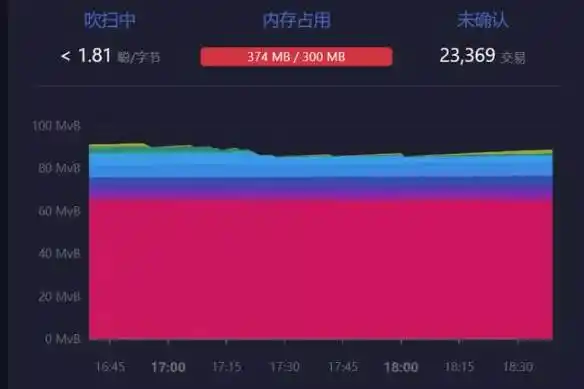
Some worry that recording irreplaceable data on the blockchain could lead to bloat, while others point to the popularity of ordinal protocols as a positive catalyst that will drive more development of the blockchain.
Here's what the protocol's author has to say to the Bitcoin community, which I think is a defense of its ecological impact: "Unlike a lot of other things in the alcatocoin space, digital artefacts have their merits. Of course, there is a huge amount of NFT that is ugly, stupid and fraudulent. However, there are many very creative things, creating and collecting art has been part of the human story from the beginning, even before trade and money, which is also old technology.
Bitcoin provides an amazing platform for creating and collecting digital artifacts in a secure, decentralized manner, protecting users and artists in the same way that it provides an amazing platform for sending and receiving value, and for the same reasons.
Ordinals and inscriptions increase the demand for bitcoin block space, which increases Bitcoin's security budget, which is crucial to ensure Bitcoin's transition to a fee-dependent security model, as the block subsidy halving becomes negligible.
The inscription content is stored on the chain, so the block space requirements used by the inscription are infinite. This creates a buyer of last resort for all Bitcoin block Spaces. This will help support a strong market for fees, thus ensuring that bitcoin remains secure.
The inscription also refutes the claim that bitcoin cannot be scaled or used for new use cases. If you pay attention to items like DLC, Fedimint, Lightning, Taro, and RGB, you'll know that's wrong, but the inscription provides an easy-to-understand counter-argument to a popular and proven use case, NFT, which makes it pretty clear.
If inscriptions become sought-after digital artifacts with rich histories, as the authors hope, they will serve as powerful hooks for Bitcoin adoption: come for fun, rich art, stay for decentralized digital currency.
Inscriptions are an extremely benign source of block space requirements. For example, Stablecoin may give large stablecoin issuers influence over the future of bitcoin's development, or DeFi may concentrate mining by introducing opportunities for MEVs, digital art, and collectibles on bitcoin, unlikely to produce individual entities with enough power to disrupt bitcoin. Art is decentralized.
Inscription users and service providers are incentivised to run Bitcoin full nodes, publish and track the inscription, thus throwing their economic weight toward the honest chain.
Ordinal theory and inscriptions have no meaningful impact on Bitcoin's fungibility. Bitcoin users can ignore both and get away with it.
We hope that ordinal theory will strengthen and enrich Bitcoin and give it another dimension of appeal and functionality that will enable it to more effectively serve its primary use case, which is the decentralized store of value for humanity."
Original link
Welcome to join the official BlockBeats community:
Telegram Subscription Group: https://t.me/theblockbeats
Telegram Discussion Group: https://t.me/BlockBeats_App
Official Twitter Account: https://twitter.com/BlockBeatsAsia
 Related Articles