Could the Ordinals protocol create a more valuable NFT by numbering bitcoin?

原文标题:《 Ordinals 协议能否造出更有价值的 NFT? 》
原文来源: Mempool Research
Aside from being digital gold or a currency, bitcoin hasn't had a new story in recent years. As recently as February 2023, Ordinals, the NFT protocol on Bitcoin, was born, providing a new style for NFT -- the first digital artifact to be fully written on a chain -- and a new possibility for the Bitcoin ecosystem.
Ordinals got a lot of attention when they went online, and on March 8, Yuga Labs, the parent company of the Silly Ape-maker, released 300 NFT by Ordinals named TwelveFold, 288 of which were auctioned off for a total of $16.5 million. On March 14th Mempool invited Merlin Protocols founder Eason and NFTScan founder Sam to do an interview, which combined Galaxy and other reports to come to a conclusion:
The Bitcoin NFT will bring a new paradigm to the NFT market. Galaxy predicts that the Bitcoin NFT market, based on the Inscription and Ordinals, will reach $4.5 billion by 2025;
NFT will have a positive effect on the bitcoin ecosystem. In the context that bitcoin is halved and miners' income continues to be less, Bitcoin NFT can make miners' income, so as to improve the enthusiasm of miners to start up, and bring a positive impact on Bitcoin network security. It would also increase the likelihood of mass adoption of the Bitcoin ecosystem.
The infrastructure that supports Bitcoin's NFT -- wallets, exchanges, browsers, etc. -- will flourish, and Galaxy expects it to flourish further in the second quarter.
1. What is Ordinals
Ordinals was proposed by Bitcoin core developer Casey Rodarmor on February 2, 2022, and went online at the end of January 2023. It took nearly a year for the whole development. Ordinals is the unexpected surprise of Bitcoin ecology to the industry in 2023.
The agreement can be understood in two parts: the Ordinals ordinal number and the Inscription:
Ordinals: ordinals:Ordinals must first understand Satoshi Cong, the smallest currency unit of bitcoin, one bitcoin is equal to 100 million Cong, and also understand the homogeneous nature of bitcoin. Originally, there is no difference between each bitcoin, and there is no difference between each Cong, but just like the central bank of every country marks the number of fiat coins when issuing fiat coins. Based on the Bitcoin UTXO bookkeeping system, Casey uses a technical solution that numbers and tracks Cong, so users can see when a particular Cong is mined and in what order.
It is written on the same inscription:When each Cong is marked on the number, you can write a piece of content witness isolation area, content can be pictures, text, audio and video, even code, as long as the size of 4MB below, this process is the art and Cong binding, so as to release, circulation.
According to public data, as of March 25, 780,000 inscriptions had been inscribed on the Bitcoin network, and the number has been increasing by more than 20,000 a day.

The Ordinal protocol, which has the ability to write code of less than 4mb into a block, was essentially built on Bitcoin's first two major technology upgrades: segwit in isolation in 2017 and Taproot in 2021, the two most significant upgrades to date.
In August 2017, Bitcoin adopted a soft fork upgrade known as SegWit, after a long battle over the path to capacity expansion. In colloquial terms, the expansion was achieved by placing data such as signatures, which take up a lot of storage space, at the end of the transaction, so that the block has more room for more transactions.
After isolation witness, new block calculation rules are also generated. The block size unit is changed from byte to vBytes. One vByte is equivalent to four weight units (wu), which also means that the maximum block size of 1MB is changed to 1vMB, namely 4 million wu. The transaction data structure is divided into two parts: transaction data and witness data:
Transaction data:Contains information about the sender, receiver, and input and output, each byte being 4wu;
Witness data:Contains script and signature data, 1wu per byte;
In other words, the data weight of the witness section is only 25% of that of the transaction section. After the SegWit upgrade, the witness section becomes easier and cheaper to store large amounts of data.
After witnessing the quarantine, Bitcoin saw another major upgrade, Taproot, in November 2021. The main feature of Taproot allows developers to write more advanced scripts in the witness section. More importantly, Taproot removes restrictions on the amount of data that can be included in the witness section of a transaction, allowing up to 4MB of data to be stored in it.
Ordinals was born after two major upgrades, SegWit and Taproot, made it possible for the Bitcoin network to store large amounts of data, provided the infrastructure to store images and create NFT on the Bitcoin public ledger.
2. Bitcoin NFT market
In the last few years, NFT on Ethereum has been very popular, especially with projects like Bored Ape, which have made NFT known to the public. In fact, the Bitcoin ecosystem has been working on digital art for a long time.
Open source project on Bitcoin in 2012Color CoinsTry to tie real world assets or services to bitcoin for things like stock offerings or car rentals. In simple terms, chrocoins take advantage of the fact that Bitcoin's scripting language allows storing a small amount of metadata in the blockchain, which can be represented by the metadata, thus forming new liquidity. For example, if a company wants to issue 1000 lots of stock, the company can mark 1000 cong of Bitcoin as the corresponding chrocoins. One cong represents one lot of stock.
However, the limitations of chromatids soon became apparent. As chromatids were based on the smartness of bitcoin, the cost of releasing assets relying on chromatids increased along with the rising price of Bitcoin. Second, due to the limitations of Bitcoin script logic, application scenarios are also limited; At the same time, Bitcoin's 10-minute block time also makes chrominans unsuitable for high-frequency trading scenarios.
It is worth mentioning that Vitalik was still active in the Bitcoin community at that time and also participated in the activities of early chrocoins. A group of developers represented by Vitalik hoped to make some changes to the underlying technology of Bitcoin, but at that time, most core developers were unwilling to accept this proposal. Vitalik started writing Ethereum whitepaper and started the history of Ethereum.
In 2014, the first bitcoin fork, Namecoin, minted the first ever NFT, a project called "Quantum", a generative artwork by Jennifer and Kevin McCoy. While that didn't happen with Bitcoin, NFT history began.
Meanwhile, attempts to issue NFTS on Bitcoin haven't stopped, and a group called Counterparty took the idea of issuing alternative digital assets on Bitcoin a step further in 2014. Counterparty is more like Bitcoin's L2 Layer 2 solution: a platform built on top of Bitcoin that inherits the security of the original blockchain, but also offers additional functionality.
In a nutshell, the idea is that on Bitcoin, through a native decentralized exchange (DEX) and token, users can coin, buy, and sell unique digital assets, while the underlying principle is to encode arbitrary data via the OP_RETURN function. CounterpartyEverdreamSoft based on Counterparty in 2015 developed the first block chain trading card games. Then, in November 2016, the Counterparty-based bitcoin NFT Rare PePe Cards came out, successfully bringing NFT into the bitcoin community for the first time. But Counterparty has its own native tokens, which it prefers to use to buy and sell cards. In short, Counterparty hasn't attracted much attention.
In 2021, Stacks launched its own Layer 1 blockchain, which adds NFT and DeFi functionality to bitcoin. Stacks are considered to be the Layer2 of Bitcoin, when in fact, Stacks are more like the side chain of Bitcoin. However, buying and selling NFT at Stacks can only be traded using the native Stacks Token (STX), so NFT issued by Stack does not count as Bitcoin NFT either - assets do not exist on the native Bitcoin chain and are not traded with BTC.
When Ordinals went live in February 2023, it provided a new paradigm for the entire NFT -- for the first time, all NFT data was stored on the chain.
In fact, due to the high cost of writing files to Ethereum EVMs, Ethereum NFT media files are mostly stored off-chain -- Ethereum NFTS are mostly stored on IPFS or other decentralized storage platforms, but the actual data knowledge media files written on the chain are hash-located. The files are actually stored on a computer, and while most miners have the incentive to run the IPFS for now, it is not ruled out that in the future, multiple nodes will shut down, rendering the NFT that users have paid millions of dollars for unable to display. At least in terms of probability, Ethereum NFT carries such risks.
But Odinals-based Bitcoin NFT all of its data is stored in bitcoin blocks. The Ordinals protocol currently has a media file limit of 4MB, which one would think would be a limit for NFT on Bitcoin, but we think that for now a media file is bound to a file, and in the future a media file may be able to span several files. But the greatest significance of Bitcoin NFT is that all media files are stored on a human permanent public ledger, which is much more physical and collectible than Ethereum NFT.
Remarkably, the inscription brings a new narrative to the NFT. Users can see when Cong was mined and in what order they were mined, that is, the Ordinals number and when Cong was mined became unique features of the Bitcoin NFT. The epigraphic numbers are ordinal, with an earlier-to-last logic, so many projects are currently trying to grab an early number in the Bitcoin NFT. At the same time, users also believe that the earlier mining of Cong is rare, however, out of the current 19.2 million BTCS in circulation, 15 million Bitcoins were mined in 2016, out of a total of 20 million Bitcoins, meaning that the "age" of Cong is not much different.
Galaxy predicts in the report that bitcoin could grow to a $4.5 billion market by 2025, which is 38% of Ethereum's current market cap.
Over the past two years, Ethereum NFT has seen a lot of hot money and a lot of bubbles. In the case of the trading platform Blur, NFT transactions were stimulated by the return of Blur tokens, and Blur tokens maintained a high market value through stimulation transactions, seemingly forming a virtuous circle. In fact, it had a negative impact on the overall Ethereum NFT market -- the trading patterns introduced by Blur did not preclude some players from making fake trades for the purpose of earning Blur tokens, and the entire market was left wondering about the price of NFT: is the asset price a spawning or real price?
At the same time, Ethereum NFT has a new application scenario. In the second half of 2022, the release of NFT will shift from the PFP (profile picture) category, which was highly speculative in the past two years, to NFT and NFT Pass, which are app oriented games with intrinsic value. The fact that these NFTS can be incorporated into certain application scenarios means that the price does not fluctuate as much as the price of PFT NFTS, which can vary by 10% to 20%.
There's no denying that Ethereum NFT markets like Opensea are still very liquid. After Ordinals took off, some players still wanted to use Opensea's marketplace to stay liquid. After launching CryptoPunk on Ordinals, One-to-one is mapped to Ethereum and then traded through Opensea. Technically speaking, BTC can be packaged to REN's Treasury address through the cross-chain mechanism of REN protocol, and then through Tongfang signature and other technologies, to issue renBTC on ERC20 of Ethereum. Although it needs to go through a more centralized mechanism such as Oracle, it is a relatively mature technology.
Will Ethereum NFT and Bitcoin NFT diverge in usage scenarios in the future? For example, Bitcoin NFT is suitable for more collectible NFT, while Bitcoin NFT has more practical application scenarios. This will take time to prove.
3. Bitcoin Ecology
Ordinals has also had an impact on the bitcoin ecosystem.
Miners' income:There is no doubt that Ordinal has boosted miners' earnings. Galaxy, a research firm, calculates that it has increased miners' earnings by 6.1% between January and February.
Miner's revenue is actually the transaction fee a trader is willing to pay for block space. It is calculated by how much a user is willing to pay per byte for a certain transaction, multiplied by the number of bytes of block space occupied by the transaction. The formula is number of bytes of transaction *N sat/B. In other words, if a transaction takes up 300 bytes, the transaction costs will be the same regardless of whether the transaction transfers 1 bitcoin or 300 bitcoins, as long as it occupies the same block space.
According to Galaxy's historical data, 182GB (87% utilization) of data was stored in bitcoin block space in 2021, and 166GB (79% utilization) of data was stored in 2022. Using an average of 33,114 bytes for the first 20,000 inscriptions, more than 1.3 million inscriptions could be created with the remaining block space in 2022.
Galaxy assumes that if the unused space is fully utilized to create 130 inscriptions, it will cost miners 330BTC at an average transaction fee of 3 Sats/vByte in 2022, whereas in 2022, The miners earned a total of 5,374 BTC from transaction fees, which added 6.1% to the miners' income.
The above is the theoretical situation, but according to the recent situation, because everyone wants to grab a higher place on the inscription, many people will raise the transaction fee, which generally needs to pay 4 ~ 8 in the daytime in mainland China. Sats/vByte, which peaks at 40 at night, when the U.S. and European markets are active. Transaction fee for Sats/vByte.
But at the moment many miners are opposed to Ordinals, not recognising the increase in earnings they have received.
Homogenization:There is another strong criticism of Ordinals in the bitcoin community, particularly from the core developers of Bitcoin, who argue that by writing special fields into Bitcoin, they make it recognisable, losing its homogeneity, affecting privacy, and undermining Bitcoin's function as a currency. Galaxy used a model to conclude that, even if etched into the future, bitcoin would account for far less than 1% of the impact.
At present, it costs about 10,000 cong to inscribe an inscription, of which 1 cong is used for numbering, and 9999 Cong is used as "postage" as the cost of transferring the inscription in the future. If 500 million inscriptions are to be cast, It would take 238 years to acquire block space per year (for example, 1.3 million blocks will remain outside mainstream transactions in 2022). And 500 million inscriptions affect 5 trillion Cong, that is, 50,000 bitcoins, accounting for 0.24% of the total 20 million bitcoins. As a result, the impact on Bitcoin's overall homogeneity is negligible.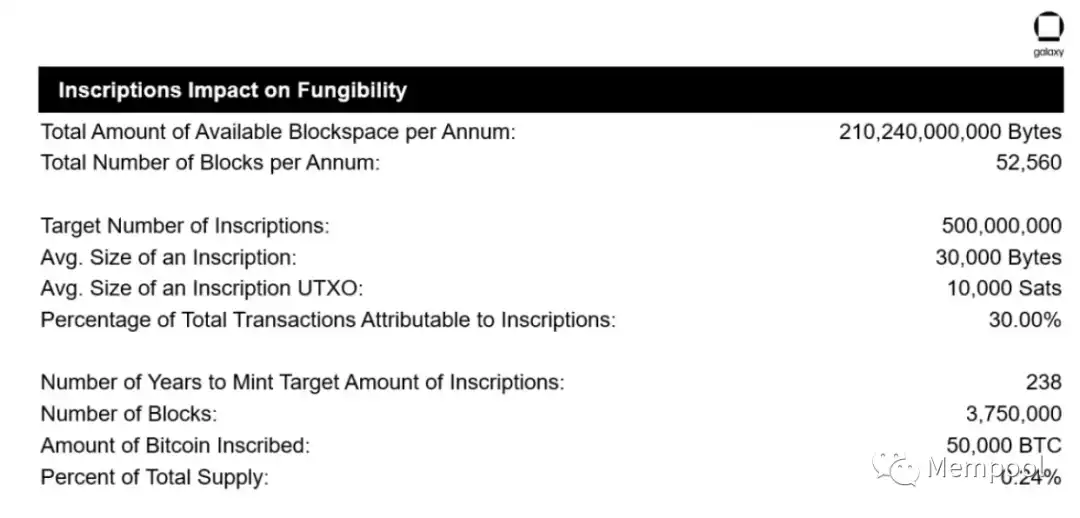
Lightning Network:According to Mempool's guest, Ordinals, far from affecting Bitcoin's function as a currency, could facilitate the mass adoption of Bitcoin's payment Layer 2 lightning network.
For a long time, as a payment system, the transaction speed of Bitcoin has been criticized. The peak throughput of Bitcoin chain is 7 transaction packets per second, compared with the average 1700 transactions per second processed by Visa. How to improve the throughput of Bitcoin isa difficult problem that developers have been trying to solve. It represents increasing the throughput of bitcoin without compromising the security of the Bitcoin network.
Lightning Networks believes that it is better to make transactions disappear than to increase the size of the block, increase the performance of the machine, or make extreme improvements to the code. The idea of the Lightning network is to transfer the user's funds to the channel down the chain for real-time settlement, and the final state will be transferred back to the chain for settlement after the end of the transaction. However, no matter how many times the user trades in the channel, the transaction on the chain only has two steps. For example, Alice has $100 and bought $5 worth of goods from Bob for the first time, leaving her with $95. Buy $35 from Bob for the second time and have $60 left over... No matter how many transactions occurred, Lightning Network recorded the process of those transactions and wrote the final result on the chain, that is, Alice had $60 left and Bob had $40.
According to Mempool guest, Lightning Network has not been a good application scenario for a long time. With the popularity of Ordinals, Lightning network will be further popularized.
4. Ordinals Ecology
Ordinals' emergence will also lead to a boom in infrastructure surrounding Bitcoin NFT, and there's no doubt that this is an opportunity for developers.
Bitcoin native NFT: Out there currently on Ordinals, in addition to TwelveFold released by Yuga Labs, there are Solana chain NFT projects DeGods traditional blue chip NFT projects and, most importantly, There are also projects like Taproot wizard that are entirely derived from the culture of the Bitcoin community.
Bringing wizards to the Bitcoin community started in February 2013, when /r/Bitcoin administrator theymos solicited ideas for community ads. For about an hour, A community member named /u/mavensbot submitted a work called the Magic Internet Money Wizard, which quickly became the most popular idea in the forum and was chosen to be the official poster for the /r/Bitcoin forum. It was posted on Reddit for a while.

The simple brainwashing design of the image generated a lot of traffic to the /r/Bitcoin forum, allowing many people to learn about, buy, and spread bitcoin, which was less than $300 at the time, and quickly became an iconic symbol of the bitcoin community. The Taproot Wizard, recently released on Ordinals, builds on this image by adding elements related to the Taproot upgrade.
At the same time, since Bitcoin NFT has the characteristics of serial number and time, these two characteristics also become the original culture of Bitcoin NFT, and the inscriptions of early serial number and time, it is believed that a unique trading market will be formed in the future.
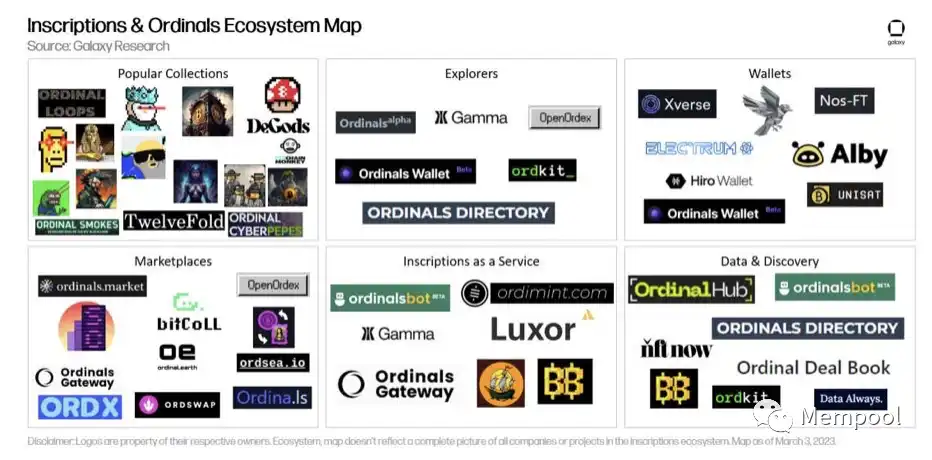
Trading market:In the Bitcoin exchange market, there is no doubt that a platform like Opensea will form, and there are already players like Ordswap, Gamma, OpenOrdex, and Magic Eden.
Browser:The browser is also an important piece of infrastructure, with products like Gamma providing inscriptions data analysis, transfer ids, addresses, amounts, weights, etc.
Inscriptions as a service: For an individual to create an NFT on Ordinals is a bit complicated, requiring a full Bitcoin node to be downloaded and Ordinal software to be installed, so some services like Luxor, Gamma, UniSat, OrdBucks, Ordswap, etc.
Wallet:Wallets, of course, will also be an important infrastructure for Bitcoin NFT, helping users save NFT and even increasing the liquidity of NFT, as developers like Unisat, Xverse, Hiro and others have done.
Overall, we believe that we will see a wave of new infrastructure development for Ordinals in the next 2-3 months and that the current user experience issues will be further resolved.
Original link
Welcome to join the official BlockBeats community:
Telegram Subscription Group: https://t.me/theblockbeats
Telegram Discussion Group: https://t.me/BlockBeats_App
Official Twitter Account: https://twitter.com/BlockBeatsAsia
 Related Articles