Challenges and opportunities for stablecoin management and collateral
Original title: Stablecoin Management and Collateral: The Challenges and Opportunities
Original article by Asad Khan
ChinaDeFi
Stablecoins play a key role in the crypto industry. They are the cornerstone of the crypto economy.
Essentially, stablecoins are on-demand liabilities issued by agreements or entities designed to provide stable price expectations. Stablecoin and its underlying mechanism must ensure the stability of Stablecoin price.
However, managing these stablecoins is a huge challenge, and judging by the management failures that have occurred, they have pushed the boundaries of common sense and brought the field to an important turning point. The Stablecoin market is as competitive as the payment system market, but it is still a platform full of growth and opportunity.
Of course, risk and opportunity always come together. Any successful stablecoin must take risks to compensate for operating costs, pursue a growth strategy and maintain a risk buffer. In the case of unmanaged decentralized stablecoins, this risk is recognized by the assets secured by stablecoins. For stablecoin issuers, the key to their long-term sustainability and continued growth is the balance between these assets and the maturity of their issuing liabilities.
The challenge of stabilizing the currency
Asset Liability management (ALM) is the balance sheet optimization method Stablecoin uses to ensure financial stability, but the Stablecoin field has not yet fully integrated this view. ALM is one of the pillars of the Stablecoin project's success, without which issuers will either take excessive risk or suffer from inefficient capital management, ultimately hampering growth.
The balance sheet is a key tool for growth planning, risk management, and community governance.
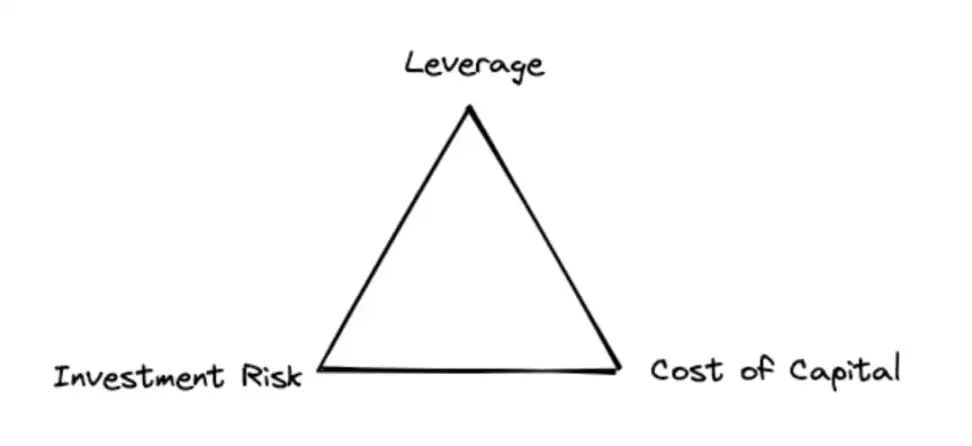
The core business of any stablecoin is balancing users' need for stability with the cost of managing volatility risk. Stablecoin issuers need to solve the optimization problem of maximizing returns and growth under solvency and liquidity constraints.
Essentially, stablecoins are borrowed from savers on demand and lent over a longer period to generate positive returns. The two basic drivers of stablecoin unit economics have to do with the cost of borrowing and the return on the agreed assets. These drivers are contained in variables that must be constantly monitored and managed: explicit and implicit risk, liquidity constraints on zero-term borrowing, and keeping fixed operating costs at safe levels.
Stablecoin balance sheet
The heart of any stablecoin is its balance sheet. While strictly speaking, the on-demand duration of a stablecoin (that is, the point in time at which a unit is issued and redeemed) is zero, the effective nature of this liability will vary depending on the overall user appeal of the Token.
Long-term value participants, such as long-term borrowers or users, constitute the stablecoin market with organic demand (that is, non-incentivised, non-speculative use). The advantage of crypto stablecoins is that this duration can be tracked reasonably accurately in near real time, providing instant insight into liquidity needs and constraints faced by stablecoins. In addition, all of this can be achieved through open source generic tools that enable the community to participate in the analysis and governance of the protocol.
An example of MakerDAO's balance sheet structure:
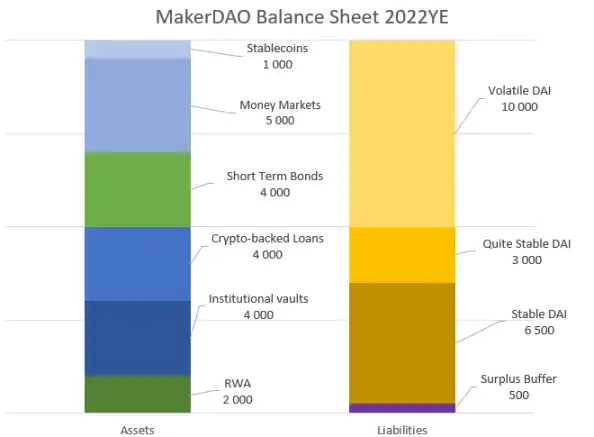
稳定币积累的收入可以作为抵御潜在长尾风险的支撑,用于支持协议扩展到新的增长机会,如果没有更好的替代方案,可以返还给协议的 Token 持有者。当资产的有效存续期与负债的有效存续期正确匹配时,条件就可以最大限度地降低可能危及协议运行的流动性不匹配的风险。这是获得正息差的最低条件。
Asset and liability management is a key tool to ensure these conditions. It involves delving into the nature of user behavior and identifying assets that properly match their duration profiles.
Real World assets (RWA) can help manage the balance sheet risk of Stablecoin
Real world assets offer a unique uncorrelated and diversified yield opportunity for crypto native stablecoin issuers, as stablecoin issuers will have access to the world's largest financial markets and consolidate the productive workflow of financial activity into a source of collateral support.
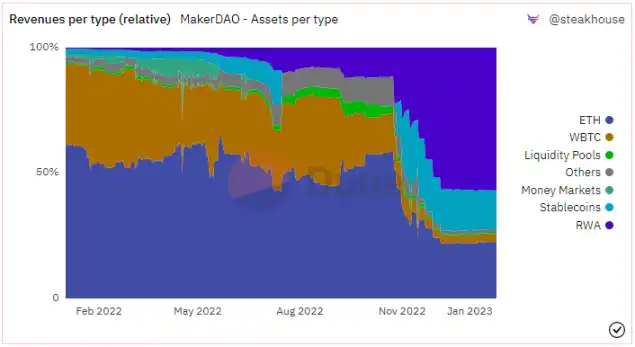
Uncorrelated and possibly inversely correlated revenue streams generate significant gains for the DeFi agreement. In the current conventional financial market environment, we are seeing interest rates rise. But in the DeFi economy, we see interest rates coming down. While MakerDAO is at the beginning of their RWA journey, they have already generated 60% of their revenue from RWA, allowing them to stay afloat and reinvest for growth in a very pessimistic crypto market environment.
Real world assets dominate DAI collateral:
The Stablecoin market is highly competitive, and they will ultimately be measured by three components: utility (how deeply Stablecoins are integrated into the ecosystem), trust (the issuer's brand as a reliable stablecoin issuer), and the returns offered to holders.
We believe that successful adoption of RWA requires a coherent and principled strategy that includes a sound portfolio approach and a commitment to on-chain integration.
Introducing RWA is a portfolio development and management challenge
Introducing RWA collateral requires sufficient financial and legal expertise to ensure that the issuer is protected to the maximum extent possible in the worst case scenario. At a higher level, from the perspective of the agreement itself, the RWA mortgage work is a portfolio development issue.
Portfolio construction is the art and science of putting investment goals into action. For Stablecoins, the RWA portfolio is constructed when allocating stablecoin supply against the infinite possibilities of RWA collateral. Portfolio construction is only one part of the equation and is only useful when paired with relevant inputs from other parts of the financial and operational model, such as organizational goals, expenditure and budget projections, liquidity and liability constraints, risk and operational management, and many other factors. We cannot value and enable any assets in a vacuum.
There are two main approaches to investment decisions: active and passive.
Passive approaches tend to focus on higher-level goals while minimizing asset-level decisions, effectively outsourcing this work to external managers. This looks like a low-fee portfolio of simple index products, typically aimed at the most liquid and least risky assets in the public markets.
A proactive approach can address the intricacies within an investment institution, using internal resources to handle the selection, management and implementation of a broader portfolio strategy. Costly and fraught with risk, the additional flexibility allows for customized strategies that ultimately achieve higher risk-adjusted returns, lower volatility and better overall long-term performance.
Under favorable market conditions, passive strategies are considered to be most effective, providing modest gains at low cost. The challenge is twofold:
- Market conditions are not always favorable, especially given the unique complexity of downchain integration and changing DeFi market sentiment. The resulting balance sheet volatility can be realized in either the revenue yield or the available balance sheet, which can be a challenge for Stablecoin.
- Portfolio returns are one of the few levers of competitive differentiation in a competitive, winner-takes-all currency market.
Active investment strategies are complex, challenging and expensive to implement. Active portfolio management requirements:
- High quality and robust risk management practices must be developed. Compared to simply managing the risk of a small number of assets and transactions, active strategy is resource-intensive and requires an integrated, systematic approach to risk management.
- Achieving differentiated returns beyond the benchmark requires taking risks and taking a long-term view.
Any strategy that involves investing outside the core business, where RWA usually falls, requires a combination of the right resources, products, and partners. RWA investments must be implemented within a coherent strategy that acknowledges the trade-offs and challenges of the chosen approach.
Bringing assets onto the chain must be a key aspect of RWA's strategy
For protocols and stablecoins, a native representation of on-chain assets and investments should be a basic requirement. Although investments can be made through off-chain channels, there are significant advantages to integrating RWA locally.
Example of available on-chain data for the New Silver portfolio on Tinlake:
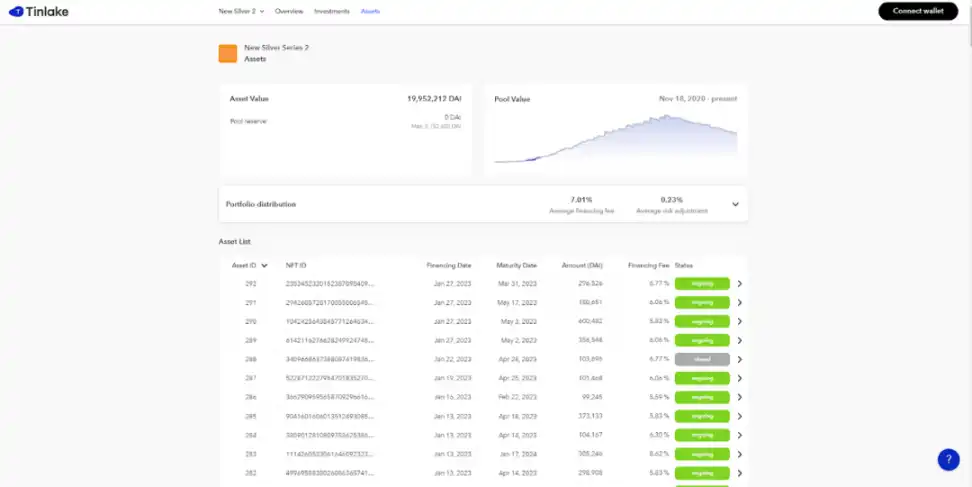
On-chain assets representing off-chain assets have three main advantages:
On-chain representation greatly improves existing trust assumptions. Being able to claim and represent ownership in the protocol's native ledger is a key advantage over an off-chain escrow account.
The transparency of public and decentralized books provides critical information about the accounting, status, and presentation of investments and collateral. Moving as many complex real-world processes and operations as possible onto the chain is a key component of long-term value realization and effective risk management.
Leveraging the composable interoperability of on-chain assets, services, and providers is a superior long-term business model for Stablecoin. The ability to integrate asset portfolios directly into on-chain systems and processes is one way in which the governance, management, and execution of RWA transactions can extend to protocols.
Real world assets can be an important part of Stablecoin's balance sheet, requiring an on-chain approach to realize value and effectively manage risk over the long term. This requires dedicated functionality, preferably provided by a strong ecosystem of service providers and contributors.
Original link
Welcome to join the official BlockBeats community:
Telegram Subscription Group: https://t.me/theblockbeats
Telegram Discussion Group: https://t.me/BlockBeats_App
Official Twitter Account: https://twitter.com/BlockBeatsAsia