The rise of Damus is a boost to the lightning network
Original title: The Rise of Damus, a Boost to the Lightning Network
Original article by Evie.eth, SevenUp DAO
Abstract
l Satoshi Nakamoto had the idea for a payment channel when he created Bitcoin in 2009 and included a draft of the code for it in Bitcoin 1.0. In the years since, the implementation of payment channels and lightning networks has been pushed forward by geeks in the Bitcoin community, even if it is a long and difficult road to fulfill the original purpose of Bitcoin -- to build a peer-to-peer electronic cash system.
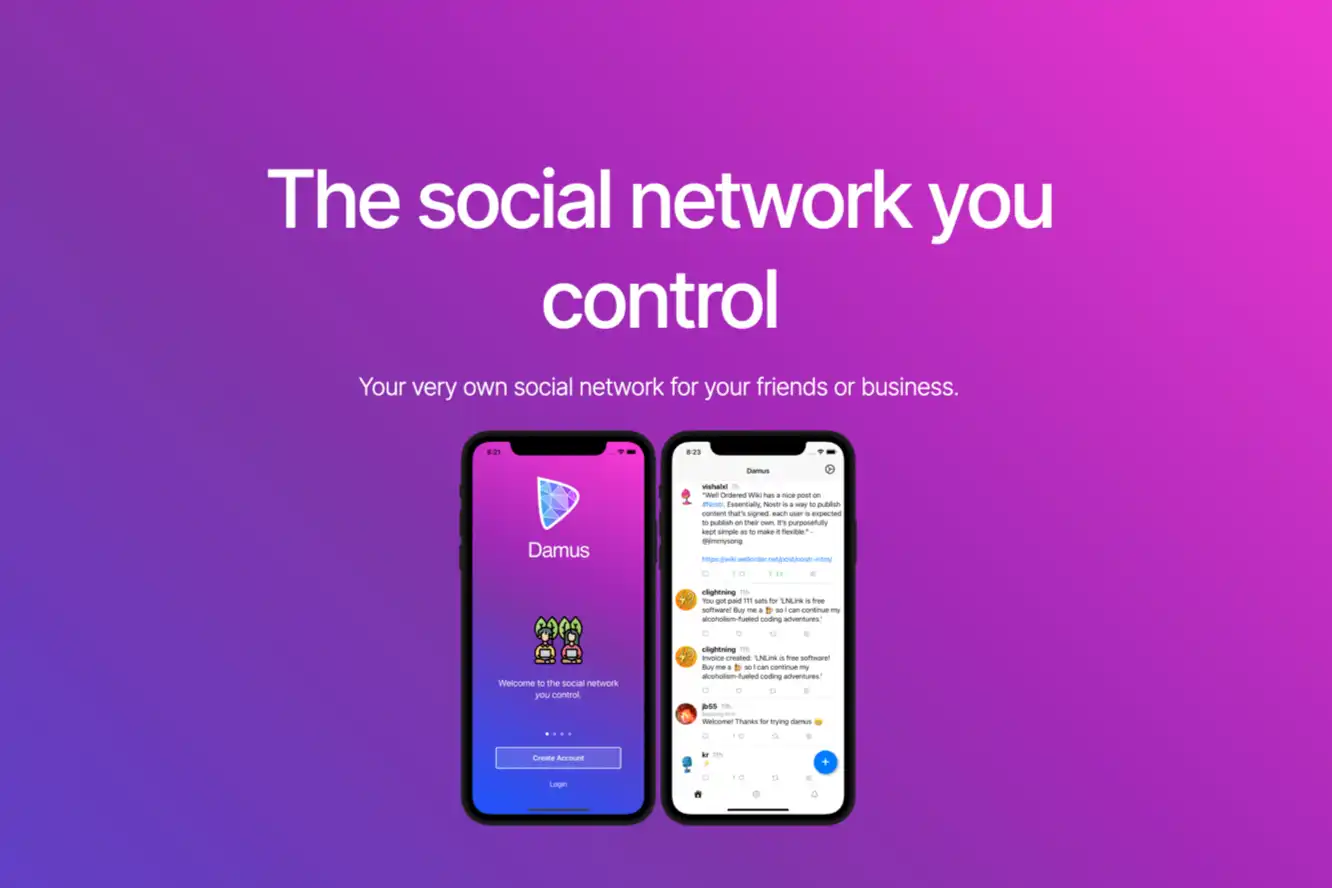
l Twitter founder Jack said it was only a matter of time before Lightning Network was integrated into Twitter or BlueSky, and announced in 2021 that Twitter could support third-party Lightning Network tipping services. Damus, a popular decentralized social app, has once again drawn attention to the lightning network with its built-in Bitcoin payment function.
l Lightning network puts the transaction link down the chain, and only the final transaction result is confirmed on the chain, thus improving the transaction efficiency of the Bitcoin network and enabling users to complete the payment at a lower cost and faster speed.
l The use cases of Lightning network include social platform tipping payment, cross-border remittance, merchant payment, transfer transaction, etc., which can meet the needs of diversified payment scenarios.
l After El Salvador legalized bitcoin in 2021, the number and amount of payments on the Lightning network rose rapidly. As of February 8, 2023, the Lightning network had 16,000 nodes, nearly 77,000 payment channels, and 5,356 Bitcoins (about $124 million).
l In 2022, the Lightning network sector also saw a number of large funding deals, with top institutions including a16z and Paradigm investing in related projects.
l Of course, there are still many challenges before Lightning network becomes universal, and there is still a long way to go to get users to accept cryptocurrency payments at a psychological and behavioral level, and to build a large payment network based on users. However, more optimistically, Lightning network has already had many real and effective use cases. Under the joint construction of Strike and Lightning Labs, as the technology continues to mature and the application scenarios continue to be rich, perhaps one day Lightning network will be to Bitcoin what Visa is to currency.
directory
A, What is Lightning Network
Two, Why do you need Lightning networks
Three, What is the status of the Lightning network
Four, How will Lightning network develop
Reference article
A, What is Lightning Network
Lightning Network is Bitcoin's Layer2 solution, designed to enable users to pay with Bitcoin at a lower cost and faster speed in a decentralized situation.
1. Development course
The original concept of the Lightning network, called the "payment channel," was designed to use transaction replacement to update the status of unconfirmed transactions until they were broadcast to the Bitcoin network. Satoshi Nakamoto had the idea for a payment channel when he created Bitcoin in 2009, and included a draft code for a payment channel in Bitcoin 1.0 that would allow users to update transactions before they were confirmed by the network. In 2013, Mike Hearn expanded on Satoshi's idea of a payment channel in a Bitcoin development email group.
In the years that followed, there were solutions, but they didn't make much of a difference. Until February 2015, a white paper by Joseph Poon and Thaddeus Dryja -- "The Bitcoin Lightning Network: Scalable Off-Chain Instant Payment ". At this point, the lightning network was born.
Figure 1: Lightning Network Whitepaper authors speaking at Scaling Bitcoin Montreal
Image source: https://www.youtube.com/watch?v=TgjrS-BPWDQ& t=2519s
In December 2015, Gregory Maxwell presented a roadmap of expansion solutions in a Bitcoin developer email, which prominently included the Lightning Network. The roadmap has the support of much of the Bitcoin technology community and is being implemented within the Bitcoin Core project. This has aroused everyone's expectations for the Lightning network.
Then, enthusiastic developers built BOLT, the Lightning network's protocol stack. Based on this standard, the Lightning network is compatible with Bitcoin, Litecoin (or other Bitcoin-like tokens).
In March 2018, Lightning Labs released a beta version of its Lightning Network implementation solution with features that can be used by early adopters, marking a milestone in the development of Lightning Network. Lightning Labs also announced a $2.5 million seed round of funding from investors including Twitter founder Jack Dorsey.
Since then, the protocols and applications related to Lightning network have gradually become rich, such as OmniBOLT, an enhanced version of the BOLT protocol, Cash APP, a payment platform that can support Bitcoin Lightning network, and Strike. After the launch of Damus, Lightning Network once again ushered in a new breakthrough...
2. Implementation mode
The core idea of Lightning network is not complicated, that is, the transaction link is carried out under the chain, and only the final transaction result is confirmed on the chain, so as to improve the transaction efficiency of the existing Bitcoin network. Its operation mode is as follows:
l The two parties to the transaction establish an off-chain payment channel at the time of the first transaction, which is essentially the bookkeeping book to be held by both parties to keep transaction records. Both parties lock a certain amount of money into the channel and then sign the transaction using a private key.
Figure 2: Running logic of the Lightning network
Image source: https://www.youtube.com/watch?v=FOT6NqaEtfc
l Money transfers between the two parties do not take place on the chain, but are kept only in each other's books, and when one or both parties decide that the channel is no longer needed, the balance settled is broadcast on the main network.
Figure 3: Running logic of the Lightning network
Image source: https://www.youtube.com/watch?v=FOT6NqaEtfc
l But a lightning network is not just a direct connection between two parties. It allows a large number of single channels to be connected in series to form an interconnected, vast payment network (see chart 4). In other words, if C and A have channels, C and B have no channels, but A and B have channels, then C can indirectly transact with B through A, and A, as an intermediary, can charge routing fees. In a lightning network, the network will find the path with the fewest nodes and transaction fees to complete the transaction.
Figure 4: Lightning network running logic
Image source: https://www.youtube.com/watch?v=FOT6NqaEtfc
Two, Why do you need Lightning networks
1. To speed up transactions:
While the Bitcoin network can currently perform a maximum of seven transactions per second, increased use of the network can lead to delays in transaction confirmation, which is detrimental to users' payment experience, Visa can perform thousands of transactions per second.
As the transactions in the channel of lightning network payment are all under the chain, only smart contracts are needed to execute, without the whole network confirmation, so the processing efficiency is greatly improved. In theory, the lightning network could handle millions of transactions per second.
Figure 5: Comparison between Lightning network and Solana et al
Image credit: Blockstream
2. Lower transaction threshold:
Lightning network can use the smallest unit divided by a single bitcoin -- Cong to pay (1 bitcoin = 100 million cong 1 cong), which meets the needs of daily small payments, but at the same time, people should pay attention to the conversion of units when transferring money in Cong.
3. Reduce transaction costs:
Bitcoin block space is a scarce resource, requiring users to bid against each other to ensure that their transactions are included in the block space in a timely manner. For miners, higher-fee deals are bound to be included first. If not many users are doing the transaction, the fee can be set very low, so that the transaction may be included in the next block, but if many people are doing the transaction at the same time, the fee can increase significantly.
Bitcoin transaction fees are currently around $1.50, compared with over $60 at the market's peak in 2021 (see chart 6). This is acceptable for thousands of dollars of transactions, but not for small, everyday purchases such as coffee.
Visa and mastercard charge 2 percent to 3 percent per transaction, while Lightning charges no more than 1 cent on a $100 transaction. The Lightning network has made it economical to use Bitcoin as a daily payment by dramatically reducing transaction costs.
Figure 6: Transaction fees for Bitcoin
Source: https://bitinfocharts.com/zh/comparison/bitcoin-transactionfees.html#3y
Three, What is the status of the Lightning network
1. Data presentation
After El Salvador legalized bitcoin in 2021, Lightning network was used more and the number of BTCS in the channel also increased rapidly (see Figure 7). As of February 8, 2023, the Lightning network had 16,000 nodes, nearly 77,000 payment channels, and 5,356 Bitcoins (about $124 million).
Figure 7: The number of BTCS in the lightning network
Source: https://river.com/learn/files/river-lightning-report.pdf
Lightning network channels are mainly concentrated in the United States, Canada, Germany. The US alone accounted for 30.15% of the total number of channels, while in Asia, Singapore alone accounted for a relatively high number of channels (1.644%). Due to the minimal use of lightning network in Asia, there is a poor understanding of lightning network between East and West.
Figure 8: Lightning network nodes and channels worldwide
Image source: https://explorer.acinq.co/
2. Usage scenario
Building on the maturing technology, payment and social giants are driving the popularity of lightning networks. The current lightning network usage scenarios include:
a) Social platform payment and tipping: Damus, which is popular recently, supports lightning online payment and tipping functions. Users can choose to use dozens of wallets such as Strike, Cash App and Blue Wallet.
b) Cross-border money transfers: Digital payment platform Strike announced its partnership with Send Globally in January 2023, enabling lightning networks to enable fast, secure and low-cost money transfers between users in the United States and the Philippines. By sending Globally, dollars can be converted into bitcoin, sent via a lightning network to a third-party partner in the recipient's country, converted into local currency and sent directly to the recipient's account.
c) Merchant payments: Strike partnered with Shopify, Blackhawk Network, and NCR to build a Bitcoin payment system that allows merchants to quickly receive dollars after customers pay with the cryptocurrency. McDonald's, CVS, Walgreens, Whole Foods and Walmart are among the merchants that currently support the payment system.
d) Money transfers: Jack Dorsey-led payment company Block's Cash APP allows bitcoin to be sent and received over a lightning network.
3. Convenience of use
For ordinary users, it is easy to recharge and pay through Lightning-enabled wallets. Take Phoenix, a popular unmanaged wallet that automatically creates payment channels for users. Phoenix charges 1% and about 3,000 cong to create the channel, but it's free if you pay with an existing channel.
In addition, it has call-in and call-out functions, allowing users to seamlessly send and receive transactions on the chain. In addition to Phoenix, other applications supporting lightning network payment include Blue Wallet, Muun, Strike, Cash App, etc. (see Figure 9). These applications have also been continuously optimized and iterative in recent years, greatly lowering the threshold for users to use lightning network.
Figure 9: Payment methods that support Lightning networks
Image: file:///Users/xiayiwei/Downloads/the-state-of-lightning-volume-2.pdf
4. Investment and financing
In 2022, the Lightning network sector also saw several large funding deals, with top institutions including a16z and Paradigm investing in related projects:
a) In April 2022, Lightning Labs, a company focused on bitcoin business, completed $70 million Series B funding, led by Valor Equity Partners.
b) In May 2022, Lightspark, a bitcoin lightning network founded by Meta's head of cryptocurrencies David Marcus, closed a funding round led by a16z and Paradigm.
c) In September 2022, Strike, a crypto payment app based on the Bitcoin Lightning network, announced it had raised $80 million in Series B funding.
Four, Problems existing in the development of lightning network
As for the defects of lightning network, there are opinions on the network that its node operation may become centralized, routing may encounter liquidity problems when the channel capacity is high, etc., but lightning network is still in its very early stage, and it is quite normal to have some problems and deficiencies, and related infrastructure and ecology are being improved. As long as lightning network is valuable and meaningful, And there are real user needs, we can give it a little more patience.
Of course, user education is a big challenge in terms of the popularity of the Lightning network, and there is still a long way to go to get users to accept cryptocurrency payments psychologically and behaviorally, and to build huge payment networks based on users.
5, How will Lightning network develop
Overall, the Lightning network opens up new ways for Bitcoin to be used for everyday payments, as well as for Bitcoin's original intention to be a "peer-to-peer electronic cash system." The Lightning network is still in its early stages, having struggled from the time it was proposed to 2018. On the more optimistic side, Lightning Network has grown rapidly since 2021, gradually building consensus among the user community and expanding the use cases that actually work.
Damus, as a decentralized social app, supports the Lightning network, allowing users to make payments and tips within the app, which could effectively foster the habit of using Bitcoin to make small payments. In addition, Strike, Lightning Labs and others continue to promote the development of Lightning network.
Perhaps one day Lightning Network will be to Bitcoin what Visa is to currencies.
Reference article
The State of Lightning
file:///Users/xiayiwei/Downloads/the-state-of-lightning-volume-2%20(1).pdf
Insights From the 4th Largest Lightning Network Node
https://river.com/learn/files/river-lightning-report.pdf
What is the Nostr-supported Bitcoin Lightning network tipping and how can it be used to make small payments?
https://www.theblockbeats.info/news/34244
Lightning Network - History and Reality
https://mirror.xyz/bitcrab.eth/T3gIfKepjfs3YUiRWTgCTqS6gc8LaC5z7lYKQY-HLEE
History of the Lightning Network: From Brainstorming, to Beta versions
https://www.btcstudy.org/2020/09/03/history-lightning-brainstorm-beta/#%E9%97%AA%E7%94%B5%E7%BD%91%E7%BB%9C
A quick overview of the current situation of Bitcoin lightning network: large amount of financing is frequent, ecological construction is taking shape
Locking Bitcoin past 5000 milestone, Lightning network may be seriously undervalued
https://news.marsbit.co/20221014134404738571.html
What is the Bitcoin Lightning Network?
https://www.youtube.com/watch?v=FOT6NqaEtfc
Original link
Welcome to join the official BlockBeats community:
Telegram Subscription Group: https://t.me/theblockbeats
Telegram Discussion Group: https://t.me/BlockBeats_App
Official Twitter Account: https://twitter.com/BlockBeatsAsia
 Related Articles