Web3 series of public interest course review - blockchain basic notes complete
The original title: "MoleEdu | Web3 series public class review - block chain base notes of
MoleEdu
Moledao and OGBC's Web3 series finally started on January 16, 2023. Week 1 was Web3 Infrastructure Week, covering blockchain basics, Ethereum, and Layer2, Layer0, storage.
In the first two classes, Tutor Duke brought us a detailed explanation of "blockchain Basics", which was full of dry goods. The course videos of the two classes have all been uploaded to bilibili of Moledao:The week of the first week: infrastructure & have spent | & have spent block chain based on screen"
Now, let's review what we have said in the last two classes.
Tutor introduction
Tutor Duke is a 5-year veteran Web3 developer, Tech Lead of Defi team of Bybit Exchange and technical consultant of Moledao. He is also one of the first batch of blockchain evangelists in China and has trained nearly 1,000 blockchain students. He is currently based in Singapore, focusing on overseas Defi, DEX, Metaverse and other business directions.
Learning harvest
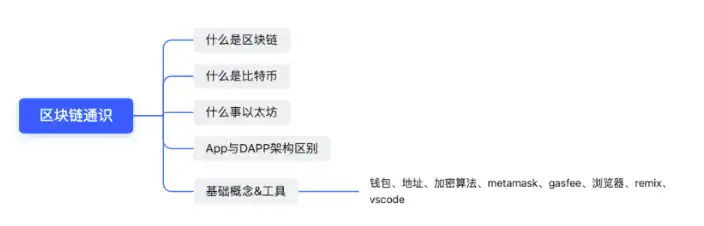
Blockchain Basics : Blockchain, Bitcoin, Ethereum, Hash algorithm, encryption algorithm, consensus mechanism. Wallet related knowledge : Private Key, Address, Wallet Classification, cex and dex, Future Trend of Wallet Smart contract knowledge : Smart Contract development will be supplemented in Weeks 7 and 8, when Tutor Duke will introduce the development knowledge in detail
Learning path
Ethereum Learning (800+star) :
https://github.com/dukedaily/solidity-expert
Bitcoin learning:
https://github.com/dukedaily/go-bitcoin-demo
The above links can help us learn to write a basic bitcoin with go. Through this learning mode, we can have an in-depth understanding of blockchain-related knowledge and strengthen our go language ability.
So let's begin our formal review of the course.
01 Overview of blockchain
1. blockchain
Blockchain is a very general concept. Blockchain can be understood as a car, and Bitcoin and Ethereum are different models.
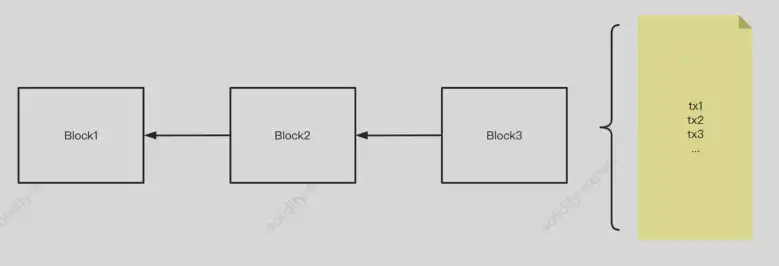
The deal:In the blockchain world, we refer to all interactions (buying something, voting, transferring money) as a single Transaction, Tx.
Block:There are N transactions in a specific period of time (say, 10 minutes), which we package together and call blocks.
Transactions are packaged into a data structure called a block.
Blocks are generated over a fixed period, 10 minutes for Bitcoin and tens of seconds for Ethereum
Blockchain:Over a longer period of time (say 60 minutes) many blocks are created, and when we link these blocks together according to certain rules, we call them Blockchain.
1.1 & have spent Hash Algorithm
The Hash is the fingerprint of the content, corresponding to the content one by one!
There are many kinds of hashing algorithms, but the most widely used algorithm in Bitcoin and Ethereum is SHA256. You can try the hash algorithm online at the following link. Online presentation: https://emn178.github.io/online-tools/sha256.html
There are four main uses of Hash in blockchain:
Connect blocks back and forth
- There is only one hash value for different contents, which is unique
- The hash value generated by the previous block is stored in the later block so that the latter block can find the previous block
- So blocks can be hashed to create a logical connection
Connect the private key to the address: private key -> Public key -> address
- The three are related one by one, one-way irreversible
Quickly validate transactions
1.2 & have spent Hashing algorithm characteristics
The hash algorithm is an important element of blockchain technology. And it is because of the following characteristics, hash algorithm became popular:
▪️ uniqueness
Only one hash value can be generated by a hash algorithm for a content.
▪️ Collision resistance
The same hash value cannot (theoretically) be generated by two different things.
▪️ irreversibility
It is not possible to extrapolate backwards from a hash value to what was born into that hash.
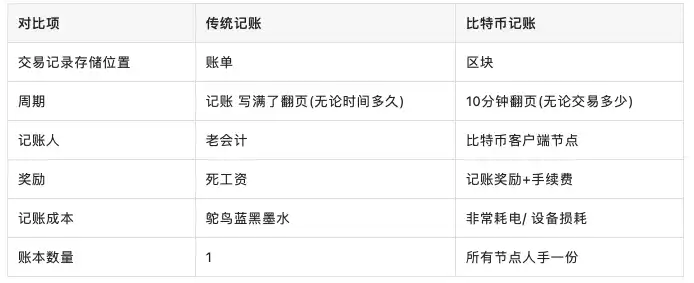
1.3 & have spent The bookkeeping method is compared with traditional bookkeeping method
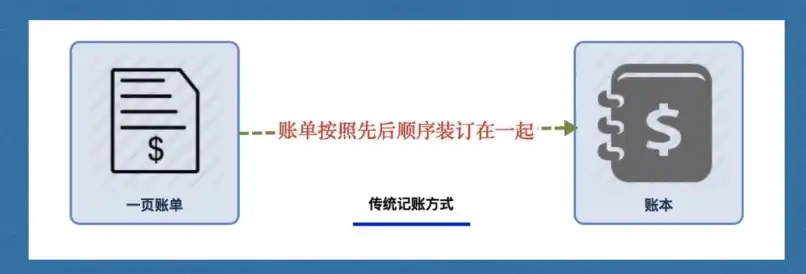
When one page is full, move on to the next
Bills are bound together in order of precedence in blockchain accounting
Blockchain accounting method

For a fixed period of time, a new block is generated regardless of the data in the block. It's strongly bound to time.
Comparison of accounting methods
1.4 & have spent Blockchain operation rules
The following will introduce the rules of blockchain, but first, we need to understand the basic concepts of blockchain, so that you can better understand the operation process of blockchain:
Transaction signature
With a private key, you need a signature to initiate a transfer, just like a bank enters a password
Peer-to-peer (P2P) networks
Any node can hold (store) the complete ledger, independent of the central node
Miners, mining, arithmetic
Around the same thing: who packages the transaction after it is sent to the blockchain (and gets the billing rights);
Only those who obtain the bookkeeping right can get token reward.

In the image above, for a particular block, the hash value has been determined, and the miners need to calculate the value of this random data. The random data is spliced with the hash value of the block, and then a hash value is calculated by SHA256 algorithm, and the hash value is compared with the target hash value. The target hash value is dynamically adjusted with the number of miners in the network to ensure that blocks can be generated within a fixed period of time.
1.4.1 Blockchain rules
For a specific blockchain project, there are specific rules for the generation, link, synchronization mode, synchronization time, etc., which can be generally described by the following figure.
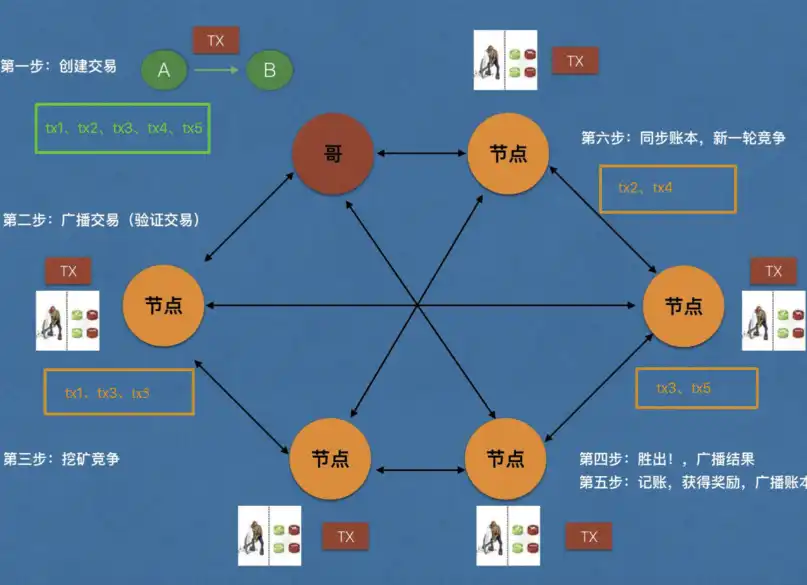
Step 1: The user creates the transaction (transfer, etc.), private key signature
The transaction creation process is essentially the initiator signing the transaction with the private key.
Step 2: The miner verifies the trade, packages it into the local trade pool, and broadcasts the trade
These transactions are picked up by the Bitcoin network and checked locally by the node receiving the transaction.
After the verification is successful, the transaction will be broadcast again. After receiving the transaction, other nodes can also verify the transaction and broadcast the transaction after the verification is successful.
Different node packages may have different transactions, and nodes can make choices.
Step 3: When the next accounting cycle begins, the mining competition begins
The mining process is to try to calculate the target hash value based on the block data and random data.
Step 4: Miner A mining success, the whole network broadcast
At some point A miner (A) successfully calculates the target hash value, and then broadcast the whole network. The other miners stopped counting. Step 5: Multiple miners confirm the mining transaction. Step 6: Miner A gets the mining reward and synchronizes the ledger of the whole network. Then the whole calculation process is repeated.
1.4.2 Verifying Transaction Logic

Verification success: The data transferred by A signed private key to B is valid. The process involves looking forward through the Bitcoin system to check whether A has the money and is using his own money. Packaging is performed only after the verification is successful.
2. bitcoin
Bitcoin was born in 2009 and was initially implemented based on C++. Its functions are very pure: it is only used for transfer, and it is basically impossible to do secondary development on it. For example, it is impossible to develop a DAPP(decentralized application) based on Bitcoin.
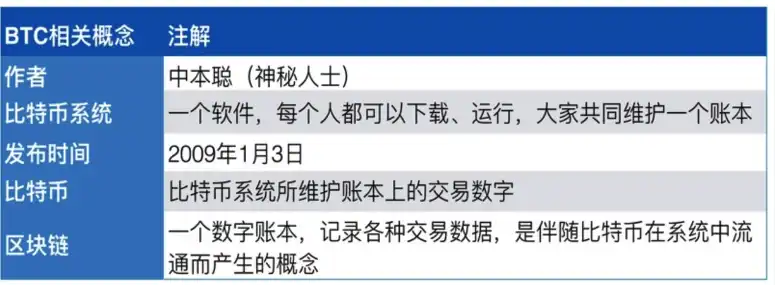
This is also why Ethereum, the blockchain project, emerged later. The existence of Ethereum makes up for the problem that bitcoin cannot be developed again, but this is also the original intention of Satoshi Nakamoto (the creator of Bitcoin), we do not engage in those flashy functions, focus on finance, security and stability. Online demo demonstrates Bitcoin Basics (ledger):
Demonstration:
https://andersbrownworth.com/blockchain/hash
Demo difficulty value:
00010000000000000000000000000000000000000000000000000000000000002.1 blocks
2.1 Block
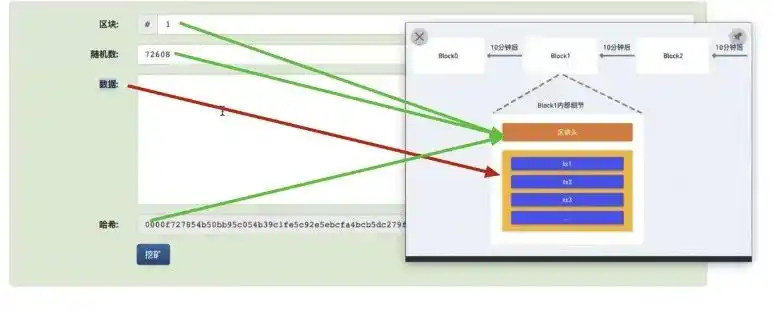
In the figure above, the data is the data stored in the block (transaction records). Blocks, random numbers, and hashes are all related to block headers.
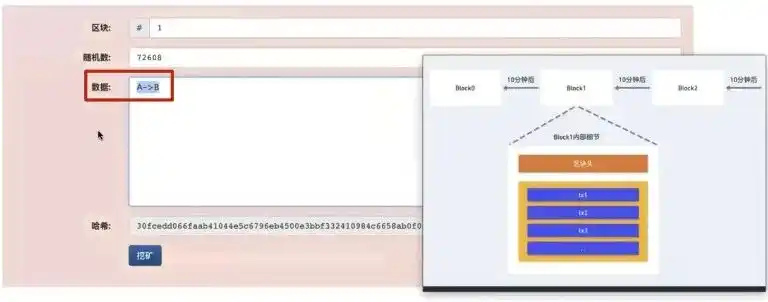
After changing the data, the page background turns red, which means that the random number and the hash value do not match at this time.
After clicking Mine, a new random number (13713) is calculated. The calculated hash value is also smaller than the difficulty value (because the hash value starts with 00008 and the difficulty value starts with 0001, so the hash value is considered smaller than the difficulty value).
2.2 Blockchain
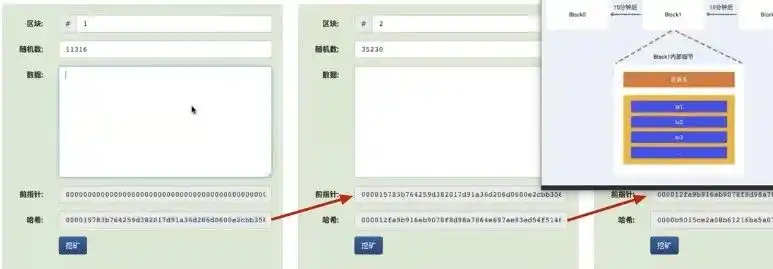
The diagram above illustrates how blockchain is connected. In the figure, the "former pointer" represents the hash value of the previous block, which is recorded in the block header of the latter block. The hash value generated by the previous block is based on all the data in the previous block. So if any information in the previous block is changed, the hash value of that block will also change. The hash value of the previous block is recorded in the header of the latter block. So if the data in the previous block changes, the hash value of all subsequent blocks should change. But since no subsequent block changes, the chain is broken and discarded by the system. In this way, blockchain is immutable.
2.3 Distributed
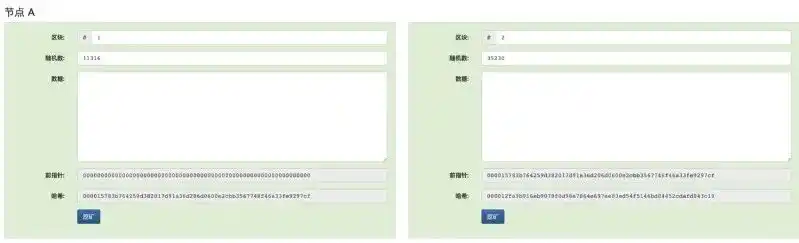
All the nodes record the transaction, meaning the transaction is distributed on exactly the same ledger on different nodes. If one ledger fails, the ledger is discarded, making it harder to tamper with.
2.4 coin based transaction
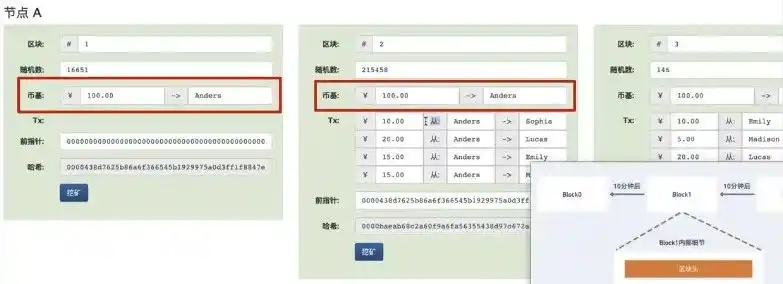
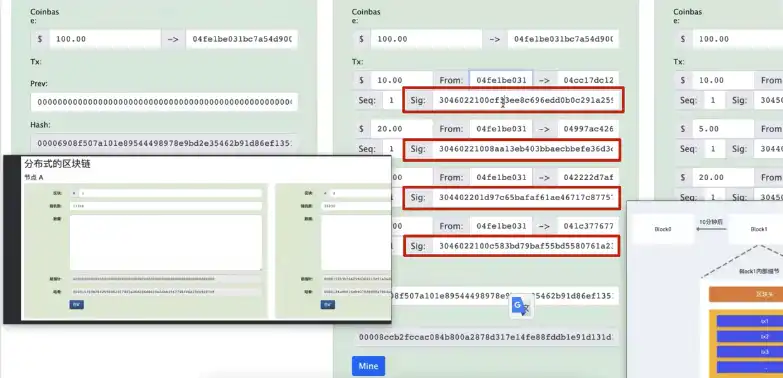
2.5 Demonstration of Advanced Bitcoin (Signature)
Demonstration:
In the advanced stage, each transaction in the block involves a user signature (marked by the red box in the figure), which is demonstrated after the wallet address is explained.
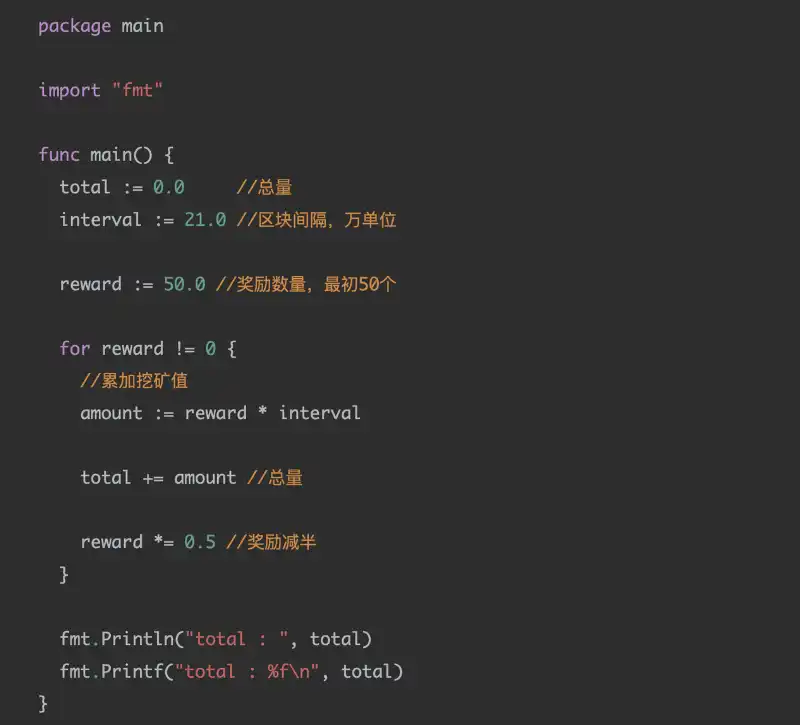
Bitcoin was designed for financial transfers and has no more sophisticated functions. The 21 million bitcoins in total will be reduced every four years (i.e. the mining reward will be halved) and will be mined out by about 2140. The total number of bitcoins will be calculated as follows: totalBTC.go
3. Ethereum
In the early days of Bitcoin, only a small circle of people knew about it. When you look at Bitcoin, it's pure. It's a financial transfer system. Four years later, a Russian guy named Vitalik Buterin, inspired by Bitcoin's design, first proposed the concept of Ethereum in 2013 and positioned it as a world-class computer on which programs can be run. Ethereum is the next generation of cryptocurrency and decentralized application platform, and heralds a new era.
3.2 Bitcoin vs. Ethereum
Functional positioning is different: BTC (Bitcoin) is designed for financial transfers, Ethereum is an operating system that can run programs (world class computers).
Different account systems: BTC and Ethereum have completely different account systems, and Bitcoin is the change mechanism (for example, you have a 100 yuan bill and a 50 yuan bill in your wallet). To buy 30 yuan of food, you just give out 50 yuan notes and receive 20 yuan change. Ethereum is an account system (similar to a banking system, that is, if you have 150 yuan in your account, after you buy 30 yuan of food, your account balance is 150 yuan minus 30 yuan, so you have 120 yuan left. The amount is deducted from the total account balance).
Functional positioning comparison
Bitcoin itself is valuable digital gold, dedicated to finance.
Ethereum ETH itself is not for financial transfers. The main purpose of Ethereum is to support program calls (such as calling smart contracts), during which a fee is generated, which can only be paid by Ethereum. ETH is valuable because it is required to pay the gasfee for calling the contract.
Comparison of account models
UTXO: unspent transaction output. The output is the btc held by the user, which is equivalent to change.
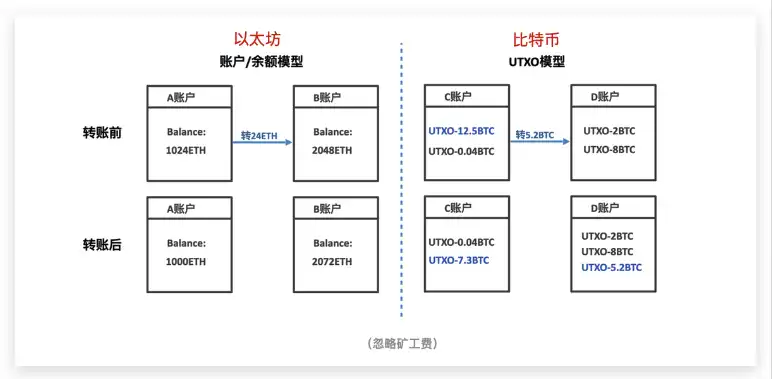
As shown in the figure above, 0.04BTC does not pay 5.2BTC, so the system calls 12.5BTC UTXO to pay 5.2BTC, and the 7.3BTC change is recorded as another UTXO.
4. Public chain chain | | alliance private chain
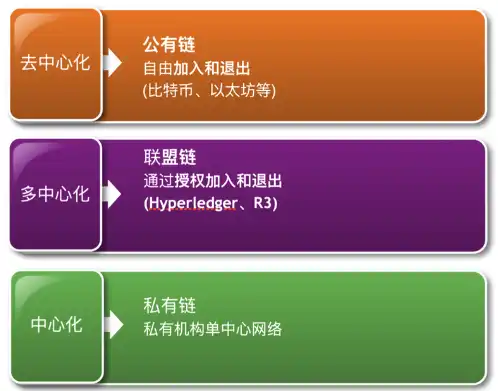
Bitcoin and Ethereum are public chains. Now the market development trend is public chain is king, alliance chain and private chain has no market. Here Tutor Duke has prepared a demonstration of the private chain for you. You can check out the article and try it yourself.
Run the geth demo, genesis.json
https://www.jianshu.com/p/c66b74d9dc355. Consensus mechanism
5. Consensus mechanism
5.1 POW:Proof of work
It means that you have done something. The process of obtaining the result is tortuous, but the verification is easy.

The calculation process is shown as follows: (online tool demonstration)
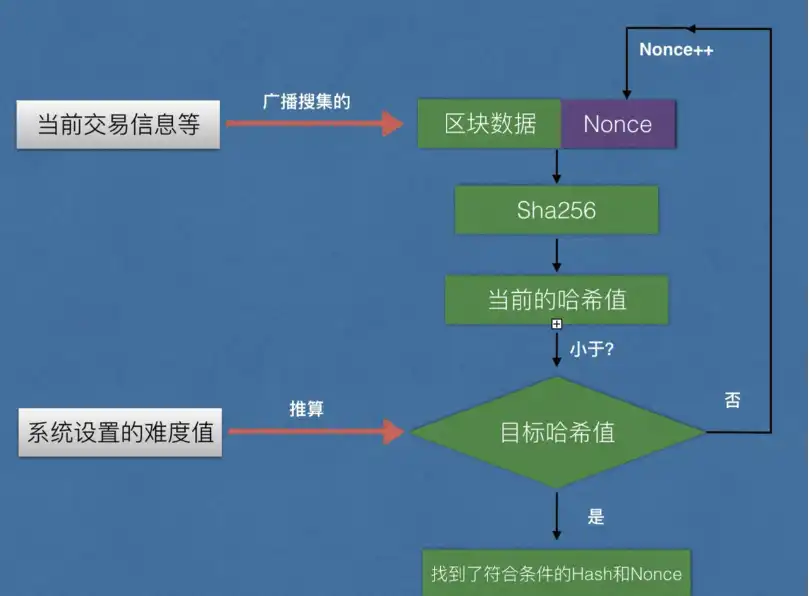
Violent computing, not very green (consumes a lot of power, also burns chips)
5.2 POS
Proof of Stake. On September 15, 2022, Ethereum converted from pow to pos in preparation for the subsequent Ethereum 2.0.
POS benefits
- Energy saving (save computing)
- Increased transaction throughput (POW may only have tens of hundreds of transactions packaged at a time, compared to the millions of transactions per second on a system such as VISA)
POS characteristics
-slot: indicates a slot with a fixed block output time every 12 seconds.
-epoch: Each 32 slots form an epoch(6.4 minutes /epoch).
- If a user wants to participate in the Consensus network, he/she needs to pledge 32 ETH and then wait for a special transaction to add it to the verifier collection (by pledging 32 Ethereum, he/she becomes a verifier);
- Before each epoch, the verifier set will be evenly distributed into 32 slots through VRF, and a block proposer will be randomly selected from each slot. In each slot, the proposer generates blocks, and the verifier subset assigned to the slot validates and votes the blocks;
- In POS mode, block generation no longer requires computational power, but is randomly assigned
-POW: probabilistic certainty, POS: final certainty
-POS is an important link in Ethereum's development (due to increased throughput) and is a pre-condition for capacity expansion, combined with L2. After capacity expansion is completed, the ether will be more friendly to the people.
In-depth understanding of pos
https://news.marsbit.co/20221008222518399952.html6.
Other concepts
Forked, double flower, detailed introduction
bifurcation
Nodes may mine blocks at the same time, so the system waits for the next block to appear and then recognizes the longest chain.
The system may also roll back due to a human attack, at which point forking may be called
Double flower
To spend the same money twice, the condition is that the computing power exceeds 51% of the whole network (POW) or the currency pledged exceeds 51% of the whole network (POS).
Transfer the money to yourself based on the previous block of the transfer. Because the arithmetic is so strong, the money transferred to myself will become the longest chain, so that the money is spent twice.
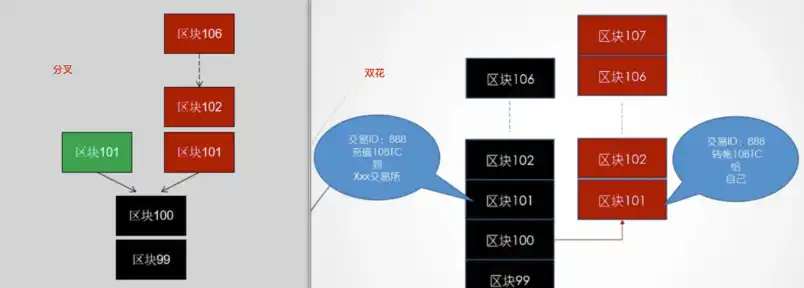
Details: https://zhuanlan.zhihu.com/p/94500557
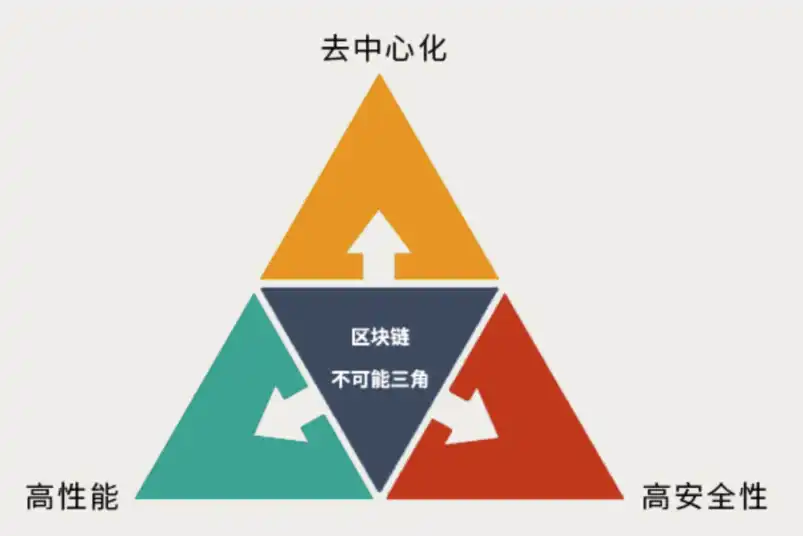
Impossible Triangle: High performance, decentralization, high security
To be secure, you need to decentralize. But that requires a consensus, and that's not very attractive. And because everyone wants to make decisions, performance can't be high. It's possible to satisfy at most two of the three.
02 Wallet
1. The private key | address
The most commonly used is the Metamask.
The approximate logic of address generation is: random number -> Private key -> Public key -> A series of algorithms such as public key hashing -> address
The address can be understood as the account number, which can receive and give money.
The wallet is used to keep the private key, that is, the money
demonstration
https://andersbrownworth.com/blockchain/public-private-keys/keys
The following links demonstrate the Bitcoin public-private key generation process

All calculations are one-way and irreversible, so security is high as long as the private key is not compromised.
The core of ensuring security is that the space of random numbers is large enough; otherwise, it will be brute-force cracked and security events will occur.
Address generation online tool
https://www.rfctools.com/ethereum-address-test-tool/
# privateKey: A4657617423513817844D8BB5BAD89C1B9C1499D1E94875DC325BEA53526BDB4
# publicKey: f91339a26b4cb0059642665f46369c3569fc26597694aff84d908de5b4833b24ab5aad66b23f43ae3607aa9278f9829a7719fd9702493a789067fa8c 7c0d98f6
#address: 0xA8AdDb283a2AcdAc6DdE3Aa44e054A00836CCf0A
2. Layered deterministic wallet | mnemonic word
However, as shown in the picture above, private keys are hard to remember, so the "one private key manages all private keys" management model is born.
That is, all private keys are derived algorithmically from one private key. That's where wallets are going.
Now basically use the layered deterministic wallet, also known as HD wallet, evolution history is :BIP32 -> BIP39 -> BIP44.
Layered Deterministic Wallet for online experience
https://iancoleman.io/bip39/#chinese_simplified
BIP32: Introduces wallet layering, where one private key is derived from N multiple private keys.
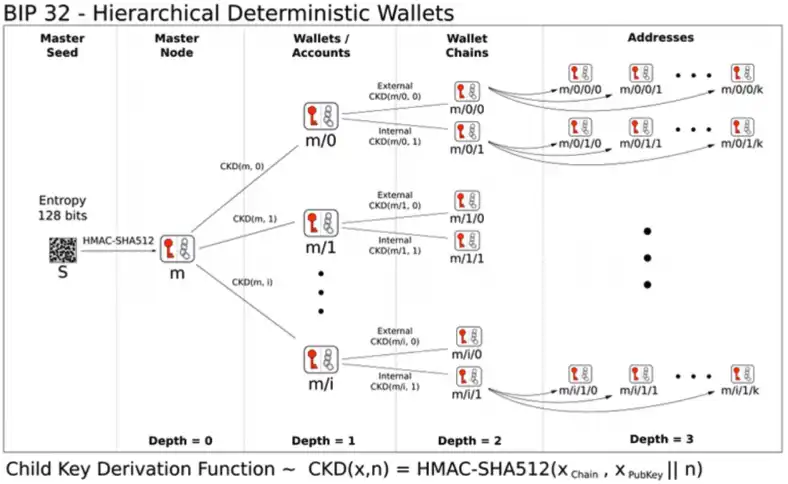
BIP39: Introduce mnemonics, adapting the code that manages all private keys into a series of words. More convenient memory, by memorizing the mnemonic words in order, and then calculate all the private keys through the mnemonic words, effectively solve the problem of private key management.
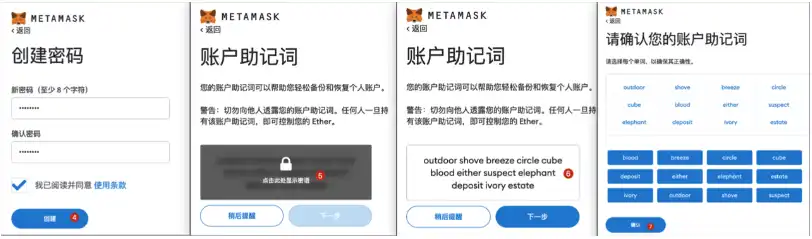
The 12 words in the picture above, they are mnemonics, there are usually 12 of them, their:
Function: Help users to more convenient to remember their private key, manage property (a set of mnemonic words can derive a lot of wallet address, little Fox can click create wallet, will automatically generate a new address).
Principle: Random numbers are converted into words in a thesaurus by a specific code.
A mnemonic is a mapping between a random number and a word. A mnemonic can be used to recover the random number, calculate the private key, and manage the asset.

Above is the mnemonic word generation process:
To put it simply, the generated random number is cut into 12 parts, and then the 12 parts correspond to the mnemonic words in the word dictionary.
3. Wallet classification

Sort by data type
Full-node wallet
The wallet contains all the on-chain data (possibly hundreds of gigabytes) and verifies the validity of the transaction locally.
The cost is high, generally unaffordable and unnecessary for private individuals. But all exchanges must have at least one full-node wallet to ensure the security of funds.
Light node wallet
To verify the validity, a request is sent to the whole network. Full nodes help light nodes with verification.
By device type
Computer wallet and mobile wallet, as the name suggests, are wallets that run on your computer and mobile phone.
Hardware wallet, hardware device store mnemonics, never exposed. Well-known hardware wallet: Ledger
Press network
Hot wallet, connected wallet. Connecting to the Internet means there is a risk of theft or phishing.
Cold wallet. Wallets that are not connected to the Internet, such as hardware wallets, are cold wallets.
By the ownership of the private key
Centralized wallet. An exchange, for example, holds a customer's private key.
Decentralized wallet, all private keys are stored locally in the customer.
Customers use a centralized wallet because it is fast and the transaction has a credit endorsement. But distrust of centralised exchanges has soared in the wake of the FTX debacle.
4. Private key signature logic
The entire blockchain system relies on asymmetric encryption algorithms. Asymmetric encryption means that encryption and decryption do not have the same key, as opposed to symmetric encryption (encryption and decryption using the same key).
Symmetric encryption: The key in symmetric encryption must be spread over the network so that the key is at risk of being stolen.
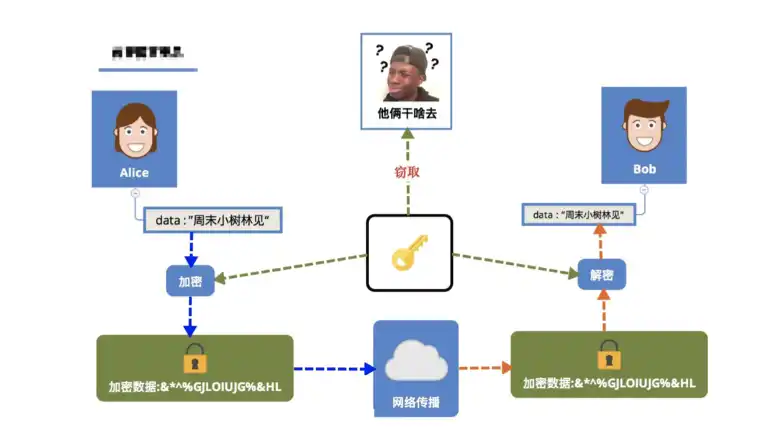
In asymmetric encryption, the private key must not be exposed, but the public key is open to the whole network. There are generally two usage scenarios:
Scenario 1: Using the public key for encryption and private key for decryption
Picture of Scene 1:

When Alice wants to send Bob a message, she encrypts it with Bob's public key. This encrypted message can only be decrypted using Bob's private key. Even if a hacker has the encrypted ciphertext and Bob's public key, he can't decrypt it without Bob's private key. Bob's private key was kept locally and never transmitted over the Internet, so hackers would never be able to crack the ciphertext.
Scenario 2: Signature with private key, public key verification (blockchain relies on this)
Picture of Scene 2:
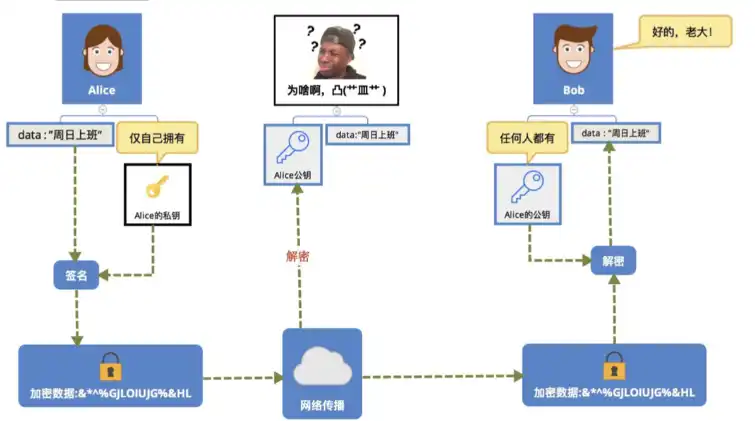
Alice signs the message she wants to send with a private key. All the people in the whole network who have Alice's public key can use Alice's public key for verification. If the verification is successful, it means that the information is sent by Alice. In blockchain, this is used to verify the correspondence between a transaction and its originator, as well as whether the originator is trading with his or her own assets.
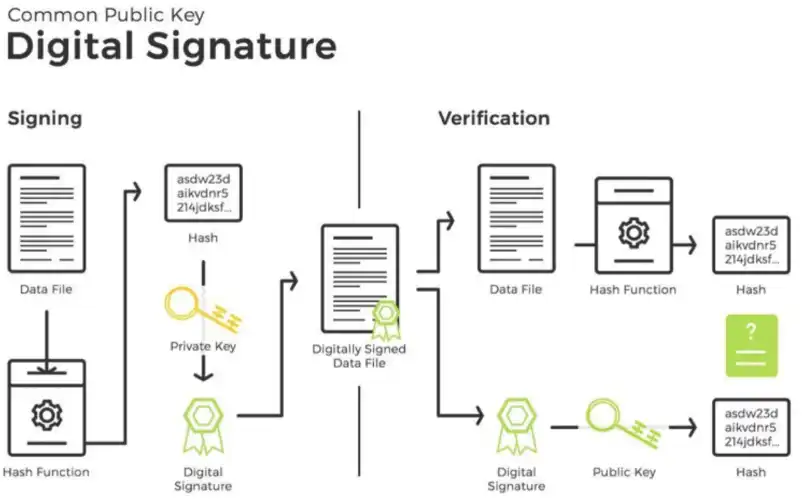
The complete private key signature process (using a transaction as an example) :
Step 1: The transaction originator hashes the entire transaction information
Step 2: The initiator will get the hash value and sign it through the private key algorithm
Step 3: Upload the transaction text along with the digital signature
Step 4: The verifier calculates the hash value of the transaction text through the hash algorithm
Step 5: The verifier decrypts the electronic signature through the initiator's public key
Step 6: Compare the hash value of the original transaction and the hash value after decryption of the electronic signature. If the hash value is consistent, it indicates that the transaction matches the initiator, that is, the verification is successful.
5. What centralized exchanges do
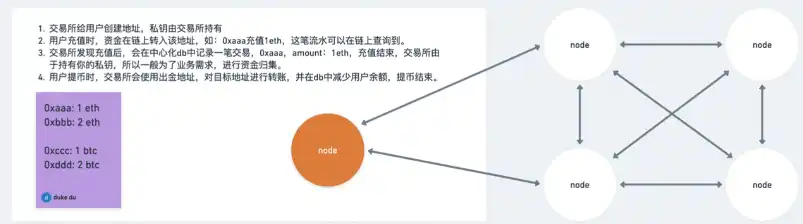
We can fill and withdraw coins in a centralized exchange. But how exactly?
In the case of Ethereum, all Ethereum nodes are shown on the right and the centralized exchanges are shown on the left. The exchange will also run a full node and then connect to each network in order to ensure customer demand (money, etc.). The three things to do are: create the address, fill the money, and withdraw the money.
After a user creates an account on a centralized exchange, the exchange creates an Ethereum address for the user, but the exchange keeps the private key. When the user charges money, only the user's address is transferred. The exchange records the transaction in a centralized ledger. Users can then trade on the exchange. However, subsequent transactions (except for the withdrawal of coins) are recorded in the exchange's database, which ensures fast transactions and no on-chain transaction fees (Gas fees). Because the exchange holds the private key, it can manipulate the coins in the account, and the exchange will transfer the coins to the exchange operation. When a user withdraws coins, the exchange transfers the coins from the exchange account to the customer account (this step is on-chain). So if the exchange goes away, customers lose all their money.
6. The future of the wallet
Add two concepts:
Externally Owned Account (EOA) : All wallets controlled by the private key are EOA wallets or external account wallets.
CA (Contract Account) : This wallet is controlled by code.
Above we see a variety of wallets, mostly mnemonic. But in fact, there are a lot of inconvenience, such as let the user manage their own wallet is actually more trouble to operate, and easy to leak, resulting in security risks. In addition, wallet transaction fees are also higher. Therefore, it is generally believed that in the future ecological development, the development of new model wallet must be the key development direction.
There are three new mode wallets:
Multi-Party Computation (MPC) wallet: multi-party computation wallet, in essence, it doesn't completely solve the problem of users' own management wallet, it slices private keys and keeps them by multiple parties. When trading, multiple parties are grouped together to trade. Because the private key is distributed on different servers, it is more secure. Major MPC wallets are currently: Bitverse, ZenGo
Smart Contract Wallet: CA is essentially a contract. The user deposits money in the contract, and all transactions are executed through the contract. Because the contract is logical, it can be more secure to control the assets, can ensure that the user has certain authority, large amounts of money is not tied to any one person. A fund wallet, for example, must be signed by many EOAs before it can be invested. Mainstream smart contract wallets are:
Gnosis Account Abstract: Commonly known as AA wallet. Smart contracts and EOAs can be abstracted to a new level, and there is a whole ecology to make smart contracts secure and more and more useful. For details, please refer to the following articles:
V God put forward the plan
https://medium.com/infinitism/erc-4337-account-abstraction-without-ethereum-protocol-changes-d75c9d94dc4a
EIP4337
https://eips.ethereum.org/EIPS/eip-4337
Code implementation
https://github.com/eth-infinitism/account-abstraction
Popular science articles
Todd, public account: AnT CapitalA& T View: How close are we to universal smart contract wallets? Read ERC-4337
03 Smart contract (Smart Contract)
When we talk about developing blockchain projects, there are two levels of meaning:
Chain development: Focus on blockchain itself, which is equivalent to operating system level projects (e.g. Mac and Windows)
Application development: Focus on the application level, such as wechat, mobile banking, etc. In the field of blockchain, we call Dapp(Decentralized Application).
Let's take a look at a simple smart contract development (application layer development Demo), and we'll have a special session on Getting Started with solidity:
// SPDX-License-Identifier:MIT// Specify the compiler version of pragma solidity ^0.8.13;
// contract same as java class Smart contract is Inboxcontract Inbox{
// State variable, there is a string public message on the chain;
// constructor constructor(string memory initMessage) {
// local variable string memory tmp = initMessage; message = tmp; }
function setMessage(string memory _newMessage) public {message = _newMessage; function setMessage(string memory _newmessage) public {message = _newmessage; }
function getMessage() public view returns(string memory) {return message; function getMessage() Public view returns(string memory) {return message; }}
04 What is Web3 (Expand Your Knowledge)
Web3 (also known as Web 3.0) Here is the definition from Wikipedia:
Web3 definition: https://en.wikipedia.org/wiki/Web3
Step 1 Define
There is no standard definition, but it is generally agreed that:
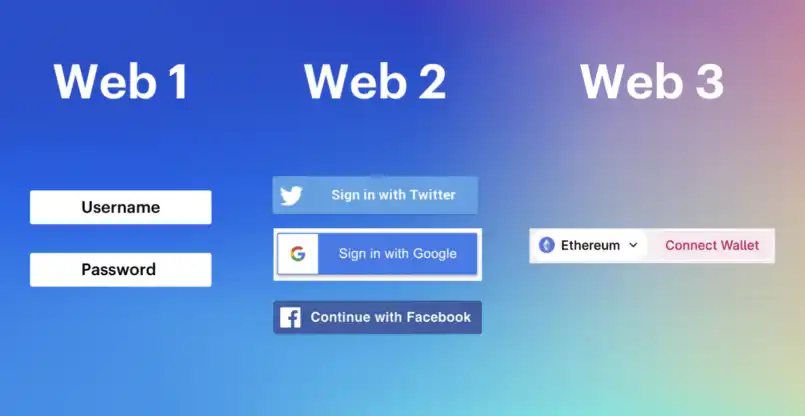
Web1 is read-only, Web2 is read + write, and Web3 is read + write + own.
Web3 is a no-trust, no-license, and decentralized value network using blockchain technology.
The core of Web3 is to understand the word "ownership". The essence of ownership is "ownership", and the carrier of ownership is mainly reflected through tokens. Therefore, the core of Web3 cannot be without Tokenomics (Token economy).
Comparison of login modes
Comparison of content interactions

2. Structure of Web3
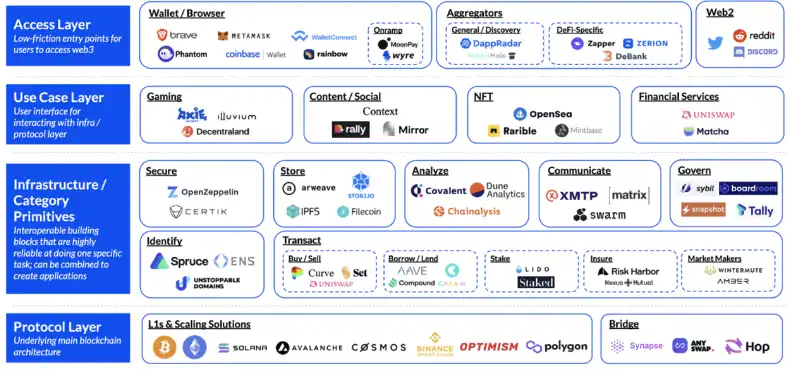
The above picture is a general picture of blockchain ecology. Currently, the track in Web3 ecology is still quite rich. Here are a few examples:
The bottom layer is the chain and the Bridge across the chain. Cross-chain Bridges can transfer assets across different chains, using a centralized mechanism to ensure security. But cross-chain Bridges are also the most vulnerable, and many of the 2022 thunderstorms were linked to cross-chain Bridges.
There are many ancillary projects in ecology. Here are some examples:
OpenOpenZeppelin provides a library of standard smart contracts that can save development time.
ENS can save addresses via wallet usernames, otherwise 160-bit addresses are hard to remember.
IPFS & arweave: Provides a decentralized storage solution that reduces storage costs.
Gaming, Content/Social, NFT, Financial Service are all in the application layer.
Above that is the interface, which allows users to tap into blockchain technology.
You can choose your favorite track according to your own interests. The following is a list of well-known projects at each level.
Protocol layer
That is, the underlying blockchain architecture layer, including Layer1 A variety of blockchains, also including Layer2 The various extension chains also include cross-chain Bridges.
Layer0~1: Ethereum, BSC, Heco, Avalanche, Near, Solana, Cosmos, Polkadot, Aptos, Sui
Layer2: Optimism, Arbitrum, zkSync, StarkNet
Bridge: Synapse, Hop, AnySwap
Infrastructure layer
It is a fairly diverse layer composed of interoperable building blocks, listed below are just some of them:
On-chain financial protocols :Uniswap, Curve, Compound, Aave
Data storage :IPFS, Arweave
Data analysis :Chainalysis, Covalent, Dune Analytics
Contract security :Certik, OpenZeppelin
Communication protocols :XMTP, matrix, swarm
User ID :ENS
Prophecy Machine :Chainlink
Data indexing service :Graph
Application layer
The application layer that interacts with the user has a variety of different types of applications, such as games, content, NFT, financial services, etc.
Games :Axie Infinity, illuvium, Decentraland
Content :Mirror, rally, Context
NFT:OpenSea, Rarible, Mintbase
Financial Services :Uniswap, Matcha
Note: there it is again. Uniswap. You can think about why?
Access layer
Portals to Web3, wallets, browsers, aggregators, and even some Web2 platforms have become portals to Web3.
Wallets :MetaMask, Dipperex Token, Ledger, Terzor, Gnosis Safe, Moonbeam Safe
Browser :Brave
Aggregators :DappRadar, DeBank, Zerion
Web2:twitter, reddit, discord
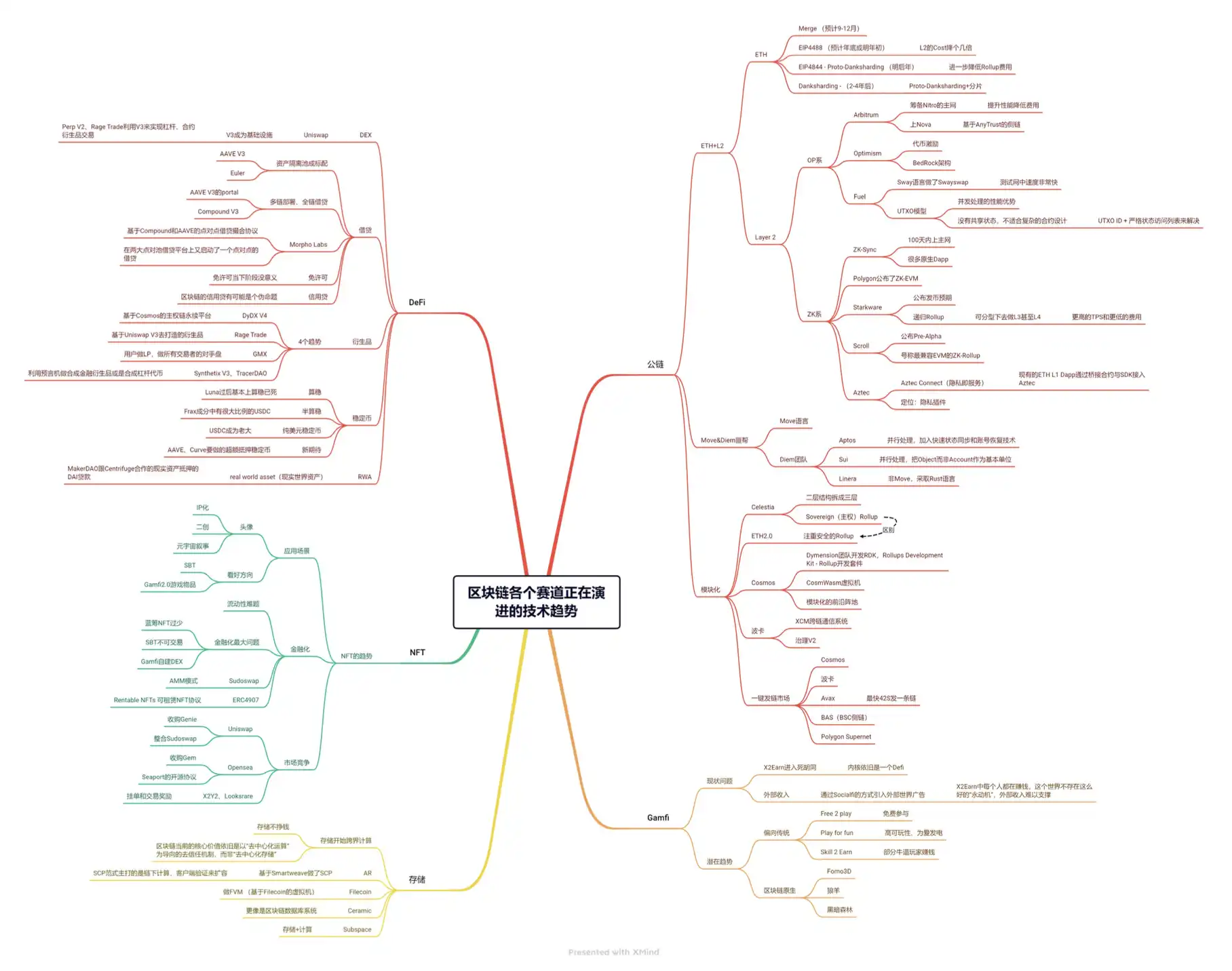
3. Current situation and trend of Web3 track
05 Resource link
DAPP full stack tutorial
https://dukedaily.github.io/solidity-expert/
Metamask download link
https://chrome.google.com/webstore/search/MetaMask?hl=zh-CN
HD Wallet extension
https://www.arcblock.io/blog/zh/post/2018/12/01/hd-wallets-design-and-implementation
Online experience BIP32, BIP39, BIP44
https://iancoleman.io/bip39/#english
Mnemonic lexicon
https://github.com/bitcoin/bips/blob/master/bip-0039/english.txt
Demo Bitcoin Foundation (Ledger)
https://andersbrownworth.com/blockchain/hash
Demo Bitcoin Advance (Signature)
https://andersbrownworth.com/blockchain/public-private-keys/keys
View MoleEdu All course arrangements for Web3 series courses
MoleDAO, public account: MoledaoIncoming MoleEdu | Web3.0 series of public lesson! Are you ready?
06 Give thanks
Thanks to the following organizations for supporting this public benefit course! Sponsored by: One Global Blockchain Centre (OGBC) : https://www.ogbc.com/
OGBC is a leading incubator for Web 3.0, working with emerging cryptocurrency startups to build the infrastructure of the future. By leveraging OGBC's expertise, network and resources in the cryptocurrency space, companies and projects can realize their full potential in an effort to develop innovative and valuable solutions for the growing number of users in the blockchain industry.
Original link
Welcome to join the official BlockBeats community:
Telegram Subscription Group: https://t.me/theblockbeats
Telegram Discussion Group: https://t.me/BlockBeats_App
Official Twitter Account: https://twitter.com/BlockBeatsAsia
 Related Articles