Confirmation Partners: Analysis of these 3 likely undervalued Products in 2023
原文来源:Richard Chen,1confirmation 合伙人
The DeFi way
As a tradition, each year I make three unspectacular predictions about product trends for the coming year. Let's take a look back and see how my predictions looked last year before making three predictions for 2023.
Look back at last year's predictions
1. Vertical specific NFT markets
Verdict: It depends
OpenSea's volume is down 94% from its all-time high, and most other vertical NFT markets have seen similar declines; SuperRare and Foundation are down 92% and 90%, respectively.
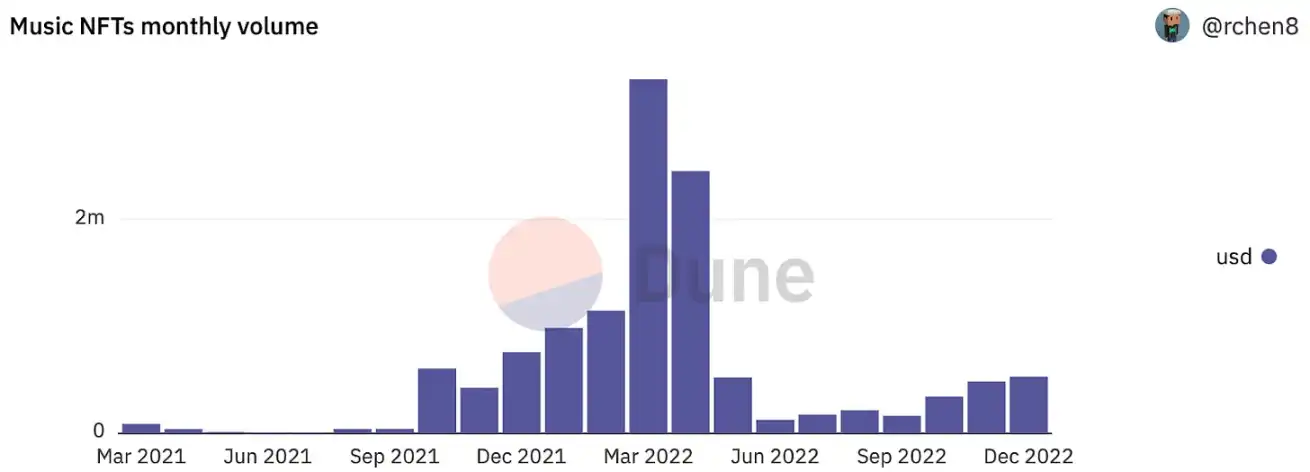
The one exception seems to be music NFT. Last year I predicted that 2022 would be a breakthrough year for music NFT. While trading volume in the music NFT is still down sharply from its all-time high, it still has a healthy year-over-year monthly gain throughout the bear market.
2. Cross-chain bridging with minimal trust
Conclusion: True
Last year I wrote, "Bridging is a huge honeypot, and I predict that cross-chain hackers will be the new CEX and DeFi hackers." It turns out that five of the seven biggest hacks of all time were cross-link Bridges, costing a total of $2.3 billion.
All of these hacked cross-chain Bridges cut corners in their design and introduced the assumption of trust. For example, there could be a centralized multiple token made up of several validators, all controlled by the same entity, or an administrative key that can unilaterally upgrade key parameters in a smart contract. These single points of failure become huge targets for sophisticated hackers. Meanwhile, minimum-trust bridge connections like Hop have so far had no security incidents and have gained significant market share.
These hacks show why it is difficult to design a bridge that minimizes trust, and why projects should not glue a solution together, sacrificing security in order to prioritize execution speed. As the old saying goes in cybersecurity, it doesn't matter if you're right 99% of the time. You only need to be wrong once to be knocked out.
3. Invest in the DAO
Conclusion: False
With the exception of a few OG funded DAOs like Flamingo DAO, the new ones that have emerged have largely been media publicity stunts. They initially got a lot of media coverage and some early use, but ultimately had no sustained traction and no product to market match. The number of new DAOs is also a vanity indicator, because the law of venture capital power applies -- only a small percentage of DAOs will get nearly all of the return on investment.
Last year, I likened investing in DAOs to dividing collectors rather than art, with the big use case being the holy grail of group-buying expensive NFT. But as a result, collectors prefer to buy cheap versions rather than gain access to blue-chip artists.
Projections for 2023
After reviewing last year's predictions for 2022, here are my thoughts on three potentially underrated product trends for 2023.
1. ENS
ENS is the elephant of the NFT world. It is by far the most widely distributed of all NFT projects in terms of the number of unique holders, and is the tenth most frequently invoked smart contract on Ethereum over the past year. (Recommended reading:ENS: The Key to Web3 Era")
However, ENS still isn't really talked about on Twitter because it's not as sexy as JPEG; Hyping names rather than images doesn't seem convincing. In addition, there is a misconception that ENS is just about grabbing popular domain names and is not designed to build a passionate community of holders like other NFT projects. However, it turns out that ENS also has their own version of PFPs, in the form of 3 - and 4-bit ENS names. I predict that ENS like 999 Club and 10k Club will be some of the most desirable forms of on-chain identity next year.
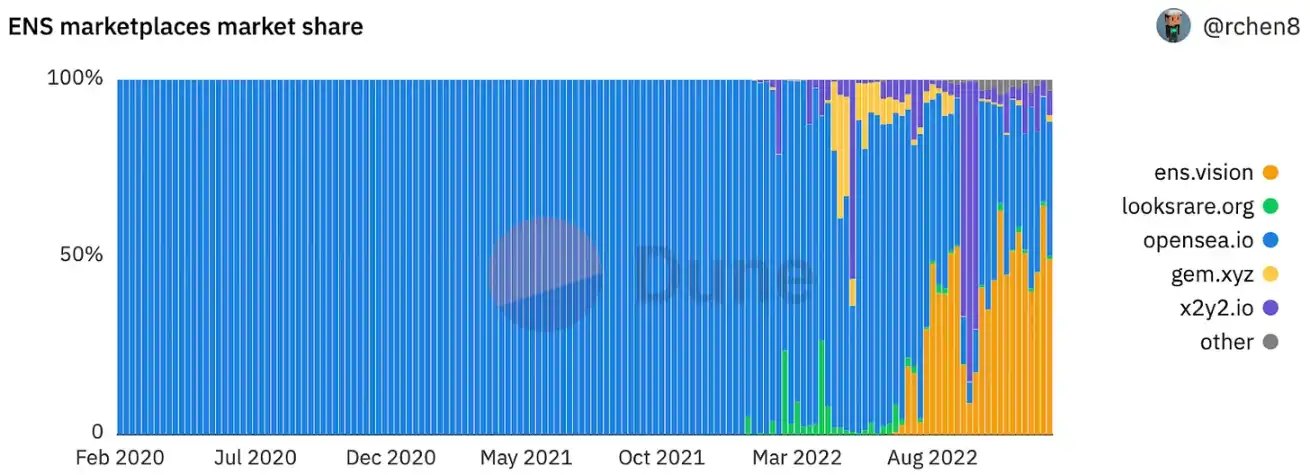
On top of all this, Ens.Vision has quickly grown into the leading vertical market for ENS domain names, and the first place to buy ENS domain names, not OpenSea. It is always good for vertical markets when the vertical market captures more volume than the general secondary market.
2. MEV business model for apps and wallets
Over the past few years, MEV has grown from crypto native enthusiasts (myself included!) Has grown into a specialized industry that requires specialized infrastructure to optimize millisecond execution speed.
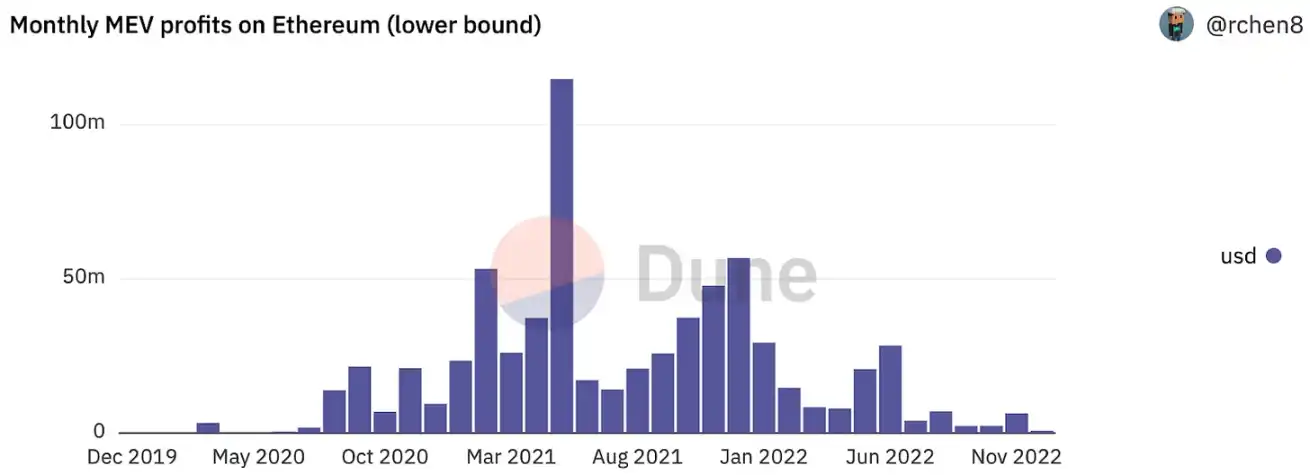
Please note that this is a low end estimate - the true total of MEV profits could be several times larger. It would be nice if there were a way to make this kind of profit for projects and users instead of searchers and validators.
Application chain and rollup. A lot has been written about the 2022 application chain theory. Contrary to claims of faster/cheaper/better scalability, I think MEVs will be the biggest reason for dApps to migrate to their own chain or rollup. This is because when dApps are deployed on their own custom chain, they can control the sequencer, which is the order of transactions. Control sequencer is the new business model for dApps, because MEV searchers pay dApps for the right to order transactions in a certain way to conduct their forward or backward operations. This money can either be used as revenue for the dApp or recycled back to the users to compensate for their impermanence.
In addition, MEVs can provide a new business model for wallets. Wallets can create their own private mempools for user transactions (or in partnership with projects) and let MEV searchers bid for the rights to bundle transactions. The wallet receives the revenue from the bid and can return a portion of it to the user. It's similar to pay for Order Flow (PFOF), which is how Robinhood makes money, where Citadel pays Robinhood for retail traffic.
A common misconception is that all MEVs are bad. But in reality, only a subset of MEVs are harmful, such as jump start trading and mezzanine trading. Arbitrage and clearing are essential to keeping the DeFi ecosystem healthy on the chain. Without a strong ecosystem of MEVs, agreements can end up going bad when there is market disruption, as happened with MakerDAO on Black Thursday.
In short, every time a new business model is created, it is a sign of 0 to 1 innovation.
3. Generative art
Generative art is a safe escape from PFPs. Generative art not only has similar properties to collectibles in creating an enthusiastic community of NFT holders, but is also seen as higher quality art created by artists who believe in the long-term value of NFT rather than by random contractors on Fiverr who may not know what an NFT is.
When NFT prices fall, critics argue that NFTS have no intrinsic value unless there is a real-world utility associated with owning them. As a result, existing projects are under pressure to create physical merchandise, build meta-universe games, license their brand IP, etc., to create value for their NFT holders.
But in my opinion, this is often the wrong approach for projects to take. NFT projects must become more execution-oriented, and most projects have proven that they are primarily good at marketing rather than building products. When external dependencies are introduced and expected to be tied to the development of the project, the project has always needed to reward the NFT owners to become productive assets, otherwise the NFT becomes worthless.
This is not the same as a store of value. This is counterintuitive, but the store of value is a feature, not a bug. As a store of value, there is more room for growth and TAM than as a company. The NFT project should strive to be a place for ETH whales and UHNWIs to disperse and park their money.
Art is one of the oldest stores of value. On-chain generative art is a paradigm shift in the traditional art world because it is a new art form that cannot be made without blockchain. The total market cap of crypto art is only $1.7 billion (0.2% of the total market cap of cryptocurrencies), so there is still significant upside potential. Decades from now, art historians will look back and define this era, just as they have done with the Renaissance, neoclassicism, Romanticism, modern art, contemporary art, and various other artistic movements.
Source of original text
Welcome to join the official BlockBeats community:
Telegram Subscription Group: https://t.me/theblockbeats
Telegram Discussion Group: https://t.me/BlockBeats_App
Official Twitter Account: https://twitter.com/BlockBeatsAsia

 Related Articles