



"Crypto Capital" Tetralogy 2: No Smoke Battlefield - VC or Token fund?
Crypto Capital Tetralogy 2: A Battlefield Without Smoke -- VC or tokenfund?
Ryuono @x element
Related reading:Crypto Capital (Part 1) : A Battleground Without Smoke -- VC or token fund?
Preface:
This series of articles, mainly from the dual perspectives of practitioners and scholars, will talk about my review, elaboration and reflection on the past, current situation and future of equity investment and financing and currency right investment and financing.
How should we treat the emerging currency rights program? How retail investors as quickly as possible to judge the rationality of currency right financing projects? And how should regulators reconcile this from the perspective of technology and industry self-discipline? How can traditional VC participate in the interests of currency rights as much as possible under its own equity legal framework? And, as an entrepreneur, how to choose equity and currency financing to help the development of his project?
wu
What determines victory in the game of poker?
A lot of people would say, card skills.
But many ignore another crucial factor, the amount of leverage.
So in the equity world, funds with huge amounts of money tend to get better deals. Of course, along with the current VC industry competition to see, earlier the competition of RMB VC showed the red Sea, and now the dollar funds have also been "internal volume". Because, for no mega fund level VC, in order to become bigger and stronger, must go to two extremes, industrial capital, or "impact capital".
In the investment world, VC as a product of the last era of information asymmetry, is no longer so rare. Instead, more industry depends on industrial capital, and core individual (entrepreneur /KOL) influence capital.
This is actually a back-end upgrade after the concept of post-investment management was put forward in emphasis around 2010. As an entrepreneur, why do I need capital if I can directly access services, information, and resources that I would otherwise need to buy with capital?
Token The same is true of fund. Moreover, because they are so young and don't have the scale of the established VCS that have been around for decades, there are almost always two ways to go -- either by backing a product (ideally an exchange), having a strong "industry" or having a partner with sufficient influence (intuitively, the number of social media followers), It helps you reach the client quickly.
All the time. The fund has been accused of selling too often and almost "fleecing" its exit -- by which we mean, of course, the bull market. In a bear market, token Most of the fund has lost its sense of rhythm and cannot survive. In fact, I think this makes perfect sense. All the primary markets in the world are influenced by the secondary market, and the exchanges are at the top of the industry. The way they compete for traffic and trading volume determines the speed at which they can load coins, which affects the speed at which they can invest and exit currency rights.
On the other hand, we can also think about the production end. From the 5*8 working system in the traditional world, the speed has doubled to 996 in the Internet era. In the blockchain era, the speed has tripled again. Why can't currency rights be more direct and faster?
I can't deny that currency option financing, with a faster way to liquidate.
I'm a big proponent and stickler for long-termism, but when there's a short-term market bubble and there's a better exit path and a higher exit valuation, let everyone follow you to make more money -- why not?
In my own business, I have one supreme rule: make money for your investors, make money for your partners, and make money for everyone in your team who follows you. These three priorities are declining in turn. When I complete these three priorities, I think my responsibility in this enterprise is successfully completed.
I'm not the messiah, I'm not responsible for every individual in the secondary market.
Moreover, purely from the financial market exit channels and means, these two years hot SPAC, and token How similar the market is, is not this "realizationism" outstanding performance?
lu
So, do we have to issue money?
Before answering this question, I think the three elements of coin issuance -- the right time, the right place, and the right people. All three are in descending order of importance.
Please note again that what I'm talking about here is not doing the project per se, but rather the order of the factors affected by the incremental value of issuing money on top of doing the project (company). I won't discuss project development and other fundamentals of running a company.
Intuitively speaking, Renhe is the "web3 gene" of the team, but what is more important is the narrative about the coin issue. In a sense, before 2021, web3 people were actually very exclusive and suspicious of people who were new to web2. But since 2021, with the arrival of a large number of "regulars", the projects of web2 background founders have dominated. When we think about the future, we have to acknowledge that projects that combine the hard power of web2 with the thinking of web3 will lead the industry.
But too many founders choose the wrong approach to coin creation -- tools, for example, are not suitable for coin creation, The Graph and Dappradar are examples. For tool projects, more suitable for To B's business model, which has a unidirectional and weakly coupled relationship with the majority of users at C end. This is not suitable for creating a good token model.
So -- what would be a good narrative for issuing money and what would be a trap?
Let's take another example, Pricing is a very good business direction for the crypto market, and many projects take it as the starting point. If the main valuer uses its accumulated data and algorithm to build a model for price prediction, then it is the traditional business model. Even with some transactions such as smart The function of trading is not suitable for issuing coins. However, if we take a step forward and open source the pricing model, set up an Oracle, let the user contribute the data, even participate in the part that affects the final decision, and benefit from it to achieve a positive feedback loop (for example, first build the algorithm and model with the data barriers established by ourselves, and then open source the model, The user is allowed to submit the correct metadata. The first step is to give a reference range of the valuation, such as $5,000 - $10,000, and then ask the user to give their own estimate within this range based on the number of tokens in hand, and finally take a weighted average. This kind of valuation method can combine data rationality and market sensibility behavior). Then the Oracle coin issue can almost be said to be natural.
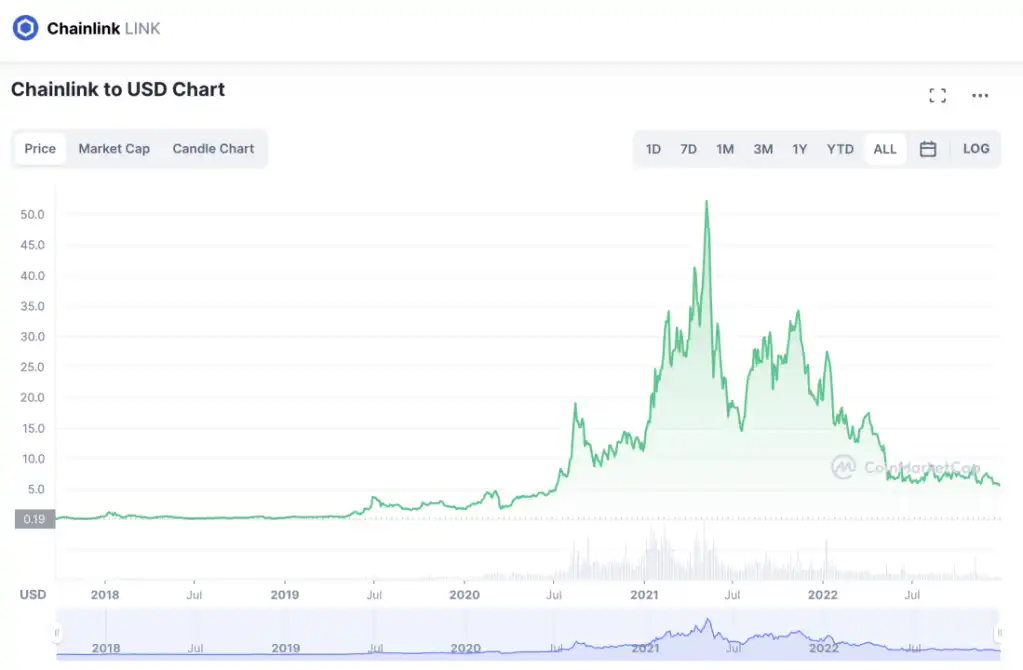
Chainlink Currency chart
A typical example is Chainlink, whose market value has gone from May 8, 2021 to May 8, 2021. time high, to now has fallen nearly 90%, but still ranked the top 20 network.
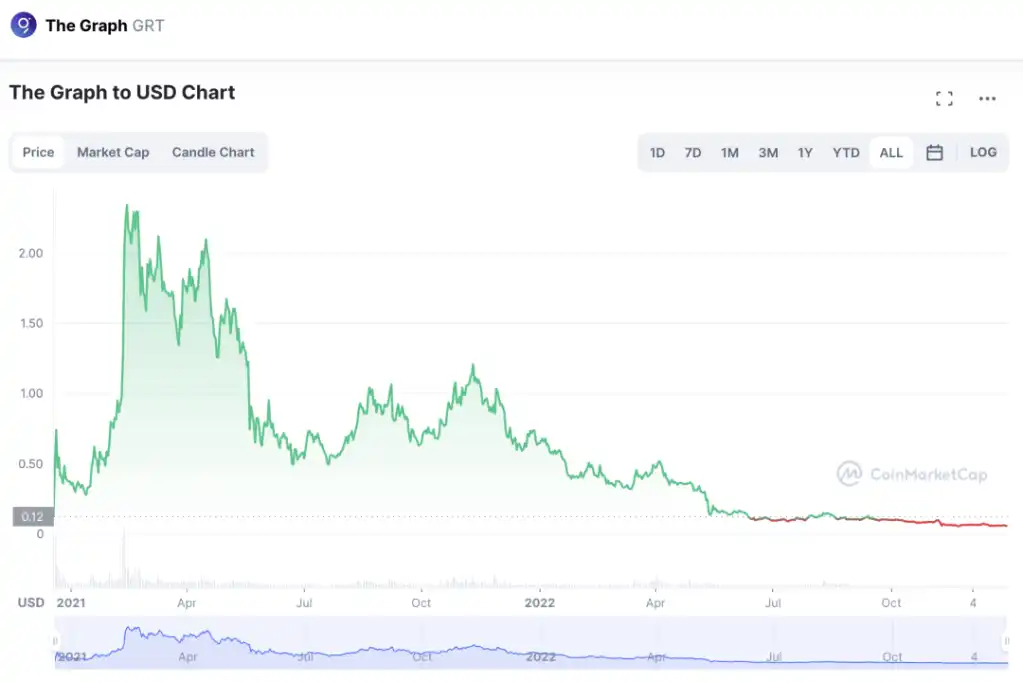
The Graph Currency chart
To sum it up, in order for a coin to be issued clearly, it must have "strong participation" and "strong turnover". That is to say, users take your coin and use it regularly to meet utility needs -- if you just use it as a voucher, then its properties as a token are basically put there to be "consumed" by users. It doesn't make much sense; At the same time, its economic model is based on "deflation" or rapid turnover; Defi's breakout in 2020, for example, began as a compound yield4. farming, but what really got more people involved was the concept of a "machine gun pool" and the fact that users could create their own machine gun pools and trading strategies, resulting in more "gameplay", increasing the overall profits of the project, bringing in more users and new gameplay, creating a positive cycle.
So, tokens need to have a strong utility, or to be more mundane, "playable." The question of "utility", like "value", is a difficult one. There are a thousand Hamlets in a thousand audiences. This will be explained in a follow-up article in this series, "A Philosophical Ramble on Business and Investment."
This is in line with the NFT, and it's a question I get asked every day -- how do you send an NFT so that more people will buy it?
1. Have a scene to interact with users. If there is no interactivity, and new stories that continue (not by the year but by the week), just digital goods that are not consumable or interactive, then the NFT as a digital commodity is sold out in one wave.
2. To have a hero "strong push", in the user entrance threshold is relatively high, only strong ties and strong push is good, if you do not charge into battle, users will not automatically transform, even if you are a star. Many people say that lowering the threshold will bring more users in. But even today, Buffett still doesn't like Internet growth stocks. People born in the 1960s still have a hard time using computers, while people born in the 1990s say that the Internet is almost the whole life. In my opinion, "lowering the threshold" is not artificial, but a process of time precipitation. In my opinion, the simple metamask can not be more simple. In the eyes of web2 people who are used to the Internet, they are still not used to it.
For this part, see the author's other series of articles, "On the Existence Value of NFT - Capitalization, utility, and mass adoption."
Location, I emphasize - the international ability of the team. In the final analysis, coin issuance is different from equity listing. Equity listing is the realization of a company's future expected cash flow, while coin issuance is the realization of "strongly connected users". For an equity listed company, can completely go. Route B, only "customer" but not "user"; For a web3 project, without a user base, there is no value.
Therefore, broadening the user base is the cornerstone of the future cash issue of web3 project. The market is not only in the English-speaking Europe and the United States, but also in China, South Korea, Japan, South America where Spanish and Portuguese are the main languages, and Southeast Asia where there is a huge population advantage but a variety of languages. All these places have huge user potential. No matter how good a project is, it needs to break the language barrier. In the last cycle, when much of the world was virgin territory for web3, it was easy for a top project to dominate other markets, but as the industry matures and there is a lot of competition for projects in each country, it is no longer as fast. Just because you're on Coinbase doesn't mean you're going to be able to make a difference outside of the English-speaking world.
In my opinion, the key to the success of a web3 project is not only the currency price and the earnings multiple brought to investors, but also the liquidity, and the liquidity only on coinbase and on coinbase and Binance. And the liquidity on exchanges like coinbase and Binance, as well as Upbit, Bitflyer, Kraken and Kucoin. Therefore, if we speak more accurately, the internationalization ability required for coin issuing is not only that everyone in the team can speak English, nor is it just about going to meetings and meeting people in various countries, or finding several market cooperation institutions and Kols to complete the task. It is also about being able to operate in several major web3 countries in the world (to be more clear, several major language areas). Can create deep local connections. How do you judge that? For example, if you're thinking about launching a coin a year from now, and rapidly expanding it to all the countries in the world, you have to think quickly in your head, in all the countries. market who you can turn to, at least one name, is the one you can rely on for more contacts in the local area quickly. Because the schedule will become very tight after issuing coins, what you have to do is to "persuade", "confirm cooperation", rather than just know each other, the two sides have no middleman introduction lack of trust foundation there just chat.
Best of all, build a local area around an anchor. team, and quickly get more depth relationships for resource hubs. No matter how strong a team is, if it does not make early preparations and find the right person, it is Binance. The localization attempt in South Korea has also received a complete failure.
For crypto, yes; The same is true for NFT. crypto is repeating the process of globalization a few years ago, but faster.
In my opinion, the three most critical countries in globalization are still the United States, China, and South Korea, with decreasing priorities. Combined with willingness to participate, purchasing power per capita and population base, I would put these three countries at the top. That is why NFTGo first set up offices in these three countries, and started to localize them at the earliest stage.
The day is the beginning of preparation for coin issuance, including the announcement of the time of coin issuance, whether to comply with the industry cycle and industrial iteration.
For example, for Defi, its bull market is mainly Defi in the period of July-September 2020 and January-April 2021. We talk about Defi In the Summer, in fact, after May 2021, when the price of Bitcoin peaked at $58,000, and Doge series such as Shiba coins attracted more attention, as well as funds, as the cut-off point, Defi has been on a downward spiral until today. The reason is that few people realize that Defi protocols exist as a "reservoir" of crypto asset. When the price of Bitcoin Ethereum, the basic asset of Crypto, rises, a series of capital spillover demands will be brought, such as financial opportunities such as borrowing of funds. At most, it will flow into the "reservoir". The Defi pool will shrink sharply or even be drained if underlying asset prices fall. Defi is more important to the industry in creating new forms of agreement than in driving innovation in underlying assets or changes in industry infrastructure.
Therefore, even though there was a bull market in the second half of 2021, especially from September to December, Defi still didn't get much better. Instead, NFT and Web3 stole the limelight. The main reason is that from the initial peak of $58,000 bitcoin in May 2021, At its all-time high of $69,000 in November 2021, bitcoin is up only 20%. The water is not big enough, or the water goes somewhere else (new assets like NFT) and doesn't reach you.
So is the coin launch (again, I'm talking about the coin launch, not the start of the build project, which is certainly much earlier than that). The best time to issue coins is the beginning of the end of the bear. To find the important inflection point of the whole industry cycle, and to issue coins a little after the inflection point, will be the "perfect time".
I spent the longest time talking about people, but only three paragraphs to talk about time.
Because the weather is really the hardest thing to control. We often say that the scarcest insights are the ones that can't be explained in words. If you really understand these three points, out of 100 web3 entrepreneurs, there may be 10 people in the right place, 5 in the right place, and 1 in the right time.
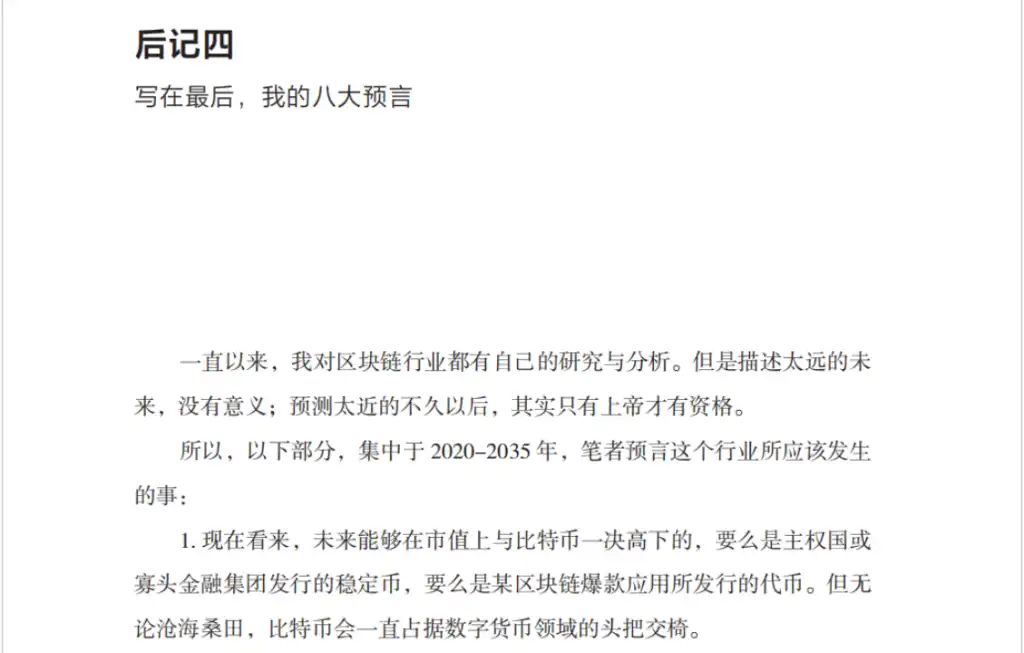
Moreover, the weather will change with the progress of the industry. The first prediction I wrote at the end of the "eight predictions" in my book Unlocking the New Password -- from Blockchain to Digital Currency a few years ago was, I now think, relatively biased. Now, I am more inclined to this conclusion, "Bitcoin's market cap will be surpassed, and it will probably be Ethereum. When that happens, it will mean the end of the cyclical change led by Bitcoin's halve four-year cycle, and the industry will become less significant and more profit-driven by achieving excess returns, which also means the beginning of the explosion of industry applications."
Four years from now, the logic that governs time may be radically different.
Retailer,
So the logic of issuing money is clear. If you can really find the right time, geographical location, people, should be at least an average level above the currency right project.
But -- as entrepreneurs, can we do better?
Yes. Combine equity and currency right financing.
Generally, equity financing is difficult after easy, currency right financing is easy after difficult. In a bull market, currency investment is the pursuit of extreme speed, often in the case of serious information asymmetry, relying on relationships, experience and even intuition to react quickly. It is a way to "quickly select projects that are sure to make money in the context of existing success, and to outperform the industry through high turnover and exit speed." So, in fact, when the valuation of the company with currency option financing is below a certain "critical value", some basic conditions can be met, and it can even be certain that it can make money.
But on the contrary, if even a project if the early valuation is not high enough, the late valuation must not be easy to go up, then in the competition, it is likely to be short of breath and the opponent will always suppress a chip.
More importantly, the proportion of investors' chips in currency rights is often far lower than that of traditional equity companies. In general, we believe that the early financing proportion of a currency rights project should not be higher than 15% or even 10%. Even if the currency rights are refinanced through OTC and other means, the proportion should not be higher than 25% when the project is launched on an exchange such as coinbase or Binance (which means the project is close to the maturity stage). For an equity project, at least 40% of the shares listed belong to various financial investors, and even more than 60% is not surprising. In this regard, I have discussed in theCrypto Capital Tetralogy 2 Part 1Have been detailed in this, not listed here.
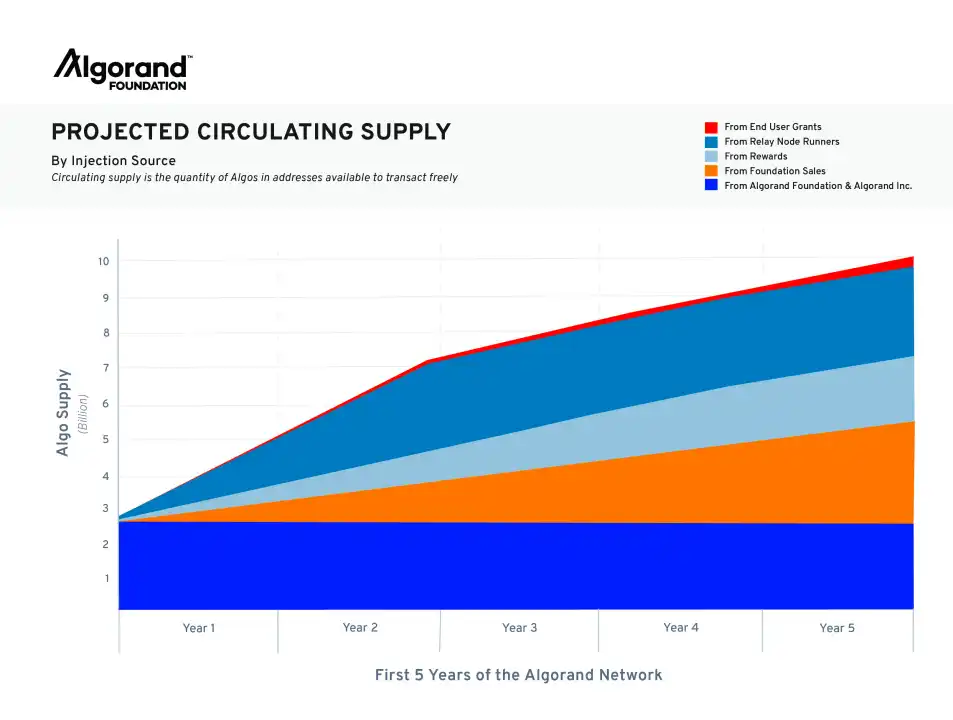
Algorand token supply chart
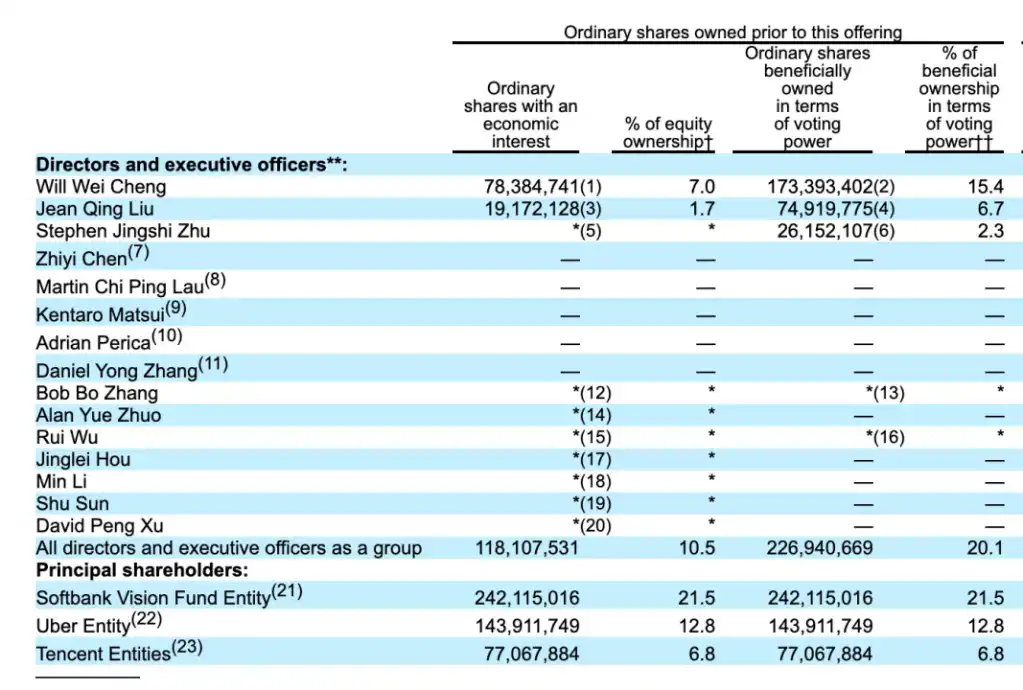
Share ratio diagram of Didi prospectus
A classic comparison is the comparison between algorand Didi, which are well-known projects in web3 and web2 industries respectively. The proportion of tokens belonging to external investors of algorand is less than 20%, while Didi's is more than 60%
As we said above, a good currency right project, to have "high interaction", then there is a point that is often questioned by investors - competition between enterprises is to have barriers, if you pursue "interaction", let users participate, is bound to open source, that is not equivalent to the loss of commercial barriers, other protocol copying is not finished?
In my opinion, many people do not understand the core significance of equity investment, which is essentially a risk investment that is discounted for the expectation of future profit dividends. This is not the case with currency rights. I think of it as discounting expectations of future public participation, which is tied to utility.
On the other hand, debt investment is an investment guaranteed by the solvency and cash flow of the core assets in the future and must have assets that can be realized. If you still can't understand currency rights investing and want to add the logic of equity investment and exit to currency rights, just think how frustrated you would be if you used the concept of venture capital to invest in corporate bonds.
So what's the problem with the coin rights project, open source, and let other protocols copy it? Let him copy, then connect with him, each project will not have fewer users, only more.
It's a lot like investing in a country, if you have an opportunity to invest in a country, you shouldn't just look at GDP, the biggest value is the right to circulate the currency it issues. One country and other countries should not open international currency circulation if only from a competitive point of view, each country to "protect local industries". In practice, a more robust "money issuing market" can only be created if international trade and currency swaps are made more market-based.
From this perspective, why do we say that web3 projects, especially public chains, are more like "states" than purely traditional equity enterprises?
Then, really from equity enterprise to an open agreement, it is necessary to complete the transition from "self" to "no self". First of all, the core value must be generated. At this stage, we must use the traditional ideas of enterprise management to look at it. Then, we can realize the exponential growth of financial value through "no self".
So, in summary, I think the best way to run a web3 project and choose between equity or currency option financing is to be "super honest". That is, first make a can guarantee the minimum, based on cash flow, use the product and global capabilities to reach as many users as possible, in the process, find the most suitable. issurance's narrative, cutting in ahead of the bull market, looks for a ceiling. And, I think, not only is it possible to issue more than one coin, but I think it's even better to issue more than one coin.
Some people ask, how can you issue more than one coin?
Why not? Equity companies can still be listed by spin-off, can SPAC shell transfer core assets, why not currency rights? As long as you have good core assets, use the right pace to make more token in different subdivisions (certainly not multiple projects in the same narrative) and at different times (certainly not multiple coins in the same period of time). Why not issurance?
Equity financing and currency right financing, if they cooperate well, can be alternated. As for the possible legal problems, I will focus on the discussion in this series of Crypto Capital Tetralogy (IV) -- Currency right Financing and Legal Practice.
In the case of rhythm, I'll start with a counter-example. Opensea's high valuation (in January 2022, it announced the completion of Series E financing with $13.3 billion) actually hinders its possible path to coin issuance. Such a high valuation must be corresponding to heavy profit expectation pressure, so it has no possibility to transform into an open protocol.
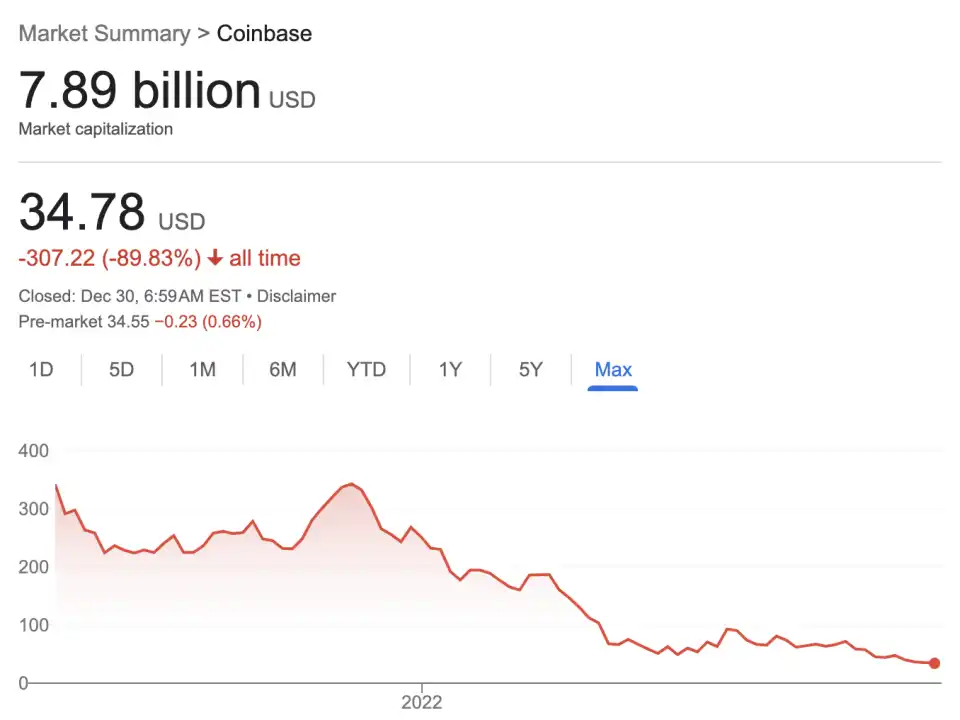
Coinbase Chart of changes in market value
By comparison, Coinbase, a nearly 10-year-old exchange, doesn't even have a market cap that high on the stock market.
Of course, I don't think it's a healthy sign that a web2 product based on a web3 world has such a high valuation.
After all, my business values, the first thing in the business is to let investors make money, far before the IPO stage, so high valuation, can we continue to carry out the next round of financing at a reasonable valuation and realize the exit?
And the positive case, I think. labs is phenomenon level, this total fraction financing model, for its spin-off listing to leave a good room. Dapper labs, as the parent company, has been insisting on equity financing for several years. Its well-known sub-projects include Flow, CryptoKitty and NBA Topshot, etc. Flow is a well-known NFT public chain, and CryptoKitty is the original project that pioneered the concept of NFT in the industry. NBA Topshot is the outstanding representative of the NFT of real IP, both to Dapper The shareholders of labs' parent company are doing well, and they're doing it through tokenize.
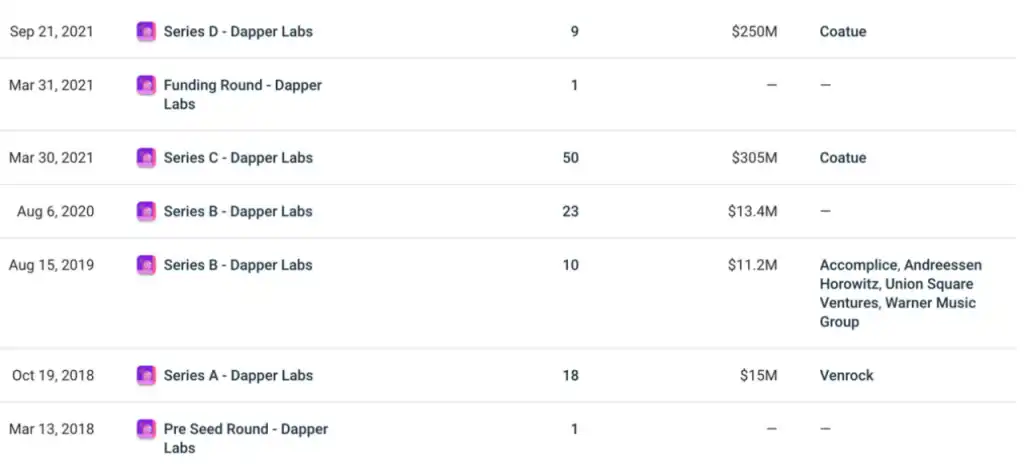
Chart of Dapperlabs' financing path (excluding the funding from the spinoff of its parent company in February 2018)
Reference: https://www.crunchbase.com/organization/dapper-labs/investor_financials
I believe that, under the background of more and more emphasis on DPI by VC, Dapperlabs, which continuously realizes phased realization of currency rights and gives returns to equity investors, while retaining the steady development of core business and strengthening the expectation of future equity realization, will be the object of imitation by many companies in the future.
捌
With coin rights and equity out of the way, let's move on to the next stage -- once we have decided to issue coins, how can we make the coin rights design more reasonable? What is a reasonable "currency rights operation" pace to ensure that the exchange is at the right point in time to achieve liquidity? In the actual operation process, how to avoid the conflict between equity and currency right as far as possible through advance design?
Wait, before we get to that, don't we have to define the word "coin" more precisely. What exactly are we talking about when we talk about cryptocurrency, token, including NFT?
The next one might be a little more academic, but hopefully you'll still find the answer.
December 30, 2022
Welcome to join the official BlockBeats community:
Telegram Subscription Group: https://t.me/theblockbeats
Telegram Discussion Group: https://t.me/BlockBeats_App
Official Twitter Account: https://twitter.com/BlockBeatsAsia






