Paradigm's MisJudgment: Why rETH will surpass stETH
Why Paradigm Was Wrong: How rETH Will Flip stETH
Originally written by Yofu @DAOrayaki
Analyze the social and economic headwinds facing stETH, and how these headwinds are reflected in the market conditions that create tailwinds for rETH, the broader LSD market crash, and the Rocket Pool bull case in general
directory
1 - Power is not law
Monopolist script
2-stETH Growing social headwinds
Governance can attack the rapidly changing cost/incentive structure multi-chain dilemma validator registry
3-stETH growing economic headwinds
Pledge -- No risk or risk cost? Execution risk tail risk centralization risk
4 - Orange cascading
Orange Creep - Before withdrawals Orange immigrants - Withdrawals Orange Future - after withdrawals
5 - New Challenger arrives
cbETH's loss of frxETH - A reflection of liquidity and design of shady super stakeholders Rocket Hands
6 - 交易对手 Token 经济学——被低估的艺术
7 - Conclusion
8 - Afterword - FTX Aftermath
1 - Power is not law
The Pareto principle, also known as the power law, is a phenomenon that occurs when a small number of individuals or groups control a disproportionate share of resources or outcomes. This can be seen in many different fields, including economics, sociology, and ecology. For example, the global distribution of wealth is often described using the Pareto principle.
The Pareto principle is the basis of a now-famous research paper by Hasu and Georgios of Paradigm, a Web3 investment firm. When it comes to the nature of liquidity pledge, they believe Ethereum's proof-of-interest (PoS) system will be dominated by mining pools that are socially scalable and offer the highest possible return by accepting MEVs (maximum extractable value). They argue that Pareto distribution will result in most pledged ETH being controlled by centralized trading platforms, or by less centralized alternatives that can be rolled out first.
作为先行者,该实体将在市场上拥有最多的时间,因此从表面上看似乎最值得信赖。这通常被称为林迪效应,投资者的信任度随着其在市场上的时间增长而增加。早期的另一个优势是流动性往往会产生流动性——流动性是协议的命脉,顾名思义,对于任何流动性质押工作来说,流动性都更为重要。作者将继续帮助创建 Lido,该协议现在占据了 DeFi 中使用的以太坊流动性抵押衍生品 (LSD) Token 市值的约 90%,远高于幂律可能表明的自然值。
On Pledge Pools and Pledge Derivatives - PARADIGM
The transition from proof of Work (PoW) to Proof of Equity (PoS) is Ethereum's most anticipated milestone since its inception. Instead of using energy-expensive POWs to extend the blockchain
The Pareto principle is made possible only by the existence of limiting pressures that prevent total domination of the ecosystem. For example, in biological ecosystems, the balance between predator and prey populations can control both populations. However, if there is man-made disruption, such as hunting or the introduction of non-native species, the ecosystem can collapse.
The claim that PoS ETH is already in a power law distribution often ignores an important component - limiting pressure. One can see this limiting pressure in the growth stages of wild animal populations modeled by logical curves. In the first phase, exponential growth rapidly pushed the population from essentially zero to extremes. In the middle of the curve, growth reaches an inflection point and slows as some pressures begin to build. For predatory species, this may reduce food rations due to excessive predation.
The last part of the curve is the carrying capacity approach - the asymptotic relationship of population ceilings, where risk or lack of food inhibits any further growth. Here, species dominate the ecosystem, but they fluctuate. Further growth is denied because it reduces resources leading to population collapse, which in turn promotes reproduction as resources become abundant again - a constant cycle around a steady state. Now, imagine if the counterforce can be suppressed or hidden. What happens to the bacterial population? It will consume endlessly.
Arguments claiming that PoS ETH is already in a power-law distribution usually omit an important component - limiting pressure. This limiting pressure can be seen in simulated growth stages of wild animal populations. In the first phase, exponential growth rapidly increased the population from almost zero to extreme. In the middle of the curve, growth reaches an inflection point and slows as some pressures begin to build. For predatory species, this may be due to over-predation resulting in reduced food ratios. The final part of the curve is the approach to carrying capacity - the asymptotic relationship between the upper limit of the population, where risk or lack of food hinders any further growth. Here, species dominate the ecosystem, but there are also fluctuations. Further growth is denied because it reduces resources and leads to population collapse, which in turn leads to resources becoming abundant again and promotes reproduction -- a constant cycle around a steady state. Now, imagine what would happen if the reaction force could be suppressed or hidden. What happens to bacterial populations? It will consume endlessly.
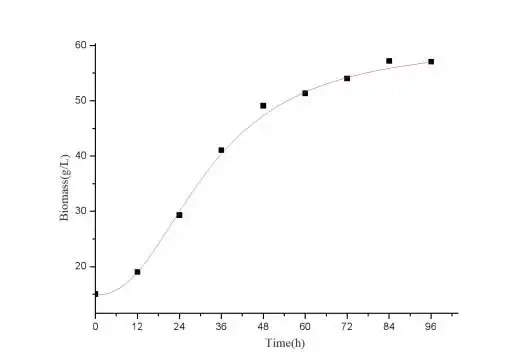
The growth of the sample bacterial colonies over time showed exponential stages of colony dynamics, slowing down of growth, and steady-state stages of population
Monopolist script
我认为 Lido 一直在人为地抑制幂律动态,以维持以太坊 LSD 市场不可持续的高比例。这种行为的长期影响是简单且不可避免的——随着看似无穷无尽的流动性激励枯竭,DeFi 整合差距缩小,市场的无形之手将推动回归帕累托分布。随着理性参与者分散风险,Lido 的 LSD Token (stETH) 的绝对主导地位应该会下降。
就像美联储为应对 Covid-19 大流行印制了数十亿美元一样,Lido 一直在迅速膨胀并挥洒他们的治理 Token (LDO),达到每月数千万美元的规模。通过花钱提高他们的 stETH LSD 的效用,Lido 一直在试图巩固 Hasu 和 Georgios 的论文中概述的先发优势。因此,散户投资者面临囚徒困境,尽管内在风险被大量 LDO 激励支付所掩盖,但自利和追逐利润的参与者仍在寻求 stETH 的价值提升。Lido 的面具在 2022 年 6 月 3AC(三箭资本)崩盘期间短暂地滑落,当时 stETH 与流动性 ETH 相比迅速吸引了高达 -6.6% 的风险折扣,这代表大约 18 个月的回报暂时消失了。要了解通过这种折扣实现的风险如何成为 Lido 失去其作为当前幂律多数参与者地位的征兆,我们必须考虑社会和经济逆风对 Lido 不懈追求完全市场主导地位的作用。
Then, I'll describe how the Rocket Pool expands in a technical sense to challenge Lido. This expansion will take place in three different stages - before, during and after withdrawal. Later, I'll discuss the contenders that might complicate or speed up the process of rETH flipping stETH, focusing on cbETH, frxETH, and osETH. Then, I'll describe how the Rocket Pool expands in a technical sense to challenge Lido. This expansion will take place in three different stages - before, after and after withdrawal. Later, I'll discuss the contenders that might complicate or speed up the process of rETH flipping stETH, focusing on cbETH, frxETH, and osETH. Then, I'll describe how the Rocket Pool expands in a technical sense to challenge Lido. This expansion will take place in three different stages - before, after and after withdrawal. Later, I'll discuss competitors that may complicate or speed up the process of rETH flipping stETH, such as cbETH, frxETH, and osETH.
2-stETH Growing social headwinds
Hasu and Georgios themselves set out the social argument:
"One of the metrics that is important for PoS security is how much equity is controlled by a single entity. 15-30% for [centralized] trading platforms; not only that, there may be concerns in society about the centralization of power in the Ethereum ecosystem. A decentralized equity pool can control any share of the network, as long as each verifier in the DAO is not too large and withdrawal vouchers cannot be changed/voted on.
We must stress how important it is for the decentralized equity pool to be free of all governance functions by then. Fees, withdrawal addresses, and the validator registry are not allowed to be changed by human input."
The italics are not my own, but the point of emphasis is. In this section, the authors suggest that social restrictions imposed on centralized trading platforms may not apply to decentralized protocols that meet the necessary governance criteria. It is Lido's failure to meet these criteria that has led to resistance to the continued growth and dominance of the agreement.
Lido can't have it both ways. Instead of growing as a centralized entity, they claim to be a decentralized entity.
Governable attack
Lido now accounts for more than 30 per cent of the network, bigger than the three biggest centralised trading platforms combined, and is still under governance. Hasu and Georgios seemed to emphasize this two years ago, but they easily forget now that government minimization is a central part of their 2020 paper. In stark contrast to the Lido's burning desire for growth, efforts to "get rid of all its governance functions" are remarkably lacklustre. The updated dual governance structure gives LDO holders voting rights and stETH holders a second veto. But, if anything, there have been no real steps taken to weaken the governance of Lido - which has understandably drawn the ire of some of Ethereum's influential core developers.
Power changes slowly and gives up control. If individuals in this group become corrupt, they could affect significant negative changes to the core Lido protocol, which could then spill over into the broader Ethereum ecosystem.
One example is the misuse of Lido's oversized control over the Ethereum network to extract added value, namely through multiple MeVs or recombination attacks. Precedent has been established that these legal but unethical actions are not taboo for the pure profit driven Ethereum organization, as F2Pool is known for small-scale attacks on the blockchain consensus to increase its own profits. If Lido forces their handpicked verifiers to implement these unethical value-extraction methods on a large scale, then the trusted neutrality of Ethereum itself will be challenged. The threat of cartelisation is precisely why Hasu and Georgios put so much emphasis on the need for any agreement with governance controls to impose a hard cap on their market share.
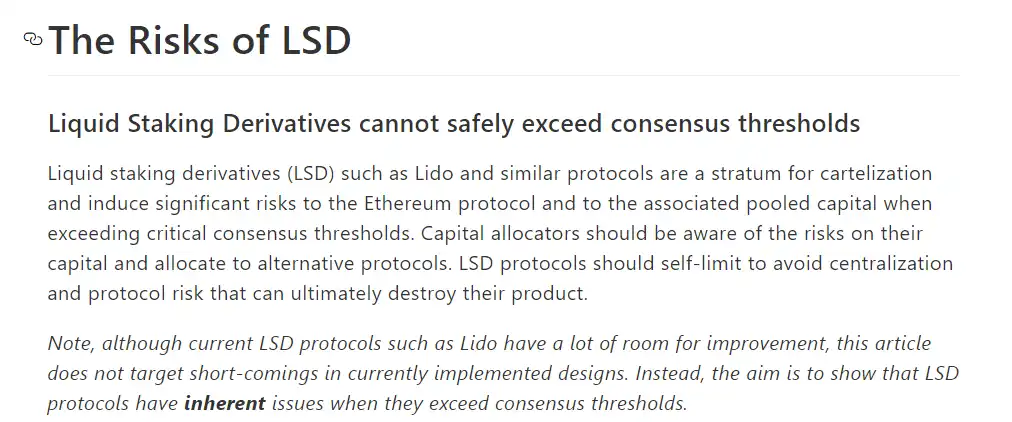
Danny Ryan, etheric workshop foundation - https://notes.ethereum.org/@djrtwo/risks-of-lsd
Looking at the different liquidity pledge agreements helps provide some interesting comparisons in terms of governance. Avoiding a tightly controlled and centralized structure, Rocket Pool operates through a rough consensus between different stakeholder groups. The overall protocol direction is driven by the node operator's DAO (pDAO), which is then changed by the core developer team.
The core development team has demonstrated a strong fit with Ethereum's core ethos in a number of ways. First, when core Ethereum developers changed Casper's pledge contract in late 2018, the team was willing to completely restart work. In addition, the team issued a statement of intent to impose a self-imposed cap on Rocket Pool's market share.
The actual implementation is controlled by a second external DAO (oDAO), which operates at a distance to review and operate protocol upgrades. oDAO is made up of major parties from across the Ethereum ecosystem and is tightly knit through a combination of three ties: financial bonds, considerable social capital, and a natural alignment with Ethereum's core principles.
pDAO 中个人的二次投票权与他们的验证者数量和 RPL 实用程序 Token 的上限数量相关联。这意味着个人通过参与网络并质押一定数量的 RPL Token 来获得投票权,而不是像 Lido 的治理结构中那样简单地持有大量 LDO Token 。这使得 Rocket Pool 的治理更加稳健,不易受到一小部分人的操纵。
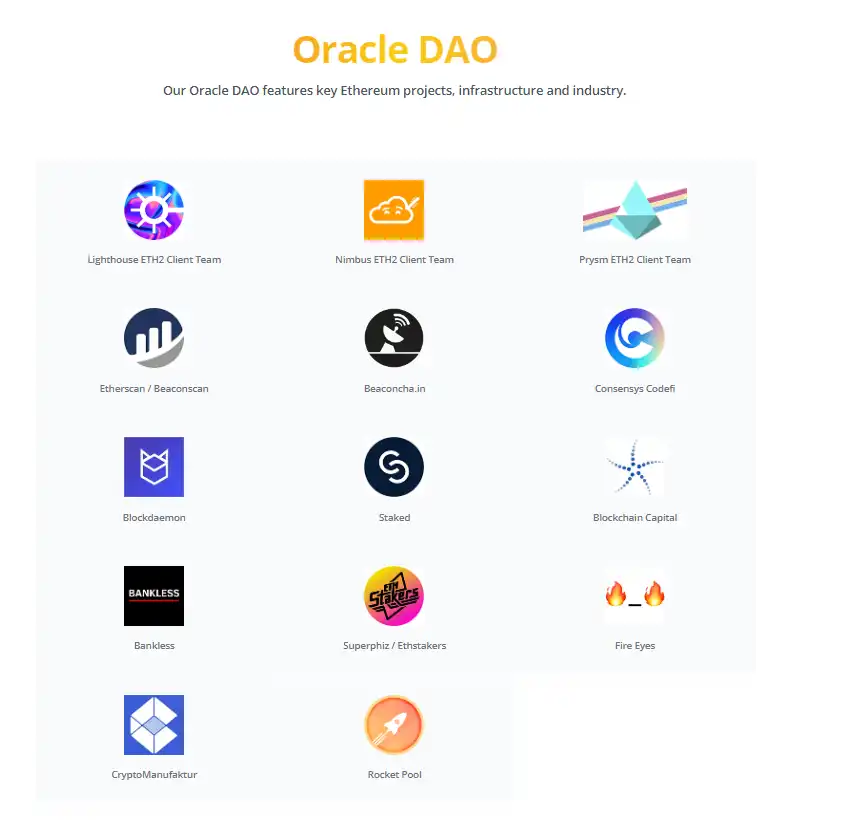
This multi-party governance system provides anti-vulnerability in the face of attacks. In fact, it reflects the rough consensus that Ethereum itself follows, where multiple different parties can signal to core developers, but no party can do so in isolation. Rocket Pool's governance is still in its early stages, but its methodical and deliberate progress towards full decentralization ensures that the agreement is unlikely to fall victim to social attacks.
Rapidly changing fee/incentive structure
Hasu & One of the governance red flags Georgios raised should lead to agreements like Lido self-limiting, namely that "fees... [should not] be allowed to change by manual input."
与此相反,Lido 的收费不仅可以改变,而且正在积极调整。虽然该协议的最高 10% 佣金率是稳定的,但这些资金的流动最近已从保险转向更通用的资金,用于其他用途,如营销。事实上,LDO Token 持有者在这一变化中投票可以加强他们的地位,同时使 stETH 持有者面临更高的风险,这引发了人们对 Lido 治理的有效性的质疑。Lido 的整个保险概况能够根据创始人核心团队决定的投票而改变,这是一个明显的弱点。

https://snapshot.org/#/lido-snapshot.eth/proposal/0xb99f87eb8e168b8ad28a70fabbe94fe5e0d9023b04c112331df0880480f96a63
一个相关的问题是链上治理的一般初期阶段。DeFi Token 充当有投票权的股份,但没有这些股份在传统金融世界中赋予其所有者的任何信息权。因此,从治理中获益最多的人(VC、其他协议)和最关心协议利益的人(创始人、活跃的社区成员)之间的信息不对称将导致偶尔的剥削性治理投票。
Venture capital firm Dragonfly attempted to sell LDO from the Lido Treasury to itself in a highly controversial vote. The vote was rejected due to strong public reaction. However, the DAO can't expect someone to sound the alarm every time a vote is taken and someone is playing dirty. The governance network is extensive, and all aspects of the Lido protocol affect each other indirectly. As long as capital flows remain flexible, the agreement will continue to be a focus of governance development.
Lido's panel, made up of 30 handpicked verifier companies, can respond very quickly to protocol changes, including adverse changes, leaving stETH holders little time to react. In contrast, Rocket Pool has a large number of node operators running validators. One benefit of this structure is that any attempt to change incentives will be slowed by gradual adoption. Take future changes to lower the ETH collateral in the mini pool. Because hundreds of carriers have to make upgrade decisions, the process will happen gradually so that rETH holders can respond. With only about 30 operators in one group, co-ordinated changes to Lido capital flows will happen more quickly.
Multichain dilemma
One advantage is that with a set of licensed companies operating Ethereum's majority of validators, profitable businesses will be more focused than home placers.
Lido's CTO even recently claimed that "[home stakers] running nodes for fun will drop them...... when it's no longer fun...... If your business [and] career depends on blockchain, you tend to be thoughtful and committed".
However, the obvious problem is that many professional validators of Lido provide services to several different chains simultaneously. This apparent conflict of interest raises questions about how loyal Lido really is to Ethereum.

The debate about Ethereum decentralization is sparked by comments from the Lido co-founder - The Defiant Shapovalov says Staking is for "hobbyists" thedefiant.io
In the event of a widespread technical outage event that takes multiple validators on multiple chains offline, it is unlikely that any professional operator will have the human resources to restart all chains at the same time. In one incident in September, 7,390 Lido Ethereum validators operated by BridgeTower Capital were offline for more than eight hours following a pre-planned Bellatrix hard fork.
If response times for pre-planned events on individual chains are so slow, think of how many hours or even days it takes them to recover from a real crisis, and how much it costs their liquidity pledgers. It also raises the risk of a more profit-focused or centralised blockchain, such as Solana offering monetary incentives to prioritise crisis management. This is akin to the fire department being bribed to respond to a fire in a particular neighborhood when the entire city is on fire. By contrast, the technical difficulties of personal pledge mean that family pledges are more likely to focus on single chains.
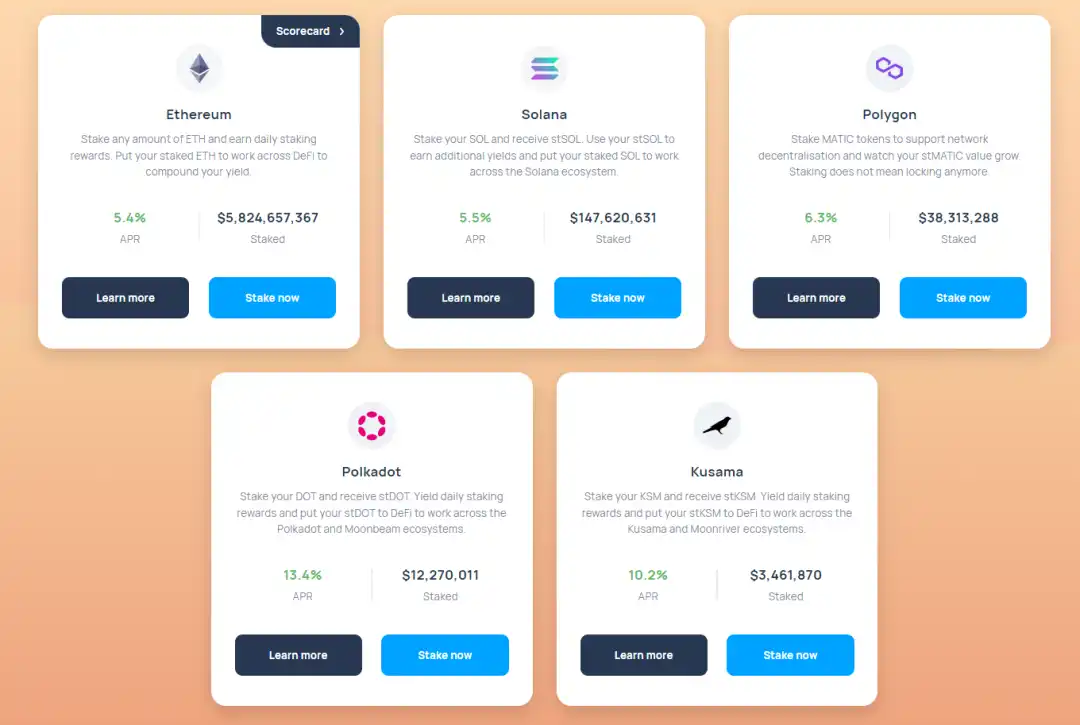
https://lido.fi/
But things could get worse. In a true doomsday scenario where multiple blockchains stop and need to be restarted, a high degree of coordination between verifiers is required. Trying to do this for a single blockchain is difficult enough, but managing multiple blockchains at the same time is nearly impossible.
In addition, the negative effects of multi-chain validation extend to everyday scenarios. Each chain for which a professional verifier is responsible has its own incentive structure. New incentives may be inconsistent with old incentives and vice versa. For example, being the majority validator in two competing chains and causing the smaller chain to fail or underperform is a problem for the more centralized, smaller Cosmos chain. As Lido continues to expand across chains without guidelines, users must begin to question Lido's consistency with Ethereum. Meanwhile, Rocket Pool only serves Ethereum, but users are free to run other validators on its hardware.
Verifier registry
Hasu & by Lido; Another red flag for Georgios governance is that Lido's "validator registry can be changed... by manual input." Despite the warnings, Lido's validator registry is still fully centralized and opaque. It's not hard to imagine that DAO members of Lido might be corrupt for personal gain. Examples might include requiring a verifier to engage in unethical value extraction on a large scale or to yield to pressure to review transactions. Despite the obvious security risks this poses, Lido still has no plans to extricate humans from this onboarding process. In contrast, Rocket Pool remains the only non-licensed pledge service for node operators. Anyone can be a node operator for a Rocket Pool, so the protocol is not subject to these centralization risks.
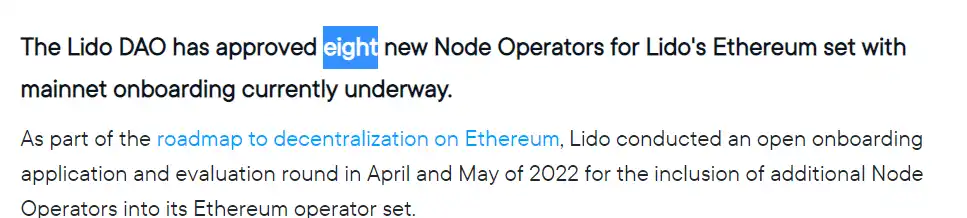
https://blog.lido.fi/additions-to-ethereum-node-operator-set-wave-4/
For these social reasons, the broad Ethereum ecosystem has shown increasing resistance to the dominance of Lido. With the DAO gaining power and Lido presenting unprecedented risk, future investors will be very concerned about social risk.
At this point, I'd like to step back and make a meta-point. Even if one disagrees with my view that Rocket Pool is superior to Lido in terms of broad governance resilience as measured by these social vectors, the difference in market share is unjustified. An individual who takes social risk very seriously will have approximately 50/50 rETH and stETH allocation to reduce risk. The issue of social pressure is most relevant to market leaders. So if I'm right about social issues, then rETH has an incredible tailwind, and if I'm (moderately) wrong, then rETH still has a big tailwind.
I believe that while these social factors are important, they are still complementary to economic forces. While Lido's online ratings soured, 3AC's capitulation and subsequent massive stETH liquidation cascade introduced a new element to the stETH market for the first time -- risk.
3-stETH growing economic headwinds
由于大量的流动性储备和 Token 保持挂钩的历史,许多散户投资者被哄骗,认为 Lido 的 stETH LSD Token 总是可以兑换成 ETH。正如在这种情况下经常发生的那样,这种看法被利用了,导致过度杠杆化的 stETH 的价格与锚定汇率相比暴跌了 -6.6%。虽然以挂钩定价,但需要很大的力量来克服 Token 的惯性并导致这种下跌——在本例中是 3AC 破产——但同样的惯性意味着不能保证恢复稳定,只能通过巨大的努力才能实现.
Pledge -- No risk or risk cost?
A variety of different LSD tokens fluctuate around their peg or reference price. Coinbase's cbETH, followed by stETH, and the largest and most persistent pegged discount is Rocket Pool's rETH, which has been trading at a premium since the merger. The ongoing stETH decoupling can be traced to the fact that hundreds of thousands of tokens were minted by leverage and subsequently sold into the secondary market, driving down prices. Because every lever-minted stETH is eligible to redeem ETH, the Lido loosely participates in fractional reserve banking by facilitating the creation of more deposit receipts than deposits.
Nansen's analysis of stETH's -6.6% decoupling event during the 3AC capitulation shows that most of the sales came from big wallets, while the buying pressure came from smaller retail investors. Thus, stETH's price deviation from the peg represents a risk discount or the possibility of a bank run on the Lido from small retail ETH deposits. Thus, the price at which retail investors are willing to buy stETH accurately reflects the market risk associated with stETH.
On the other hand, anyone who bought stETH shortly before the crash would have seen about 18 months of supposedly low-risk returns disappear in a matter of days - and it is important not to underestimate the scale of this decoupling. During this event, it became apparent that few considered stETH to be a risk-free package for future ETH redemptions.
It is worth noting that rETH also decoupled at the same time, but to a much lesser extent, and recovered more quickly. ETH mortgages have a lower APR than the other pathways in DeFi, so losses are more painful because they are harder to earn back. In such a capital-intensive, low-yield environment, proper risk management is critical. Fortunately, the market has more or less priced all LSD tokens as a function of perceived risk through their degree of "decoupling." From this pricing information, we can draw conclusions about the risk of LSD tokens.
The natural question is, where does this risk come from? It can be divided into three broad categories: execution risk, tail risk, and centralization risk. I will demonstrate that Lidos are dangerously high risk in the latter two categories, which can be calculated by comparing execution risk between tokens.
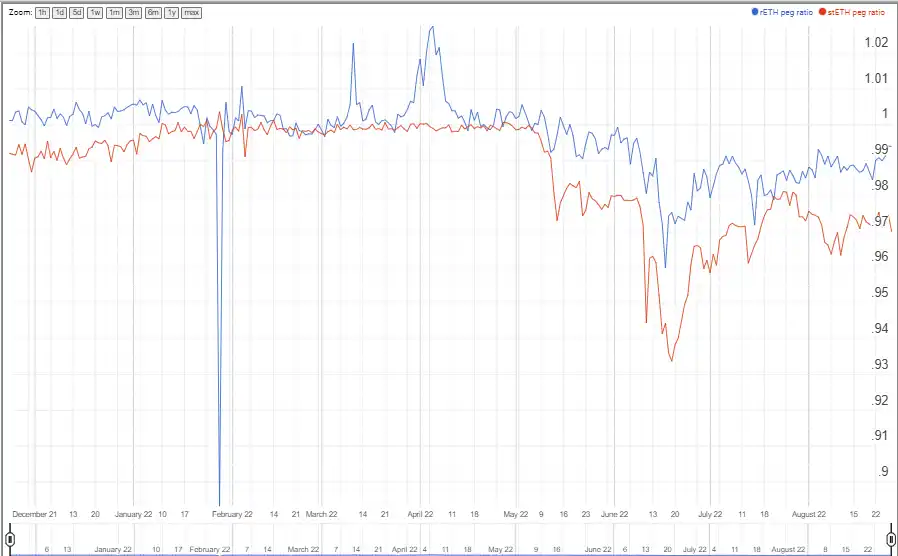
Data provided by valdorff.eth - range focused on May crash. Note the adulterated insistence on 1 ETH hook stETH before sudden capitulation
Execution risk
I define execution risk as existential threats to the agreement arising from necessary upgrades in the future.
Some of the marginal risk between tokens can be assigned to the individual protocols themselves, and is largely related to the breadth and complexity of the individual smart contracts. Upgrades to Ethereum itself fall into this category, and therefore apply equally to all LSD protocols, as they are equally at risk of hard fork failure. The successful completion of The Merge demonstrates the role of execution risk. After the merger, stETH depeg dropped to 1% and rETH reached parity. It can then be inferred that a large part of the remaining decoupling is now due to centralization and tail risk.
Tail risk
Next, tail risk refers to a range of potential governance abuses and events that can occur on or off the chain, such as smart contract exploits, cuts, secondary leaks, hardware failures, and custody errors. These events are difficult to predict and occur infrequently, but are important to consider in risk management because of their potential severity. In addition, the resilience of an anti-faltering DeFi primitive like wETH should be measured by its ability to withstand worst-case scenarios.
In the Ethereum ecosystem, penalty events for node operators (such as offline losses and cutbacks) are proportional to the number of validators involved. Each of Lido's node operators manages thousands of verifiers. As a result, protocol-wide tail exposure is higher with each operator running a smaller number of validators than with a more decentralized set of operators. In other words, Lido is putting a lot of eggs in a few baskets.
In addition, Lido does not have enough insurance to cover the worst-case scenario and has even started to move money out of its small protection fund of about 5,000 ETH. If losses exceed this amount, they are spread among all stETH holders. In contrast, other LSDS such as rETH and sETH2 offer a higher degree of protection, although only rETH offers real tail risk protection through substantial excess collateral. To properly compare how different LSD tokens provide insurance, see dabdab's analysis.
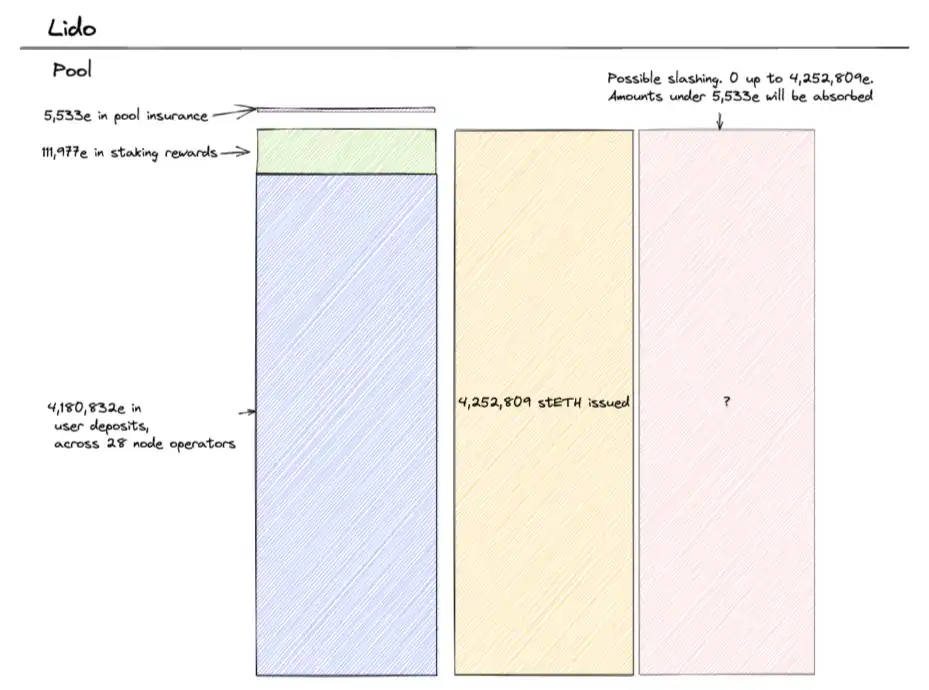
Supplied by Dabab.eth - Note that the entire stETH supply is almost uninsured
To make matters worse for Lido, there is no path to resolving the substantial dependence on earlier Lido node operators in the short term. The BridgeTower Capital incident mentioned earlier shows that Lido operators are protected even if they underperform. These carrier managed pledge ETH cannot be drawn at this time. It is not possible to mitigate this risk through diversification by adding additional node operators, as it only leads to an increase in the third and final category: centralization risk.
Centralized risk
While the above two categories are bad enough for Lido itself, any event that occurs in any event that is supposed to be a DeFi primitive has the potential to get worse, with repercussions throughout the entire industry built on it. This is an example of centralised risk, where execution risk and tail risk have a greater impact as the size of any agreement grows.
Since Lido refuses to set any self-imposed cap on size, it may one day hold the vast majority of pledged ETH. As a result, any failure within Lido spills over and affects the entire Ethereum ecosystem. This risk should manifest itself in higher selling pressure as Lido's market dominance increases. Even if governance risks are addressed, the emergence of a supermajority of Lido risks could still generate this selling pressure. In a risk-off or volatile market scenario, the widening gap between stETH and other low-risk assets such as rETH represents a market "risk off" to potentially adverse scenarios that could befall Lidos.
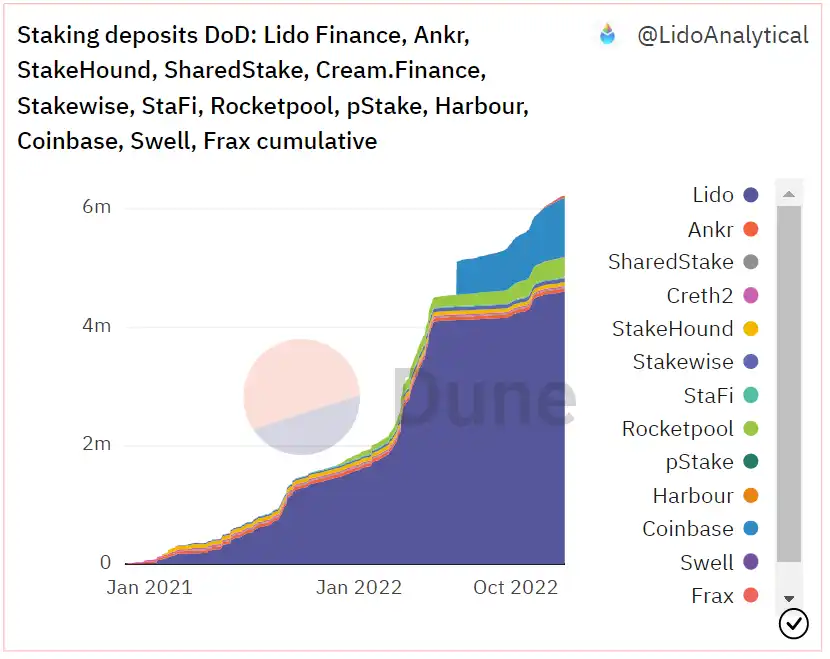
https://dune.com/LidoAnalytical/Lido-Finance-Extended Lido: 4.6 m ETH, Rocket Pool: 330 k ETH
stETH accounts for over 30% of all verifiers and 75% of all liquid ETH, an order of magnitude larger than rETH, accounting for 1.5% of all verifiers and 5% of liquid ETH. Although Lido does not yet have an absolute majority of all ETH, they voted against self-capping and maintained a peculiar, perhaps unnatural, lead.
To review, rETH's execution risk, tail risk, and centralization risk are much lower than stETH's, as evidenced by rETH's continued premium demand for stETH. In terms of execution risk, Rocket Pool handled the merger well, while one of Lido's main node operators experienced significant downtime. As highly complex merges complete, the impact of future upgrades is likely to be minimal, and therefore the relevance of execution risk is minimal. However, Lido still faces slightly greater execution risk because the concentration of validators means that any errors are more costly, as the BridgeTower incident points out.
rETH is much more insured than stETH in terms of tail risk, with all deposits now more than 100 per cent over-collateralised. This will prevent almost any serious cuts unless there is an entire ecosystem failure. As a result, rETH holders are unlikely to take a hit. In addition, upgrades to Rocket Pool smart nodes are opt-in, so the overall system propagation is gradual enough for risk-averse operators to wait for any errors to occur. This also means that the Rocket Pool node can run indefinitely without any upgrades from the core team. However, oracle DAOs do represent a centralized source in the protocol. If the oracle DAO is compromised, rETH could suffer significant losses as oracle data is manipulated. Such an attack would require the coordination or compromise of a majority of the public, doxxed, oDAO, and Ethereum aligned participants. I will elaborate on this in the Rocket Scientist Reflections section.
Finally, in terms of centralized risk, rETH is a minor player in the ecosystem, and the development team and community have expressed support for limited equity. In terms of risk reduction, rETH is the clear leader in LSD. Thus, the only remaining challenge is how to technically expand the Rocket Pool to meet the requirements of being a core DeFi asset. I call this process the Orange Cascade.

Anthony Sassano, turned orange by The Rocket Pool's mighty power, The Daily Gwei #332 https://youtu.be/x_I8WF5Vk9U? t=705
4 - Orange cascading
I will now discuss how stETH's market share has fallen from a near monopoly to less than a majority. I begin by reviewing the social and economic pressures driving stETH and providing a tailwind for rETH. I then detailed the factors that allow rETH to expand before making a withdrawal. These factors are primarily ways to expand and improve the node operator experience, including reducing ETH bonds, MEV smoothing pools, rescue nodes and Rocketarb. Looking ahead, I discuss the importance of withdrawals and independent staker migration, stETH/cbETH flight, and liquidity migration. At this point, rETH should be able to expand to millions of ETH pledged. However, the post-withdrawal future is brighter thanks to native Pledge as a Service (StaaS), Eigenlayer, forced exit, and Distributed Validator Technology (DVT). These technology assets will allow rETH (Ethereum's healthiest LSD) to have the desired 22% of pledged ETH, regardless of the total percentage of pledged ETH.
Orange creep. - Before the withdrawal
Paradigm's researchers suggest that the first socially scalable and MeV-friendly LSD could quickly attract the Lindy effect and dominate in a power-law distributed fashion. I think the growth of Lido was so aggressive that what was supposed to be a power-law area became a single market, in which stETH accounts for more than 90 per cent of LSD's market capitalisation in DeFi. Socially and economically, there is growing resistance to this stETH dominance. Ultimately, most ETH remains unpledged and more money is expected to enter in the coming months. There will be a more rigorous focus on tail risk scenarios as markets become more aware of risk than during the boom years of 2021.
Since stETH's inflexible and inadequate insurance has been transferred to general "financial" use, Lido will find itself unable to safely expand further. stETH may have reached its relative peak. As far as social barriers to growth are concerned, Lidos rely too heavily on corrupt white lists for governance. Economically, the liquidation cascade that collapsed in June and continued decoupling prove that stETH actually has greater centralization and substantial reduction risk than other LSDS.
One major cutback event in any one of Lido's node operators will permanently reduce trust in the system - because over a long time horizon, it becomes a question of when are large investors willing to participate? There is already evidence that shaken confidence in the broader market can wipe out years of gains. How bad will the impact of a particular Lido event be? What happens when mass stETH rebalances to red? It may be necessary for ecosystems to learn lessons through major sequestration events, but the pressures remain.
Even if Lido tried to increase stETH's LSD dominance through distorted incentives, better alternatives offered by competitors would most likely return the market to a traditional Pareto distribution.
Rocket Pool is already the most tail-risk resilient, socially scalable, and MeV-friendly decentralized LSD protocol. It makes sense to be the one who benefits the most. The pre-withdrawal era will also be marked by 8ETH Collateral Reduction (LEB8s), which lowers collateral requirements to 8ETH per mini Pool, and quality of life upgrades, which offer a unique way Rocket Pool provides the best experience for node operators.
The power multiplier on the LEB8s is enough to triple the rETH power supply alone. Each group of 16 node operator ETH will generate 48 rETH, whereas previously it would only generate 16 rETH. The real significance, however, is that it lowers barriers to entry. There are many more people willing to bind to 8 ETH than 16 ETH, so we can expect more growth despite the expected threefold increase.
Quality of life improvements will proliferate during this period, such as MEV smoothing pools (the only way for small node operators to get EVs equal to those of larger operators), Rescue Nodes and Rocketarb. Collectively, these exclusive features will attract node operators to the Rocket Pool and expand rETH offerings. The MEV smoothing pool is an opt-in system in which each node operator shares MEV + tips with each other. This gives all participants a higher chance of being exposed to long-tail MEVs, which can often make up a large part of the returns.
Ken Smith of the Rocket Pool community offers an analysis here:
GitHub - htimsk/SPanalysis: indicates the statistical analysis of smooth pools in the Rocket Pool.
Rocket Pool Statistical analysis of smooth pools.
- GitHub - htimsk/SPanalysis: Statistical analysis of Rocket Pool Smoothing Pool.
With hundreds of node operators involved, it is a powerful entity in its own right that can make it profitable for other large entities to join. This in turn will attract larger players into the ecosystem and expand rETH supply.
Rescue Node is a community-led project that will allow any Rocket Pool node operator to utilize the auxiliary beacon node as a backup. This is useful during pruning or minor interruptions. Normally, this is tricky and expensive to set up because it is an unusually redundant amount, but the Rocket Pool network will quickly make it available to all node operators in the network at no extra cost. There are currently some assumptions of trust between the user and the rescue node maintainer, however, the maintainer is all public. In addition, rate limits are in place so users cannot over-rely on the rescue node as a centralized delegate node.
As a direct result of the rescue node, the overall performance of the protocol will be significantly improved. Customer outages will be reduced, resulting in higher returns for rETH. In addition, downtime can be daunting for new node operators. The presence of rescue nodes makes Rocket Pool a more forgiving learning environment without sacrificing performance. Even for experienced users, knowing that any planned or unplanned downtime may no longer correspond to lost revenue is a huge benefit to quality of life. Most importantly, making node operations more accessible to users of the Rocket Pool ecosystem will attract new members and increase TVL.

Finally, Rocketarb is a way to profit from the public market premium rETH currently enjoys. The supply of rETH is limited by the node operator and the deposit pool is full of 5k ETH. When a new mini ore pool is started up, 16 ETH worth of rETH will be minted at the original asset value. If you manage to mint 16 ETH worth, you can make a profit of 16 x 2-3%, or 0.3-0.45 ETH. Rocketarb contracts bundle the creation of a mini mine pool with the casting and sale of rETH so that node operators receive a mini mine pool and substantial bonuses for expanding the supply of rETH.
rocketarb/README.md is at main · xrchz/rocketarb
Arbitrage rETH mint/burn with minipool deposit/withdrawal - rocketarb/README.md at main · xrchz/rocketarb. Arbitrage reth Mint /burn with minipool deposit/withdrawal - rocketarb/ readme.md at main · XRCHZ /rocketarb
When the demand for the product increases, the contract gives people an incentive to add more rETH, which was not there before. The opaque value generated by excess demand in the open market can now be captured by agreement as an incentive to grow in a healthy way. So when stETH holders flee to rETH, as has happened many times before, there is now a way to capture this in the form of TVL growth without any inflationary incentive.
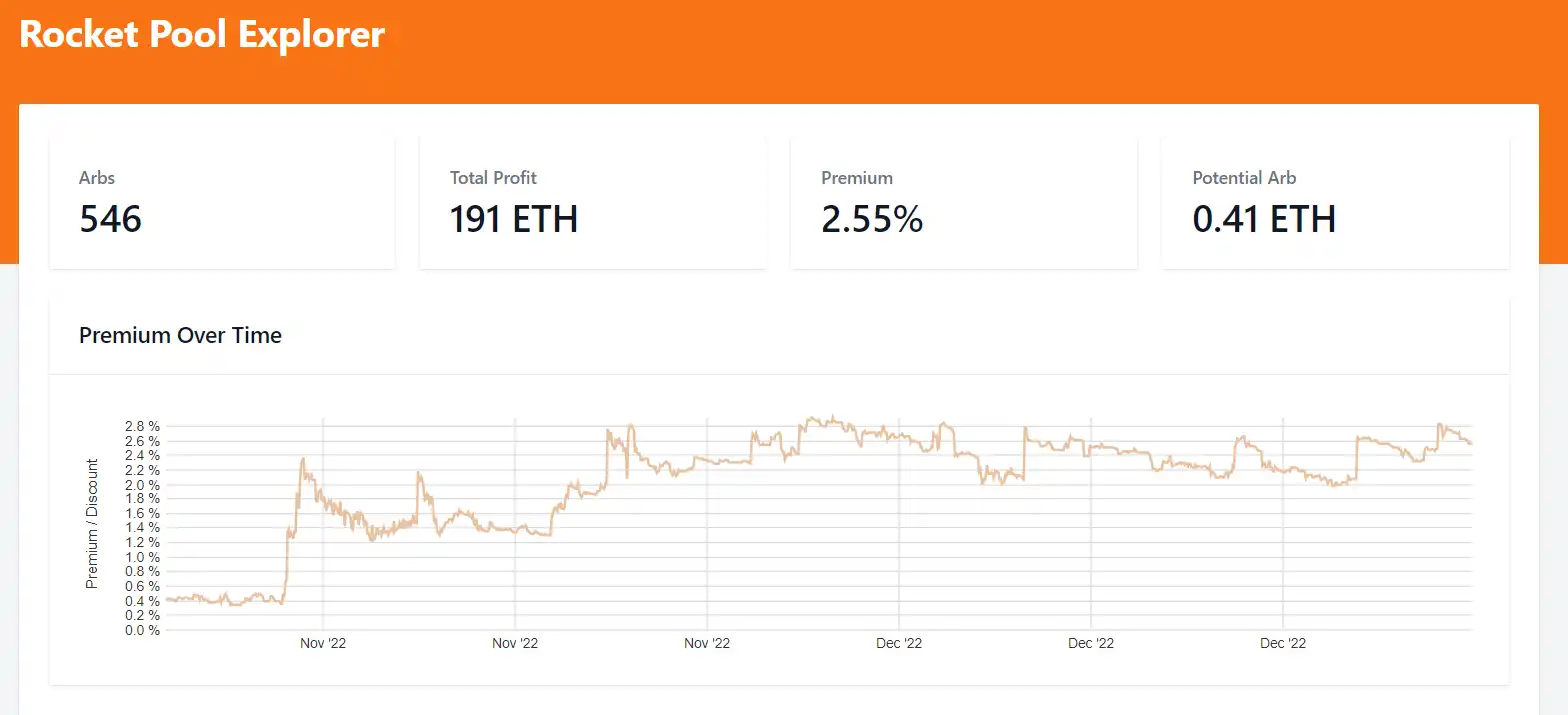
https://rocketscan.io/rocketarb
Rocketarb is also a glimpse into the future. After withdrawals, arbitraging the LSD back into hooks can be a very profitable business. The incredible work of the Rocket Pool community is simply to find a way to get this benefit before withdrawals go live.

To be on par with another Web3 power struggle, Sushiswap was never able to flip Uniswap, despite its launch with much fanfare. But at the same time, Sushi has never been able to offer a convincingly better product, which may explain why it was able to break UNI's monopoly on dex volume without making further headway. It has been established that Lido's stETH is opposed by social and economic forces, with mobility and the Lindy effect underpinning its dominance. But with the emergence of a level playing field among mature players, Rocket Pool's superior social narrative and higher resilience could propel rETH past stETH's market cap. The trend line for the original DeFi asset is toward maximum security. This is how rETH will flip stETH.
Orange Immigrant - Withdrawal
Over the next six months, withdrawals are likely to come online, and rETH will get three big unique boosts: a separate staker migration, an escape from stETH/cbETH, and liquidity relief.
The first users who were able to transfer their money to the Rocket pool after making a withdrawal were individual pledgers who made deposits prior to the launch of the Rocket Pool at a later date. There is a strong economic case for converting a single conventional validator into multiple mini-pools (at least four for withdrawals) and earning commissions on liquid pledged deposits. A person with 32 ETH pledges can migrate and access 128 ETH. A Smoothing Pool is another benefit unique to Rocket Pool node operators that not only reduces the volatility of rewards, it also increases average returns for most participants. Quality of life upgrades will continue to roll out.
It is estimated that about 30% of the existing shares are managed by these early node operators. Most of these ETH were launched before the Rocket Pool came online, and certainly before it was considered battle-tested. Despite pledging so much ETH before Rocket Pool is ready, Rocket Pool node operators still account for 15-25% of all node operators on the network. More and more new node operators are choosing to use Rocket Pool instead of vanilla or other services. So it's reasonable to assume that a large number of users who were mortgaged prior to Rocket Pool's launch will want to migrate over. Immigration will mainly affect the supply of node operators, which will magnify the growth of TVL. If 10% of the approximately 4.2 million ETH earlier individually pledged ETH migrated to LEB8, the rETH capacity would increase by nearly 300%. The deal will be able to handle 1.7 million rETH TVLS. This capacity will be needed in view of the second wave of migrants.
The second group of migrants will come from stETH and cbETH. Being able to convert LSD into ETH without having to perform a secondary market sale means that investors can immediately adjust their risk allocation without having to worry about liquidity. If the facility becomes available during the 3AC crash in June 2022, Lido's TVL could collapse significantly. In fact, the sharp decline in the prices of stETH and ETH and the fear of a decline in the larger portfolio are the two restraining factors preventing investors from selling their stETH positions at a loss. I expect several groups to experience this transition for different reasons; Moral shift, as a response to the pruning event or hacker depegging steth, or perhaps a search for gains.
Finally, and perhaps most importantly, withdrawals would cause the cost of maintaining adequate LSD liquidity to plummeet, thus eliminating one of the strongest advantages of Lidos. Natural arbitrage can be achieved by buying and redeemingmispriced LSDS. Rocket Pool has proven the value of this in the deposit pool, where the minting and destruction of rETH helps keep DEX prices stable. Liquidity can be tightly concentrated around net asset value and provides a strong guarantee that arbitrageurs will remain tightly linked.
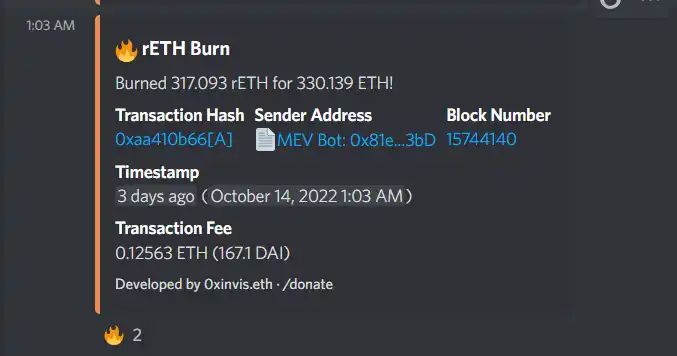
Taken from the #events TAB of Rocket Pool discord
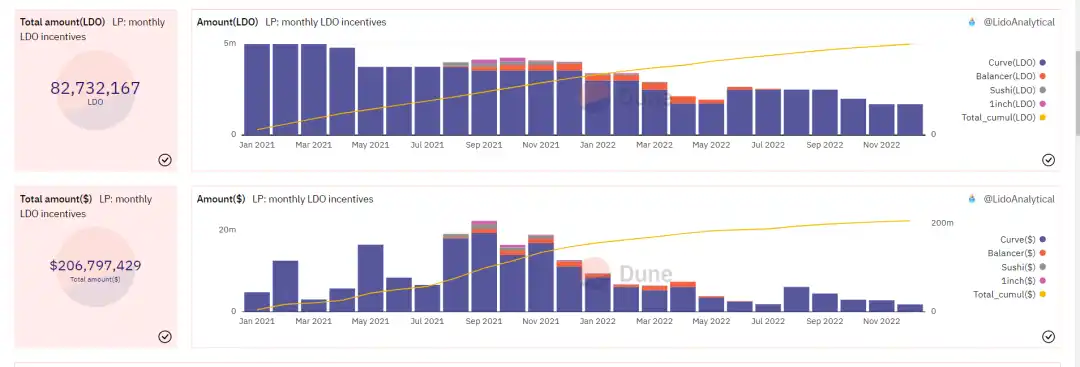
If Ethereum itself supported such arbitrage opportunities, liquidity costs would be significantly reduced, leveling the playing field for all pledge agreements. Suddenly, Lido was getting liquidity from its multi-billion dollar Curve pool at a monthly maintenance cost of 20MM, [Edit: This was true at the peak of the bull market, and as of 22 December, it had fallen to 2MM as a reflection of the bear market. Since then, the number of Ldos for the Curve has only halved] will be freely available to all via exit queues. MEV robots will patrol LSD prices, hoping to squeeze out any ETH for themselves. The type of clearing that previously saw stETH's price spiral will now only create a feast for arbitrageurs as market prices barely move. A Lido-licensed set of carriers can accept new Ethereum deposits as soon as the Ethereum network allows. However, just as Lido is a black hole to ETH, it may eventually follow the path of a black hole and return that part of ETH entirely in the future.
Once the ability to enter and exit LSD locations becomes negligible, expect a proliferation of Lido competitors to be integrated into DeFi applications. Moreover, and perhaps more nefarious, a reduction in the baseline risk level of all LSD tokens would stimulate leveraged pledges. Each LSD will be as easy to fold as the icETH, packing the lever stETH. While these tokens promise incredible returns, they introduce significant risk to the market. The exit queue is not infinite and we may see a second, larger leveraged mortgage boom. If this is to go through, the fallout and dust will favour the most resilient assets.
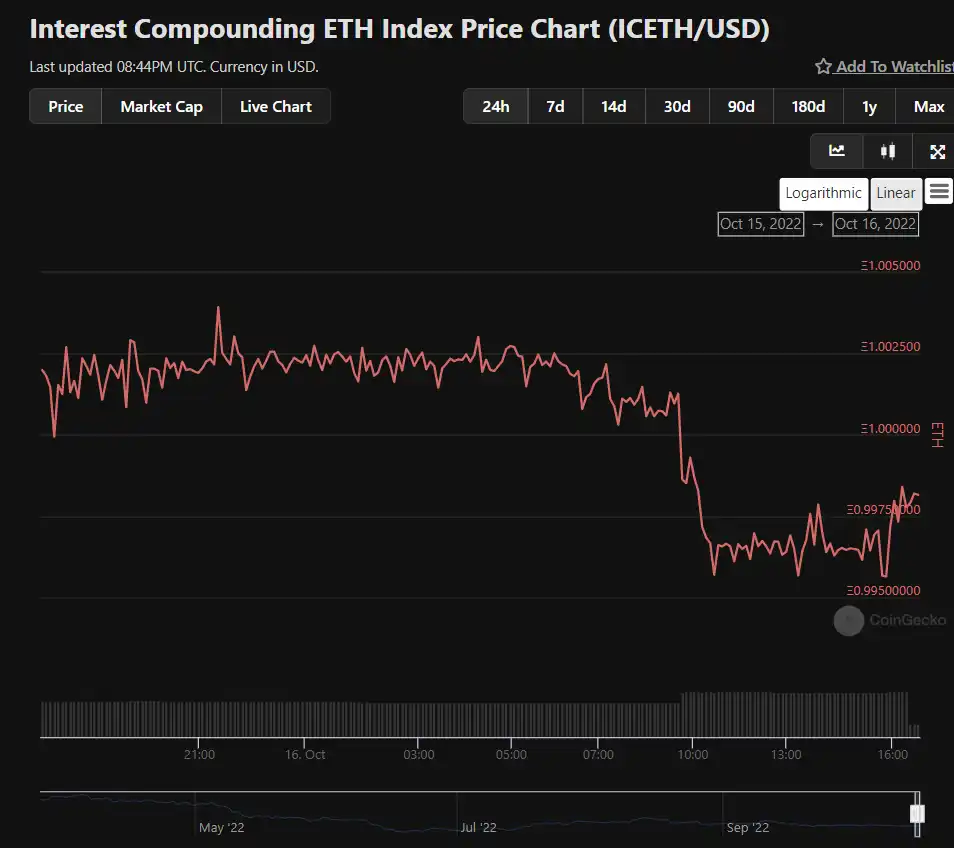
icETH uses stETH against ETH to increase the rate of return on pledge
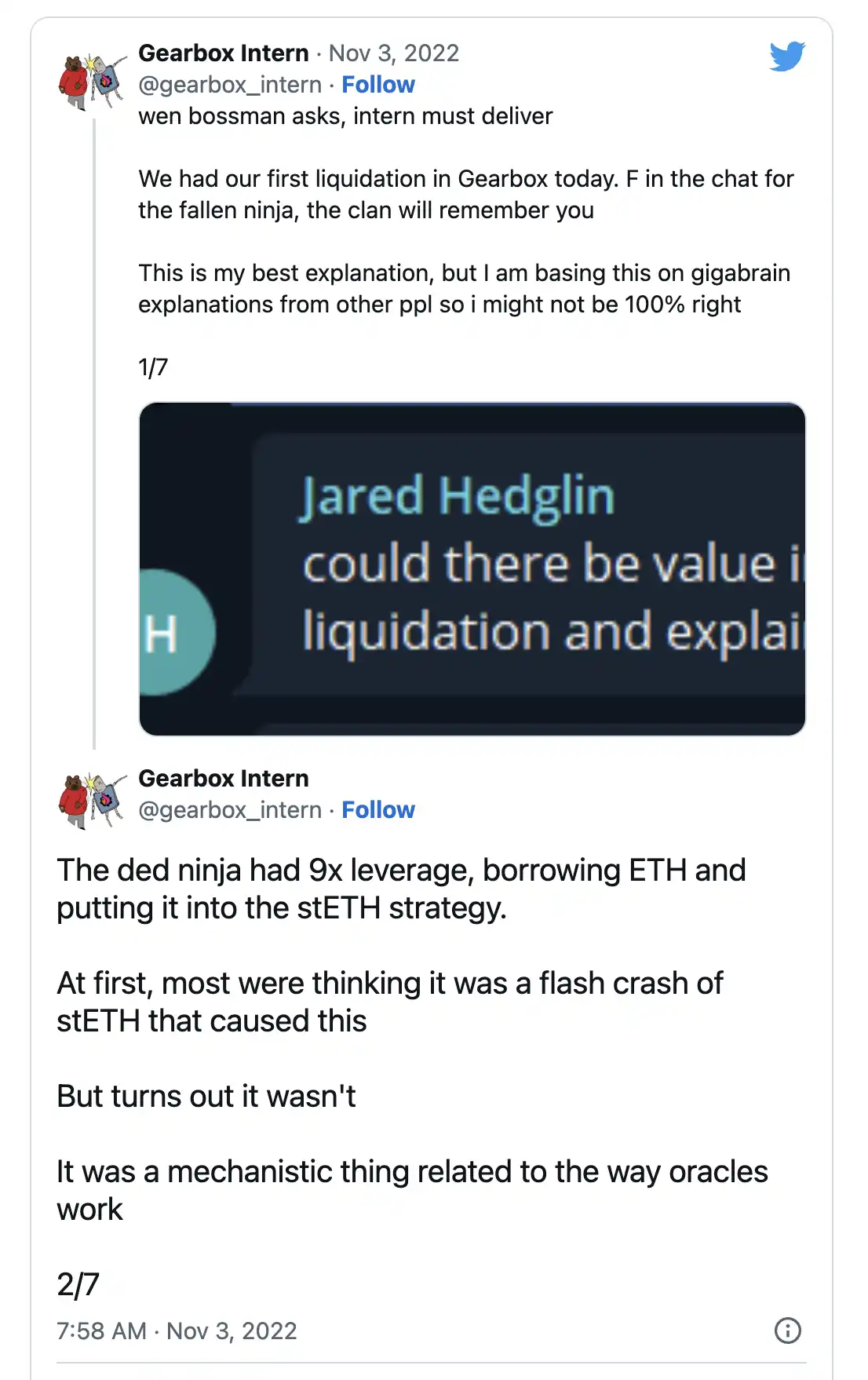
In fact, with the development of the new leverage strategy, the first batch of liquidation cases of stETH depegs began to gradually increase. For example, the Gearbox protocol creates generalized leverage. One user is long stETH/ETH 8x using this generalized leverage. A slight reliance on stETH and some oracle technical details resulted in this user's location being the first to be liquidated on the Gearbox agreement. Greed will drive users to chase seemingly safe returns with LSD tokens. The most resilient LSDS will be spared.
Orange Future. - After the withdrawal
Rocket Pool's big future is exciting. The path to a world-dominant deal is clear, and they involve four major upgrades that will happen at some point after the formula. These upgrades, in roughly the order we're likely to see them come online, are Native Pledge as a Service (StaaS), Eigenlayer, forced Exit, and Distributed Validator Technology (DVT). Together, these upgrades will enable the Rocket Pool to scale up to millions of ETH pledges.
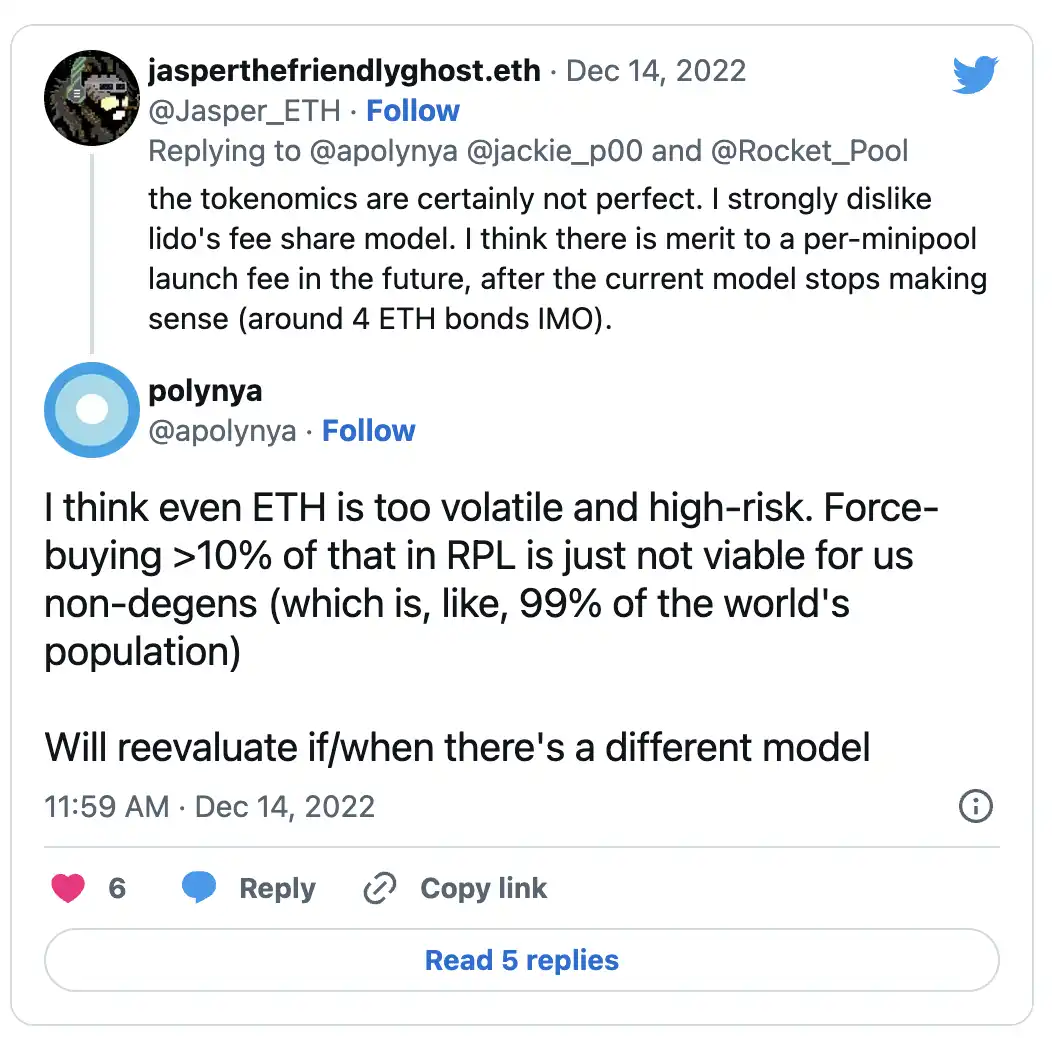
One of the most prominent criticisms of the Rocket Pool system is that it forces node operators to speculate on RPL. Many family pledges participate because they are suspicious of other tokens, so this is a big hurdle. In addition, holding an RPL becomes a problem for some larger institutions. As a result, the Rocket Pool team has designed an upgrade that will introduce super nodes, thereby creating a new relationship between node operators and ETH and RPL collateral providers. It will introduce an in-protocol approach to separating the risks of three parts: node operations, ETH, and RPL. Rocket Pool will greatly expand its Total Addressable market (TAM) as many people have expressed a desire to mortgage ETH only and not wish to expose RPL and vice versa. The StaaS design will allow third-party groups such as node operator associations to join these users and transfer the burden of RPL collateral.
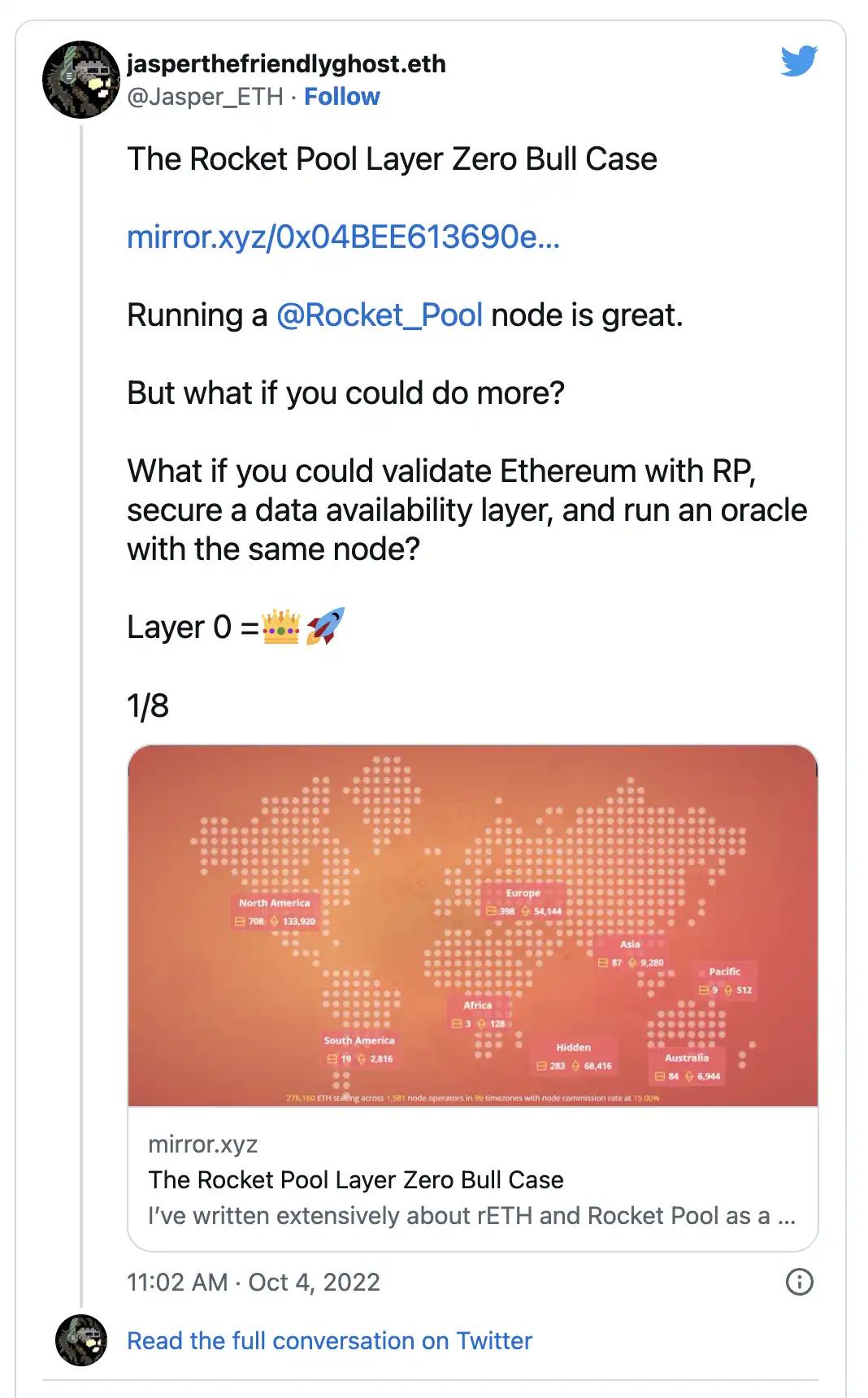
Eigenlayer represents a novel idea - pledge remortgage. The general idea is to add new reduction criteria to the ETH shares of the node based on the added tasks (such as oracle responsibilities or data storage). This would allow the market to reclaim the incredible economic security locked up in deposit contracts. The Eigenlayer team is developing a data usability layer for the initial product design, but is exploring other forms of implementation. In a sufficiently developed market, a savvy node operator may be able to earn several times as much as the native ETH by taking on the additional burden.
There are likely to be many custom Settings in the future, with some node operators taking on pure ETH pledges and others taking on a dozen additional responsibilities. This presents challenges for centralised operators such as Lido and opportunities for license-free operators such as Rocket Pool. For Lido, there may be a need for a long-term governance process centered on safe use of Eigenlayer applications and an acceptable level of risk for DAOs. stETH's APR will suffer as a result. For the Rocket Pool, users may be free to experiment.
Rocket Pool and Eigenlayer continue to talk about how to integrate the two agreements in a way that makes profit-sharing with rETH easy. This relationship between Eigenlayer and Rocket Pool is mutually beneficial. The Rocket Pool ecosystem is the most widely distributed node operator market on top of Ethereum. Any Eigenlayer product that wants strong decentralization right away can target Rocket Pool operators.
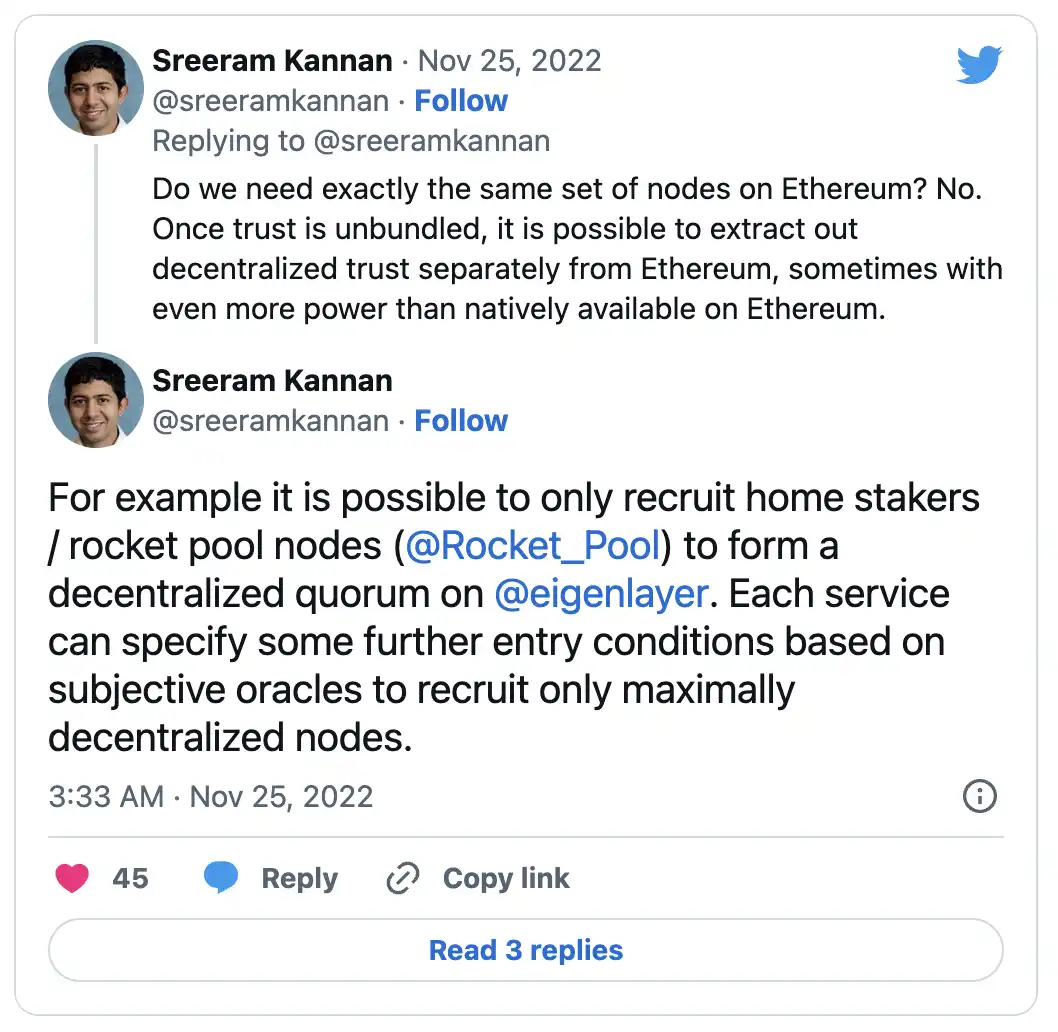
Another future upgrade is forced exit. Currently, the Rocket Pool cannot force a verifier to quit. This is a restriction of the Ethereum specification that requires an EIP to change. Forced exit is a useful feature for all LSD protocols to increase decentralization and security. So it's working together. Mandatory opt-outs will help prevent bad actors and increase the value of retention when actors go rogue. Therefore, including a forced exit may cause the Rocket Pool to lower the margin requirement all the way down to 2 ETH. This is a big change. In the long run, if every current node operator switched to the 2ETH Pool, that would give the Rocket Pool the capacity to carry 15 times as many rETH, or 2.4 million rETH. Currently, a 16-node ETH generates 16 rETH, but with the mandatory exit, a 16-node ETH will hold 240 rETH.
A drop in collateral from 16 ETH to 2 ETH will also mean a substantial increase in the node operator base. If this drop is 4 times on a node basis, albeit 8 times cheaper, then the Rocket Pool will expand to 10 million ETH.
Last but not least is distributed Validator technology (DVT). In the past, I've been critical of DVT because I don't think it's a solution to the centralization problem. Lido's long-term plans center around DVTS, which I don't give a shit about. The premise of DVT is that several "committee" members each run a node. If a node fails for whatever reason, nothing happens because only some consensus threshold of the committee is needed to maintain uptime. There are huge benefits to be gained. DVTS can prevent outages or slash much of the damage, but there are some important things DVTS can't do.
DVT by itself does not mitigate centralization. For example, if about 30 node operators of the Lido network start operating on the DVT board, stETH tokens will have better uptime and reduced tail risks, but centralization and some tail risks, such as smart contract risks and secondary leaks, remain. In addition, DVTS related to MEVs are an area of open exploration. One of the main reasons for offering Rocket Pool bonds was to provide some compensation for MEV theft. If stealing MEVs at the cost of bonds is trivial, then starting mini mining pools and abandoning them after receiving a large MEV payout is probably +EV. These issues must be resolved before they can be adopted by large protocols.
For Rocket Pool, DVTS represent exciting technology that could lower the price of bonds and improve the overall efficiency of the pledge. Overall, the average uptime of home stakers tends to be slightly lower than that of institutional stakers, often due to erratic Internet or electricity, but DVTS can even greatly improve the playing field.
Overall, the post-drawdown era will ensure that the Rocket Pool can scale to whatever level of demand is required and that node operations and liquidity pledges are competitive in the broader ecosystem. This timeline shows that one of Rocket Pool's biggest criticisms, namely that capital is inefficient, is moot. Rocket Pool can and will scale up to challenge Lido and Coinbase.
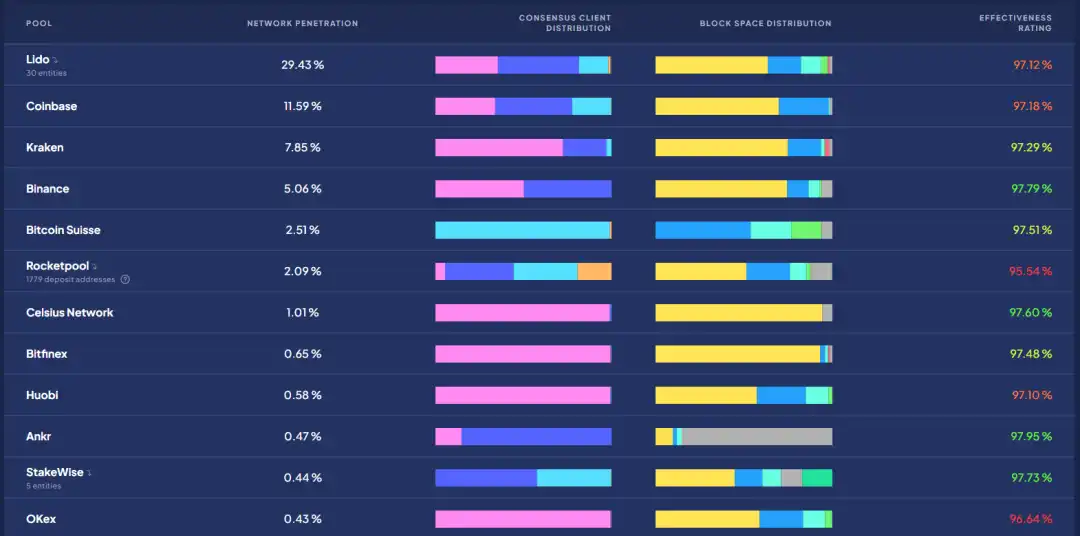
https://www.rated.network/?network=mainnet& view=pool
5 - New Challenger arrives
The history between Lido and Rocket Pool is well established at this point. However, the LSD ecosystem is expanding rapidly, with a new generation of players following stETH and rETH. In this section, I'll break down the other major LSD tokens, which I think will compete for the majority of the total shares. These tokens (cbETH, frxETH, and osETH) all embody different approaches to pledge, and all have their own drawbacks. Finally, I took a critical look inward and discussed areas where Rocket Pool could be improved.
The loss of cbETH
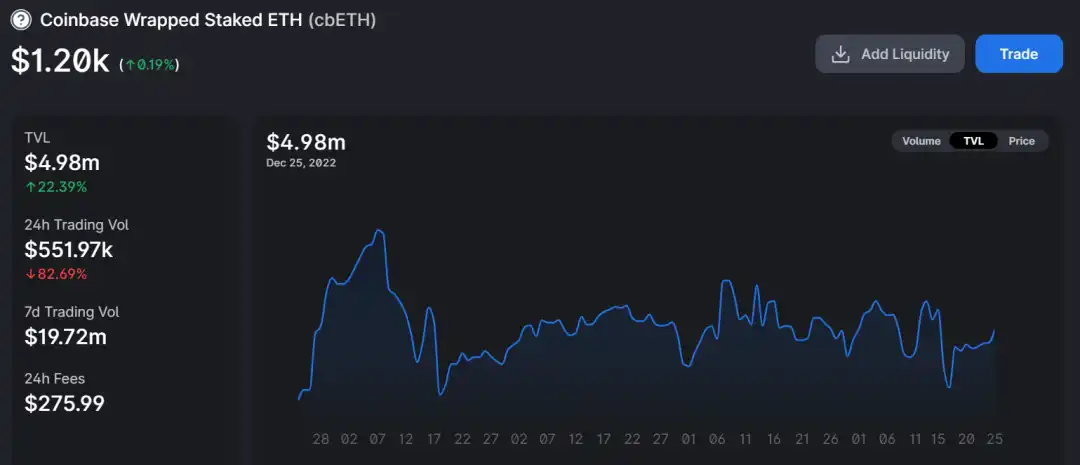
https://info.uniswap.org/#/tokens/0xbe9895146f7af43049ca1c1ae358b0541ea49704
Hasu and Georgios argue that centralized exchange platforms (CEX) staking a dominant position in the Ethereum staking market can only be avoided if competitors are focused on scaling quickly. Lido interprets this as prioritising growth over decentralisation. But oddly enough, the launch of Coinbase's cbETH LSD actually provides a useful demonstration of how market participants will graven toward the most decentralized option when there is no incentive.
Currently, cbETH is mainly used for Uniswap. About $6 million is locked up in the cbETH/ETH 0.3% and 0.05% pools, which reflects the lower daily volume as the total value of cbETH is many orders of magnitude larger than this TVL. Uniswap is firmly permissionless and easy to use, so it's logical that this is where most cbETH will end up. Outside Uniswap, adoption rates have been low. Curve, stETH's dominant dApp, used to have only a few hundred Beth in its cbETH/ETH pool. With the help of some incentives in the Curve protocol, it has grown to a still paltry 2000 ETH TVL. This suggests that without a strong liquidity incentive campaign or supportive public climate, tokens naturally do not achieve deep liquidity.
cbETH's widespread illiquidity has myriad effects. This makes it impossible to use cbETH safely in lending platforms such as Euler, Maker, or Aave. The following image is taken from the front end of Euler. It showed that cbETH would be relying on a very insecure Uniswap v3 TWAP predictor. The prophecy machine is vulnerable, and any debt positions built around cbETH could be liquidated by malicious actors. A powerful prognostic machine, such as the one provided by Chainlink, requires large amounts of data across multiple CEX or DEX. In addition, lending platforms that want to be able to safely liquidate positions need tokens with large amounts of inactive liquidity. Curve stETH/ETH Pool is the best example. The pool has billions of dollars worth of liquidity, but trades only a few billion dollars a day. Excess buffers are useful in black Swan events when large volumes must be sold, such as during the 3AC surrender.
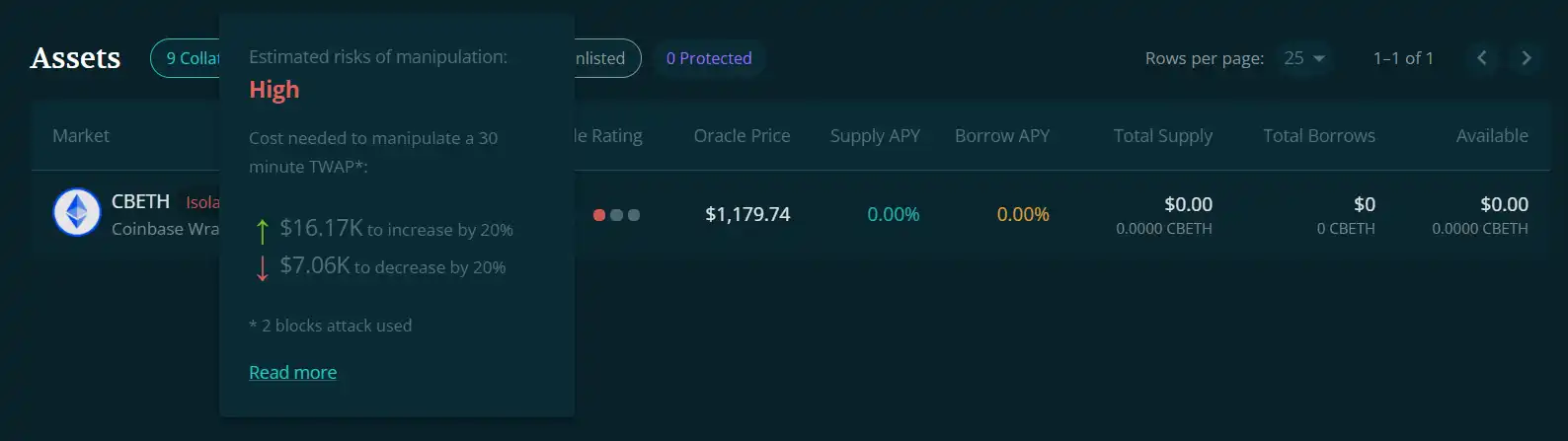
https://app.euler.finance/
As noted earlier, illiquidity and the resulting low prices can trap holders and prevent them from selling. Those who do sell are likely to sell to arbitrageurs because there is no productive use for cbETH and competitors earn more. Currently, the popular DEX aggregator 1inch shows that only 2000 cbETH can be sold for ETH before the 1% slip point occurs. The same trade would only have a 0.4% slip on rETH. Due to limited yield opportunities and liquidity, most cbETH buyers on uniswap are likely holding the token for arbitrage available after withdrawal. Therefore, a new framework is being built.
Over time, existing or new Coinbase users will at some point want to exit their position from cbETH. This may be due to the collapse in ETH prices or the desire to explore DeFi. Both users will soon realize that their best option is to sell their cbETH to arbitrageurs. More and more Beth will eventually be purchased for the express purpose of destruction. This large group of buyers does not need DeFi integration and is therefore happy to sit on the illiquid cbETH they buy at a discount and accumulate until withdrawals create a pathway for any LSD to convert into hooked ETH. This will not be a reshuffle between small holders and big whales like the stETH ecosystem did during the 3AC crisis. But there will be a one-way flow that will quickly pull cbETH towards the destruction site.
Considering the purse 0 x7f507739b6242b048be9185cf462be816b8eff1f, it has accumulated 1% of all cbETH circulation. The wallet has slowly migrated from wstETH to cbETH to support tokens and integrate withdrawals. Of course, the owner is taking a risk. It's possible that Coinbase will see the writing on the wallet and try to prevent the damage. Rather than letting these scouting cbETH whales exit en masse, Coinbase could limit or even prevent cbETH redemptions, which would greatly hurt Coinbase's cash flow. Such a move, while highly unlikely, would have a devastating effect on the cbETH/ETH hook by losing all confidence. A bank run could be on the cards. It is a gamble to participate in CeDeFi's opaque world.
All in all, while the growth rate of cbETH supply may seem frightening, it does not represent an existential threat to DeFi.
In fact, DeFi has rejected cbETH across the board, and if I think is correct, DeFi is dragging Coinbase into a long-term scam - slowly amassing cbETH to deplete Coinbase's shares after the withdrawal. This process of great arbitrage sucked up liquidity, undermining any hope cbETH had of securing DeFi adoption. Unless Coinbase actively pushes for the use of cbETH in DeFi, it seems likely that DeFi will remain a battleground for Lido and Rocket Pool.
frxETH - Mobility and Design
LSD 领域的最新参与者之一是来自 FRAX 生态系统的 frxETH。FRAX 是一种稳定币,通过 FRAX DAO 积极收购和使用流动性导向Token (veCRV/vlCVX) 而声名鹊起。DAO 通过他们的 DAO Token 的投票权为 FRAX 持有者创建有利可图的流动性提供策略,从而吸引用户铸造他们的稳定币。该模型具有明显的优点。提款前,所有主要的 LSD Token 都必须创造流动性,通常需要支付租金。通过拥有这些流动性导向 Token ,FRAX 可以避免 Lido 等竞争对手产生的资本支出。由于 FRAX 在这种稳定币模型上取得了如此巨大的成功,因此 DAO 决定冒险进入一种新型稳定币,即与 ETH 挂钩的 LSD。
frxETH Token 经济学在 LSD 世界中是独一无二的。大多数 Token 要么为了奖励而变基(stETH),要么被动地增加价值(rETH)。FRAX 走了一条不同的路。frxETH Token 本身不会产生任何质押奖励。为了让 Token 持有者获得锁定在验证器中的 ETH 所赚取的 APR,用户必须将 frxETH Token 存入一个 staking 金库。该协议质押的 ETH 所获得的所有奖励,减去费用,然后分配给质押在该金库中的任何用户。任何持有 frxETH 而不是在金库中抵押的用户都不会获得任何奖励。用户被迫做出选择——要么使用 frxETH 在 DeFi 中追求收益,要么在金库中获得质押奖励。
这里的目标是勇敢的。这个二元期权将迫使质押的 frxETH APR 高于任何其他 LSD Token ,因为 DAO 正在让自己的 LP 与自己的质押者竞争。如果当前主要 DeFi 集成 Curve 池中 LP 的 APR 为假设的 20%,而 staking 保险库反映的 APR 为 7%,那么用户很可能会自然地迁移出保险库并进入 Curve 池。在平衡状态下,领先的 DeFi frxETH 集成的 APR 应该接近与质押的 frxETH 回报持平,也可能超过 10%。理论上,其他 LSD Token 的持有者会看到这种收益并进行转换。
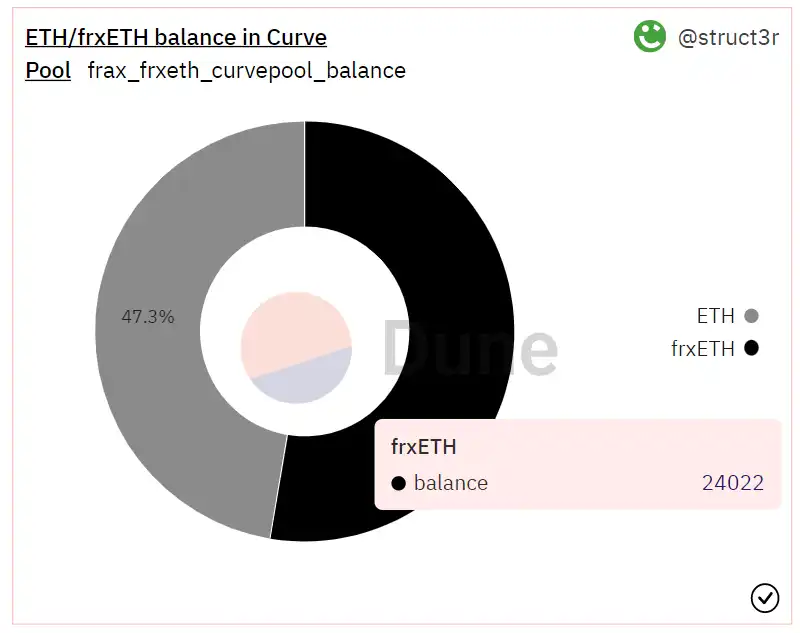
https://dune.com/struct3r/frax-frxeth
现在抓住了。首先,该模型违反了 DeFi 的一些核心原则,即资本效率和可组合性原则。这种模式故意不具备资本效率。FRAX 可以激励产生收益的 Token ,以便流动性提供者获得 LP 奖励以及质押奖励。通过强迫用户选择其中之一,成本最终会更高。以一个长期假设为例,其中质押的 frxETH Token 收益率为 9%,而 Curve 中的 frxETH Token 收益率为 11%。Curve 流动性提供者不会提供流动性,除非激励措施超过质押率,否则,他们将迁移到质押池。这必须付出代价——无论是通过激励还是通过引导流动性。在此示例中,为维持相同水平的流动性而支付给 LP 的成本可能会下降约 30%,因为如果没有重定向这些 ETH 奖励,Curve 池的 APR 可能是 14%(假设 ETH 奖励率为 6%)。随着生态系统中 TVL 的建立,成本节约变得越来越重要。
frxETH 的另一个令人困惑的因素是,质押金库是一种流动性 Token sfrxETH。FRAX DAO 目前只选择激励 frxETH 池。表面上,精明的 DeFi 构建者会希望将 sfrxETH 整合为实际的 ETH 奖励 Token 。这将使 FRAX 处于与 Lido 试图将流动性从 stETH Token 迁移到 wstETH Token 时所面临的类似情况。必须支持两个 Token 的生态系统将比一个更昂贵。如前所述,顶级 LSD 的融资流动性可能需要数百万美元/月。因此,尽管 FRAX 以强大的流动性激励能力开始,但它是在一个本质上资本效率较低的系统上这样做的。对于稳定币供应商来说,这是令人担忧的第二个原因。
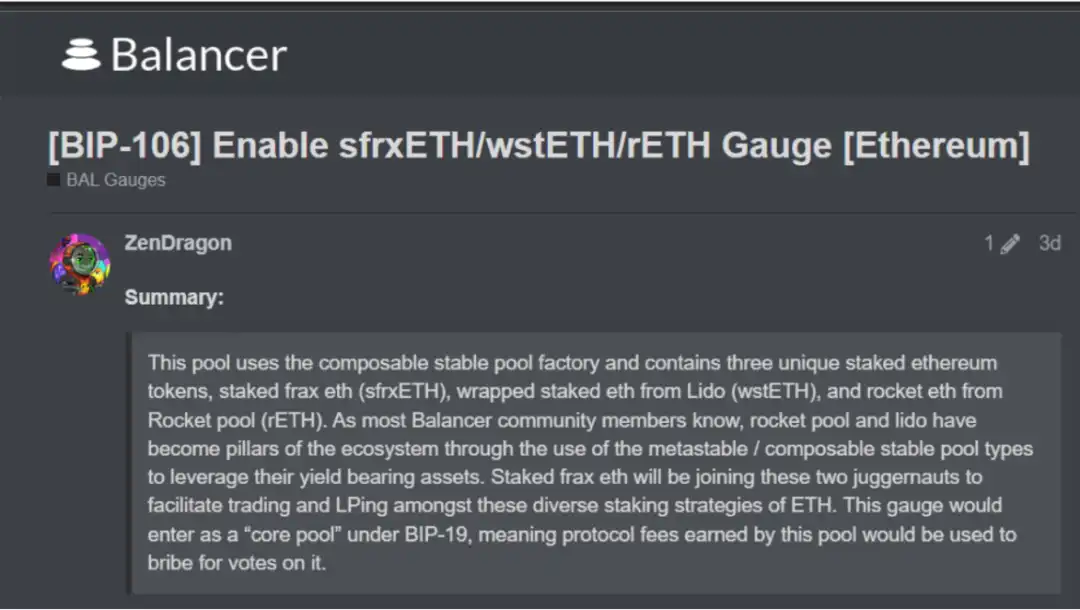
https://snapshot.org/#/balancer.eth/proposal/0x16fd7c010fa1d7318fab383a1a6cb59471dda824b53a1026cd197eea3890dcb4
The cost of incentivizing frxETH is twofold. First, it is capital inefficient compared to other LSD tokens and cannot create the appearance of a higher APR (LSD APR should be equal to or higher than pledged frxETH when including its DeFi strategy). Second, and more importantly for FRAX, the liquidity tokens used to incentivize frxETH cannot be used to incentivize the FRAX Stablecoin that underpins the entire FRAX ecosystem. By shifting excitation from the FRAX base pair to the frxETH pair, the strength of the FRAX is weakened. Liquidity is a zero-sum game, and FRAX uses their liquidity capabilities in inefficient modes.
In a post-withdrawal world, FRAX's sudden accumulation of liquidity-oriented tokens would be worth much less to LSD tokens. Exiting the queue will enable large orders to navigate outside the open market without damaging the LSD hook. As a result, FRAX will lose its main advantage in the LSD token wars. At this point, FRAX's position as a very centralized pledge provider will come into focus. Currently, the FRAX team runs all of the validators and has no specific plans for decentralization.
Shady super stakeholders
The most difficult LSD to analyze is one that does not currently exist -- osETH. The Stakewise is a stakewise service that currently operates using a licensed set of nodes and two token models. Stakewise v3 will be completely redone with a planned 2023 release. In this release, Stakewise is challenging Rocket Pool dominance as an independent node operator by becoming license-free. The user will be able to start the validator and cast osETH against the validator in a manner similar to the loan value calculation. Many details about osETH have yet to be released, so this part should be seen mainly as speculation.
The Stakewise v3 platform will allow for a personalized debt market. The benefit of this structure is that risk can be managed on a case-by-case basis, so the coverage provided by Stakewise that was previously lacking may be improved. Additionally, depending on the Stakewise allowed LTV ratio, it may take as little as 4-8 ETH to start running the validator. However, the Stakewise team faces a number of difficulties.
The biggest problem was that the SWISE team had to migrate all of their liquidity from sETH2 and rETH2 to a single token, osETH. A complete rebranding and token economy redesign is a costly venture that will force them to start integrating again. DeFi governance is slow, which can be a time consuming process. Another problem is that Stakewise will expect large migrations of individual stakers.
This group, however, has a reputation for being risk-averse. The Rocket Pool node operator sign-ups are a good example of this, as there has been no surge in sign-ups in the period since launch. Many individual ETH pledges may want to see the resilience of the main network without any hacking before entrusting funds to the protocol. Probably most osETH supplies are minted by Staking as a Service provider using Stakewise. However, it is unclear how these StaaS groups will attract demand.
Concerns around the reward model also remain. MEV theft is a major issue that leads to Rocket Pool insurance discussions. It is unclear how Stakewise will solve this problem in extreme LTV vaults. If they do solve this problem, they will provide a convincing alternative to Rocket Pool in the permissionless pledge ecosystem.
Reflections of the Rocket Man
Ethereum ecosystem participants will ultimately decide which LSDS are worth expanding. In the pursuit of intellectual honesty, I'll now explore some legitimate criticisms of the Rocket Pool protocol in hopes of driving better iterations.
One of the earliest criticisms of the protocol was that Rocket Pool was a medium of attack against the Ethereum consensus. Any agent looking to broadly attack Ethereum Consensus can double their attack power by launching Rocket Pool minicore pools instead of individual verifiers. Using LEB8s, the vector is further amplified. One limitation of this problem is that the mini-pool can only be started if the deposit pool has ETH in it. For this attack to work, two difficult conditions must be met. First, the attack takes a long time to execute because the deposit pool must be filled repeatedly. It also requires the Rocket Pool to be far larger than previously discussed caps. So this criticism, while true, is unlikely to be relevant.
One criticism I have now addressed at length is that Rocket Pool capital is inefficient, unscalable, and has nasty token economics that require access to RPL. As discussed in Section 4, there is a clear path for rETH to scale to millions of ETH through planned iterative upgrades. These will include a design change to allow users to enter with ETH only or RPL only exposure.
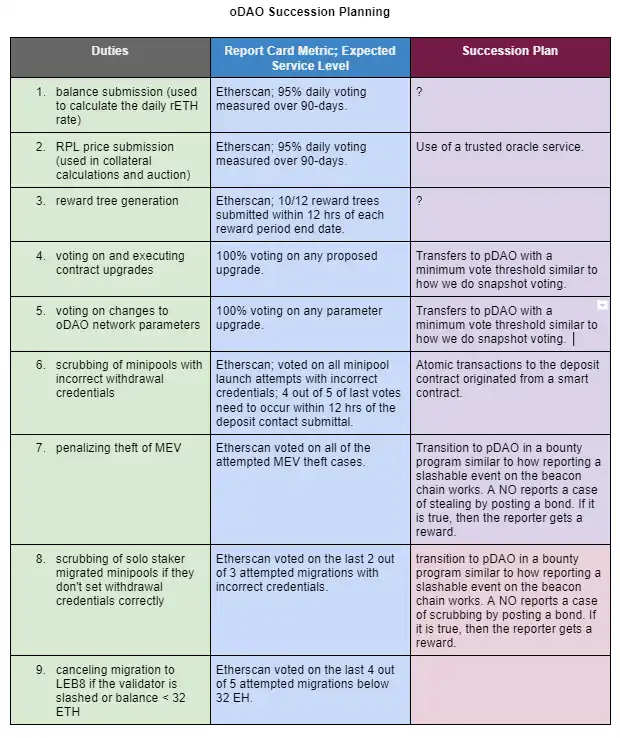
Important discussion about reducing reliance on the core development team and oDAO. Most of the team now lives in Australia. In addition, most ODAOs are located in the United States or the European Union. Both the core team and oDAO have the ability to wreak havoc on the agreement if it is breached, so moving away from them is the most important issue. Odaos cannot be disbanded until certain changes are made in the core Ethereum specification, such as better communication between the implementation layer and the consensus layer. The community is already brainstorming ways to migrate all oDAO responsibilities to a decentralized protocol DAO, as shown in the table below.
Another criticism of Rocket Pool governance is that node registration is not resistant to witch attacks, meaning that one person can register multiple nodes. Currently, voting is done based on the second root of a valid RPL pledged by each node. A malicious agent can start many nodes and launch a mini-pool on each node to maximize their voting power in future votes. Such attacks have not yet been detected, but may be difficult to notice until a vote is compromised. Therefore, there has been discussion about moving to a linear scaling approach before introducing a more powerful witch mechanic.
Proposal: Switch to linear voting rights to fend off attackers
The LEB8 Vote's Max Effective Stake demonstrates the RP community's ability to organize and reach productive conclusions on controversial issues. Unfortunately, it also highlights the damage that can be done if an evil whale plays with the quadratic voting mechanism. Referring to @Valdorff's comment shown below, the whale with a few hundred votes could turn it into a few thousand votes and single-handedly decide... The winning result of
dao.rocketpool.net
In addition, rETH holders lack a voice in Rocket Pool governance. It is possible to be a representative rather than a node operator and advocate for rETH, but the table is for this behavior. While the best governance is no governance, the interests of rETH should be more represented until this is possible.
The pessimistic view of Rocket Pool is that it is bringing a lot of people into node operations who are not affiliated with node operators. Advocates of professional pledge sometimes argue that amateurs are irrational. By lowering the barriers to entry, some will argue that we increase Ethereum's risk by increasing the number of node operators who don't know what to do if something goes wrong. The Rocket Pool smart node makes setup very simple. This easy entry approach might make staking professionals concerned because it allows someone who never ran a server to secure Ethereum now.
Despite the need for easy access, maintaining network resilience is a challenge Rocket Pool is happy to take on. With the Rocket Pool guide and support from the community, even a complete novice can set up and run a complete node efficiently. As a bastion of full-time node support and Ethereum knowledge, the Rocket Pool Discord server is one of the most active in the ecosystem. In addition, the rescue node will reduce the impact of user errors, so the network is not affected. Timely DVTS only speed up the process.
Moreover, I find this criticism strongly against Ethereum. Ethereum's long-term vision idealizes a world in which millions of light client nodes running on personal devices all contribute to the network. In this world, the barriers to entry must be incredibly low. Don't listen to the pros -- Ethereum Pledge will (and should!) Making it easier while maintaining maximum security.
Extreme security enthusiasts may have reservations about Rocket pools. Currently, one limitation of smart nodes is that they cannot be used for key generation on air gap devices. In addition, Rocket Pool is always inherently more risky as an additional set of smart contracts on top of Ethereum's deposit contracts -- but the same risks apply to all LSDS.
Finally, there are accusations that Rocket Pool is fighting a pointless battle. This group might argue that Rocket Pool's hard work to create high-tail-risk resilient LSDS is meaningless because the pledgor is only concerned with chasing yield. I believe this criticism paints the multi-billion dollar LSD ecosystem in a grim light. For this argument to work, either VAR has to be close to zero or investors are in for a rude awakening. The former scenario is hard to imagine in the near future - there are too many pathways of risk in any LSD to address. If the latter is true, namely that investors are blind to the growing risks posed by a more centralised LSD, then it is likely that risk is once again gaining value because of their own painful realisation. As long as traders overexploit unsafe products, there will be events that punish profit seekers and reward caution. Risk must be highly correlated with value if the LSD ecosystem is to mature into a next-generation bond market.
6 - 交易对手 Token 经济学——被低估的艺术
最后,我想谈谈围绕 LSD 的更广泛的 Token 经济学。协议实用程序/治理 Token (LDO、RPL、SWISE)和 LSD Token 本身(stETH、rETH、sETH2)之间存在着重要的紧张关系。大多数协议都忽略了这种紧张关系,但却是可持续抵押协议的基础。所有质押协议都是双边投资;大多数人只是选择集中其中一方。我将讨论 LDO 的费用转换和 RPL 的抵押品系统。
As a means of achieving sustainable value, cost conversion is trivial and will perpetuate the risk factors of LDO governance. In effect, the soft cap on fee conversion is 5 per cent of the pledged return, since another 5 per cent is guaranteed to elite node operators. This already hints at the problem, as a small number of core operators should receive the same rewards as the entire DAO.
Alignment is inefficient because the node operator seems to extract too much value. In order for this 5% to be worthwhile, the LDO must be at most one-twentieth (1/20) of stETH's market value and cannot deviate. If LDO/ETH falls, your existing LDO shares will become worthless. If LDO/ETH increases, your shares will be more valuable, but the return will be a smaller percentage gain. In the vast majority of cases, holding stETH seems to make more sense for token holders, as there is a hard cap on potential fee income. Ldos have no unique added value other than freely accessible governance.
In the fee conversion design, the agreement token acts as a pure rent withdrawal mechanism and is not used to coordinate incentives. This has become a problem because greed drives DAO governance to allocate expenses inappropriately. This may already be happening, since Ldos have limited their insurance pools and opted to reallocate these funds to the Treasury. This is not a direct rent-withdrawal transfer, however, it is indicative of the type of behavior that simple structured DAOs tend to behave in.
Rocket Pool's design does respect the tension between protocol token holders and LSD token holders. Node operators need to issue RPL bonds in order to meet rETH demand and start mini pools. This can either implement a permissive set of node operators or tie the growth of rETH to RPL. There is no agreed vault and no agreed commission, so there is no impulse to draw rent widely. Furthermore, Rocket Pool recognizes that governance should not be open, as the wishes of rETH holders require protocol consistency. Therefore, only RPL as collateral for bonds can be used for governance. The RPL does have a unique added value, either as a license to collect commissions or as collateral in the event of serious losses.
7 - Conclusion
The team behind Lido has played an important role. Research presented by Paradigm shows that any entity that can leverage liquid ETH pledges quickly and efficiently will dominate. If the choice is either Lido exists or all ETH of Lido is divided among Coinbase, Kraken, and Binance, then obviously Lido exists is absolutely fine. However, this is not the early days of the Beacon chain. Lido's stETH has reached its peak of utility for the ecosystem, and now it's time to transition to Rocket Pool and competitors. The Lido's actions to maximise growth are one-off and quickly obsolete.
In this article, I begin with an overview of the liquidity pledge ecosystem. In it, I describe Lido's near-monopoly position in the LSD market and how it transcends power-law dynamics. The balance of power in nature is manipulated by the Lido's mobility incentive campaign, one of the largest of all DeFi. However, the golden age of Lido is now over, as the gap between the power of these incentives and the DeFi is narrowing. I made the bold claim that rETH would upend stETH's market share, and began outlining the social and economic reasons for believing this.
In the social world, stETH has reached a tipping point and raised the ire of core ETH developers. I made four main arguments; The governance of the system is attachable, the allocation of expenses is unstable, DAOs and their operators are multi-chained, and the validator registry remains a powerful and centralized stick. On the economics side, I detailed the history of the Reth-Steth peg as a way to understand the implied risk in the market. I then break this risk down into execution risk, centralization risk, and tail risk. The point of this section is that rETH is designed to be resistant under extreme circumstances, which is a desirable characteristic of base layer assets.
After introducing these stETH headwinds /rETH tailwinds, I give my predictions for how the power transfer will play out. The main accelerators will be the full rETH DeFi integration, a major CEX/Lido cut event, support for withdrawals, and lower collateral requirements. The post-drawdown era will see Lido's greatest asset, its strong liquidity-mining activity, undermined by the cost that exit queue reduction agreements must pay to maintain liquidity.
With the case against stETH established, I turn my attention to the newest challenger in the LSD space. Starting with cbETH, which has quickly become the second largest LSD, I pointed out that without DeFi, cbETH could end up being a stepping stone for users to migrate to rETH. Next, FRAX's frxETH is built on a capital inefficient system where the pledge incentive is separated from the liquidity provider. I've provided a few guesses about osETH, a prospective Stakewise v3 competitor. The token is intended to challenge the Rocket Pool of unlicensed node operators, however, the product is not yet live and requires a full restart of the protocol - no cheap, quick or easy task. I conclude this section by taking a step back and looking at Rocket Pool itself through a critical lens.
Finally, I briefly explained why the basic models behind RPL and LDO differ. I suggest that the end result of LDO is just a stETH wrapper that gives no unique value to the user, not even governance, while RPL adds value to the system by acting as collateral. These different models provide a clear upper limit to the value of LDO, but not RPL.
Why is this important? LSD will be an intrinsic part of Ethereum. The pledged ETH will become the bond market of the future. If LSD becomes too powerful, it can become an attack on the host chain. The asset that spreads and survives will be one that is resilient under extreme circumstances, like Ethereum. Rocket Pool has been building toward that future since 2017. It will not be one that starts with a rigged early lead, nor one that aims to maximize gains at all costs. The invisible hand of decentralization will test market participants. Today, people can freely run validators in any country/region. That may be the luxury of the moment, as nation-states have yet to set their sights on Ethereum. When that day comes, LSD will no longer be the reason why Ethereum failed. rETH is the way forward. You can choose to ignore it or oppose it, but rest assured that the Orange Cascade is coming.
8 - Afterword: FTX Aftermath
After the merger, the LSD hooks all quickly converged back to parity. In the process, rETH has been trading at a premium. Suddenly, the stETH/ETH ratio is back to where it was before the 3AC capitulation. Is it deserved? Has risk left the ecosystem, or has the influx of new equity after the merger combined with the lack of income opportunities again confused the risks posed by Lidos?
FTX is dead. Volatility and disaster are cryptocurrencies' best friends. It is no surprise, then, that markets are volatile again as cascading clearing hits most DeFi markets. The value of the SOL token was halved in a matter of days. Many lenders, institutions and unsuspecting retailers have now lost their assets. For an asset aiming to be the bottom tier of DeFi, the market capitulation we experienced should have been a breeze. The latest fiasco is just the opposite for Lido. I'll briefly discuss how stETH hooks are held, what's going on with stSOL, and why infectiveness is a real threat.
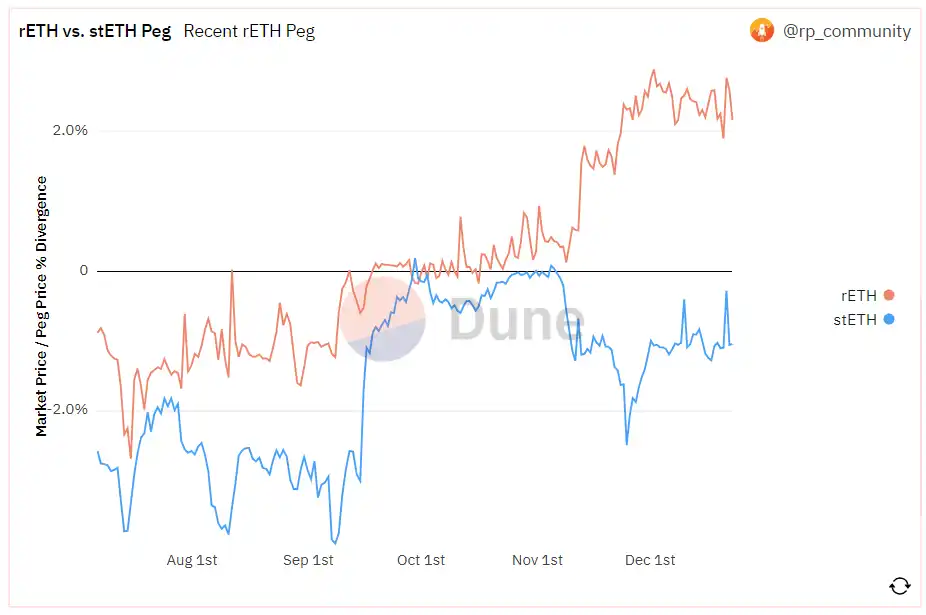
https://dune.com/sheriffjohnbrown/rpcommunitydashedit
Once again, stETH's anchor rate collapsed when the broader market went into the doldrums. This time the loss widened to about 1.5%. It is likely that many leveraged stETH/ETH positions were liquidated in the process, as this was the largest single day peg since the 3AC cascade. If this event occurs after the withdrawal, Lido will see the largest outflow of equity and Rocket Pool will gain equity. While stETH fell 1.5 percent, rETH increased its premium to its net asset value, showing how resilient rETH is in the eyes of the market.
Lido DAO was more concerned with the performance of stSOL, Lido's Solana liquid pledge derivative. The Solana network as a whole has been struggling since FTX News. A large amount of SOL has exited or is waiting to exited, which reduces network security. stSOL is reportedly trading at -10% on the open market compared to SOL.
The volatility of LSDS is not a problem on the face of it, but this arbitrage opportunity has pushed a lot of SOLs into their withdrawal queues. As a result, the network is being stress tested, and Lido node operators running Solana nodes have special responsibilities.
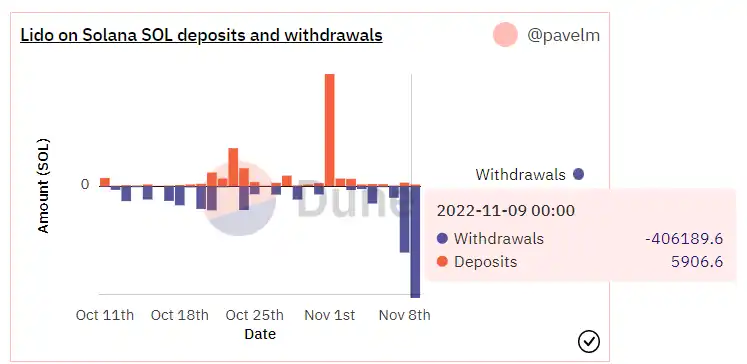
https://dune.com/pavelm/stSOL
Node operators are shared among all chains operated by Lido. Solana Lido validator also runs Ethereum validator. Maybe not on the same hardware, but the same team must manage both chains. The complexity of running a validator correctly for a blockchain can be profound. Having to constantly monitor Telegram for updates on the Solana reboot directly inhibits the team's ability to service other networks. Imagine if the FTX crash event triggered serious consequences for the Ethereum ecosystem. Will Lido operators running two blockchains be forced to allocate resources one way or the other? In addition, Solana may represent a cash cow for some verifiers. By suddenly losing a large revenue stream, professional validators may be forced to adjust staffing. As long as Lidos continue to diversify across chains, their commitment to Ethereum will decline, while the risk for stETH holders will multiply. In addition, it is not clear whether the Lido insurance pool extends to every chain. If so, then stETH's security model is even worse than I've described.
Only one LSD has the same set of values as Ethereum itself -- rETH. In the wreckage, social class trumps all else. When that day comes, rETH's decentralization and security will push it toward the cornerstones of DeFi.
Original link
Welcome to join the official BlockBeats community:
Telegram Subscription Group: https://t.me/theblockbeats
Telegram Discussion Group: https://t.me/BlockBeats_App
Official Twitter Account: https://twitter.com/BlockBeatsAsia

 Related Articles