What's the difference between market manipulation and prophecy manipulation?
The Difference between Market manipulation and Prophecy Manipulation
Original article by Chainlink
The security of blockchain prognoses is critical to Web3. Secure prognoses have led to a rich set of decentralized applications that dramatically reduce counterparty risk and enable smooth exchange of value. When accessing financial market data for DeFi applications, developers must not only ensure that the Oracle is watertight in terms of security, tamper-proofing and incentives, but also consider the quality of the markets the Oracle connects to and its ability to withstand attacks.
This article discusses the difference between market manipulation and predictive manipulation, how Chainlink Price Feeds can fully cover the market price of assets, and how developers can improve app security.
What is market manipulation?
Market manipulation refers to the artificial manipulation of asset prices by changing the balance of supply and demand. This is a deliberate act initiated by an attacker, usually to profit from other traders.
Illiquid assets are more likely to be manipulated
An attacker's ability to manipulate prices depends on the liquidity of the asset itself. Liquidity is the ease with which an asset can be traded without affecting its price. The more liquid an asset is, the more money is needed to manipulate its price. Conversely, the less liquid the asset, the lower the cost of manipulating the price. As a result, illiquid assets are more prone to market manipulation and therefore pose greater risk to the underlying financial products.
The liquidity of an asset depends on how much it trades, how deep it is, and the market in which it trades. Here's how each metric is defined and why it's important:
Volume - Volume refers to the amount of assets traded in a given period of time. High trading volume indicates high market liquidity. However, some assets, while highly traded, lack depth.
Trade depth - Trade depth refers to the number of orders and sell orders posted at each price. This represents the market's ability to absorb large orders without large price swings.
Trading markets -- assets are traded simultaneously on multiple platforms, including centralized trading platforms, decentralized trading platforms (DEX), and OTC over-the-counter markets. The liquidity of a particular platform may be lower than that of the market as a whole, especially if the volume of trading on the platform is insufficient to attract arbitrage traders to create cross-platform markets. That is, even if an asset is highly liquid in the market as a whole, it may remain less liquid on some trading platforms.
Market manipulation to guard against
There are many ways to manipulate the market, here are some ways to manipulate the traditional financial and DeFi markets:
spoofing -- Posting a trade but not executing it. Bots are used to post large numbers of trades to influence the behaviour of buyers and sellers, and then cancel the trades before they can be executed.
ramping -- artificially inflating the market price of an asset to stimulate demand from real buyers and then selling to those buyers.
bear raids - artificially driving down asset prices by smashing trades or shorting them.
cross-market manipulation -- initiating trades in one market in order to manipulate prices in another market and ultimately making money through arbitrage.
Wash trading -- acting as both buyers and sellers, creating fake volumes to attract real traders into the market.
frontrunning -- initiating trades based on inside information before the market knows or reacts to the news. In the crypto industry, preemptive trading is also a part of MEVs.
These strategies can manipulate the price of a small segment of the market, or they can manipulate the price of the entire market. It is cheaper to manipulate a handful of markets than it is to manipulate the price of the whole market. But such locally manipulated attacks are also easier to defend against and less profitable.
DeFi protocol market manipulation risk
Over the past few years, market manipulation has caused DeFi to lose a lot of value in various ways. Even if the DeFi integrated price predictor works properly, the protocol remains at risk if the market the predictor accesses is manipulated.
DeFi platforms at risk of market manipulation are:
Money markets - Lending agreements that do not liquidate low mortgages in a timely and efficient manner could lead to bad loans or even dry up liquidity. Artificial price manipulation can also lead to user funds being wrongly liquidated, and cause losses.
Options Markets - Like money markets, clearing must be triggered efficiently in the options market in order to remain liquid. These liquidations may be forced.
Synthetic assets, which pay out positions based on false prices or generate bad debts, can result in capital losses for liquidity providers.
stablecoin algorithm -- If the stablecoin stability mechanism and implicit incentive mechanism are destroyed due to price manipulation, the stablecoin can break anchor.
Automated asset management -- trading algorithms based on false prices can cause investment losses.
What is predictive manipulative behavior?
Prognostics feed external data such as digital asset prices, sports results and weather data into blockchain and smart contracts.
Seer manipulation can cause seer to report incorrect data about external events or the real world. This could be an intentional attack or a mistake, or it could be a problem with the source of the data.
Prophecy machine manipulation due to error report
False report refers to the difference between the predicted feed price and the real feed price. Whether the prophet causes the error report intentionally or unintentionally, it will bring the manipulation risk to the protocol that accesses the prophet.
For example, suppose the true market price of an asset is $100, but the price quoted by the Oracle is $50. This could lead to lending platforms that tap into the feeder's price to mistakenly trigger clearing. Even if a clearing engine is built, it will still be wrongly cleared because the wrong asset price is passed on to the forecaster.
Prediction machine manipulation due to insufficient market coverage
A lack of market coverage can cause forecasters to misreport asset prices. Prophecy machines are more likely to be manipulated if they cover only a few markets, because an attacker can manipulate prices in those markets without affecting the overall market price.
For example, if an asset is traded on five platforms and 85 per cent of the volume is on two of them, then if the predictor is covering three other, less liquid platforms, the coverage is insufficient. If an attacker manipulates prices on the three illiquid trading platforms, the price reported by the predictor will be out of line with the actual price, leading to manipulation risks.
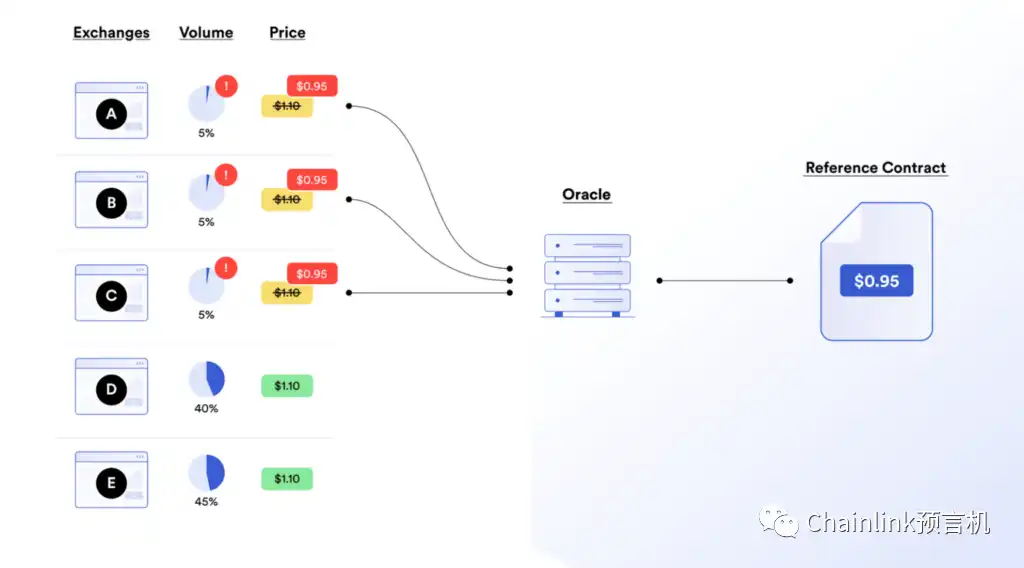
Prophecy machine if access to low liquidity trading platform data, may lead to the risk of prophecy machine manipulation
A highly secure prophecy machine
Improving the design security of prophecy machine can effectively eliminate the control risk of prophecy machine. The security of prophecy machine includes the following aspects: 1) to obtain feed prices from all trading environments to achieve coverage breadth; 2) Prevent external parties from tampering with data through decentralization and eliminate single point of failure; 3) Establish an economic incentive mechanism to ensure the accuracy of the prediction machine report.
Without these defences and economic incentives in place, forecasters are likely to misreport asset prices. Secure prognosticators can resist manipulative attacks and report accurate market prices.
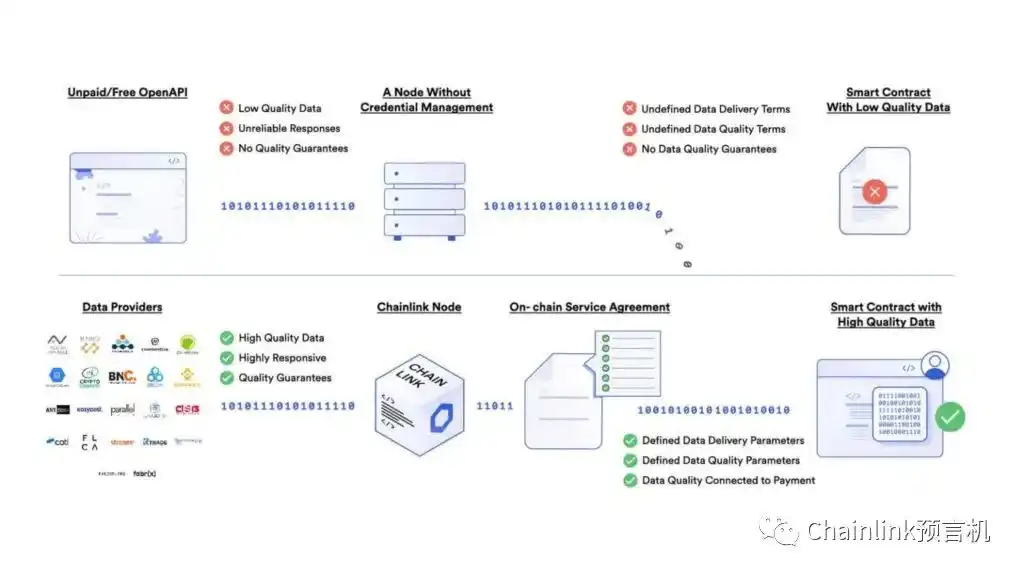
The predictive machine has established reasonable mechanisms to ensure the quality of data and the reliability of the transmission process, and prevent manipulation
DeFi protocol predictive machine manipulation risk
Predictive manipulation of DeFi protocols such as money markets, options markets, synthetic assets, algorithmStablecoin, and automated asset management will result in a number of negative consequences, such as stablecoin unanchoring, malicious carry trading, forced liquidation, and drying up of protocol liquidity. While the risks of prophecy manipulation are similar to those of market manipulation, the two types of behavior have different roots.
Market manipulation and prediction machine manipulation are to manipulate the feed price to deviate from the real market supply and demand situation. While the risks are similar, the mechanisms are very different.
What is the fundamental difference between market manipulation and prediction machine manipulation?
Market manipulation changes asset prices, while prognosticator manipulation uploads false or invalid feedprices onto the chain that do not reflect the true price of the asset. The two issues have long been conflated because they appear at first glance to be losses caused by distortions in asset prices.
The essence of market manipulation is to change the underlying supply and demand of assets so that their prices deviate from normal levels. Under normal circumstances, prognostics report real asset prices based on actual conditions. If the full market price of an asset is manipulated, the prognosticator will still quote that price -- which is what the prognosticator is designed to do.
When the predictor is manipulated, market prices still reflect the true relationship between supply and demand, but the predictor misstates prices intentionally or unintentionally.
Failure point example
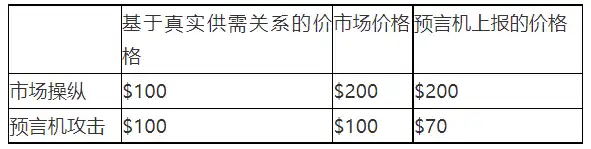
As mentioned in the table above, the failure points of market manipulation and prediction machine manipulation are not the same. Let's say I have an asset that's trading at $100 based on real supply and demand. When the market is rigged, the real price of $100 is artificially rigged to $200, and that's the point of failure. The prognosticator simply reported the market price of $200. When the machine was rigged, the market price remained at $100. The prophecy machine incorrectly reported the price as $70, which was the point of failure.
To build secure DeFi protocols and protect against market manipulation and oracle manipulation, developers must consider both the security of the oracle and the quality of the underlying trading market, including volume, depth, and trading environment. Otherwise, the agreement will hardly withstand the risks.
Chainlink Price Feeds can protect Dapps from seer attacks
To eliminate the risk of Oracle attacks, apps can integrate Chainlink Price Feeds to access high-quality, tamper-proof market data.
Chainlink Price Feeds have a variety of security features, including:
Decentralization at multiple levels -- Decentralization of the infrastructure at the data source, node operator, and predictor network levels avoids the risk of single points of failure and ensures that predictor reports reflect true market prices.
Highly reliable Seer Node Operators - Node operators are located in every corner of the world. They are not only experienced, but also security assessed and can resist witch attacks. These nodes are responsible for transferring pricing data to the Web3 network.
Defense in depth strategies -- on-chain transparency, active monitoring, failover, disaster recovery, and a network of alternate predictors -- work together to create a multi-tiered architecture.
Chainlink Price Feeds How to deal with market manipulation
If the all-market Price of an asset is manipulated, Price Feeds will quote that price because the call will accurately reflect the current state of the market. But if only a small part of the market is being manipulated (a few illiquid markets, for example), Chainlink Price Feeds will still quote the price for the whole market to fend off manipulation attacks.
Chainlink Price Feeds are multi-tiered aggregators, so volume weighted average price (VWAP) calculations (and others like them) and outlier monitoring are a good way to prevent a few markets from being manipulated. The VWAP system assigns more weight to more actively traded markets, with flexibility to adjust the weight as liquidity shifts between markets. Data aggregators typically filter out market anomalies such as flash crashes and fake trades to ensure they don't affect the final aggregated data points.
Explore Chainlink Price Feeds, video details: https://youtu.be/-pJqlI61ZKc
How do DeFi developers secure Dapps
The first step for DeFi developers to secure their Dapps is to integrate Chainlink Price Feeds to get accurate, tamper-proof, and reliable price data. Second, developers must evaluate the quality of the assets in the agreement.
Illiquid assets are more vulnerable as collateral because they are easier for attackers to manipulate. Therefore, it is necessary to carry out a specific analysis of market risks and clarify how to set the loan-to-value ratio to best guarantee the liquidity of the agreement and avoid risks.
Further enhance the security of DApps:
Circuit breakers -- smart contracts that halt operation in case of extreme price volatility.
Deferred contract upgrade - The contract will not be updated until the protocol receives the latest data feed.
Manual emergency stop switch - If a bug is found in the upstream smart contract, users can manually pause the operation and temporarily cut off the data feed.
Monitoring - Some users will create their own monitoring alarm mechanism to alert when the data feed deviation exceeds a certain threshold.
Risk awareness is always there, so constantly monitor, upgrade, and refine processes in response to changing market conditions.
Improve dApp security and promote DeFi to mainstream applications
If DeFi application is to be popularized in daily life, DeFi security must be watertight. That means we have to deal with market manipulation and the manipulation of prophecy machines. While Chainlink can be used to avoid oracle manipulation, developers must take security precautions and users must do their own research before they can deposit money into a protocol. At the end of the day, securing Web3 assets requires a multi-pronged approach. We need to work together to keep our users' money safe.
If you're a DeFi developer and want to integrate Chainlink Price Feeds, check out our developer documentation, ask a question in the Discord group, or get on the phone with a Chainlink expert.
Original link
Welcome to join the official BlockBeats community:
Telegram Subscription Group: https://t.me/theblockbeats
Telegram Discussion Group: https://t.me/BlockBeats_App
Official Twitter Account: https://twitter.com/BlockBeatsAsia
 Related Articles