Comprehensive explanation of visualized DeFi value flow.
Original Title: "Visualising DeFi Value Flows"
Author: Aw Kai Shin
Translation: ChinaDeFi
This article is based on the technical concepts introduced in "DeFi Ecosystem: Primitives and Technology Stack" and outlines the new value channels created by this technology. By focusing on the value flow within a single EVM chain, a framework is provided to identify the value flow between the following three entities:
Traditional finance and decentralized finance.EVM compatible chain.
dApp on the same chain
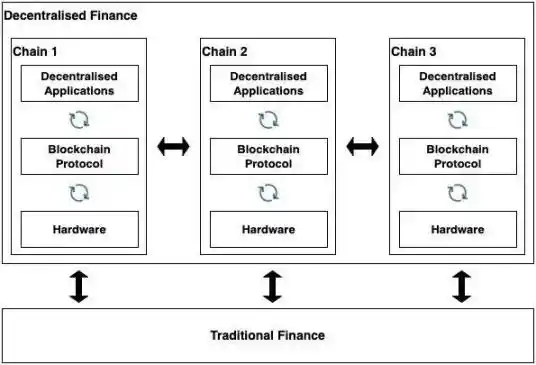
Through this conceptual overview, we can gain a deeper understanding of how value is created/reallocated at the ecosystem level when various DeFi primitives are mixed and matched. Value in the DeFi space is built gradually by stacking different primitives together. We must recognize that the DeFi stack is as fragile as its weakest link and therefore risk must be managed accordingly.
Like any other market, the value flow is coordinated by three parties:
Supplier: A user who provides resources in exchange for corresponding fees. In addition to trading standard assets (such as fiat currency, tokens, etc.), suppliers can also provide resources such as data and hardware leasing.
Demander: Users who obtain resources by compensating the opportunity cost of the seller. There are various reasons why the buyer bears the cost of acquisition, ranging from resource utilization to speculation on future asset prices.
Service provider (i.e. protocol): The facilitator of transactions, who provides convenience to both buyers and sellers and charges a portion of the transaction value. In terms of DeFi, this refers to various protocols and their respective smart contracts.
Please note that supply and demand factors will not only redistribute value within the chain, but also stimulate the inflow/outflow of value in the external ecosystem. This is particularly evident in the early stages of the chain, as new users need to transfer value from external resources to participate in on-chain activities and obtain on-chain assets.
The key is that, due to the market interests of liquidity, financial value often has a tendency towards monopoly. Therefore, creating an active value transfer ecosystem depends on achieving benchmark-level liquidity to stimulate further value creation. With this in mind, we can now begin building our ecosystem value stack.
Assets: Value Creation
The most basic form of value creation is through on-chain Token demand. In the context of DeFi, these will refer to ERC20/721 Tokens, which specify the standard interface for Token interoperability across decentralized applications. Given the subjectivity of valuation, the focus here is on identifying key use cases that make Tokens more valuable relative to another asset.
Although speculation is an important mechanism that guides the market towards "real" value, it is not helpful in this case because it cannot directly perceive the relative attractiveness of an asset. Therefore, in order to improve readability, this article ignores demand-driven factors based on speculation.
Token Whether the net present value of the chain depends on the source of Token . In order to develop the ecosystem, Token must be obtained through external capital. To this end, there are some types of Token , whose use cases incentivize net positive intrinsic value flows:
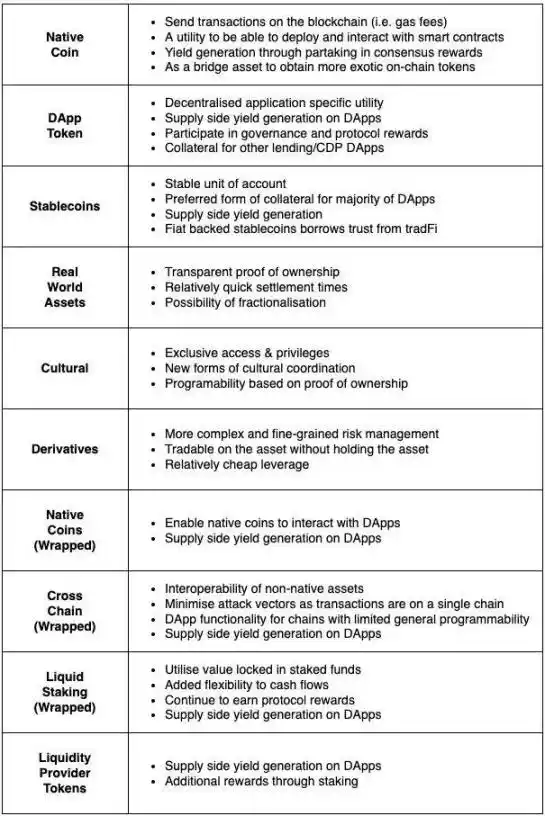
The demand for Token will organically grow based on each individual's valuation of the use cases mentioned above. After explaining why each Token has value, we can now continue to explore the transfer of value.
Liquidity: Value in Motion
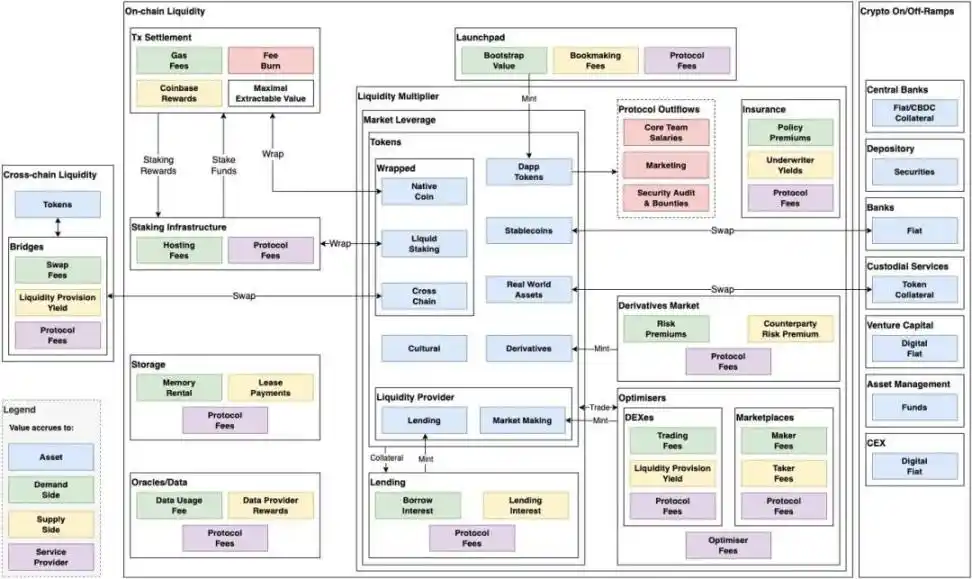
The above figure summarizes all major DeFi value flows in a single image. Considering the composability of DeFi, the figure has been simplified to some extent, but the above content should be sufficient as a starting point. The asset overview in the previous section is the foundation for building our value stack from bottom to top:
Token
represents a tradable accounting unit that can tokenize value. The value of a Token increases based on its use case. The market value of a Token is a rough measure of its value. All the value captured by a Token is contributed to a net present value-based protocol that manages them.
Market Leverage
By mortgaging Tokens, the lending market can provide leverage, thereby improving capital efficiency.
Borrowing and Lending:
Token holders provide their dormant Token s to the lending protocol, which offers them loan interest as a reward for opportunity cost. Borrowing demand drives the borrowing interest, which includes borrowing interest and protocol fees.Liquidity multiplier
The interoperability of Token on the public market can create deep liquidity. The value recirculation between Tokens is crucial for driving the growth of dApps, as their use cases rely on the accessibility of Tokens .
DEX: Token Holders provide Token to the DEX protocol and generate revenue through market making. Buyers are charged transaction fees, which include liquidity provision rewards and protocol fees.
Market: A trading model that is more suitable for non-fungible tokens (NFTs), where information discovery is crucial. NFTs provide a desired price to the protocol, which is then put up for sale on the public market, waiting for interested buyers to purchase. For convenience, both suppliers and buyers may be charged protocol fees.
Derivatives Market: Generating secondary value by creating a trading risk market. On-chain value can be directly amplified by collateralizing derivative contracts, or indirectly amplified through the financing rate market. In the first case, Token holders collateralize their Tokens to earn a portion of the buyer's paid risk premium. On the other hand, both parties pay a risk premium to benefit from changes in Token prices.
Insurance:
Token Holders provide Token to insurance protocols, enabling them to profit from underwriting certain policies. Insurance premiums paid by buyers include underwriting fees and protocol fees. Payment decisions can be made through voting or event-driven code.
On-chain Liquidity
In order to support decentralized financial markets, value is also circulated on the blockchain protocol layer. These markets are crucial for ensuring the security of the entire ecosystem. The value on this foundational layer can also be tokenized for interoperability with dApps.
Tx Settlement: Each transaction requires Tx/gas fees to incentivize the final determinism of the blockchain. According to the consensus mechanism, the resources of validators are at risk in order to obtain transaction fees (i.e. mining machines, coins, etc.). According to protocol rules, validators may also receive Coinbase rewards (i.e. mining rewards). In addition, the protocol can define a fee destruction mechanism to reduce Token supply. Without any external capital, changes in coin supply can lead to appreciation/depreciation of coin value.
Pledge infrastructure: Validators can also pay custody fees and entrust some pledge responsibilities to pledge infrastructure providers. These services can include payment for computing resources and even pledge on behalf of validators. The authorization of Proof of Stake Token has enabled the creation of liquidity collateral tokens, which can be further traded on dApps.
Storage: Data still needs to be stored on a hard drive, and depending on the underlying chain design, this memory space can be very expensive. Storage protocols have created a market where data can be encrypted and reliably stored on a device network at a lower cost, with only one proof stored on the main chain. Buyers pay memory rental fees, including the cost of renting storage and protocol fees.
Oracle / Data: Many on-chain applications require secure and reliable external data to supplement on-chain data (such as prices, off-chain data, etc.). This data can be purchased for a fee from oracle / data providers. Most of the data usage fees will be used to incentivize data providers to report accurate and timely data.
Launchpad: Such protocols enable value guidance when launching dApps using Tokens. By raising funds through a pool of coins/Tokens, value is transferred to the newly issued dApp Tokens. Additionally, protocol fees may be deducted in exchange for guidance services.
Cross-chain Liquidity
Considering the replicability of the code, all the aforementioned technologies can be easily deployed onto another chain. Therefore, when assets are collectively exchanged through cross-chain technology, the value captured by each chain will be determined by the market. In cases where the use cases are the same, the user experience at the main chain layer will determine the relative valuation of tokens on each chain.
Bridge: Incentive
Token holders provide liquidity to the cross-chain bridge in exchange for a portion of transaction fees. Depending on the bridging method, if the Token is destroyed on the source chain and minted on the target chain, its value can be fully transferred between chains. Alternatively, the Token on the source chain can be locked and used as collateral for the packaged Token on the target chain. Bridge protocols typically charge protocol fees for this service.Encryption currency ups and downs
The last type is aimed at the transfer of value in traditional economies. Currently, as cryptocurrencies have not yet become a key component of modern life, most of their "value" still exists in traditional finance. In addition, since most people in the world have never owned cryptocurrencies, these ramps are a key infrastructure that allows for the transfer of value to the cryptocurrency field.
Legal tender: The value stored in legal tender is usually transferred to the cryptocurrency field through stablecoins supported by legal tender of equivalent value, such as through minting. Therefore, such stablecoins usually require holding corresponding legal value in traditional bank accounts. Although the value is not directly transferred to cryptocurrency, stablecoins play a crucial role as a medium of exchange.
Token Mortgage: By depositing real-world assets (such as gold, property, art, etc.) in custody, these services enable Token to be mortgaged at the value of the underlying assets. Depending on the type of assets, these Token can generate additional value by building ecosystems based on ownership proof.
On-chain evaluation of the DeFi ecosystem
The total value of the ecosystem begins with the deployment of Tokens on the chain. As a value reserve, the "real" value of Tokens will be largely driven by their use cases. The total value locked in Tokens can then be utilized through lending protocols.
This leverage value enables the formation of liquidity, thereby encouraging the redistribution of value to the best use cases. Deep liquidity also incentivizes the inflow of external value, as there will be opportunities for returns and capital appreciation.
The opportunity for value appreciation is also presented in the services of these financial markets. In DeFi, many of these services require physical resources for calculation, networking, and storage. Accurate off-chain data also has a significant market.
At the chain level, the net value flow will depend on the flow of assets between other chains and traditional financial systems. Changes in on-chain token supply must be accompanied by external positive value inflows in order to maintain sustainability at the current scale.
In looking to the future, if cryptocurrency becomes even more indispensable in modern life, the appreciation of value will decrease reliance on cryptocurrency. New use cases will drive demand growth, leading to more social value being allocated to the cryptocurrency field. While value is subjective, it always has a strong tendency to flow towards use cases with the best incentives.
Original article link
Welcome to join the official BlockBeats community:
Telegram Subscription Group: https://t.me/theblockbeats
Telegram Discussion Group: https://t.me/BlockBeats_App
Official Twitter Account: https://twitter.com/BlockBeatsAsia
 Related Articles