DeFi revolution is coming? On-chain barter brings the market back to the rhythm of cryptocurrencies
Original author: Armonio, Zheng Haosheng, AC Capital
Introduction
In this article, we present two interrelated narratives: the first outlines the technical evolution of DeFi liquidity, while the second highlights the transformative impact of on-chain barter from the perspective of economic history. In short, our goal is to prove that a profound DeFi revolution is coming, it just takes a little more patience. Those visionary builders who stick to the end will eventually be rewarded by the market.
We carefully tracked the development of the DEX market to illustrate that the emergence of on-chain barter trading is no accident, and on-chain barter trading is a real game changer. It represents an important chapter in the history of Web3 builders. A lot of innovation and improvement were required to realize its functions, not only within the DEX, but also at the underlying infrastructure layer.
If on-chain barter becomes an important historical milestone, we believe that all related efforts and contributions should be properly commemorated.
Have we lost control of the rhythm of the crypto industry?
Since January 2023, Bitcoin has fallen to a low and rebounded to a new high, driven by ETF approval and new expectations of quantitative easing. However, the prices of most altcoins are not like before, showing stronger upward momentum. Some investors scoff at real innovation and regard the crypto world as a criminal domain. At various conferences, industry insiders even refer to the entire industry as similar to a casino. Many crypto enthusiasts revel in the excitement of PvP (player versus player). While memecoin was sought after in the early days of the bull market, value tokens were ignored by the market.
Veteran players feel that this time is indeed different. Some developers are confused and question whether cryptocurrencies can really change the real world. Since last year, many have turned their attention to artificial intelligence, while more are still hesitant.
Why is the cryptocurrency market different this time?
We cannot ignore the impact of venture capital and team greed, misaligned interests, unethical behavior, and short-term thinking. The market has been in a dark forest for a long time. In addition to the code, there are not many rules to regulate participants. These problems have existed for a long time and are not enough to explain the weakness of this round of bull market. Therefore, we put forward an additional reason: the self-expansion within the crypto market is no longer sufficient to provide the necessary liquidity for our crypto ecosystem.
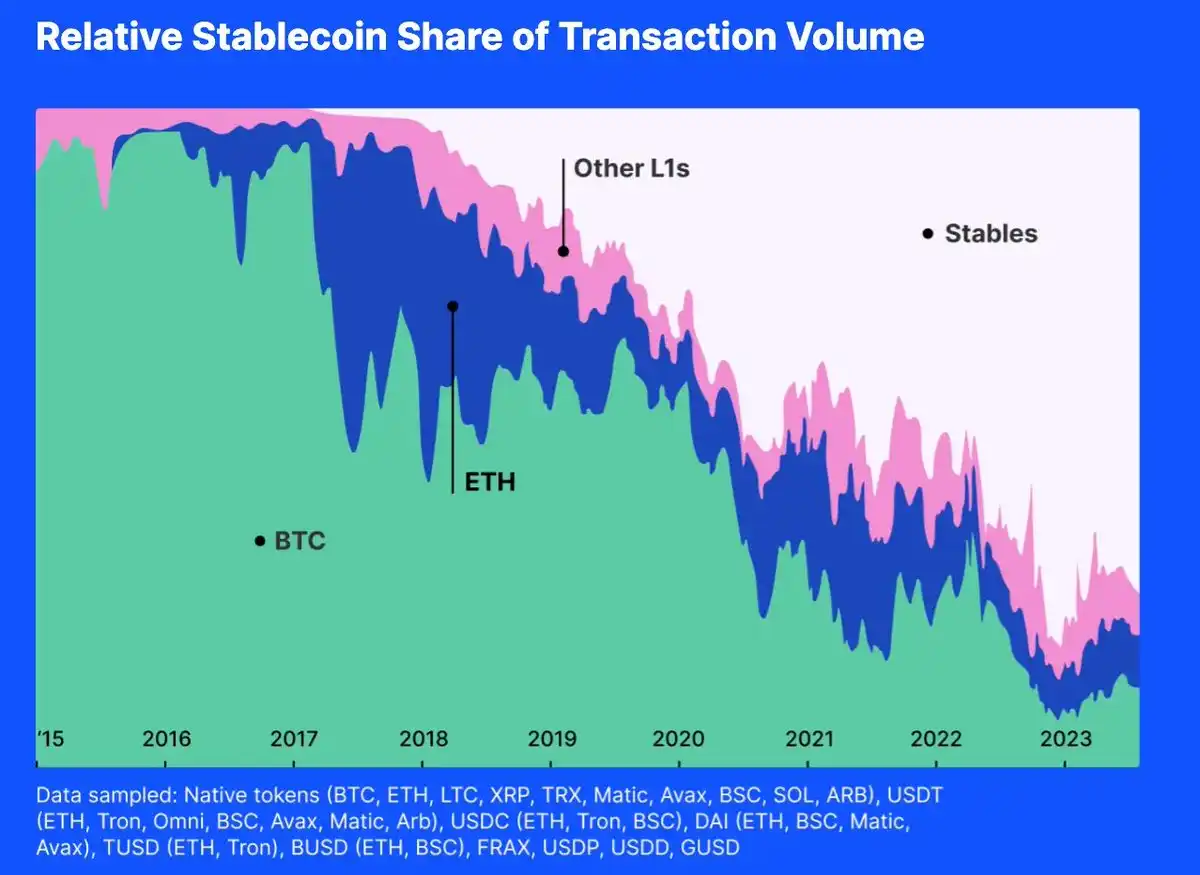
Therefore, we put forward an additional reason: the self-expansion within the crypto market is no longer sufficient to provide the necessary liquidity for our crypto ecosystem. Please see the figure below:
Source
The above chart shows the activity of various crypto-equivalents. If we look at the proportion of trading volume, we can find that in the past one or two years, most of the transactions are US dollar stablecoins. If the market value of US dollar stablecoins cannot expand, the liquidity pool will be drained as new coins are continuously issued.
Historically, since tokens can become liquidity for others during the bull market of Bitcoin and Ethereum, altcoins rarely lack liquidity. But now, most trading pairs are stablecoins pegged to the US dollar. Even the explosive growth of the value of Bitcoin or Ethereum is useless, and the status of stablecoins makes it difficult for BTC and ETH to inject liquidity into other tokens.
Pricing power of cryptocurrency falls into the hands of Wall Street
All stablecoins and other compliant financial instruments pegged to the US dollar are bait. Cryptocurrencies follow the Wall Street clock.
In October 2014, Tether began to offer a stable digital currency that could bridge the gap between cryptocurrencies and fiat currencies, providing the stability of traditional currencies and the flexibility of digital currencies. Now it has become the third largest token by market capitalization. In addition, USDT has the most trading pairs in the index, 10 times that of Ethereum or wBTC.
In September 2018, Circle partnered with Coinbase to launch USD Coin (USDC) under Centre Consortium. It is pegged to the US dollar, and each USDC token is pegged to US dollar reserves at a ratio of 1:1. As an ERC-20 token, USDC enables seamless transactions and integration with various decentralized applications.
On December 10, 2017, the Chicago Board Options Exchange (CBOE) took the lead in launching Bitcoin futures, which can have an impact on the spot price of Bitcoin even if it is settled only in US dollars, especially since the current Bitcoin holdings account for 28% of the global market.
Wall Street not only affects the crypto market physically, but also psychologically. Do you remember that we began to pay attention to the attitude of the Federal Reserve, Greyscale's trust write-downs, the "dot chart" of the FOMC, and the cash flow of the BTC-ETF? All this information psychologically affects our behavior. Stablecoins are bait cast by the US government. Since we accept stablecoins pegged to the US dollar as a means of providing liquidity, it has begun to accumulate consensus, replace the liquidity role of crypto native tokens, compete and weaken the credit of other tokens, and the US dollar has gradually dominated the market for universal equivalents.
In this way, we lose our own market rhythm.
I am not blaming the stablecoins pegged to the US dollar. On the contrary, this is the natural result of fair competition and market selection. Tether and Circle help investors invest in assets pegged to the US dollar directly on the chain, allowing them to bear the risk equivalent to the US dollar, and also provide investors with more choices.
We are all fighting for liquidity!
The Millennium War of Liquidity
Liquidity is always a real demand
Liquidity is a basic feature of the market, and any innovation that can improve market liquidity is a major historical progress.
According to organizational theory, a market is defined as a structured environment for the exchange of goods, services and information between buyers and sellers. This environment is guided by established rules, norms and institutions to promote coordination, reduce transaction costs and support efficient economic interactions.
Liquidity is crucial to market organization because it directly affects the efficiency, stability and attractiveness of the market. High liquidity reduces transaction costs by minimizing slippage and increasing trading volume. Markets with high liquidity also show greater price elasticity, which helps to find more accurate price information. Information economics emphasizes the role of the market in information discovery. In an ideal market, information flows freely, enabling participants to make informed decisions, optimize resource allocation, and achieve equilibrium prices. Highly liquid markets produce reliable information, which helps to allocate resources more efficiently.
Whether it is price discovery efficiency, price stability and resilience, or lower transaction costs, these characteristics enhance the market's ability to attract participants. Therefore, improving liquidity is essential for any market.
Money is an innovation to alleviate liquidity problems.
Academically, there are two mainstream theories about the origin of money. One is that money is a convenient means of transaction, which is accepted by the general public and scholars; the other comes from David Graeber's "Debt: The First 5000 Years", in which he believes that money originates from debt relations, but at the same time recognizes the role of money as a universal equivalent.
In addition to Glyn Davis’s A History of Money: From Antiquity to the Present and Karl Marx’s Capital: Volume I, there are other sources that hold similar views on the origins and evolution of money.
For example, Niall Ferguson in The Rise of Money: A World Financial History argues that the development of money also stems from society’s need for an efficient system of exchange, beginning with barter and evolving into a more complex system using items of intrinsic value.
Similarly, in Felix Martin’s Money: An Unauthorized Biography, the author touches on the concept of money as a social technology that developed out of the need for a more efficient system of exchange. Martin, like Marx, argues that money is a universal equivalent that originated as a common commodity in the days of barter.
Finally, David Graeber's Debt: The First 5000 Years offers a unique perspective, arguing that money evolved from systems of debt and obligations that predate the invention of money itself. However, Graeber's view remains consistent with the core idea that money was created as a universal equivalent to facilitate the exchange of goods and services.
These resources further emphasize the role of money as a medium of exchange, echoing the views of Davis and Marx.
To summarize, the academic consensus on money is that the function of money after its birth is a general equivalent and a product that solves market liquidity. The disagreement lies in whether the starting point of the monetary carrier is a commodity or debt.
Money is the answer of the ancient elites to the problem of market liquidity before the emergence of the Internet of Value. Money is a means to increase liquidity.
The old forces that equated money with liquidity in the past rarely tried to improve the organizational structure of the market to achieve better liquidity conditions, and they never considered market liquidity without money. Perhaps it’s because they’re like fleas trapped in a covered box for so long that they’ve forgotten how high they can jump.
DEX: A Force for Change
The primary goal of any market is to provide the most accurate prices and the most efficient allocation of resources. Every component, mechanism, and structure is designed to achieve this purpose. Since ancient times, humans have continuously created new ways to make markets more efficient.
Over the centuries, markets have undergone tremendous changes. The price generation mechanism has undergone multiple upgrades. To meet different economic needs, the market has developed a variety of settlement procedures, such as dealer markets, order-driven markets, brokerage markets, and dark pool markets.
With the advent of blockchain technology, we encounter new limitations and viable solutions to the old liquidity game. We must create innovative ways to solve exchange needs and provide liquidity for tokens.
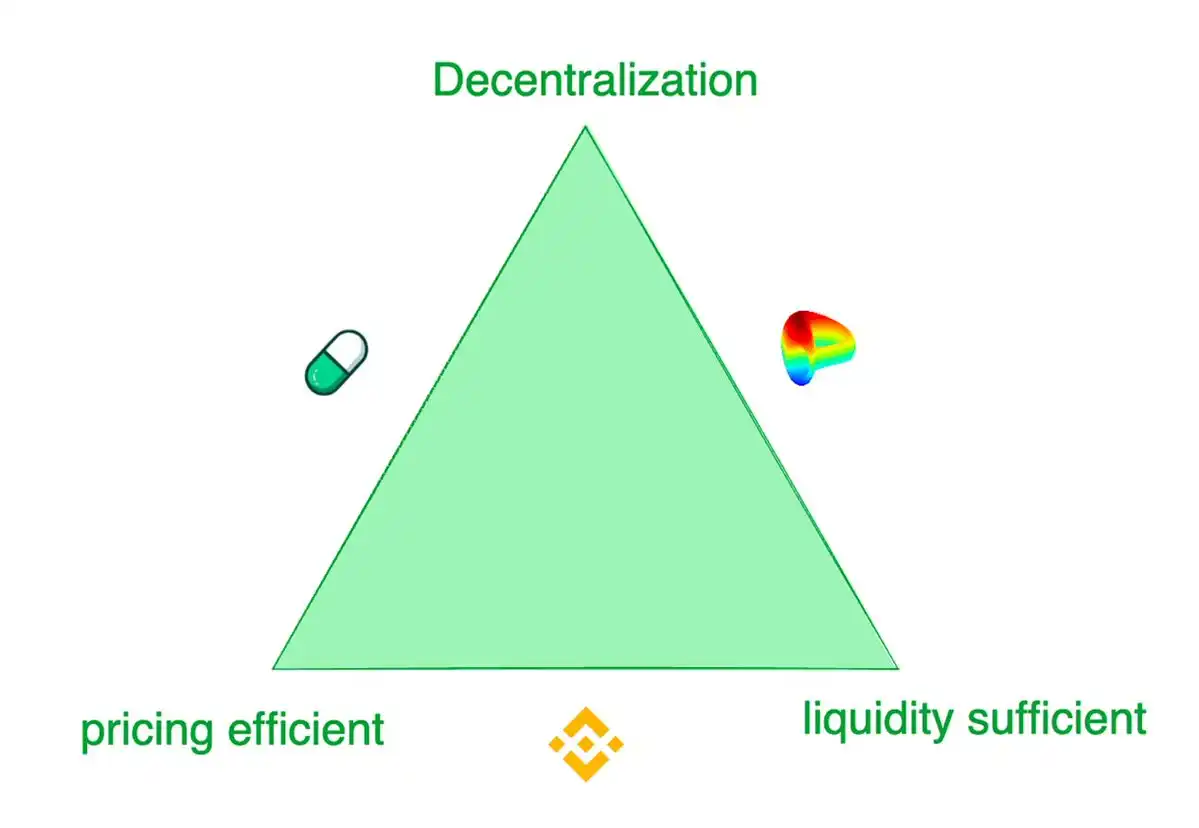
To summarize, contemporary token trading platforms face a trilemma: 1) sufficient liquidity, 2) effective pricing, and 3) decentralization.
The Exchange Trilemma
While centralized exchanges like Binance offer the best trading experience, they are also plagued by risks such as fraud and monopoly. In contrast, decentralized exchanges cater to different demand scenarios. For example, Pump.fun offers an extremely sensitive token supply curve, while Curve offers the best liquidity in most cases, rather than price discovery sensitivity. These exchanges adopt various models to meet the trading preferences of their different target customers.
Attempts to Create On-Chain Liquidity
Decentralized exchanges have made significant progress in solving this trilemma and other on-chain trading challenges through innovative solutions. Uniswap is a benchmark in this niche industry. The innovation of the joint curve marks the beginning of a new era. Before Uniswap's "X*Y=C" curve, decentralized exchanges used order books to settle on-chain trading needs. Subsequent automated market makers (AMMs) followed Uniswap's exploration direction and created liquidity pools. In Uniswap V2, liquidity in different trading pair pools is algorithmically connected. Uniswap V3 introduced segmented liquidity pools, allowing users to define the price range in which they want to provide liquidity. Uniswap V4 further advances this by providing liquidity pool customization solutions.
Curve Protocol, which focuses on stablecoin trading, has developed its own supply liquidity curve to provide more token liquidity around a predetermined equilibrium point. To address the challenge of joint liquidity pools, Curve Protocol invented a multi-dimensional formula that enables users to stake more than two tokens in a liquidity pool, thereby sharing liquidity among all tokens in the pool. In practice, CEXs have shown better liquidity and pricing efficiency. On-chain pricing systems usually lag behind off-chain CEXs. Hashflow has established a pool of professional market makers (PMMs) with the help of oracles to connect on-chain and off-chain liquidity.
However, traditional joint curves are costly for small-scale tokens. Friend.tech designed a steeper joint curve to accommodate small investors who prefer price appreciation rather than sufficient liquidity. As the value scale of tokens increases, investors' preferences shift to liquidity. Inspired by this, Pump.fun uses a steep curve when the token value is low, but as the value increases, the curve shifts to a different slope or even a different curve.
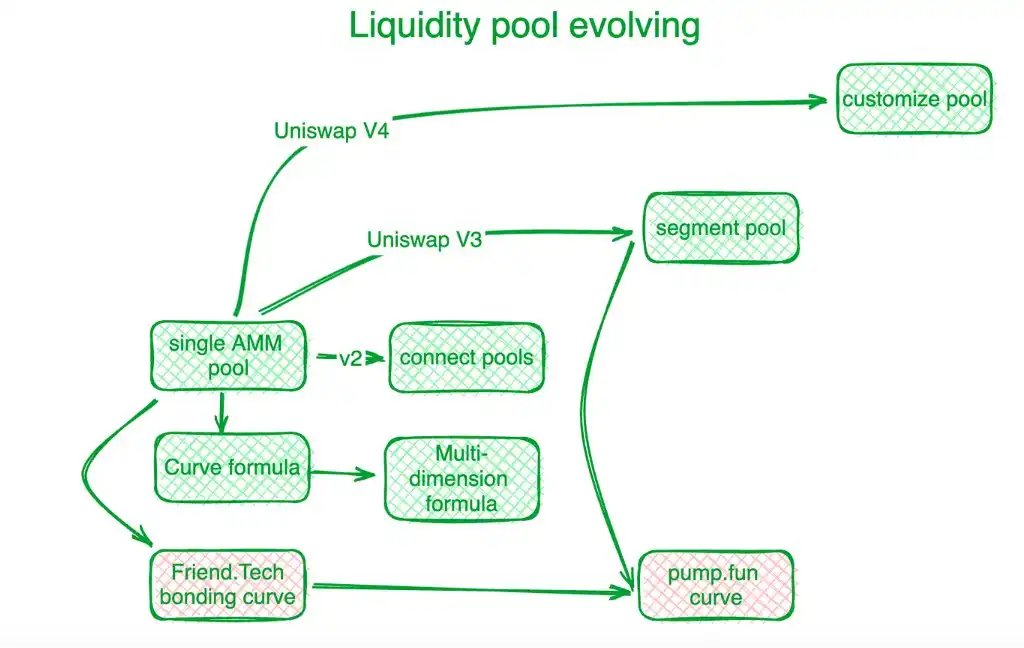
The Evolution of Liquidity Pools
MEV, the Race for On-Chain Liquidity
MEV is another arena for decentralized exchanges.
Maximum Extractable Value (MEV) refers to the profit earned by miners or validators through their ability to arbitrarily include, exclude, or reorder transactions within the blocks they generate. It can be viewed as a liquidity cost. In a liquidity pool, each exchangeable token (liquidity) is distributed along a price scale, and the liquidity of each price span is limited. Those who are able to interact with the liquidity pool contract earlier gain an advantage by obtaining better prices. In this way, MEV is intrinsically linked to the liquidity problem.
MEV is manifested in decentralized transactions by sorting transactions to obtain favorable liquidity. This competition improves the efficiency of on-chain transactions, but it also harms the interests of all parties. In order to retain as much transaction value as possible in decentralized trading platforms and return it to participants more completely, developers have built algorithms and mechanisms at the application level to intercept MEV generated by transactions.
Flashbots, as a veteran in the field of MEV management, focuses on the distribution of node revenue. To ensure the transparency and efficiency of MEV distribution, they established a MEV auction system at the node level. Eden Network pursues similar goals. KeeperDAO combines MEV extraction and staking, allowing participants to benefit from MEV while protecting users from its negative effects. Jito Labs, a liquidity staking project on the Solana network, also solves this problem.
Projects led by Cow Protocol, including UniswapX, 1inch Protocol Fusion, etc., all use auction interaction rights to keep MEV within the transaction process instead of migrating it to the node accounting level. Intercepting MEV protects active traders and AMM liquidity pools, eliminating the previous dilemma of DEX bribing nodes and MEV loss.
Liquidity dispersion calls for agents to solve the problem
As mentioned earlier, token liquidity is scattered in various custom pools controlled by different protocols on different blockchains or layer 2 solutions. Polygon proposed a concept of aggregation layer to collect liquidity from different layers. Initially, some DEX aggregators emerged to integrate liquidity from these different pools. However, after accumulating enough traffic, a more effective approach is to create platforms that promote competition, such as 1inch and Cow Protocol.
In addition, the batch auction mechanism enhances the role of agents. It introduces a new market mechanism to alleviate liquidity constraints. In fact, traders can place orders at a limited price within a specified period. The batch auction smart contract collects these orders and bundles them into a batch. The smart contract then allows agents to bid on these batches. The agent who offers the best price will win the opportunity to settle all potential transactions within the batch.
CoW Protocol Batch Auction Mechanism Description
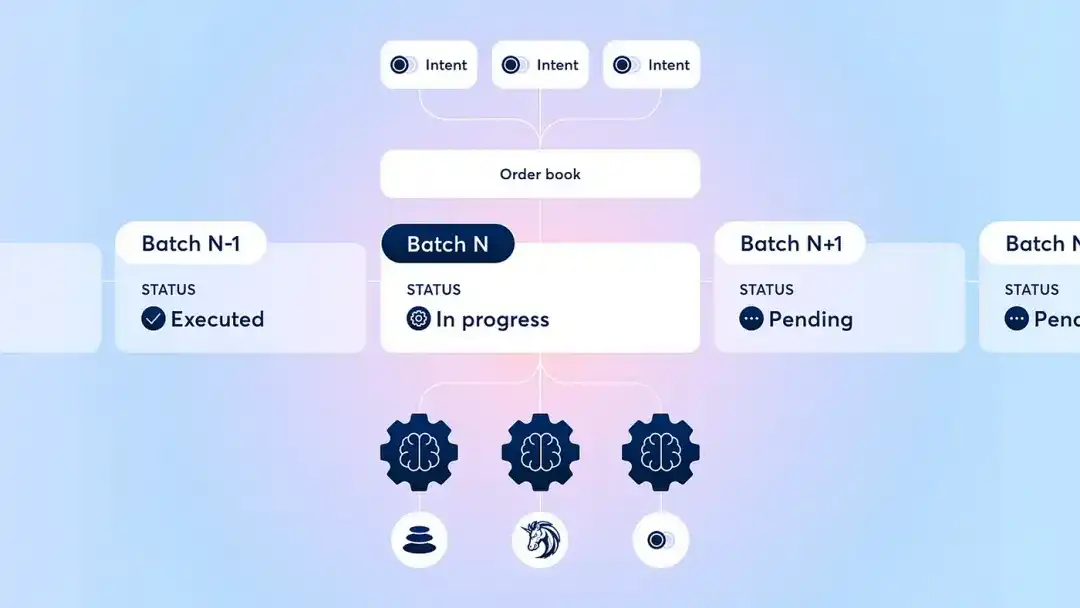
Batch Auction Draft from Cow Protocol
Batch Auctions: The Grandmaster of DEX Development
After years of DEX development, the industry has embraced methods such as batches, auctions, and order matching to optimize trading results for all participants. The specific implementations of auction mechanisms vary, but in general, they shift the complexity of optimizing exchange results to professional participants and redistribute the remainder to relatively immature exchangers.
Such auctions can solve many DEX problems in multiple ways.
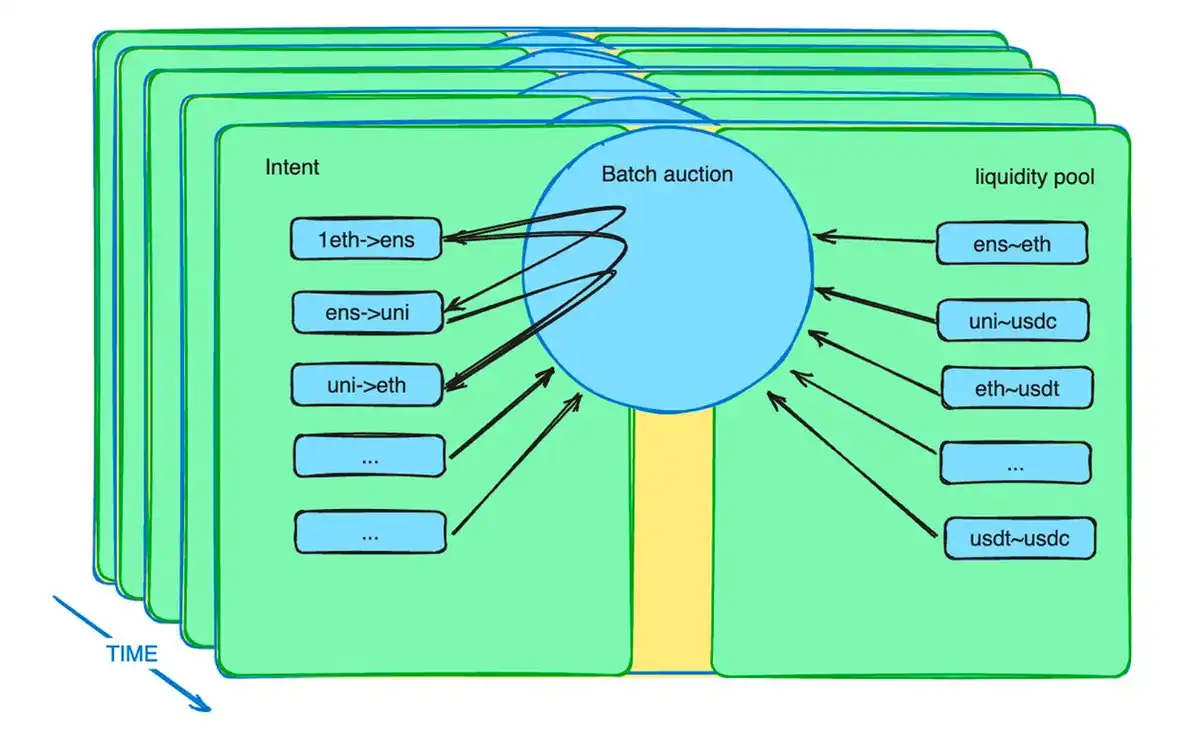
Batch Auction Diagram
In addition to the MEV redistribution mentioned in the previous section, batch auctions can do much more than that. What traders send to smart contracts is not an instruction, but an intention. This intention can last for several minutes. These intentions are packaged into a batch and proposed to a group of competing specific trading agents. We know that with so many intentions and various liquidity pools, optimization is a difficult problem. Professional things should be left to professionals, which can improve system efficiency. Batch auctions maximize their value efficiency by sacrificing time efficiency (each transaction intention lasts for a few minutes by default), forming differentiated competition with CEX. What's more? Barter is revived! Barter is back on the stage As the ancestor of all cryptocurrencies, Bitcoin defines itself as a currency. Decentralized markets are an emerging field without clear consensus constraints. Barter is a cryptocurrency-native trade model that naturally fits into this environment. DEX is often referred to as an "exchange" platform. In its trading model, there is no predetermined universal equivalent role. Traders do not have to use fiat currency or stablecoins as intermediaries. At the liquidity pool level, any trading pair is allowed. Traders can use any token they like to exchange for other tokens and bear the cost of liquidity inefficiency.
However, there are significant limitations to relying solely on liquidity pools for bartering. There are not enough pairings for all types of bartering. Due to the structure of the liquidity pool, liquidity deployment time is long and it is difficult to find an equilibrium price. Therefore, liquidity must be deployed over a wider range of prices, which leads to scarcity compared to the limited-time demand of intent. This is where intent and batch auctions come into play.
Assume that there are multiple potential trading intents that can meet each other's needs and are supplemented by liquidity from the funding pool. In this case, bartering will return to the market in a more efficient state. As the scalability of web3 infrastructure increases and more commodities and financial instruments join web3, batch auction smart contracts will capture thousands or even millions of trading intents per second. Any token can be used as a means to liquidate other tokens. We will get rid of the liquidity limitations imposed by the US dollar in the general context.
Batch Auctions: The Key to On-Chain Barter
The resurgence of barter represents a renaissance that responds to market needs.
Historically, when money was invented, it was difficult for traders to find direct barter opportunities that met their immediate needs. Therefore, they exchanged goods for a universal equivalent (money) and then bought what they really needed in another transaction. Once this exchange model became widely accepted, it forced real barter demand to be divided into at least two steps, and the direct barter market was completely replaced.
Today, on-chain barter demand exists in the form of short-term intentions. Batch auction smart contracts collect these intentions. Anyone, whether human or AI agent, can meet the entire transaction demand as long as they provide the best bid. If the intentions are matched, there is no need for a stablecoin pegged to the US dollar. The token retains its utility and shares liquidity as before. This matching of barter needs is based on global markets and stronger information matching capabilities, which is based on the cultural tradition of cryptocurrency barter.
In the short term, the existence of the intention time span enables arbitrageurs to transfer liquidity across chains and from off-chain to on-chain. For example, an algorithm that finds price gaps between different chains or between DEX and CEX can buy at a lower price and sell at a higher price within a specified time. It may need to use financial instruments to hedge market risks to achieve a risk-free state. However, in the future, when on-chain, off-chain, and cross-chain transactions can be synchronized, all transactions can be executed at the same time. This can eliminate risk costs and provide traders with the best experience.
Why is barter under batch auction a milestone in the DEX era?
The reason is simple. If we look back at the history of currency, the right to coinage was originally private. According to Debt: The First 5000 Years, debt can be personal. Even in modern times, as detailed in A Monetary History of the United States, 1867-1960, private individuals could once mint silver coins. Today, however, all credit is issued by the Federal Reserve. Even Bitcoin is denominated in US dollars, which is the misfortune of the times. The US dollar has overshadowed the brilliance of cryptocurrencies. Barter trading provides an opportunity to recapture this position, which is the era of the importance of the revival of barter.
The development of DEX gives us the confidence that we can eventually surpass centralized trading platforms (CEX). In the last DeFi summer, it was widely believed that DEX would surpass CEX in due time. How many people still hold this belief today? If we study the development of DEX, the introduction of batch auctions is no coincidence. This is a well-thought-out step towards solving the liquidity problem and a phased result of the continuous technological iteration of DEX. DEX has evolved from just having a liquidity pool to a comprehensive liquidity system with different participant roles, specialized components, and permissionless composability. This progress was achieved through the efforts of predecessors. Relaxing time constraints and creating conditions that differentiate from centralized trading platforms have allowed us to see more possibilities. It even restored my confidence in DEX surpassing CEX.
A business cycle has passed, and although the DeFi giants remain unchanged in appearance, they have undergone a transformation in their hearts. Batch auctions are an important milestone, as important as the invention of liquidity pools. I believe they can realize the dream of DEX surpassing CEX. When barter becomes the main trading mode again, we can regain control of our own market rhythm.
Postscript
When discussing the future with many industry leaders, I found that there is a general confusion in the market. The market's lack of attention to technology has led to a general lack of confidence.
I still remember that at the end of 2018 and the beginning of 2019, when I was eating hot pot in Chengdu, I talked with a friend about the bright future of DeFi and Ethereum. He talked enthusiastically about the future of DeFi and Ethereum. Although the price of ETH was less than $90 at the time, his eyes were shining with excitement.
Think about it, when did the development of the industry fall to the point where it needed to be defined by speculators' wallets?
DEX is just a small part of the vast DeFi industry. If we look closely, we will find that DeFi and other fields are making significant and exciting progress. As long as technology continues to advance and develop, and never stops, what do we have to worry about? Dreams will surely come true.
For all the industry builders who are forging ahead, I have only one ancient Chinese poem to give to you: "Don't worry about having no friends on the road ahead, everyone in the world knows you."
Original link
Welcome to join the official BlockBeats community:
Telegram Subscription Group: https://t.me/theblockbeats
Telegram Discussion Group: https://t.me/BlockBeats_App
Official Twitter Account: https://twitter.com/BlockBeatsAsia
 Related Articles