What is "Ethereum Login", one of the five achievements of Ethereum 2022?
Original title: Details of IP-4361: What Is Ethereum Login?
TokenviewLabs
To facilitate your reading, preview the table of contents
Part 1: What is IP-4361?
Part 2: How Important is Ethereum Login to Web3?
Part 3: Creating the Ethereum Login Interface
Part 4: Analyzing ENS data Part 5: Tokenview popularization time
Beginning of text
Users are required to use a user name or email address and password when logging into the web2 service. Sign-In with Ethereum, however, will change that.
Usually when logging into a "web2" service, we need to use a username or email address and password. The service can then look up our username or email address in their internal database to see if the corresponding password matches the one we provided. Generates a random key for further authentication, usually stored in a cookie. This submission to the "Big login" (where the same login method is used across many Internet services (e.g., Facebook, Google, Weixin, etc.) often relies on large Internet companies and email providers, which are the centralized entities that have ultimate control over a user's identity.
The advent of Ethereum Login (EIP-4361) changes this rule by providing a new self-hosting option for users who want to take more control and responsibility over their digital identity. Instead of having to compromise with some big middlemen, users can now log in directly (without going through a middleman) using the same private key that controls their blockchain account. Big companies can no longer deny users the ability to access services or monitor their behavior.
Logging in with Ethereum is expected to return user power.
Part.1
What is IP-4361?
What is IP-4361: Logging in with Ethereum?
It is the off-chain authentication for the Ethereum account to establish sessions.
Ethereum Login (EIP-4361) describes how an Ethereum account authenticates an off-chain service by signing a standard message format parameterized by scope, session details, and security mechanisms. The goal of EIP-4361 is to provide a self-hosted alternative to centralized identity providers, improve interoperability of Ethereum authentication-based off-chain services, and provide wallet vendors with a consistent machine-readable message format for better user experience and consent management. In other words, the purpose of EIP-4361 is to change the way we log into web2 services by using methods commonly used by web3 services such as wallets and dapps.
A number of services already support workflows for authenticating Ethereum accounts using message signatures, such as setting up a cookie-based web session that manages privileged metadata about authenticating addresses. This is an opportunity to standardize login workflow and improve the interoperability of existing services, while also providing wallet vendors with a reliable way to identify signing requests as Ethereum login requests to improve the user experience.
The Ethereum login works as follows:
The wallet provides the user with a structured plaintext message or equivalent interface for signing using the EIP-191 signature data format. Before signing, the Message prefix is defined in EIP-191 as \x19Ethereum Signed Message:\n< length of message> . The message must contain the Ethereum address, the domain in which the signature is requested, the version of the message, the chain identifier chain-ID, the uri used for the scope, the relying party acceptable nonce, and the issuing timestamp.
The signature is then presented to the dependent party, which checks the validity of the signature and the message content.
Other fields, including expiration time, not-before, request id, statement, and resource, can be incorporated as part of the login process.
A dependent party may further access data associated with an Ethereum address, such as from the Ethereum blockchain (e.g., ENS, account balances, EIP-20/EIP-721/EIP-1155 asset ownership), or other data sources that may or may not be allowed.
Case message
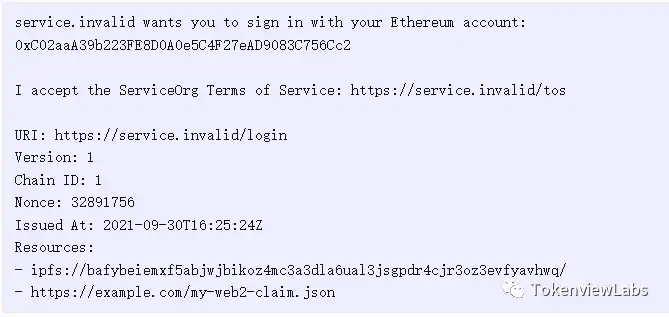
Ethereum Login (EIP-4361) defines an open Creative Sharing (CC) signature format for Ethereum accounts. Instead of using a combination of username and password, users log in by signing messages with their private key. And any web-based service can be securely verified. Ip-4361 was created by the community with direct support from the Ethereum Foundation and ENS.
Part.2
How important is Ethereum login to Web3?
For all the builders of Web3, the Ethereum login means a lot more than the Connect Wallet. Connecting wallets is currently the main way to access Web3 dapps. By connecting to the wallet, users can start interacting with the blockchain, but connecting to the wallet doesn't make the app record any information about you, it just creates a front end display for simple interactions. Ethereum login, on the other hand, allows users to establish sessions with applications, allowing them to have richer situational interactions and safely read and write their data.
We illustrate with the examples Connected Carl (a Carl that uses connections) and Session Sam (a Sam that uses sessions). The "Connected Carl" uses the dapp. He can trade on Uniswap, borrow on Aave, or even buy NFT on OpenSea, just by connecting his wallet. Things were going pretty well for Carl for a while, until one day he ran into a problem: He wanted the Dapps to remember him so they would give him a better experience the third, fourth, and fifth time he used them.
Carl wondered if Uniswap could automatically import his liquidity preferences, Aave could remember his favorite lending markets, or even OpenSea could remember his name instead of 0x2Fe1a3... Account, his experience will be much better. But it starts all over again every time he connects his wallet.
Session Sam doesn't have this problem. This information is saved after authentication and a session is established with dapps. Even if Sam disconnects and authenticates again, Sam picks up where he left off and still remembers everything about him in the application. His information can even be kept in a remote database that he controls.
Connecting to your wallet is as simple as notifying the dapp which account you're using, and the dapp has no memory of you, creating a platform for simple interactions. But the Ethereum login authenticates users in order to set up a session with them, and all sorts of contextual interactions between you and the dapp are securely read and written.
Part.3
Create the Ethereum login screen
Wallet creates Ethereum login interface as follows:
The wallet implementer must show the following terms in the Ethereum login signature request to the user by default and before signing: domain, address, statement, and resource. Other existing terms must also be provided to the user by default or before signing through an extension interface. When the wallet implementer displays a plaintext message to the user, it should ask the user to scroll to the bottom of the text area before signing.
Wallet implementers can build custom login Ethereum user interfaces by parsing ABNF terms into data elements used in the interface. The above display rules still apply to the custom interface.
In terms of user experience, wallet can present a friendly and stylized interface to make the user experience better. For example, the signature information usually prompted to the user is LOGIN. "Sign in with Ethereum" is a bit cluttered by comparison, but we can use it to make requests to users in a generally accepted way. Once you have an agreed upon signature message format, the application and the wallet speak the same language. When the application makes a signature request to the user, the wallet can examine the request, check whether it fits as an IP-4361 message, and let the user know that they are signing into a website (and thus get a cleaner interface). The specification also introduces additional security requirements for wallets, such as domain binding to prevent phishing attacks and nonce Settings to prevent replay attacks, further protecting users throughout the experience. For example, if the wallet finds a valid Ethereum login information, but the user signed for example.com but was actually at exampie.com, the wallet could warn the user of the situation.
Part.4
Parsing ENS data IP-4361 is cleverly integrated with Ethereum Name Service (ENS).
The ENS data can also be parsed by the dependent party or wallet, as this can improve the user experience by displaying human information related to the address. If an address has a primary ENS name, the service can look up that primary ENS name and parse data based on it. For example, you can store your preferred username, profile picture, email address, or any other information in the ENS name. This gives you control over your own data and eliminates the need for web2 services to store this information about users. This could lead to future standard login to authenticated applications using authenticated, signed EIP-191 messages, eliminating email/password combinations altogether. ENS data that can be parsed includes: Primary ENS name. ENS head. Any other resolvable resources specified in the ENS document. If ENS data is parsed, implementers should take precautions to protect the privacy and consent of users, as their addresses may be forwarded to third-party services as part of the parsing process.
Part.5
What is an EIP?
An important process used in Ethereum governance is the Proposals in EIPs: Ethereum Improvement Proposals. EIPs is a standard that specifies potential new features or processes for Ethereum. Anyone within the Ethereum community can create an EIP. For example, none of the authors of IP-721 (the EIP of the standardized NFTs) were directly involved in Ethereum's protocol development. Assuming an EIP is approved, tested, and implemented, it will be scheduled as part of a network upgrade. Because network upgrades are expensive to coordinate, EIP's are often bundled together for upgrades. After the network upgrade is activated, the EIP will go live on the Ethereum network.
We've previously covered the four EIP families that will be activated in the Ethereum Shanghai upgrade, including EIP-3651 (which reduces the gas overhead for accessing COINBASE addresses); Ip-3855 (operand code PUSH0 added); Ip-3860 (limits initcode size and introduces gas metering to this field) and IP-4895 (beacon chain push withdrawal as system operation).Click to review.
Original link
Welcome to join the official BlockBeats community:
Telegram Subscription Group: https://t.me/theblockbeats
Telegram Discussion Group: https://t.me/BlockBeats_App
Official Twitter Account: https://twitter.com/BlockBeatsAsia
 Related Articles