A brief analysis of the multi-privilege NFT Management Protocol IP-5496
Title: Talk about the upcoming review of the Multi-authority NFT Management Protocol IP-5496
Original source: Jason chen
Note: There are many personal views in this article, which do not represent the official position. There may be some bias and inadequacies. Welcome to exchange and discuss.
For the Web3 industry as a whole, I think anything that lowers the barriers and costs to entry for the average user is a good thing, and for the NFT track I think anything that enhances mobility and usability is a good thing.
Before that, forLease NFT Agreement 4907I also wrote a special article, NFT has developed into the next narrative in the post-small picture era. I think it is the practical NFT that is closer to life scenes.
First of all, for the small picture this matter again wordy two sentences, it seems that many people will see the small picture as the original sin of NFT, NFT ridicule as a small picture, but I don't think so, small pictures for crypto to the public vision must be immeasurable promoting effect, can not pick up the bowl to eat down the bowl to scold.
Before this, crypto for ordinary people's understanding and participation in the threshold is still very high, colorful k line and stimulate the rise and fall range determines its or a small number of people's financial game, but after the emergence of NFT at least posted on the above the small picture is really visible things, even if you do not understand finance and encryption, Do not know mining and defi, but at least can judge the picture is not good, the community is not interesting, small picture + profile picture brought by the community culture greatly reduces the understanding of ordinary users and participation threshold, highly promotes the participation of a large number of outside personnel, so small pictures for the popularity of crypto absolutely has a great credit can not be denied.
It is only because of the low liquidity of NFT that zombie assets are much higher than tokens, which is why it is important to improve the liquidity of NFT. Secondly, I think the asset attribute of NFT only releases half of its value. Because of its uniqueness and anything-goes, NFT (URI Mount) brings the other half of the practical value, which has a much larger imagination space than token, but so far the practical value has not been fully released, which depends on the application scenario exploration brought by the construction of infrastructure. In addition, the enhancement of practicality will also bring the appreciation of its asset value. This is a left foot on the right foot. I don't think the NFT, which only has utility but no asset transaction value, is interesting.
The utility of NFT is the empowerment of the holder's equity. At present, the most common empowerment focuses on the process from asset verification to community entry. It can also be seen that wearable NFT issued by Adidas or some subscribable NFT (which is being proposed by our BuidlerDAO community) are gradually emerging.
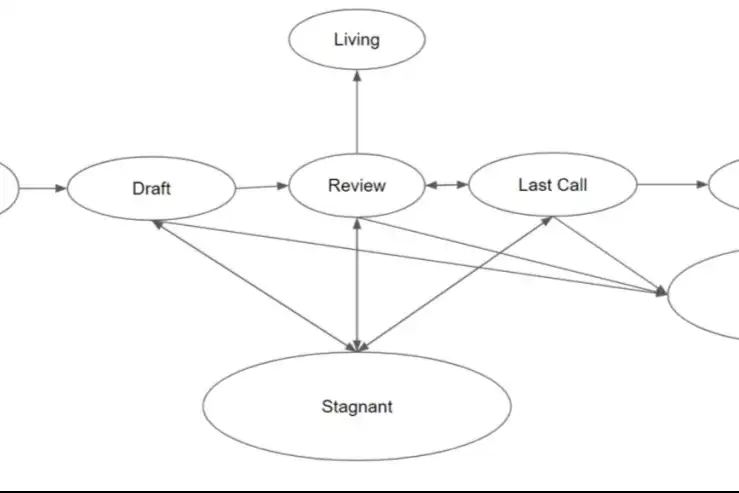
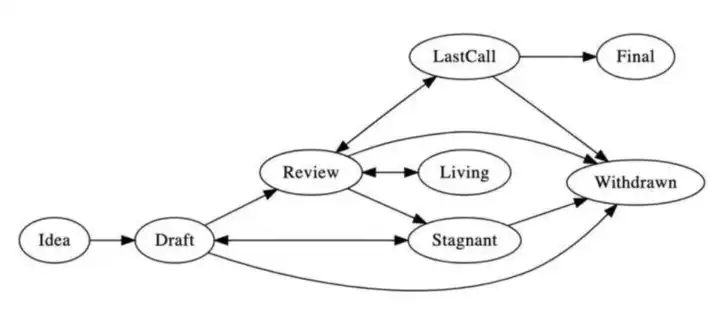
In this article, IP-5496 provides multiple shareable rights. It has entered the LastCall state and is about to be reviewed. Here is a brief introduction to the EIP process. After the preliminary review, you will be given a number according to the time sequence, and the life cycle as shown in the figure below will be discussed and reviewed. EIP can be divided into many types, including Core, Networking, Interface, ERC, Meta, and Informational. Each of them has different problems to solve. For example, Core refers to the underlying content related to the core, such as consensus fork. The familiar ERC is application-level standard setting. 20, 721, 3535, 4337 (account abstraction), and 5192 (soul binding) all fall into this category, so ERC is also the closest and best understood layer for ordinary users. I usually like to read EIP, which is not only a history book of Ethereum, but also a book of prophecy. Every EIP may contain huge opportunities, and reading EIP is also a way to grasp the direction of the market. I suggest you to pay more attention to it when you have nothing to dohttps://eips.ethereum.org/all
It believes that in addition to pictures and asset attributes, NFT has practical applicability and can be expanded in different scenarios. Rights and interests may exist on the chain, such as voting rights, browsing rights and airdrop rights, etc., or under the chain, such as shopping discounts, restaurant discounts and airport VIP room use rights. In the eyes of EIP-5496, each NFT can contain multiple rights and interests. And this equity should have several optional characteristics
Verifiable: The equity can be verified
Transferable: An interest can be transferred to another
Shareable: Equity can be shared among multiple people
Expiration: An interest can be set to expire
As the issuer may have a lot of rights to the NFT, the owner of the NFT may not want to use their rights, while the traditional ERC721 only records the ownership and transfer process of the NFT, the rights of the NFT are not recorded on the chain, EIP-5496 allows the project side to write the rights on the chain. Moreover, the owner of each right can manage each right independently. Thus, both the project side and the holder have the ability to manage the right, which releases the value of NFT in the field of equity practicality.
At present, if the project party wants to empower the NFT holders with multiple levels of equity, it can air drop multiple types of NFT. For example, an airline company airdrops a series of NFT to the Crypto Punk holders and grants them equity to attract them to join the airline's membership. However, the NFT of the new airdrop is not bound to its master NFT, so if the master NFT of Crypto Punk is transferred, the NFT of the airdrop still continues to enjoy the rights in the hands of the original owner, while the new master NFT holder cannot automatically enjoy the rights. Therefore, IP-5496 can bind the equity to the underlying master NFT, and allow the user to autonomize the administrative rights.
The most difficult part of the protocol is how to support the expansion of more complex business scenarios at the simplest possible level. It requires elegance and restraint rather than the pursuit of power and sophistication. So let's take a look at what IP-5496 does and what its design principles are through its technical implementation. There's a lot of code and I'm going to take some of the core stuff and explain it to you.
First of all, it ID all the rights and interests in the contract. Before that, I thought that the process of setting the rights and interests of NFT was to directly write the rights and interests of NFT into the contract. For example, an NFT has 3 rights and it is not written in the form of string text [can discount] [can use products] [can get airdrop]. Instead, the equity ID of the NFT is set as 1, 2, and 3, which is right. It is set in the contract that there are 3 equity, and the content of the equity is not directly written into it. This is what I think is elegant and restrained as an agreement.
1. As a protocol, I only need you to set several rights and interests, and the ID of each right and the specific rights and interests will be handed to the outside of the contract, i.e. decided down the chain. Just like a computer has three USB ports, which can be used to insert USB disk or mouse, the user can decide what to insert.
2. Equity ID will be very convenient for the verification of equity. For example, a product requires that the NFT holder can only use the equity that "can use the product", so when the user opens the product, the product code needs to write a logic to verify whether the user holds the NFT and has the corresponding authority. It is necessary to match the permission name word by word. "Product can be used" and "Product can be used" are two completely different permissions for the code, but if the ID is used, it only needs to check whether the current NFT has "2" permissions.
3. The content of rights and interests is changed frequently. If the content of rights and interests is placed under the chain, only the number of rights and interests ID is placed on the chain, if the project party changes the rights and interests, there will be no gas fee.
However, after equity ID, the same problem is that it is impossible to intuitively see what equity this NFT has, only 1, 2, 3 these ID numbers. Third party products are also required to do a separate equity content setting and query function to index to the corresponding ID.
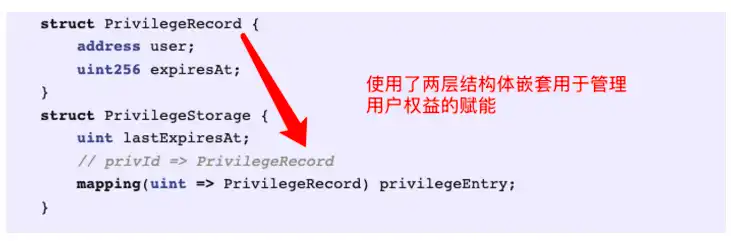
PrivilegeRecord defines PrivilegeRecord, which stores the user address and expiration time, and then PrivilegeStorage, which stores the latest expiration time. The rights ID is bound to the PrivilegeRecord by mapping.
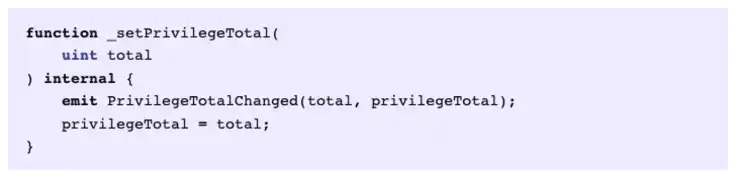
The _setPrivilegeTotal function is used to set the privilegetotal number. This number will be used during the weighting process. In other words, there are only 3 rights and the ID must be less than 3.
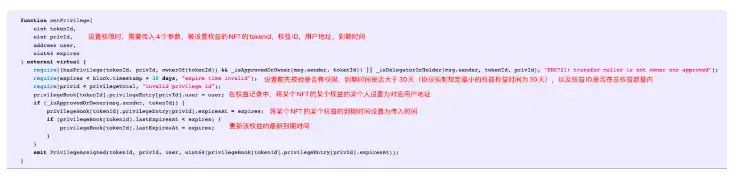
The following figure shows the core code of equity setting. First, when setting permissions, you need to pass in 4 parameters: NFT tokenid to be set, permission ID to be set, the address of the user to be granted, and permission expiration time. There are three verification conditions that need to be carried out when granting rights, namely, whether the document has authority, whether the expiration time is greater than 30 days, and whether the equity ID is within the scope of total equity. I think it is quite strange that the time limit of the equity in the agreement must be more than 30 days. I don't know why such personalized restrictions are added to the agreement. Logically, this limit should be left to the discretion of the project side.
privilegeBook is a mapping data type used to manage the assigned rights of each NFT. The code sets the privilegeBook to the assigned user address for a certain person of a certain interest of an NFT and then updates the expiration time.
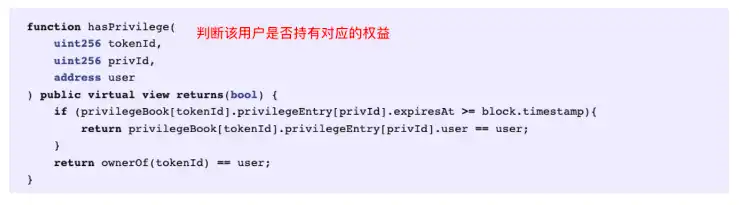
The following figure is also a very core interface used to determine whether the user holds the corresponding rights and interests. This interface will be a key way for other third-party products to verify the rights and interests. It can be seen that three parameters, tokenId, equity id and user address, are passed in. Here, the latest expiration time is obtained to determine whether it is larger than the timestamp of the current block. If there is an expiration date, the user corresponding to the current tokenid is verified to be the user address passed in.
The following chart shows the latest maturity time for acquiring an interest in an NFT.
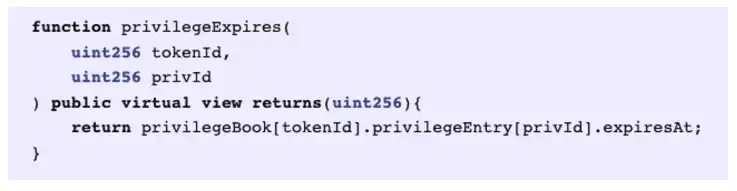
Above is the content of IP-5496. Overall, I think it makes a contribution to NFT from the perspective of practicality, but it also has its own limitations. Through the above code analysis, it can be seen that its permission granularity is at a specific level of NFT, namely, in the unit of tokenid. Maybe I haven't studied it thoroughly, but if I want to set the permission for a certain batch of NFT or even the whole collection, it will be very troublesome. If there are 10,000 NFT, I need to set 10,000 times. I don't know how the proposer considers this issue.
In short, as mentioned at the beginning of this article, NFT has passed the stage of PFP, and the next narrative is to be opened by the innovation of infrastructure and upper application, which will bring the influx of incremental users after the next break through the circle. There are a lot of personal opinions in this paper, there are shortcomings and biases, which does not represent any organizational position and does not constitute any investment suggestions. Welcome to exchange and discuss.
The above are personal opinions with bias and defects. Please forgive me if there are any shortcomings. They do not represent the position of any organization and do not constitute any investment proposals.
Link to original article
Welcome to join the official BlockBeats community:
Telegram Subscription Group: https://t.me/theblockbeats
Telegram Discussion Group: https://t.me/BlockBeats_App
Official Twitter Account: https://twitter.com/BlockBeatsAsia
 Related Articles