



Ethereum MEV: Is the Flashbot "Slave Class" Democratized the Right Solution?
Ethereum MEV: Is the Democratisation of Flashbot 'Slave-owning Class' the Right Solution?
Original source: limblock Zhang Liang
With the in-depth understanding of mev problem, I have my own new thinking on this topic. The term Mev (miner extractable value) comes from Ethereum, and there are actually similar MEVs for other public chains, though they may not be called the same. Under the previous Ethereum pow consensus system, miners verifying transactions and packaging blocks had the power to reorder, insert, ignore or review transactions. This means that they can earn in addition to transaction fees and block awards through arbitrage trading, clearing and other opportunities.
Specifically, when a user sends a transaction on the chain, the transaction is first located in a public memory pool (mempool) for processing. Miners and arbitrageurs can monitor the memory pool for opportunities to arbitrage. For example, if a user makes a large trade on a trading platform, the price drops, creating a large arbitrage space. Arbitrage robots carry out arbitrage trades, arbitraging the market price to the true price level.
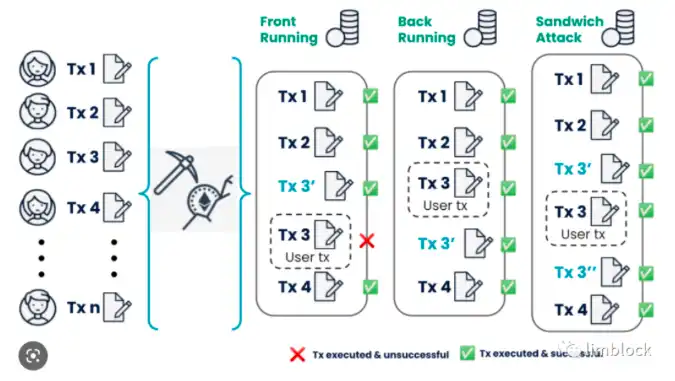
According to lim block Weekly, the process is somewhat similar to sending a delivery in our daily lives. Users first deliver the express to the express collection point, waiting for the Courier to package, processing, send to the car.
Suppose the epidemic is lifted, and Shanghai residents stock up on drugs for treatment. As a result, the price of drugs will soar, exceeding the normal price by ten or even tens of times. Let's say you are a Courier and you own a pharmacy in Shanghai, which is also stocking up on drugs to treat COVID-19.
At this time, as a Courier, you have received a large amount of drugs to be sent to Shanghai, which can fully meet the drug supply demand of Shanghai during the period when the epidemic is unsealed. You realize that once this batch of drugs is put into the Shanghai market, your stock of COVID-19 drugs in your pharmacy may quickly be discounted and your profits greatly reduced. To this end, you would probably tell the staff of the pharmacy in Shanghai to sell the drugs in the store quickly to avoid risks and ensure profits.
From the above cases, it is not difficult to find the core of mev, namely information asymmetry. Verification miners and search arbitrageurs have up-to-date on-chain transaction information that is not available to the average market user. This creates an on-chain privilege that affects the fairness and efficiency of the on-chain economy, and even security.
For example, let's say miners are rewarded $100 for each block they find. Miner A found three blocks, the first of which contained a $10,000 trade arbitrage opportunity. Miner B can continue mining on the 3 blocks discovered by Miner A, or he can remine the first block for the $10,000 arbitrage of this trade. So Miner B decided to dig the first block again; At the same time, Miner B also needs to re-excavate the second and third blocks to match the block height. For miners C, D, and others, remining these three blocks is also their best option, which is the time-bandit attack. In cases where the block reward is much smaller than the MEV, miners will choose to profit at the expense of the consensus.
For mev, the current solutions mainly focus on:
First, the establishment of the pool outside the public pool, to avoid other miners listening;
Second, establish better trading procedures to reduce the occurrence of mev;
Third, the establishment of cryptographic transaction mode, in the protocol layer to avoid miners monitoring;
Fourth, establish a new miners ability model, take the ranking right away from the hands of miners.
On Ethereum, the most common solution is the first, which is to create a new off-chain marketplace outside of a public pool. Among them, Flashbot is the most well-known project. It puts itself between the searchers and the miners. Miners run MEV-GETH, which is a fork of the regular GETH client with a separate communications and payment network that connects miners and searchers. Instead of sending the MEV to the public memory pool with high Gas, the searcher sends the transaction to Flashbots, which connects it to the miner running the MEV-GEth. For each MEV opportunity, searchers will attach a certain percentage of MEV revenue to be divided between miners and searchers.
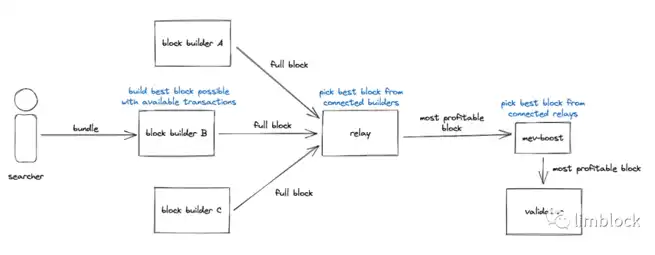
That is to say, before MEV, only a few people eat meat, and everyone fights over each other to raise gas costs, which affects the whole Ethereum ecology, and the excessive competition leads to less meat for the participants themselves.
The emergence of Flashbot allows fair participation and meat for all MEV stakeholders, at least for those involved in MEV, although less meat. But is the Flashbot approach in line with the future direction of blockchain development?
Taking the example of Courier and medicine mentioned above, the practice of Flashbot is just like that Courier not only informs his own pharmacy to sell drugs, but also informs other pharmacies in Shanghai to sell drugs, which reduces the information asymmetry to some extent. But the best thing for the market would be for the couriers to share this information with the entire population of Shanghai, making the information asymmetry disappear for everyone. This avoids the problem of a run on resources and benefits everyone. In other words, what Flashbot calls democracy is democracy for a few people, not for all people; It's information symmetry for a few people, not for everyone. The author believes that a better way is to protect the trading information at the protocol level, so that the trading result information can be fairly displayed among arbitrage searchers, miners and ordinary users, so as to promote market fairness and efficiency, and promote the market discovery of on-chain value.
Of course, without the Ethereum community coming up with a better solution at the bottom of the protocol, Flashbot at least reduces Ethereum gas, significantly reducing the cost of using Ethereum for the average user. This is just like the slave-owning democratic political system in ancient Athens. Women and slaves did not have the right to participate in democratic politics, but it was indeed progressive and positive at that time. Even today, there are still many countries and regions in the world whose political systems have not reached the level of ancient Athens.
As layer2 arrives, and especially as Zkroll up matures over the next few years, and high-performance blockchains become possible, the issues surrounding MEVs are likely to get worse. lim block Weekly believes that a solution beyond Flashbot will emerge.
Limited to the current level of cognition and understanding, the views may have shortcomings, welcome to criticize, correct, salute. In the meantime, I will continue to follow up and learn to provide updated insights for readers of lim block Weekly.
Related reference links:
https://explore.flashbots.net/
https://mp.weixin.qq.com/s/Yd-umFnjhXyB7crei2lynA
https://www.8btc.com/article/6792352
https://docs.flashbots.net/Flashbots-auction/overview/
Link to original article
Welcome to join the official BlockBeats community:
Telegram Subscription Group: https://t.me/theblockbeats
Telegram Discussion Group: https://t.me/BlockBeats_App
Official Twitter Account: https://twitter.com/BlockBeatsAsia






