Analysis of the Unpegging Risk of the Top 7 Stablecoins

Original Article Title: "Comprehensive Analysis of the Unpegging Risk of 7 Major Stablecoins"
Original Source: Biteye
In the first half of the year, the unpegging of the "stable" coin UST directly led the cryptocurrency market into a bear market, and its domino effect also brought down a series of star projects. So, are other stablecoins stable? If another unpegging occurs, the crypto community will once again face a bloodbath!
This article comprehensively analyzes the unpegging risk of the current top seven stablecoins, providing a guide to help everyone better protect their assets.
01 Stablecoin Introduction
Stablecoins usually refer to cryptocurrencies pegged to fiat currencies such as the US Dollar or other value-stable assets. Commonly anchored assets include the US Dollar (USDT, DAI, etc.), Euro (EURT, etc.), Gold (PAXG, etc.), among other assets.
Currently, the most common anchored asset is the US Dollar, so the following text will focus on introducing USD stablecoins, and the stablecoins mentioned without specification refer to USD stablecoins.

Why Stablecoins Are Needed
Store of Value:
People are accustomed to measuring the price of goods or assets in fiat currency, including crypto assets. Although many NFTs issued on Ethereum are priced in ETH, buyers still combine the stablecoin price to estimate the fiat value of NFTs. Measuring the value of crypto assets in USD is commonly referred to as "USD Standard," while measuring the value of crypto assets in other cryptocurrencies is commonly referred to as "Coin Standard."
Storage Means:
For stable assets like the US Dollar, they have a strong government credit endorsement, wide purchasing power in the real world, and do not "zero out" like crypto assets. Therefore, when Web3 users want to keep their on-chain assets as stable as possible, they can choose to convert the risk assets in their account into an anchored stable asset's stablecoin to preserve value.
Medium of Exchange:
In the crypto world, there is a demand for holding stablecoin assets to store value and measure asset value in fiat units. Therefore, fiat stablecoins have also become the main medium of exchange in the crypto world. Stablecoins issued on the blockchain allow users to directly purchase blockchain-based goods, services, or assets, enjoy the good properties of a blockchain ledger, and do not need to frequently convert fiat into stablecoins and then withdraw them to an on-chain wallet for purchases.
Stablecoin Classification
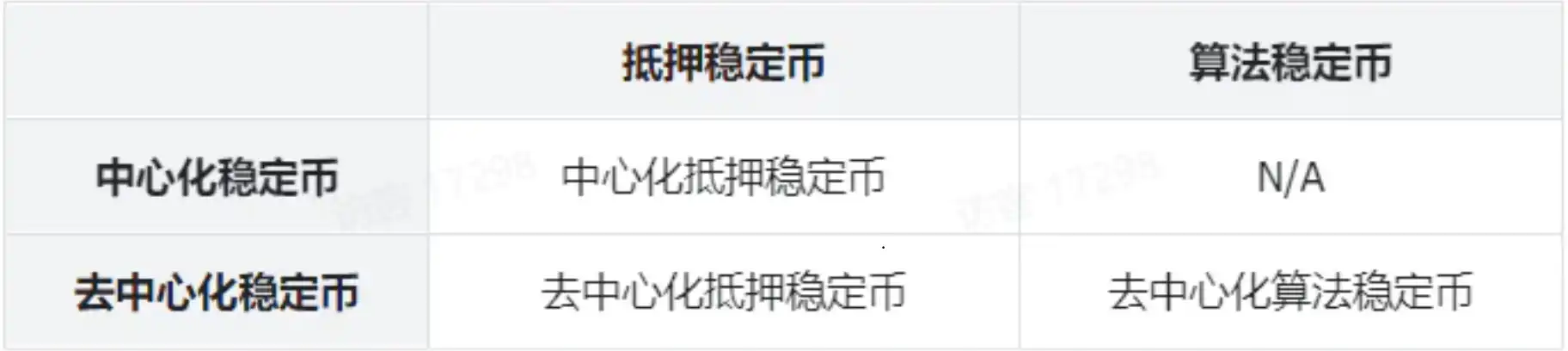
The most important characteristic of a stablecoin is its price pegged to the US Dollar. Achieving price stability against the US Dollar can be accomplished through various mechanisms, each of which brings its own set of risks. Generally, stablecoins can be classified based on the "Issuer" and "Pegging Mechanism."
Based on the Issuer, stablecoins can be divided into two categories: "Centralized" and "Decentralized":
1. Centralized stablecoins are usually issued by some off-chain entity
2. Decentralized stablecoins are typically generated by on-chain decentralized stablecoin protocols
Based on the Pegging Mechanism, stablecoins can be divided into two categories: "Collateralized Stablecoins" and "Algorithmic Stablecoins":
1. Collateralized stablecoins usually have adequately or over-collateralized assets
2. Algorithmic stablecoins maintain price pegging to the USD through a specific algorithm combined with arbitrage mechanisms
Typical Risks of Stablecoins
The core feature of stablecoins is their peg to the US Dollar. Based on this peg, stablecoins can serve as a unit of account, a store of value, and a medium of exchange in the crypto world, becoming an asset type that users find hard to bypass.
Therefore, the biggest risk with stablecoins lies in the deviation from the peg to the US Dollar, with such risk typically originating from different stablecoin issuers.
Risks from the Native Issuer
1. Collateralized Stablecoins: Inadequate collateral backing
Whether issued by a centralized or decentralized organization, the price peg of a collateralized stablecoin depends on whether the issuer has reserved enough assets to support the stablecoin and ensure that users can always redeem at a 1:1 ratio.
Decentralized collateralized stablecoins are usually minted and issued by on-chain smart contracts, where the transparency of collateral asset value is visible, with risks mainly from the smart contract level.
In contrast, centralized collateralized stablecoin issuers hold reserve assets in an account, less transparent than decentralized ones, exposing them to misappropriation risks. Therefore, centralized stablecoin issuers typically need to disclose collateral to gain user trust.
2. Algorithmic Stablecoin: Risks such as unlimited issuance due to algorithmic flaws, and uncoupling due to loss of confidence
Risks from Derivative Issuers
The original issuer of a stablecoin may find it challenging to issue the native stablecoin on all chains. Therefore, when users need to use a certain stablecoin on an unofficial chain, they can only do so by using a cross-chain bridge or a centralized exchange to move the required stablecoin to the target chain.
The corresponding stablecoin on the target chain is usually issued by the corresponding cross-chain bridge, centralized exchange, or other derivative issuer. Its security also depends on the corresponding derivative issuer, leading to the following two corresponding risks.
Cross-chain Bridge Risk: When a user utilizes a cross-chain bridge for a cross-chain transfer, the bridge typically locks the user's stablecoin on the original chain and sends the corresponding stablecoin to the user on the target chain. If the stablecoin on the target chain is issued by the cross-chain bridge and the bridge is attacked, the stablecoin on the target chain loses its backing, leading to a risk of becoming unpegged.
Centralized Exchange Risk: When a user uses a centralized exchange for cross-chain deposits and withdrawals, the exchange accepts the user's stablecoin off-chain and sends the corresponding stablecoin to the user on the target chain. If the stablecoin on the target chain is issued by the centralized exchange and the exchange has a motive for over-issuance, it can result in insufficient collateral, posing a risk of becoming unpegged.
02 Analysis and Comparison of the Seven Major Stablecoins
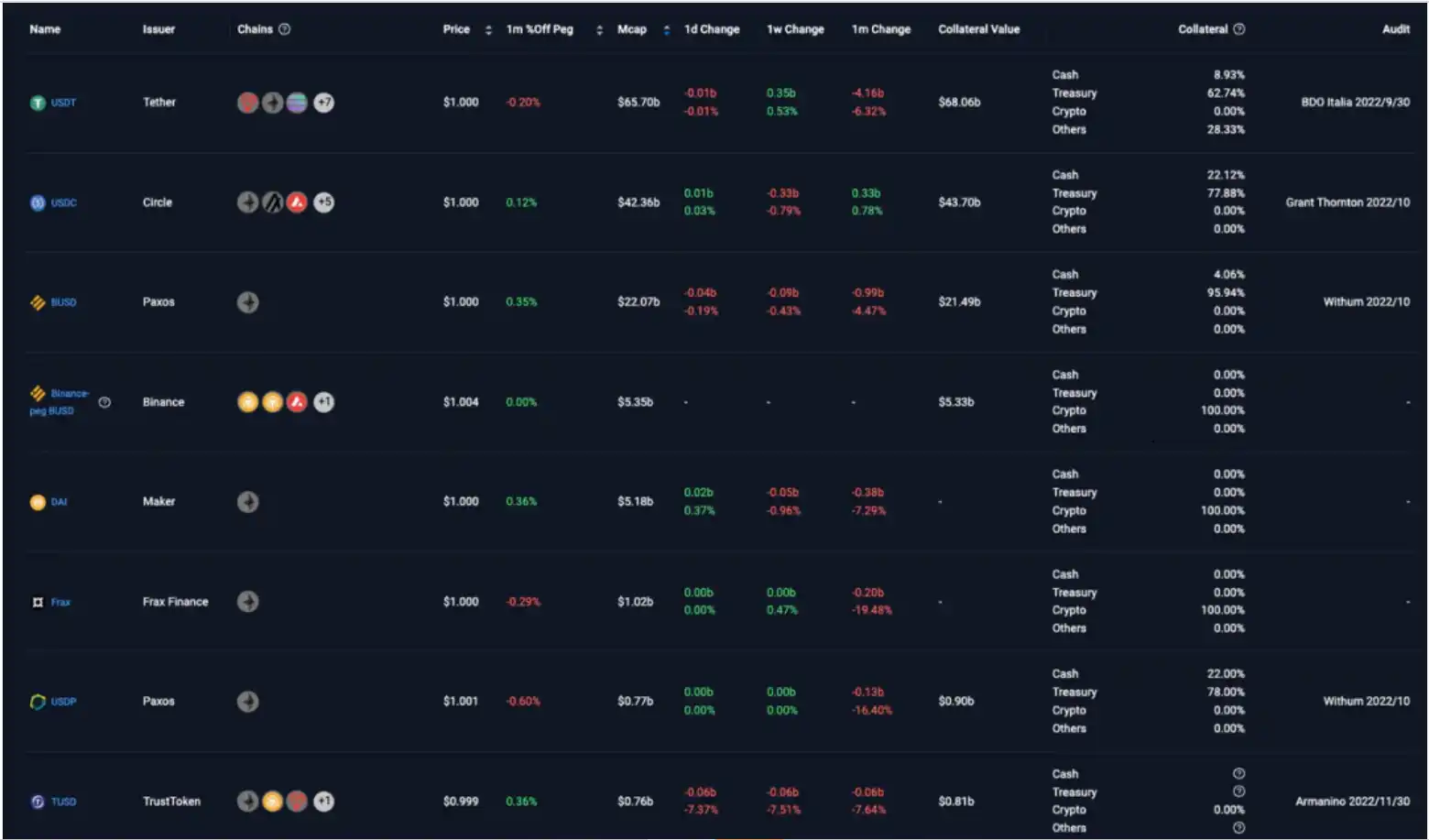
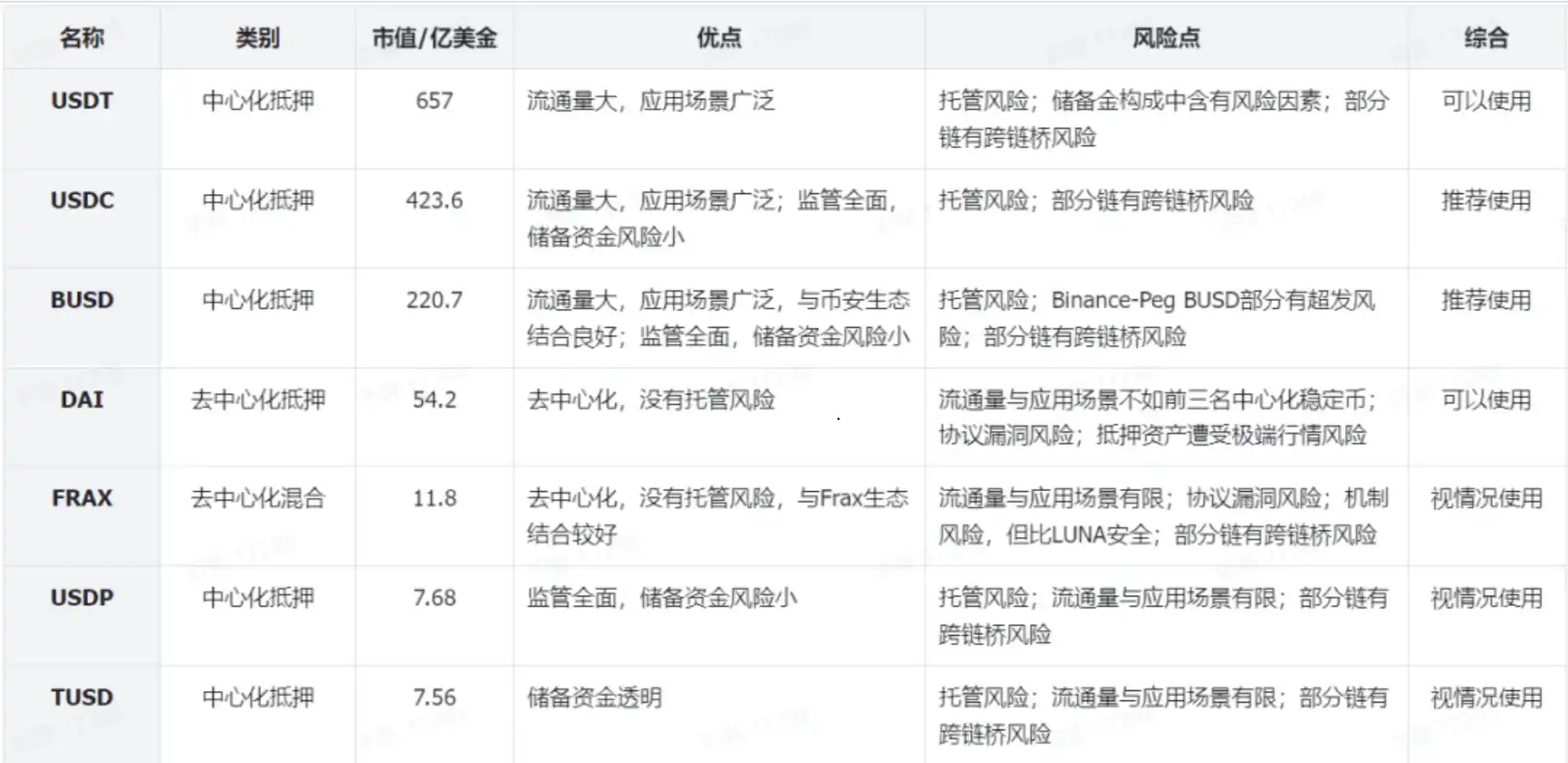
Stablecoins come in different types, mechanisms, and market positions. When users exchange stablecoins, they should consider the pros and cons of each stablecoin, then proceed with the exchange and usage. The following analysis compares the top seven stablecoins by market capitalization for users' reference. (Stablecoins are listed by market capitalization)
USDT (Centralized Collateralized Stablecoin)
Introduction
Tether USD, known as USDT, is issued by Tether company and is currently the highest market capitalization stablecoin, with a total market capitalization of approximately $65.7 billion.
Blockchain Distribution
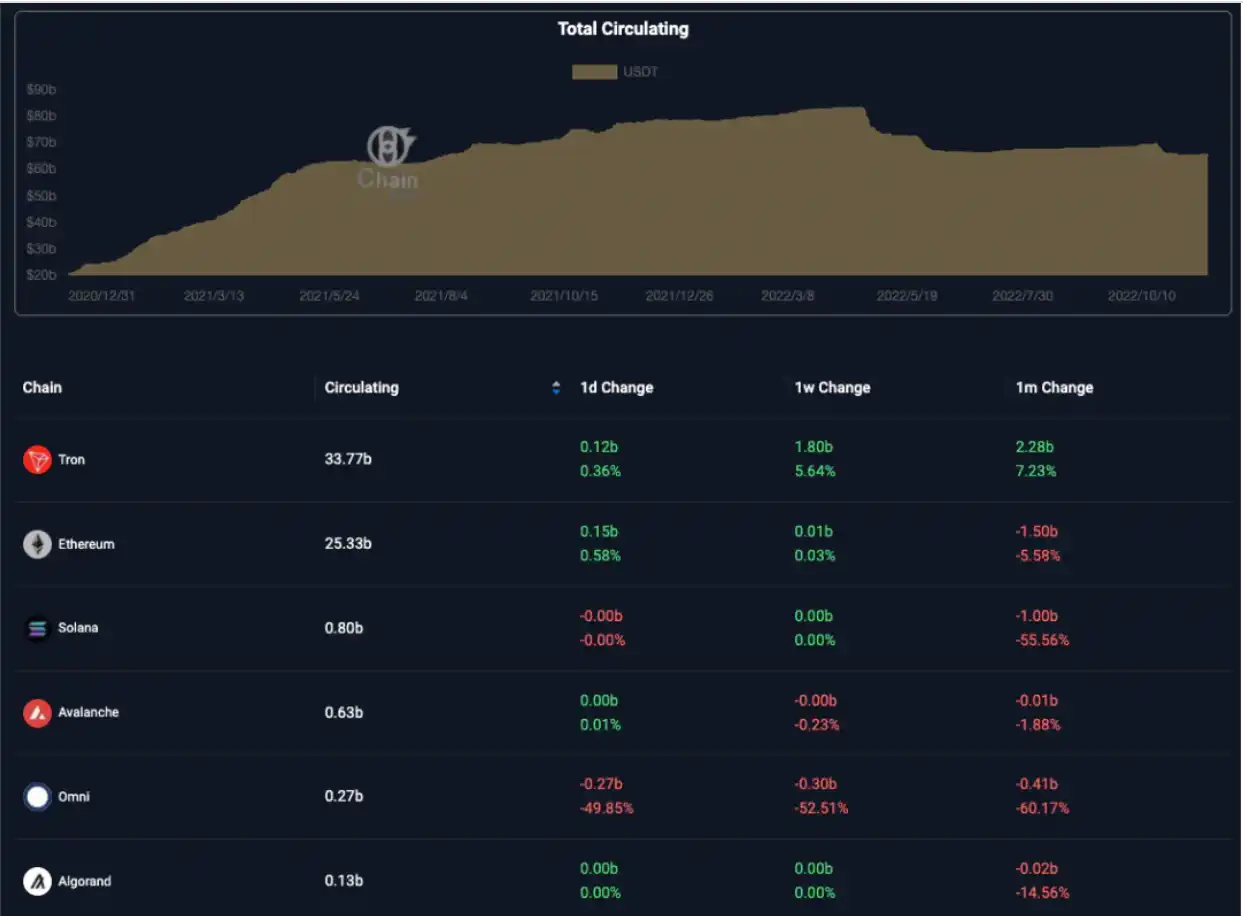
- USDT circulates on 61 chains such as Tron, Ethereum, BSC, Solana, etc., with the largest circulating market share on Tron and Ethereum, accounting for 51.22% and 38.34%, respectively
- USDT issued by the native issuer Tether is available on 14 public blockchains including Tron, Ethereum, Solana, Omni, Avalanche, Tezos, Algorand, EOS, Liquid, Statemint, SLP, Near, Statemine, and Polygon
- USDT on other public blockchains is issued by derivative issuers
Anchor Mechanism
The issuer maintains full reserves to enable users to exchange USDT for USD at any time at a 1:1 ratio.
Potential Risk Analysis
1. Insufficient Collateral Risk from the Native Issuer
The assets backing USDT in Tether's reserves are not entirely transparent, posing risks of misappropriation by the company and associated investment risks.
USDT holders can use Chaineye to view Tether's asset-liability situation and reserve distribution to assess their potential risks.
Currently, Tether's reserve asset value for USDT is approximately $68.06 billion, exceeding the circulation of $65.7 billion. About 90% of the reserve assets are highly liquid cash and cash equivalents, and 9.02% ($6.14 billion) is invested in various assets, including cryptocurrencies, introducing some risk factors.
Since 2017, Tether has been irregularly releasing audit reports. The latest audit report was published on September 30, 2022, by BDO, the world's fifth-largest accounting firm headquartered in Brussels, utilized BDO in Italy. Previously, the audits for Tether were conducted by an auditing firm in the Cayman Islands, previously known as MHA Cayman (formerly Moore Cayman), a subsidiary of the UK's top registered accounting firm MHA MacIntyre Hudson, which was investigated by the UK Financial Conduct Authority in January 2022 due to audit issues.

2. Derivative Issuer Risk
Cross-Chain Bridge: The security of USDT transferred via a cross-chain bridge is subject to the security of the bridge. Specific information on bridges can be found on DefiLlama
https://defillama.com/stablecoin/tether
Centralized Exchange: Depending on the specific exchange and the specific coin issued on the target chain, asset reserve details can be found on the respective official website.
USDC (Centralized Collateralized Stablecoin)
Introduction
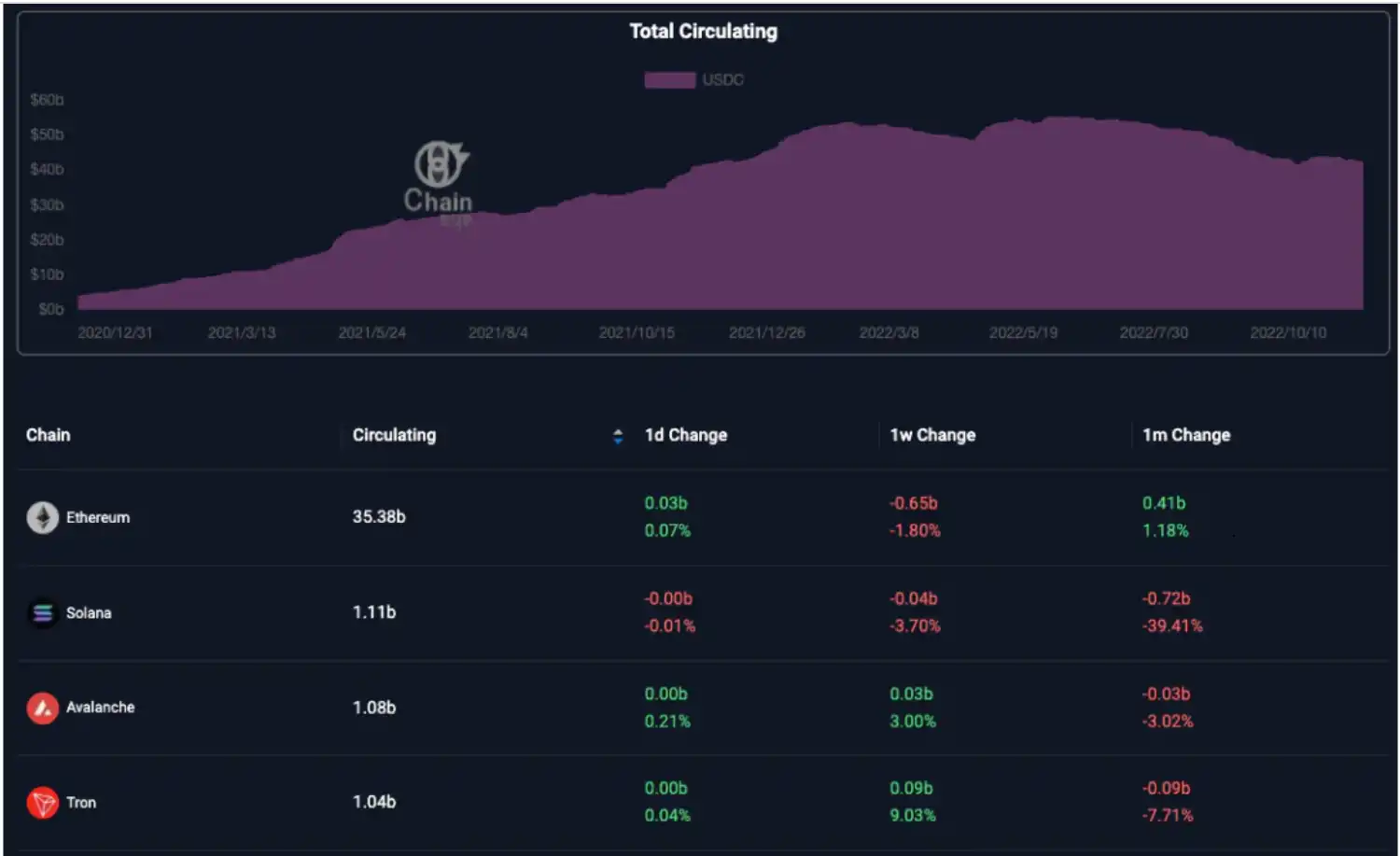
Issued by the blockchain payments company Circle, composed of companies like Coinbase, it is currently the second-largest stablecoin by market capitalization, with a total value of approximately $42.36 billion.
Mainchain Distribution
USDC circulates on 59 blockchains such as Ethereum, Solana, Avalanche, and Tron, with Ethereum accounting for 83.7% of the share.
USDC issued by the native issuer Circle is present on a total of 14 blockchains, including Ethereum, Algorand, Avalanche, Flow, Hedera, Solana, Stellar, TRON, Arbitrum, COSMOS, NEAR, Optimism.
Anchor Mechanism:
The issuer holds full reserves so that users can always exchange USDT for USD at a 1:1 ratio.
Audit and Compliance:
USDC Reserve
Potential Risk Analysis
1. Insufficient collateral risk from the native issuer
USDC holders can use Chaineye to view Circle's balance sheet and reserve distribution to assess its potential risk.
https://chaineye.tools/stablecoins/stats/USDC
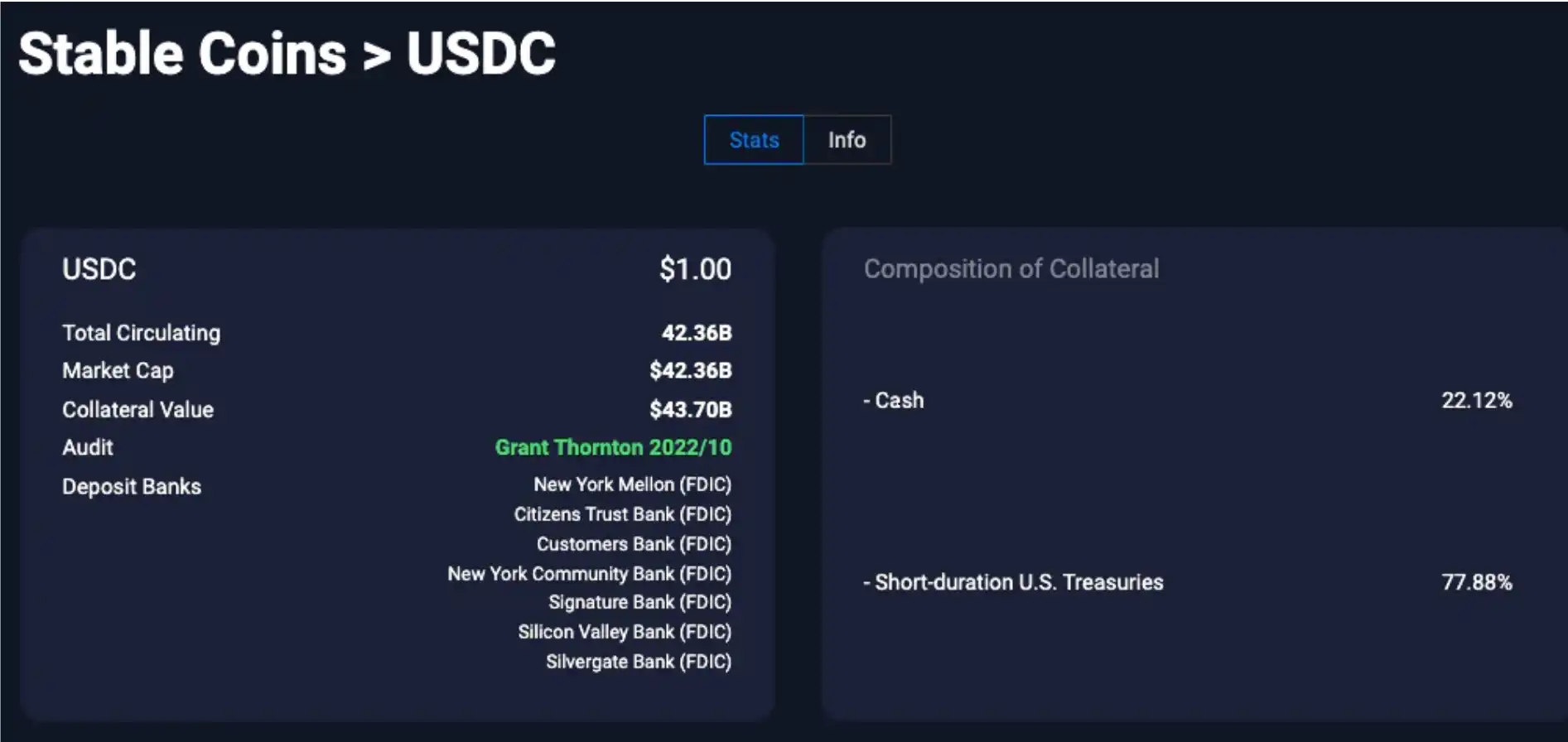
Circle updates reserve and issuance information weekly. As of December 10, 2022, Circle's USDC reserve asset was valued at approximately $43.7 billion, exceeding the then issuance of $42.36 billion. The reserve funds consist only of cash and short-term U.S. Treasury bonds, accounting for 22.12% and 77.88%, respectively, with low risk.
Since October 2018, Circle has released an audit report every month, provided by Grant Thorton, the sixth-largest accounting firm in the U.S. Circle's reserves are held by major U.S. financial institutions, including BNY Mellon and Bank of New York Mellon. Additionally, on August 9, 2021, Circle announced its plans to become a national digital currency bank and operate under the supervision and risk management requirements of the Federal Reserve, U.S. Treasury, Office of the Comptroller of the Currency (OCC), and Federal Deposit Insurance Corporation (FDIC). Circle's stablecoin reserve assets are held in a range of FDIC-backed banks like New York Mellon, with each account having a maximum insurance coverage of $250,000 to mitigate redemption risk to some extent.
2. Issuer Derailment Risk
Cross-chain Bridge: Specific information regarding cross-chain bridges can be found on DefiLlama. https://defillama.com/stablecoin/usd-coin
Other Issuer Derivatives: Case-specific analysis required.
BUSD (Centralized Collateralized Stablecoin)
Introduction
BUSD is a stablecoin issued through a partnership between Binance and Paxos (Paxos is also the issuer of the USDP stablecoin) and is approved and regulated by the New York State Department of Financial Services (NYDFS). BUSD is currently the third-largest stablecoin by market capitalization, with a total value of approximately $22.07 billion.
Blockchain Distribution
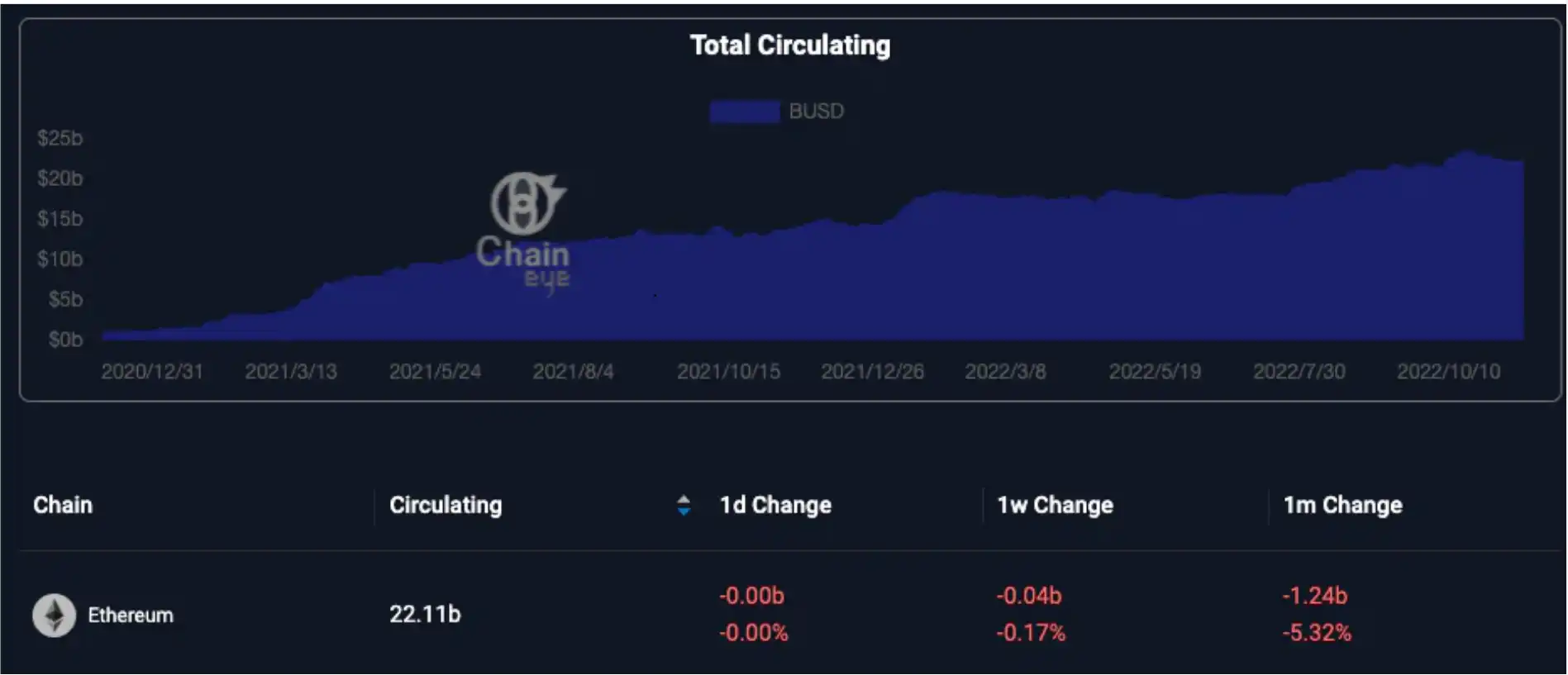
BUSD circulates on 33 different blockchains, including Ethereum and BNB, with a share of 77.96% on the Ethereum blockchain.
Native BUSD is only issued on Ethereum.
In order to expand the liquidity of BUSD to other chains, Binance has fully collateralized some native BUSD on Ethereum and issued Binance-Peg BUSD on BNB, BSC, Avalanche, and Polygon.
BUSD on other chains is issued by other issuer derivatives.
Anchoring Mechanism
The issuer maintains full reserves so that users can perform a 1:1 exchange between USDT and USD at any time.
Potential Risk Analysis
1. Native Issuer Risk
BUSD holders can use Chaineye to view BUSD's asset-liability status and reserve distribution to assess its potential risk.
https://chaineye.tools/stablecoins/stats/BUSD
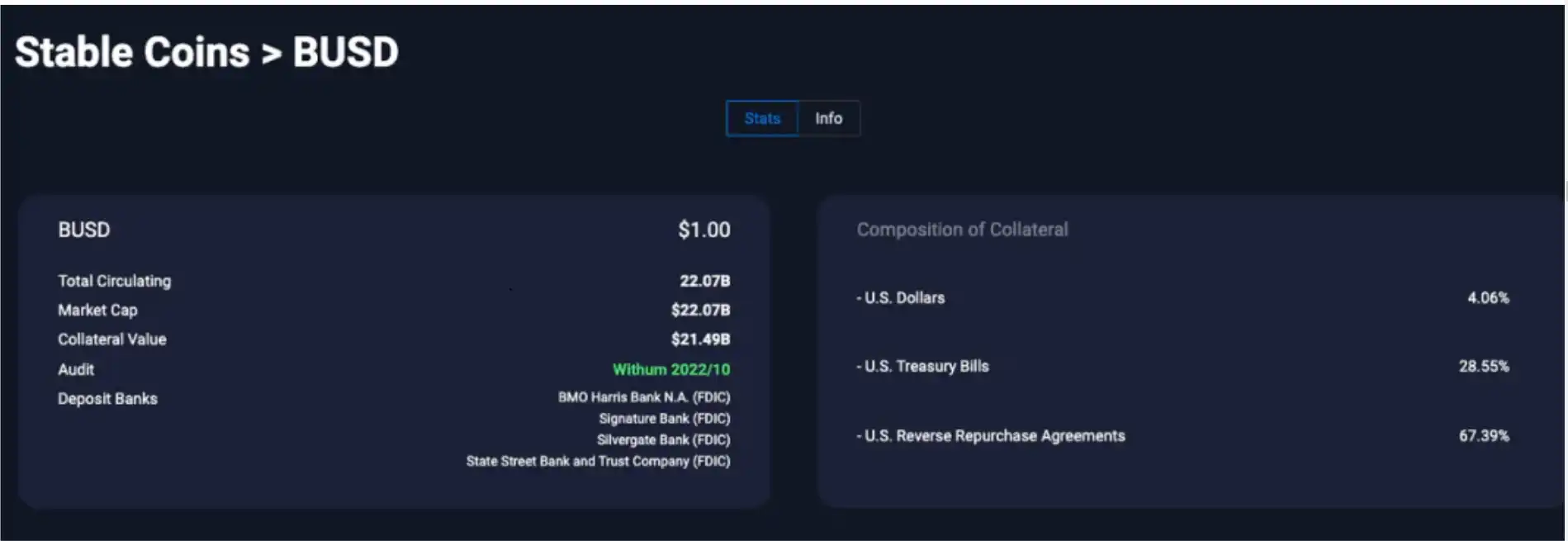
At the end of each month, Paxos will publish a reserve asset report. The collateral data disclosed in the latest report may lag behind the current circulation. The total circulation of BUSD is currently 22.07 billion USD (2022.12.10), and the corresponding report has not been released.
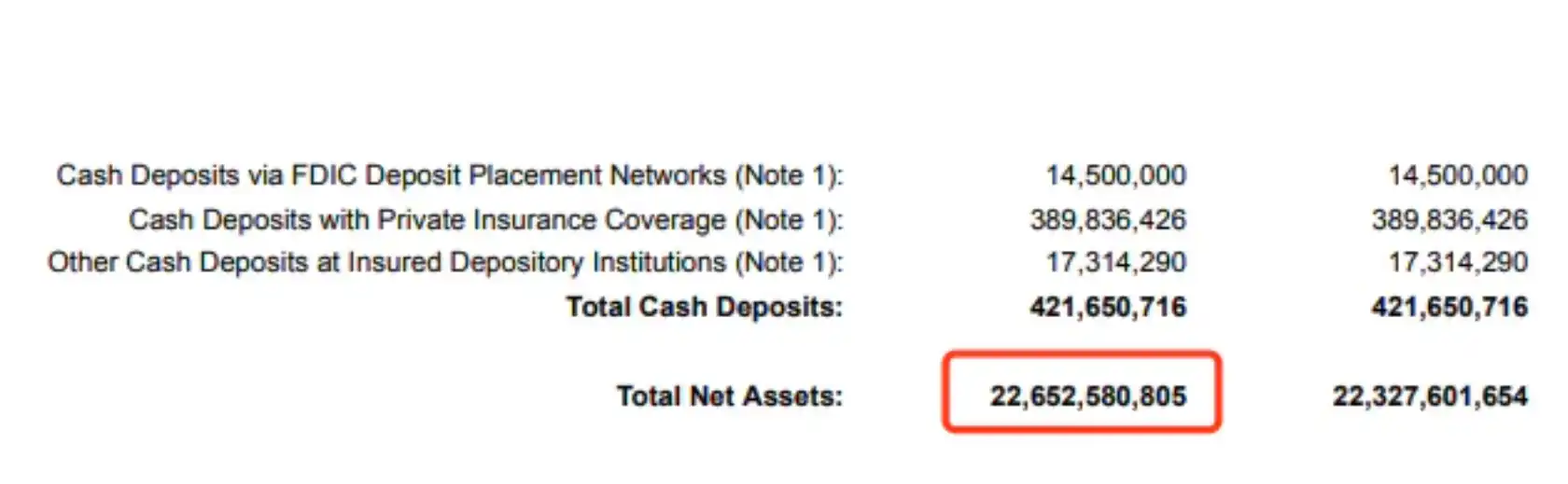
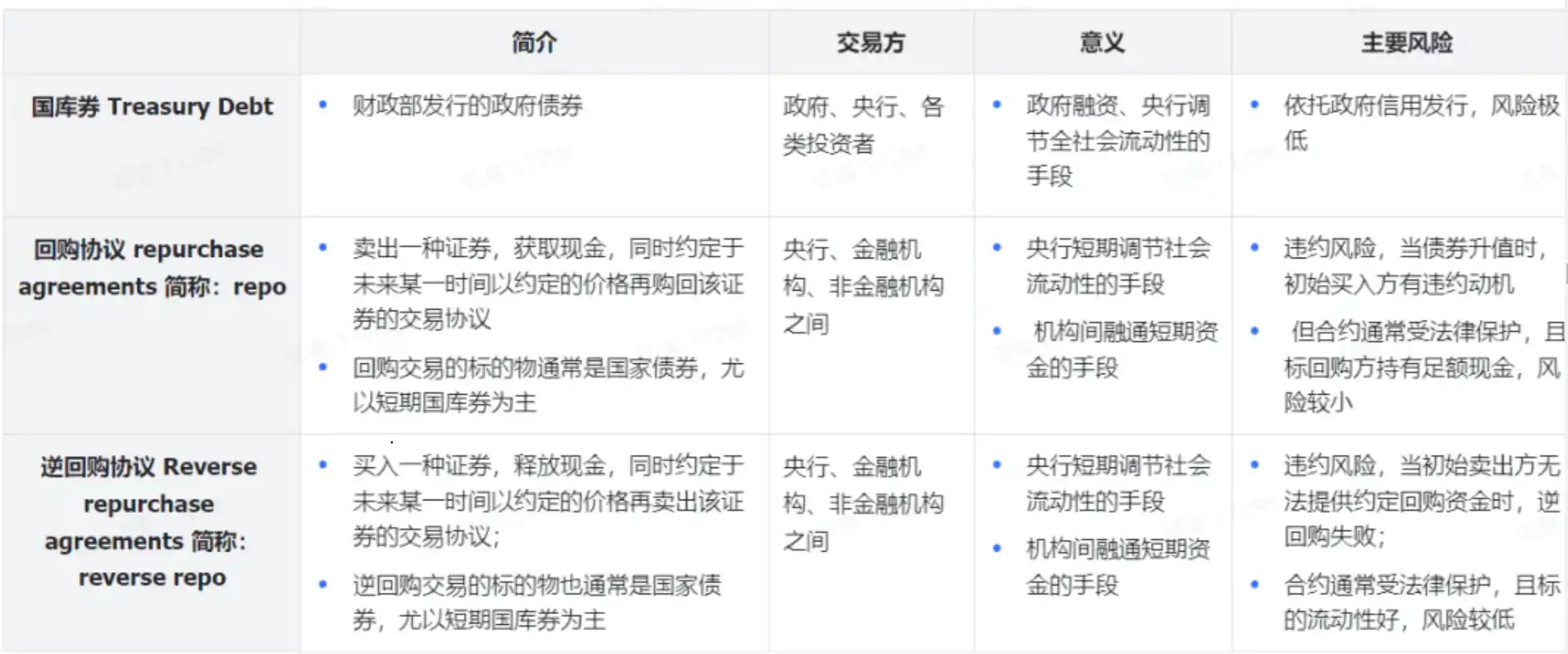
The latest report, published on November 30, 2022, shows a net asset market value of 22.65 billion USD, exceeding the same-day circulation of 22.38 billion USD. The reserve funds include cash, US Treasury securities, and US Treasury bond repurchase agreements, indicating low risk.
You can check the latest reserve asset situation monthly on Paxos (Note: Paxos' latest report has not been audited by a third-party audit firm. Reports audited by third parties are usually released about a month later than Paxos' reports. Data on Chaineye reflects the latest audited reports). https://paxos.com/busd-transparency/
The BUSD reserve is held by banks such as BMO Harris Bank. Paxos's audit report is conducted by the third-party audit firm WithumSmith+Brown, a top 25 global accounting firm.
2. Derivative Issuer Risk
Cross-Chain Bridge: Specific information regarding cross-chain bridges can be found on DefiLlama https://defillama.com/stablecoin/binance-usd
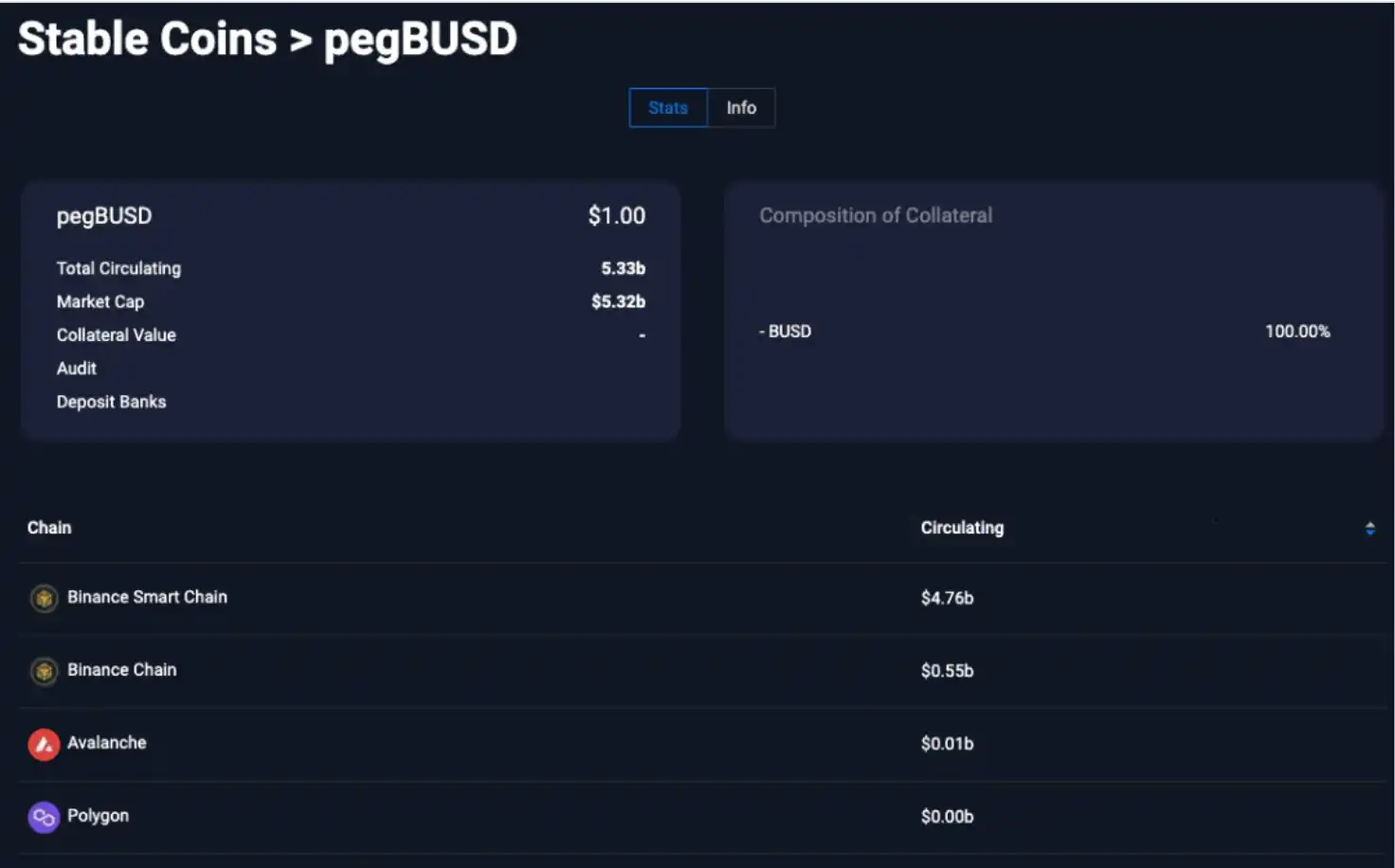
Centralized Exchanges: Binance has fully collateralized native BUSD on Ethereum, issued Binance-Peg BUSD on BNB, BSC, Avalanche, and Polygon. The reserves for Binance-Peg BUSD on respective chains by Binance can be verified using Chaineye. Binance maintains a 100% collateralization ratio for locked BUSD, resulting in lower risk.
https://chaineye.tools/stablecoins/stats/pegBUSD
Other Derivative Issuer: Case-by-Case Analysis
DAI (Decentralized Stablecoin)
Introduction
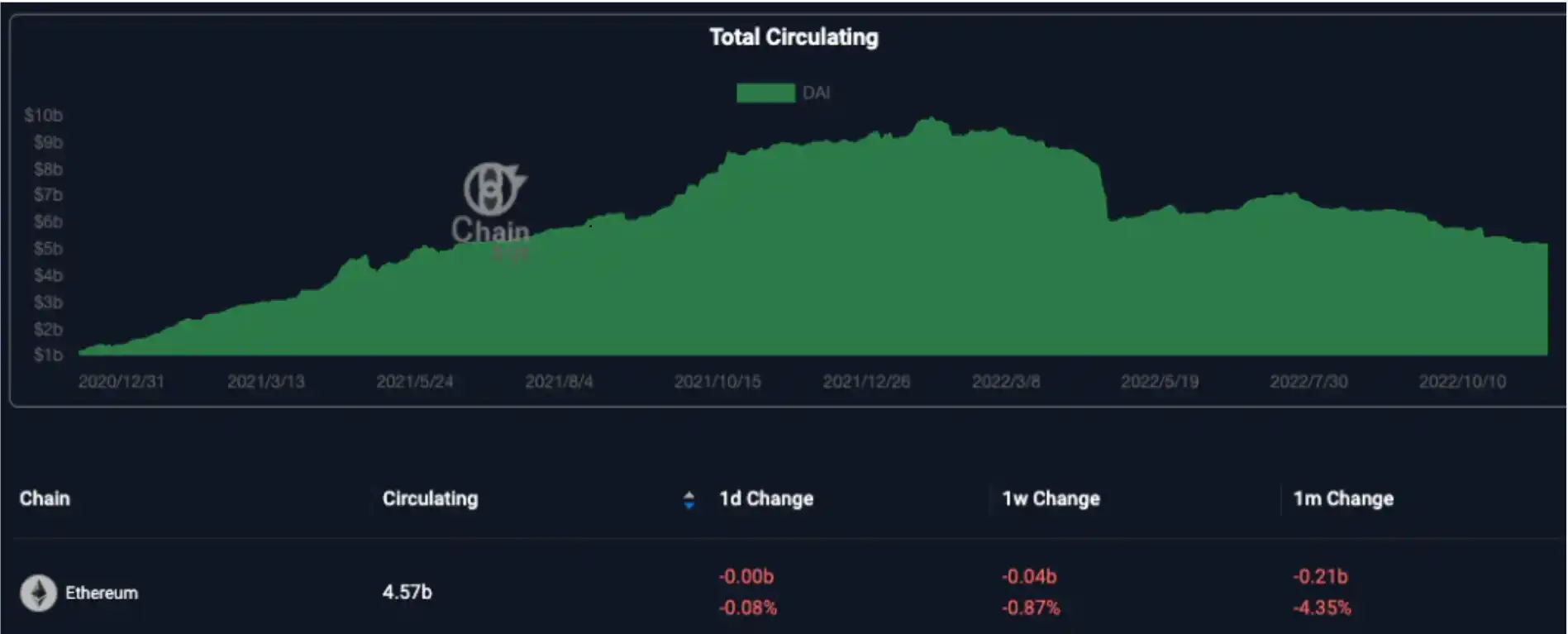
DAI is a stablecoin minted by the decentralized lending protocol MakerDAO, currently ranked fourth by market capitalization among all stablecoins, with a total market cap of around $5.42 billion.
Blockchain Distribution
DAI circulates on 40 blockchains such as Ethereum, Polygon, BSC, with Ethereum accounting for 88.33% of the share.
MakerDAO is only deployed on Ethereum, so native DAI exists solely on Ethereum.
DAI on other chains is issued by other derivative issuers.
Issuance Mechanism
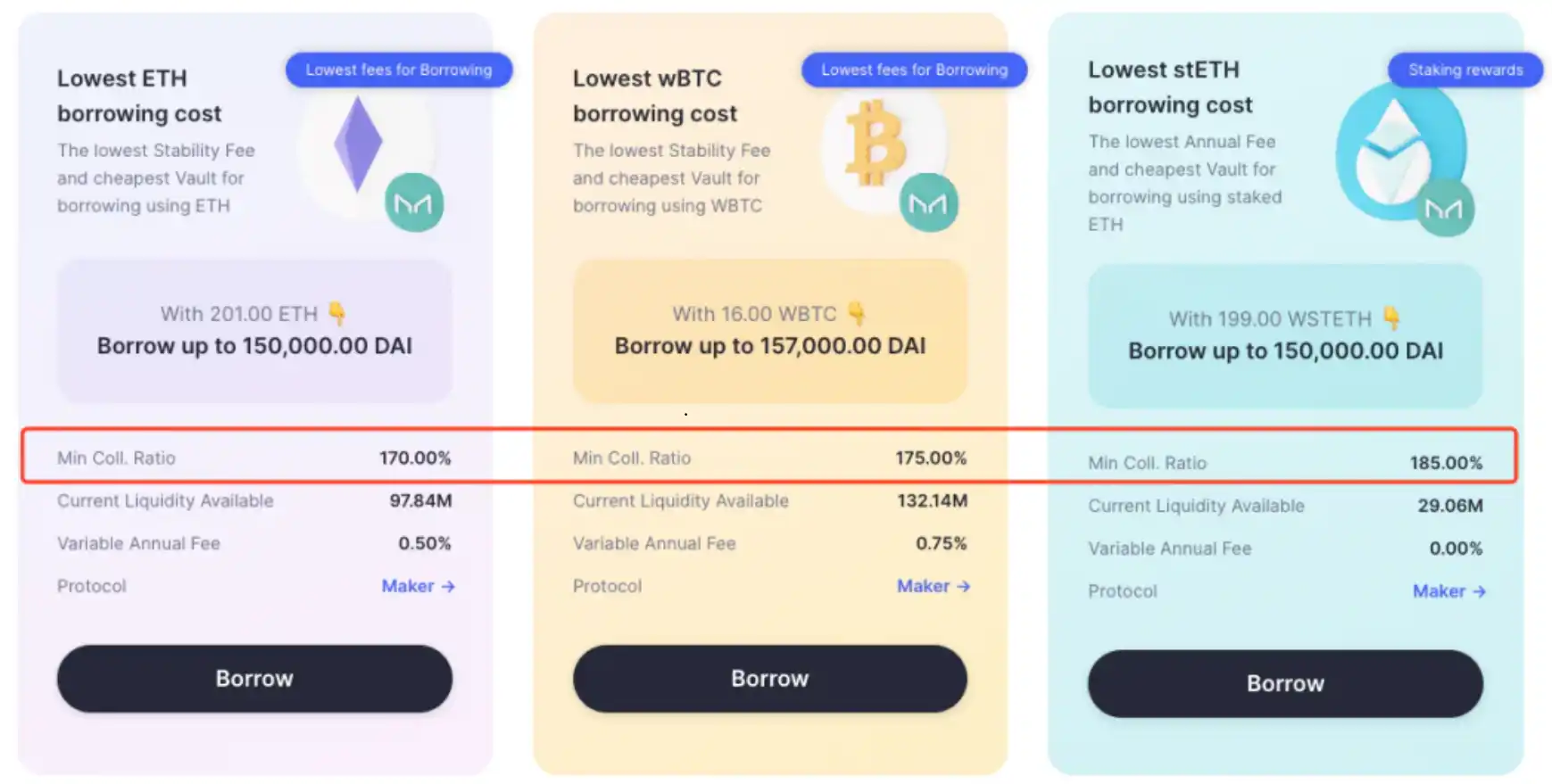
DAI is minted by users through the Maker protocol by overcollateralizing assets, where the amount of DAI that can be minted cannot exceed a certain ratio of the collateral's value, similar to collateralizing real estate to borrow cash in traditional finance. Users can redeem the collateral and burn DAI at any time, but a stability fee is incurred upon redemption.
If the value of the collateral drops, causing the collateralization ratio to fall, liquidation is triggered. The user's collateral is forcibly liquidated at a premium, and a 13% penalty must be paid. After liquidation, the user is not required to repay the DAI.
The Maker protocol supports over 20 types of collateral such as ETH, WBTC, where the collateralization ratio and stability fee are determined by the asset's inherent risk parameters and MKR holder governance.
Stability Mechanism
When DAI's price is below $1: The amount of DAI minted is based on the collateral's USD value. When redeeming collateral with DAI in the Maker protocol, DAI is valued at $1 by the protocol, allowing users to redeem collateral with a specific amount of DAI, burn the DAI, and reduce the DAI supply.
When the price of DAI is above $1: Users are incentivized to mint more DAI and sell it for profit; meanwhile, MakerDAO provides a DAI savings mechanism, and the community will increase DAI savings, encouraging holders to lock DAI and reduce circulation. DAI's interest is paid from MakerDAO's Stability Fee revenue, and if the Stability Fee revenue cannot cover the total expenditure of the DAI savings rate, Maker will mint MKR to make up the difference.
Proposal to allow DAI to be uncoupled from the dollar: On August 28, 2022, MakerDAO co-founder Rune Christensen released an article titled "The Road to Compliance and The Road to Decentralization: Why Maker Has No Choice But To Prepare For Free-Floating DAI," pointing out that currently over 50% of DAI is backed by USDC, and regulatory crackdowns on cryptocurrency could happen without prior notice, with no possibility of recovery even for legitimate, innocent users.
Therefore, Rune Christensen proposed gradually increasing DAI's share of decentralized asset collateralization through a scheme called the "Endgame Plan" to enhance resistance to censorship. Rune mentioned that this process might result in a 50% user loss, but Maker would prioritize decentralization and allow DAI to be somewhat decoupled from the dollar to maintain decentralization.
1. Main Contents of the "Endgame Plan"
a. Splitting the complex MakerDAO governance into multiple MetaDAOs responsible for specific governance duties to increase decentralization of governance: Each MetaDAO can focus on its own tasks, achieving multi-centered governance, allowing MetaDAOs to execute in parallel, speeding up the governance process. MetaDAOs are independent of each other, have their governance tokens and governance processes, and need to earn their revenue.
b. Introducing more decentralized assets: Reducing the Stability Fee for assets such as ETH, wBTC, decreasing the demand to mint DAI through USDC; introducing ETHD, allowing users to mint ETHD through stETH and then mint DAI, to increase ETH's share in collateral assets, thus increasing the proportion of decentralized assets.
c. Three progressive collateral strategies to gradually achieve decentralization: The three strategies are Dove, Hawk, Phoenix, progressing forward gradually over a timeline, advancing progressively based on regulatory threats.
Dove Strategy: Maximize collateral assets to maintain asset hypergrowth; Hawk Strategy: In the event that DAI is subject to a governance attack, limit exposure to Real World Assets (RWA) controlled by centralized entities to 25% to seek a balance between performance growth and resilience;
Phoenix Strategy: Transition to the Phoenix Strategy, eliminating all RWA risk exposure, if evidence suggests an imminent governance attack or if all collateral for RWAs has been seized, with only RWAs beyond the control of centralized entities eligible as collateral.
d. Allowing DAI to decouple from the dollar in the event of a governance attack: Rune assumes that in the initial phase of activating DAI's free float, as many as 50% of protocol users will exit rapidly.
During this phase, Maker allows DAI to freely float from the 1:1 peg to the dollar and gradually adjust its price based on the target rate, where a positive target rate increases demand for DAI, reducing its supply, and a negative target rate has the opposite effect.
DAI's relative stability is achieved by adjusting the rate, without the need to peg 1:1 to the dollar. Rune also indicates that DAI will remain anchored to the dollar for at least 3 years and potentially longer if not under direct threat.
If the decentralization level of collateral can be increased to 75%, DAI will maintain its peg to the dollar indefinitely.
2. Progress on the "Endgame Plan"
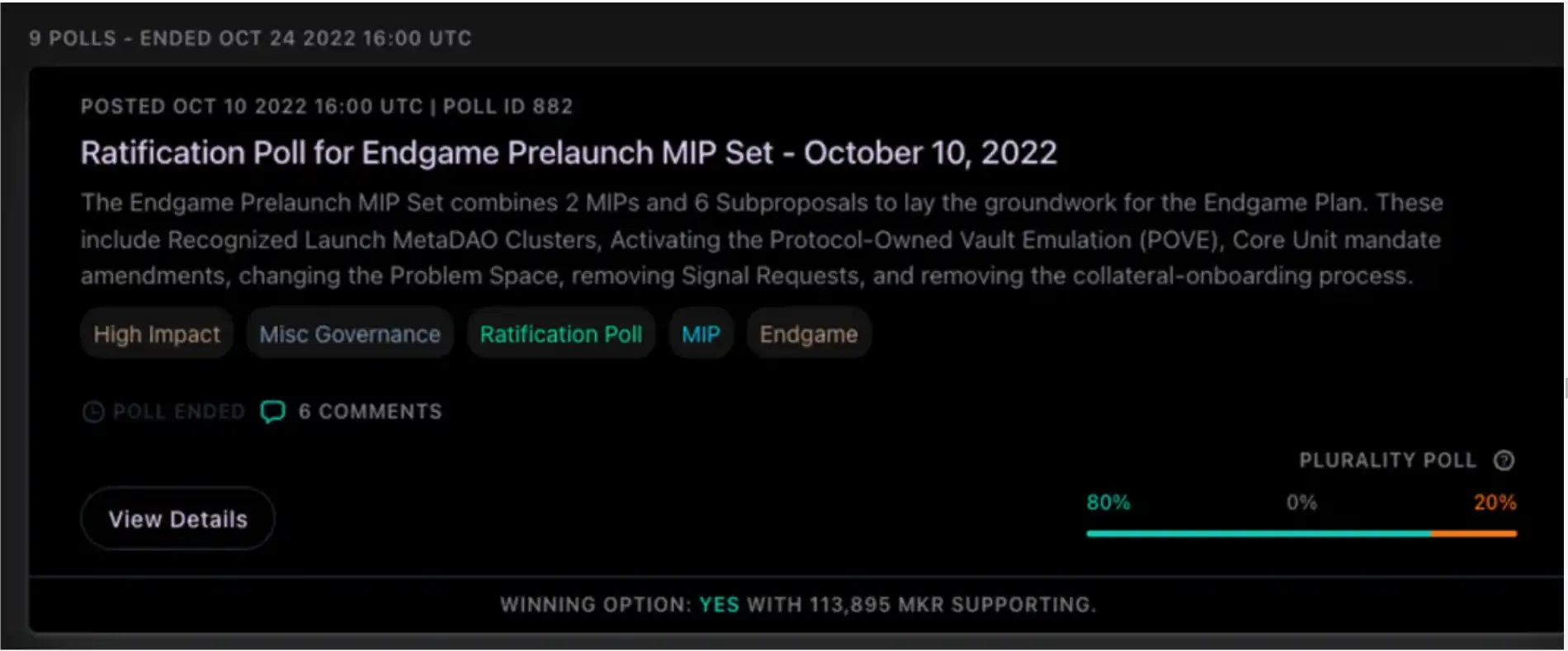
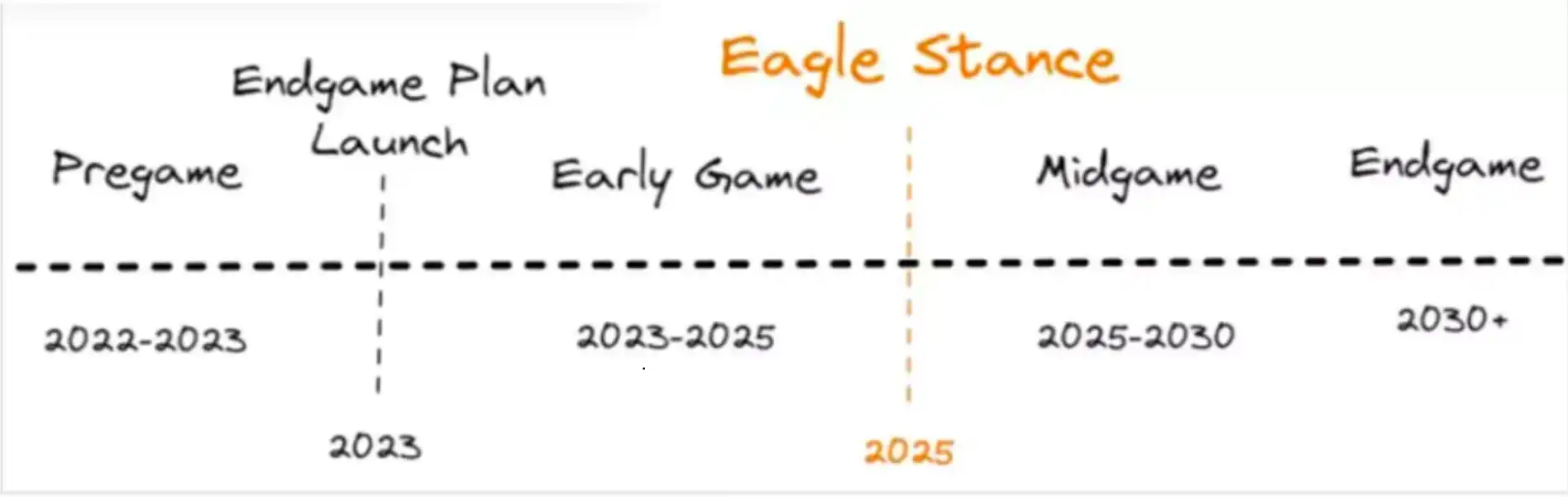
The "Endgame Plan" proposal was launched on October 10, 2022, and has now passed a community vote, with the roadmap for the Endgame Plan divided into 4 key phases.
The Early Edition will launch within 12 months, build ETHD, launch 6 MetaDAOs, and initiate liquidity mining for the MetaDAO's native token system. However, the Full Edition will not launch until 2030 or later.
Potential Risk Analysis
1. Native Issuer Risk
MakerDAO Protocol Vulnerability Exploited for Malicious Minting. MakerDAO has been running smoothly for 5 years since its mainnet launch in 2017, with well-validated code. MakerDAO also restricts the types of supported collateral assets, mostly consisting of high-quality tokens.
Liquidation Risk: When the market experiences an extreme black swan event causing a rapid overall drop in collateral asset prices, or if compliant assets like USDC are frozen for some reason, Maker will lose the value of collateral that cannot be liquidated in time, resulting in Depegging Risk.
2. Derivatives Issuer Risk
Cross-Chain Bridge: Specific information about cross-chain bridges can be found on DefiLlama
Other Derivatives Issuers: Each issue needs to be analyzed specifically https://defillama.com/stablecoin/dai
FRAX (Decentralized Algorithmic & Collateral Hybrid Stablecoin)
Introduction
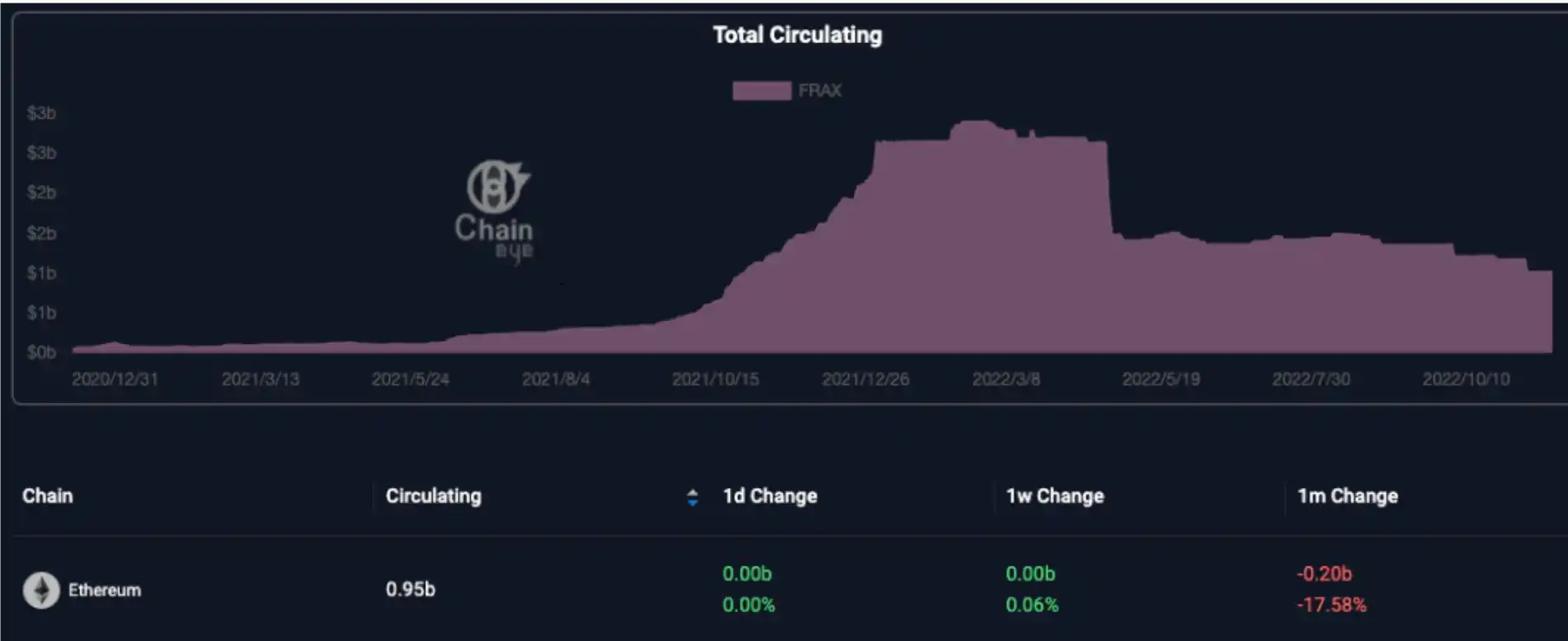
Frax is a decentralized stablecoin protocol that uses a mix of collateral and algorithms, with FRAX being its issued stablecoin. FRAX currently has a market capitalization of around $11.8 billion, ranking as the fifth-largest stablecoin by market cap.
Blockchain Distribution
FRAX circulates on 33 blockchains like Ethereum, Arbitrum, with Ethereum holding a share of 92.89%. The native FRAX issued by Frax only circulates on Ethereum, while Frax on other chains is issued through derivative issuers in cross-chain issuance.
Issuance and Redemption Mechanism
When a user deposits $1 worth of collateral into the Frax system, Frax mints 1 FRAX for the user. The deposited collateral is a combination of a stablecoin and FXS. Users can also return 1 FRAX to the protocol in exchange for a combination of $1 worth of FXS and U tokens.
During the minting and redemption of FRAX, the involved FXS is burned and minted, altering the supply of FXS in the market.
During the minting and redemption process, the mixed ratio of stablecoin and FXS (Frax's governance token) is equal to the Frax protocol's target collateralization ratio (FRAX amount / stablecoin collateral amount). For example, when the collateralization ratio is 80%, a user mints one FRAX with 0.8U worth of the stablecoin and 0.2U worth of FXS. The target collateralization ratio is adjusted hourly by the FXS-holding community.
Anchoring Mechanism
When the FRAX price is above $1, arbitrageurs can mint FRAX by injecting $1 worth into the system and sell it on the market for profit.
When the FRAX price is below $1, arbitrageurs can buy FRAX at a discounted price in the open market and redeem $1 worth in the system.
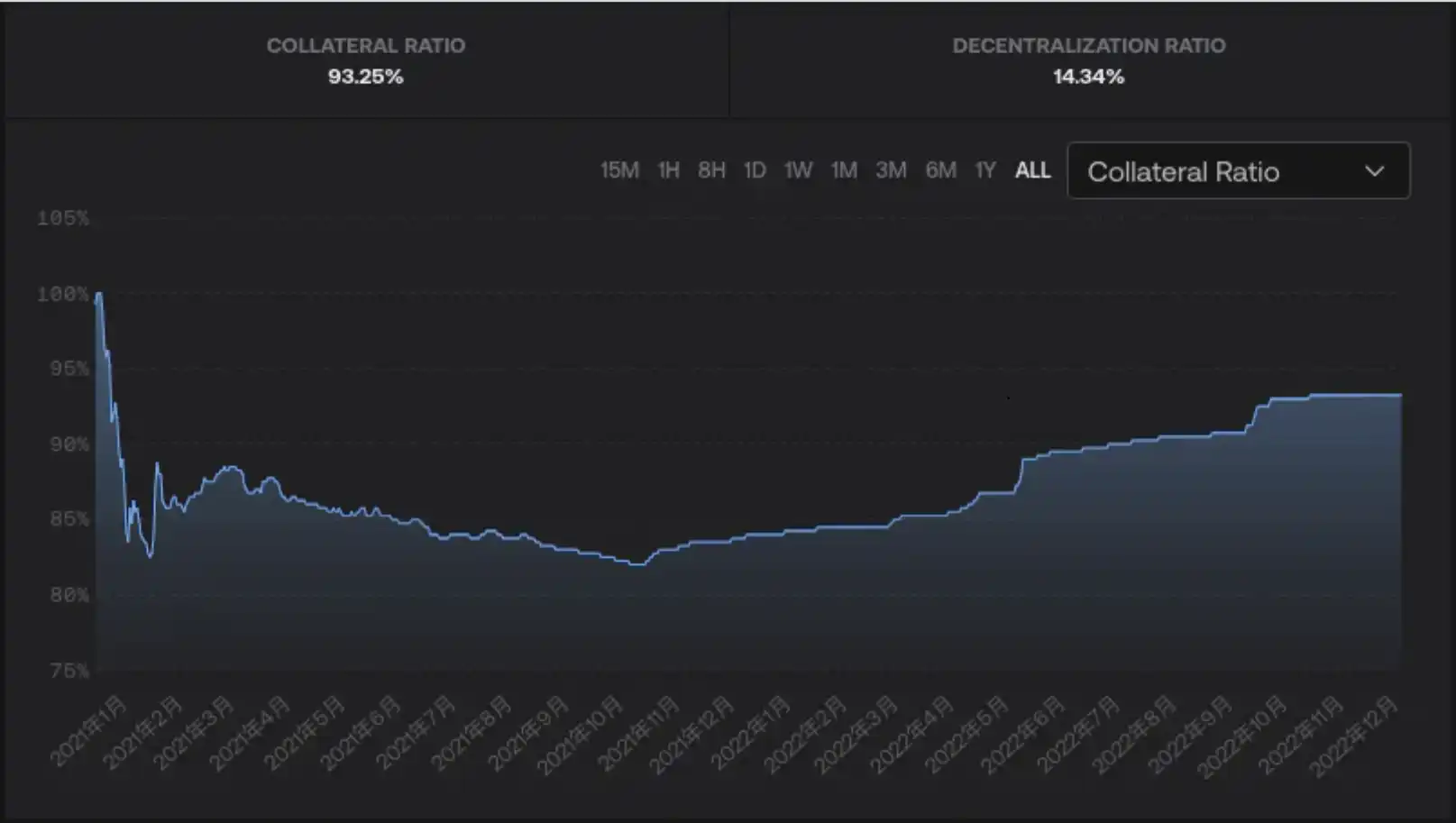
During favorable market conditions and when users have confidence in Frax, Frax tends to lower the target collateralization ratio. This allows the same stablecoin collateral to mint more FRAX into circulation, with the minimum collateralization ratio being 0%.
During adverse market conditions and declining confidence in Frax, Frax tends to increase the target collateralization ratio to prevent excessive FRAX issuance, while increasing the reserve of stablecoin collateral, with the maximum collateralization ratio being 100%.
The current collateralization ratio of FRAX is 93.25%, with a historical low of 82% and a high of 100%.
Potential Risk Analysis
1. Native Issuer Risk
If the Frax protocol has a vulnerability that malicious actors exploit for a supply increase attack. Frax was launched at the end of 2020 and has not experienced any protocol vulnerability issues to date.
Mechanism Risk
When the FRAX price experiences a decline, it relies on arbitrageurs buying FRAX and depositing it into Frax, minting FXS to target the collateralization ratio and redeeming part of U to push the FRAX price back to $1. If FXS is excessively minted, it can undermine market confidence and lead the Frax community to lose control.
Frax employs U+FXS Hybrid Collateralization with an adjustable target collateral ratio stabilizing mechanism that narrows arbitrage opportunities in extreme one-sided market conditions, helping to maintain the stability of the FRAX price.
When FRAX is below $1, arbitrageurs buy a large amount of undervalued FRAX, mint a U and FXS combination worth $1, and sell for a profit. The selling pressure of U does not affect the price of U, but the selling pressure of FXS causes the FXS price to drop, triggering a chain reaction. Over-minting of FXS will cause protocols governed by FXS to lose control, driving the FXS price to "zero."
The presence of U reduces the selling pressure formed by excessive FXS minting, also supporting the floor price of FRAX: at a collateral ratio of x, arbitrageurs need x proportion of U and (1-x) proportion of FXS. The higher the collateral ratio x, the smaller the proportion of FXS (1-x), resulting in less FXS selling pressure, thereby mitigating the extent of the chain reaction. At the same time, the x proportion of U as the backing asset for FRAX forms the floor price of FRAX, ensuring that FRAX always has the recognized value of xU and does not directly drop to "zero."
The minting and redemption of FRAX are not always open, increasing the cost of attacking Frax maliciously: only when FRAX is sold in large quantities causing it to deviate from the peg, arbitrageurs have an incentive to mint more FXS.
When the market price of FRAX is in a stable range ($1.0033FRAX$0.9933), the FRAX protocol will not open FRAX minting and redemption. Therefore, malicious attackers of Frax need to first sell a large amount of FRAX to push the price below 0.9933 to launch an arbitrage attack. Hence, the design of the arbitrage range significantly increases the cost of the attack.
Moreover, a slight deviation from the peg does not immediately trigger a significant minting of FXS, providing Frax with a self-rescue window, giving it enough time to adjust the collateral ratio or add collateral assets. Overall, the FRAX-FXS mechanism is more stable compared to the UST-LUNA combination.
2. Derivative Issuer Risk
Cross-chain Bridge: Specific information regarding cross-chain bridges can be found on DefiLlama
Other Derivative Issuers: Analysis of specific issues https://defillama.com/stablecoin/frax
USDP (Centrally-Backed Stablecoin)
Introduction
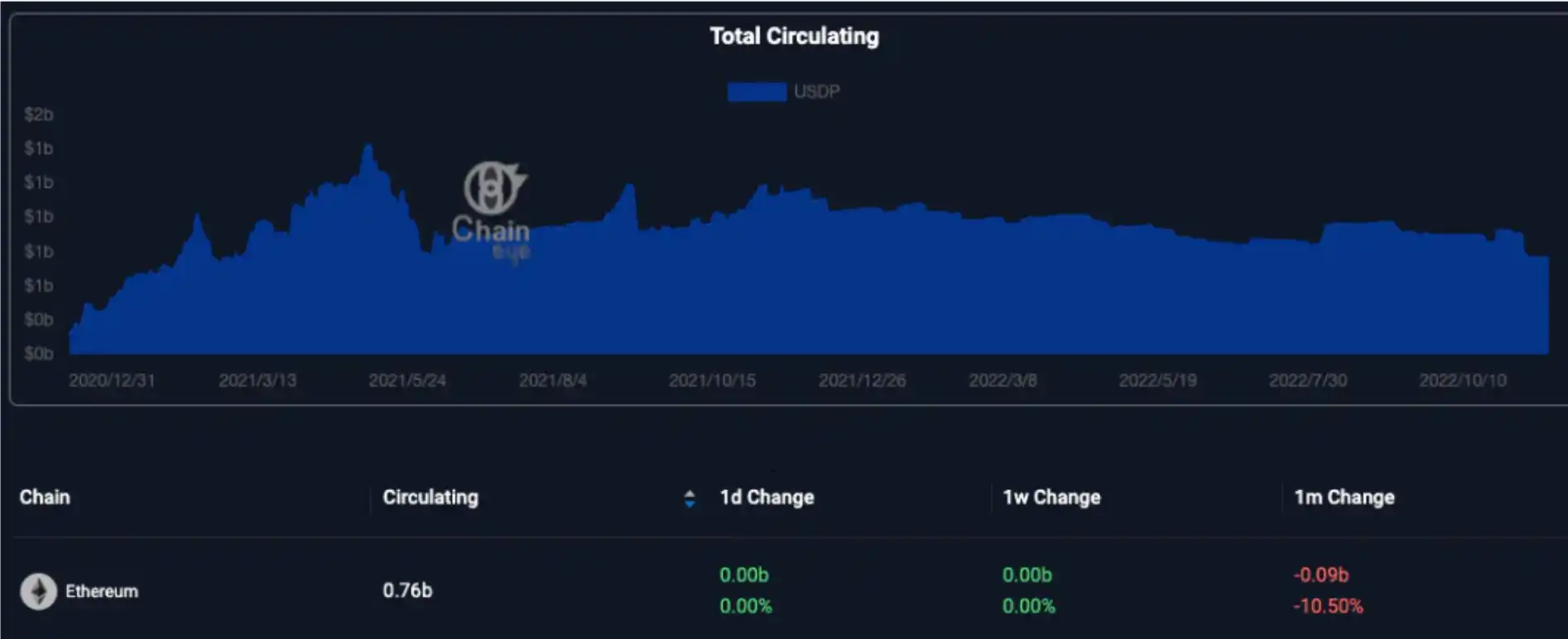
USDP is a collateralized stablecoin issued by Paxos Trust Company, approved and regulated by the New York State Department of Financial Services (NYDFS). Currently, its market capitalization is approximately $7.68 billion, making it the sixth-largest stablecoin by market cap.
Mainnet Distribution
USDP is currently only circulating on Ethereum and Binance Smart Chain (BSC), with Ethereum accounting for 99.68% of the supply, while the remaining portion is bridged to BSC via the BSC Bridge.
Reserve Mechanism
The issuer maintains full reserves to enable users to redeem USDP for USD at a 1:1 ratio at any time.
Potential Risk Analysis
1. Issuer Risk
USDP holders can use Chaineye to view BUSD's asset-liability status and reserve distribution to assess its potential risk.
https://chaineye.tools/stablecoins/stats/BUSD
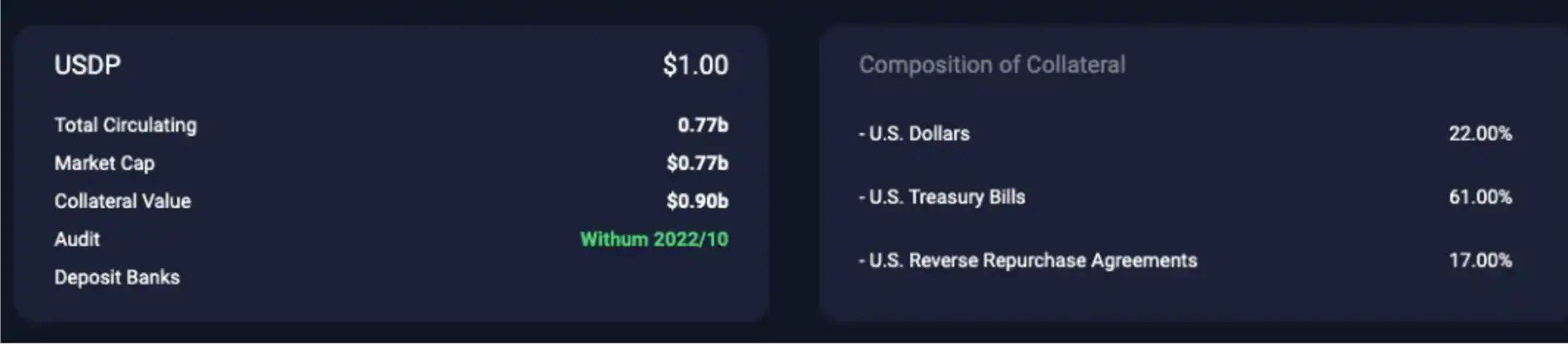
At the end of each month, Paxos publishes a reserve asset report, but there is a time lag between the last disclosed collateral data and the latest circulating supply. Currently, BUSD's total circulating supply is $770 million (2022.12.11), and the corresponding report has not yet been released.
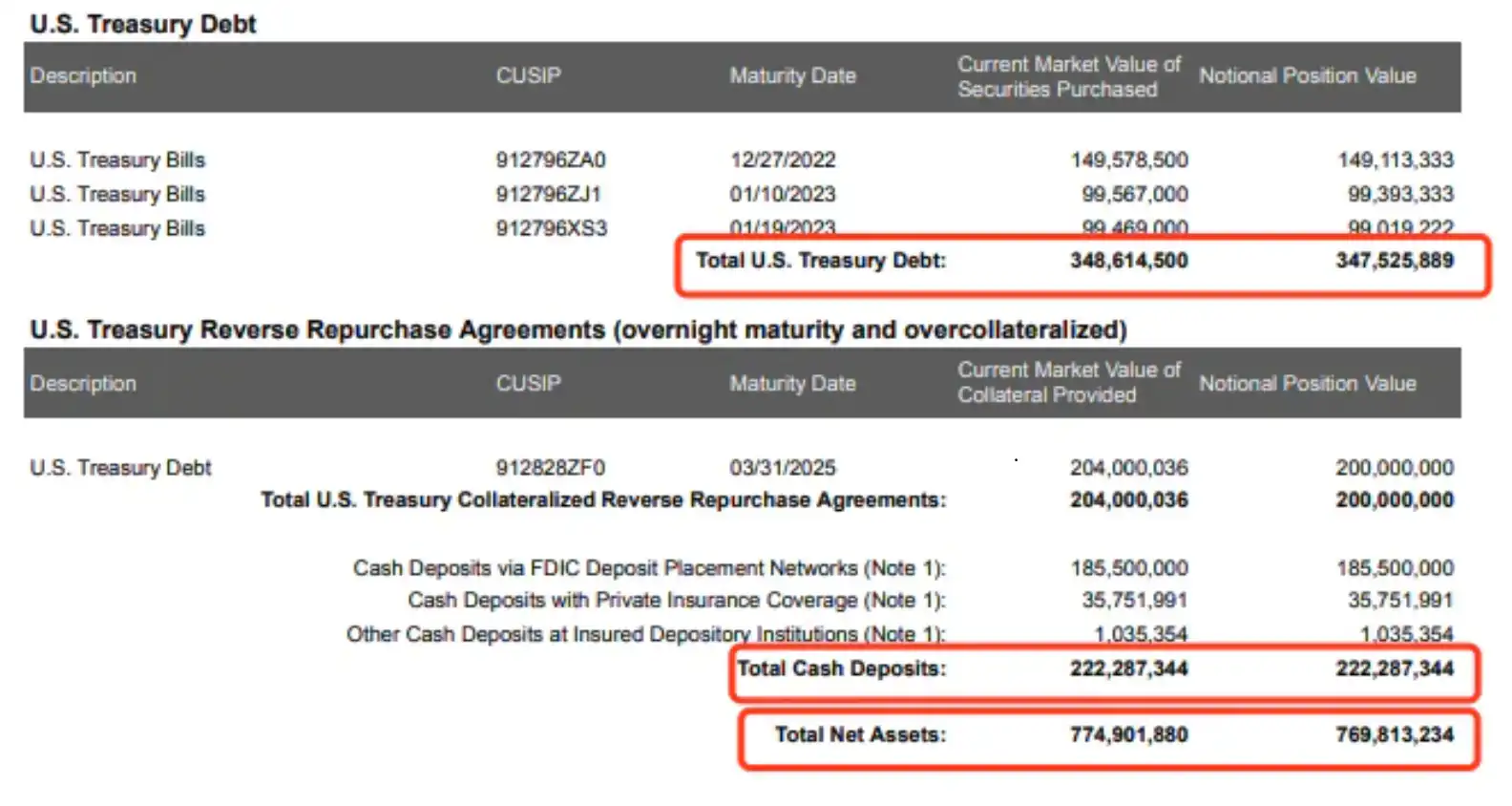
The latest report was released on November 30, 2022, with a reserve net asset value of $774.9 million, less than the day's USDP circulation of $790 million, but its circulation decreased to $767 million on December 1, possibly due to a timing discrepancy.
The USDP reserve assets consist of US Treasury bonds and cash, with relatively low risk. The latest reserve fund situation can be found on the Paxos website. (Note: The latest report released by Paxos has not been audited by a third-party audit firm. Reports audited by a third party will be about a month behind Paxos's release date. The data in Chaineye is from the latest report audited by a third party.) https://paxos.com/busd-transparency/
Similar to BUSD, USDP's reserve is custodied by Paxos and is under the full supervision of the New York State Department of Financial Services (NYDFS), with audit reports provided by the third-party audit firm WithumSmith+Brown.
2. Derivative Issuer Risk: BSC Bridge Risk
TUSD (Centralized Collateralized Stablecoin)
Introduction
TUSD is a collateralized stablecoin issued by TrustToken, backed by support from the Stanford Startup Fund. TUSD currently has a market value of approximately $756 million, ranking as the seventh-largest stablecoin by market capitalization.
Public Blockchain Distribution
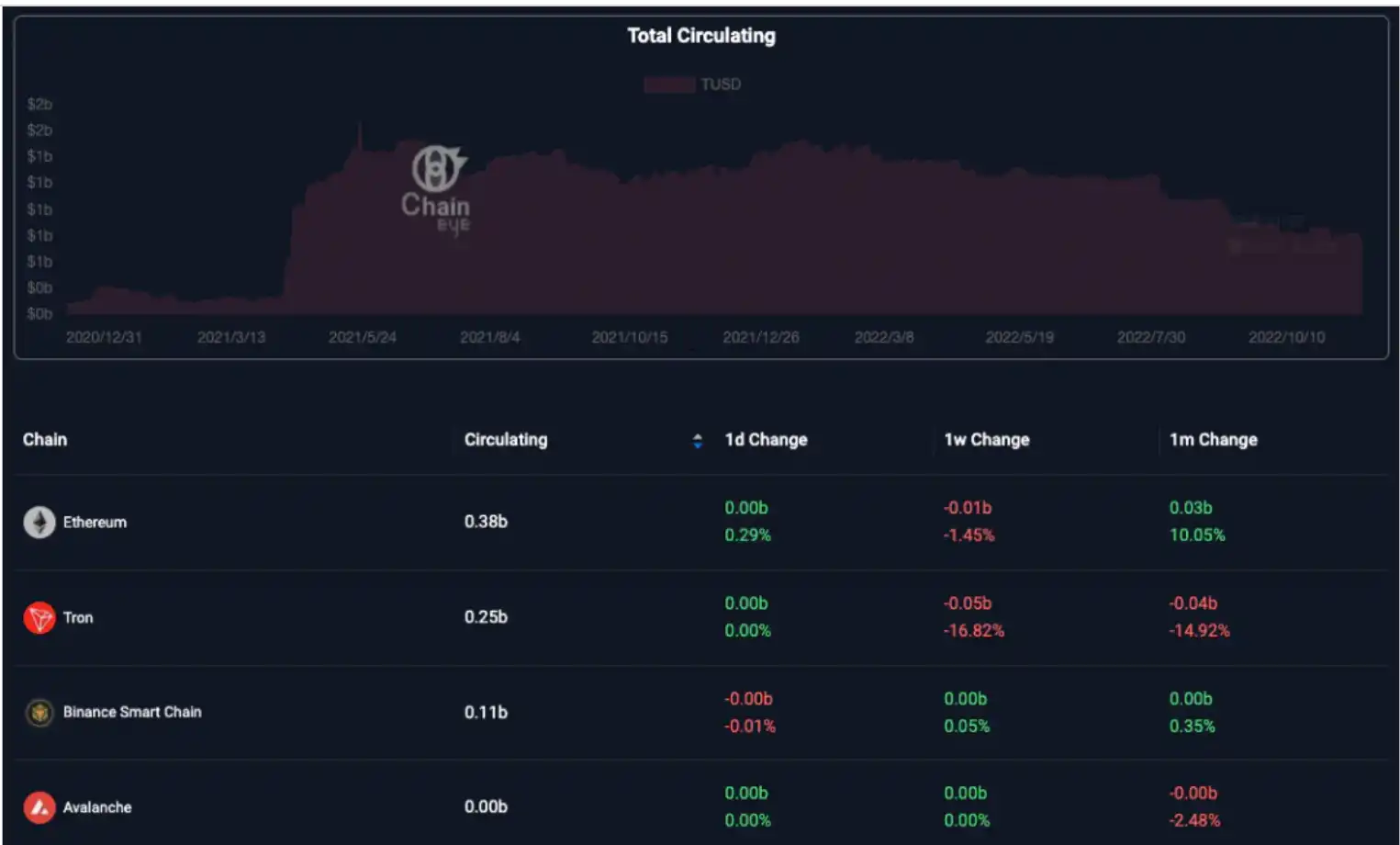
TUSD circulates on 10 public blockchains, including Tron, Ethereum, and BSC, with shares on Tron and Ethereum accounting for 49.8% and 33.57%, respectively.
TrustToken's native TUSD issued by the company is distributed across Ethereum, BSC, Tron, and Avalanche blockchains
TUSD on other chains is cross-chain transferred by the derivative issuer
Anchoring Mechanism
The issuer maintains full reserves to allow users to freely exchange USDT for USD at a 1:1 ratio.
Potential Risk Analysis
1. Native Issuer Risk
Users can check TUSD's reserves via ChainEye.
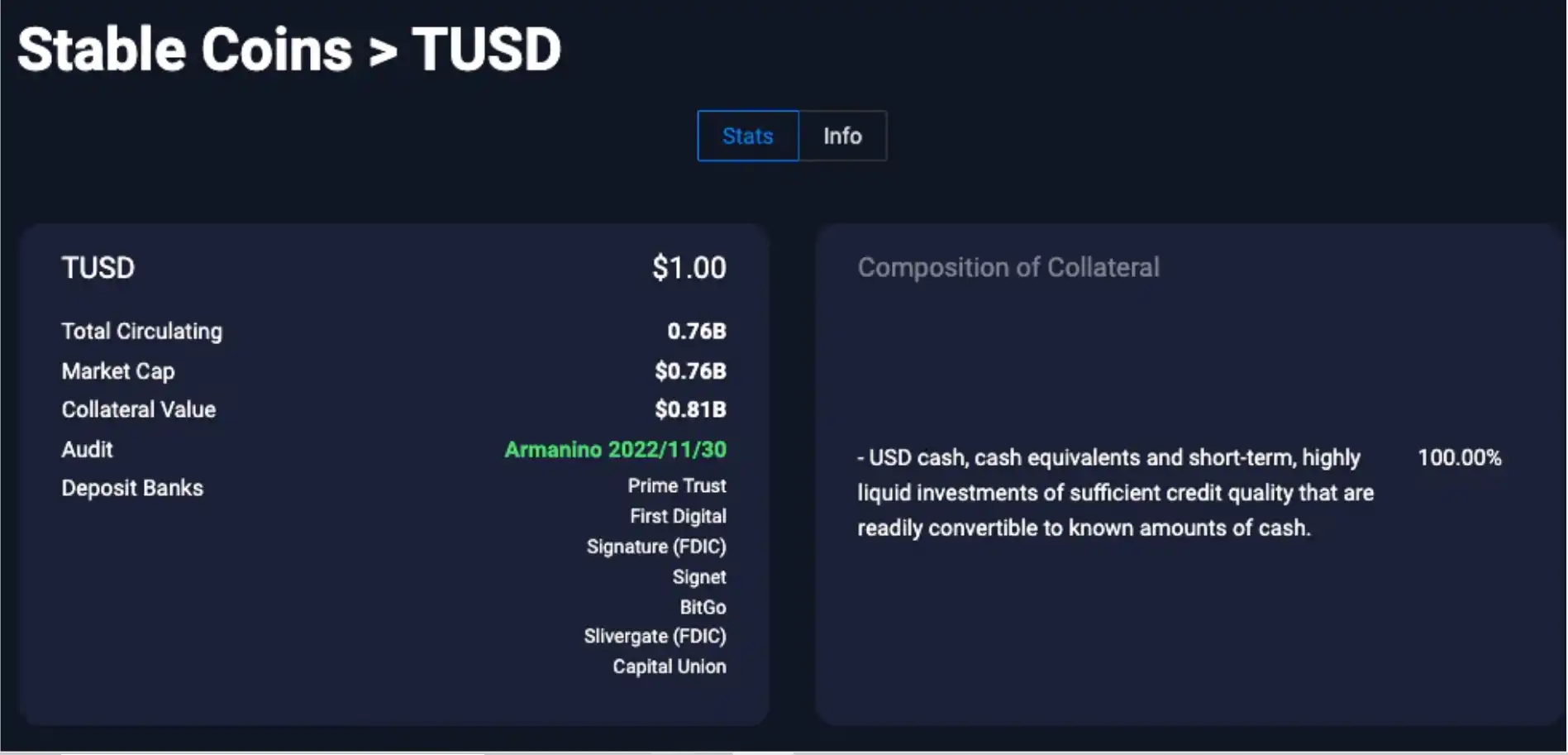
Currently, TUSD's reserve asset is valued at $810 million, exceeding the circulating supply of $756 million, held in multiple bank accounts but without visibility into the specific asset allocation within banks.
TrustToken's audit report is issued by the third-party accounting firm Cohen & Company, which specializes in digital asset solutions.
Furthermore, TrustToken collaborates with a top U.S. accounting firm, Armanino, to develop reserve data-fetching software. Armanino's web crawler continuously retrieves custodial balances and TUSD's on-chain total circulating supply, showcasing the two in real-time to provide live proof of TrueUSD balances.https://real-time-attest.trustexplorer.io/truecurrencies
2. Derivative Issuer Risk
Cross-chain bridge: Specific information related to cross-chain bridges can be found on DefiLlama: https://defillama.com/stablecoin/trueusd
Other Derivative Issuers: Case-by-Case Analysis
Additional Information
Silvergate is the custodial bank for both BUSD and TUSD. Silvergate is a US-based bank that primarily serves cryptocurrency companies. Its clients include well-known cryptocurrency companies such as FTX, Coinbase, Circle, and Paxos.
FTX has approximately $1 billion deposited in Silvergate. On the day FTX filed for bankruptcy, Silvergate issued a statement indicating that its bank was not at risk with FTX. FTX's deposits in Silvergate account for less than 10% of the bank's total deposits, and these funds will be returned to FTX's creditors through the FTX bankruptcy process.
Additionally, Silvergate is backed by FDIC (Federal Deposit Insurance Corporation) insurance, with each account at Silvergate insured for up to $250,000. This insurance helps to mitigate run risks to some extent. Overall, the likelihood of Silvergate going bankrupt due to a run is relatively low.
03 Summary
The use of stablecoins needs to consider two key metrics: security and usability
Security:
Ensuring the ability to redeem on a 1:1 basis with the US dollar under any circumstances.
- For centralized stablecoins, it is crucial to examine the issuing entity's reputation, collateralization ratio of reserve assets, risk exposure, and the credibility of third-party regulatory and auditing entities to ensure that the issuer has an adequate fund reserve to handle run scenarios.
- For decentralized stablecoins, the minting and burning mechanisms should be examined along with the presence of infinite minting capabilities and triggering conditions.
Usability:
Key considerations include circulation volume and the usage scenarios that accept the stablecoin for payments. It is advisable to choose stablecoins with high circulation volume and wide acceptance.
Welcome to join the official BlockBeats community:
Telegram Subscription Group: https://t.me/theblockbeats
Telegram Discussion Group: https://t.me/BlockBeats_App
Official Twitter Account: https://twitter.com/BlockBeatsAsia
 Related Articles