



Everything is just a cycle.
Original Title: "Coming full circle"
Original Author: Lui Luu
Translated by: Kxp, BlockBeats
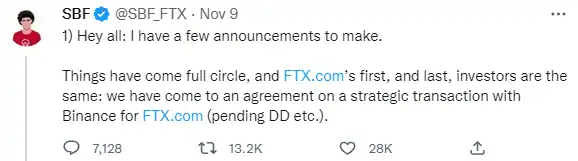
BlockBeats Note: The original title "Coming full circle" is taken from SBF's announcement that FTX has been acquired by Binance. FTX has officially come to an end, and the cryptocurrency industry is rebuilding in the ruins.
In 2014, Mt. Gox was hacked, causing many people to withdraw from Bitcoin trading. It was also the year I began my journey in blockchain. After Bitcoin's price dropped from $1100 to less than $200, people began to seek further development in decentralization. The Mt. Gox incident served as a warning to us that the security of funds and order matching in centralized systems is completely controlled by exchanges, so we must abandon this practice. At that time, users, investors, and developers all unanimously decided to adhere to the fundamental principles of blockchain, which are openness, transparency, trustlessness, and verifiability.

We need to ask FTX / 3AC about this issue now.
Over the next 8 years, many secure and non-custodial trading solutions emerged like mushrooms after the rain: from atomic swaps to Layer 1 DEXs (such as BitShares) focused on DEX, from smart contract DEXs on EVM chains (such as Kyber, which I co-founded in 2017, as well as Bancor and Uniswap) to hybrid DEXs (0x, Airswap, dYdX). Just as we were immersed in the construction of post-Mt. Gox and constantly expanding the boundaries of crypto security and transparent trading, no one expected FTX to collapse in just a few days earlier this month.
Current Situation
The collapse of FTX is shocking not only because it has caused huge losses to users (possibly exceeding $8 billion), but also because FTX has always been considered one of the safest and most compliant CEXs in the industry. With this incident, many associated issues have arisen: What measures could we have taken to detect such events earlier? What warning signals did we overlook? After the Mt. Gox incident, people had a stronger determination to build decentralization, but why did such an event still occur? And the most pressing question for people is, where do we go from here?
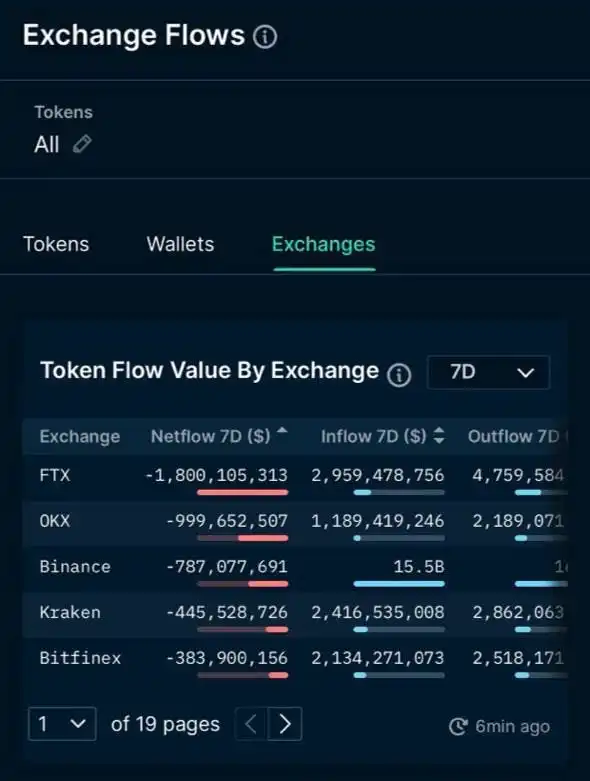
Nansen - November 13th 09:45 GMT
Before answering these questions, we should first carefully examine other centralized trading platforms in this field and observe whether they provide the security and reliability that we urgently need.
This undoubtedly includes Binance and Coinbase. So far, CEX has always used a custody model, storing users' assets in their centralized wallets. Users have always been unaware of how their funds are stored (such as through reserve proof) or how trading platforms use these funds (such as FTX providing customer assets to Alameda). Therefore, after the FTX incident, people began to explore new solutions, such as non-custodial CEX, fiat-only deposit/withdrawal CEX, and on-chain asset proof solutions. Considering the collapse of several major centralized trading platforms in the current bear market, solving this weak link in the industry will be a key step in market recovery.
Centralized stablecoins are another major risk factor in the industry. Table 1 lists the profiles of the top 5 stablecoin issuers, with a total market capitalization of $138 billion. The market capitalization of decentralized stablecoin DAI accounts for only 4%, and half of it is supported by USDC-backed assets. The problem with this situation is that if any contact point fails, is over-regulated, or decouples, the entire stablecoin market will experience a chain reaction.
Table 1: Overview of Stablecoin Market Cap (Source: Coinmarketcap)

Aside from the risks associated with centralization, we are also in a period of widespread decline in crypto adoption. NFT trading volume has decreased by 99% compared to its peak, and the high yields of DeFi, which were once the main driver of users leaving CeFi, have now decreased to the point of being unattractive. Meanwhile, the yield on short-term US government bonds has reached 4.15% to 4.65%. The pace of innovation for new products has slowed down, and the industry is filled with various copycat projects that do not make any substantial contributions to crypto. Finally, although we have seen a large number of new L1 and L2 projects, it is currently unclear how they will bring about minor improvements to the user experience. In the past year, the best L1 innovation projects have saved users transaction costs and improved security, but all of this is predicated on users encountering truly high-quality use cases.
Reason Analysis
In an interview after the FTX crash, SBF talked about how much of his work was aimed at demonstrating FTX's values to the outside world: accepting regulation, altruism, and risk management. However, the actual values guiding his daily decisions at FTX and Alameda are a different set: growing bigger and stronger, gaining positive publicity, and earning profits.
Since these founders have caused serious damage to Crypto, we must now reflect on these issues to avoid similar events in the future.
Not only that, but the development of Crypto is progressing too quickly without proper critical review and effective self-regulatory frameworks. The significant price increase will indeed attract a large number of users in the short term and bring explosive growth to Crypto projects (as well as some impulsive and unrealistic visions such as "landing on the moon"). Therefore, I believe that most people are not joining in because they believe in Crypto technology or support the concept of blockchain, but rather just to make quick money. Unfortunately, many supposedly more mature Crypto venture capital firms are also eager to invest in newly established projects. Unlike TradFi, these projects lack comprehensive due diligence procedures and best practices, and their cash flows are filled with short-term speculative funds, making them often high-risk.

Finally, I have to admit that Web3 is still difficult for most people to understand and use. The design of decentralized solutions not only requires a strong technical background, but also a developer-centric UI/UX system, both of which are major obstacles to mass adoption. In the past, the high yields of DeFi and the incentives of P2E games have prompted users to actively learn about Web3 knowledge, but the situation is no longer the same. In the future, we still need to focus on investing in the following areas: (i) the advantages of CEX functions - deposit/withdrawal; (ii) the interface between DeFi applications and wallets; and (iii) integration with known payment UIs (such as the checkout process of Web2).
Future Outlook
We have learned a lot from the Mt. Gox incident, but FTX has brought us back to square one. In many ways, our vision of building decentralized finance has regressed by several years as a result. Retail and institutional investors in this field may need a long time to recover from this crisis and rebuild confidence.
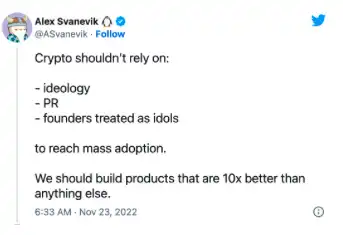
Our focus now should be on building a technology platform and user experience that can surpass CeFi. In the process of building Web3 over the past 2-3 years, people have been completely negative towards Web2. But I believe we can learn a lot from Web2, such as customer first, product management, data-driven decision making, and rigorous due diligence before funding new projects. This is also the advice that venture capital firms and early investors (including our Kyber Ventures) should follow. Web2 has achieved such great success in the past few decades, there must be places where we can learn and draw from, and these experiences will form the basis of our future development. Alex Svanevik appropriately summarizes these points in the tweet below.
In addition, catastrophic events such as FTX, 3 Arrows Capital, and Celsius have revealed the importance of the phrase "trust but verify". If a CEX trading platform does not disclose their reserve proof, liability proof, and cannot provide real-time updates on their solvency information, then we should leave quickly. Vitalk Buterin further elaborated on this topic and proposed solutions such as Merkel trees, Plasma, and validiums for proof-of-solvency, and suggested that customer assets and CEX assets be marked separately. Binance expressed support for Buterin's reserve proof plan and its CEO commented, "In our industry, we cannot gain trust through mere words."
The standard of trust has irreversibly increased, and users will be better protected as a result. Compared to before, centralized projects must make more than 10 times the effort to establish the confidence of users and investors. As a result, teams may choose a decentralized model from the beginning instead of proposing an unconvincing "decentralization ten-year plan".
Investors should maintain an open attitude and study related knowledge such as Token economics, decentralized governance models, administrator key management, and product-market fit. After all, FTX creates Tokens out of thin air and sells them in large quantities to insiders and retail investors, which is already a warning sign for knowledgeable investors.
Finally, what I want to say is that we need to support the teams that are seriously involved in creation. Unlike some Ponzi schemes or improper token transactions, they bring substantial innovation to the entire crypto industry. The crypto industry still needs more open-source product funding platforms like Gitcoin to provide corresponding financial support for public welfare projects.
Conclusion
Despite the recent events that have seriously impacted the growth and mainstream status of the industry, we can still find the motivation to continue building in this bleak landscape. Similar to the Mt. Gox incident, Crypto still has a long way to go before becoming mainstream. Compared to the billions of users in Web2, we still have enormous potential and possibilities in terms of user growth and innovation. For those builders with a long-term vision and rigorous attitude, now is definitely a great opportunity for them to show their skills, avoid interference, and ultimately stand out. Currently, Crypto and blockchain are still the only means to revolutionize our existing technology stack. Ten years later, when we look back at all these events, we will find that they are all for the same beautiful ideal. At the same time, this vision also reminds us to reshape the entire Crypto industry with a more solid foundation and more reasonable expectations. In the future, we need to continuously build decentralized infrastructure and protocols, gradually optimize the Web3 user experience - a demand that is stronger than ever before.
Original article link
Welcome to join the official BlockBeats community:
Telegram Subscription Group: https://t.me/theblockbeats
Telegram Discussion Group: https://t.me/BlockBeats_App
Official Twitter Account: https://twitter.com/BlockBeatsAsia







