



Bankless: 5 on-chain signals indicate that the crypto market has bottomed out.

Original Title: "5 On-Chain Signals That We've Bottomed"
Original Author: Jack Inabinet
Original Translation: Deep Tide TechFlow
In November, the main theme of the cryptocurrency industry is the concern about the fate of encryption: a top three cryptocurrency exchange with a valuation of $32 billion in June collapsed overnight; a mainstream cryptocurrency lending platform also collapsed.
However, ETH did not create a new cycle low point!
Despite the market turbulence, the surprising resilience of cryptocurrencies has led us to ponder an age-old question: are we there yet?
Under the inflationary pressure, the Federal Reserve seems to be less hawkish, and global conflicts may ease slightly.
So, what does the blockchain offer to support this bullish view?
Today we will examine 5 on-chain signals representing "bottom".
1. Yield Increase
Since hitting bottom on June 9th, the total yield of DeFi has been on the rise.
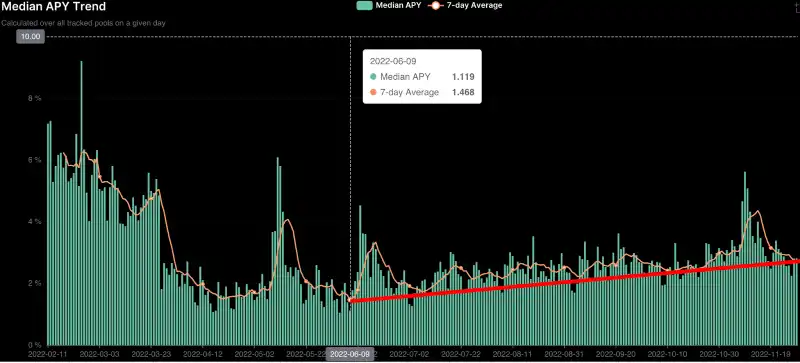
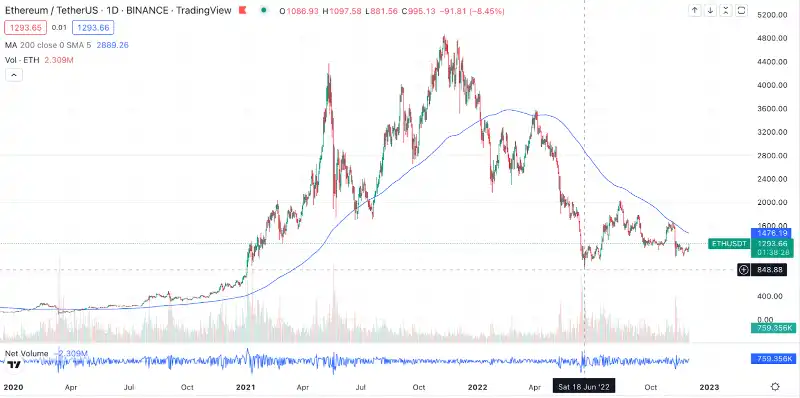
Ethereum reached its cycle low on June 18, one and a half weeks later.
The increase in yield from June 9th to 18th reflects the increased demand for borrowing of cryptocurrency assets by users who opened short positions. Subsequently, the seven-day moving average yield peaked locally on June 19th.
Unlike traditional financial markets, where the yield of debt instruments such as mortgage loans, commercial bills, and US Treasury bonds is mainly driven by the macroeconomic interest rate situation and the Federal Reserve's interest rate target, the yield of cryptocurrencies is generated by asset demand.
Higher DeFi yields are often associated with higher cryptocurrency asset prices.
Why?
Individuals and institutions primarily obtain leverage or implement profit-generating strategies through borrowing. Higher yields indicate that borrowers are willing to pay higher capital costs, indicating an overall better capitalization level for borrowers.
In addition, the increase in borrowing interest rates indicates that borrowers are turning to investment methods that are more focused on risk, which is beneficial for risk asset categories such as cryptocurrency.
2.Curve Pools Rebalancing
Do you remember when FTX crashed, Alameda allegedly shorted USDT, causing it to break its peg.
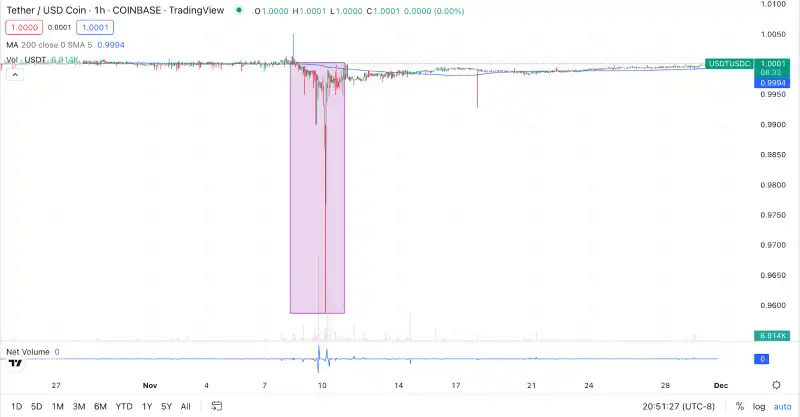
Alameda's move and the resulting decrease in demand for USDT by related parties, as well as the increase in its supply, led to the peg falling below $1.
Due to this sudden supply-demand mismatch, Curve's 3Pool, which can be said to be the most important and liquid stable exchange pool in decentralized finance, has seen an increase in the proportion balance of USDT compared to DAI and USDC.
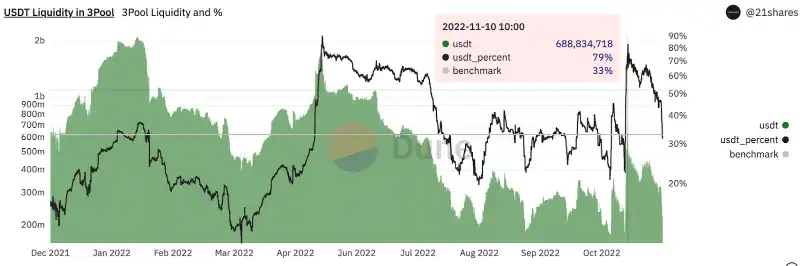
The increase in supply brought about by short-selling activities, selling pressure from relevant holders, and the lack of demand to absorb the increased supply have increased the proportion of USDT in 3Pool.
During market downturns, the balance of stablecoins often fluctuates from the target level of 1:1:1 between USDT/USDC/DAI. Recently, the influx of USDT has brought the pool to the expected level, with USDT accounting for 38% of the Curve 3Pool, and USDC and DAI accounting for 31% each. The stability of Curve 3Pool, especially after periods of extreme volatility, demonstrates confidence in support of major stablecoins.
As an industry insider in the encryption industry, I can translate the following Chinese text to English:
3Pool serves as a barometer of fear and greed in the industry, and the rebalancing of USDT balances is a bullish on-chain signal.
Although the ratio between USDT, USDC, and DAI in 3Pool is still affected by rapid fluctuations, the stability of this ratio indicates that the market is expecting a period of calm or positivity in the near future.
3. Negative interest rates, but stable prices
The funding rate keeps the price of perpetual futures consistent with the spot price of the tracked asset.
When the short position is too large, the price of perpetual contracts will be lower than the price of the underlying asset. In this case, short users compensate long users through funding rates.
When the futures price is higher than the spot price of the underlying asset, the long position will pay the short position through the funding rate. This mechanism encourages the tool to track the spot price of the asset.
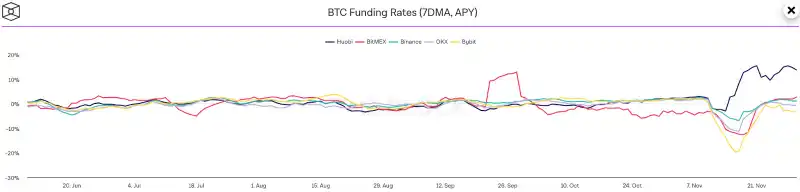
Throughout November, the BTC funding rates for all major exchanges tracked by The Block were mostly negative. Generally, positive funding rates indicate positive funding behavior, while negative funding rates indicate negative price behavior.
However, the combination of persistent negative interest rates and stable market pricing provides hope for the bulls, demonstrating the market's resilience to further asset shrinkage, despite the unusually high selling pressure on cryptocurrencies.
4. Volatility Level Normalization
After reaching a peak of $126.02 during the FTX crash on November 9th, the Cryptocurrency Volatility Index (CVI) - a crypto solution that tracks the Standard & Poor's 500 Index - has been declining and reached a baseline level of $80.71.
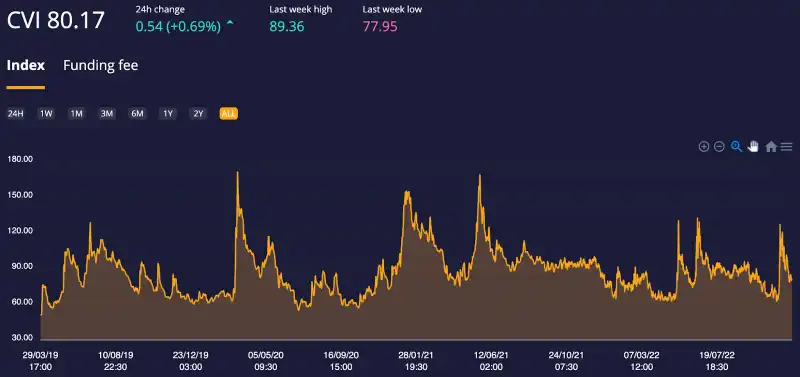
Similar to VIX, the high level of CVI is usually associated with unfavorable market conditions. Currently, the level of CVI is similar to the level when ETH formed a potential cyclical bottom in June to July of this year.
The volatility and uncertainty of the encryption market must be reduced in order to form a bottom. Low CVI readings confirm this low volatility.
If the bottom is truly formed, we expect CVI to continue to decline, just like before November 7th.
5. The holding amount of the smart money stablecoin has decreased
The allocation of smart money to stablecoins only began to decline after reaching a peak of 38% on November 9th.
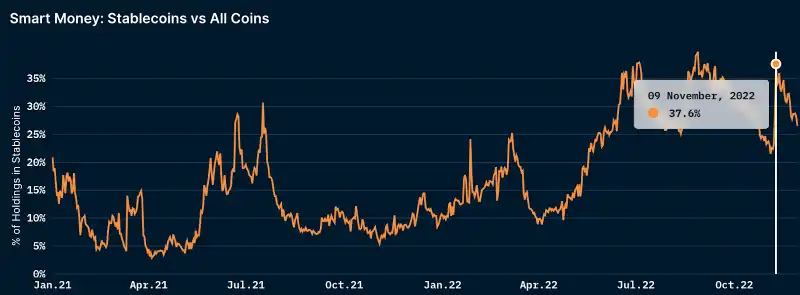
During the remaining time in November, Smart Money transitioned from a high concentration of investment portfolio to stablecoins to its current level. Currently, stablecoins account for 27% of Smart Money's wallet balance.
Just like stablecoin holders selling Tether, when the future value of cryptocurrencies is questioned, cryptocurrency holders turn to holding stablecoins.
Investing in stablecoins allows cryptocurrency holders to reduce risk and limit potential portfolio shrinkage, while keeping funds on-chain, and enabling whales to easily redeploy capital when market conditions become more favorable.
Although most of the Smart Money investment portfolio is still in stablecoins, like in April this year when ETH rebounded to $3,500, their stablecoin holdings fell below 9% before the bottom was fully formed, and Smart Money will reduce its allocation to stablecoins. Currently, this data is trending in a bullish direction.
Original article link
Welcome to join the official BlockBeats community:
Telegram Subscription Group: https://t.me/theblockbeats
Telegram Discussion Group: https://t.me/BlockBeats_App
Official Twitter Account: https://twitter.com/BlockBeatsAsia







