How far can Solana go? An article to clarify the history of Solana's involvement with FTX.
Original Title: "How Far Can Solana Go? This Article Clarifies the Beginning and End of Solana's Dispute with FTX"
Original Source: R3PO
FTX has yet to recover from its collapse, and the aftermath is still ongoing. Solana, once considered an Ethereum killer, has also been affected and is now on the brink of collapse. While it is understandable that Terra and LUNA collapsed at the same time, what is the connection between FTX and Solana, two seemingly independent projects? Why did Solana end up in such a situation? What degree of consequences will SOL's significant devaluation bring to Solana? Can the self-proclaimed "world's fastest blockchain" survive the storm? Together with the web3 industry, which is reflecting on the FTX incident, R3PO will provide readers with an answer to the above questions from the perspective of the Solana project itself, and attempt to draw more experience and lessons from the accident.
Why Solana?
After the FTX crash, Solana was immediately placed at the center of the storm, which can be traced back to the DeFi summer of 2020. At that time, Solana was still relatively unknown, just one of many public chains trying to crack the "impossible triangle". However, SBF (Sam Bankman-Fried), co-founder and CEO of FTX and founder of Alameda Research, discovered Solana. In addition to participating in Solana's multiple rounds of financing, he also chose to build the decentralized trading platform Serum on Solana (the first decentralized trading platform on Solana), and subsequently invested in multiple applications based on Solana, such as offline maps Maps.me, bulk broker Oxygen, Bonfida, which fully leverages Solana's potential, and Raydium, which combines AMM/mining/IDO functions.
This kind of recognition with real gold and silver has bound SBF and Solana together, and some even mistakenly thought he was the founder of Solana. The large amount of tokens held by FTX, Alameda, and Solana also caused SOL to plummet all the way to today's price on November 9th, the day of FTX's explosion.
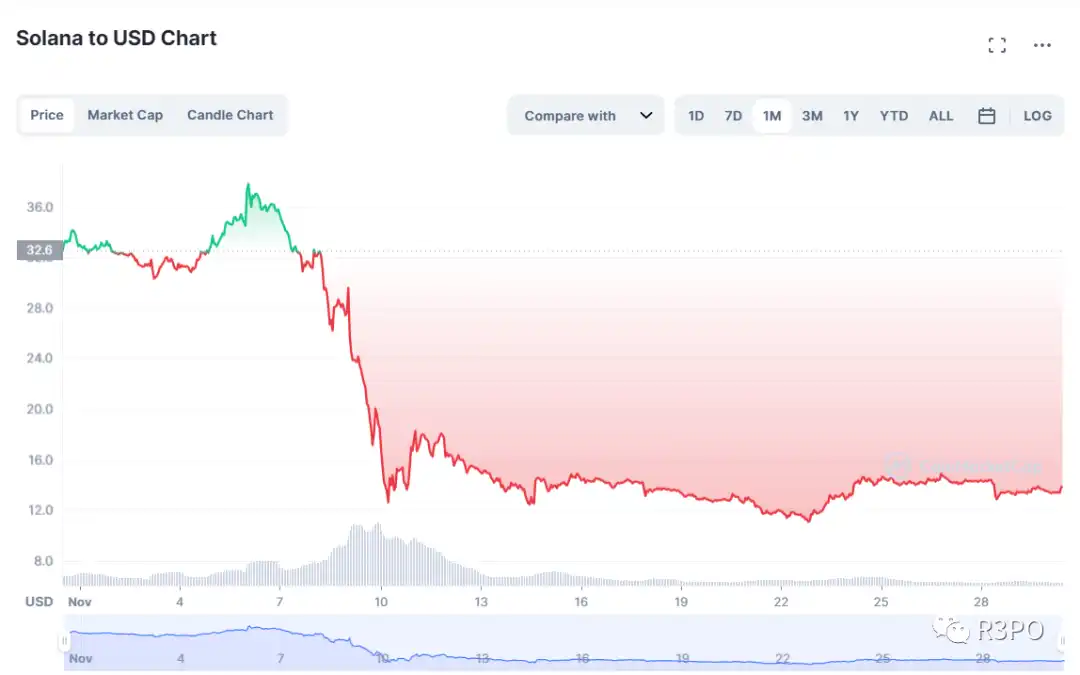
Image Description: SOL Price Trend Chart in the Past Month
Image Source: CoinMarketCap
To some extent, the degree of infiltration between FTX, Alameda, and Solana is second only to the symbiotic relationship between Terra and LUNA. Therefore, when FTX collapses, it is like informing the world that the backer behind Solana has fallen, and it is only natural for everyone to turn their attention to Solana. The outcome of the collapse of the wall and the push of the crowd is not difficult to imagine.
Especially Serum, as one of the cornerstones of Solana DeFi infrastructure, brought not only speed and low cost, but also embarrassment and doubt after the FTX crash, and quickly moved towards failure and disintegration. On November 13th, due to concerns that Serum may have been damaged in FTX's hack, Solana developers urgently forked the DEX Serum developed by FTX. The forked version, OpenBook, quickly went live on the Solana mainnet, with a daily trading volume of over $1 million, while Serum's trading volume and liquidity have dropped to near zero.
Amidst the spread of negative emotions, the funds in the Solana DeFi ecosystem are significantly decreasing. According to DefiLlama's data, the total value locked (TVL) in Solana DeFi has plummeted to $280 million (as of the time of writing), which is much lower than the level during the significant cryptocurrency market downturn in June 2021.
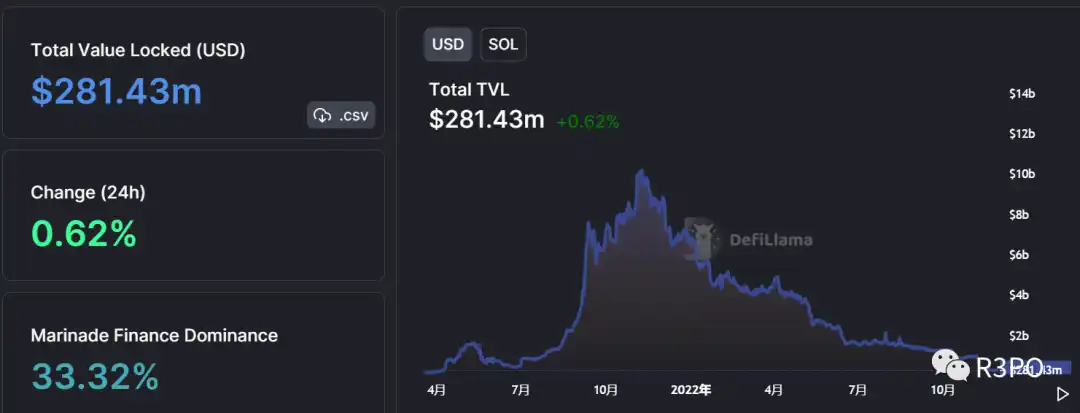
Image Description: Total Locked Value of Solana DeFi
Image Source: DefiLlama
On one hand, the DeFi ecosystem is in crisis, while on the other hand, the NFT ecosystem is experiencing a sell-off. According to Forbes, the FTX scandal is destroying the Solana NFT ecosystem and triggering a sell-off. Public data shows that the daily trading volume of NFTs on the Solana chain's Magic Eden, OpenSea, and Solanart has more than doubled from over 80,000 a week ago to over 250,000 at one point, indicating that holders are rapidly selling their NFTs.
There are other new public chains besieging it from the outside, and it is also involved in the huge storm of FTX. Does Solana still have room for a comeback in the future?
What is Solana?
In order to answer the above question, we first need to understand what Solana is and where its value lies.
Solana is a public blockchain founded by Anatoly Yakovenko and his two former colleagues at Qualcomm, Greg Fitzgerald and Stephen Akridge. The three founders' strong technical background has given investors and the market greater confidence. The founding intention was to respond to the "impossible triangle" of blockchain technology. Solana attempts to use a new blockchain architecture based on Proof of History (PoH) to improve scalability. It positions itself as the world's fastest high-performance public chain. According to its white paper, PoH is used on Solana to encode untrusted time flow into the ledger - a data structure that is only appended. When used with consensus algorithms such as Proof of Work (PoW) or Proof of Stake (PoS), PoH can reduce message passing overhead in Byzantine fault-tolerant replicated state machines, achieving sub-second deterministic time. Solana also proposes two algorithms that use PoH ledger timekeeping features - a PoS algorithm that can recover from any size partition and an efficient Proof of Replication (PoRep). The combination of PoRep and PoH provides defenses against ledger forgery in terms of time (ordering) and storage. In theory, Solana can achieve 710,000 TPS per second on a standard network of 1Gbps.
And Solana's eight core innovative technologies have created possibilities for its high performance and low cost.
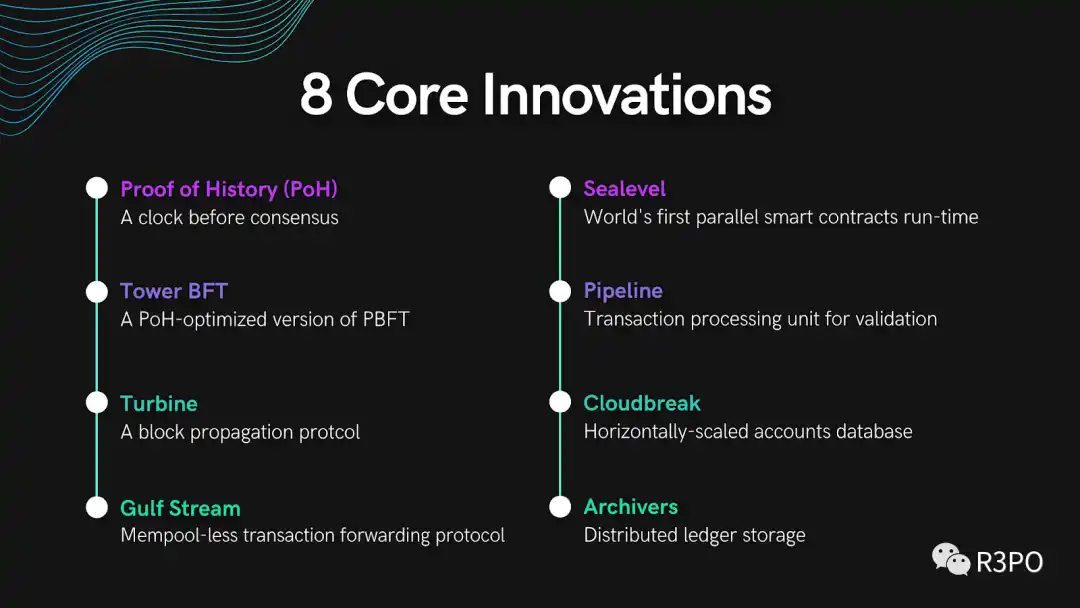
Image Description: Solana's Eight Core Innovations
Image Source: The Tie
Solana supports the creation of smart contracts, Dapps, DeFi platforms, and NFT markets. To a certain extent, Solana has achieved Anatoly's original intention of building a high-performance blockchain network with low transaction fees and high TPS that can accommodate many projects. Solana can achieve large-scale expansion without sharding, and applications can be freely combined on top of a complete layer network. In contrast, Ethereum has long applied a resource-intensive PoW governance system before the merger, which has long been overwhelmed. With the long-prepared Ethereum bridge - Wormhole protocol, Solana provides a low-cost and fast migration public chain without the need to rewrite contracts, providing a foundation for a large number of high-quality projects and active users to migrate to Solana.
In addition, Solana also has "predictability", which is a burden-free programming mode: developers write the code and know that it will always be effective, and the cost of executing the code in the future is even lower than it is now. This provides enough confidence for developers and project parties to develop and maintain for the long term.
Overall, Solana's advantages provide a good supplement to Ethereum's shortcomings, offering developers and projects in the market an attractive and stable option. As a result, Solana has begun to heavily invest in building its ecosystem.
As a blockchain infrastructure, Solana has gained recognition from many applications. Taking the Solana ecosystem project Francium as an example, Francium has pointed out "the three reasons for developing DeFi on Solana".
· Public chain has the advantages of low transaction costs, long-term scalability, higher network value, decentralization, etc. at the underlying level;
· Stateless execution transactions enable large-scale parallel programming;
· Ecological development is growing rapidly and has begun to take shape, providing a foundation for building combinable Lego blocks.
Solana is not satisfied with just that. It has established a long-term and effective ecological support plan (Grants), and continues to hold hackathons with high prizes and Breakpoint conferences to promote community communication. Solana has also joined hands with well-known companies in the industry to establish multiple ecological funds and creator funds, providing real funding to encourage project development. The influx of new projects, highly active users and developers, and abundant financial support have formed a prosperous ecosystem for Solana.
In addition, Solana has also issued its native cryptocurrency SOL. SOL uses a delegated PoS consensus algorithm, where miners delegate SOL to validation nodes to participate in network maintenance and receive rewards. SOL is used to pay for transaction fees, staking, and governance on the network. The Token mechanism of SOL sets its initial inflation rate at 15%, which decreases by 15% each year until it reaches a long-term stable rate (1%-2%) and remains unchanged. This Token mechanism allows for rapid growth in early SOL supply and stable supply in later periods.
Solana will go where?
The direct impact of the FTX incident on Solana has gradually bottomed out. According to information on the Solana official website, the Solana network did not encounter any significant performance or normal operation time issues in the FTX incident. At the same time, the Solana Foundation clarified the recent SOL Token unlocking event that caused community panic, stating that this is a normal event that occurs every two to three days, and at the end of each epoch, token holders can request to release their pledge from validators. The current large amount of unlocking actually comes from about 250 addresses, canceling the pledge release of about 29 million SOL at the end of Epoch 370, while the originally expected 63 million SOL to be released from pledge at the end of Epoch 370 has been delayed due to the Solana Foundation's commission of canceling the pledge action of 28.5 million SOL, which will take effect in the near future.
Although it is bad news, the other shoe has also dropped. According to the Sollet interface announcement, the soBTC issued by FTX or Alameda on Solana has been confirmed as unredeemable. Solana Compass also stated that the 48,636,772 SOL Tokens previously controlled by Alameda are now held by the liquidator and have been difficult to sell for nearly a decade.
Solana Foundation Asset and Liability Statement on FTX/Alameda's Risk Exposure
· According to the Solana official website, the Solana Foundation has approximately $1 million in cash or cash equivalents on FTX.com, which has suspended withdrawals. This is less than 1% of the Solana Foundation's cash or cash equivalents, so the impact on the operation of the Solana Foundation can be ignored.
· Solana Foundation does not have SOL hosted on FTX.com.
Solana Foundation 对 FTX/Alameda 的资产敞口
Solana Foundation's exposure to FTX/Alameda's assets.
· According to the Solana official website, the assets it holds in its FTX.com account include (as of November 6th when FTX.com stopped processing withdrawals): approximately 3.24 million shares of FTX Trading LTD common stock, approximately 3.43 million FTT tokens, and approximately 134.54 million SRM tokens, with risk exposures of $75.46 million and $107.6 million, respectively.
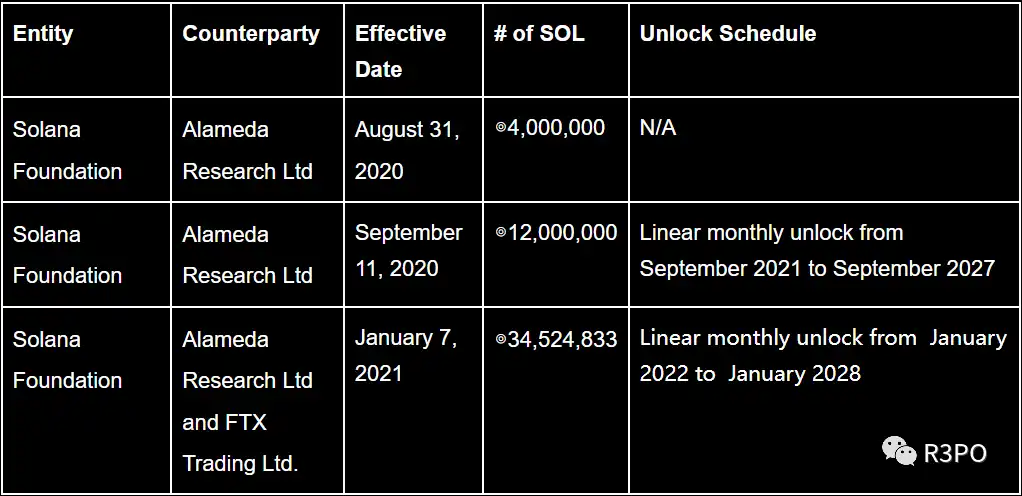
Image Description: Summary of Solana Foundation's Sale of SOL to FTX/Alameda
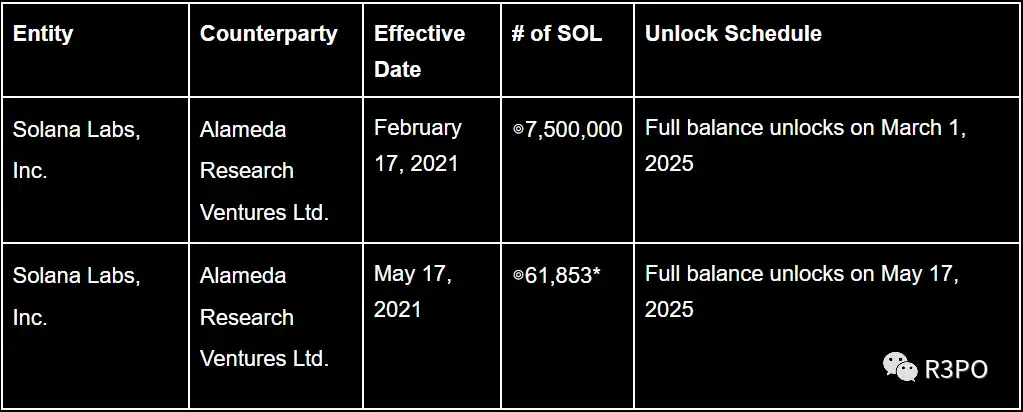
Image Description: Summary of SolanaLabs, Inc's sale of SOL to FTX/Alameda
According to the Solana official website, the total value of Sollet-based assets circulating on the Solana blockchain that are affected by the Sollet custody bridge is approximately $40 million, and the status of the underlying assets is currently unknown.
Despite the clear risk exposure, the aftermath of the FTX incident has not yet ended, and the price of SOL has not yet bottomed out. Especially for Solana, even without the FTX incident, it faces many problems, such as fierce competition in the blockchain infrastructure field, late entry into the market, lack of substantial commercial content and clear feature lists, heavy VC allocation, frequent network outages (3 times since March 2022), insufficient revenue due to low transaction fees, and too narrow target customer groups. The FTX storm swept away not only funds, but also opportunities and confidence. Solana has little time left to strengthen its fragile foundation, which is currently its top priority. Optimistically speaking, in terms of the overall blockchain infrastructure race, there is currently no product that is good enough to completely replace Solana's functionality and position in the market. The highly anticipated launch of the Aptos mainnet did not perform as expected and failed to successfully take over from Solana, leaving Solana with a glimmer of hope.
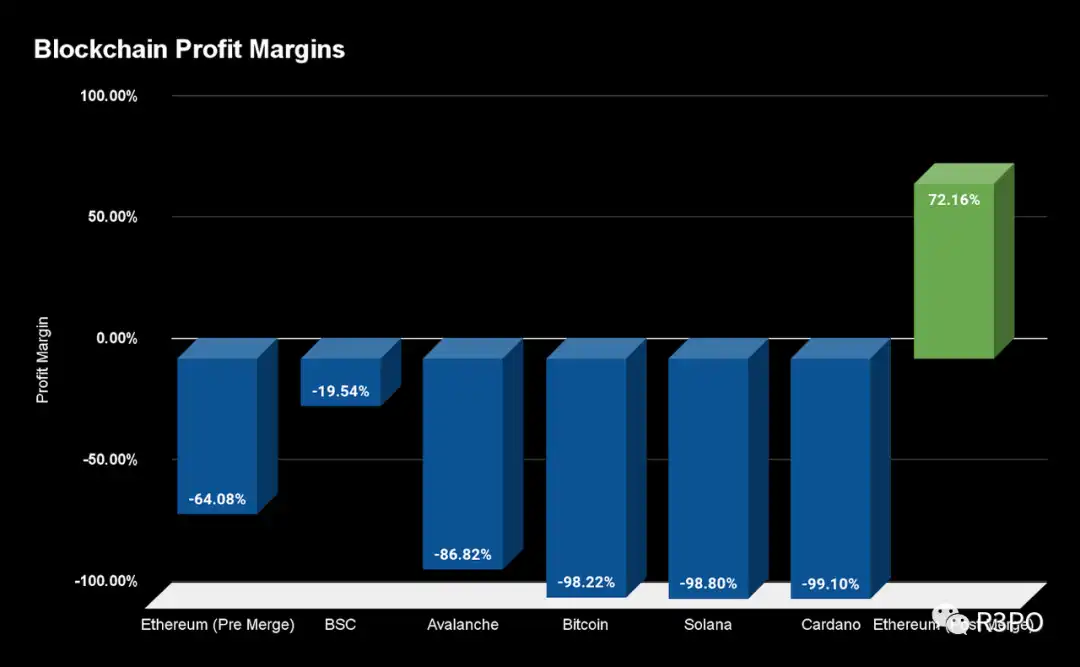
Image Description: Profitability of various public chains
Image Source: Bankless
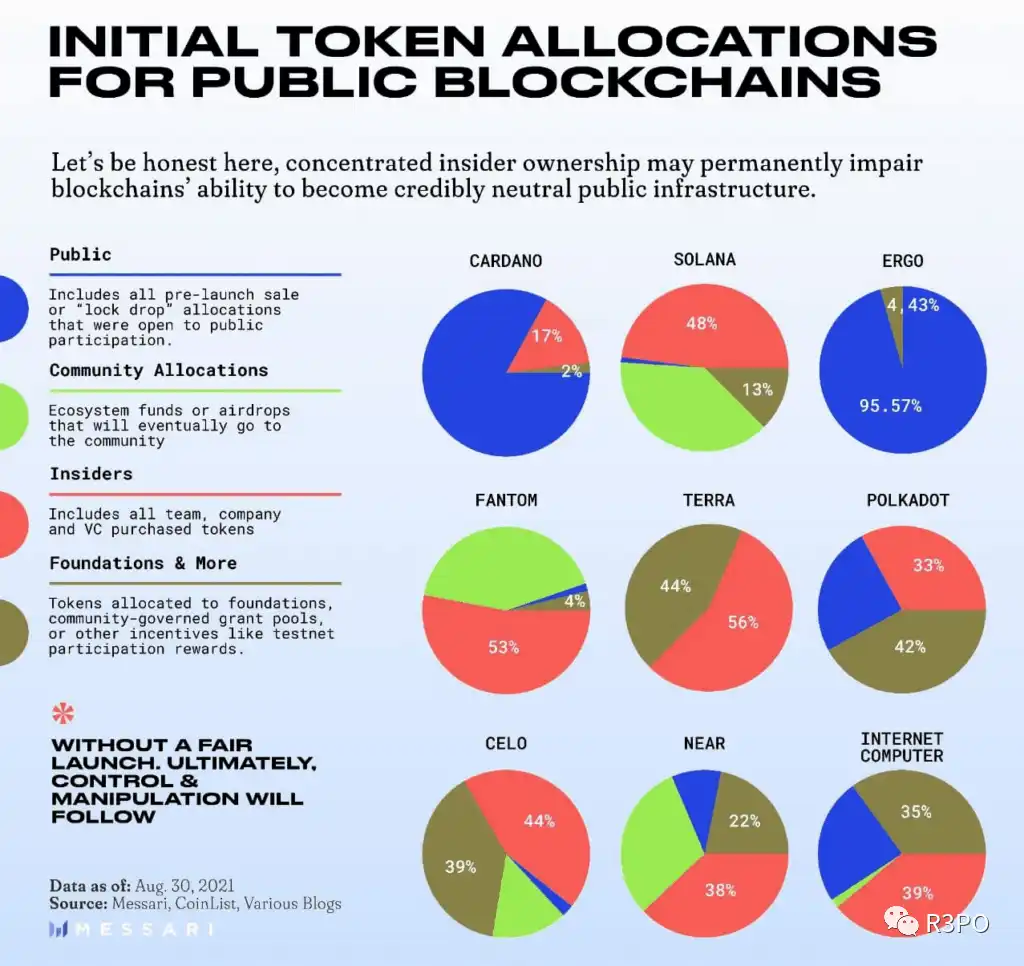
Image description: Initial token distribution of various public chains
Image source: Merssari
Discussions about Solana on social media platforms are also very active, but there seems to be a general consensus that the future of Solana lies in its ecosystem (if there is a future). Fortunately, this belief not only exists in Solana's internal team and SOL holders, but also in the minds of many project parties and developers in the Solana ecosystem. Especially for NFT projects, Solana is currently the second largest blockchain after Ethereum, with sales exceeding 1.7 million US dollars, more than 8 times that of the third-ranked Cardano. Solana provides a globally scalable tool that can meet the development needs of projects of different scales. It is a basic infrastructure development platform that is both small and beautiful, and large and comprehensive. All tools are open source and free, and participants can create NFT artworks and build communities for free. If Solana collapses, it is undoubtedly something that NFT project developers do not want to see.
Some technical data also supports that Solana is on a development trajectory, with the maximum transactions per second (TPS) increasing continuously from the beginning of the year until now. Despite being affected by the FTX incident in the short term, it quickly resumed its upward trend.
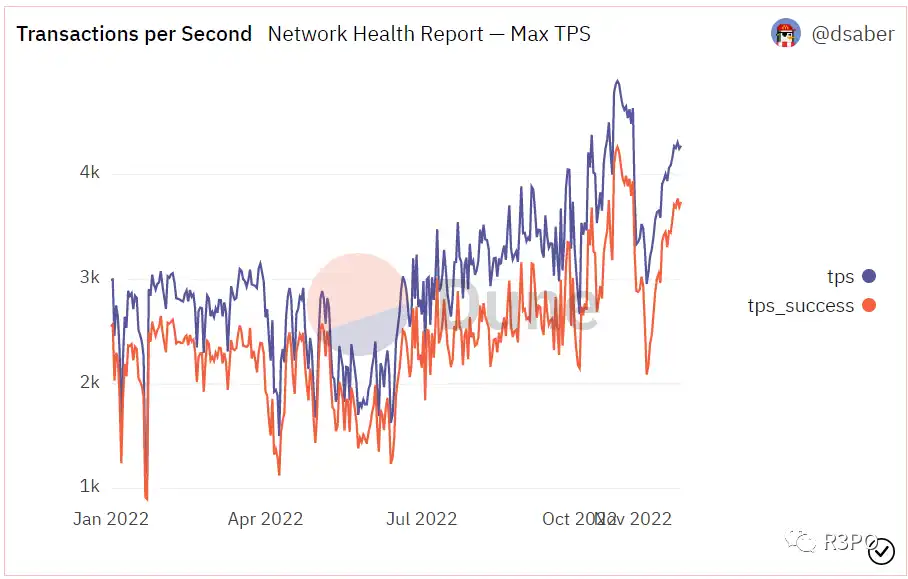
Image Description: Solana TPS from January 2022 to present
Image Source: Dune@Dsaber
In its October report, Solana made technical changes to address some existing issues, with the aim of solving current network stability problems, increasing revenue without raising transaction fees, and expanding its user base:
Applying QUIC on the mainnet test version:
QUIC is a protocol built by Google, designed for fast asynchronous communication. This is an improvement over existing UDP-based protocols. Previously, the Solana network used a UDP-based protocol to transmit transactions between RPC nodes and current block leaders. UDP lacks traffic control and receive confirmation, so it failed to provide a meaningful way to prevent or reduce abuse. To solve this problem, Solana's transaction ingestion protocol is being re-implemented on top of QUIC, which can control sessions and traffic. Currently, it is running on the testnet and mainnet beta. However, the mainnet beta still supports UDP and QUIC. QUIC is planned to become the default transaction ingestion and forwarding protocol on the mainnet testnet. Once QUIC is adopted, there will be more options available to optimize data ingestion and prevent abuse.
Increased Trading Volume:
Currently, transactions on the Solana network are limited to a maximum of 1,232 bytes. This limitation restricts the ability to combine programs with each other. With the implementation of QUIC, the possibility of increasing transaction size is within reach.
Stake-weighted Quality-of-Service (QoS):
This is built in parallel with QUIC and enabled before QUIC is adopted on the mainnet testnet. Currently, block producers accept transactions without considering the source of the transaction. Solana is an equity proof network, and equity-weighted QoS extends the utility of equity weighting to transaction quality. In this mode, nodes with 0.5% ownership will have the right to transmit at least 0.5% of the packets to the leader. Regardless of how much traffic comes from nodes without equity, transactions submitted by validators with equity in the network will always be accepted by block producers.
Fee Market:
The fee market has already been partially introduced and is expected to be further implemented after QUIC is fully adopted. The first part of the fee market implementation is to support priority fees. Previously, transactions were processed on a first-come, first-served basis, which did not give users any way to express the urgency of their transactions. Priority fees change this by allowing users to decide for themselves to pay an additional fee when executing a transaction and including it in a block. Priority fees are calculated based on the expected amount of computing resources required for the transaction. For example, a simple token transfer requires a lower total priority fee than an NFT Mint with the same level of urgency. Since July 2022, priority fees have been running on the mainnet test version. Future versions will add additional features to the fee market, including new RPC methods that will help users and applications determine the minimum additional fee required to be included in the next block, higher fees for competitive accounts, and improvements to block scheduling. These pending improvements are expected to create a more efficient fee market for all Solana participants.
From an ecological perspective, currently there are over 500 ecological projects built on Solana. Solana has formed an ecosystem that covers eight major areas: DeFi, NFT, gaming, tools, wallets, dApp applications, and development. The covered sub-sectors include DEX, derivatives, transaction analysis visualization, lending, synthetic assets, and stablecoins. With the support of these vast sub-markets, Solana's confidence in challenging the most important infrastructure of Web3 remains strong.
Solana revealed that the first generation Saga developer toolkit for mobile devices will be shipped in December. The SolanaMobile dApp Store will also open in January 2023, and consumer devices will be launched in early 2023. Solana seems to be full of confidence for the future, aiming to challenge Ethereum and compete with Apple.
Conclusion
Solana was born from SBF, but also suffered a big setback because of SBF. R3PO believes that throughout the process, Solana itself did not encounter any serious problems. When it encountered SBF, it received full support from SBF based on its own strength. SBF's downfall may have given Solana an opportunity to prove itself. In terms of public chain competition, Solana's characteristics, advantages, and functions are currently irreplaceable, but the window of opportunity is often fleeting. Whether Solana can seize it and achieve success remains to be seen. R3PO believes that the top priority for Solana is to solidify its own foundation, solve the problem of downtime and profitability, rather than blindly rushing to the market. After all, the tender shoots that sprouted in the cold winter not only welcome the sunshine, but also more frost.
Reference:
资料 1, 资料 2, 资料 3, 资料 4, 资料 5, 资料 6, 资料 7, 资料 8, 资料 9, 资料 10, 资料 11, 资料 12
Original article link
Welcome to join the official BlockBeats community:
Telegram Subscription Group: https://t.me/theblockbeats
Telegram Discussion Group: https://t.me/BlockBeats_App
Official Twitter Account: https://twitter.com/BlockBeatsAsia

 Related Articles