From Exchange Platform Evolution History to Exploring the Trajectory of Crypto Gaming

Original Article Title: " Exploring the Evolutionary Trajectory of Crypto Games "
Original Article Author: Overnight Porridge, The Way of DeFi
When it comes to blockchain games, the choice between Onchain and Offchain has always troubled me. Looking back at the past few Crypto cycles, including successful games like Axie Infinity, STEPN, The Sandbox, and others, they all belong to Offchain chain games that only record NFTs and tokens on the chain. However, with the arrival of the bear market, the depreciation of these tokens and NFTs has shifted the focus of many observers to Onchain chain games.
This article attempts to speculate on the evolutionary trajectory of Crypto games based on the evolution of Crypto transactions.
Image Source: Created by Unbounded Map AI
Let's first borrow a picture from 1confirmation co-founder Nick Tomaino to introduce the concepts of Purists, Tourists, and the intermediaries between the two.
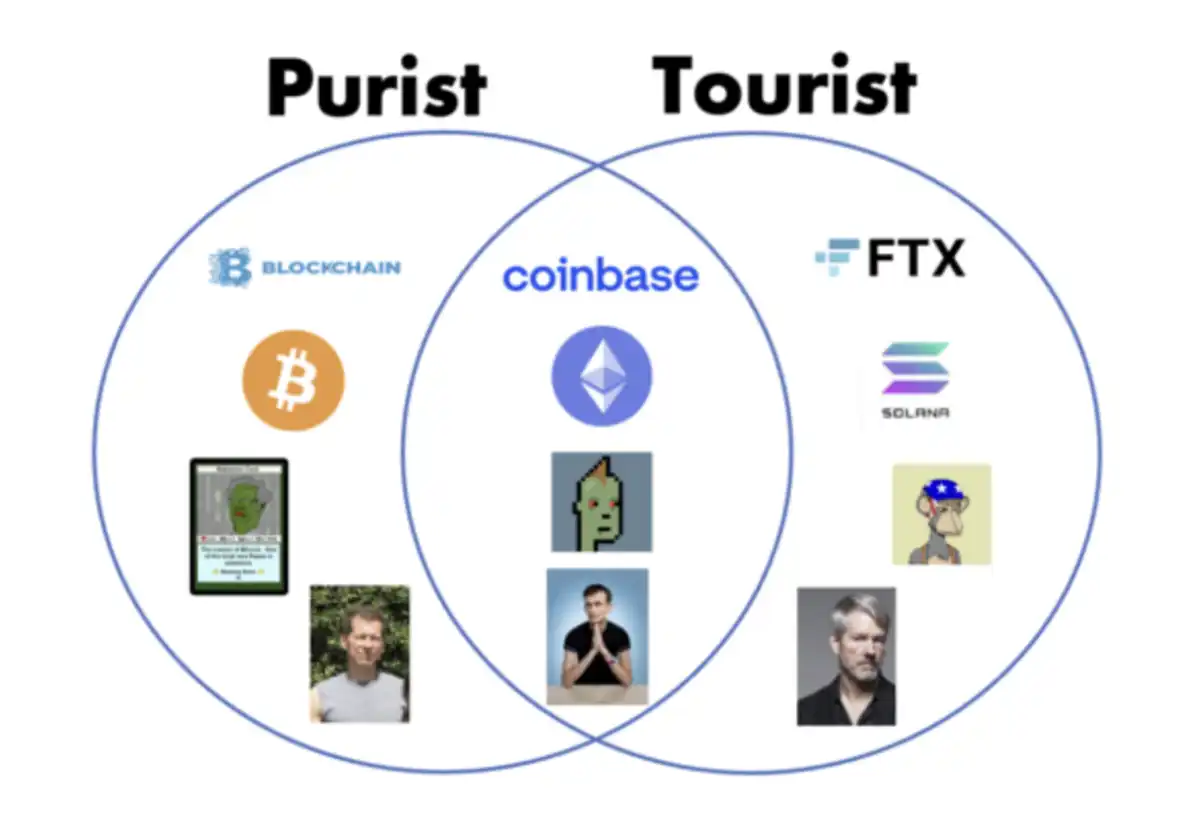
"Purists are people who are well versed in craft history and subtle differences. They understand nuances, consider all previous things before building, appreciate authentic things, and bring truly new things to the table. The products made by purists may be too niche for the mass market, but they are original and meticulously crafted.
Tourists are people who do not care about history or subtle differences; they just want to create a product that resonates with people. What they are building may resonate for a while, but tourists come and go easily. If a product is too touristic, it lacks long-term sustainability, and what was popular yesterday will disappear tomorrow." — "Purists and Tourists in Crypto"
In the above image, FTX in the Crypto trading field was classified by Nick Tomaino as a Tourist, and indeed his judgment has been proven correct. FTX did have a rapid rise and fall!
The Evolution of the Crypto Trading Landscape
In the Crypto trading space, centralized exchanges that misappropriate user funds and overlook private key security fall into the category of Tourists, such as Mt. Gox during the 2010-2014 period and FTX from 2019 to 2022.
On the other hand, centralized exchanges that prioritize security and do no evil reside between Purists and Tourists, such as Coinbase founded in 2012 and Binance established in 2017.
The most idealistic Crypto trading projects are Crypto-Native, existing on-chain, with Uniswap being classified under this last category.
Most of the time, Tourist-type projects are unrelated to the Crypto ethos. They simply leverage certain terms or technologies, rapidly expand by increasing security risks, hence exhibiting a more explosive growth during a Crypto bull market but are more prone to death in a bear market.
Simultaneously, centralized exchanges like Binance have also been successful in the short term, bridging the gap between Purists and Tourists while considering user experience and security.

(The left side represents DEX, the right side represents CEX, created by Unbounded Map AI)
However, Crypto-native trading projects such as Uniswap face scalability challenges due to the underlying blockchain's throughput limitations and issues like MEV. To enhance user experience, DEXs with an order book structure have moved secondary logic off-chain. Additionally, many DeFi projects default to setting token approval amounts to unlimited, a compromise that undoubtedly sacrifices security.
Over time, as foundational infrastructure like public chains matures, on-chain DeFi has the conditions for large-scale expansion, truly realizing the vision of decentralized Crypto finance. From a long-term perspective, Purist projects are indeed the most noteworthy.
How Will the Crypto Gaming Sector Develop?
What about the Blockchain Gaming Sector?
We can consider most of the multi-chain gaming projects that emerged during the previous GameFi craze to fall into the Tourists category. They are characterized by issuing tokens and NFTs on a Tourists-type public chain and not focusing on the gameplay itself but rather emphasizing a Ponzi token economy. The purpose of this approach is to gain market attention through hype in the short term. Obviously, these types of Crypto games cannot stand the test of time.
On the other hand, Blockchain game projects built by Purists are entirely different, possessing the following characteristics:
Highly innovative (representative project Dark Forest, which uses zero-knowledge proof technology to expand the game's new boundaries). All meaningful data is stored on the blockchain, eliminating concerns about developers or agent operators. The game is developed following open ecosystem principles, where game contracts and accessible game clients are open source. Third-party developers can build games based on this infrastructure, even fork the game, giving such games a greater imagination space. There are almost no scammers, and most participants are knowledge-seeking individuals or hardcore gamers.
However, such Blockchain games also have very obvious drawbacks:
The game's user experience is poor, difficult to understand, niche, and challenging to scale. Lack of VC funding support. Long development cycles.
Compared to DeFi, games have higher infrastructure requirements. Therefore, theoretically speaking from a mid- to short-term perspective, Crypto games between Purists and Tourists are more likely to succeed. This is also why VCs have poured a lot of funds into off-chain games and have not invested too much in on-chain games.
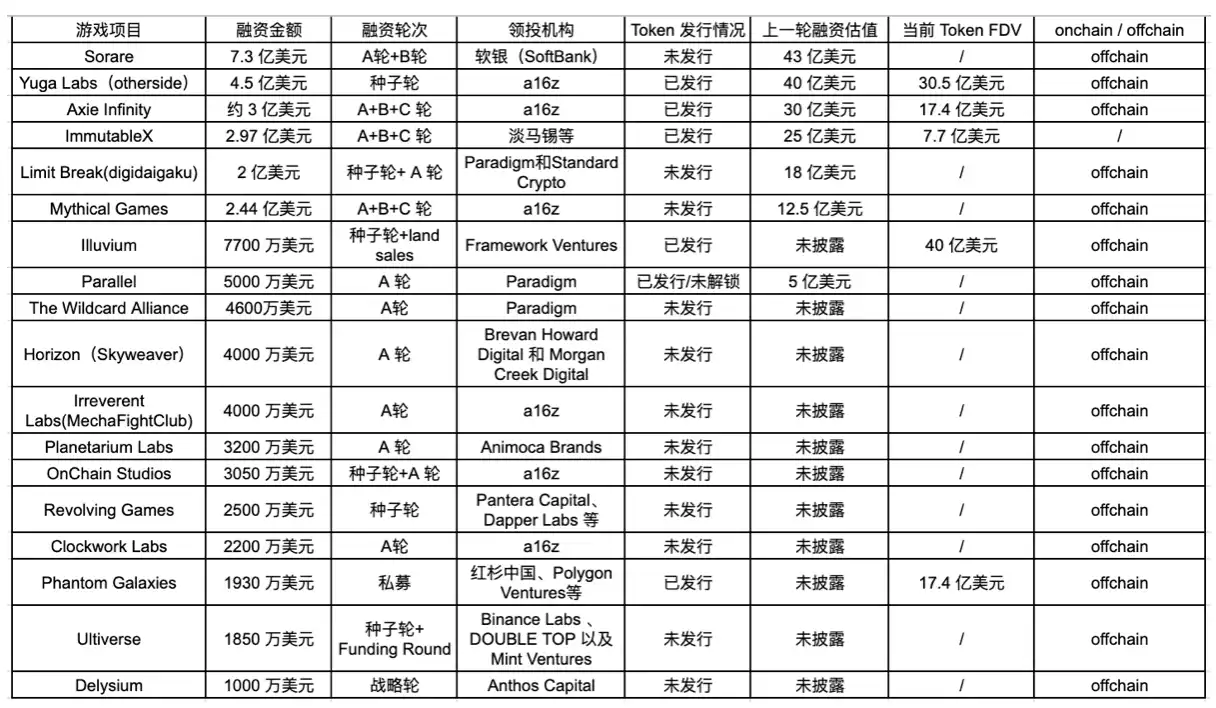
(Note: This does not mean that VC firms are not paying attention to Purists on-chain gaming projects. For example, the pure on-chain game Dark Forest has attracted attention from several top Crypto VC firm partners such as a16z, Paradigm, Coinbase Ventures, etc.)
So, what characteristics should Crypto games between Purists and Tourists have? Here are some reference points:
The issuance of the game's token and NFT occurs on a non-guest-type public chain (such as Ethereum); although most of the game's logic and data are off-chain, the NFT as the core asset is entirely on-chain; it does not adopt a simplistic Play-to-Earn model (which has proven to be unsustainable) but has been improved, for example, with a Win-to-Earn (W2O) model suitable for competitive games or an eye-catching Free-to-Own (F2O) model; players can participate in the game for free; while focusing on gameplay and tokenomics rather than solely pursuing the latter; it can stand out among similar games, whether through game story, gameplay, art quality, innovative gameplay (such as AI integration), etc.; it can continue development even in a Crypto bear market, and the game development progress and community atmosphere are healthy; for already issued NFTs, there will be no unilateral issuance or removal by the project team; the entire project's treasury is managed through a multisig wallet, and the distribution of private keys must be healthy, whereas blockchain games that, like Star Atlas, hold funds on platforms such as FTX are prone to failure;
Conclusion
Drawing from the development history of the Crypto trading sector, we may also see similar phenomena in the Crypto gaming sector: Off-chain blockchain games may experience explosive growth earlier, while Tourist-type projects will continue to emerge and then disappear.
On the other hand, On-chain blockchain games will be better at innovation, and their longevity will be more sustainable.
Lastly, whether On-chain or Off-chain blockchain games, both will learn from each other, much like CEX and DEX.
Original Article Link
Welcome to join the official BlockBeats community:
Telegram Subscription Group: https://t.me/theblockbeats
Telegram Discussion Group: https://t.me/BlockBeats_App
Official Twitter Account: https://twitter.com/BlockBeatsAsia