《The Wall Street Journal》 - The Fated Crypto Empire of SBF

Original Title: They Lived Together, Worked Together and Lost Billions Together: Inside Sam Bankman-Fried’s Doomed FTX Empire
Original Authors: Alexander Osipovich, Caitlin Ostroff, Patricia Kowsmann, Angel Au-Yeung, and Matt Grossman
Original Translation: Leo, BlockBeats
In the Bahamas-Nassau, recently, SBF's $32 billion cryptocurrency trading empire collapsed in full view of the public, raising questions from investors, cryptofolk, and Silicon Valley titans as to why a seemingly bright future company would crumble so swiftly.
The latest developments indicate that FTX did not go bankrupt merely from being bested by its rivals, bad trades, or this year's continued crypto market plunge; rather, it was the culmination of long-standing turmoil. Court documents, balance sheets, and interviews with employees and investors reveal that early FTX was a "difficult-to-constrain corporate entity, client assets, and SBF" conglomerate, with no one able to definitively describe who it belonged to. Prosecutors are currently investigating FTX's issues.
According to a filing submitted to a federal court by a person seeking to help FTX through its troubles, SBF's company lacked both accounting work and a functioning human resources department. Company funds were used for real estate purchases but left unrecorded. There wasn't even a staff roster, let alone their terms of employment. Bankruptcy documents reveal that an entity's outstanding loans included at least $1 billion given to SBF personally and $543 million to an executive (Nishad).
The lives of the executives running FTX and affiliated companies were equally chaotic, with the ten of them living, working, and blurring the lines between work and play in a $30 million penthouse at a luxury resort in the Bahamas. According to former employees, there were ambiguous relationships among the top ranks of SBF, and the use of performance-enhancing drugs was also common.
SBF, at 30, maintained a high-intensity work ethic, switching between six screens, sleeping only a few hours a day. Former employees revealed that he was often in a romantic relationship with 28-year-old Alameda CEO Caroline Ellison.
Ellison once wrote on Twitter: "Nothing makes you appreciate how dumb regular, non-drug-using humans are quite like regularly using amphetamines." Ellison's lawyer declined to comment on this.
Externally, SBF is seen as the "mayor of cryptoland," responsible for convincing lawmakers, investors, and crypto enthusiasts to establish a new finance. He urged Congress and regulatory agencies to approve his crypto trading model, stating that on FTX, computers perform position and risk cross-checks, with algorithms reacting in milliseconds to prevent bad trades from overflowing and harming other customers. On Twitter, he warned competitors that their behavior is unsafe.
But behind the scenes, SBF himself took on enormous risk. Despite publicly stating that Alameda is just a regular user of the FTX trading platform, the company still spent $8 billion acquiring a stake in this "startup" and engaged in credit trades not available to other users. Most of the funds (much of which belonged to FTX's customers) have likely disappeared.
FTX collapsed in a little over a week, going from an "industry standard" to "on life support." Its unregulated status and the issue of many investors potentially being long misled once again raised doubts about the crypto world. In recent years, investors have poured hundreds of billions of dollars into the crypto space, with many established financial institutions eventually getting involved.
John Ray III, an executive handling FTX's aftermath, stated that FTX's situation was the worst he had seen in his ten-year career, including Enron's accounting scandal. He noted that many of the company's digital asset records appeared to be missing or incomplete, with bank accounts often untraceable.
In last week's bankruptcy filing, a Kenya-based money transfer company was listed as an FTX corporate entity, to the surprise of its CEO, Elizabeth Rossiello. In a 2021 financial report, FTX claimed to have agreed to a $220 million acquisition of the company, but this never happened. Rossiello stated that there was no agreement or investment from their end. "We were to be their exclusive partner in Africa," she said, and that was it.
「From compromised system integrity and foreign regulatory oversight failures, to power consolidated in the hands of a few inexperienced, immature, and potentially harmful individuals, this situation is unprecedented.」 stated John J. Ray III in court documents.
A more detailed analysis of FTX's issues may take several months, but dreaming of a risk response and image recovery after such a catastrophic company and operating outcome is wishful thinking.
SBF has attributed the misuse of client funds to poor asset records and a large number of unexpected client withdrawals.
「I'm sorry, this is the most important thing.」 he wrote on Twitter on November 10th. 「I messed up and should have done better.」
「Golden Boy」
SBF's mix of bravado and humility attracted numerous crypto and financial firms, with investors pouring billions into this 「run by a League of Legends fan with an explosive haircut」 company. He, wearing a shabby T-shirt, slept on a bean bag chair, raised by two prominent professors on the Stanford campus who spoke the language of the highly educated.
Unlike most startups, FTX seemed to generate billions in profit from daily trading, and SBF, unlike other crypto founders, said his sole purpose in amassing wealth was to donate it, part of a concept known as 「effective altruism,」 lobbying lawmakers to regulate the 「sly」 crypto market.
SBF's company seemed very stable, with FTX seemingly flush with cash after raising around $2 billion from investors like Sequoia Capital and the Ontario Teachers』 Pension Plan.
However, by the end of last year, the company made an unusual offer to a Bahamian bank: according to the bank, depositing its cash into FTX would earn up to 12% interest.
Then, in May, the crypto market plummeted, several crypto firms collapsed, and SBF played the role of a white knight.
FTX and Alameda provided hundreds of millions of dollars in credit to support a struggling lending firm BlockFi and attempted to avert a collapse at Voyager Digital.
The community likened SBF's heroic deeds to John Pierpont Morgan's one-man rescue during the 1907 banking crisis.
He told the Wall Street Journal in July, "Some troubled small firms had indeed taken on significant and unreliable risks."
Borderless
Behind the scenes, the entanglement between Alameda and FTX was far more intricate than outsiders envisioned.
Alex Pack first met with SBF in December 2018 at Cafe Gray Deluxe on the 49th floor of the Upper House Hotel in Hong Kong, where the potential investor was concerned that the two companies seemed to lack barriers.
At the time, as a managing partner at the crypto-focused venture capital firm Dragonfly Capital, Pack was considering an investment in Alameda. He was charmed by the casually dressed founder, who showed up 20 minutes late to the meeting in shorts and a t-shirt.
During a month-long due diligence process, a trading error from April 2018 that resulted in a loss of over $10 million at Alameda was uncovered. Dragonfly only learned of this incident after chatting with Alameda's traders, as the financial data provided by the company did not reflect the trade. When questioned about the loss, SBF seemed unruffled, "We thought at the time that it was a very reckless move." Pack is now a managing partner at Hack VC.
When SBF revealed that Alameda was developing a crypto trading platform — the future FTX — and only wanted Dragonfly to fund Alameda, not the new project, Alameda and FTX became intertwined. Pack said, "The proposal to use our money to fund his new business, which would hurt the business we were already invested in, made me very uncomfortable."
SBF told the Wall Street Journal in July that Alameda and other FTX traders abide by the rules, stating, "No team has any privileges."
He has long praised the benefits of FTX's "risk engine," a system that monitors traders' bets across a range of messy crypto trades, requiring more collateral if someone's bet sours, and FTX can liquidate a trader's assets if the trader does not top up on time.
However, according to bankruptcy court filings, Alameda has a "secret waiver" that allows it to avoid liquidation in some circumstances, with no details about it in the filings.
Alameda's special status allows it to easily tap more than $8 billion directly from FTX, with most of the funds, as per a November 7th financial filing seen by the Wall Street Journal, being used to purchase stakes in startups and illiquid tokens.
The filings show that Alameda spent $1.1 billion between August 2021 and April 2022 to purchase shares in Genesis Digital. Genesis Digital and similar companies have seen steep drops in value in recent months.
Alameda also invested in an artificial intelligence startup called Anthropic, founded last year by a supporter of the effective altruism movement. In a press release, Anthropic stated that SBF and top officials from FTX led a $580 million funding round for the company. The filings show that this funding was actually done with the company’s money.
The filings reveal that Alameda invested in a venture capital fund supporting FTX, including a $200 million fund operated by Sequoia Capital and a $20 million fund operated by Paradigm. Alameda and FTX had a combined valuation of over $5 billion for their venture and crypto investments before the collapse.
FTT's Exponential Value
FTX's and Alameda's fates are intertwined in another significant way. Financial documents viewed by the Wall Street Journal show that Alameda heavily relies on its holdings of FTT.
Throughout history, humanity has always attributed value to the physical. After all, a US dollar bill is just a piece of paper, but its value comes from centuries of tradition, agreements, laws, and conventions. Cryptography has leveraged this well: creating a type of token with code, giving it a name, making others believe it is worth $10; if you hold a hundred thousand of such tokens, then theoretically, the assets you now own are worth $1 million.
Crypto investors view FTT similar to FTX stock; as FTX grows into one of the world's largest cryptocurrency exchanges, its value soars.
Alameda holds the largest share of existing FTT. Documents indicate that before going bankrupt, Alameda's FTT was valued at $5.5 billion.
These tokens provide Alameda with a sort of superpower: the company can use its reserve of FTT as collateral and borrow other currencies to fund its trading strategies.
But this strategy has a significant flaw: if the FTT price crashes, Alameda's source of funds dries up.
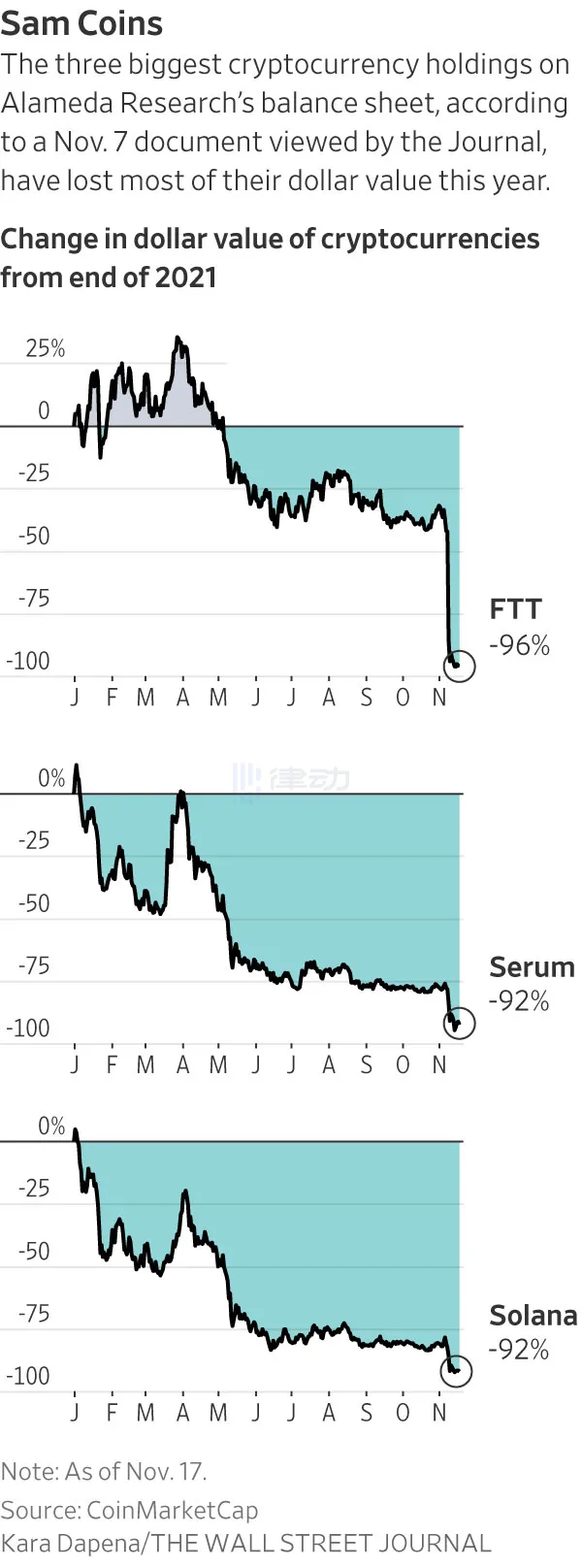
The document also lists $5 billion in SRM and $1.7 billion in SOL, sometimes referred to as the "Sam coin" due to SBF's involvement in driving these tokens. Alameda created SRM in 2020, while SOL was launched by a startup backed by Alameda, with FTX listing the token on its platform, providing credibility in the crypto market and helping boost its price, which Alameda accounts for as an asset on its balance sheet.
SBF's proudest transaction was the "saving of his own company in a time of crisis." According to sources, this summer, BlockFi held hundreds of millions of dollars worth of FTT as a loan collateral. If the borrower defaulted, the liquidation of these tokens would crash FTT; FTX then provided BlockFi with a $400 million revolving credit line to keep it operational.
A spokesperson stated, "BlockFi was not aware of or involved in any improper business conduct by FTX or its counterparties."
On June 6, as a wave of layoffs swept through the crypto industry, SBF tweeted that FTX would be "growing while others are shrinking." Sources said that later that month, FTX laid off around 20 employees, mostly in the Bahamas, without public notice, and some were asked to sign nondisclosure agreements.
Gamer at Heart
SBF began his career after leaving MIT, starting at Jane Street. For fun, he and some colleagues played mind-testing games like Bughouse chess, a version of chess where four players operate on two boards.
He founded Alameda in 2017 and later FTX in 2019. The exchange platform specializes in perpetual futures, leverage, options, and other investment methods, with U.S. regulators barring Americans from such markets that allow traders to make high-leverage bets.
After working in Hong Kong for a while, SBF and FTX relocated to the Bahamas in 2021 to take advantage of the country's crypto-friendly regulatory environment.
Locals say that on New Providence Island, there is an 80-square-mile oasis where financial elites feel like it's a small club. FTX's arrival and rapid acquisition of this property have made a big splash on the island.
Islanders express their excitement at being part of the new industrial wave. Bahamian Prime Minister Philip Davis has expressed in several public speeches his desire for FTX to help the Bahamas become a hub of the crypto world. When given the opportunity earlier this year to buy FTX equity, a Bahamian FTX employee mentioned that nearly every employee spent thousands of dollars to purchase.
According to sources, FTX has invested tens of millions of dollars in constructing residences, transforming part of a beachfront resort into an extension of the FTX domain, and the resort has opened a 24-hour restaurant for FTX employees.

Fundraising Ability
In 2021, Silicon Valley saw a surge in cryptocurrency interest. Coinbase Global Inc.'s direct listing led to the company achieving a massive $65 billion market cap after its first day of trading. According to PitchBook data, venture capitalists poured over $9 billion into cryptocurrency and blockchain startups in the first half of 2021, nearly triple the investment seen in the whole of 2020.
According to financial statements reviewed by The Wall Street Journal, FTX has never truly experienced the typical startup phase of losses, with the exchange platform generating $89.9 million in revenue and $14.4 million in operating profit in 2020, its first full year of operation. Ray, the new CEO brought in to help FTX, expressed skepticism about the company's past profitability.
Sources say that SBF personally can dictate any terms of a deal, to the extent that a venture firm recommended by SBF was told — with less than a week to decide whether to come on board — that when it asked for more information about FTX's balance sheet, FTX refused.
Potential investors note that compared to typical founders looking to cash out, SBF seems uninterested in money, often deferring to another executive, Ramnik Arora, for advice before going off to do other work.
In September, a post about FTX on Sequoia's website stated that SBF was on a call with Sequoia Capital while playing League of Legends, which was later deleted.
Overall, in just seven months, dozens of investors poured around $2 billion into his company, flocking to bet on one of the world's hottest startups.
Big Spending
SBF donated millions to the Democratic Party and funded various causes, including climate change initiatives and tropical disease treatments, immersing deeply into the effective altruism movement.
FTX made a significant investment to attract new customers, with the company agreeing last year to pay $135 million over 19 years to have its logo on the home basketball court of the Miami Heat.
This transaction seemed to elevate FTX to the top tier of US corporate, which was followed by other sponsorships including the F1 championship, a prominent international chess tournament, esports organizations, and other NBA teams.
Its ads, featuring sports stars including Tom Brady and Stephen Curry, roughly conveyed that understanding and joining the crypto world is not essential, what matters is the FTX app.
In one ad, retired Boston Red Sox slugger David Ortiz received a call while watching a game.
"Are you interested in crypto? Join FTX? Stephen and Tom are in it too?" Ortiz said, "I'm in, brother".
First Cracks Emerge
This year's cryptocurrency market downturn has sent a chill through Silicon Valley, but SBF needs more money. He aims to deploy another $1 billion to acquire struggling crypto startups and solidify control over the industry.
According to two investors who spoke with SBF, he painted a grand vision to potential investors and floated the idea of acquiring Robinhood Markets Inc.
But having made inroads in Silicon Valley, SBF turned to deep-pocketed Middle Eastern sovereign wealth funds. At last month's Saudi Future Investment Initiative, he met with officials from the Public Investment Fund and introduced them to FTX before flying to Abu Dhabi to seek investment from the emirate's wealth fund.
But he came back empty-handed.

On November 2, CoinDesk published an article detailing a copy of Alameda's financial report, revealing the first "crack" in the SBF empire, showing that Alameda's balance sheet was teeming with billions of dollars' worth of FTT and various "sam coins".
Ellison tweeted that the leaked balance sheet only reflects "a portion of our corporate entity," but the damage has been done.
The CoinDesk report caught the attention of Binance CEO CZ. Binance is a major holder of FTT, with over $500 million in FTT.
On November 6, CZ tweeted that Binance would sell its FTT holdings, a move that could lead to a significant drop in value. While many observers attributed this action to his long-standing rivalry with Bankman Fried, CZ stated that he was protecting Binance from the risk of illiquid token holdings.
Subsequently, Ellison tweeted that Alameda would be "happy to" buy all of Binance's FTT at $22 per FTT. Sources familiar with the matter indicated that Binance had reached out to her regarding this proposal but never received a response.
CZ's tweets raised questions among customers about FTX. On November 7, FTX saw withdrawals totaling around $5 billion.
If FTX managed customer funds like traditional financial institutions, it would segregate customer funds from its other business.
However, sources indicated that FTX had lent billions of dollars in customer funds to Alameda to repay its debts.
Reports suggested that FTX intended to lend customer funds to Alameda, a move that FTX questioned. In an article published on Vox on Wednesday, he criticized the "messy accounting," adding, "It wasn't until a few weeks ago that I realized the full scale of it."
With a significant withdrawal while under the cloud of hidden loans, the situation proved fatal, with SBF writing in a tweet on November 7, "FTX is fine. Assets are fine." However, behind the scenes, he was actively seeking a deep-pocketed investor to plug the hole, and the tweet has since been deleted. According to sources, he had talks with rival platforms Coinbase and Kraken, but to no avail.
Ultimately, SBF was forced to turn to his arch-rival: Binance
A source familiar with the matter said that on the evening of November 7, while CZ was preparing notes for an upcoming meeting in his Dubai office, he received a message from SBF via Signal, congratulating CZ and referring to Binance as the perfect buyer for FTX.
On the morning of November 8, SBF sent a message to his team, apologizing for the chaotic situation and thanking them for their efforts.
FTX's Senior Marketing Officer Nathaniel Whittemore said, "It's clear the game is over."
That morning, Binance announced a non-binding agreement to acquire FTX, a move that shocked investors who believed in SBF's empire and surprised his employees, the vast majority of whom were unaware of FTX's issues.
A source said that as Binance executives carefully reviewed the FTX terms, they faced a confusing mess. Furthermore, the gaps needing to be filled kept expanding: FTX initially valued itself at $20 billion, then $50 billion, and eventually over $80 billion.
It is alleged that most of FTX's lawyers quit during the negotiation process, contributing to a significant loss of staff at the company.
On November 9, SBF messaged Binance to inquire about the latest developments: "Hello, we are still very excited to work with you on this. We've seen many public articles claiming leaks, but we don't know if this is true. We'd love for you to clarify."
Three minutes later, CZ replied to FTX. "Sam, I'm sorry," he said, "We can't proceed with this deal. Too many issues. CZ."
Aftermath of the Explosion
SBF attempted to raise funds from other investors, who inquired about the whereabouts of customer funds. In a conference call on November 9, he told potential investors that FTX had accepted $16 billion worth of customer assets in various cryptocurrencies, with over half of it lent to Alameda.
According to a Wall Street Journal audio recording, SBF told prospective investors, "There's a... a thing called about an $80 billion margin position, which is quickly going to mean that we have insufficient liquid assets to cover withdrawals."
Per a source familiar with the matter, during a video call with Alameda employees on November 9, CEO Ellison apologized, admitting she had let the staff down.
The source stated that Ellison indicated that she, SBF, and two other FTX executives knew about the decision to send customer funds to Alameda, leaving many Alameda employees blindsided the next day.
A former colleague mentioned that Ellison, known for her oversized glasses and ability to connect with like-minded individuals, would often become quiet and could be overshadowed by louder, more confident peers, especially SBF, in high-pressure trading situations.
On November 10, the Wall Street Journal reported that FTX used client funds to support Alameda. The crypto community heavily criticized SBF, dubbing him "Scam Bankrun-Fraud" on social media.
"I'm really struggling to control my anger," tweeted Kraken CEO Powell. "This isn't a case of setting too ambitious a goal and making a mistake; this is recklessness, greed, selfishness, hubris, antisocial behavior that risks decades of hard-won progress in this industry for personal gain, even though he was already very rich."
The following day, FTX filed for bankruptcy.
FTX's collapse sent shockwaves through the crypto world. BlockFi halted withdrawals on November 10 and prepared for bankruptcy. Cryptocurrency lending platform Genesis, which paused withdrawals on November 16, stated in a tweet that they had hired advisors and were exploring all possible solutions.
Shortly before filing for bankruptcy, FTX hired a Bahamian security firm to guard its headquarters. Upon news of this, most non-local FTX employees left the island, with security finding them protecting a ghost town.
SBF and the remaining batch of employees attempted over the weekend to raise funds to cover FTX's $8 billion shortfall and repay customers.
Restaurant staff said that prior to the company's collapse, FTX employees were regulars at Island Brothers, a high-end French bistro particularly close to FTX. The owner got to know them when SBF's father dropped by to visit his son—Stanford tax law scholar Joseph Bankman.
During last week's collapse of FTX, a despondent SBF came to Island Brothers bistro, exchanged pleasantries, and then broke down in tears.
Welcome to join the official BlockBeats community:
Telegram Subscription Group: https://t.me/theblockbeats
Telegram Discussion Group: https://t.me/BlockBeats_App
Official Twitter Account: https://twitter.com/BlockBeatsAsia