How can Developers Protect Themselves: Evaluating the Top 5 Anonymous Privacy Solutions

Title: How to Protect Yourself: An Overview of Web 3 Privacy Solutions
原文来源: Arcane Labs
• Tornado Cash raises questions about whether developers who contribute to agreements should be held accountable for users who abuse them.
• On-chain privacy is particularly important in the absence of clear guidance for developers and their open source code
• This guide Outlines some of the existing and upcoming privacy chains as options for privacy conscious developers to safely deploy
No developer wants to go to jail for a few lines of code, but that's what happened to Alexey Pertsev. As a significant contributor to Tornado Cash, Alexey Pertsev is suspected by the U.S. government of helping bad actors Money Laundry through the Ethereum Dapp Tornado Cash. The drama has sparked a backlash around the world, with critics also pointing out that developers have no control over how users use their code.
While the story may be more convoluted than it appears, it has sparked debate about on-chain privacy. The arrest of Alexey Pertsev for writing code sets a dangerous precedent and threatens the future contribution of developers to open source software. Who wants to be responsible for the users of their code when they can't control their behavior?
Blockchain's community culture preaches openness, but that doesn't apply to data security and privacy. In some cases, full transparency is not necessary (see @GeneralRinaker's article).
This article evaluates some of the existing and upcoming privacy solutions designed to maintain some anonymity for Web 3 developers.
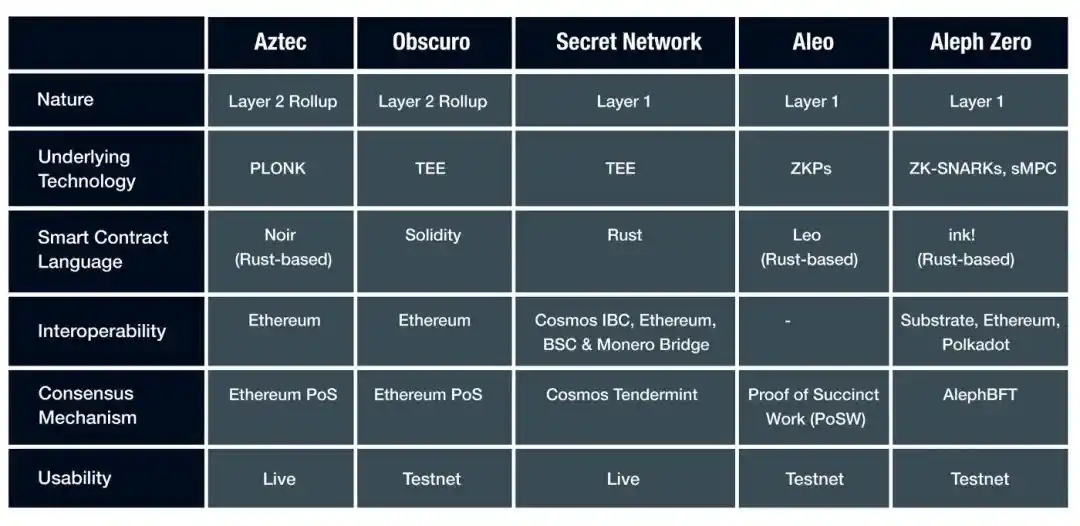
#1 Aztec Network
Aztec is the first Layer2 privacy chain (privacy layer) on Ethereum to use zero-knowledge proof. Smart contracts run on the Aztec chain to keep assets private. Users can guarantee the privacy of on-chain behavior while trading, pledging and making profits, and enjoy low transaction fees at the same time.
Chain: Ethereum
Status: The main network is running
Underlying technology: PLONK, a two-layer transaction processing system developed by zk-SNARK standard
Architecture: Double SNARKS. The first layer is a privacy circuit, which verifies each transaction while keeping the sender, receiver and transaction assets private. The second layer is the rollup circuit, which packages all transactions and uploads encrypted transaction information to Layer1 in bulk
Github: https://github.com/AztecProtocol
Main Application Scenarios
With the Aztec Connect Privacy Bridge, users can interact directly with Layer1's DeFi application in the Layer2 privacy chain. Dapps on Layer1 can reference Aztec Connect's SDK to the protocol to profit from private transactions, such as zk.Money. As Aztec's main product, Aztec Connect allows users to conduct private transactions using ETH and DAI. Aztec Connect has about 255,000 transactions as of this writing.
progress
The team is now working on adding custom smart contract capabilities to its network. Smart contracts will be written in Noir, a Rust-based language specifically for Aztec networks. The project is currently in a test network and is scheduled to be completed by the end of 2022.
assessment
Aztec can make all ERC-20 assets private, making it an important application scenario for Ethereum. Given how active Ethereum is already, it's easier to reach more users by keeping existing assets private than by creating a separate privacy chain. Based on this, Aztec could develop into an indispensable privacy layer for Ethereum in the future.
#2 Obscuro
Another Layer2 privacy solution for Ethernet, Obscuro is designed to optimally handle MEV issues while maintaining the privacy of transaction and contract status. Because of its dual use of Optimistic and zero-knowledge proof, Obscuro claims to be "the optimal solution between Optimistic and zero-knowledge proof."
Chain: Ethereum
Status: Test network
Underlying technology: Intel SGX technology runs EVM on TEE hardware. It is essentially a black box in the CPU where the user can perform fully private calculations.
Architecture: The Obscuro network has two kinds of nodes. Aggregators are responsible for verifying all encrypted transactions, packaging them and sending them back to Ethereum. Verifiers perform similar duties, but are verified on a hardware-based basis and operate outside the Aggregators network. Having both types of nodes makes the Obscuro platform more decentralized and secure.
Github:https://github.com/obscuronet
Main Application Scenarios
As Obscuro is still in the testing phase, there are no products to introduce. However, the platform offers many possible application scenarios, including DeFi Privacy and Web 3 strategy games.
Obscuro is one of the few privacy solutions that allows developers to develop smart contracts using Solidity. Solidity is known to have a higher usage rate among Web 3 developers than Rust. In contrast, the other solutions mentioned in this article are primarily based on the rust language.
progress
Mainnet rollout is expected in 2023.
assessment
There is huge potential and room for growth in Solidity language-based Obscuro. Developers can easily run Mainnet smart contracts on the Obscuro platform. In addition, many core ecological applications are EVM-compatible, giving Obscuro a significant advantage over other Rust-based projects, but it remains to be seen how much it will need to change smart contracts.
#3 Secret Network
As the OG in the industry, Secret Network was launched in September 2020 and is called the first network with privacy smart contract at Layer1 level. A Secret Network built in Cosmos Tendermint SDK with smart contracts written in Rust via the CosmWasm tool package.
Chain: Cosmos IBC, Ethereum, Binance and Monero Bridges
Status: The main network is running
Underlying technology: Like Obscuro, Secret Network uses Intel SGX for computing on TEE. The protocol code is divided into two parts: the trusted part (sensitive information) and the untrusted part (the rest of the code).
Architecture: Currently, a group of 50 verifiers uses the Tendermint Consensus Engine, a BFT-based proof-of-interest mechanism, to secure the network. The verifier is responsible for verifying the transaction and proposing blocks on the chain via the pledged SCRT, earning revenue in the process. Authorization is issued by a non-verifier.
Github:https://github.com/scrtlabs
Main Application Scenarios
Secret Network currently has a rich ecosystem, covering more than 20 DApps and more than 100 developers. As the Cosmos Tendermint SDK project, the chain can interoperate with other parts of the Cosmos ecosystem, especially after implementing IBC. Essentially, the Secret Network allows the entire Cosmos IBC ecosystem to be equipped with privacy capabilities.
Because there are enough files and tools around the Cosmos development framework, the Secret Network is relatively friendly to Web 3 developers.
progress
Development of Secret 2.0 is ongoing. Developers are working on key improvements, including using FHE and hardening existing networks.
assessment
The team has clearly put effort into developing the network. Functional products in the ecosystem are growing, and community participation is growing. What's more, due to the influence of regulators, complete privacy does not apply in every situation. It seems that Secret Network has found a balance between satisfying supervision and ensuring user privacy to a certain extent. SCRT Token is completely open and transparent, but trading activities involving platforms and contracts are completely hidden. This value proposition cannot be ignored in an increasingly stringent regulatory environment.
#4 Aleo
Based on recent developments in ZK cryptography, Aleo is described as the first decentralized, open source protocol. Aleo allows private and programmable applications. Users can allow third parties, including smart contracts, to verify the data without disclosing the transaction information, while allowing users to choose to disclose some of the information at different levels of the transaction. This is useful for interaction and building between composable DApps to create broader ecosystems.
Chain: Aleo
Status: Test network
Underlying technology: The platform's consensus mechanism is PoSW, which means that each transaction in a block generates a ZK certificate, derived from the Bitcoin SHA algorithm. However, unlike an arbitrary hash function, the underlying computation is done via PoW. Essentially, it allows the user to verify the state with minimal computational power.
Architecture: Aleo combines Ethereum's programmability and account model with Zcash's private transaction design for complete on-chain privacy.
Github:https://github.com/AleoHQ
Main Application Scenarios
Aleo provides a DSL called Leo to privacy contracts. Inspired by Rust, Leo was primarily used to develop privacy applications and merge ZK lines. Although it is a proprietary language, its developer documentation is comprehensive, concise and clear.
Other developer tools include Aleo Studio, Aleo Package Manager, and Aleo Explorer.
progress
Aleo Version 3 Beta Network was gradually opened in three phases. This month, validators (with 10 million Aleo credits) can start making blocks and collecting revenue. The project will move the consensus mechanism to AleoBFT to prevent centralized blocking.
assessment
The progress of the project has made breakthroughs in stages. Now that the testnet is running a full programmable language, it has also set up a studio to help with ecological development. The Aleo team promises to launch more products and services in the future to help developers build a decentralized network within the ecosystem and bring great experience to developers.
#5 Aleph Zero
The final project is also relatively new to the industry -- Aleph Zero. Built on Polkadot's Substrate technology and based on a peer review consensus protocol, Aleph Zero claims to provide instant clearing, speed, as well as scalability and security. Once fully launched, the network's privacy framework will eventually be available on all major chains.
Chain: Substrate, Ethereum, Boca
Status: Test network
Underlying technology: The project has a unique solution for privacy contracts, combining zero-knowledge proof and sMPC. ZK-SNARKS are used to exchange a user's secure and hidden key. sMPCs are responsible for protecting data between different computers, which need to agree on permission before they can access the data.
Architecture: Aleph Zero's custom algorithm combines PoS variants with DAG technology. The PoS consensus mechanism verifies the state of the block through rotating verifiers. Using DAG as an intermediate data layer, it allows for faster transaction speeds and higher throughput, fundamentally reducing transaction costs.
Github:https://github.com/aleph-zero-foundation
Main Application Scenarios
The first product on Aleph Zero is Common, a decentralized trading platform with its own wallet, and a decentralized dark pool to prevent a jump start. A false start occurs when a user, knowing from inside information that a future trade will affect the price, places a trade in a queue for arbitrage.
progress
Aleph Zero is developing a multi-chain privacy solution called Liminal. It will provide innovative security measures based on a combination of ZK-SNARKS and sMPC. Second, over the bridge, Liminal supports transactions between Aleph Zero and other chains such as Ethereum, Near, Cosmos, and BSC. Developers can write smart contracts on these chains while keeping them private on Aleph Zero.
assessment
Substrate itself's growing developer community and interoperable system were a major factor in Aleph Zero's success. The core team's own experience and its partners are also factors in Aleph Zero's future success. In addition, the ease of operation of the protocol itself will attract more merchants and users to join its ecosystem.
# outlook
The privacy chain, both methodological and mechanistic, is centered on whether developers can choose to conduct private transactions. In the privacy track, innovation brought by homogenized competition will promote the birth of new projects and the iteration of existing projects. Web 3 developers should have the option to maintain some level of privacy that empowers them to write code that pushes boundaries and drives blockchain innovation.
The original link
Welcome to join the official BlockBeats community:
Telegram Subscription Group: https://t.me/theblockbeats
Telegram Discussion Group: https://t.me/BlockBeats_App
Official Twitter Account: https://twitter.com/BlockBeatsAsia