a16z: What are the obstacles on the road to compliance

原文标题:《 Regulate Web3 Apps, Not Protocols 》
Original source: a16z Crypto
原文作者:Miles Jennings
Kxp, BlockBeats
Many of the Internet's early supporters hoped it would remain open forever, a borderless, unregulated tool for all humanity. In the past 20 years, however, the authorities have cracked down on all sorts of bad behaviour, undermining some of that optimism. Still, most of the underlying protocols of the Internet, such as HTTP (Web site data exchange protocol), SMTP (E-mail protocol) and FTP (file transfer protocol), remain as free and open as ever.
In order to maintain people's good vision, the world authorities have reached a consensus that Internet technology needs open source, decentralized, autonomous and standardized protocols. The passage of the 1992 Science and Advanced Technology Act in the United States laid a solid foundation for the commercial Internet to flourish without tampering with the computer networking protocol TCP/IP. The Telecommunications Act passed by the US Congress in 1996 further clarified the legal framework of the Internet on the basis of the continuation of the data transmission mode, so that the US authority and Alphabet, Amazon, Apple, Facebook and other Internet giants enjoy the same say and jointly dominate the Internet economy. While there is no perfect legislation in the world, established laws can still guide the development of industry and innovation, creating many of the Internet services we enjoy today.
In a traditional network environment, the authority does not change the underlying protocols, but rather regulates the applications that people use to access the network, such as browsers, websites, and other user-facing "client" applications. In my opinion, this principle applies to Web3 as well. It is another evolution of the Internet, creating new applications and clients, such as WebApps and online wallets, as well as advanced decentralized protocols, including a value exchange and settlement layer made possible by blockchain and smart contracts. The question we should be thinking about today is not whether Web3 needs to be regulated, as it is clearly necessary and justified, but where on the Web3 technology stack should we regulate it to make the most sense.
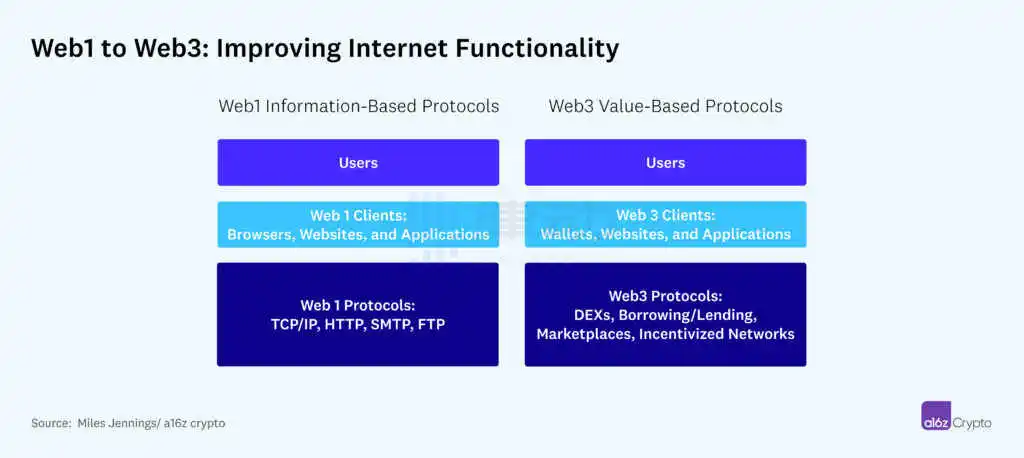
Today, the process of using the Web, from the Internet service providers used to connect to the web to the browsers, websites and applications used to access information, is governed by policies, and most of them rely on open protocols. Authorities can optimize people's web experience by restricting access to content or requiring them to comply with privacy rules and copyright revoking requests. That's why the U.S. can force YouTube to take down terrorist recruitment videos, but leave DASH (a video streaming protocol) alone.
Regulation at the agreement level is neither desirable nor feasible for a number of reasons. First, from a technical point of view, it is impossible for agreements to comply with regulations because the process usually involves a lot of subjective judgments that are difficult to define. Second, it is difficult to have a uniform agreement, because different jurisdictions will set up different regulations and may conflict with each other. Finally, rewriting the technical foundation of the network is unnecessary or even counterproductive, given that applications and clients can comply with higher level technical specifications.
I will further analyze the above three reasons as follows:
The agreement cannot comply with subjective laws and regulations on the technical level
No matter how well intentioned a regulation is, as long as it involves subjective judgment, it is difficult for agreements to comply.
For example, although we all hate spam, if the authorities rule that the E-mail protocol (SMTP) cannot support the sending of spam, then the network environment may be worse instead. That's because the definition of spam itself is so subjective and can change over time. Big companies like Google spend billions of dollars on spam removal, but they still make mistakes. Moreover, even if some authorities require SMTP to filter spam by default, due to the open source nature of the protocol, some malicious actors can still circumvent the restrictions of the filter with a number of operations. So blocking spam via SMTP would not only be a drop in the bucket, but it would also potentially upend current email protocols.
In Web3, the tokens in the Decentralized Exchange Protocol (DEX) are very similar to the E-mail mentioned above. If authorities identify certain tokens as securities or derivatives and want to prohibit users from using this protocol to exchange these tokens, they need to make a clear definition of these tokens so that they objectively fit into the above classification. However, such objective classification criteria do not exist because determining whether an asset is a security or a derivative relies on subjective judgment and requires an artificial analysis of the relevant facts and law. Even America's Securities and Exchange Commission is having a hard time solving this problem.
In my opinion, embedding second-order subjective analysis into the base layer instruction set is futile. Like SMTP, a decentralized autonomous protocol like DEX cannot conduct subjective analysis without human intervention, so the protocol cannot achieve true decentralization and autonomy. Thus, such a rule would mean the end of DEX, a new field of technological innovation, and the entire Web3 ecosystem.
It is difficult for the protocol to conform to the global uniform specification in practical application
Even if we overcome the technical hurdles and build protocols that make complex and subjective judgments, it will be difficult to apply them on a global scale.
SMTP allows us to send email to anyone in the world, but if the United States requires SMTP to filter spam, then other foreign authorities might set similar restrictions. However, since the definition of spam requires subjective judgment, these authorities will differ in their specific requirements. So even if we have the technical ability to design protocols that can make complex and subjective decisions, that doesn't mean we can create universal standards. There is simply no way that SMTP can incorporate the changing spam filter requirements of 195 countries, and even if it could, it would have no idea which country a user lives in and how to fairly prioritise various criteria. Standardization is the solid foundation of agreement, and the addition of subjectivity will only destroy it.
In Web3, each country has different laws regarding securities and derivatives, and these laws are constantly changing. DEX cannot establish a uniform global standard for these laws, and, like SMTP, it cannot restrict access by geography. So an agreement cannot succeed if it is based only on changing global regulation.
Applications and clients should be the subject of regulations to avoid the above problems
Clearly, policing the application is more critical than policing the protocol. Application level oversight, which can achieve the goal of authority without compromising the underlying technology, is starting to work.
Early network protocols are still useful more than 30 years later because they remain open source, decentralized, autonomous, and standardized. But today's authorities can regulate the flow of information through protocols by regulating apps and protecting the free flow of information, as Section 230 of the Communications Decency Act of 1996 did. Each country can adopt its own approach, and companies operating browsers, websites and apps in each jurisdiction can adapt their products to comply.
The same unity of opposition between protocol and application exists in Web3, so our approach to Web3 oversight should remain the same. Users can deposit digital assets into the liquidity pool of lending and lending agreements through Web3 applications such as wallet and Webapp, purchase NFTS through market agreements, and trade assets on DEX.
Web1 provides us with many useful tools for network connectivity, data exchange, E-mail, and file transfer protocols, all of which enable high-speed information transfer over the Internet; Web3 helps to deliver value efficiently on the Internet, and lending and asset exchange have become its native functions. Obviously, this is a good thing for all of us, so we must give it our full support. As Web3 gradually expands beyond DeFi to video games, social media, the creative economy, and the gig economy, we need regulations for these areas as well to level the playing field. After weighing all the pros and cons, the right approach is clear -- regulatory application, not protocol.
The original link
Welcome to join the official BlockBeats community:
Telegram Subscription Group: https://t.me/theblockbeats
Telegram Discussion Group: https://t.me/BlockBeats_App
Official Twitter Account: https://twitter.com/BlockBeatsAsia

 Related Articles