VC's views and suggestions on 11 types of NFT start-ups
Original title: "Crypto Gaming and NFTs: A Nuanced Perspective"
Original author: Richard Kim, partner of Galaxy Interactive
Original compilation: Kxp, BlockBeats

As early as 2018, we decided to invest in chain games uniquely, because in our opinion, Crypto will become an accelerated open economy in the virtual world. The base layer for mass adoption in the world.
Now it seems that investing in chain games in 2018 is indeed a good choice. The world's top consulting firms predict that by 2030, chain games will have a market value of 5-15 trillion U.S. dollars in the metaverse market. Although the market was generally not optimistic about chain games in 2018, it has achieved vigorous development now.
Even today, even though some people still oppose blockchain games, Axie Infinity will be The rise of is enough to change the minds of many people. The success of this game marked the first breakthrough for chain games, and since then investors have not hesitated to invest in this field.
As Token projects become more and more popular, former DeFi investors have also poured into the chain In the game market, those large funds that recognized the blockchain back then have almost invested all their money in the game market.
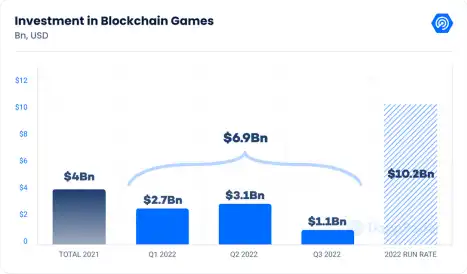
Delphi, since 2021, chain games have received 130 investments totaling approximately US$5 billion. As the scope of blockchain games continues to expand, DappRadar x BGA believes that this number It could also reach $11 billion. That's a lot of money for an area that hasn't yet made profound sense in the minds of mainstream gamers.

Howard Marks wrote to investors in 1993 : "The problem is that extraordinary performance comes only from correct non-consensus forecasts, and non-consensus forecasts are very difficult to be both accurate and easy to implement."
While there will be a lot of hype surrounding chain games during 2021 and 2022, we have been doing our best to avoid hype. Amid all the criticism, we've partnered with many talented entrepreneurs to advance the space while addressing key issues of sustainable economics, high valuations, inexperienced teams, and structure and governance:
Sustainability:In the past two years, sustainable Sex has never received enough attention, and speculation has become the main economic activity in the market. We have neither explored viable ways to retain players nor designed a fund pool that can absorb token supply. Integrating speculators/whales into the gaming experience without disrupting the gaming experience of other players is a design paradigm that the market has yet to crack. We think there are a lot of lessons to be learned from Web2 open economy games like EVE Online, and from China's "SLG" (Life Simulation Game). Only those who can retain players in Web2 and actively experiment with Web3 primitives while retaining design flexibility will be able to achieve real success.
Valuation: In the past two years, Token pricing More like an option pricing model than a question of fundamental investment analysis: lock-up periods, liquidity depth, and narrative heat of Token opportunities (“option terms and volatility”) need to be compared to spot discounts or expected market caps for listing (“option terms and volatility”) Option Price") to trade off. More important than fundamentals or fully diluted valuations (FDV) in the interim is whether investors can get out of speculation first. Due to the above factors, some products can even reach hundreds of millions of dollars in pre-launch valuations, and some generation tokens, such as Illuvium, have reached a fully diluted valuation, exceeding the price Bethesda sold to Microsoft.
·Team experience:The biggest risk of game investment is not related to a certain It is not whether the game will be successful, but whether the studio can finally release a game. Many Crypto investors are now realizing that they are actually investing in a blockchain game SPAC (Special Purpose Acquisition Company) rather than an actual game studio. That said, now is a great time to be an outsourced studio.
·Structure and Supervision:About the actual Rights, there are still some fundamental problems. Most chain games will continue to produce legal currency, but Token holders cannot legally obtain these benefits. It is difficult for a studio to distribute economic benefits to token holders without violating securities laws. However, the reason why Crypto investors only want tokens is that they provide a shorter term of liquidity (1 to 3 years) than the risk period of equity (7 to 10 years), although this also leads to severe imbalances in the funding market. Obviously, if virtual currency only accounts for 1-5% of personal game revenue, then its valuation should not reach 1-5 times personal assets.
Although these issues have not been resolved, we have seen some hope that investors may Turn your attention to experienced publishers and entrepreneurs in this field. The ability and experience of the chain game development team have been significantly improved, and its valuation has also dropped to a more reasonable level. Starting in Q3 2022, only seasoned founders and publisher spin-off studios will be able to raise funds at the fully diluted value of the Token, rather than $300 million+ fully diluted valuations from inexperienced studios value (first quarter/second quarter of 2022) to buy Token. By September 2022, with the issuance of stock + Token warrants becoming the norm, and the valuation generally does not exceed 100 million US dollars, public offerings of only Token are rare. While valuations for popular projects are still high, we believe there are plenty of opportunities for experienced developers to build Web3 games that are meaningful to the mainstream market.
We should not only design more interesting game content for players, but also promote the possibility of an open economy Continue to develop and gradually expand to the mainstream market while integrating with Crypto. In addition, we also need to ensure the flexibility of investment strategies in digital collectibles (NFT), Token and equity.
In our view, virtual currencies can be continuously generated without being considered securities Economic Value. However, this is a fine line, and the economic potential of tokens may be better realized if tokens are rewarded for participating in games rather than being sold as bonds. The key is to achieve coordination between equity holders and token holders to implement flexible strategies without liquidity pressure. We want to create a digital co-op:
The benefits of creating a digital co-op for Web3 are that it has (i) a transparent governance structure; (ii) an ecosystem that incentivizes creators and developers, and (iii) an efficient means of value exchange through digital collectibles.
·Transparent governance structure:By formulating a series of Guidelines, it will be difficult for developers to unilaterally change the rules of the system. Transparent governance plays an important role in the game experience and facilitating open world activities.
Creator/Developer Incentive Ecosystem: Create mechanisms to reward contributors. The role of an open world game developer will change from a closed-loop designer to an initial contributor to an open ecosystem.
· Value exchange in digital collections: Based on status, NFT will provide corresponding services according to the game environment and social structure.
Different from the traditional Crypto theory, we believe that those experienced teams from Web2 game companies (Startup founders and publishers) will have a competitive advantage over "Crypto native" teams who have never run a game studio. In the blog post above, we used Nexon's development of Web3 MapleStory as a case study. Oddly enough, while we are bullish on companies that have already made it in Web2, there is no consensus with all parties. We believe experience, patience and an open mind will all be needed in the transition to an open economic game.
Ultimately, we set our North Star metrics to be: Engagement, Community, and Agency. Interactivity is a product of the gaming experience, community represents the depth of the relationships we form, and agency implies our self-sovereignty to express ourselves. Crypto has the ability to greatly improve the virtual game experience in these aspects, provided that developers can handle the balance between game consumption and game experience.
But what we need to think about is whether Crypto is "necessary" in order to achieve all these goals? Clearly, Crypto isn't the only or best way to bring games to market. Instead, the real power of Crypto lies in its ability to incentivize community participation in the creation, curation, and transaction of virtual worlds in an open-source manner. Regardless of your opinion on blockchain games today, we should all support this trend.
In-depth exploration: the ecosystem of NFT start-ups
Of the 1930 Crypto projects we recently learned about, most have raised venture capital. We have conducted in-depth research for several days in the subdivisions of GameFi, music, NFT and DAO, and would like to summarize some overall situations below.
At a high level, we believe that Crypto investors need to carefully study the "Baseline Growth Rate". Michael Mauboussin has done an in-depth analysis of this, laying the theoretical foundation for investment decision-making. Although Web3 is still in its early stages, after analyzing the competition, it is not difficult to judge the future performance of the companies you invest in.
In this study, we first focus on the NFT entrepreneurial ecosystem. It’s safe to say that there are now a lot of startups entering the NFT space.

< /p>
We categorized 317 NFT startups and attached some of our thoughts. In my opinion, the NFT space is already very crowded, and it has received sufficient funding relative to the size of its TAM. We are very optimistic about the GMV that NFT and Token will generate in the content ecosystem, but we are still cautious about the TAM of the NFT market infrastructure. Most start-ups make minor variations on the same building blocks.
This is why we prefer to spend our energy on "Web2.25" (Web2 is more advanced than Web3 Difficult to achieve) consumer companies, these companies are better at Web2 construction (let consumers pay attention to your content and the status of virtual goods in the community), they use NFT and Token to add value to the things consumers care about, Instead of purely building NFT infrastructure. However, venture capital firms may prefer this type of underlying technology because they believe that "content is a hotspot-oriented business" and there is quite fierce price competition.
Not much to say, let me summarize the main categories of common NFT start-ups:
p>
White List Providers
Functionality:
·Distribute NFTs to its participants in a provably random manner
· Curate whitelists based on real-world identities
Members can mint NFTs before public sale
Set up community threshold mechanisms (e.g. Discord for NFT holders)
Observations:
These companies tend to focus on providing a specific service rather than achieving scale.
Automated Market Maker (AMM)
Function:
By concentrating the long-tail liquidity on the bottom NFT (a certain series The cheapest NFT in the world, with no features or rarity multipliers), endows NFT with homogeneous properties
Allows NFT holders to provide liquidity in automated market making (AMM) pools Earn passive income as a trader and earn spreads
Compete for floor prices on exchange fees and royalties
< /p>
Observations:
In general, same as DeFi , many projects hope to bring liquidity to long-tail NFT projects by concentrating the "floor price" (lowest quotation) of popular NFT series, which is usually achieved through a mechanism similar to futures contracts, that is, people can deliver A specified "minimum delivery price" asset to settle a futures contract.
Sudoswap introduces some interesting innovations to on-chain order books (see end of article for details Content overview)
Although this has a certain share in the PFP transaction market (introduction picture NFT, such as Bored Ape Yacht Club), but I doubt that these NFT AMM platforms can achieve scale growth, mainly because the underlying collateral cannot maintain the scale of transaction volume. It should be noted that a considerable number of NFT transactions today are wash transactions for the purpose of earning native Tokens in the market (even reaching 80-95% of the platform's transaction volume)
More importantly, Web3 game designers should study the innovative development of these markets in depth and incorporate them into their own internal markets. For example, if you want to analyze the cost and benefit of an AMM pool, you need to analyze it from two aspects: treasury management (to support liquidity mining rewards and exchange listing fees) and player attention (extrinsic motivation is often greater than intrinsic motivation) Weigh the benefits and costs of liquidity.
Game projects should provide regular price discovery mechanisms (similar to what the U.S. Treasury Department does with national debt reverse Dutch auction), rather than worrying about whether a central limit order book can provide continuous liquidity.
Analytics Service Provider
· Analyze and summarize the social network and on-chain activities of NFT project collectors, and make a unified Profile
· Score user behavior and target advertising
· Provide alerts, analysis, market data and execution modules for traders
· Serving as a recommendation engine and discovery platform
Observations:
This type of enterprise is often well-funded and has a large number, and they are all providing similar services.
Among these, analysis tools such as Nansen do provide professional traders with Great help, but in fact the vast majority of analysis services are not worth buying.
The minting warnings they provide do have some effect, but those for Ponzi-like schemes The warnings of the high-frequency PFP trading game have largely been drowned out by the noise.
As the gaming and NFT ecosystem matures, the market will need a "Bloomberg for NFT transactions" , and the willingness of consumers to pay for advanced tools/industry analysis will become stronger than ever. I believe that various platforms will be subdivided into different fields, such as games, art, music, photography, etc., and there will not be only one winner in the market.
Quantitative analysis combined with qualitative planning by trusted community members will, in some contexts, It will play a powerful role in the context of the game - such as generative art, and it may be the first way to participate in Web3 social (this will be a Web2 social community based on Web3 collection games).
Evaluation Service Provider
Function:
Scarcity according to characteristics Identify undervalued NFTs
Provide evaluation services for lending platforms
Observation:
As collectors, we usually do not use NFT valuation services. A lot of startups are trying to provide these services, but until a truly useful product emerges, there will always be an oversupply of these services. No lending company will rely on the valuation of NFT evaluation services, they will pay more attention to transaction volume, liquidity depth and minimum quotation.
The quotation space of NFT is very large, and the value of a person's collection depends entirely on his location market, making mid-market valuation services impractical.
Some protocols have developed extreme Token economic incentives to encourage NFT market bidding, but I suspect that these measures may not be useful except to achieve player size in specific situations, such as Harberger's land value tax.
Instalment Payment Service Provider
Function:
Allow buyers to purchase NFT in installments, the first payment is generally set at 25% of the NFT purchase price %
Observation results:
Essentially, this is a secured loan against the value of the payment. The risk is greatest at the beginning of the loan, and if the value of the NFT falls by more than 25%, the lender is exposed to the unsecured market risk of the borrower defaulting on future payments. We don't think lenders will be willing to take this risk for most NFT assets, and until the LTV ratio drops below 50%, the size of the market will not be very large.
For game developers, this could be a way to extend credit to potential NFT buyers interesting method. Since the game developer acts as a "vault", it can naturally return any defaulted game assets to the developer without any loss, and prepaid insurance premiums as compensation.
Creative Studio
Function:
Help brands create NFT's Full Service Agency
·Community as Service Platform
·Digital Architect
Observation Result:
Although large third-party creative studios can be profitable, but Given its agency role, its upside is also limited. Overall, the market opportunity for most agencies will dwindle—many brands will begin to in-house produce their digital collections rather than relying on third parties, while others will work with multiple third parties at the same time. Three-party studio cooperation. Changes in market structure will make venture capital investment in this space more difficult.
We believe that certain studios starting out in the third party agency business will be well positioned to Because of their ability to create successful first-party NFT communities. For example, some digital fashion creation studios have partnered with luxury brands to combine high-value NFTs with fashion (D&G x UNXD NFT sales reached $30 million).
NFT Derivatives Provider
Function:
NFT Series Synthetic Asset Trading (With or Without Leverage)
· NFT Options
· NFT Loan Bundled Credit Default Swap Transaction
· Containing Token Rights and Interests Qualitative Token (used to facilitate the transaction of unattributed Token)
Observation results:
Dave White wrote an article about floor-price synthetic NFT transactions, a topic many projects are trying to build around. The biggest problem with all of these projects, though, is that the underlying assets are often not liquid enough to create a continuous market to which market makers are willing to provide liquidity. In the case of users raising leverage, once the NFT transaction is out of touch, the credit risk of the exchange will increase significantly.
Although there are many startups trying to build an NFT options market, there is still a long way to go some distance. It's hard for me to see, and I don't think a liquid two-way market (similar to the one Deribit has developed for Crypto large holders) will serve the development of NFTs given the difference in the liquidity dynamics of the underlying assets.
In theory, the use of credit default swaps (CDS) in NFT loan portfolios Nice idea, but in practice it doesn't work because of the risk of collusion between lenders and buyers of loan portfolio insurance.
We should further optimize the Token release and distribution process, and gradually convert the unreleased Token rights It is the released Token. If the unreleased tokens can be used on-chain as a "semi-homogeneous token" tool (interchangeable with other tokens released on the same date), then it is likely that these remaining token rights will develop an active trading market.
Ownership Allocation Service Provider
Function:
According to SPV for Distribution of ownership of NFT
· Defining social ownership of artwork and digital collectibles
Observations:
We do not believe that a one-time SPV structure can make a group of strangers willing to share a high Value NFT ownership, because their collection experience in this model will be greatly reduced. While this mechanism works well for for-profit commodities and collectibles (eg, securitized blue-chip art), we still don't think NFTs today can support this type of collection.
However, we believe in the power of social ownership in small groups because members understand each other, and engaged in many interactions. For example, some of our partners are collectives of less than 100 collectors who join forces to collect blue-chip art on the Tezos chain, and their art discovery and curation experience is no different from that of individual collections. Additionally, digital artwork, unlike actual artwork, does not have to be owned by one person, allowing everyone in the group to display the same digital artwork without fear.
So far, NFT artwork has been the trump card use case of social ownership, but with the integration With the development of tools, players will have more and more access to jointly owned virtual items, so their status is likely to be replaced by game guilds in the future.
We don't think the future will be dominated by the current "big game guilds", but we are satisfied "Two-pizza principle" micro-guilds may develop, which already have a certain advantage in a specific game category.
Infrastructure Providers
< br>
Function:
· Backup scheme for NFT media files
· NFT wallet and credit card processing
· Game-oriented NFT Creation SDK for Developers
KYC/AML for NFT Issuers
Blockchain Scalability
Observations:
For a In a field that prides itself on decentralization, after you have been in the NFT market long enough, you will gradually realize how centralized the market structure actually is.
Earlier this year, Moxie Marlinspike wrote on his blog "My First Impressions of Web3" Some realities were stated in , which caused quite a stir in the NFT community.
These realities present opportunities for infrastructure providers to Connect under the hood to provide game developers with integrated payment, wallet and SDK solutions.
There is a big misunderstanding about NFT, they think that the media is stored on the chain. With the exception of certain on-chain NFTs (10% of NFTs), metadata associated with NFTs is typically stored on centralized servers (40% of NFTs) or IPFS (50% of NFTs), and thus associated with these NFTs of media are at risk of loss, which illustrates the importance of backing up your personal NFT collection.
Institutions should consider many factors when issuing Token or NFT, and these complex factors are also Providers of consulting, compliance and licensing services create opportunities. Questions they need to think about include:
According to local laws, Token belongs to a class of "securities" ?
· Does a particular NFT airdrop violate gambling or loot box regulations?
· Is an NFT marketplace for a game compliant with the App Store or platform?
· Can Token/NFT be bought/sold by the Ministry of Finance without involving market manipulation issues?
How to deal with intellectual property issues related to NFT (especially user-generated content)?
· Do issuers of virtual currencies need to conduct KYC and transaction monitoring of asset flows in their economy and integrate compliance monitoring solutions?
Marketplace and Aggregator Providers
Function:
Chain Opensea for X
· Best Execution Aggregator Across Multiple Markets
· Zero Royalty Trading Marketplace
· Market Segments for Specific Groups ( e.g. photography, generative art)
Software development tools that provide market functionality in games
Observations:
NFT marketplace platforms are the most profitable in the entire NFT space, and everyone wants to create "The Next OpenSea".
Many people in the NFT market have tried to take a share from Opensea, and have launched Tokens one after another Incentives, low fees, and zero royalties. (Note: The execution of royalties has always been in accordance with market practice, not the provisions of smart contracts)
Competition among other marketplace platforms is based on special execution agreements that emphasize liquidity pooling mechanisms based on floor prices. While these marketplaces have had some success in taking market share away from Opensea, their trading volumes are generally difficult to sustain (e.g. LooksRare/X2Y2).
The key to the success of a market platform is whether it can find other reliable investors besides speculators Sources of liquidity – for example, in game worlds where players are encouraged to buy/sell virtual goods in specific social contexts.
Professional market makers cannot participate in providing "long tail liquidity", so we must put Turn our attention to market makers in the player community, and we cannot concentrate liquidity in "homogeneous" NFTs.
In theory, the Token model of the market platform is very convincing (a certain percentage of market fees return to Token holders, or implement a repurchase/burn mechanism), but it may also raise concerns about market manipulation and legal concerns.
Over time, some details that are closely integrated with the social situation or collection activities in the game The sub-market will take a certain market share of Opensea.
Lending Service Provider
Function:
· Guaranteed loans, namely Borrowers can apply for loans from mortgage lenders at a minimum loan interest rate of 25%-75%, and the annual interest rate is usually between 15%-75%.
· Pricing can be done on an algorithmic basis or via RFQ (Request for Quote).
· Pricing for top collectibles is usually done automatically and offers 50% mortgage/20% APR to high quality collectors/borrowers. This provides borrowers with immediate access to liquidity to purchase blue-chip art.
Observations:
The continuous growth of loan volume in the past 12 months can prove that "trustless lending" is feasible. At the end of the day, current TAMs are constrained by a small number of borrowers and blue-chip NFT assets. In this case, where will the market go?
Although there is healthy competition with the Crypto trading market, large platforms will continue to accumulate market share, Because the lending pool will focus on the integration of mainstream platforms (such as NFTfi) and create a composability framework around the promissory note itself.
Observe whether the lending platform will white label its own structure in the end, so that participants can enjoy It will be interesting to have a more complete lending experience. Without seamless integration, it’s hard to imagine deep lending pools developing due to the long tail of NFT assets — like the sword in the XYZ game. This liquidity will most likely come from in-game marketplaces that have been integrated with the escrow architecture of the backend lending platform.
Welcome to join the official BlockBeats community:
Telegram Subscription Group: https://t.me/theblockbeats
Telegram Discussion Group: https://t.me/BlockBeats_App
Official Twitter Account: https://twitter.com/BlockBeatsAsia

 Related Articles