Messari: Avalanche third quarter ecological progress report

原文标题:《 Messari:2022 年 Q3 Avalanche 表现的回顾和分析 》
Original article by James Trautman, Messari Research Analyst
Deep tide TechFlow
Avalanche introduce
Avalanche Network will provide the infrastructure for decentralized applications. PoS Smart contract platform. Avalanche sets itself apart by creating and implementing a new consensus algorithm called Avalanche Consensus. After years of research, Avalanche MainNet launched in September 2020 and released a multi-chain framework that uses three chains as its architecture: P, X, and C. Each chain plays a key and unique role in the Avalanche ecosystem while providing the same capabilities as a single network, often referred to as the master network.
Avalanche Consensus and Master networks are designed to support sovereign interconnected blockchains called subnets.
Subnets are part of the main network validator and run the same virtual machine (VM) with its own rules.
Subnets achieve different attributes of reliability, efficiency, and data sovereignty. They provide the ability to create custom blockchains for different use cases while isolating high-traffic applications from the congested activity of the main network.
The narrative of the third quarter
Despite the general market decline in the second quarter, Avalanche remained focused on its vision to digitize all assets, enhance network capabilities, and scale horizontally through architecture design and subnets. It uses Core, the Web3 operating system, to improve user access.
Along with Trader Joe's Joepegs and GameFi Development & have spent NFT With the launch of the market, its ecosystem continues to expand. DeFi And other areas. It's a continuation of the Avalanche ecosystem, and the network is still looking at the long term.
Performance analysis
Network and financial profile
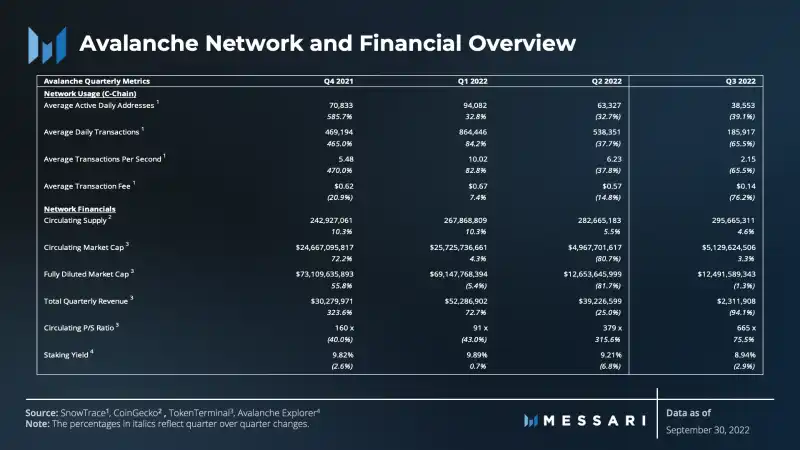
The data used to evaluate the quantitative aspects of the Avalanche network comes from the autonomous network and, more specifically, from the Avalanche C chain.
Subnetwork activity is also considered along with the C chain, but is not listed in the datasheet, as each subnet has its own sovereign security, local Token, and value accumulation mechanisms. C-Chain, by contrast, is currently a. AVAX The main value driver of.
Similar to the second quarter, Avalanche C-Chain saw a decline in network usage and financial performance, with the exception of a slight increase in market capitalization in circulation (i.e., network value).
While the value of the network increased slightly (3.3%), usage and revenue declined sharply. Average daily trading volume fell 65.5 percent and total revenue fell 94.1 percent as transaction fees fell 76.2 percent. From a valuation perspective, the relationship between network value and revenue (price-to-sales ratio) continues to reverse, rising from 379 times to 665 times.
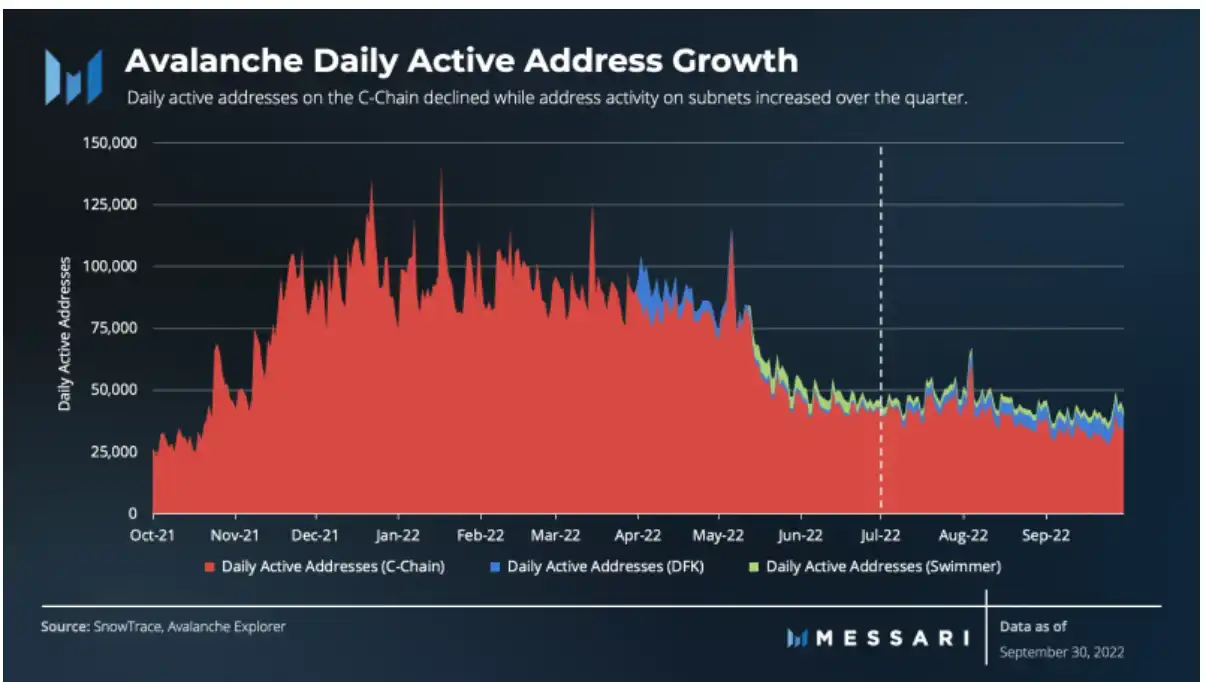
Daily active addresses also continued to decline, with address activity averaging 38,000 per day, down from an average of 63,000 in the second quarter. Outside of C-Chain, DeFi Kingdoms (DFK) and Crabada (Swimmer) have seen an increase in daily active addresses.
The address activity of DFK and Swimmer subnets mirrors previous use in C-Chain.
Still, address activity on the C-Chain is four times what it was a year ago. Growth in subnet activity indicates a healthy subnet.
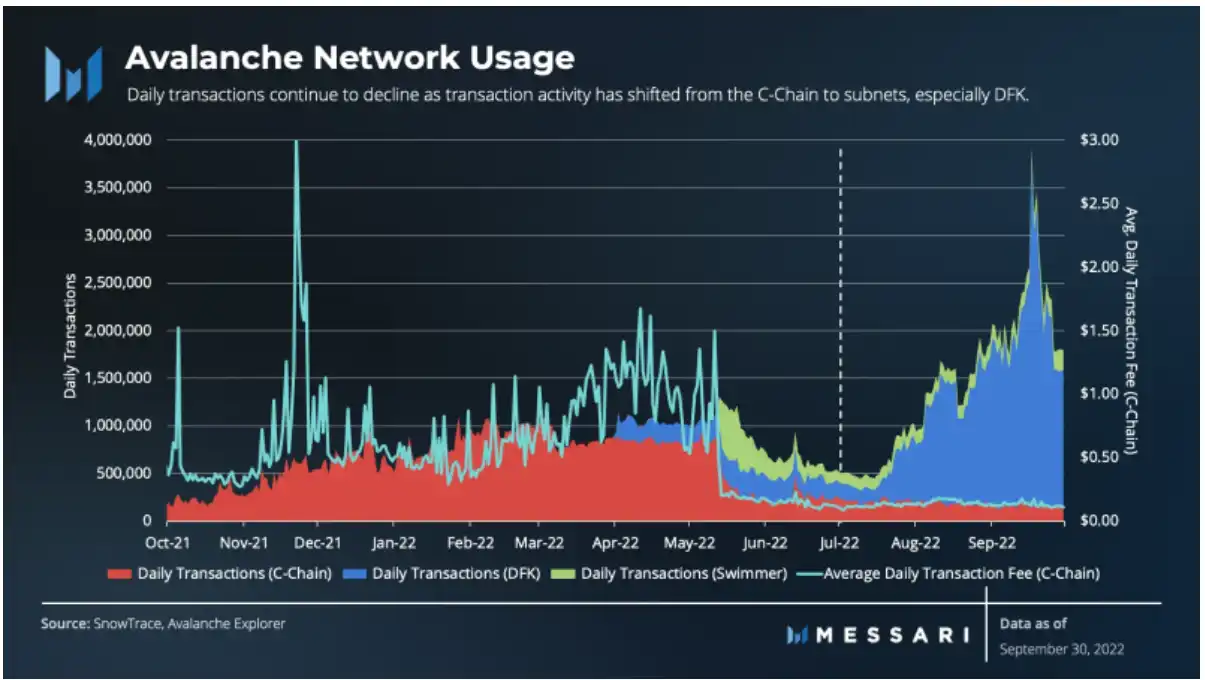
The decline in transaction activity on the C-Chain is more pronounced than the daily active address activity. Avalanche's average daily transaction volume dropped from 540,000 last quarter to 186,000 in Q3. Daily C-Chain volume continues to decline as trading activity moves from C-Chain to subnetworks, especially DFK.
Previously, DFK and Crabada were large deals and revenue drivers for C-Chain. These subnetworks now generate an average of 1.5 million transactions per day on their sovereign networks. Overall, Avalanche Infrastructure averaged more than 1.7 million transactions per day in the third quarter, hitting an all-time high of 45 million total transactions in August. However, the shift of transactions from C-Chain to individual subnets continues to put downward pressure on Avalanche transaction fees (by design) and substantial downward pressure on revenue.
Managing the relationship between security, transaction fees, revenue, and network value has been a balancing point for Avalanche since its inception.
Throughout 2021 and the first quarter of 2022, the network's average daily transaction fee fluctuated as network usage and financial metrics grew. The implementation of several Apricot Phase 5 versions and Avalanche Go (Apricot Phase 6) in Q3 contributed to the lower average transaction fees.
Since subnets generate traffic on their own networks, transaction costs on the primary network fall even more. This intent has always been part of Avalanche's ability to scale laterally. But as a result, total revenue fell as transaction fees fell.
收入仍然是生态系统中许多参与者的重点,因为 Avalanche 从网络的循环供应中烧掉了全部的收入(交易费)。在理论上,这增加了稀缺性,为所有 AVAX Token 持有者创造了价值。

Due to the combustion mechanism, the growth or decline in C-chain revenue affects AVAX's market value up or down. As evidenced throughout last year, peaks and declines in daily revenue were accompanied by peaks and declines in fully diluted valuation (FDV). As the relationship between revenue and network value persists, C-Chain's network usage and revenue will continue to affect network value.
子网在短期内明显给收入带来了下行压力,并在一定程度上给网络价值带来了短期压力。收入和价值之间的关系继续引出一个问题:子网是否对 AVAX Token 的效用和 Avalanche Primary Network (C-Chain) 的价值产生了负面影响。
How subnet values are accumulated
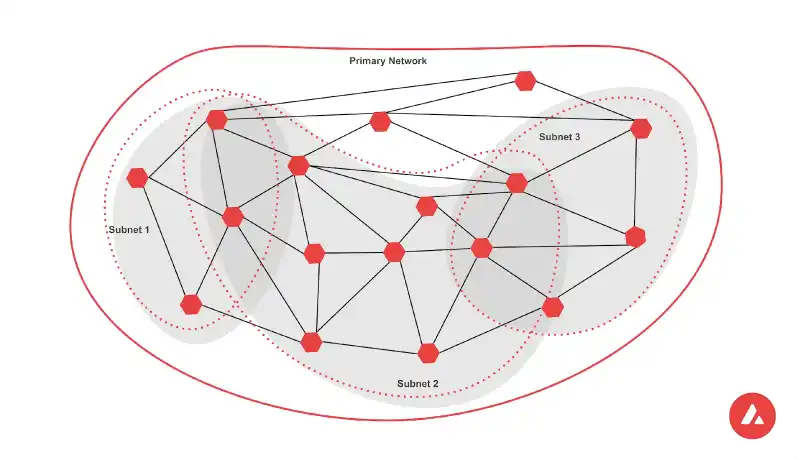
Subnets are not only a way to extend the entire network, but they are also a value proposition for developers.
Subnets allow decentralized applications to take advantage of Avalanche consensus and infrastructure, and they make it easy for developers to launch a uniquely customized blockchain environment.
There are opportunity costs that are not easily quantified when evaluating quantitative indicators of the main network. Without subnets as their final solution, would DeFi Kingdoms and Crabada be the first to build on Avalanche and generate activity on the C chain?
Maybe they will find a different solution.
Assume that subnets are an ideal solution for DFK and Crabada, as well as for the hundreds of other projects under development on Fuji Testnet. Suppose the reasons for building in subnets described by game developers like Pulsar are valid. In this case, the value accumulation is represented by an increase in verifiers, as each subnet pledges 2,000 AVAX and validates on the primary network.
In other words, if it were not for the attractiveness of subnetworks, the main network's infrastructure might not have an inherent growth momentum. As a result, there will be fewer verifiers to pledge 2,000 AVAX. Thus, the value generated from expanding the number of verifiers is very different in time horizon than the value generated from revenue on the C-Chain and transaction fees burned.
Other value accumulation mechanisms include AVAX's fees for creating new subnets and blockchains, which allow AVAX to capture value indirectly through its burning mechanism.
其他价值可能来自子网对 AVAX 流动性的需求,以及利用 AVAX 作为最终跨子网通信的 Gas。最后,子网也可以选择使用 AVAX 作为他们的原生 Token 。
Several strategies to increase C-Chain adoption remain unchanged. Many applications may choose to be built entirely on top of C-Chain because C-Chain works better for them.
They can also build on C-Chain first and then migrate to their own subnets, such as DFK and Crabada.
Ultimately, each option has its trade-offs, and developers have the flexibility to implement product or business solutions.
The rollout of subnets may have had a short-term impact on C-Chain network activity and value.
However, as more subnetworks come online, the value of the main network in terms of scale, flexibility, and robust infrastructure should accrue over the long term.
Overview of Ecosystems and development

DeFi
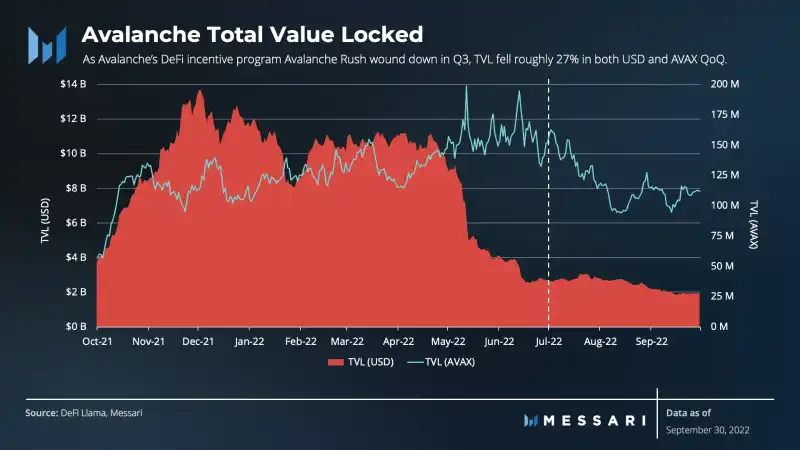
With Avalanche's DeFi incentive program Avalanche Rush ending in the third quarter, TVL in dollars and AVAX was down roughly 27% between quarters.
However, over the 12 months of Avalanche Rush's schedule, TVL averaged 126 million in AVAX terms, which is roughly the average for the third quarter.
From this perspective, AVAX's TVL is stable. As TVL returns to its average value, it reflects a sustainable utility rather than a value catalyzed purely by incentives.
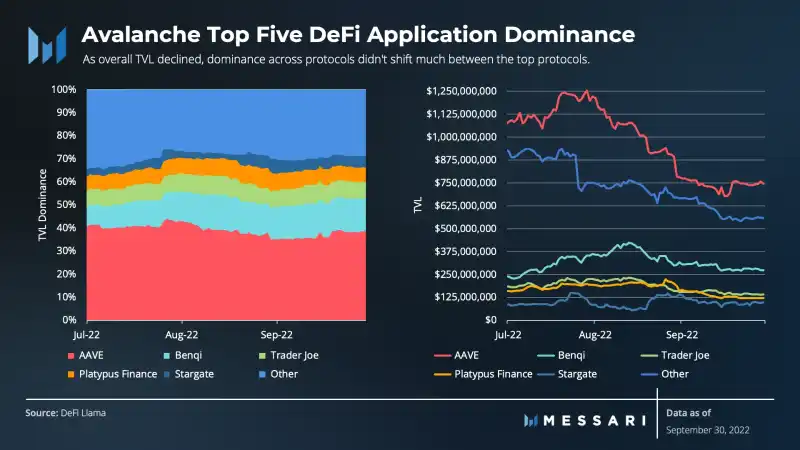
Two of Avalanche's most important lending deals in the third quarter. And Benqi, saw their TVL go in the opposite direction.
The Aave and Avalanche DeFi ecosystems are pretty much the same overall (-30%), while Benqi is up 13%.
However, Benqi's growth can be attributed to its recent liquid mortgage products, as TVL of its lending platform was flat during the quarter.
With the decline in overall TVL, the dominance among the top protocols has not changed much.
The broader DeFi ecosystem was stabilized by the TVL growth of other relatively new projects in the Avalanche ecosystem: Synapse (139%), Stargate (14%), and GMX (6%).
In addition to the existing DeFi, Avalanche made a clear effort to introduce real-world assets (RWA) in Q3.
On-chain ecosystem for RWA structured credit Centrifuge Announces that its Centrifuge Connectors integrate with Avalanche.
After Centrifuge Connectors is a mixture of cross-chain The solution leads into Avalanche directly with the real asset of Centrifuge.
此外,Intain(目前在 Hyperledger 上的资产约为 50 亿美元)宣布,它正在建立一个 Avalanche 子网,将资产支持证券(ABS) Token 化。Intain 表示,之所以选择 Avalanche 是因为它的子网架构以及它如何支持限制金融机构访问的许可空间。
最后,全球领先的投资公司 KKR & Co 宣布与数字资产专家 Securitize 合作。他们计划一起将 KKR 的医疗保健战略增长基金的一部分 Token 化,并在 Avalanche 的公共区块链上提供。
NFTs
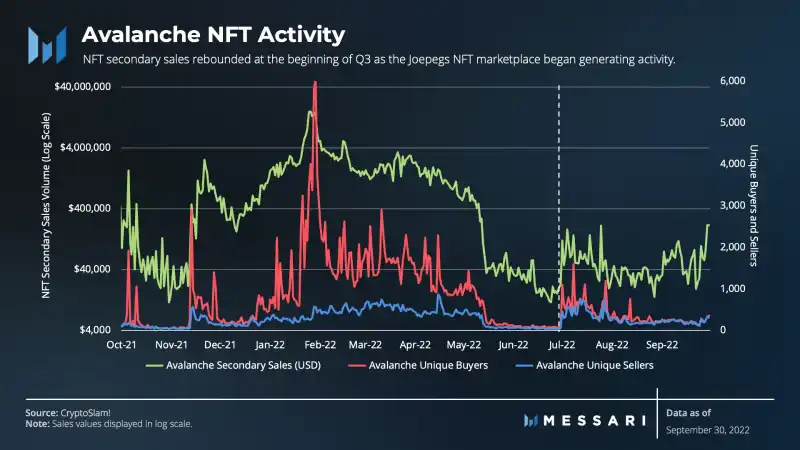
TVL's downturn is not limited to DeFi. Avalanche's nascent NFT market experienced a decline in secondary sales (-88.8%) and single buyers (-34.5%), while single sellers increased by 25.1%.
However, it is worth noting that NFT sales rebounded early in the third quarter. Average daily sales in June were $25,000, followed by an average of $70,000 in July. This rebound represents a 180% increase from the low point at the end of the second quarter, and much of this rebound can be attributed to the launch of the Joepegs NFT market in the second quarter and the subsequent Conscious Lines sale, which sold out in 30 seconds, And has attracted interest from buyers such as Paris Hilton.
Gaming
While DeFi's incentives may have slowed, Avalanches' $200 million-plus ecosystem fund Blizzard is still up and running and attracting creators and GameFi.
With RWAs, GameFi is clearly starting to find its place in the Avalanches ecosystem.
Heading into the third quarter, a gaming company with a strong ecosystem of player-centric hardware, software, and services called Razor partnered with SHRAPNEL.
SHRAPNEL is a triple-A first-person shooter from a team with backgrounds in Halo, Call of Duty, HBO, and built around Avalanche.
Family Feud's celebrity host Steve Harvey has announced his entry into Avalanche's game world, allowing players to earn rewards in the form of NFTS.
In addition to Razor, SHRAPNEL, and Steve Harvey, there's a range of games, including Cosmic Universe (from Harmony Migration), OpenBlox, and Domi Online.
RWA and GameFi are likely to drive activity on the C-Chain and expand the primary network verifier through subnets in the coming months.
The development of
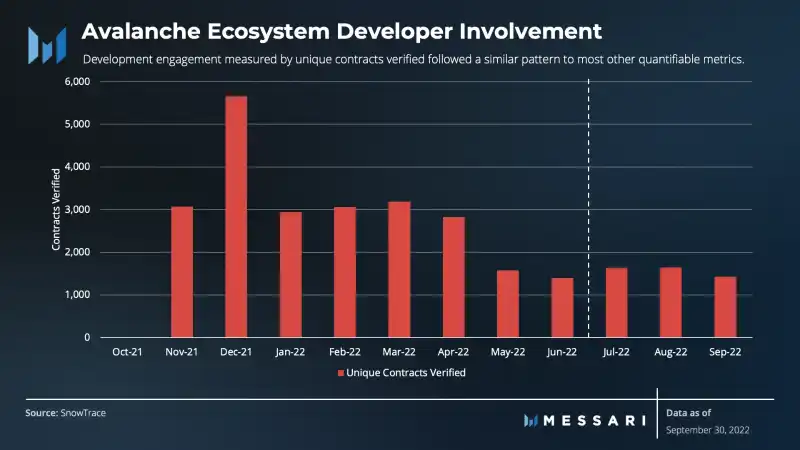
Development engagement, as measured by unique smart contract validation, has yet to catch up with the progress seen in RWA and GameFi. The developer triggers smart contract validation to translate the code into a higher-level language. This measure followed a similar pattern to most other quantifiable measures quarter-on-quarter, with quarterly totals falling by 20 per cent. Moreover, similar to address and transaction activity, smart contract verification has been on the rise in DFK and Swimmer networks.
In previous reports, core developer engagement was measured using data sources that track events in Ava Labs' GitHub repository.
The data shows that core development has increased over the past few quarters, growing 33 percent in the second quarter and 34 percent in the third quarter. By this measure, the core contributors to the network seem to have found opportunities for success in infrastructure development.
However, the data sources that currently exist for developer data are imperfect, and they take an imperfect approach to gathering core developer activity.
While there is evidence that core developers are contributing to the Avalanche infrastructure, future reports will aim to come up with accurate metrics by evaluating activities with more reliable data sources and methods.
An overview of pledge and decentralization
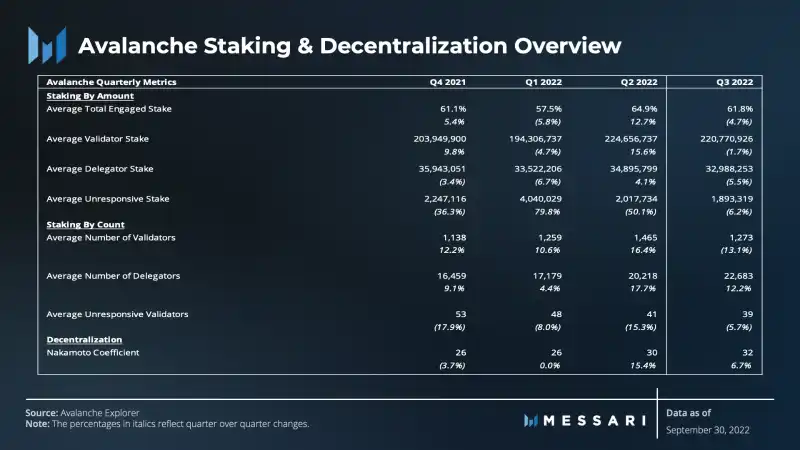
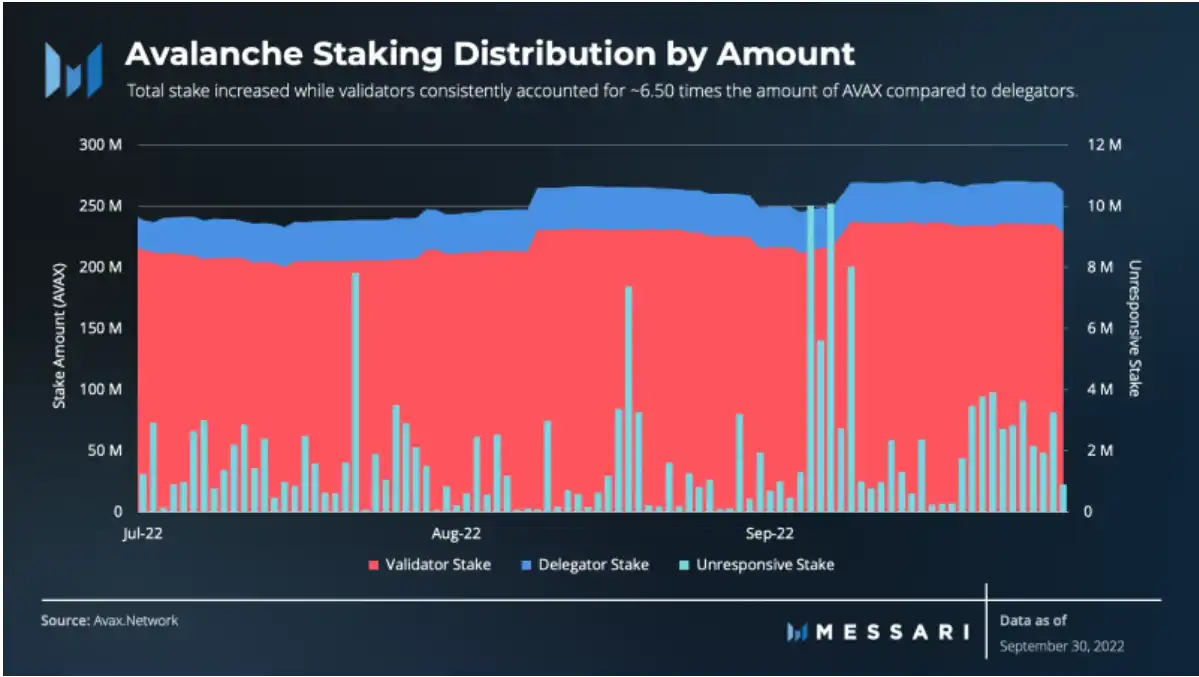
Despite a turbulent second quarter, cyber pledging and decentralization remained strong.
While average daily pledges and participation pledges were relatively flat month-over-month, total pledges grew from 243 million AVAX to more than 260 million Avax. Verifier pledges remain 6.5 times larger than entrusted pledges, and pledges from nonresponsive verifiers are also flat, indicating continued participation, reliability, and network health.

Unlike the average pledge amount, the average number of verifiers and principals changed significantly. The average number of verifiers shrank from 1465 to 1273 (-192 verifiers), representing a ~13% decline in cybersecurity participants. Given the recent subnet access, the average number of verifiers should increase with AVAX pledges.
While the amount pledged by the average principal was flat from the previous quarter, the average number of principals grew substantially. The average number of delegates went in the opposite direction of the verifier, increasing from 17,179 to 20,218 (+3,039), or an increase of about 12%. Clients consistently outnumber verifiers.
Technically, the number of non-responsive verifiers is decreasing month-on-month, but as a percentage of the average verifier number, it is increasing. Avalanche Go V1.8.0 (Apricot Phase 6) was a mandatory security upgrade released during this period and node operators were given until September 6 to upgrade it or risk losing uptime for their nodes. While not a serious problem, the upgrade seems to have been delayed by some verifiers.
Finally, low volatility in equity, verifier, and principal numbers continues to indicate a healthy network and a move toward greater decentralization.

Avalanche's Satoshi Nakamoto. The coefficient continues to hover around 30, but it is slowly improving over the long term. Similarly, the Satoshi coefficient should gradually improve as more subnets come online and are validated on the main network.
This improvement continues to put Avalanche above the industry average when compared to other Layer 1 networks.
Competitive analysis
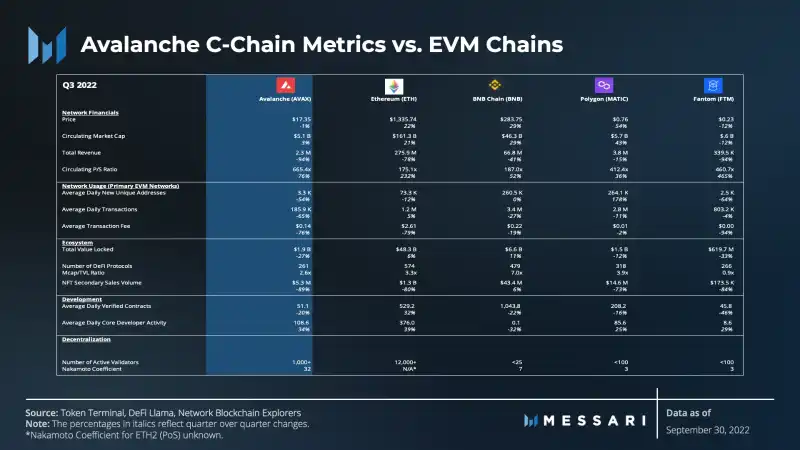
Technological advances, developer activity, and ecosystem growth strategies separate L1S from each other.
Here, we evaluate the key metrics of Avalanche against the top five EVM-compatible chains (including Avalanche) with the highest number of EVM-compatible chains by TVL and DeFi protocols.
This peer group consists of the EVM chain with the largest TVL and the most protocols, as DeFi is still the structure that drives most of the economic activity in each network.
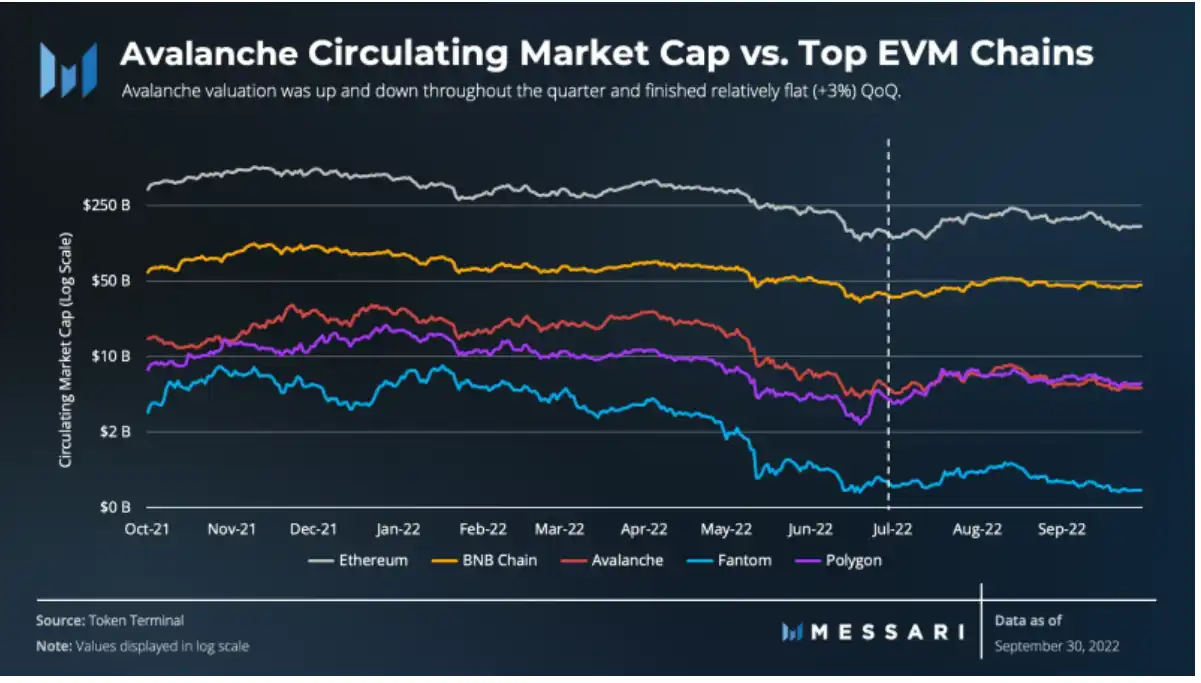
Avalanche's valuation went up and down throughout the quarter, but it was relatively flat in market cap (+3%).
Ethereum, BNB Chain and & have spent Polygon It regained its market cap dominance and posted double-digit percentage growth in the quarter.
While & have spent Fantom On the price front, we are in deep trouble.
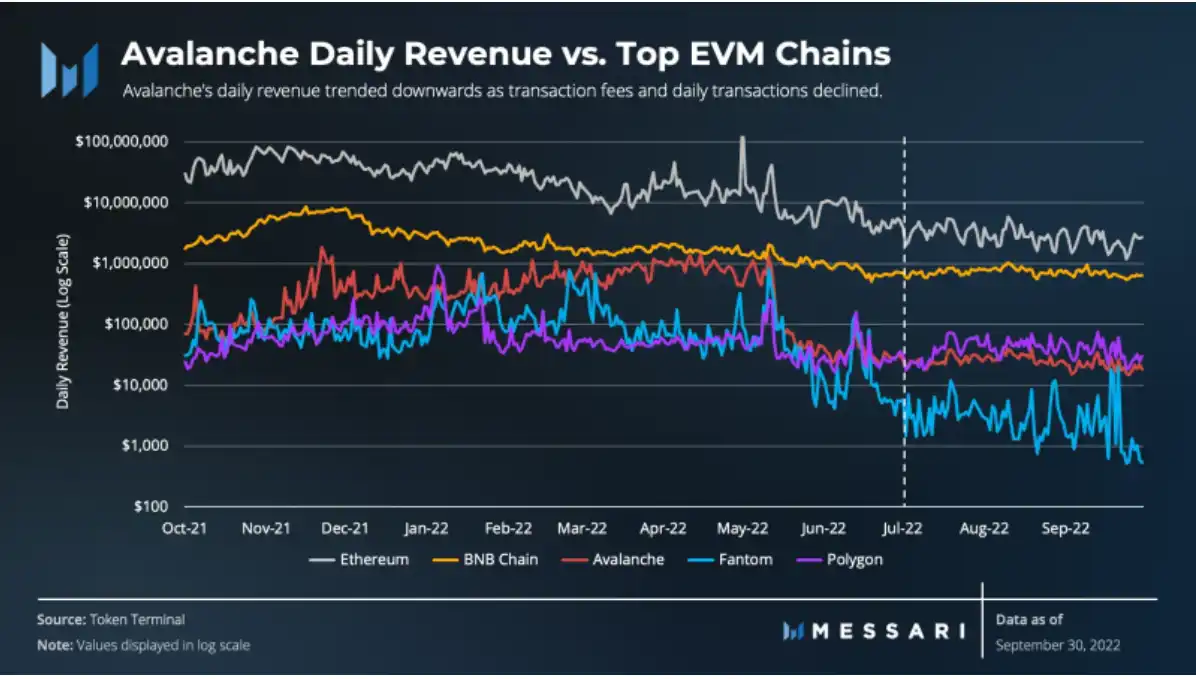
Avalanche's daily revenue is clearly on the decline as average transaction fees and daily transactions decrease.
Peers (minus Ethereum) saw a similar trend in revenue due to lower average transaction fees and daily volume.
Interestingly, Ethereum's average transaction volume was up, but after the merger, they experienced a sharp drop in transaction fees that drove down revenue from the protocol by ~80%.
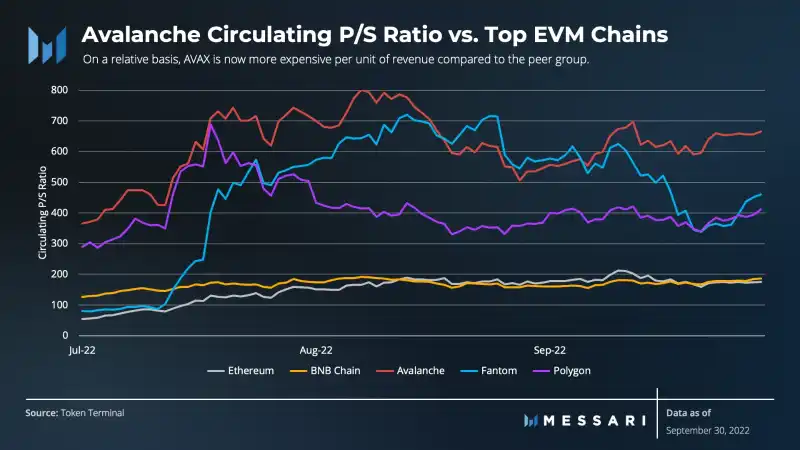
Avalanche's P/S ratio increased significantly in the quarter compared to its peers.
The change in P/S measures the revenue of a protocol and gives a sense of the number and price of transactions processed by a protocol.
Ethereum's P/S increase is not due to lower transaction volume, but comes from lower transaction fees, which is generally considered a good thing.
Avalanche, on the other hand, experienced a decline in transaction fees and daily volume, making its growth even more significant.
然后,用估值(价格)除以收入(销售额),可以进一步了解到每单位收入的原生 Token 价值多少。
On a relative basis, AVAX is now paying a higher price per unit of revenue compared to its peers.
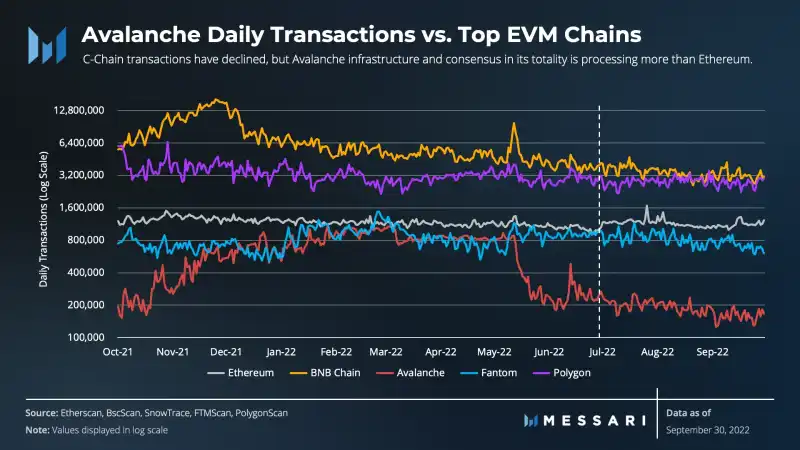
Avalanche (C-Chain) saw similar daily transaction volumes to Ethereum throughout the first quarter and early part of the second quarter. Daily C-Chain transactions experienced a sharp decline with the introduction of DFK and Swimmer networks and have remained relatively stable ever since. Transactions on Ethereum are steady at 1.15 million transactions a day, with Avalanche trading as high as 74% of Ethereum's earlier this year, but now hovering around 20%. Considering Avalanche's infrastructure and consensus integrity, the network handles more transactions per day on average than Ethereum. Overall, Avalanche's entire infrastructure currently processes about 2.3 million transactions per day.
Crypto The DeFi market was flat, with total TVL starting and ending at about $54 billion in US dollars. Avalanche has the second highest TVL drop rate among the top EVM chains (-75%), Fantom drops even more. Since the decline in TVL is usually assessed in US dollars, the decline in asset values represents the TVL price change versus the actual utilization of DeFi. While TVL is down in dollar terms, lock-in amounts in AVAX are relatively stable.
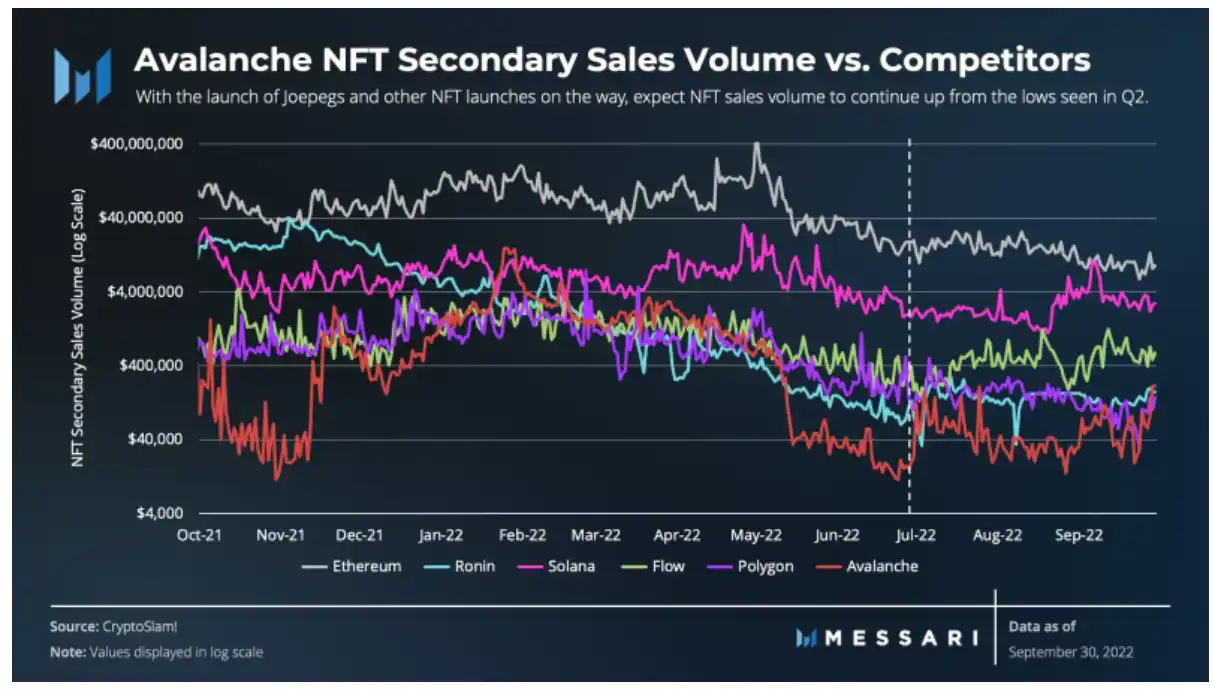
Avalanche quickly outpaced Ronin, Flow, and Polygon in NFT sales in Q1 and early Q2.
However, secondary sales fell in May around the time Swimmer was launched.
Even so, Avalanche NFT activity rebounded in the third quarter and cracked the top 10 in terms of all sales last year.
With the launch of Joepegs, Lost Worlds, and other NFTS, NFT sales should continue their upward trajectory from the lows of Q2.

While Ethereum still dominates about 80% of the secondary NFT market, Avalanche managed to break into the top 10 by historical sales in early 2022.
The qualitative analysis
Key events, catalysts, and strategies for ecosystem growth
Like many networks in a bear market, the third-quarter narrative was relatively uneventful.
However, the narrative for the third quarter centered around building the Avalanche ecosystem and continuing to focus on executing its growth strategy.
As mentioned earlier, the agreement has made significant progress with the deployment of Blizzard and other efforts to introduce real-world assets (RWA) and GameFi.
Avalanche strategy also has several (albeit indirect) core elements, which can be summarized as follows:
Technology integration
Improvement of core technology
Improve user experience (including user access)
Push toward unique domains and use cases
In July 2022
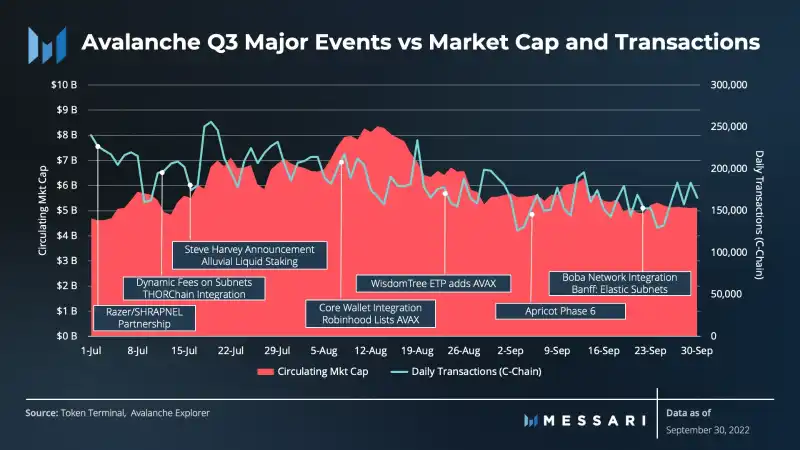
In July, technology integrations to enhance the user experience included THORChain's integration with Avalanche C-Chain. This integration will allow C-Chain users to enter and exit the ecosystem without using a cross-chain bridge. In addition, the widely used blockchain developer toolkit Infura The C-Chain is supported. This integration will enable developers to use easy-to-use tools to take advantage of C-Chain.
There is also an influx of enhanced user experiences through institutional liquidity pledge solutions. Alluvial Finance and Rome Blockchain Labs bring liquid pledge standards to Avalanche. The platform will be managed in a decentralized manner and provide standards for institutions with regulatory obligations to know their customers (KYC) and anti-money laundering (AML) requirements.
Core technology enhancements were also introduced with the introduction of configurable subnet fees. One of the most requested features since the introduction of Subnet-EVM is the flexibility to reconfigure fees without upgrading the network. Configurable expenses became a reality in the third quarter, enhancing the value proposition of the user experience and subnet.
Finally, unique use cases begin to emerge in July. Landslide Network, a subnet designed to reduce the finality of Tendermint consensus, announced that it will open an incentive test network in the fourth quarter of 2022. In addition to reducing the finality of Tendermint, it will make this tendermint. Cosmos And & have spent Terra The ecosystem will be able to run any Tendermint-based application native to the Avalanche ecosystem.
In August 2022
Technology consolidation continued in August. The unhosted Web3 browser extension Core rolled out support for all blockchains running EVM and custom subnets. This integration allows seamless handoff across all major blockchains, including Ethereum and Bitcoin. As demonstrated at Avalanche House Brooklyn, QuickNode enables builders to launch a node in seconds using their global network of RPC terminals.
Liquidity pledge solutions bring more user access. GoGoPool is a new deposit agreement that raised $5 million in a seed round, bringing the liquidity pledge to Avalanche. In particular, it aims to reduce the cost and friction of starting subnets. In addition to more liquidity pledges, it is also linked to Shapeshift, Robinhift & NBSP; And Wisdom Tree have formed a number of financial partnerships to drive greater access to AVAX.
更多独特的使用案例也不断浮出水面。CurateDAO 推出了一个基于 Avalanche 的 "从策划到赚取 "的类似 Pinterest 的数据库平台,参与者可以通过对数据库的贡献来赚钱。此外,8 月为 Avalanche 带来了 Republic 和第一个 Token 化的电影金融产品(FFO)。FFO 在 8 月开始接受投资承诺,迎来了一种获得和参与电影融资的独特方式。
In September 2022
The quarter ended with more integration to improve user access and experience. In early September, wallet provider Bitcoin.com announced its support for AVAX.
Another notable integration aimed at improving the user experience is the integration with the Boba network. Boba Network is a Layer 2 extension solution, the first L2 of Avalanche C-Chain. This integration gives Avalanche developers another low-cost, fast, and scalable approach.
9 月最引人注目的事件可能是 Banff 的推出,这是 AvalancheGo 的一个升级,将为生态系统带来弹性子网。Banff 将使子网创建者能够激活 Proof-of-Stake 验证和基于运行时间的奖励。该升级将允许任何人成为一个子网的验证者,只需在 P-Chain 上抵押其原始 Token 。该设置将为建设者在设计他们的子网时提供更多的选择。
Ecosystem challenges
There were no material adverse results arising from technical challenges in the third quarter. However, the launch of the Apricot 6 does require some attention. Mandatory security upgrades lead to an increase in unresponsive validators, but do not put the network at risk.
Avalanche cross-chain Bridges are also experiencing node instability issues, with transactions not being processed until the issue is resolved. Avalanche maintains a node and quickly updates it to the latest AvalancheGo version.
除了升级维护的影响,本季度还发现并解决了一个漏洞。原生资产调用预编译是 C-Chain 上独有的功能,用于与 Avalanche 原生 Token 互动,存在被利用的风险。该漏洞很快得到解决,因为所有对潜在漏洞开放的 Avalanche 合约都被禁用。AvalancheGo V1.9.0 将完全废除预编译,并引入一个更安全的替代品,以恢复 C-Chain 上 Avalanche 本地 Token 的全部功能。
The way forward
So far, Avalanche doesn't offer a roadmap that can be made public. However, announcements about future plans are communicated regularly.
In the coming months, many subnets on Fuji Testnet will start transitioning to Avalanche mainnets. The P-Chain verifier is expected to expand with this migration.
在 Avalanche 的 Apricot 升级阶段完成后,Banff 的升级周期将加速进行。Banff 将释放整个 Avalanche 生态系统在互操作性方面的价值,类似于在 Cosmos 上完成 IBC。它将允许跨子网的资产转移,无权限的子网,以及子网验证者在其原始 Token 中的奖励。
While the Avalanche incentive may continue to catalyze ecosystem growth, major technological advances like Banff are expected to boost growth soon.
End summary
Overall, the third quarter is the quarter when Avalanche's strategy and vision are built and executed. While the quarter lacked the excitement witnessed during last year's bull market, the network's base user base and ability to advance its market progress have surfaced.
For example, integration with Core increases user access and enhances the user experience.
In addition, the ecosystem expanded beyond DeFi and ushered in unique use cases such as NFT activities, real-world assets (RWA), GameFi, and FFO.
As network functionality advances and the use of subnets continues to grow, so does the adoption mission of Avalanche.
The Avalanche incentive program will likely continue to boost ecosystem growth. Many subnets on Fuji's test network will start transitioning to the Avalanche main network. The verifier and ecosystem expansion should accompany this migration. Finally, like Banff Such major technological advances are on the horizon and are also expected to boost growth.
The original link
Welcome to join the official BlockBeats community:
Telegram Subscription Group: https://t.me/theblockbeats
Telegram Discussion Group: https://t.me/BlockBeats_App
Official Twitter Account: https://twitter.com/BlockBeatsAsia

 Related Articles