In-depth analysis of DeFi insurance: indispensable in open finance
Original title: "7 O'Clock Capital: An article to understand the indispensable DeFi insurance for open finance"
Original source: 7 O'Clock Capital
Banking, securities, and insurance are the troika that supports the operation of the traditional financial industry. The banking industry is currently valued at $8.4 trillion, the securities industry is currently valued at $100 trillion, and the insurance industry is valued at $5.5 trillion (data from Statista and the World Federation of Trading Platforms).
In the insurance industry, institutions are not only the largest policyholders (Bank of America spends an average of $400-$700 per year on $1 million in general liability insurance) , The insurance company itself, as an asset management institution, has also injected a large amount of liquidity into the market. According to the 2022 insurance survey conducted by Goldman Sachs in the United States, the funds managed in the accounts of the global insurance industry are as high as 26 trillion, which shows the important position of insurance in traditional finance.
In the blockchain financial market, all kinds of agreements need to obtain liquidity through pledge mining in order to complete their core functions, which is the biggest difference between DeFi finance and traditional finance. one of the differences. Therefore, most users will identify important roles based on TVL data, and DEX, lending, and cross-chain bridges rank among the top three in the DeFi market.
DeFi insurance has developed so far, only Nexus Mutual, established in 2017, is still operating stably, and it is also the current leader in the insurance track. The entire track shows a trend of weak development and low attention.
So why stress the importance of insurance with only 1% TVL?
The encryption industry is a brand new field, the risk of project running away, the risk of protocol loopholes, the risk of Token, the risk of supervision... the risk is a bottomless pit that cannot be seen. According to The Block, a total of $1.44 billion will be stolen from various protocol vulnerabilities in 2021.
Therefore, the slow development of DeFi insurance is not because there is no market. Through research, the reasons are as follows:
High threshold;
Low liquidity;
< br>
What is the overall development of DeFi insurance in today's encryption market, how is the development of insurance projects, and is there any innovation? 7 O'Clock Capital Based on market research, it is summarized as follows.
Table of Contents
Insurance Mechanism and DeFi Insurance Development Overview
Insurance agreements in the current market and their operation
Some attempts of emerging insurance projects
1. Insurance mechanism and development overview of DeFi insurance
(1) Insurance operation mechanism
Insurance is a tool for pooling capital and socializing large losses so that participants do not go bankrupt in a catastrophic event.
The policyholder pays the insurance premium to the insurance company or the third party in accordance with the contract. When the contracted loss occurs or the contract expires, Beneficiaries will receive claims.
The healthy operation of the insurance system is based on two main assumptions:
1. Law of Large Numbers
Although the probability of insurance loss is difficult to capture and calculate, as long as the number of units is large enough, random events will A large number of repeated occurrences will eventually lead to inevitable laws.

2. Risk sharing mechanism
The frequency of insurance loss events is low but the impact is large, so the number of participants should be large enough to transfer the risk of potential loss of an entity to the average of a collection of entities pass on.
(2) Comparison between DeFi insurance and traditional insurance
Traditional insurance is provided by centralized insurance companies Management, which protects assets such as people, things, and traditional finance, its algorithm and core claim mechanism are non-public. The insurance policy is borne by the institution, and the risks and benefits are borne by the institution.
DeFi insurance is managed by the DAO organization. All insurance purchases and claims are executed by smart contracts to protect various assets on the chain. The algorithm is open and transparent. The insurance policy is undertaken by the community, and anyone can become an insurer, take risks and obtain benefits.
With DeFi insurance, the risk control of decentralized finance is complete.
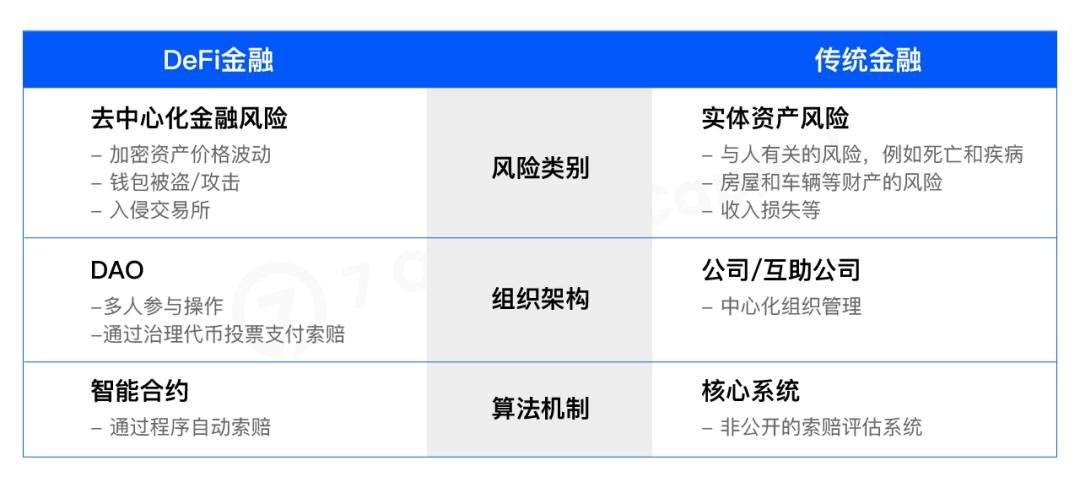
Figure: DeFi Finance vs Traditional Finance
In DeFi insurance, there are five main components and roles: capital pool, DeFi insurance platform, insurance purchase operators, underwriters, claims assessors.
1. Fund pool
Traditional insurance All the money comes from a centralized organization. Its business model is to sell insurance and invest with the buyer's money, and minimize the probability of claims through careful actuarial techniques.
DeFi insurance is different. The money for each policy comes from a liquid pool of funds. Like DeFi lending and mining, each user can act as an institution, inject liquidity funds into different insurance projects, and form a fund pool. Insurance buyers purchase insurance from the fund pool, and also obtain claims from the fund pool, providing People with liquidity are interested in the safety of the insurance, so as to obtain investment income.
2. DeFi insurance platform
Basic The operation is similar to DeFi lending. As a platform, various insurance pools are set up, insurance purchase and underwriting functions are opened to the public, and various insurance pairs are formed for bilateral users to freely purchase insurance and inject liquidity.
When a claim event occurs, as a neutral third party, it will deploy functions such as claims through smart contracts, and the profit model is to charge a certain handling fee.
3. The insurance buyer
is Purchase insurance for various assets, such as centralized institutions being hacked, DeFi protocols being hacked, etc. Choose the appropriate supplier, and purchase insurance according to the type of insurance and the length of time. The greater the risk, the more you will pay.
4. Underwriter
Anyone can become an underwriting provider for the insurance pool. Just like staking to become an LP, users can choose which types of insurance to inject funds on different DeFi insurance platforms, and bear the risk of being claimed (the higher the safety factor of the insurance policy, the lower the return, and the lower the safety factor, the higher the return), and thus get some Insurance premiums as income.
5. Claims Assessor
When When a buyer makes a claim, the traditional insurance company will determine the damage and decide whether to make a claim, while the DeFi insurance platform will verify it in two ways:
(1) Token holders vote: According to the system of the insurance agreement, claim evaluators (need to purchase Token) will be set up, and these members will vote according to the claim proposal, and if the claim is passed, the claim will be made.
(2) Automatic Verification: Automated verification of claims through oracles.
Basic insurance interaction logic
After understanding the five important roles, we simulate a complete With specific insurance purchase and underwriting scenarios, you can clearly grasp the interaction logic of DeFi insurance.
Xiaohong wanted to choose a relatively stable DeFi mining project, so she decided to underwrite a certain insurance of the DeFi insurance platform AAA. She chose the DeFi agreement policy X, injected funds into its fund pool, and obtained a certain fixed income by staking the Token for a period of time.
At the same time, Xiao Ming (DeFi insurance purchaser) worried that the 10,000 USDT he put in a certain DeFi protocol liquidity pool would be hacked and cause losses, so he decided to Buy an insurance policy for this part of your encrypted assets.
Xiao Ming also came to the DeFi insurance platform AAA, where there are various agreements and policies of different Token pools for Xiao Ming to choose from.
Xiaoming chooses policy X, the duration is 3 months, the policy amount is 10,000 USDT, and the price is 35USDT.
In the next 3 months, if the agreement is safe, the policy will be void and Xiao Ming can choose to buy it again. If the agreement is attacked and the funds are lost, Xiao Ming can file a claim, and the platform will enter the claim review mechanism.
Through the vote of the claim evaluator, or automatic verification methods such as oracles, the platform agrees that the DeFi protocol has been attacked as true, Xiao Ming’s claim is true, and the 10,000 USDT claim; if it is determined that the DeFi protocol has not been attacked, no claim will be made.
The following is a list of DeFi insurance interactions:

(4) Types of insurance provided by DeFi insurance
The types of insurance provided by various agreements are different, but basically fall into the following categories:
Centralized Custody Insurance: Provide insurance for users’ assets hosted in centralized institutions;
Smart contract insurance: provide insurance for various types of smart contracts being attacked or invalidated;
Encrypted wallet insurance: provide insurance for encrypted wallets being stolen;
Stable coin decoupling insurance: a series of stable coins linked to the US dollar, DAI, etc.
(5) Why DeFi insurance develops slowly
We mentioned earlier that the development of DeFi insurance The slowness is not because encrypted assets are risk-free, but the root cause is high threshold and low liquidity.
1. High threshold
(1 ) The development threshold is high: DeFi projects such as DEX, lending, and smart pools have relatively simple economic models and codes are also open source to a certain extent. However, the economic model and project design of insurance rely heavily on actuarial pricing and are extremely complex.
(2) High design threshold: How should risks be priced? In the traditional insurance industry, actuarial is the core department of each institution, and the threshold is extremely high. Currency price evaluation and smart contracts are very new fields, which test the industry analysis, security audit, and reasonable pricing ability of DeFi insurance project practitioners at different latitudes, which are extremely challenging.
(3) High education cost: Compared with other staking mining, the insurance method is relatively complicated, so user education costs are high and enthusiasm is not high.
2. Low liquidity
( 1) Competing with DeFi’s income: Most users participating in DeFi projects are aggressive in style, and the proportion of users seeking short-term income is high. The profits earned by acting as insurance underwriters are relatively low, so the attractiveness is also low .
(2) High risk of reinvestment: Most of the income in the traditional insurance market comes from reinvesting collateral in safe investment products. And in DeFi, what is a safe investment for a capital pool? Putting funds back into a DeFi protocol creates the same risks it is supposed to cover.
(3) Lack of liquidity: The compensation ability of DeFi insurance mainly depends on users injecting assets into the fund pool. Based on the above factors, the current capacity and volume of DeFi The underwriting capacity and underwriting services of a single project are very limited, so the liquidity is very low.

At the same time, the early development of DeFi insurance was very bumpy. At the end of 2020, due to code loopholes in the P2P insurance project Cover Protocol, hackers issued additional tokens and unlimited arbitrage, which caused the market to be full of doubts about the insurance track. In September 2021, the development team left collectively and the agreement was closed, which undoubtedly had an impact on the development of the later track.
However, the financial market is full of resilience and opportunities, and the value of the insurance track cannot be ignored.
Second, the current insurance agreement in the market and its operation
Currently active DeFi insurance The projects are very limited. During the research process, we found that the early leading project Nexus Mutual has been ranked first on the track since its establishment in 2017. Other projects have made minor changes and framework adjustments based on its logic, but The essence is still inseparable from the Nexus Mutual model, and this phenomenon also reflects the difficulty of development and innovation to a certain extent.
Below we will show some important insurance agreements at present, understand their innovation and current data.
(1) Nexus Mutual: DeFi
Official website: https://nexusmutual.io /
Nexus Mutual is the leader and pioneer of Ethereum insurance, and other insurance projects are basically innovations and modifications based on its operation. Understanding Nexus Mutal is very helpful in clarifying the gameplay of the entire track.
Nexus Mutual is a mutual aid company registered in the UK, founded in 2017, its founder Hugh Karp has more than 15 years of experience in the insurance industry, 10 years Get started with Bitcoin. Unlike a shareholder-based company, this mutual company is managed by its members. Only members are allowed to trade with the company. Users need to pay 0.002ETH and complete KYC to become a member before they can purchase its insurance policy.
Currently, Nexus Mutual offers three types of insurance with prices determined by the market:
Token decoupling insurance (spanning multiple agreements, only Yearn V2 and Curve pools are covered, odds 90%)
Agreement insurance (single agreement, odds 100%)
Centralized asset custody insurance

Nexus Mutual has more than 100 policy types, and users can insure these contracts for a period of more than 30 days. Each insurance is denominated in native Token NXM and allows payment in ETH or DAI. Users can also purchase NXM to enjoy governance rights, or pledge NXM to become a claim evaluator, and NXM will flow into the fund pool.
It is worth noting that NXM can only be traded within members, and can only be circulated in the secondary market if it is replaced by wNXM, but wNXM cannot participate in any governance activities.
When purchasing an insurance policy, 50% of the fee will be injected into the capital pool, and 50% of the fee will be distributed to the pledger as a bonus. If a claim event occurs, the pledge The Token of the applicant will be burned in proportion, if the amount exceeds the pledged amount, all will be burned, and the agreement as a whole will pay for the policy. In order to prevent the collective claims of a certain type of smart contract from affecting the compensation ability of the entire fund pool, each fund pool has a capacity limit.
In order to generate income, Nexus Mutual currently participates in two agreements:
Staking in Lido ETH
Staking MPL on Maple Finance


Nexus Mutual has a locked position of 180 million, NXM market value of 290 million, wNXM circulation market value of 24 million, according to its public data , we got two questions through analysis:
1. How to safely increase income and attract funds
As of September 19, the active coverage on the platform was US$183 million, the most popular being Convex Finance (21 million), followed by Anchor (20.66 million), and Curve pool (15.66 million), with a total pledge amount of 328 million. According to the model conversion, the total fund pool is 240 million, but the minimum capital requirement (MCR) fund pool covering the current insurance is 254 million, so the number of pledges is not enough.
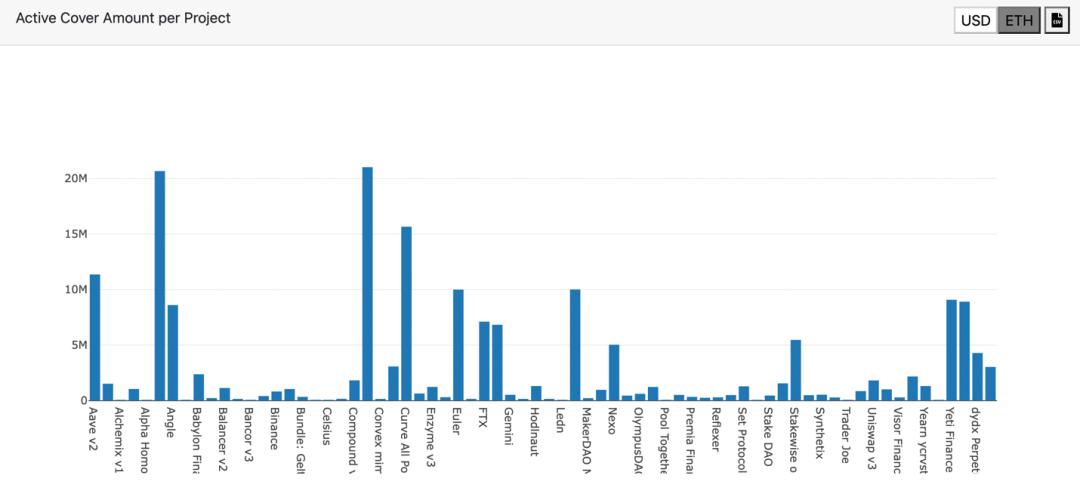
Figure: Insurance amount under each agreement
On the pledge side, the pledge amount of the entire platform is 328 million, the pledge income is 9.3 million, and the average yield is 2.8%. The most popular protocol is Convex Finance, with a pledge amount of 21.48 million, followed by Aave V2 (1482 million) and the Curve BTC pool (13.75 million).
The top three address pledge accounts for 67.1% of the total pool:
First place It is the treasury of Armor.fi, its liquidity provision agreement, accounting for 34.4% of the total pool, providing 115 million pledges
The second place is the founder Hugh Carp , accounting for 16.7% of the total pool
The third place is the Genosis Safe smart contract address of the protocol, accounting for 16% of the total pool
< br>
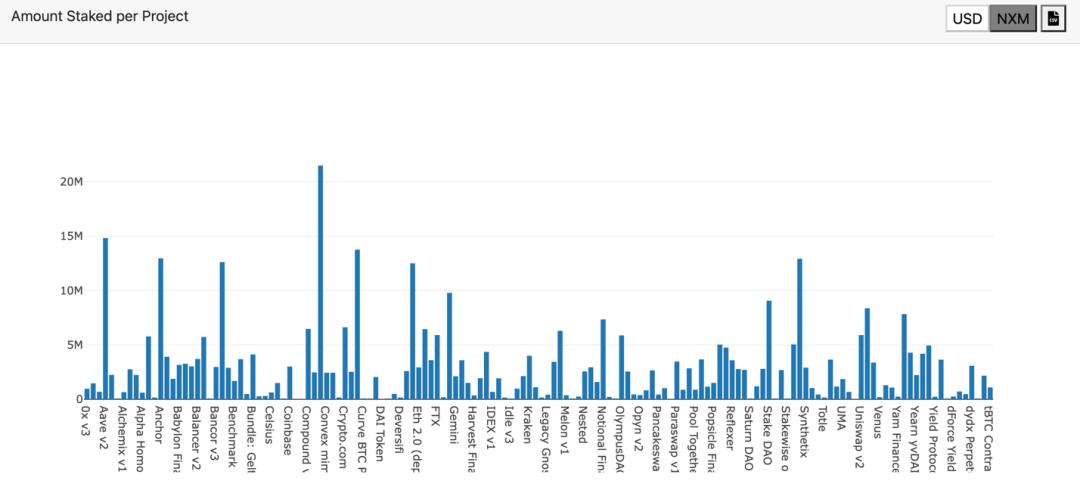
Figure: pledge amount under each agreement
At present, Nexus Mutual's pledge amount is not enough. Although its total pledge amount is 328 million, due to the leverage effect of pledge, it is not enough to guarantee the occurrence of claims on the whole platform. At present, the pledge income of most agreements is 0%. How to invest reasonably and increase the pledge income is the primary task of Nexus Mutual to attract more funds, and it is also a problem that all similar agreements must face.
< br>
2. How to avoid insurance fraud by hackers
On the claim side, so far The platform received 121 claim applications, the pass rate was 24%, and the total compensation amount was 7.49 million, with a probability of 3.8%. Among them, the largest compensation was 4.99 million, which was an insurance policy of Rari Capital (the insurance policy of Rari Capital has been removed from the platform at present).< /p>
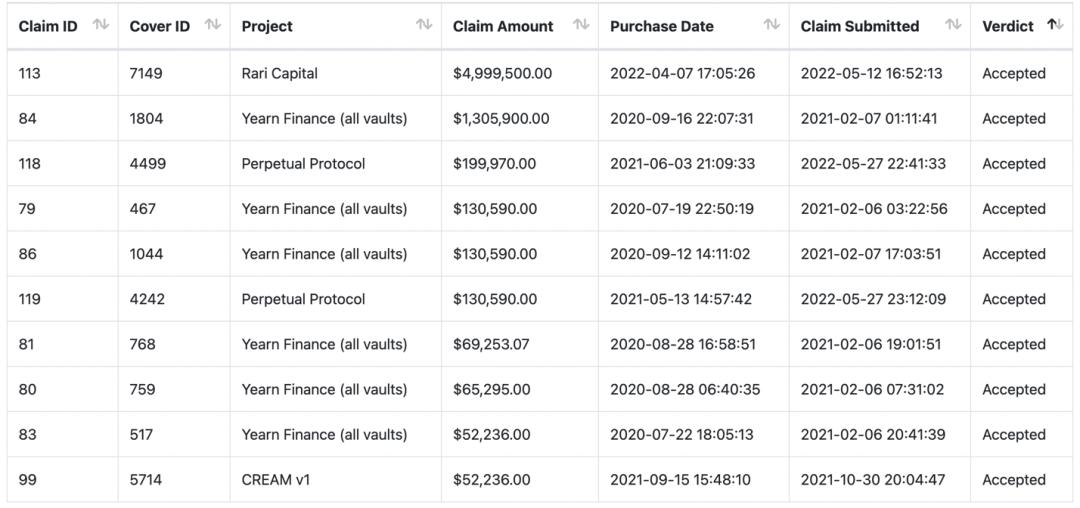
Figure: Nexus Mutal top ten payouts
Rari Capital's policy directly led to 66% of the claims on the platform, which is a very interesting case.
The policy was purchased on 4/7/22 , with an amount of nearly 5 million US dollars. Then on April 30, Rari Capital was hacked and 80 million was stolen. On May 12, the buyer applied for a full claim and it was passed.
The incident is so compact that we can’t help but wonder if the insurance buyer is the hacker himself: first create a small wallet and buy insurance for the assets; secondly attack the protocol and take away the wallet including your own funds; finally make an insurance claim , to defraud the funds.
Although Nexus Mutual implements the KYC function, it cannot directly prove the relationship between the insurance buyer and the hacker, so the hacker defrauded the insurance accomplish.
How DeFi insurance solves the following two problems is the key to whether the insurance track can grow:
The focus is on how to do a good job of auditing and risk control when opening an insurance policy for a non-head DeFi protocol.
(2) Armor.fi: Nexus Mutual Liquidity Release
Official website: https: //armor.fi/
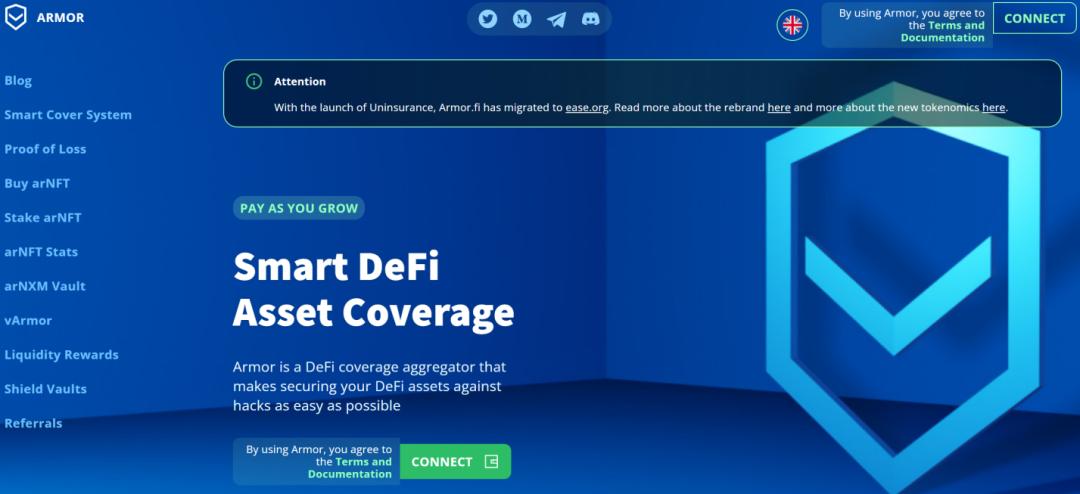
Armor is a project initiated by the core developers of the Cover team after leaving Cover. Armor is positioned as a distribution agent for Nexus Mutual, providing liquidity and transforming DeFi insurance from static insurance to a tradable existence.
Armor protocol has two main products: arNXM and arNFT (arCORE and arSHIELD have been delisted this year).
1. arNXM: Release NXM Liquidity

2. arNFT: Release policy liquidity
Armor allows Users exchange Nexus Mutual's policy for arNFT to trade at the second level.
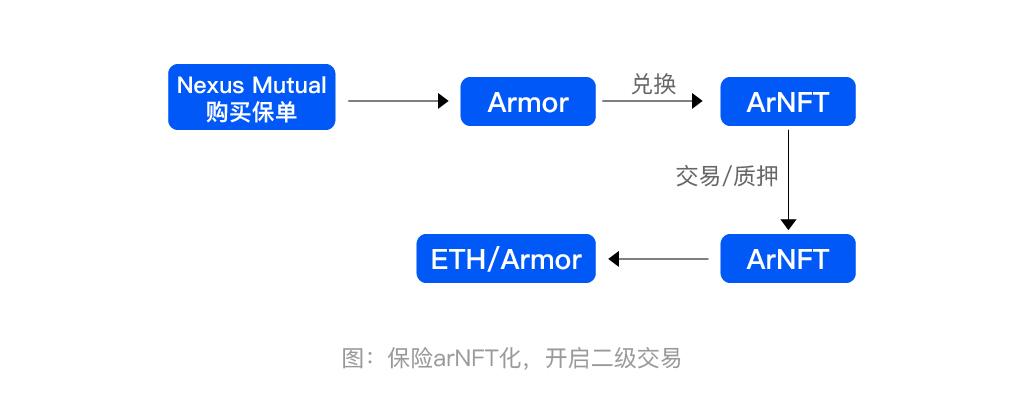
Currently, the locked amount of Armor is higher than that of Nexus Mutual, which is 189 million, which is the highest among all insurance agreements Highest.
(3) Unslashed Finance: Aggregating capital pools to provide risk control for underwriters
Official website: https://unslashed.finance/
Unslashed Finance provides insurance for a range of DeFi products, protocols and markets. The protocol relies on Unslashed DAO for its operation, Enzyme for asset management (providing additional yield), and Kleros for independent claim assessment (ensuring fair outcomes).
The biggest feature of Unslashed Finance is that it brings together a series of policies of the policyholder into a "capital bucket". For the insurer to inject funds to help them spread the risk.
Among them, Spartan Bucket is the first structured insurance product listed on Unslashed, containing 26 policies:

The default maximum risk exposure of Spartan Bucket is 5% of the insurance capacity of each policy. This parameter can be modified by DAO vote.
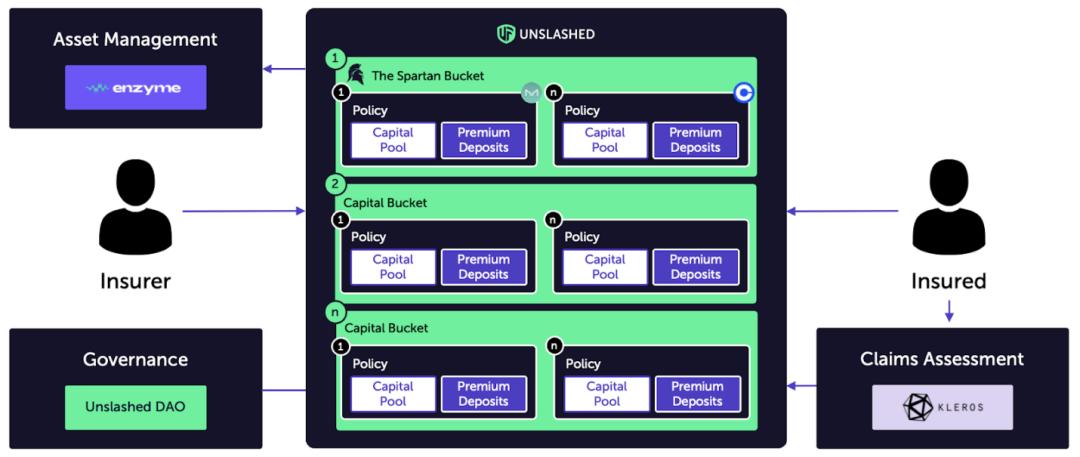
Figure: Unslash Finance Interaction Logic
Unslash Finance’s insurance policy unit is ETH, the current lock-up volume is 22.3 million, the policy amount and pledge amount have not been announced, and there have been 102 claims, with an amount of about 9.8 million US dollars, most of which are UST decoupling compensation in the LUNA incident.
(4) InsurAce: A basket of insurance insurance platforms
Official website: https:// www.insurace.io/
InsurAce, founded in 2021, is the first insurance offering a cross-chain investment portfolio. Users can purchase smart contracts, centralized custody, and stablecoin decoupling insurance, covering 137 protocols and compatible with 20 chains.
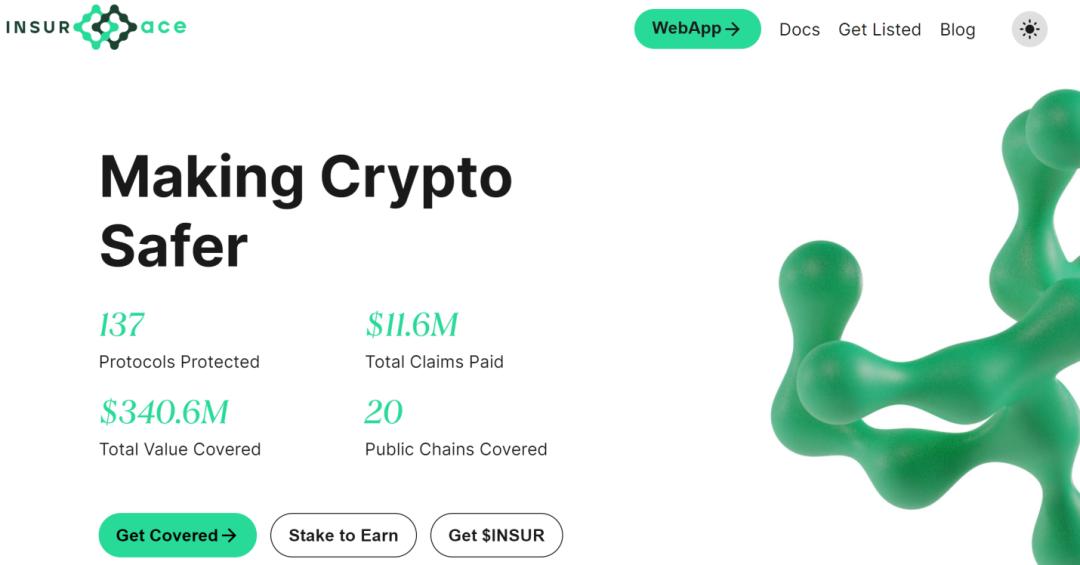
The process of purchasing insurance for users is similar to online shopping. After selecting all policies, they check out together in the shopping cart. On the pledge side, users directly pledge the type of Token, and the fund pool corresponds to all insurance policies that own the Token, reducing risks and increasing pledge income.
The biggest feature of InsurAce is its capital solvency requirement (SCR), which ensures that the platform can fulfill the requirements provided to policyholders within the next 12 months with a probability of 99.5% Indemnity, which limits the probability of financial ruin to 1 in 200.
The SCR value consists of the following 6 elements:
All active policies
All unclaimed orders
Possible but unreported claims
Market Token Shock Risk
Non-life insurance payments and reserves, lapses and huge Disaster Risk
Potential Operational Risk
To achieve this goal, InsurAce has two asset management divisions: Investments and Insurance.
The fund pool of the insurance department is used to ensure the repayment ability of the policy, and the investment department is responsible for obtaining income and attracting investment. The overflow funds of the insurance department will be transferred to the investment department to generate income, and the investment department will serve as the umbrella of the insurance department.
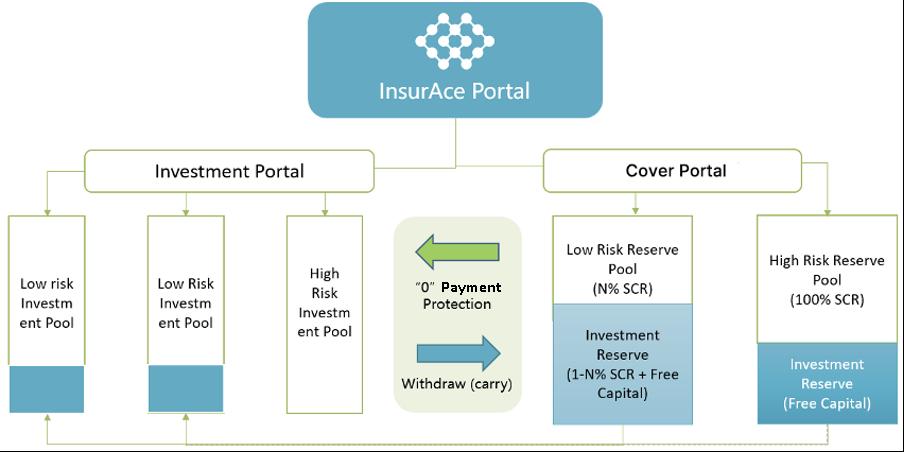
Figure: Fund Flow Logic of InsurAce Protocol
Currently, the locked position of InsurAce is 16.44 million, the total historical insurance amount is 345 million, the current active insurance amount is 15.67 million, the fund pool is 15.84 million, and the SCR is 6.51 million. Funding is in good shape.
On the claim side, there are 215 independent claim events (74.8% pass rate), 4 collective claim events (50% pass rate), and a total compensation amount of 2391 Ten thousand. Among them, the claim events are UST decoupling (accounting for >90%) and Elephant Money protocol being hacked. It can be said that the black swan incident of LUNA has hit the agreement hard, but its good capital ratio has survived the difficulties.
(5) Risk Harbor: Automated insurance market, faster claims
Official website: https://www.riskharbor.com/
Risk Harbor is a transparent and impartial algorithmic insurance protocol, driven by a fully automated invariant detection mechanism, automatically Adjudicate and issue claims without intermediaries.
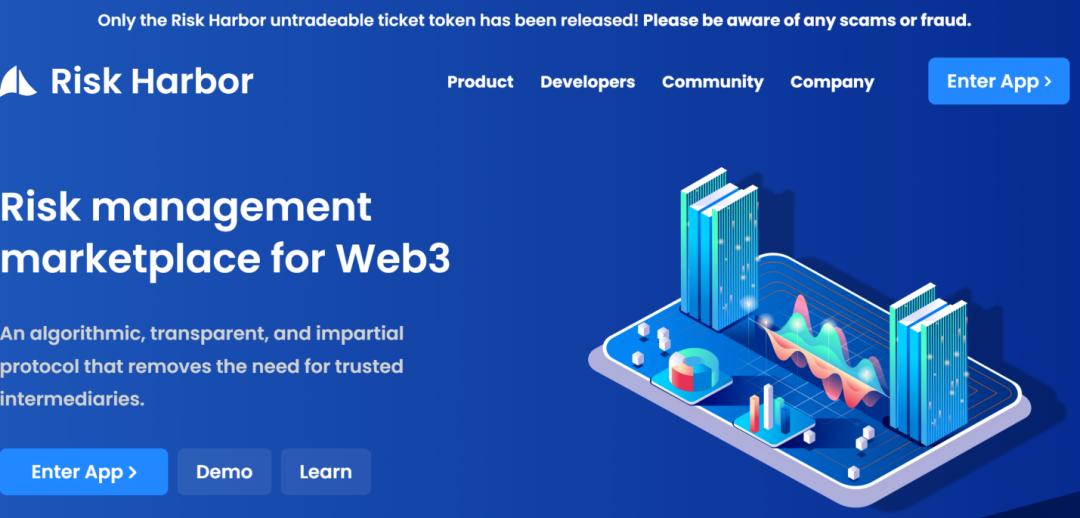
Risk Harbor generates insurance prices through AMM, and the factors that affect the price include the agreed risk and the amount of insurance sold. Due to the risk-averse design of the protocol, it is natural to want to have a variety of policies, and if the demand for a particular policy is too high, the price will be raised.
In order to provide more liquidity for the fund pool, the agreement insurance policies on each chain are gathered in a treasury to jointly provide guarantees for all assets on the chain , currently has 27 contract insurances, supporting Ethereum, Avalanche, Fantom, Aurora, Arbitrium, and Terra2.
If a user applies for a claim, by checking the key invariants on the chain, Risk Harbor can automatically identify whether the protocol has suffered a claim event, and claim USDC. Based on this, the speed of claims is faster, eliminating the possible perverse incentives that may arise when both claim reviewers and governance members are policy holders at the same time, and the capacity is greater.
Risk Harbor currently has the highest quality capital behind it, with Pantera Capital, Coinbase, Digital Currency Group, etc. participating.
Currently, Risk Harbor has a locked position of 16.49 million and provides 29 types of currency insurance policies. There is no public data.
Chapter Summary: Since the rise of DeFi, many insurance projects have disappeared or been taken off the shelves. A project of a certain size. Through the research, it is found that the products they provide have very little difference, only slightly different in terms of purchase mechanism, underwriting mechanism, claim mechanism, and price positioning.
The development and design threshold higher than any DeFi protocol has led to a situation where Nexus Mutual is still the only one.
How the insurance agreement evaluates the risk and sets the price is the core element of whether the project can be established. Therefore, there is a huge test for the background and experience of the team. The algorithm and then slightly modify the code, the value is not great.
Then what attempts have been made by some of the current emerging insurance projects, we have explained them in the third chapter.
Third, some attempts of emerging insurance projects
(1) Neptune Mutual: Benchmarking Nexus Mutual, capital ambush?
Official website: https://neptunemutual.com/
Neptune Mutual calls itself Nexus Mutual2. 0. Compared with the protocol that requires KYC and only members can participate, it is a decentralized parametric insurance that does not require KYC and is open to everyone.
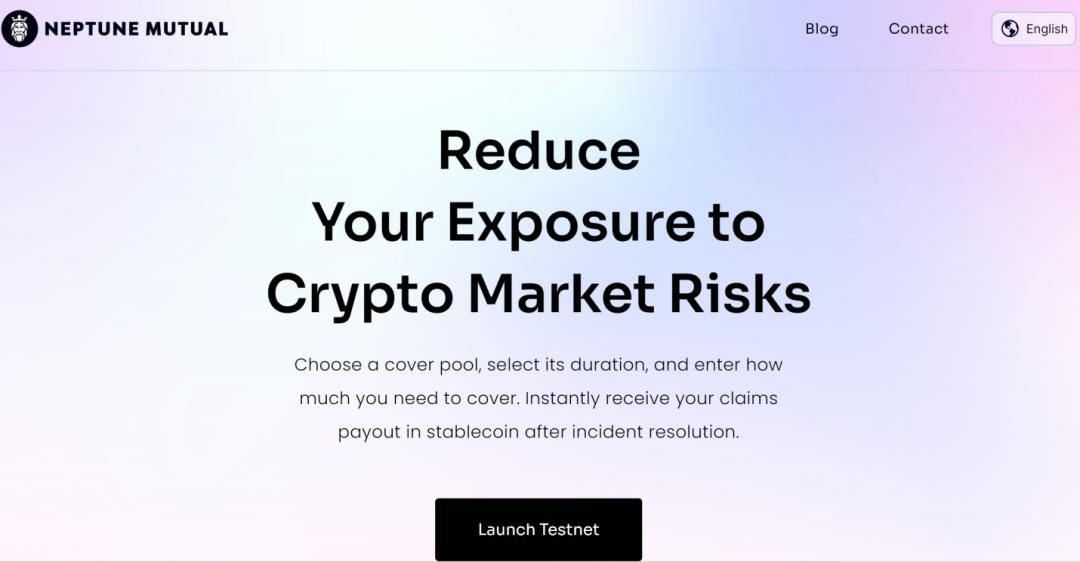
Neptune Mutual's insurance interaction has three roles:
Insurance Creator: Project teams or community leaders can design insurance for their own projects. Currently, only invited people can create insurance types. To create insurance, you need to burn 1000NPM and pledge 4000NPM.
Insurance Buyer: Anyone who holds more than 1NPM can buy an insurance contract for up to 3 months without kyc. Buy insurance to get cxToken, and after a claim event occurs, everyone who owns xcToken can get stable currency compensation.
Liquidity provider: To provide liquidity for the fund pool needs to inject at least 250NPM at the same time. Provide liquidity to obtain POD deposit certificates to redeem funds and income. There are several incomes from providing liquidity: policy share, flash loan, loan income (aave, compound), and POD pledge income.
Claim events:
Claim events do not need to be submitted by users themselves, but by "reporters " Hit report. Anyone with a certain amount of NPM can become a reporter by staking a certain amount of NPM and reporting on policies they deem eligible.
During the voting period, the first one who votes negative will become a candidate reporter and needs to stake NPM, and other users need to stake at least 1NPM to vote. The majority wins (the reporter of that party becomes the final reporter), 60% of the Token pledged by the losing party goes to the winning party, 10% goes to the final reporter, and 30% is burned.
At the same time, once the claim event is identified, all people involved in the event can get compensation without everyone having to file.
The project completed the ETH testnet test at the beginning of this year, and is currently undergoing testing and second Round code audit.
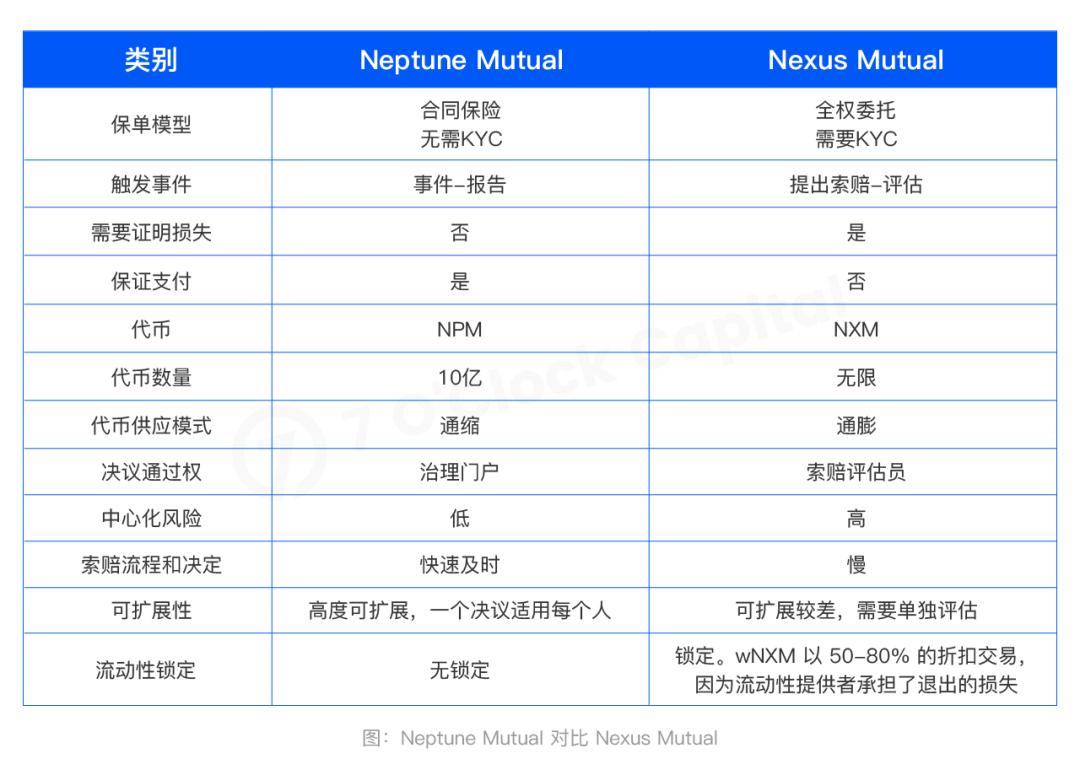
Compared to Nexus Mutual, Neptune Mutual cannot be called innovation, it can only be said to have copied the Nexus Mutual gameplay, and canceled the KYC and claim mechanism. But even so, Neptune Mutual has so far received investment from Animoca Brands, Coinbase Ventures, Huobi Ventures, OKX, Fenbushi Capital, GSR, Gate, Fundamental Labs and other VCs.
The organization may hope that its appearance can shake the leading position of Nexus Mutal and replace it, but whether it can really challenge Nexus Mutal remains to be seen, interested Friends can follow.
(2) UnoRe: Decentralized reinsurance service provider, a way of thinking
Official website: https://unore.io/
UnoRe comes from Polkastarter, advertised as the first decentralized reinsurance trading platform, established in 2021, currently supports Ethetrum, BNB Chain, and Kava.
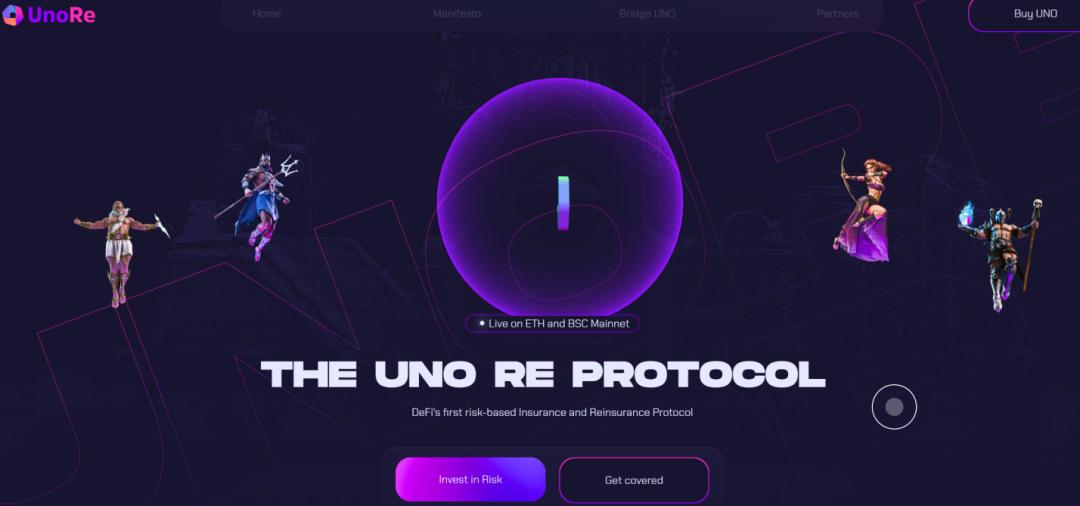
Reinsurance is a means for insurance companies to sell their own insurance agreements to third parties as a means of risk transfer, so reinsurance Companies are also known as insurance companies for insurance companies.
The vision of UnoRe is not only to provide reinsurance services for encrypted assets, but also to break down the barriers of traditional reinsurance in a decentralized way and integrate travel and health insurance The reinsurance service is on the chain, so that every user can participate in it and earn benefits.
To achieve this, UnoRe will go through three stages:
Investor stage : Open the reinvestment pool to the public and break the traditional reinvestment barriers;
Venture transaction stage: build DEX, users can tokenize the venture capital in their hands and carry out Trading, providing risk liquidity;
Innovation stage: Anyone can create their own insurance products, which are voted and managed by the DAO organization.
Currently UnoRe is still in the first phase. Its reinsurance pool currently has only one asset portfolio, including two agreements, Umbrella Network and Nord Finance, for users to inject funds into it and pledge to obtain income. Its role is more like a middleman, bridging the agreement and users.
Maybe because the current insurance market is too small, the demand is insufficient, the reinsurance track is too segmented, and the development force is insufficient. In April this year, UnoRe also began to directly provide users with Selling insurance, released its own smart contract and stablecoin decoupling insurance. These policies are all settled by USDC, which is convenient for packaging the fund pool and selling them to users in parallel with the reinsurance pool.
At present, UnoRe has more than 30 cooperation agreements, 90 self-sold insurance policies, 1.37 million locked positions, and 480 million US dollars of insurance policies have been sold. Currently it is actively cooperating with other protocols, NFTs, Metaverse and Gamefi companies, but the so-called reinsurance pool is unknown when it will be launched.
UnoRe does not have any financing. Judging from the current product form, it is still far from its vision. Will it be able to complete the reinsurance on-chain and realize the traditional industry in the future? There are also doubts about the decentralized transaction of insurance. But the thinking of its model can indeed give some inspiration to more practitioners: Is it possible to chain traditional insurance?
(3) Bumper Finance: Encrypted asset floor price insurance, some small attempts
official website : https://www.bumper.fi/
Compared with other platform insurance, Bumper Finance should be regarded as a new attempt of encrypted asset insurance: providing users with Token floor price insurance.
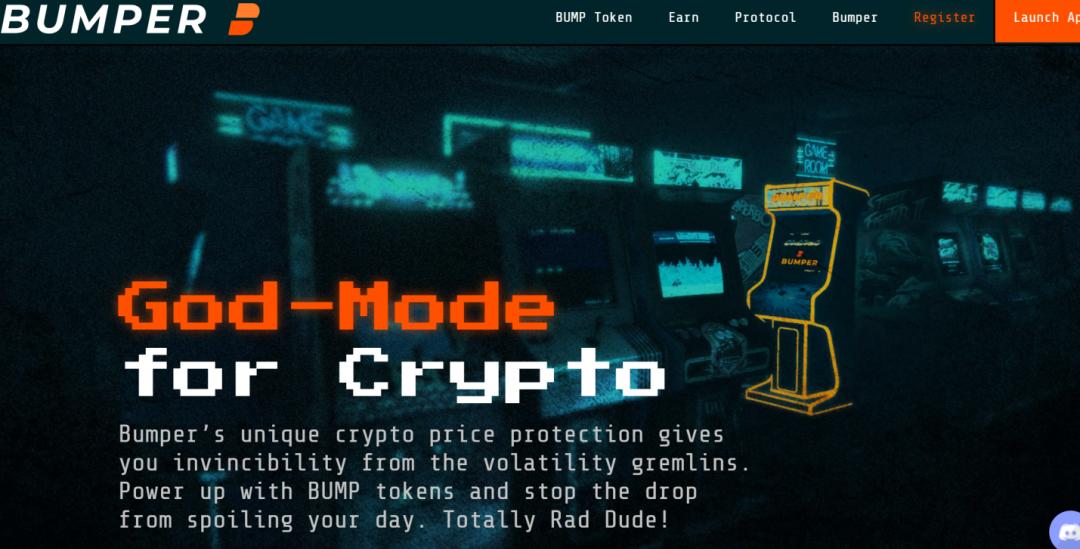
Users lock the Token in the platform by selecting the Token type, policy period and floor price. If the floor price is broken, a claim will be received. The insurer earns income by staking the stable currency USDC. The project currently supports Ethereum, Avalanche, BNB Chain, and Near.
When buying insurance, users can choose the percentage of the current currency price as the floor price, such as 80%, 90%, the higher the percentage, the more expensive the policy. If the price falls below the floor, users can file a claim and receive that percentage of the price at the time the policy was purchased, settled in USDC.
Whether you are buying insurance or becoming an insurer, you need to exchange and pledge TokenBUMP. The pledge will earn income according to time, and Token will develop governance rights in the future. Bumper just completed the alpha test in July this year, started the community beta test in August, and is expected to be open to the public in Q3. At present, there is no project in the market that provides insurance based on currency price fluctuations. As the first project of this category, it is relatively new and you can pay attention to the follow-up data.
Fourth, the future and expectations of DeFi insurance
The projects we have seen so far are all It is an insurance within the chain, an insurance agreement for the capital on the chain. The status quo is that "one company is the only one that lives on its laurels, and it is not easy for latecomers to catch up."
As an asset security track, insurance is the core of security, and model innovation and different mining methods can only be used as additional items.
This is why the status of Nexus Mutual is difficult to be shaken: physical company (low risk of running away), established early (authoritative), full of categories (convenience), It has crossed bulls and bears so far (strength), and it is its strong moat.
Therefore, if you simply do in-chain insurance, you need to meet some conditions if you want to be recognized by the market:
Strong industry background: For example, from the top DeFi protocol, with its own technology and resources, familiar with business logic;
Solid insurance algorithm: mathematics/actuarial elites join , master the core of insurance;
Strong institutional endorsement: first-line VC and Fund screening;
Optimization UX: The operation is relatively friendly, and the learning threshold for users is low;
In addition to in-chain insurance, traditional insurance on-chain is also an area worth exploring.
There are two ways of insurance on the chain:
1. Blockchain native project development Agreement to make insurance policies for off-chain assets
2. Traditional insurance companies provide tokenized insurance policies, which users can purchase online
The Etherisc tool platform for insurance development is a tool similar to Aragon in the DAO field, providing developers with a compliant and regulated scalable tool platform.
Currently, its community has developed off-chain asset insurance, users can purchase on-chain insurance for crops, flight delays, and hurricane events, and get on-chain insurance claim.
This form of insurance directly skips the cumbersome interaction process with traditional insurance companies and the pulling of claims, and directly interacts through the wallet.
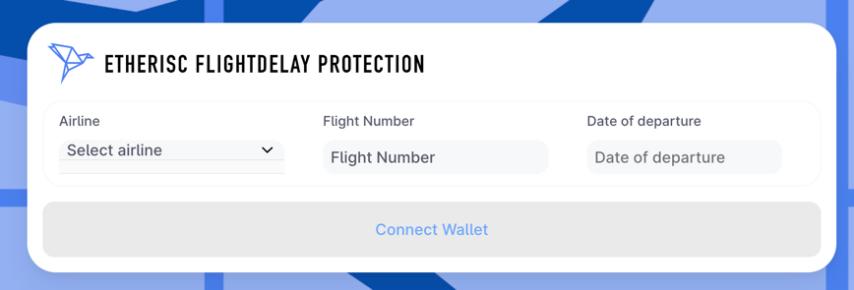
Figure: Purchase flight delay insurance in Etherisc
Another way of chaining requires the bold attempt of traditional insurance companies to put their products on the chain.
Not long ago, one of the largest private equity investment listed companies in the United States, KKR & Securitize cooperated to tokenize a PE fund and release it on Avalanche.
"We strongly believe in blockchain technology and the role it will play in shaping the future of free markets," Dan Parant, KKR Managing Director and Co-Head of U.S. Private Wealth express.
Image: KKR News
This It is not only a bold attempt, but also the intention and determination of traditional assets to seek to enter Web3.
DeFi insurance is still in its early stages of development, but the future is worth looking forward to:
From asset management From the point of view, whether it is an institution or a user, insurance is a rigid need to disperse the investment risk of encrypted assets;
From the perspective of market expansion, the traditional DeFi gameplay is basically exhausted. Funds need to find new blue oceans and destinations;
From the perspective of industry development, based on the experience of the last round of bull market, the next DeFi reincarnation will be more stable and will also There are more developers pouring into it.
7'O Clock Capital is always paying attention to the potential and explosive power hidden in different tracks, and is also looking forward to the next stage of insurance, and hopes to be able to Work with industry partners to discover gems in the sea.
Thinking and interaction at the end of the article: the impossible triangle of insurance
The impossible triangle of insurance agreement are: user cost, staking profit, and protocol security.
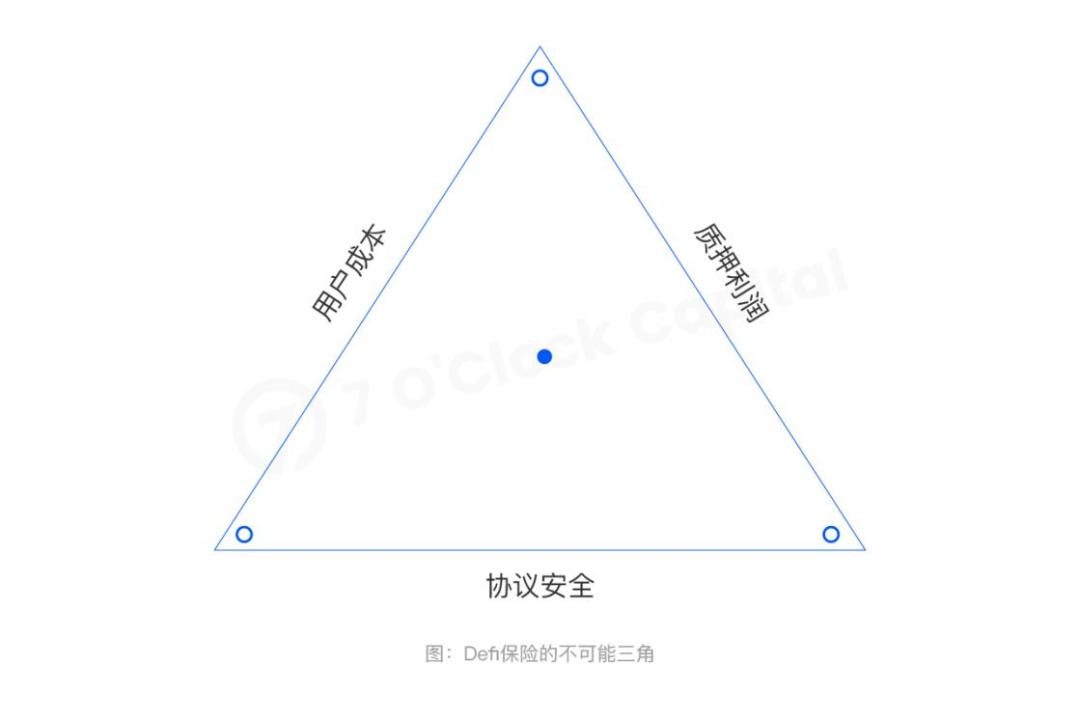
If the user cost is low and the protocol is kept safe, then the pledge profit will not be high; if the user cost is low, And if the pledge profit is high, then the agreement must be insecure; if the pledge profit is high and the agreement is safe, then the cost will be high.
Traditional DeFi protocols must find a balance in the middle, but with the development of various insurance projects and competition with other DeFi benefits, many DeFi insurances have Protocol security may be sacrificed.
What do you think about the impossible triangle? What are the solutions? Welcome to discuss together.
Original link
Welcome to join the official BlockBeats community:
Telegram Subscription Group: https://t.me/theblockbeats
Telegram Discussion Group: https://t.me/BlockBeats_App
Official Twitter Account: https://twitter.com/BlockBeatsAsia
 Related Articles