Ethereum is the best option
Original title: " Ethereum is the best option "
Original author: DeFi Surfer
Original compilation: Block unicorn
Ethereum is in the market and has won The cryptocurrency that people use the most isn't just about being the hardest money.
One of the most important questions that new capital entering the crypto ecosystem must ask is staking funds Note where, as the two largest cryptocurrencies with over 50% market capitalization, the relative question of Bitcoin vs. Ethereum is probably the most important question asked by institutions and high net worth individuals looking to move beyond the asset class.

Bitcoin is the number one encrypted asset target, since the first encrypted currency For 13 years, Bitcoin has dominated the crypto asset class.
The OG (Old Grade) cryptocurrency is currently worth $420 billion, or roughly 38% of all cryptocurrency market capitalization. Bitcoin has the highest brand recognition, with about 3 times the search volume of the second-ranked Ethereum. It also received the most institutional funding. Bitcoin is the only cryptocurrency in which both public company MicroStrategy and a country, El Salvador, are fully invested.
Bitcoin went from nothing to a $1 trillion+ asset in a little over 10 years, perhaps the most incredible technology ever story. However, despite Bitcoin's stature today, it is likely to lose its dominance over time. Bitcoin may even become irrelevant in the not-too-distant future, it is not enough to be the "hardest currency", the most decentralized and the most secure.
These are all desirable attributes of an internet-native currency, but they are unlikely to define a successful internet-native currency, which will ultimately be one that uses most currencies.
By this most important metric, Ethereum is the best bet as the number one and most enduring cryptocurrency of the future.
The most used cryptocurrency will succeed
Fiat money is what cryptocurrencies are trying to disrupt One of the best examples of how a monetary instrument, specifically the king of fiat currencies, the U.S. dollar (USD) is being adopted, rather than other possible "defining" factors that allow cryptocurrencies to succeed.
In terms of assets alone, the dollar is seriously flawed. A core property of the dollar is that it loses value forever. Over the past century, the dollar has lost more than 96% of its value. Economist Amus estimates that annual currency depreciation could be as high as 8%.
Furthermore, the dollar is used by its creator, the US government, as a tool of aggression. The dollar's status as the global reserve currency allows the US to finance ongoing wars, forcing other countries to submit to US policies under the threat of sanctions or even aggression and violence.
The defining attribute of the US dollar as a financing medium for devaluation and hostile hegemony is not ideal for its users - US citizens or US trading partners, But none of that is the point.
Despite accumulating a trade deficit of over $10 trillion and a recent attempt to wipe a country from the global financial system, 59% of global foreign exchange transactions is conducted in US dollars. The second and third most common currencies are the euro at 21%, followed by a basket of "other" currencies at 10%, led by the US dollar.
Why is this? Because the US dollar is the most common currency. The United States of America has the largest economy and military in the world. After decades of growing trade and military might, the dollar has become the most used currency in the world. As the largest consumer market and military power, the US dominates the terms of trade far beyond its 24% share of global GDP.
Although the dollar is depreciating every year, and the United States has a history of foreign aggression. In other words, it is not the attributes of the dollar that determine its success, but its acceptance.
Bitcoin is unlikely to become the most used cryptocurrency
Compared to Bitcoin Compared to Ethereum, Ethereum has a significant advantage in terms of potential widespread adoption. This advantage spans two universal and interrelated domains—technology and culture. Ethereum’s technology and culture foster innovation and encourage adoption, Bitcoin’s does not.
Bitcoin's key feature is its immutability, which of all cryptocurrencies is the least susceptible to change. The final upper limit will always be only 21 million pieces, "the hardest money in the world". Since Bitcoin is the least susceptible to change, it is touted as the ultimate store of value (SoV).
To his credit, SoV MEME (Ultimate Store of Value Meme) kicked off the first $1 trillion+ use case for cryptocurrency. However, Bitcoin's core SoV use case presents several underappreciated issues for the #1 cryptocurrency.
What exactly are you going to do with a store of value? Hold it, accumulate it, hoard it for consumption at some indeterminate point in the future, in other words, it doesn't do much.
This value proposition sounds a lot like other existing stores of value, namely gold. While gold remains the world's largest asset by market capitalization at about $11 trillion, the yellow metal's share of global assets is dwindling.
Gold has little utility and no yield (i.e. cash flow). On the other hand, competing stores of value such as stocks, bonds, and real estate pay those who hold them through earnings. In addition, stocks and real estate typically appreciate faster than gold and provide increasing returns at the investor's cost through growing cash flows.
More capital appreciation plus growing cash flow? What's the point of holding gold for savers? problem, and one that may become even more relevant to Bitcoin as ethereum and other yield-generating cryptoassets are better understood.
While Bitcoin improves upon some of gold's weaknesses, such as transportability and divisibility, the greatest value proposition of a static technology is that virtually everything Don’t, and in the race to market, Bitcoin could be replaced by a superior competitor, just as gold is losing out to a yield-generating asset. Again, the Bitcoin community has not paid enough attention to this point, and Bitcoin's value proposition as a "sit and talk " asset advocates converting more and more of its influence into a future store of value.
Bitcoin's long-term security model depends on a strong fee-based market for "mining rewards," which today accounts for 98% of Bitcoin's security budget (about $18 million , while the daily fee is $300,000), and the mining reward is halved every four years. Bitcoin’s reward halving dictates that Bitcoin’s rewards are rapidly decaying and will need to be replaced by robust fee generation in the not-too-distant future.
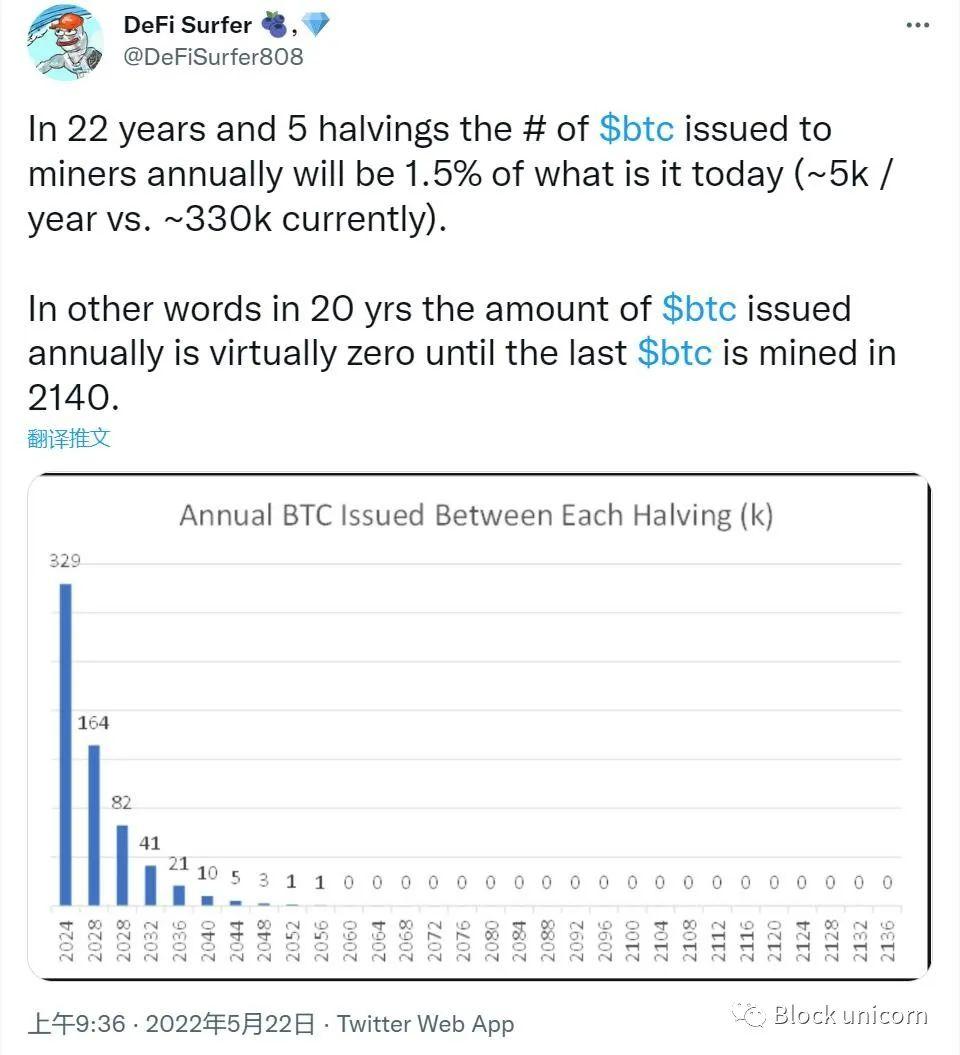
The use case for the store of value is not consistent with the high volume of activity and therefore the cost. From one cycle to the next, the fees generated by the Bitcoin network have dropped by over 60% in Bitcoin terms:

In other words, if users cannot say with 100% certainty whether the Bitcoin network will exist in 100, 50, or maybe only 20 years, then Could Bitcoin really be a store of value?
Ethereum encourages adoption and innovation
In contrast, Ethereum encourages adoption in a fundamentally different way than Bitcoin. The most important feature of Ethereum is the smart contract function. The smart contract function realizes a virtuous circle of development and user acquisition that Bitcoin does not have.
Being able to develop applications on Ethereum, issuing Tokens to developers and early users at critical times in order to benefit from their work, this may be the case The most important difference between the two chains. For most of its history, and even today, the United States has provided desirable resources, such as cheap land, education, and strong property rights, to encourage entrepreneurs to build companies, fuel the growth of the American economy, and continually improve the lives of its citizens. standard of living. Likewise, Ethereum offers developers the opportunity to build innovative applications that unlock enormous value for users brave enough to explore the frontiers of cryptocurrencies and public blockchains.
The first breakthrough application was the first in 2017 Token Issuance (ICO). The second is Decentralized Finance (DeFi) applications in 2020, such as Uniswap and Aave, and the most recent breakthrough application is irreplaceable in 2021 Token —NFT.
All of these applications attract new users to Ethereum and encourage the use of the blockchain. In fact, Ethereum has attracted twice as many users as Bitcoin, measured by addresses with balances greater than $0 (Ethereum 86M / Bitcoin 43M), and generated 47X more fees in the last 12 months ($9 billion for Ethereum / $200 million for Bitcoin), even though Ethereum is 6 years younger than Bitcoin.
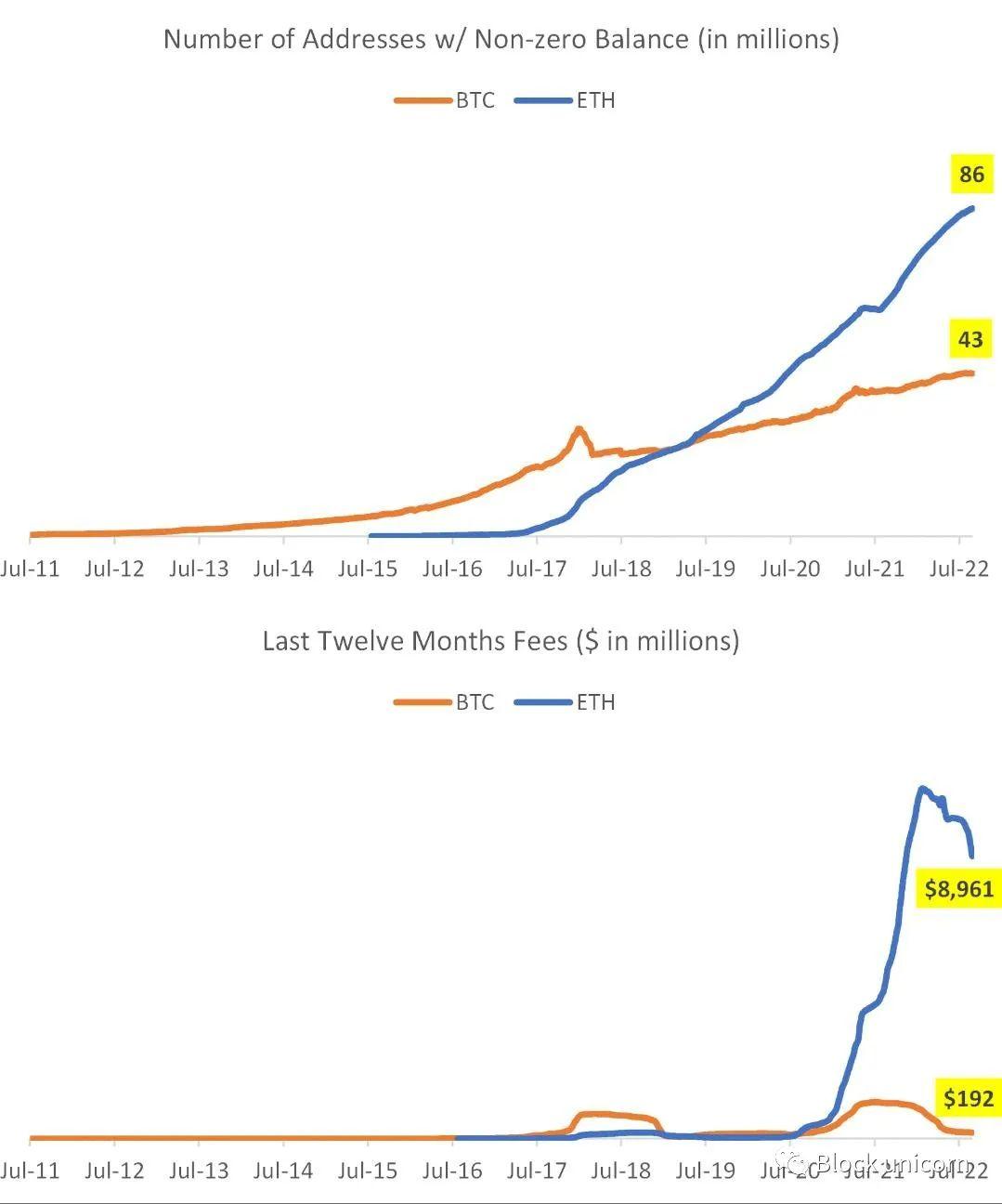
Ethereum has made thousands of individuals rich, not just holding Ethereum , the cumulative value of applications built on top of Ethereum is tens of billions of dollars.
As long as it is possible to build new applications and reap the rewards of taking risks, Ethereum will continue to attract talented developers and early adopters to create applications The next frontier of programming, thereby attracting the next billion users of Ethereum.
This technology reflects the culture of Ethereum. Whereas the Bitcoin culture is extremely conservative and resistant to change, the Ethereum culture is open, self-aware, and risk-seeking.
The most prominent example of Ethereum’s innovative culture is Ethereum’s merger, merger, and shift from Proof-of-Work (PoW) to Proof-of-Stake (PoS) consensus, for A highly risky move for an already very successful chain. However, the merger definitely makes Ethereum stronger, offering more security at less cost and energy consumption.
Perhaps most importantly, merged into Ethereum Token Holders offer the opportunity to earn yield. Depending on the staking rate and percentage of activity on Ethereum, the yield for Ethereum stakers can range from 5-10%.
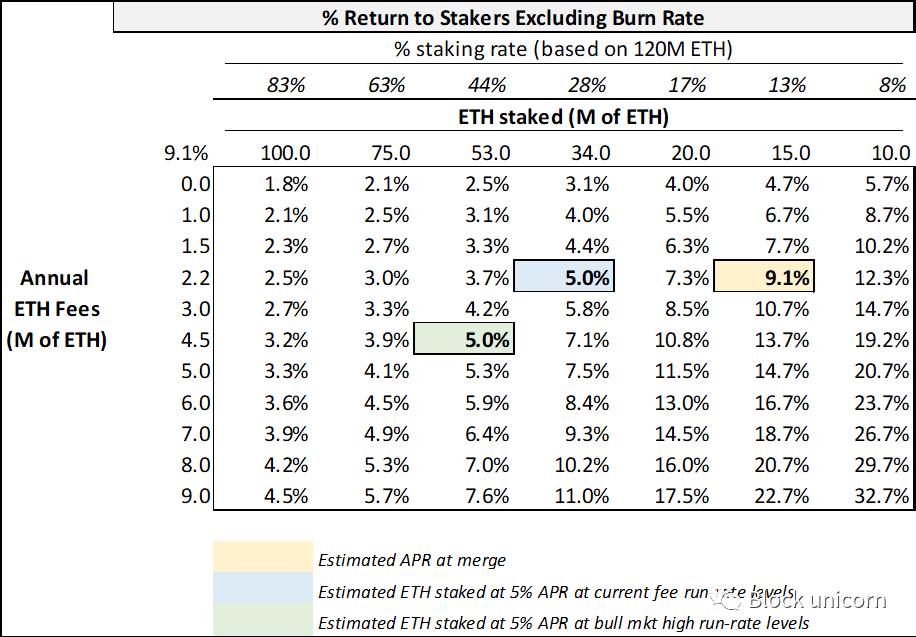
Since Bitcoin cannot generate original income, the merged Ethereum may gradually attract more capital, Just as gold's share of global assets continues to be displaced by yield-generating alternatives such as stocks, bonds and real estate.
But the merger is only one part of a much longer development roadmap, and over the next decade, the Ethereum merger is followed by:
< p>Surge (introducing sharding and massive scaling of chains).
The Verge (introduces Verkle trees and expands further).
The Purge (thin storage and bad debt).
Splurge (a series of smaller upgrades to keep Ethereum running smoothly).
For any cryptocurrency that aspires to be number one in the long term, a robust fee market will be critical. For Ethereum, you know there is a strong fee market today, and developers will likely continue to be strongly incentivized to develop on the chain and attract more users to grow the fee market for decades to come.
For every dollar invested in cryptoassets, new investors are constantly asking themselves, why risk their bet when Ethereum outperforms Bitcoin Bitcoin? They'll figure it out.
It’s all about adoption, Ethereum encourages innovation and adoption
In summary:
p>
- Adoption and ubiquity determine the success of an existing currency (such as the US dollar), rather than a currency's attributes such as "soundness".
- Compared to Bitcoin, Ethereum has built a superior system to encourage adoption. Compared with Bitcoin, which has no application and no income, a strong application ecosystem and income-generating attributes may attract more and more users and capital.
- Without a vibrant fee market, cryptocurrencies cannot prosper for long. The Ethereum model maximizes the likelihood of generating strong fees in the future. Not so with the Bitcoin model.
Just as gold was overtaken by fiat currencies and yield-generating store-of-value assets, Bitcoin is likely to be overtaken by technologies with stronger value propositions such as Ethereum.
The Ethereum community has the ability to foster innovation and chart a compelling path to building an increasingly robust public blockchain for decades to come, This shows that Ethereum is more likely to become the most adopted and largest cryptocurrency in the medium to long term. Additionally, Ethereum’s culture of risk-taking and innovation suggests that Ethereum is at low risk of being overtaken by alternative technologies in the future.
Therefore, Ethereum is the best choice.
Original link
Welcome to join the official BlockBeats community:
Telegram Subscription Group: https://t.me/theblockbeats
Telegram Discussion Group: https://t.me/BlockBeats_App
Official Twitter Account: https://twitter.com/BlockBeatsAsia
 Related Articles