3 former encryption VC partners talk: thinking and prediction of the next cycle
Original title: "Tangent Fireside Chat: Ex Top Fund Investors on Crypto Investing - Jason Choi, Darryl Wang, Mable Jiang Ep. 209"
Original source: The Blockcrunch Podcast
Original compilation: Yuan, Shenchao TechFlow
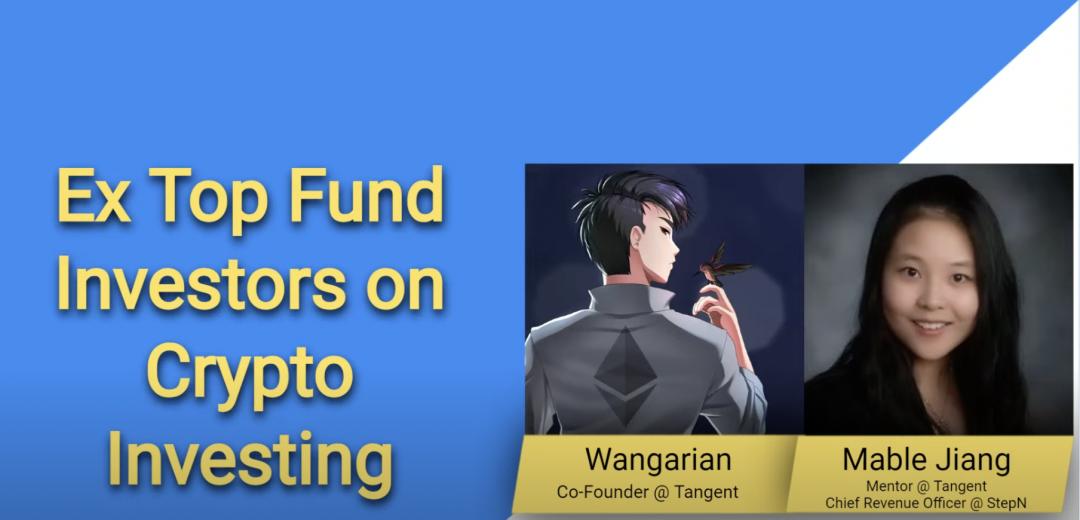
In July, former Spartan Group partner Jason Choi announced that he and former DeFiance Capital executive Wangarian co-founded the Crypto Venture Capital Club Tangent, Mable Jiang, former partner of Multicoin Capital, also joined as an advisor.
On a recent episode of The Blockcrunch Podcast, three ex-crypto VC partners talk about the founding of Tangent , the views on killer apps, how to evaluate excellent founders, the track and fields that are currently being paid attention to, the prediction of the bear market and the next cycle...
For example,In Mable's view, the next wave of encryption explosion may appear in the B2C application field, which requires a sufficiently attractive UI or front end, which Various other protocols can be aggregated, and the core narrative is to capture more users. The podcast brings a lot of inspiration and thinking, and Yuan, a volunteer from Shenchao TechFlow, organizes the core notes to share with you.
Leaving Crypto Fund
Darryl Wang: At the end of 2021, I found myself wanting to make more frequent cryptocurrency investments in traditional funds. I realize there are several pain points that VC or Crypto VC can't necessarily solve.
So Jason and I started to build an investment entity that can really solve these pain points—Tangent. In order to do this, we need to sacrifice the number of bets and focus the portfolio to ensure that we can sit down and deal with every part of the company (invested in), and finally help the founders solve the burning problems of the early stage.
I see Tangent as a service or product, not a fund. My philosophy is as an entrepreneur, pitching my services to founders to see if they are interested in what I have to offer, rather than saying: I'm fun, here's my money, do you want it? When I tried to conceptualize Tangent, I thought this was the main difference between it and other VCs.
Mable Jiang: Working at Multicoin Capital is very interesting, colleagues are very smart, even now I still feel that I can learn from all colleagues to many things.
One of the main reasons I left Multicoin was because I wanted to work at StepN. Multicoin is actually very focused on investing in protocol level stuff, but not doing much consumer or anything B2C related.
I really like Tangent's business model. It doesn't force you to be involved in something, you just invest when you feel you can really make a difference. Basically everyone at Tangent is a founder, each with different expertise, resources, and experiences. So, we can teach students in accordance with their aptitude and really help different projects develop.
Jason Choi:I want to work more closely with founders. But it's getting harder to do that in large/venture funds these days. The only way I can really develop an intimate relationship with the founders and really get involved is with a centralized venture portfolio, but building an institutional fund around that is very difficult. Therefore, we combined the advantages of DAO's flexibility in employing people and the rigor of fund investigations to establish Tangent. Therefore, we have established such an investment group: everyone is a friend, a partner or someone we trust and respect very much.
The next killer app
Mable Jiang: It may not be fully crypto-native or fully on-chain. Web2.5 is actually cool and can also get 10-20 million new encrypted users, StepN is like that. In 2020, I'm thinking more about fully on-chain and DeFi super apps - one project that handles everything. But I obviously realize that with all the composability factors in DeFi, that might not actually be the case.
And my view on Super App (Super App) now is: have a UI or front end that is attractive enough. Then actually we can aggregate various other protocols, no matter who provides that protocol layer, there may be many different teams working on the backend protocol layer.
Tracks and areas of concern
Mable Jiang: StepN is a social entertainment product partially driven by the blockchain. Many things have nothing to do with cryptocurrency, but use the advantages of the blockchain-simple account system.
Focus:
1. Improve blockchain utilization.
2. DeFi protocols do not need to exist independently. Exchanges may still have order books as a standalone product, but basically most of the big names will do simple lending/AMMs themselves.
3. Be able to take advantage of the situation and use the traffic of App to provide DeFi products to those who have not participated in DeFi.
Darryl Wang: With the debacle of Luna, I think the need for decentralization is now more than ever.
Focus:
1. Stablecoin with strong adoption. An industry is only as good as it is by product adoption.
2. Decentralized assets. In the form of making money in the game, you can basically achieve decentralization, you can create a virtual economy, and then start using it and start distributing virtual assets.
Jason Choi:Stablecoin Really interesting. On the one hand, it can be said that Terra collapsed because there was no supervision, while USDC is technically regulated; on the other hand, when the market value of USDC reaches one trillion U.S. dollars and penetrates the entire encryption market, if the regulatory authorities suddenly want to ban such products, then basically all DeFi will be banned.
Focus: Strong decentralized Stablecoin.
Encryption vertical field
Jason Choi: As early as DeFi Summer, I saw projects start to verticalize. For example, as an aggregator, 1inch built their own AMM-Mooniswap, but no one really uses it, and we haven't really seen a successful example of vertical integration. To me, this contradicts the argument that composability is one of the best things about cryptocurrencies.
Founders are almost always motivated to verticalize and build their own layers of the application stack, rather than spilling value to others, they start building their own new Banks, and largely isolated from each other, are like reinventing Web2.
Mable Jiang: Whoever owns the traffic can use it to do many things, including providing these protocols themselves.
Smart Contract Wallet
Jason Choi:Argent is a StarkNet-based smart contract wallet recently launched a wallet recovery solution that does not consume Gas and does not require mnemonic words, allowing users to access Dapps in the application itself. Metamask is probably the most valuable offering of all cryptocurrencies today. Almost everyone uses Metamask.
Darryl Wang: I think people haven’t started using smart contract wallets more because: users are still used to using the computer It is not the mobile terminal for Web3-related activities. At present, there is a need for a safe mobile terminal product that allows users to use it with confidence to break this situation. As the number of new protocols increases, developers will focus more on security and focus on connecting Web 2 players to Web 3. In the next cycle, we will see more solutions that really help increase adoption.
Mable Jiang:The mass adoption of Web3 account login system is actually very important. I am very optimistic about smart contract wallets. I even think that the fact that the order book on the chain has not risen in this cycle is actually because the threshold for traditional users is still too high, so it is the key that smart wallets can lower the barriers to entry.
The smart contract wallet in the next cycle will be very interesting. Private key management solutions like Torus may also have a place. Since most of the smart contract wallets in this round are built on Ethereum, Gas fees are too expensive, so people have gradually begun to forget about smart contract wallets. But if you want to help users access blockchain wallets in a non-custodial and simple way, smart contract wallets are almost the only option.
On-chain identity credentials are also worth looking at. Not only Project Galaxy, but many other projects are working around this.
If you want to enhance the user experience, whether it is on-chain or off-chain, building these infrastructures will also be very important.
GameFi & NFTFi
Jason Choi:I am optimistic Identity solutions and games that can attract players outside the circle are also of interest to NFTFi. Darryl and I are both big fans of Sudoswap, an AMM built specifically for NFTs, which is a superior design compared to existing NFT exchanges.
Putty Finance allows you to buy put options on NFT, basically playing the role of NFT insurance. We invested in a project before that tried a lot of NFTFi-like ideas, and they are expanding to other verticals.
How to choose a founder
Jason Choi: Just filter For founders, first, while we do have an application form, we prefer founders with endorsements. When someone we've worked with or an investor we've co-invested in recommends a deal to us, it's usually a very positive sign and we'll put it at the top of the list.
Secondly, we actually have a scoring system with different weights that weight founders on several metrics. We have backtested with many transactions done on Defiance and Spartan.
Darryl Wang: I value two points most:
1. Does the founder have the unique ability to solve the problem of the team.
2. Valuation investment, as a fund, the margin of safety is our top priority.
Mable Jiang:I am willing to support those who are willing to continue to work very hard, and at the same time know how to let The public clearly sees the founder of the project party doing things.
Solana is a good example, they did a lot of hard work in the early stages, but I think it only really took off after they started to know how to market . Effort and advocacy, both are essential.
Thoughts on the bear market
Darryl Wang: The next few months will be a very challenging time. Ethereum has caught many institutional funds by surprise from 4,000 to 1,000 in the past few months. Either the funds have withdrawn sharply or they have withdrawn from the market. In the subsequent Ethereum merger narrative, many funds were also put on hold, waiting for a larger macroeconomic recession before building positions.
First, I think when attention starts to come back, it will drive crypto-focused capital inflows from the rest of the world; GDP data to see if the world is heading into a recession or if we fail to achieve a soft landing from the Fed. I'm not a cryptocurrency expert, so my views may not really be the same as those of the audience.
Mable Jiang: Note that everyone is talking about the Ethereum merger, which is probably the only one that is really hot these days The topic of Ethereum mergers and market interest rate hikes, new funds have not poured in.
Consider OTC and see if more active SAFT sell orders start to appear. If that happens, I think it might be a good starting point to start thinking about the next cycle.
Prudently consider the valuation, which can be a good measure of the popularity of a project.
Jason Choi: It will be a very challenging two years, especially for founders trying to raise capital But if you don't have a strong endorsement, it will be difficult to get a share of this market. For those founders who have launched tokens, their funding depends on the secondary price of the token.
Prediction for the next cycle
Jason Choi: In 2019 I tried to predict that the TVL of DeFi would be $1 billion, but the top in the past few years seems to be about 180 billion. So if I had to make another prediction, in the next five years, across all applications, there will be a trillion dollars in TVL.
Darryl Wang:I think the market cap or FDV of GameFi related projects will reach 100 billion.
Mable Jiang: Three thoughts:
1. In the next cycle, some social entertainment applications may attract about 50 million users, and they will interact with the blockchain and interact through Web3 accounts.
2. The founders may care more about UI and UX, because good UI and UX can harvest a large number of users.
3. The next big explosion will happen in anything B2C, a lot of opportunities will happen in Asia, but it's a long way off. Looking back at the Web 2 wave, although many innovations always happened in North America, especially the United States at the beginning, but very few things came out at the application layer. Asian founders are actually very good, they are very good at thinking about operating models and other factors.
Welcome to join the official BlockBeats community:
Telegram Subscription Group: https://t.me/theblockbeats
Telegram Discussion Group: https://t.me/BlockBeats_App
Official Twitter Account: https://twitter.com/BlockBeatsAsia
 Related Articles