



Discussing Web3 Infrastructure Protocol: Token Value Creation and Value Accumulation
Original title: "How do Web3 infrastructure protocols try to capture value?" "
Original author: Sami Kassab
Original compilation: Block unicorn
key Insights
Burn-and-Mint The Equilibrium (BME) model and the Stake-for-Access (SFA) model are the two most common token models used by Web3 infrastructure protocols. They solve the speed problem and establish a relationship between network usage and token price.
When using the BME (Burning Token Access Service) model, end users need the native Token of the burning protocol to access the service, which essentially converts protocol use into Token purchasing power.
SFA (Staked Token Access Service) model requires service providers to stake the native Token of the agreement to perform work on the network, which converts network participation into Token purchasing power.
The SFA model is best suited for agreements that provide undifferentiated goods and services, while the BME model is best suited for agreements similar to business operations, as they can set their own prices, and in business development and cooperation compete.
Value creation and value accumulation are not the same thing. While cryptocurrencies have been successful in value creation, the industry is still figuring out the value accumulation side of things. The gap between value creation and value accumulation can be clearly seen at Uniswap. While it’s the most popular decentralized exchange (DEX) with the largest trading volume, Uniswap’s token has struggled to accrue value as its only utility is protocol governance.
Over the past few years, there has been an explosion of infrastructure protocols serving the middleware layer of the Web3 stack. They all face the challenge of aligning network usage with token prices. This report evaluates two of the most popular utility token models used by Web3 infrastructure protocols to capture value: the Burn-and-Mint Equilibrium (BME) model and the Stake-for-Access (SFA) model.
Investors generally believe that if the protocol's utility token supply is fixed, then the price will rise as demand for the protocol's services increases. However, this belief does not take into account the token velocity, which measures the number of times the currency changes owners. Velocity is a key input in the exchange equation (MV=PQ). Chris Burniske by defining the variable as:
Speed issues
M = Size of Asset Base
V = Velocity of Asset
P = Price of Digital Assets Offered
Q = Quantity of Digital Assets Offered
According to Berniske’s equation, when solving M , the Token price can be calculated by dividing it by the circulating supply, and the speed of the Token is inversely proportional to the value of the Token. In other words, the longer people hold Token, the higher its price. In the absence of additional Token utility, users will get Tokens to use services and then sell Tokens, this cycle creates downward pressure on prices.
In order to solve the speed problem and increase the time for users to hold Token, the protocol implements a mechanism to increase the utility of Token and attract the motivation of holding Token.
Token value accumulation
Token price is driven by two parts: a speculative part and a fundamental part. Initially, the price of utility tokens is often driven by speculation. Over time, as the protocol matures and network usage increases, a token's value should transition to be driven by its utility and demand.

The basic value is determined by the demand for protocol services and the protocol Driven by value capture mechanisms. Outlier Ventures and LongHash Ventures describe how value can be accumulated through various mechanisms, including but not limited to:
Governance Mechanisms
On-chain governance: empower Token holders to formulate power of agreement.
Voting Delegation: Allows Token holders to delegate their voting rights to another participant.
Continuous Governance: Incentivize Token holders to maintain their governance Token pledge to maximize voting power.
Pledge Mechanism:
Proof-of-Stake: consensus mechanism, requiring validators Stake Tokens for a chance to create new blocks and earn rewards.
Stake-for-Access model: Participants are required to pledge Token in order to participate as service providers of the network.
Reputation Mechanism: Incentivize Token holders to pledge their Tokens to provide a source of truth for the protocol.
Profit Distribution Mechanism
Burn-and-Mint Equilibrium model: Users are required to burn native Tokens to access protocol services.
Direct income distribution model: The agreement will distribute part of the income generated to the pledged Token holders.
Treasury/Donation Model: A portion of revenue generated is distributed to the protocol's treasury, where it can be allocated for various purposes.
These mechanisms help Token accumulate value. They reduce velocity (increasing the amount of time a token is held) by locking up tokens and incentivizing users to hold tokens in exchange for rewards or protocol voting rights. In addition, token burning and reducing the total supply of tokens lead to fewer tokens chasing the same value. Token value is also affected by several other important design considerations, including a protocol's fixed supply of tokens, inflation, and deflation.
In order for the Token of the protocol to capture value, well-designed Token economics are essential. As Web3 protocols are still in their infancy, they still need to reach a consensus on the best token economics criteria. Therefore, the protocol will continue to try different value capture mechanisms and token economic models.
Associate network usage with Token price

The two most popular token models are Burn-and-Mint Equilibrium model and Stake-for-Access Model. The Web3 infrastructure protocol uses these models to create a link between network usage and token price. Essentially, the BME model works by translating protocol usage into token buying pressure, while the SFA model translates network participation into token buying pressure.
Burn-and-Mint Equilibrium model:
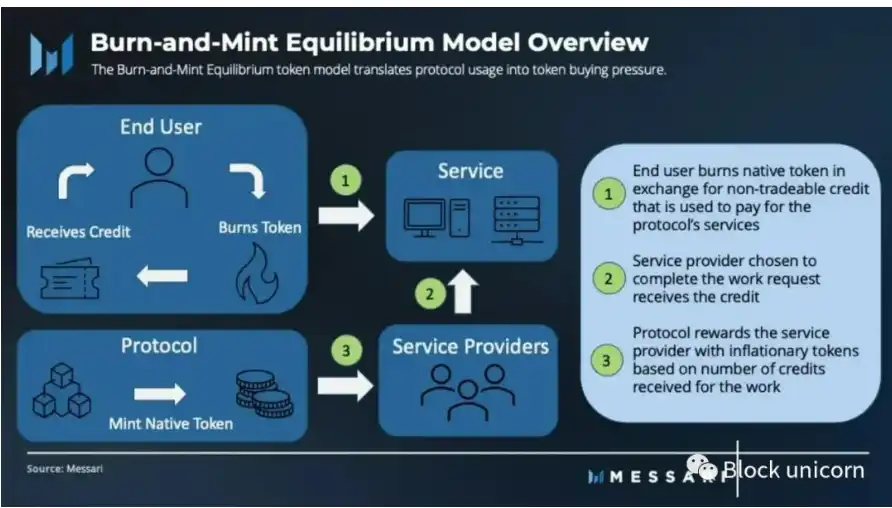
Burn-and-Mint Equilibrium uses a dual token model:
1. A Tradable value-seeking Token
2. Non-tradable payment token, called credit
To use the BME model to obtain the services of the agreement, the end user must burn the tradable Token of the agreement to obtain the exclusive payment Token (credit) required for payment. Token credit works similar to mobile phone card prepaid airtime.
The dual Token system allows the services of the agreement to have a fixed price and be denominated in USD or other less volatile assets/currencies. Rather than pricing services in value-seeking tokens amid fluctuating prices, the protocol sets a fixed dollar price for credits.
To help explain, let's look at the Helium network, where each credit is fixed at $0.00001. In order to earn 100,000 credits to use on the network, $100 worth of Helium's Value Seeking Token (HNT) must be burned. Therefore, the ratio of points to HNT will eventually fluctuate, rather than the price of transferring data on the Helium network.
Once the value-seeking Token is burned and payment credits are obtained, the end user will use these credits to pay the service provider of the agreement. After the network has verified that the service provider has completed the work requested by the end user, the protocol mints a predetermined number of value-seeking tokens, independent of the token burning process, to reward the service provider.
Therefore, if the number of Tokens burned is equal to the number of newly minted Tokens, the system will be in equilibrium. However, if more tokens are burned than minted, there will be a net deflationary effect where the reduction in token supply will eventually put upward pressure on prices. Under this upward price pressure, fewer tokens need to be burned in order to obtain the same amount of credits, which eventually brings the system back to an equilibrium state.
Token supply caps are a common design feature of protocols, although they have some drawbacks. Once the limit of the supply cap is reached, it becomes impossible to continue to incentivize network participants. Fortunately, a new cryptoeconomic innovation called "net emission" allows the BME model to work in harmony with supply caps.
Net Emissions reclaims burned tokens and reissues them as rewards, ensuring the protocol continues to incentivize participants forever. In order not to offset the required deflationary effect, there is an upper limit on the number of tokens that can be recovered per cycle. Therefore, if the number of tokens burned exceeds this upper limit, a deflationary effect can still be achieved. Back in November 2020, the first protocol to implement such a mechanism was Helium. Since then, the mechanism has become standard for protocols using the BME model, which has a capped supply.
Stake-for-Access Model:

Stake- The for-Access model, also known as the work token model, requires service providers to stake native tokens in order to perform work for the network. The pledged Token can be used as collateral, and can also punish malicious participants of the node.
Taking Graph (multi-chain index application) as an example, this protocol requires supply-side participants (Indexers and Curators) to hold local tokens (GRT) in order to be able to provide indexing and Query processing service. The more GRT is invested, the more rewards service providers get.
Generally, the amount of Token pledged is directly proportional to the amount of work the service provider can perform. This relationship creates a dynamic where service providers earn revenue (in native tokens) based on the amount of tokens they hold. Therefore, when using the SFA model, the token price should increase with network usage. Kyle Samani, Managing Partner of Multicoin Capital, eloquently explained the game theory involved:
"As service demand grows, more revenue will flow to service providers. Considering the Token With a fixed supply, service providers will reasonably pay more for each Token to obtain a part of the growing cash flow.”
While the SFA model is usually only applicable to participants on the supply side, it can also be used on the demand side of an agreement. Pocket Networks not only require service providers to stake in order to work, but also require access to the protocol's RPC (Remote Call) service. This demand-side approach captures more value, but it comes at the expense of the end-user experience.
Final Thoughts
Both SFA and BME address the speed issue and create a relationship between network usage and token price. As network usage increases, the price of the token should also increase. However, the downside of this relationship is that if network usage goes down, the price of the token will also go down. Either way, both token models align the incentives of all participants by incentivizing community participation and leveraging the network.
Kyle Samani believes that the SFA model is more valuable than the BME model, but SFA cannot be applied to all protocols. The SFA model is only applicable to agreements that provide undifferentiated goods and services. The BME model is most effective for agreements where the service provider does not provide a pure commodity. The BME model allows protocols to operate like businesses, where protocols can set their own variables and pricing, while also competing in areas such as business development and partnerships.
As developers continue to experiment, new variations and even new models may emerge. For protocol tokens to capture value, well-designed token economics that create fundamental value are essential. The speculative component of token prices will never completely disappear, but as more and more project teams focus on token value-add, a future where token prices are driven by actual network usage seems feasible.
Original link
Welcome to join the official BlockBeats community:
Telegram Subscription Group: https://t.me/theblockbeats
Telegram Discussion Group: https://t.me/BlockBeats_App
Official Twitter Account: https://twitter.com/BlockBeatsAsia






