Arthur Hayes: My expectations for US monetary policy

Original title: "Arthur Hayes: My Expectations for U.S. Monetary Policy"
Original author: Arthur Hayes, co-founder of 100x
Original compilation: Wu Zhuocheng, Wu Shuo< /blockquote>
Recently, the Fed's slowdown in tightening over the past few weeks, coupled with the Treasury's flood of liquidity injections into the credit system, has fueled a rally in risk assets . We don't know what has driven the Fed's recent actions, but if it continues, it will somewhat dampen our expectations for monetary tightening in the US. At this time, we have not changed our view, but we will continue to monitor the situation closely.
USD liquidity consists of three parts:
1. The size of the Fed’s balance sheet . The Fed deposits money with banks, and in return, the banks sell U.S. Treasury bonds and/or U.S. mortgage-backed securities. This is how the Fed "prints" money to energize the financial system.
2. The size of the reverse repurchase (RRP) balance held by the New York Fed. The Fed allows eligible counterparties to deposit dollars and earn a certain rate of return. Once the deposited funds enter the Fed's account, they become dead money because the Fed does not use the deposited funds to make commercial loans. In effect, the money multiplier is 0 for RRP balances at the NY Fed and non-zero when deposited with any other financial intermediary. (Pre-pandemic, reserve requirement ratios hovered between 3% and 10%—leading to U.S. commercial banks with money multipliers of 33 to 10—but the Fed has since lowered it to 0%, meaning commercial banks can 100% of the deposits they receive).
Money market fund (MMF) is a fund where retail investors and institutions place cash to earn short-term income. All my spare money is deposited in MMF. Get my cash back within one business day. MMFs can deposit funds in RRPs, as well as a variety of other low-risk short-term credit instruments (such as U.S. Treasury bonds, AAA-rated U.S. corporate commercial paper). Leaving money at the Fed is the least risky option and pays about the same as the other two options, but it does carry some risk. Therefore, money market funds would prefer to park their money at the Fed if they can, rather than in a leveraged financial economy, as well as a variety of other low-risk short-term credit instruments (e.g., U.S. Treasuries, AAA-rated U.S. corporate commercial paper).
3. The U.S. Treasury General Account (TGA) maintains a balance with the Federal Reserve, which is the checking account of the U.S. Treasury Department. When it decreases, it means the U.S. Treasury is pumping money directly into the economy and creating liquidity. When it increases, it means the U.S. Treasury is saving money rather than stimulating economic activity. TGA also increases when the Treasury sells bonds. This action removes liquidity from the market, as buyers must pay for their bonds in dollars.
In a nutshell, USD liquidity increases/decreases when:
Rising USD liquidity:
Fed Balance Sheet - Increase
RRP Balance - Decrease
TGA - - Decrease
Decline in USD liquidity:
Fed Balance Sheet - Decrease
Fed Balance Sheet - Decrease
p>
RRP Balance - Increase
TGA - Increase
However, all three potential factors are not always point in the same direction. For example, sometimes the Fed's balance sheet is growing and the TGA is growing. Therefore, whether dollar liquidity increases or decreases depends on the interaction of these three factors, their direction, and the degree or speed at which they occur.
Even though the Fed started quantitative tightening (QT) in June this year, meaning they decided to shrink their balance sheet to fend off inflation, their balance sheet The reduction in size was recently offset by reductions in RRP and TGA. This usually results in an increase in dollar liquidity, not a decrease.
The maximum size of the RRP facility, the rates of return offered, and the companies allowed to use it are all at the Fed's sole discretion. Therefore, the Fed can influence the impact of this liquidity spigot on the overall market. For example, the Fed could close the facility entirely, forcing money market funds and other institutions to move cash elsewhere, and releasing $2 trillion of base money into the system in the process. This base currency, depending on whom it is provided to, can be further leveraged to actively drive financial economic activity. Recently, RRP has dropped, and I don't have (and haven't read) a convincing theory as to why the balance dropped - but for the purposes of this article, all we need to understand is that it has been dropping.
With the election just a few months away, it is widely believed that many vote with their wallets. Between now and November, to help boost wallet voters' perceptions of the U.S. economy, Yellen and the U.S. Treasury could choose to simply create easier monetary conditions—injecting a significant portion of the TGA's remaining $500 billion into the economy, Furthermore, it stinks. Over the summer, TGA balances shrunk. Similar to the recent drop in RRP, I have no solid theory as to why - but again, what we need to know is that it got smaller.
As a result, the RRP balance has declined recently, as has the TGA. Here's the question: Is the Treasury actively using RRP and TGA leverage against the Fed's current stated policy of reducing the quantity of money to fight inflation? If so, do they plan to continue doing so? I don't have answers to these questions, but there is always a strong political will in the ruling party to create favorable short-term economic conditions before elections so that party members can keep their jobs.
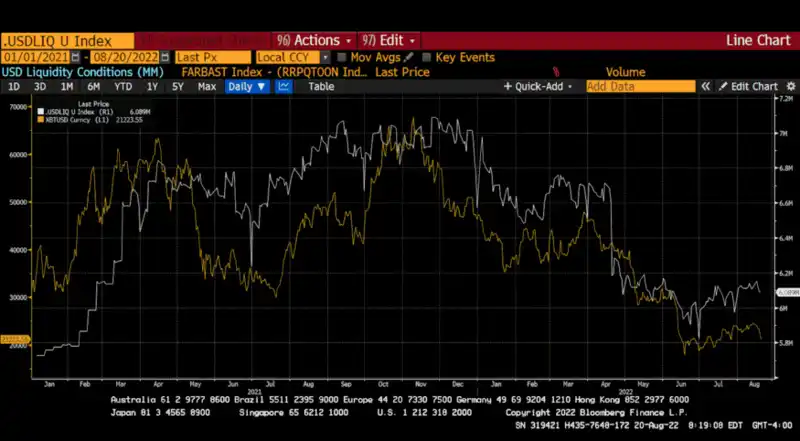
When it all finally came to my head, I created a custom chart depicting what I call the USD Liquidity Conditions Index.
USD Liquidity Conditions Index = [Fed's Balance Sheet] - [Total Repo Bids Accepted by NY Fed] - [Holds in NY Fed US Treasury General Account Balance]
Bitcoin and USD Liquidity Conditions Index
In At the current stage of the crypto capital markets, Bitcoin represents a strong synchronization (and sometimes a leading indicator) of global dollar liquidity conditions.
Bitcoin (yellow) and USD liquidity conditions (white)
In order to determine the authenticity of this relationship , let's look at local liquidity tops and bottoms from 2021 to date.
Each date corresponds to a partial top or partial bottom - and the timing is magical. Bitcoin has been rising on the upside and down on the downside. It's a bit of a shame that at the moment, Bitcoin is just a high-powered indicator of USD liquidity, but fundamentally, that's not surprising.
Bitcoin is a digital currency that represents different systems and ideologies about how society best organizes its monetary affairs. The U.S. dollar is the global reserve currency, which is installed with the Western financial system led by the United States. If the dollar system generates excess, Bitcoin absorbs them. Bitcoin is a real-time smoke alarm about the profligacy of the dollar-based financial system.
Price vs Quantity
Which is more important for risky assets - the price of the dollar (federal funds interest rate) or the amount of dollars (dollar liquidity conditions)?
Federal Funds Cap (Yellow) vs. Dollar Liquidity Conditions (White)
The Federal Reserve started in March this year" Actively raise policy interest rates. However, rebounding from the recent local bottom, USD liquidity conditions are starting to improve. Risk assets such as Bitcoin and U.S. stocks have reacted positively to rising dollar liquidity despite rising currency prices.
So, at the moment, it appears that the performance of financial assets is more dependent on the quantity of money than its price.
Bitcoin Controlling Factors
With Bitcoin being institutionalized, most crypto The currency cannot beat the dollar performance of the market on an absolute basis. However, I am confident that Ethereum's recent positive price performance is entirely due to the expected impact of the upcoming merger. I explained this in detail in my last two articles "ETH -flexive" and "Max Bidding".
In the latter article, I argue why we may see the Fed shift from fighting inflation to easing financial conditions in the short term. However, if we look back at the USD Liquidity Conditions Index chart, the Liquidity Conditions Index has recently declined from local highs (meaning tightening liquidity conditions), and the cryptocurrency has been halved as a result. I can form all the theories I want about the Fed's turn, but if the USD Liquidity Conditions Index continues to move lower, I'm simply wrong. But now that I have a more general understanding of how different aspects of this index contribute to an increase or decrease in dollar liquidity, I can form a more nuanced view of how the Fed swings from side to side.
Let's approach this situation as a politician who cares more about accounting and public perception than economic reality. I need the Fed to look like it's fighting inflation, but I also need the stock market to go up so my rich donors are happy. how should I do it?
If the quantity of money affects financial markets more than its price, then the Fed can raise rates at will without hurting markets - as long as the dollar liquidity conditions index also rose. The act of raising policy rates can make it look like the Fed is fighting inflation, and the Fed can even allow its balance sheet to decline to help maintain its image. But behind the scenes, it still has the power to affect RRP balances, and it can also call on the Treasury to spend more money to generate economic activity — leading to a net increase in money and boosting stock performance. Clearly, these two potential leverages have limited capabilities - neither RRP balance nor TGA can go below zero - but they can still be used to effectively offset QT in the short term.
In summary, I remain concerned about the pre-merger and post-merger macro-financial month. I still think that even if the Fed does not signal a formal turnaround, there is a good chance that the NY Fed and Treasury will release USD liquidity (via RRP balances and TGA) before the election, which will act as a booster for risk assets in the market.
Unless the Fed or the Treasury come forward and tell us clearly that the rate at which the RRP facility or TGA is depleted will change, there are only three liquidity index variables we can monitor , and make imperfect assumptions about their recent trajectories.
Some would argue that I'm moving target positions to justify my market positioning, and that's perfectly fair. However, as I said before, regardless of the USD liquidity situation, I think the consolidation will drive the price of ETH higher. I still believe that the positive impact on price of a large reduction in ETH output and the positive reflexivity between price/network activity/network usage will overcome any tightening of USD liquidity conditions - just that price action may be weaker than I predict or hope.
Original link
Welcome to join the official BlockBeats community:
Telegram Subscription Group: https://t.me/theblockbeats
Telegram Discussion Group: https://t.me/BlockBeats_App
Official Twitter Account: https://twitter.com/BlockBeatsAsia