



What is the NFT "Crowdfund" protocol Tessera, led by Paradigm, all about?
Original Title: "A Quick Look at the NFT 'Crowdfund' Protocol Tessera, Led by Paradigm"
Original Source: The DeFi Way
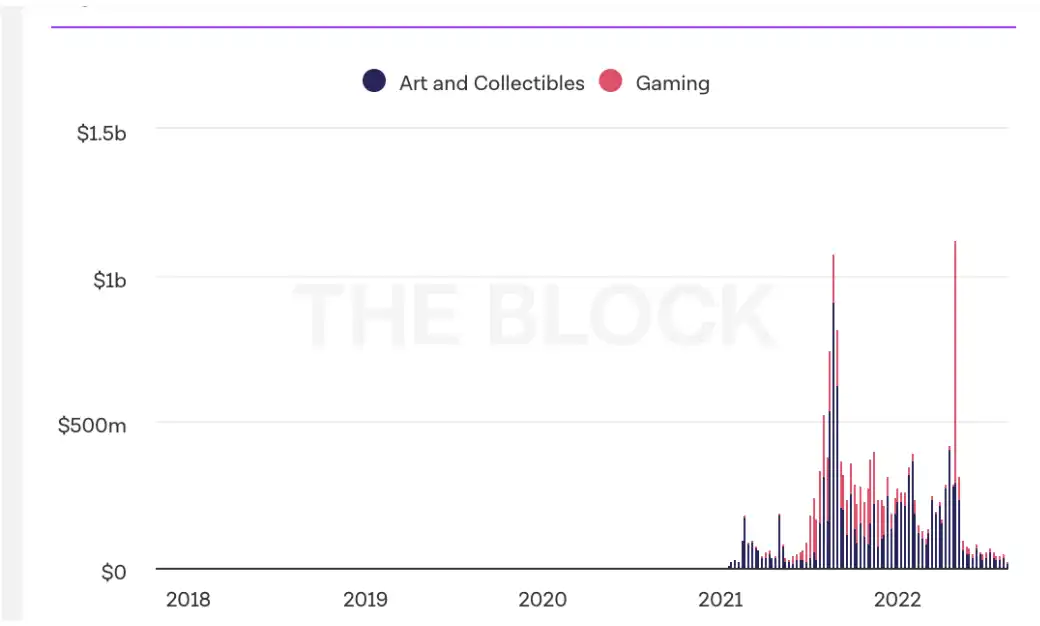
According to data, in the past 30 days, the daily trading volume of the NFT marketplace OpenSea has dropped to $16.6 million, while its average daily volume over the past year was approximately $83.28 million, indicating that the NFT market is currently in a declining state.
(Note: Image from theblock)
So, is the NFT market about to "rug pull"? Simply looking at the data trend, most people would probably think so.
However, some institutions with "gigabrain" are going against the grain. According to The DeFi Way, the NFT platform Tessera recently completed a $20 million Series A funding round led by Paradigm, with additional participation from Uniswap Labs Ventures, Focus Labs, eGirl Capital, Yunt Capital, and over 50 individual angel investors. Tessera, formerly known as the NFT fractionalization protocol Fractional, also received a $7.9 million seed round led by Paradigm during last year's NFT bull market.
Daring to increase their bets in the NFT bear market, these investment institutions naturally see a bright future for Tessera and the entire NFT market.
So, what exactly does Tessera do?
Tessera's New Fractionalization Protocol
According to a blog post by Andy8052, co-founder of Tessera, their original fractionalization service, Fractional.art, will continue to exist, with its key features such as buying fractions through the frontend, initiating buyouts, and claiming NFTs all remaining intact. Additionally, NFTs acquired through PartyBid collective bidding will continue to appear on the fractional.art explorer.
However, it is worth noting that Tessera will no longer actively develop the Fractional.art interface, and at some point in the future, the Fractional.art website will be sunset, with the related functionality moving to Tessera.
Additionally, the "Fractionalize" fractionalization feature on the Fractional.art website frontend will be disabled, and the interface for creating new vaults on Fractional.art will also be deprecated (although users can still interact with smart contracts directly to fractionalize).
It is evident that the existing fractionalization solution has been disapproved by Tessera, with Andy8052 explaining Tessera's next steps as follows:
"We aim to help build a world where anyone has the opportunity to collectively own and govern the things they cherish, without relying on centralized gatekeepers to represent them in making decisions and taking action. In the coming months, you will start to see us roll out new and exciting ways to collectively own NFTs online with friends and strangers."
According to the Fractional V2 design document, the new protocol is designed around the concept of Hyperstructures (a concept proposed by Zora co-founder jacob), which is permissionless and trustless. Furthermore, the new protocol adopts an NFT fractionalization scheme called "RICKS," ensuring that fractions can always be converted back to their underlying NFT, while addressing liquidity and coordination issues of all-or-nothing Dutch auctions.
Another notable change is that tokens fractionalized using the V2 protocol are no longer speculative homogeneous ERC-20 tokens but ERC-1155 standard tokens used to manage trustless vaults containing NFTs.
Explore Trustless Gaming NFT Aggregation Service
In addition, Tessera is exploring new gaming NFT aggregation services. For example, it recently launched an NFT bundling service for the sci-fi card game Parallel. In essence, Parallel distributes its ecosystem's key resource, Prime Token , to card holders through staking. Parasets, composed of these cards, can receive more Prime Token . However, since Parasets need to collect multiple cards, and some rare Parasets are very expensive (e.g., the current secondary market price for a set of PD1 Art Cards is 143.5 ETH), most NFT holders are unable to complete this collection task and therefore miss out on additional rewards.
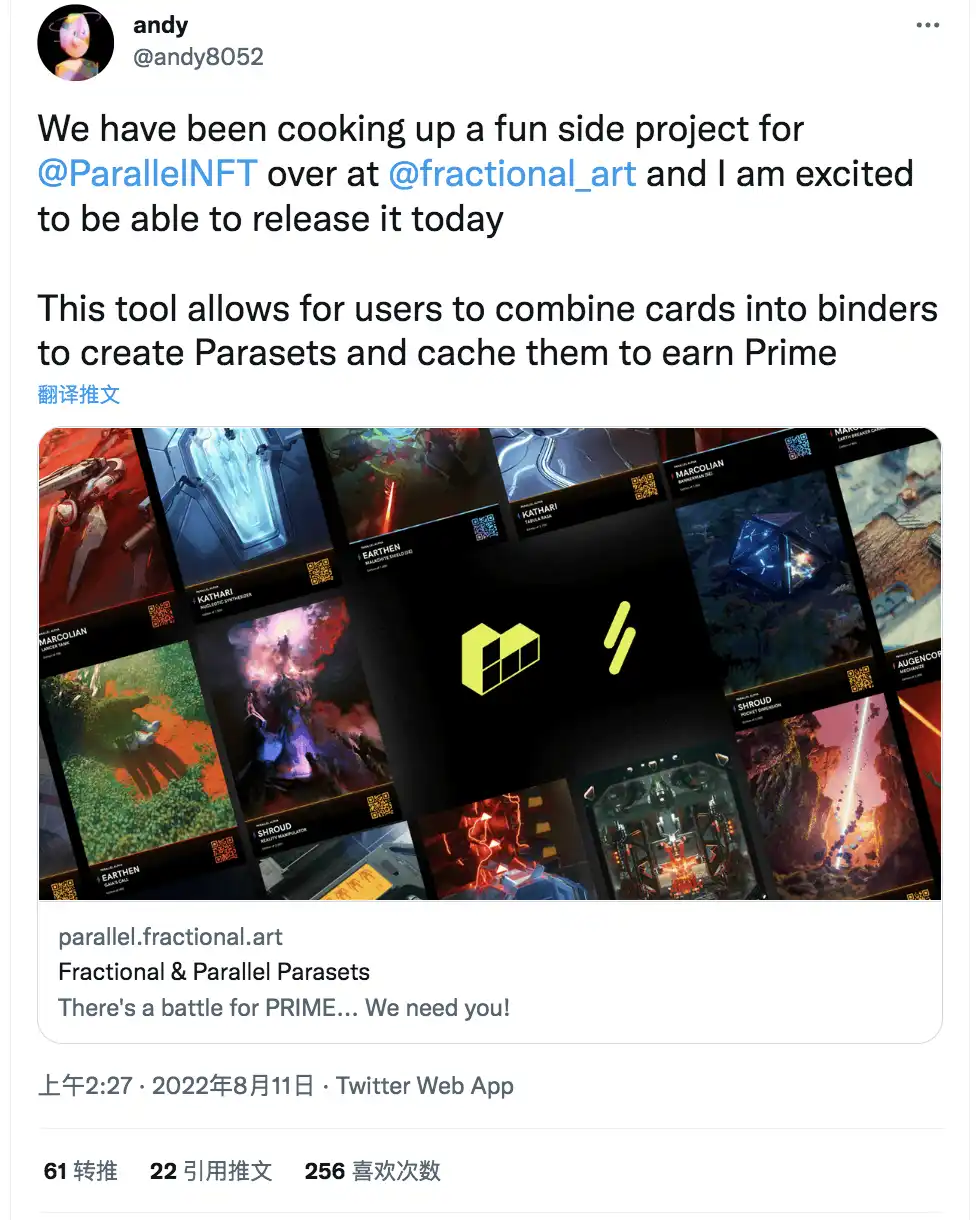
The tools provided by Tessera allow holders of Parallel NFT Cards to collaborate to collect Parasets and earn Prime Token rewards through staking, and then distribute the Token to NFT holders via the Splits protocol. As a third-party service provider, Tessera will take a 10% cut of the Prime Token as a fee.
All of this is accomplished through smart contracts, which means that if the contract is bug-free, gamers can confidently pool their NFTs and unlock additional rewards. (Note: The code for this service has not yet been audited.)
Here is another example from a well-known traditional game: in World of Warcraft, there are challenging dungeon bosses that, when defeated, yield greater in-game rewards. However, due to trust issues among players, they cannot pool their best gear together. As a result, most guild players are at a significant disadvantage. But if a trustless method is provided that allows ordinary players to securely entrust their gear to others and receive corresponding rewards, this service would see high demand. As a service provider, one could earn significant income from this.
However, this will clearly face significant challenges because different games have different rules. Therefore, Tessera needs to select appropriate games and tailor its services accordingly. And as a chain game led by Paradigm, Parallel will naturally be the first target supported by Tessera.
A Modest View
Currently, Tessera's two NFT business lines target two different markets. Fragmentation is aimed at high-value art collectibles, such as Doge meme pictures, CryptoPunks, Bored Ape Yacht Club, Cool Cats, etc., which were the stars of the previous NFT bull market. Tessera's new aggregated NFT service route targets the emerging blockchain gaming market, which has a more obvious use case.
Finally, regarding the governance Token of the project, Tessera's Discord FAQ page currently mentions that it does not have a Token or airdrop, but anything can happen.
One thing to note, however, is that before taking any action, we need to ask ourselves two questions: (1) Are we still bullish on the NFT market? (2) Are we bullish on Tessera's business direction?
Original Article Link
Welcome to join the official BlockBeats community:
Telegram Subscription Group: https://t.me/theblockbeats
Telegram Discussion Group: https://t.me/BlockBeats_App
Official Twitter Account: https://twitter.com/BlockBeatsAsia


