Dialogue with the founder of BAYC: the story behind the boring ape with a valuation of 4 billion US dollars
Original title: "Planet of the Bored Apes: Inside the NFT world』s biggest success story"
Author: Jessica Klein, inputmag
Original compilation: Old Yuppie< /blockquote>This article comes from the WeChat public account: Old Yuppie
On the evening of February 4 this year, Greg Solano, 33, and Wylie Aronow, 35, were at their respective homes with their significant other when they got some shocking news.
They have just learned that BuzzFeed News will publish a story revealing their identities to the wider world, having been carefully concealed until now True identity (they think they are hiding it well).
Speaking at a midtown Manhattan hotel earlier this month, Solano recalled: "We had a 20-minute warning."
As Solano and Aronow do when they make a big or even a small decision about their business, they immediately make a phone call and everyone freaks out , and then planned the next move. "Frankly, we have very real security concerns," Aronow said. He sits on a bench in the hotel courtyard restaurant, next to Solano. Bad guys may try to hack into their accounts. People could show up at their home or do worse things to them than that. "We don't know what's going to happen," they both said.
They started removing personal information from the Internet. Aronow recalls deactivating his Instagram, fearing it might contain clues about his home's location, before they warned his own family of what was about to happen, lest they, too, be targeted.
While Aronow's immediate family fully understands why the upcoming article is drawing such attention, Solano had to explain the situation to his father. He and Aronow are the creators of The Boring Apes Yacht Club, the hottest NFT project on the internet. They launched Bored Ape Yacht Club in April 2021 through Yuga Labs, a company currently valued at $4 billion.
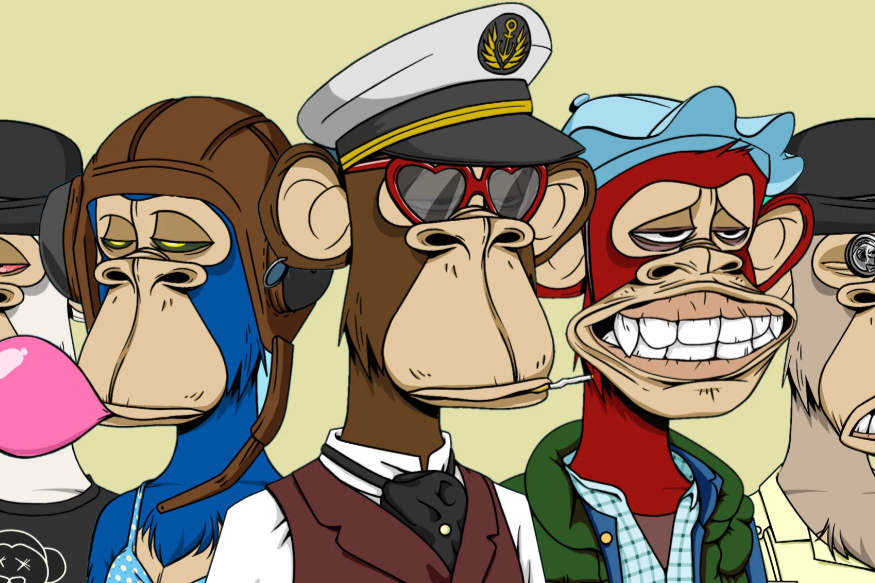
The Boring Ape is an orangutan made up of 10,000 unique digital head and shoulder paintings, each with a unique combination of traits ranging from the common ("boring" beak) to ultra-rare (“pure gold ” fur). Last October, a rare ape fetched an eye-popping $3.4 million at a Sotheby's auction. That same month, Guy Oseary, a senior talent manager representing Madonna and U2, became a business partner of BAYC.
Today, the Bored Ape is ubiquitous in pop culture, from T-shirts sold at Old Navy to VMA-nominated music videos shot by Snoop Dogg and Eminem. Celebrities like Steph Curry, Justin Bieber, Gwyneth Paltrow, Post Malone, and Seth Green all have Boring Apes. Other high-profile holders include Jimmy Fallon and Paris Hilton, who had a controversial exchange about their apes on The Tonight Show in January. (Solano and Aronow said they had no prior knowledge of Fallon's quote and thought it was "very surreal" to be on the show.)
Despite the collapse of the cryptocurrency and NFT markets this year, Boring Ape is still considered a "blue chip" investment in the space. The current floor price for an ape is about $140,000, down from a high of about $434,000 in April. Yuga Labs gets a 2.5% royalty for every secondary sale of the Boring Ape NFT.
Solano's father knew his son was working on a project in the NFT and cryptocurrency space, but he didn't know until that night in February when he got a call from his son detail. Solano, who is of Cuban descent, explained: "I didn't tell my father because he would tell everyone. He would tell the women at la carreta (coffee shop) - my son was behind it!. Who else would want to know , who else would want to know?"
This would have been a problem, because before the BuzzFeed article was published, most people only knew the account names they used online— —Solano is Gargamel, taken from the villainous wizard in The Smurfs, Aronow is Gordon Goner, a punk-inspired name, and their corresponding ape-like head.
The same goes for the other two co-founders of BAYC, who are responsible for the technical aspects. Zeshan Ali, 32, whose name was No Sass, later shortened to Sass (his profile on BAYC's website reads "Here for the orangutans, not Sass"), and Kerem Atalay, 31, aka Emperor Tomato Ketchup (named after an album by Anglo-French indie pop group Stereolab).
And all four of them want to keep it that way. In their view, Solano and Aronow were underdogs. (The identities of Ali and Atalay were not disclosed in the article.) Buzzfeed News senior technology reporter Katie Notopoulos, who wrote the article, disagreed with that assessment. "I would qualify it as news. Many other reasonable people would, too," Notopoulos told Input. As she explained on June's Untangled podcast, "we don't know" the people who run a multibillion-dollar company that seems to go against all social norms.
While working out their plan of action on the phone, Solano and Aronow decided it would be best to "human flesh them" by tweeting their picture first. Solano marvels: "Aronow found good photos of themselves very quickly. Instead of preempting BuzzFeed's story, they revealed their true colors to the Internet within an hour of the report's publication."
Four days later, Ali and Atalay followed, at Their names and pictures of themselves were tweeted. "We wanted to have more control over the narrative and make it a more celebratory event than Greg and Wylie," said Atalay.
Months Now, Solano and Aronow are trying to take back control of their own narrative. So this meeting, accompanied by their publicist, finally told their story in full for the first time and publicly resolved a major controversy that had dogged them for more than a year.
“F*CKING EVIL”
During our time together, Solano and Aronow exude A fraternal yet guarded atmosphere. "We are the most superstitious people in the world," Solano said. He wore a tan T-shirt to the interview because Aronow thought he needed “yellow energy.”
Aronow wears what he considers a "positive" amber bracelet and barely eats his cheeseburger. At one point, Solano kindly made fun of his friend's eating habits. "Wylie only eats things like cheeseburgers and chicken wraps. We joke that he has a baby mouth," he said.
I later learned that it was the result of a debilitating disease that crippled Aronow for the better part of a decade, starting in his 20s. Li has been bedridden. He is now able to control the condition, but it remains fluid and even the salad is a threat to him, causing his disease (he won't say what) to flare up again.
That's the pressure. As Yuga's current public face, that seems like a nerve-racking one. The company is growing: In March, it purchased two other popular NFT collections, CryptoPunks and Meebits, from creator Larva Labs. Shortly thereafter, Yuga launched what was essentially its own cryptocurrency, ApeCoin.
In the days since our chat, Yuga will be hosting a massive demo of Otherside, an immersive game it's developing with UK-based studio Improbable . Only, this isn't just a game - it's the beginning of the Web3 metaverse, open to the masses beyond the Boring Ape community. Yuga will compete directly with big players like Meta.
More stressful, however, is litigation. In June, Yuga sued concept artist Ryder Ripps (which is the same event known for working with artists like Kanye West and brands like Gucci) for trademark infringement, among other complaints, for creating an NFT collection identical to Boring Apes in May. The project raked in an estimated $1.8 million in profits, Artnet reported. (Mainstream NFT marketplace OpenSea removed this series).
But Ripps' copycat project (known as RR/BAYC) is only part of the problem. (Ripps told Input that he worked with three others on RR/BAYC, including NFT marketplace creator Jeremy Cahen, who was also sued). Since late last year, Ripps has been very public in accusing BAYC of being riddled with racist and neo-Nazi symbolism. BAYC's founder has denied these claims, saying they are all part of a plan to drum up interest in Ripps' knockoff ape.
Solano said: "It is extremely obvious to anyone who knows our history, what an absurd thing this is. Having said that, The obsession of the trolls, the malice, frankly, how fucking evil the whole thing is, it's hard."
A grim look crossed Aronow's face as he described the onslaught of online hate they had received over the allegations. "It's like this every day," he said.
Weird couple
Aronow said: "Background-wise, we're really an odd couple partner". He was referring to his friendship with Solano. This is obvious. The first thing you notice is the huge height difference between the business partners: Aronow, at 6-foot-2, is taller than Solano.
Aronow has thick black hair and is covered in tattoos (he is embarrassed by the lifelike portrait of author Charles Bukowski on his right arm, which he tattooed as a teenager). His voice was low and sonorous. He is the human incarnation of "LFG" ("Let's Fucking Go"), a rallying point for NFT enthusiasts. Solano, a bald, goateed, soft-spoken man, calls Aronow the perfect motivating “workout buddy.”
Aronow said: "We would fight over every idea, whether it was a simple tweet or an entire NFT project. In fact, our friendship started with a We first met at a dive bar in Miami during our college break home about ten years ago, where they started debating the merits of David Foster Wallace’s Infinite Jest, which Solano hadn’t even read, but He hated the book reflexively because his creative writing classmates raved about it. They kept in touch at a distance, arguing about books, movies and ideas, and playing World of Warcraft together online.”
A few years later, in 2017, the two started talking cryptocurrency. Like everyone else, they're trying to make some money in a bull market. But they are most interested in the possibilities presented by the Ethereum blockchain, on which people have built decentralized applications, including gamified collectibles like CryptoKitties, where you can buy, trade and breed unique cartoon cats to create more Kitties.
Despite his interest in digital collectibles, Solano did not purchase his first NFT until early 2021. Shortly thereafter, in February, Solano texted Aronow about starting an NFT project of their own. “We started thinking about it right away,” Aronow said. One of the ideas was a public digital canvas, which Aronow shared with his longtime friend Nicole Muniz, who is now the CEO of Yuga. She keenly predicted that someone would draw on it. A little brother".
These guys did just that. "I was like, where would you draw a dildo?. The answer was: on the bathroom wall of a dive bar. So what kind of person would go there?" Aronow said. The kind of people he knows on Crypto Twitter who have made their fortunes from crypto but still only want to play MMORPGs online rather than live the expected multi-millionaire luxury life.
Aronow sent Solano "an entire article" outlining the idea, where the name "Bored Ape Yacht Club" came up. “As a great editor, Solano said—‘That’s it. That’s it,’” recalls Aronow. This concept evolved - in cryptocurrency millionaires are real apes, the word "ape" means someone living in 2031 compulsively investing in a new project without doing much research. Aronow said he and Solano created an LLC the next day. (The information BuzzFeed reporters used to candid him was mostly related to Solano’s address at the time)
“I’d love to talk to other people who suddenly created some Very popular stuff. It's unbelievably surreal."
They weren't artists, and at the time, Solano was working in publishing and Aronow wasn't, So they hired a team to execute their idea. Muniz, the founder of a brand consultancy, introduced them to a visual artist known as Seneca, who created the original BAYC concept art based on directions like "raggy punk rock" and "dive bars in the Everglades." Four other artists helped design the original 10,000 apes.
In a Rolling Stone profile earlier this year, Seneca called her compensation for the project "suboptimal." They compensated her for four or five days of work, roughly what Solano was making at the time in the five figures, and paid Seneca and four other artists $1 million each late last year, the two said. (Seneca did not respond to Input's request for comment).
Meanwhile, Solano got in touch with his friends Ali and Atalay, whom he met while studying computer science at the University of Maryland. (Solano first met Atalay when they were both at the University of Virginia—Solano's MFA, Atalay's undergraduate). Ali grew up on the West Coast to immigrant parents from Guatemala and Pakistan who met in English class. Atalay's parents are also immigrants from Turkey; he says he had a "normal, suburban upbringing," mostly in Washington, D.C.
Solano, who is not a programmer, asked if they knew Javascript, which is not a blockchain-related coding language. The technical duo quickly learned the right programming language - Solidity. "That's the easy part," Atalay said. Because the ERC-721 token standard for NFT programming has long been public, it is easy to use as a template.
The complexity lies in managing the multiple components of the project: the website, the smart contract, the token-gated community space, and stringing them all together. Ali said: "There are only two of us, especially just learning blockchain programming, and it is a big challenge to do this."
But they did it. The presale and minting started on April 23rd. And on the night of April 30, 2021 (the date of Hitler’s death), as Ryder Ripps and other BAYC conspiracy theorists will point out — the quartet released the monkeys, which cost $200 each. Then they went to sleep.
Around 3 am on May 1st, Ali received a call from Atalay. He said Ali thought something was "big wrong," but instead, he and Atalay watched the collection sell out in real time in the early morning hours. (As it turns out, word of BAYC has spread throughout the rabid NFT community). At that moment, they knew they had created something big.
This all happened almost exactly 15 months ago. Shortly thereafter, all four co-founders started working full-time at Yuga Labs. Yuga added new NFTs for the ape family, giving them dogs in June 2021 (via the Bored Ape Club airdrop), and Mutant Apes in August; the latter series sold $96 million within an hour of launch . Steph Curry, one of the first celebrity holders, bought his ape for about $180,000 that same month.
In September 2021, Muniz joined as a partner (one month before Oseary) and became CEO in January of this year. In March 2022, Yuga Labs raised $450 million in a funding round led by a16z. Today, the company has about 70 employees. “I’d love to talk to other people who suddenly created something that became so wildly popular so quickly. It’s just unbelievably surreal,” Aronow said.
The four founders insist that they do not live a glamorous lifestyle. They've all bought homes in locations across the U.S. they declined to disclose (except for Solano, who lives in Miami). But Solano and Aronow say they spend most of their time in their homes, working at least 10 hours in their home offices — Solano’s office is bare-bones, Aronow’s is filled with BAYC items and children’s wallpaper, He said these came with the house.
But they do see Celebrities like Snoop Dogg and Colin Kaepernick. “Sometimes Guy would introduce us to someone on speakerphone. Oseary would hold his phone up to the screen. He would FaceTim with people I totally adore,” Aronow said. Aronow’s favorite celebrity is primatologist Jane Goodall (Yuga Labs donates one percent of the total ApeCoin supply to her foundation). Solano said he enjoyed meeting digital artist Beeple.
Perhaps the biggest change for Solano is that he now takes business calls from celebrities with disdain. In the past, he said, he too has been so introverted: "I wouldn't want to call and order a Pizza Hut."
Queer characters
Both growing up in Miami, Solano and Aronow lament that, because of their The industry in which Miami has become less cool. Their Miami is not the concrete jungle of crypto bros living in downtown high rises. Aronow says his Miami is particularly "lush, beautiful, and full of really weird characters."
As a kid, he met many of these characters—powerful "1980s Miami Vice-era dudes" who were his father's old friend. They would take him out to lunch and tell him stories about his father, Don Aronow, who was murdered in 1987 when Wylie was a baby.
Aronow said: Don Aronow, the son of Jewish immigrants born in Brooklyn, made his fortune in New Jersey construction in the 1950s and later Become a leader in the powerboat industry and become famous in the process. There he witnessed "the emergence of the industry," selling and dealing with "movie stars, kings, and queens."
Subsequent presidents Bush Sr. is a friend who owns Don's power boat. US border security agents use his boat - just like the drug smugglers they hunt. John Travolta's 2018 film Speed Kills ), Aronow described the film as "terrible" and RogerEbert.com gave it half a star.
In 1987, Don was shot dead in his car in North Beach. He was 59 years old at the time. About a decade later, two people—a former powerboat competitor and his alleged hitman—have "no objection" to his murder. But there are still plenty of conspiracy theories surrounding the businessman's death involving gang connections and a jealous partner of an alleged mistress. According to online speculation, Don was also a CIA agent.
Regardless of the true circumstances of Don's life and death, Aronow said the stories he heard from his father's friends often paralleled those of his mother (former Wilhelmina Agency model Lillian Aronow) Conflicting, his death deeply affected Wylie's childhood. He grew up in Coconut Grove with his mother, stepfather, and an older brother who was eight years his senior, the "bar hero" of Miami's punk scene.
Aronow said he did not want to offend his parents, but described his family environment as "shoddy." Much of his childhood was spent in video games, such as Final Fantasy. By the age of 12 or so, he was often away from home, like his older brother before him, to attend local punk rock acts. There, Aronow found a sort of "second family" of similarly problematic characters.
By the age of 15, Aronow was an alcoholic and drug addict. He would run away from home for months at a time, sleeping on construction sites and in mangroves with other young runaways. He said he had been to the same "court-forced treatment" facility twice. He added: "The head of an agency said I had the worst case of alcoholism among teens he had ever seen."
He was sent to No. Two "very messy" institutions. He said: "It's like the Paris Hilton goes, where they kidnap you at night and take you into the desert. The people who ran the Utah center wouldn't let him read anything but the Bible or popular science books, which were basically Alcoholics Anonymous' bible. Aronow chose the latter, saying he read it about 50 times while in Utah, and the book changed his life.
He said, "The minute I got back to Miami, I was captain A.A. trying to help other alcoholics see me feeling in the desert He was 15 years old, smoking cigarettes and drinking black coffee with abstainers decades his senior (these days, Aronow drinks occasionally, but doesn’t do drugs).”
I really wanted to give it all because in the back of my head, I thought, maybe I'm going to be sick again.
Aronow went to college with hopes of getting into a top MFA program like his hero, Syracuse, taught by author Joe George Saunders Just like the university. Those dreams were dashed when Aronow fell seriously ill in his 20s and had to drop out of school.
Again, Aronow won't name his disease - given his superstitious nature, he doesn't want to give it "that energy". But it kept him in bed for the better part of a "truly dark decade." His family supported him financially due to his illness. He traveled across the country looking (mostly to no avail) for a doctor who could help him , he learned to meditate and hung out in online communities, "surviving" by Twitch streamers and YouTubers. He traded cryptocurrencies but never had a real 9-5 job. He somehow managed to meet his current girlfriend.
Finally, in his early 30s, he found the right specialist, the right medicine, and the right diet. He recovered from his illness. Then, at the same time, the rest of the world fell ill. COVID-19 has the upper hand. With everyone stuck at home, people are looking online for ways to get involved in their communities, as Aronow has done for the past decade. NFTs as art and collectibles are on the scene.
Then, in February 2021, Solano texted Aronow: "Hey, do you want to make an NFT?"
< br>
Aronow said, "At the time, I was like, I want to do anything. I really want to give everything, because in the back of my mind, I thought, maybe I'm going to be sick again."
p>
Ordinary People
Solano, by his own admission, has a far less dramatic backstory than Aronow's. His parents, both Cuban immigrants, came to the United States at a very young age, when his mother was an infant and his father joined the Young Vanguard, a communist youth group, when he was old enough. (Solano only went to Cuba for the first time about seven years ago).
Solano's mother has lived in Miami all his life while his father served in the U.S. Army Special Forces, also known as the Green Berets, in his 20s move there. His parents divorced when Solano was 11, and he and his older sister lived with his mother, who worked for a television network, which he declined to name.
Solano wanted to be a writer since he was 11 years old. After graduating from NYU, he moved South to earn an MFA at the University of Virginia, which ended up being "the best time of my life," he says. He could devote all his time to writing, he made friends in no time, he also met his future wife, now a professional landscape architect, who first approached him because she liked him poetry.
“You look at the founder online as a larger life character. Then when you meet them, you’re like, well, that It could really be me."
After graduating from the University of Virginia, he found a job at a small publishing house, working on licensing intellectual property -- Harry Potter coloring book and World of Warcraft handbook. It's not a dream job, nor is it the highest-paying job (cheap Bored Ape NFTs are now selling for double his salary at the time), but it can be satisfying. He said: "When I retire later, I want to write a physical book, which is amazing."
He is aware of the irony of the fact that - his work is now almost invisible. "But at the same time, we've been trying to make it more tangible," he said.
It is true that BAYC has real-life benefits (including access to branded merchandise like hats and hoodies). What's more, ape holders own the intellectual property rights to their apes, which opens up a wide avenue for branding. Actor Seth Green said, "When you're talking about people spending X dollars on any one of these boring apes, what's in that spending is commitment, and opportunity, to be the next Mickey Mouse!".
(In May of this year, Green lost his boring ape, Fred, to a phishing scam. Green later managed to regain ownership of his ape, and he Said he reached a "multi-faceted" deal with the NFT collector who bought the ape from a scammer, and, he told Input: "The Los Angeles County Sheriff's Cybercrime Squad is working on the case. Once I make a deal, get me back." I'm relieved to be able to see this market through God's eyes. Instead of feeling so crazy that all my plans are terminated at the touch of a key.")
< /p>
Business aside, there's fun in the form of an IRL event. Last fall, in conjunction with the NFT.NYC conference, BAYC organized its first-ever ApeFest, which culminated in a warehouse party in Brooklyn featuring performances by Strokes, Beck and Lil Baby (an early celebrity Ape holder) .
At that time, founders can enjoy the festivities without being recognized by the wider BAYC community. Ali said: "I remember last year at ApeFest, I could play with anyone, and no one knew who I was. Once the leak happened, I knew it would be different." The second annual Ape Festival, during the return of NFT.NYC in June, features four nights of acts such as LCD Soundsystem, HAIM, Snoop Dogg, Eminem and (again) Lil Baby.
There are also more modest BAYC parties held around the world. For example, the meetup I went to with Solano and Aronow after our interview. It was held on the leafy patio of a dark basement bar in midtown Manhattan, and about 15 ape holders, one of whom had launched his own Boring Ape brand of hot sauce, gathered for drinks. Like the NFT scene in general, the team skews young and male.
Plans for the 2023 Festival of the Apes have emerged. Someone said, "I'd love to go to Las Vegas. I don't know how many orangutans live in Vegas, but..." Someone else floated the idea of taking the festival to the desert. A prominent community member, Josh Ong, replied, "Apechella!". The concept of the Tokyo Ape Festival in 2025 was proposed. Solano suggested going somewhere "a mountain".
After a quick photo session, the founders' publicist sent them back to the hotel. But some insisted on staying, so I asked How they felt meeting the man who created BAYC. Says a young man named Doris Burke on Twitter (“Not an ESPN announcer,” reads his bio): “It’s almost surreal because they’re just , for example, ordinary people".
He continued: "You see them online as larger than life people, and then you meet them in person and you're like, okay , that could really be me."
"Evil troll"
Not everyone They all regard the founder of BAYC as a "normal person". Many of the critics on Twitter see them as opportunists at the top of a monkey JPEG pyramid scheme, an allegation that Input has previously investigated. (The founders, of course, disagree with that characterization.) And, of course, perhaps their most vocal detractor—Ryder Ripps.
Ripps set up a website earlier this year, GordonGoner.com, where he compared the Yuga Labs logo to the Totenkopf logo used by the Nazis and claimed that Yuga was a The word is an allusion to anti-rightists. (The company says the name comes from a villain in the Nintendo 3DS game The Legend of Zelda: A Link Between Worlds).
Ripps believes that all of the founders' aliases have sinister connotations. Gordon Goner is a variant of drongo negro. Gargamel of the Smurfs is an anti-Semitic depiction of a Jew. Sass was a combination of "two major Nazi military branches," the SA and the SS. Ripps notes that Emperor Tomato Ketchup was originally the title of a Japanese film that was widely censored because it was considered child pornography.
In addition, Ripps claims that apes themselves are a race Anthropologists – This is an example of "apeization," in which people demean a racial or ethnic group by comparing them to monkeys. He also pointed to some allegedly problematic ape features, including a "Prussian helmet" (another Nazi whistle, according to Ripps) and a "sushi chef's headband."
Others have taken his guns and gone a step further, such as popular YouTuber Philion, who recently posted an hour-long video titled For "The Boring Ape Nazi Club", the image of Yuga was dissected. To date, the video has been viewed more than 1.6 million times.
Input investigated Ripps' claims earlier this year, speaking to the artist himself and consulting with experts from the Jewish organization Anti-Defamation League, who have been critical of most of the allegations. doubt. However, experts at the Anti-Defamation League did agree with Ripps that the "hip-hop" features (gold chains, gold teeth) and "sushi chef headband" were problematic. Still, one of the researchers told Input at the time: " It's hard to deduce from that that the people behind them are white supremacists."
Aronow compared the controversy to the rumors surrounding his father's life and death: "We're all wrapped up in a shitty world of intrigue." Both he and Solano became dignified and measured when they spoke of Ripps. The allegations are an understandably sensitive subject. (During their photo shoot the next day, Aronow noticed what appeared to be a German badge on the sleeve of the green army jacket he was wearing. He kept repeating, "This is not my jacket." The camera team promised to edit out this detail).
The founders say Ripps is a "vicious troll" who is good at "stealing" and embarrassing them in front of people who don't know the situation. They suggested the factional line that Aronow and Oseary were Jewish and that the other three Yuga founders were the children of immigrants.
Oseary said: "Early on, I was really offended. I even contacted Ripps. I figured by talking to him through me, he would know that I was always Wouldn't be associated with something like that. You know, I'm Israeli, I'm Jewish."
"This should always be a fun, rebellious club. It should never be above criticism of any kind."
The founder added that Ripps had been deliberately trying to get them to sue him. (In June, Yuga Labs filed a lawsuit against Ripps in the U.S. District Court for the Central District of California, alleging that Ripps "deceived consumers into purchasing RR/BAYC NFTs by misusing Yuga Labs' trademarks" and "by using knockoff NFTs of the original Bored Ape Yacht Club image. series flooding the NFT market, belittling Bored Ape NFT".
Ripps said, "By implying that I'm doing things for the money, it's a note to the validity of my critique means of force transfer". He called his series a "protest and parody of BAYC." In a video interview with The Defiant, Ripps called RR/BAYC, "probably the greatest work I've ever done." He added , "It proves what an NFT is. It is a provocation to a company. It reveals a very important problem. It is creating an army of educators".
I brought up features like the sushi chef's headband when discussing the controversy at the hotel with Solano and Aronow. Solano said: "This was supposed to be a fun, uninhibited club. It should never have gone beyond Criticism of any kind.”
Aronow added: “It’s hard not to offend everyone in the world.”
< /p>
Entering the Metaverse
Three days after meeting Solano and Aronow, I was standing in an all white room surrounded by what appeared to be stone The robot that did it. About 4,500 of us (including the four founders) gathered, and Curtis, a great ape in a Hawaiian shirt and captain's cap, explained the trip we were going to take together. Beside him was a pudgy called Koda. The man's name is Blue.
Curtis announced at the start of Yuga Labs' first public demonstration of the new metaverse: "Welcome, Travelers, come to another world. Or to infinite space, kind of like the halls of other worlds.”
In some of the articles about how to let us After being directed like avatar dancing, a hole opened up beneath us. We were all sucked into a swirling rainbow channel that spit us out onto a verdant island. Curtis quipped, "Whoa, nerds, get down." It's raining!".
in For the next hour or so, we nerds completed a series of tasks under the guidance of Curtis and Blue. We're looking for a "new pair" of glasses for someone who broke them at a recent NFT.NYC conference, and teamed up to incapacitate a dangerous, drunk Koda (we're told, Otherside's "First Boss Fight" "). At the end of the demo, everyone strikes a set of "selfie" poses.
On Crypto Twitter, the reaction to the demo was overwhelming. A few days later, Solano, Aronow, and I chatted on Zoom about the demo. "Honestly, it was one of our best launches," Aronow said. They point out that while in Otherside there are quests to complete and drunken baddies to overthrow, the point of the game isn't that it's a game. It is a virtual casual place where players can simply play with their ape brothers, buy assets in the world with ape coins and own them in the form of NFT.
They explain that this is an "interoperable metaverse" because people can bring their NFTs in and out of the Otherside, and use them on Web3 use them elsewhere. Fortnite, for example, makes money from players buying in-game assets, such as skins for their avatars; its publisher, Epic Games, made more than $9 billion from the game in 2018 and 2019. "All of this value is going into the metaverse, and none of it is coming out," says Aronow.
It's also a collaborative metaverse. Travelers (users who buy with Otherdeed tokens) get a piece of land in the Metaverse, which they can use as they please (according to the Otherside document: "under the informed guidance of the community"). Voyagers can also provide feedback through the Discord server, which is likely to affect the shape of Otherside. “They were iteratively typing in what this was going to be, every step of the way, along the way,” Aronow explained.
“The ambition and scale of what we are trying to accomplish here is enormous.”
He goes on to say that this will help Yuga compete with Internet giant Meta in the race to the ultimate Metaverse. "The ambition and the scale of what we are trying to accomplish here is enormous," he said.
Solano and Aronow believe they are the right people for the job. "In the wrong hands (possibly bad actors) the metaverse can be a utopian, scary place," Aronow said. "They envision their metaverse as lush, beautiful, and full of really weird characters." .(Though probably packed with "a lot of men" as someone put it in the group chat of the Otherside demo)".
Otherside will take years to develop, they say. But when it's ready, one has to wonder, who cares? The world of cryptocurrencies is moving fast, and by then, wouldn’t the ape craze be over? Plus, the cryptocurrency and NFT markets have been on the decline lately.
When I brought up the ongoing crypto winter at the hotel, Solano told me: "The loser's game is on to focus on the bear market". Plus, they're not worried. They have plenty of money.
Aronow added: "We are extraordinarily high margins. We have a very good competitive fund here to make sure we survive, and not just survive , but building in any multi-year bear market. Just keep building, building, and building.”
This is a huge challenge when founders are still Just a pair of completely anonymous partners who could never have imagined it while discussing drawings of dicks on a hypothetical bathroom wall. Aronow said: "We may be the largest company in the NFT field at the moment, but we are far from the largest company in terms of building the metaverse. We are going to kill some giants."
Original link
Welcome to join the official BlockBeats community:
Telegram Subscription Group: https://t.me/theblockbeats
Telegram Discussion Group: https://t.me/BlockBeats_App
Official Twitter Account: https://twitter.com/BlockBeatsAsia


 Related Articles