Which DeFi protocols have achieved profitability in this bear market?

Original title: "Six blue-chip DeFi protocol bear market profitability analysis, only one achieves profitability"
Original author: Ben Giove, Bankless analyst
Compilation of the original text: The way of DeFi
Today, the continuous optimization of growth in the early stages of startups has become the standard for achieving development.
They forget about profitability and focus entirely on achieving strong product market fit.
This is a tried and tested strategy that has helped build some of the largest web2 companies in the world.
This is alpha. The same is true for DeFi protocols.
Today, a DeFi protocol is focused on acquiring users, liquidity, and whatever else it needs. And because DeFi projects control their own “money,” they can rely on clever tricks like token releases to generate short-term appeal.
But is this model sustainable?
Will this use be Token Overwhelmed by incentives?
Are users really willing to pay for the services provided by the agreement?
Can the DeFi protocol be profitable?
In this article, Bankless analyst Ben Giove conducts an in-depth study of the six major DeFi protocols (Uniswap, Aave, Compound, Maker , Lido, and Maple) to answer that question and assess their path to profitability.

Which DeFi protocols Profitable in this bear market?
Introduction
One of the defining themes of the 2022 bear market is increasing Pay more attention to the fundamentals of all directions of encryption, especially DeFi.
As prices have dropped, reckless spending habits and a lack of sustainable business models have come into focus. While many blue-chip DeFi protocols have been lauded for their ability to generate revenue, less attention has been paid to whether they are actually profitable.
Let’s take a look at six market-leading exchanges over the past six months: Uniswap, Aave, Compound, Maker, Maple, and Lido The profitability of blue-chip DeFi protocols, and a deep dive into the wider implications.
Defining profitability
Before starting our analysis, it is important to define a protocol profitability What it means, but this definition has always lacked a clear consensus.
While all DeFi protocols generate revenue to compensate participants (such as lenders or liquidity providers) for the risk they take, Not all protocols capture some of that value for themselves.
Furthermore, there is usually little discussion of the major costs of generating such revenue. Like many businesses, the protocol "costs money to make money". They have payouts, and the largest and most common payout is Token freed.
Token is a very powerful tool that can be used to incentivize all types of behavior, and is most commonly used in DeFi to incentivize adoption in the form of liquidity mining.
With these concepts in mind, in our analysis we will use the Talking About Fight Club article "Comparing DEX Profitability Profitability definition outlined in .
In the article, the authors define profitability (net income) as:
< /p>
Net Income = Agreement Income- Token Release
Although the author is submitting Token Protocol revenue is referred to in cases where holders receive fees, but we will expand this definition to cover all DAO revenues, whether they are for Token holders, accrued to a local treasury, or used for any other purpose.
Token Release refers to the allocation of participants in the protocol Token , such as through liquidity mining or referral programs. This definition does not include team or investor unlocks.
While it does not cover all operating expenses such as compensation, it does give a good illustration of the profitability.
Profitability
In addition to looking at net income, we will also discuss profitability. Profitability is a valuable metric that allows us to understand how efficiently each protocol captures a portion of the total revenue it generates, and will allow for more nuanced comparisons of profitability.
The two ratios we will be using are the Negotiated Margin and Profit Margin.
The protocol bond is a measure of the protocol's take rate, or what percentage of the total revenue generated should go to the DAO. It is calculated by dividing agreement revenue by total revenue.
Result table

Indicators from the past six months (January 27th - July 27th)
Achieving Profitable Agreement
;
Maker

Maker agreement income - Source: Token Terminal
Maker generates income by charging borrowers interest (called a stability fee) and by cutting protocol liquidations.
Over the six-month period, the protocol generated $28.61 million in gross revenue, all of which went to the DAO. Since Maker doesn't have Token release, so its agreement and profit margin are both 100%. Nonetheless, it’s worth mentioning that Maker is one of the DAOs that provides insight into its operating expenses, and the protocol has managed to remain profitable.
Unprofitable agreement
Aave

Aave Protocol Revenue- Source: Token Terminal
Aave generates revenue by taking a cut of the interest paid to lenders on the platform.
Over the past six months, Aave’s total revenue was $101.41 million, of which $90.48 million was paid out to lenders ( supplier revenue), $10.92 million was paid to the agreement. This puts their agreement margin at 10.8%.
However, Aave paid out $74.89 million in incentives during this period as Token Released, the agreement lost $63.96 million.
Compound
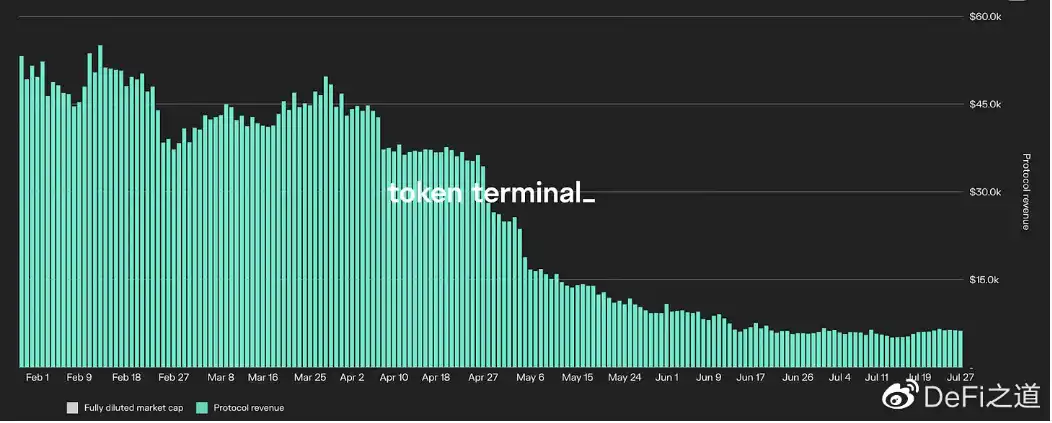
Compound Protocol Revenue - Source: Token Terminal
Compound generates revenue by reducing interest payments to lenders (although this is currently used to buffer protocol reserves ).
Compound generated $42.31 million in revenue, of which $4.8 million accrued to the protocol. This gives them a protocol margin of 11.3%, 0.5% higher than Aave's main competitor.
Despite higher margins, Compound still lost $21.36 million over six months (though smaller than Aave).
Maple Finance
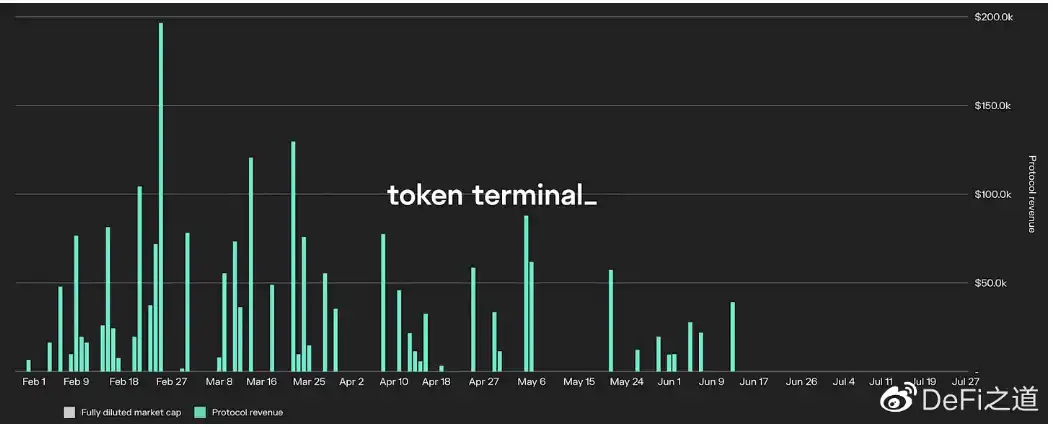
Maple Finance Protocol Revenue - Source: Token Terminal
Maple generates revenue from origination fees collected from loans issued by pool delegates , pool representatives are entities that manage liquidity pools on the platform. Currently, the fee is 0.99%, with 0.66% accruing to the protocol (distributed between the DAO treasury and xMPL stakers), and the remaining 0.33% going to pool representatives.
Maple generated $2.15 million in protocol revenue over the last six months while disbursing $25.74 million in MPL incentives to encourage deposits into various pools, which cost them $23.58 million over the period.
Lido Finance
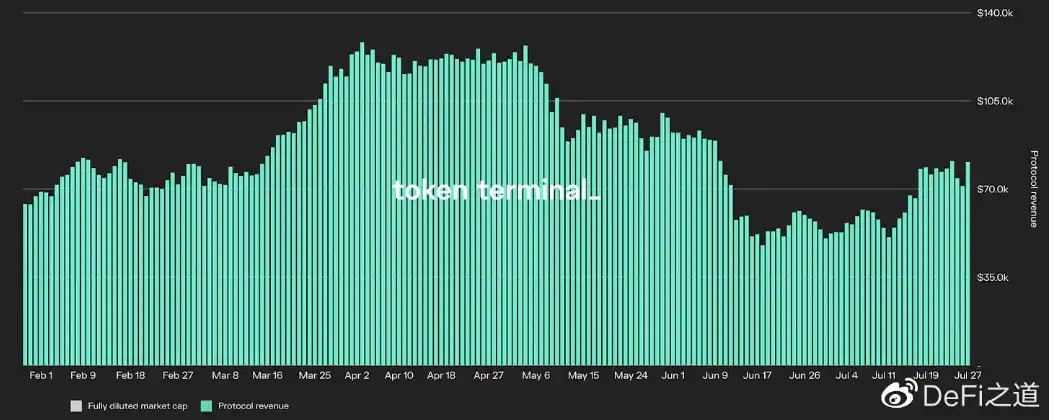
Lido Protocol Revenue - Source: Token Terminal
Lido through the pledge obtained from validators on the Beacon Chain 10% of the rewards are taken to generate income.
In this regard, Lido generated $15.64 million in protocol revenue while incentivizing liquidity on trading platforms like Curve and Balancer and $48.98 million in LDOs generated through the Voitum Bribe and Protocol Referral Program.
This means the LDO lost $33.34 million during the period.
A potentially profitable agreement
Uniswap

Uniswap Supply Side Income- Source: Token Terminal
Uniswap Generated $458.5 million in revenue for liquidity providers in the past six months. However, none of this is factored into the protocol, as Uniswap has yet to turn on a “fee switch” where the DAO can earn 10-25% LP fees for pools that open it.
It is unclear what impact the fee switch will have on Uniswap's liquidity, as cutting fees for liquidity providers may causing them to migrate to other platforms. This could worsen trade execution, reducing trading volume in the highly competitive DEX industry.
Uniswap aims to pay out $0 in the last six months Token release, which makes it very likely that the protocol will be profitable if they choose to turn on the fee switch.
Summary
As we can see, MakerDAO is the only one of the six protocols by our definition profitable.
On the one hand, this is understandable. The vast majority of early-stage startups — DeFi protocols certainly qualify — are unprofitable.
The fact that the protocols listed above, and many others, simply follow the Web2 model of operating at a loss to fuel growth, is One strategy has proven to be very successful for a variety of different startups and corporations.
Nevertheless, the issue Token Certainly an inherently unsustainable strategy. Money is not infinite, and liquidity mining schemes are highly reflexive due to their Token The longer they last, the longer they last, the less their potency and effectiveness will be. also, Token The selling pressure of the issuance often robs the protocol of its ability to capitalize itself, as the DAO treasury is usually traded in the protocol's native Token valuation.
Perhaps more worrisome than the lack of profitability of these blue-chip deals is their thin profit margins.
For example, lenders such as Aave, Compound, and Maple have protocol margins of only 10.8%, 11.3%, and 6.7%, respectively, which is Meaning they only get a fraction of the total revenue generated by their platforms. Lido has an 89.9% market share in the liquid staking space, and its protocol margin is only 10%.
Given the intense competitive dynamics within DeFi, these protocols are unlikely to significantly increase their profits or they would expose themselves to Risk of losing market share to competitors or being forked.
In order for these protocols to become profitable, the real solution may be to think outside the box and create higher-margin revenue streams.
While this is certainly challenging, we've seen the earliest signs of DAOs doing this, such as Aave with their GHO Stablecoin, which will have a similar business model to Maker (with higher profit margins and not having to rely on Token excitation).
Original Link
Welcome to join the official BlockBeats community:
Telegram Subscription Group: https://t.me/theblockbeats
Telegram Discussion Group: https://t.me/BlockBeats_App
Official Twitter Account: https://twitter.com/BlockBeatsAsia
 Related Articles