Ethereum is about to embark on a new merger journey, looking back at the crowdfunding trail of eight years ago
原文标题:《 以太坊合并在即,回顾 8 年前的众筹数据以及目前供应占比情况 》
原文作者:Kyle Waters、Nate Maddrey 和 Matas Andrade, Coin Metrics
The way of DeFi
Editor's Note: V God revealed at the EthCC conference in Paris that Ethereum developers are working on five long-term phases aimed at improving the overall capabilities of the network. The first item on The agenda is "The Merge," which is 90% complete and only needs to be tested on Ropsten. Once the "merge" has successfully occurred, the verifiers will be able to withdraw their ETH locked into the ETH 2.0 deposit contract.
Ethereum crowdfunding eight years ago
After years of testing, research, and development, people are excited about The potential timeline for Ethereum's planned conversion to proof of equity (PoS) via The Merge. The merger, arguably the biggest protocol-level change in Ethereum's history, eliminates mining and introduces a verifier system, where verifiers will pledge their ETH to earn rewards for creating and verifying new blocks.
Tracking ETH supply continues to be of concern as ETH holdings directly determine a user's ability to participate in PoS. At the same time, the shift to PoS will also introduce a new mode of ETH issuance and influence ETH monetary policy. However, to better understand the current supply of Ethereum, observers need to go back to the critical period one year before the launch of the Ethereum network, from July 22, 2014 to September 2, 2014: ETH crowdfunding.
This article will be published by Coin Metrics ATLAS Data A data review of ETH crowdfunding. As well as reviewing the data behind the sales, current Genesis accounts (those involved in crowdfunding) were also checked.
background
How should cryptocurrencies be initially allocated? The issue has been a source of constant debate for years. There are now many initial launch models with different amounts of rewards for early adopters and contributors, resulting in significantly different supply allocations.
In the case of Bitcoin, Satoshi Nakamoto solved this problem when he released the first version of the Bitcoin code in 2009:
You can do this by asking someone to give you some coins, or by opening Options- > Generate Coins to run a node and Generate blocks. I made the proof-of-work difficulty very simple, so for a while at first, a normal computer would be able to generate coins in just a few hours.
Anyone can download Bitcoin's open-source software and contribute computing power to secure the network in exchange for newly minted BTC. According to the Bitcoin supply schedule, the first 50 BTC were generated in the Genesis block, the same number as any other block, until the block reward was reduced to 25 BTC when it was first halved in 2012 (interestingly, these 50 Genesis coins were unusable and proved to be lost).
Since then, new models have been tested as Bitcoin alternatives to cryptocurrencies proliferate. In 2013, Mastercoin (MSC), the predecessor of Bitcoin's Omni layer, launched a fundraising campaign using Bitcoin as a crowdfunding platform. Anyone can send a BTC to a specified address and receive a certain number of MSC at a predetermined rate. The project raised more than 5,000 bitcoins worth about $500,000 at the time. The success of this model will pave the way for Ethereum's high-risk ETH crowdfunding in 2014.
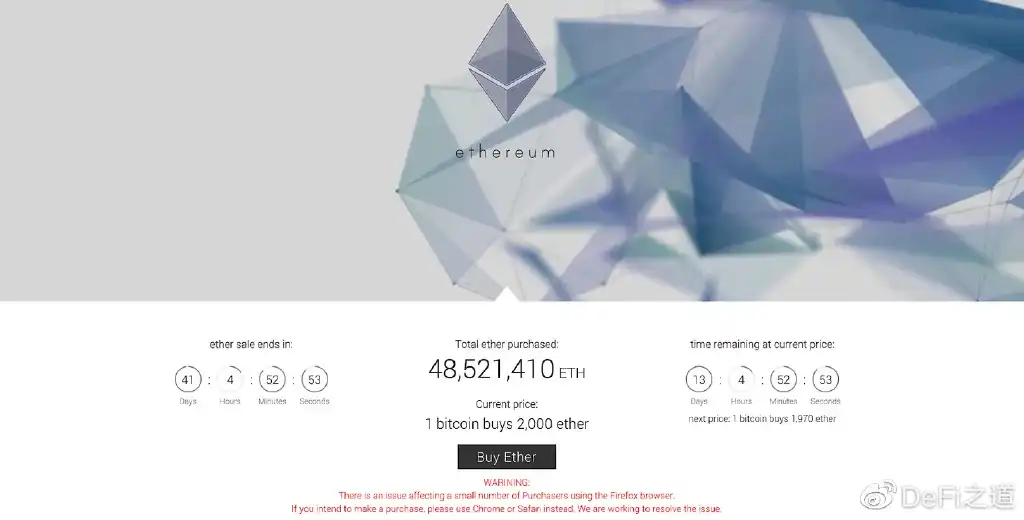
Ethereum.org looks like during ETH crowdfunding in summer 2014
Like Mastercoin, Ethereum crowdfunds BTC in exchange for ETH. When Ethereum launched the following year, crowdfunding participants were promised ETH allocations. By using Bitcoin as a crowdfunding platform, anyone in the world could theoretically participate. Defiant News founder Camila Russo sums up The profound implications of ETH crowdfunding in her book, The Infinite Machine, which gives a fascinating account of Ethereum's roots:
"Before, anyone who wanted to buy shares in big tech companies like Facebook or Google needed a US bank account; for those who wanted to invest in startups that hadn't raised money on the public markets, things got more complicated. Now anyone can be an investor in one of the most cutting edge tech companies. All they need is an Internet connection and at least 0.01 bitcoins."
Crowdfunding was launched on July 22, 2014, and was planned to last 42 days. By this point, Vitalik and other early contributors had shown the world the vision for Ethereum, most notably in an Ethereum white paper in 2013 and a presentation at Bitcoin 2014 Miami in January of that year.
Crowdfunding has an interesting set of incentives for those willing to participate early. During the first two weeks of sale, 1 BTC can buy 2000 ETH, after which the price changes linearly and eventually 1337 ETH can be purchased per BTC. The chart below shows ETH prices in BTC to show the discounted ETH price at the beginning of the crowdfunding and the increased price from day 14 to day 36 of the offering.

Source: Terms and Conditions of Ethereum Genesis Sale
At the time, using Bitcoin as a crowdfunding mechanism was a novel experiment on many levels. But one consequence of crowdfunding on a public ledger is the ease with which we can access this rich dataset of contributions years later. Unsurprisingly, the data has been the subject of a great deal of scrutiny to date - most vehemently by Preston Byrnes' 2018 comments and a data-driven follow-up analysis from independent cryptocurrency researcher Hasu.
Bitcoin "Exodus" address statistics
The following figure shows sent to the etheric fang team control currency address (36 prz1khympqsyaqxsg8vwbuiq2eogxlo2) amount of BTC (called "Exodus wallets"). It is worth noting that this address was one of the most valuable multiSIG addresses at the time.
It also shows the total amount of BTC and dollar equivalents raised and the total amount of ETH sold during the crowdfunding period. More than 31,000 BTC was raised, valued at approximately $18.3 million, and 60 million ETH were sold (making Ethereum the second most popular fundraising event at the time).
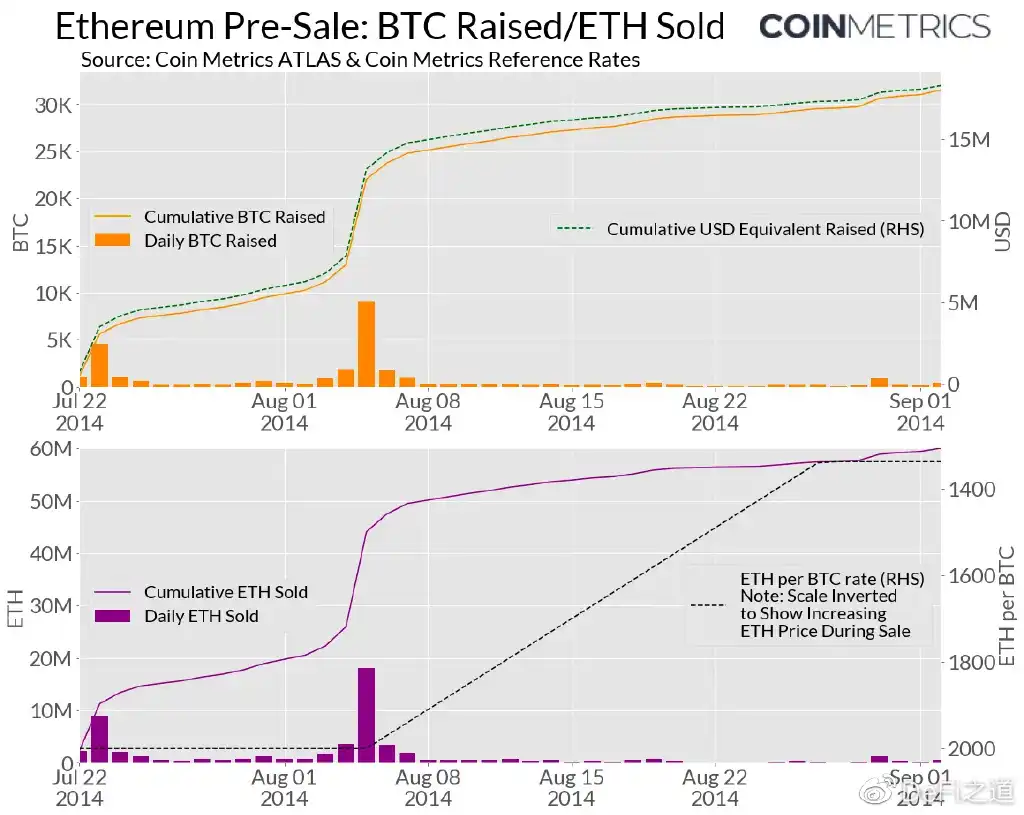
Source: Coin Metrics ATLAS And & have spent Coin Metrics reference exchange rates
Of the 60m ETH sold, about 50m were sold in the first two weeks when prices were heavily discounted - with significant spikes in sales at the beginning of the sale and on the last day each BTC bought 2000 ETH.
Between the minimum purchase amount of 0.01 BTC and the maximum purchase amount of 500 BTC, there were 8,437 transactions in total (although there is theoretically no way to restrict contributors from splitting larger amounts into multiple addresses). The three largest purchases are 500, 466 and 330 BTC. The average purchase was 3.65 BTC or about 7000 ETH.
Ultimately, given the pseudo-anonymity of bitcoin addresses, it's hard to say much more about the players involved, but the results nonetheless provide valuable insight into one of the most important events in cryptocurrency history to date.
Current proportion of crowdfunding supply
In addition to the 60 million ETH sold in the crowdfunding, early ETH contributors received an additional amount equivalent to about 10% of the total ETH sold, with another 10% or so set aside for the Ethereum Foundation.
This means that the total supply of Ethereum at network launch is about 72 million ETH, spread across 8,893 addresses. But as additional ETH is distributed through mining, crowdfunding participants and early contributors control a smaller percentage of the total supply over time. The total ETH supply today is nearly 120 million, and nearly 50 million new ETH have been issued since Creation.

Source: Coin Metrics Formula Builder
Note that the graph above is only for comparison with proof-of-work (PoW) issues over a period of time and does not reflect the distribution of the Genesis account's tokens over time. In other words, the set of accounts controlling 72 million ETH is constantly changing and growing since Genesis.
So far, more than 92% of the genesis account has moved their ETH, only 693 accounts the ETH never move them so far (the biggest is 0 x2b6ed29a95753c3ad948348e3e7b1a251080ffb9eth, It controls 250,000 ETH).
Throughout all account creation, by today hold ETH quantity calculation, the biggest is 0 x1b3cb81e51011b549d78bf720b0d924ac763a7c2, it controls the 347000 ETH (as at today's ETH is about $530 million), The address received 560,000 ETH at Genesis (about 213,000 ETH were transferred until this year).
But overall, Ethereum accounts created at Genesis only control 2.66 million ETH today, or about 2% of the total ETH supply, down from 7 million ETH in 2018 (of course, some holders may simply be moving their ETH into custodians/exchanges or new accounts).
While its lasting impact on supply distribution is often debated, ETH crowdfunding is undeniably an ambitious project, and its success reflects the enthusiasm surrounding the new era of programmable blockchains to de-support smart contracts and decentralized applications. With The Merge coming up, many eyes are on Ethereum as it enters a critical phase in its less than a decade of history.
Also see other resources covering ETH supply and its presale:
The Galaxy Digital Research:A breakdown of the supply distribution of Ethereum since its inception century
Takens theorem:Visualize the history of Ethereum
The original link
Welcome to join the official BlockBeats community:
Telegram Subscription Group: https://t.me/theblockbeats
Telegram Discussion Group: https://t.me/BlockBeats_App
Official Twitter Account: https://twitter.com/BlockBeatsAsia
 Related Articles