Discussing the Web3 social protocol: Can soul-bound Token and multiple identity solutions coexist?
Original title: "Foresight Ventures: Web3 Social Protocol Monopoly & Soul Binding Token"
Original author: Alice, Foresight Ventures
Abstract:
The essence of social products is matching. Web3 maximizes the matching ability of applications and improves the efficiency of user information acquisition by building a unified data bottom layer. efficiency.
The accumulation of high-quality relationships and network effects needs to reach a critical point to form a qualitative change. The process is tortuous and spiral. The web3 infrastructure just allows the new economic Governance model for fastest iteration.
The theory of "fat protocol and thin application" may not be applicable in the social track. Protocols and applications are facing the pressure of homogeneous competition, and it is difficult to form a complete monopoly Ecology and uniqueness are the basis of competition.
Compared with the existing web3 identity protocol, Soul Binding Token (SBT) can be used in non-transferable reputation, governance airdrop, negative reputation, wallet recovery and other scenarios have stronger advantages. There are many issues such as privacy, security and storage to be resolved before the large-scale implementation of SBT. In the future, it is very likely that SBT will coexist with multiple identity solutions, just like the L1 expansion solution.
"Foresight Ventures: Breaking the "Walled Garden", Web 3.0 Reshaping the Social Paradigm" Due to the limited space, the main text is used to outline the panorama of the web3 social track, Some controversial topics have not been discussed in depth. This article will discuss the three topics of Web3 social evolution path, social agreement monopoly and soul binding token (SBT).
Web3 Social Evolution Path

As As described in the previous article "Walled Garden", everyone's identity, relationship, social interaction, and content creation data should belong to themselves in web3, and should no longer be separated in walled gardens. The return of data sovereignty will be greatly reduced. Data reading and usage costs, everyone's identity and achievements on the chain become open and transparent. Dapps can more efficiently discover and contact high-quality contacts and high-quality creators.
However, we are back to the question of which came first, the chicken or the egg: the accumulation of high-quality relationships and network effects needs to reach a critical point to form a qualitative change. Before that, web2 social will still be a better choice for most users. Therefore, for a web3 startup, should it develop high-quality resource providers first, or develop c-end users first?
The author believes that the core should be to reward high-quality resource providers, that is, high-quality creators and high-quality personal connections. For example: Mirror attracted a group of high-quality kol platforms during its cold start, and Phaver used content pledge to select the best quality creative content; returning to the Web3 creator economy itself, the blockchain has natural advantages that can help high-value people realize Reputation is realized, and the centralized platform commission is completely eliminated. Therefore, I am still relatively optimistic about the prospect of web3 social development.
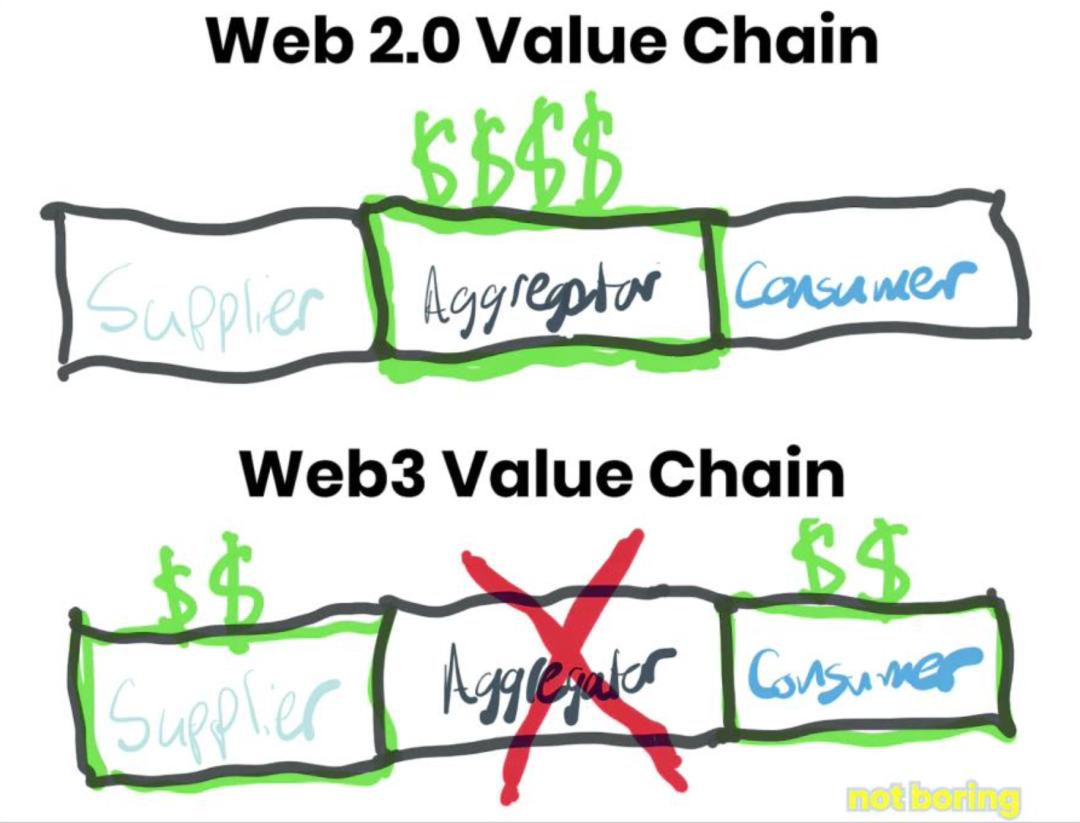
From a user perspective, we really can't ignore the elephant in the room --- everyone is used to Using web2 social applications, the giant's user stickiness is extremely high. This does not mean that web3 has no chance at all. Just like Gamefi challenges traditional games and Defi challenges traditional finance, social networking can also attract users through tokenomics and rewrite the rules of the game. Furthermore, compared with defi and gamefi, the significance of SocialFi lies in lower entry barriers, a more universal reward mechanism (everyone can get rewards), higher user frequency, and more young people who are curious and waiting People provide a web3 gateway, and social networking may be the most potential onboard next 1 billion user track.
Of course, the accumulation of high-quality relationships and network effects needs to reach a critical point to form a qualitative change. Tokenomics Pond's needs to attract native residents of web3, and gradually break the circle to attract more web2 users. Only companies that can continuously iterate products and business models and explore a reasonable and sustainable PMF can survive. The web3 infrastructure precisely allows for the fastest iteration of new economic and governance models, and startups will act as a "hive" to experiment, learn, and develop rapidly. In this process, data/content/relationships are no longer the private property of the platform, network effects will be accumulated as public goods, and the composability of data protocols will also make each innovation the starting point for the next innovation.
Inquiry into Web3 Social Monopoly
August 2016, Joel Monegro of USV, an American fund, Published an article titled "Fat-Protocols". The "fat" protocol theory believes that blockchain and Internet value capture models are different, and most of the value in the Internet era is captured by the application layer, such as Google, Facebook, Amazon, Ali, Tencent, etc. The underlying protocols such as TCP/IP and HTTP that provide support for the Internet cannot capture value. In the blockchain era, the value will be concentrated in the shared protocol layer, and only a small part of the value will be distributed in the application layer, thus giving birth to the "fat" protocol and "thin" application theory.
For most blockchain-based protocols, two factors lead to this result:
1. Shared data layer - the underlying data and blockchain transactions have equal and free access rights, and the application will compete with low cost and homogeneity;
2. Token Incentive-The protocol can use tokens for value capture to enhance system security (the higher the currency price, the higher the security), and realize commercialization.
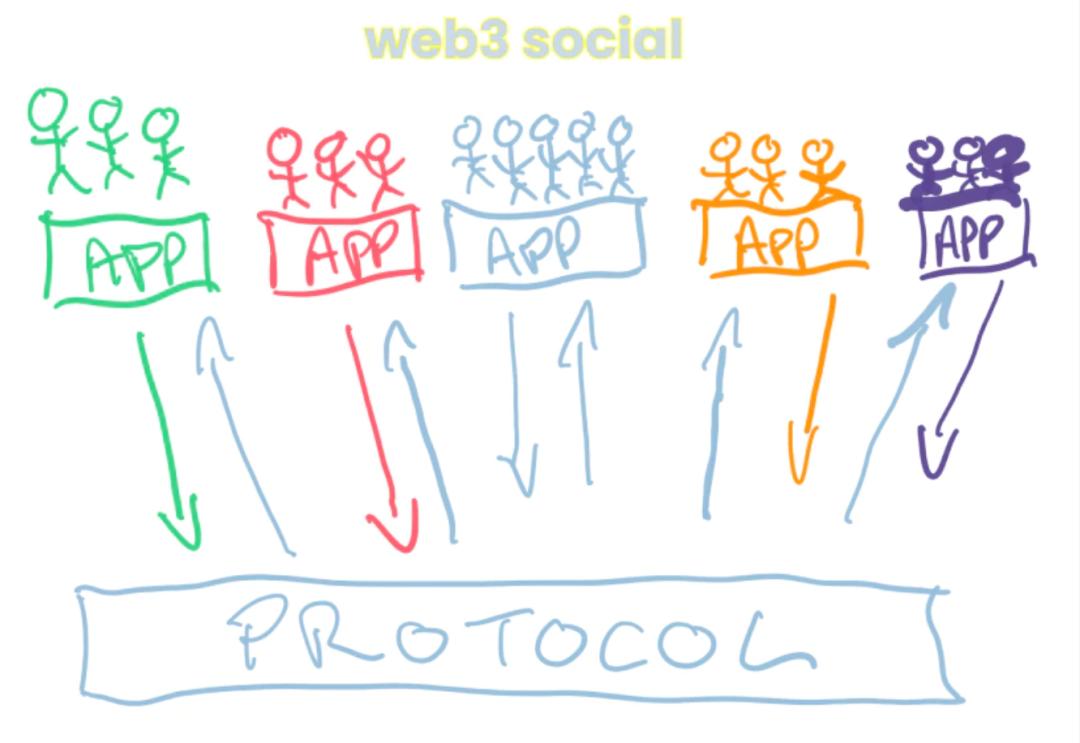
But I think the fat protocol theory is not a panacea, at least not necessarily so on the social track.
a. Data is not all about competition
First of all, the shared data bottom layer does not represent homogeneous competition. Data barriers are important, but not the whole story of competition. Looking back at web2’s social product KSF (except data), the summary is as follows:
WeChat sends text messages with 0 cost
Telegram is anti-censorship
p>
Twitter Short Tweet
Tiktok Sliding Match
Snapchat Burns
Delete Data In addition, for social applications, product functions, user experience, matching efficiency, and community atmosphere are all soft barriers. web3 should also add tokenomics to these factors.
b. Competition theory is also applicable to agreements
In fact, "fat" agreement theory The low-cost, homogeneous competition created by composability described in , also applies to protocols. Based on the decentralized and open source system, the protocol can also be easily reused, and then optimize products that are more popular with users. For example, when Compound was an open source protocol, Lendf reused their code for optimization. Then Lendf developed by leaps and bounds, and the amount of locked positions quickly entered the top ten in the industry; the same is true for social protocols. The collection, cleaning and presentation of data on the chain is not a monopoly resource. New players can still quickly access various databases and challenge the existing Industry pattern.
c. What is a reasonable value capture mechanism?
As pointed out by "Fat Protocol Theory", token incentives are an important way to capture value. In fact, the design of many protocol Tokens is not satisfactory. The core problem is: social networking is a thing with a strong network effect. The issuance of Token by the protocol is equivalent to the start of collecting tickets for the amusement park, which is a common entry for developers and users. threshold.
The superstructure theory points out that the ideal basic protocol layer should be free-to-use, at least on the user side. In order to onboard next 1 billion users. The protocol layer should play the role of minimally extractive coordinators (Minimally Extractive Coordinators), "the less the protocol extracts in the coordinated exchange, the more user economic exchange will occur."
However, this vision has led to another problem: the demise of the web1 protocol is precisely because there is not enough commercialization capability, and the value creation and value capture of the web3 protocol How should it be reflected. For this problem, I prefer to understand the social protocol as a to-b business and the application as a to-c business. Ideally, the agreement charges the project party and the application charges the user. It is worth noting that the agreement needs to achieve a sufficient business scale to start commercialization, and premature commercialization will hinder its development. From this perspective, the application layer may be easier to achieve value capture: they are closer to the user group than the protocol, easier to build trust and stickiness, and can gain user recognition through profit sharing.
Token value capture and commercialization trade-offs are a topic worth discussing. NFT and other tracks may be dedicated to a research phase in the future.
d. Dynamic balance between social protocols and applications
The bargaining power of applications and protocols is Dynamic changes. When an application occupies most of the traffic of the protocol and must pay a large amount of fees to the protocol, the application will tend to fork the protocol to obtain greater benefits, and the so-called "application steals the value of the protocol" phenomenon appears , For example, large-scale Gamefi games have opened exclusive App-chains one after another.
e. Whether it is a social protocol or a social application, both face the pressure of homogeneous competition, and it is difficult to form a completely monopolized ecology. In such a competitive environment, uniqueness is the foundation of blockchain protocol and application competition. The uniqueness of the social project is reflected in the following points:
Combination ability: in the food competition, there are all kinds of top ingredients on the table (storage solutions, Data model, identity DID), each chef’s choice of ingredients (demand scenarios, technical paths), cooking methods (product design, tokenomics), flavors and tastes (core customers, community tonality), cooking skills (commercial implementation capabilities), The ability to innovate is not the same, and the dishes presented in the end will also be ever-changing. Even if it is the same dish, ordinary people and state banquet chefs have different effects. Moreover, the ingredients are changing dynamically (data accumulation, technology upgrading), how to capture the best state of the ingredients for your own use will also determine the final quality of the dishes.
Token Design: If Token is an inevitable choice for web3 applications to compete with web2 giants, then our focus should be on how to design the x2earn model more reasonably. Just like the Internet platform subsidy war, what we need is not flooding but subsidizing core high-value users and early participants; on the other side of the coin, how should we design the Token model so that Token captures the value creation of the community instead of A Ponzi fund that simply applies the "governance + utility" dual-currency model. It can be combined with the idea of the game, using methods such as random equipment drop and game externality extension, to weaken the simple to earn attribute, and use Token as a tool to design a more reasonable reward mechanism, so that users can return to the fun and recognition of social networking itself The sense of accomplishment, the sense of honor of the community builder, etc., can also refer to the Ethereum Foundation to do offline Networking to enhance the bonding between members.
Community Atmosphere & Product Performance: As an open bilateral platform, user data and relationships may be easily copied, but community atmosphere, product experience and first-mover advantages more difficult to replicate. Different from Gamefi gold, if the game’s profit-making efficiency becomes low, some users will choose to imitate the disk, and the two-sided platform naturally has user stickiness-developers may not have such a good user-base if they change the protocol ecology, and ordinary users change one Community does not have such a good community atmosphere and such high information matching efficiency.
Team Execution: Good teams are very rare in Web3, especially in the social field. A strong and well-resourced team.
Soul Binding Token (SBT)
a. What is Soul Binding Token SBT ?
The name "Soulbound" comes from the game World of Warcraft. Soulbound items refer to items that cannot be traded with other players, mailed or given to other players. Can only be used by the player himself. Soulbound token, that is, Soulbound Token is a non-transferable Token bound to your wallet (account). Any online or offline institution or individual can issue SBT to a wallet, such as the school you graduated from, the company you work in, the non-profit organizations you have participated in, the DeFi platforms that have taken loans or participated in liquidity mining, and the DAO organizations you have participated in deeply, etc. Wait, your wallet can receive all kinds of SBT.
SBT is non-transferable and non-tradable. This feature weakens the speculative attributes of NFT, and returns more to the nature of social interaction, proving people's identities, experiences and reputation. Its original intention is to help users obtain persistent identities, trust and cooperation models in the Web3 world that lacks personal credit, reduce the possibility of sybil attacks (referring to a single user forging an identity to attack), and improve the efficiency of capital utilization.
b. What are the application scenarios of SBT?
Identity credentials without application scenarios are of no value to users. Compared with other web3 identity solutions, SBT has advantages in the following scenarios:

Governance & Airdrop: Through SBT, core early contributors are screened out to give higher governance voting rights, making community governance more fair, returning to the essence of democratic governance, and no longer a pure capital wrestling field. Real experience and identity verification will help the project party to accurately issue airdrops and efficiently match more real, effective, and high-value community contributors.
Negative reputation: If someone does evil on the chain or has a high loan default, he will receive a negative reputation SBT, so that SBT can become a "Sesame Credit Score" ", users can use social reputation to make loans, and the protocol can conduct background checks on users before lending, such as using zk zero-knowledge proofs to verify that customers have at least no record of default or excessive leverage.
Wallet recovery: If the wallet private key is lost, it can be recovered by obtaining the approval of most SBT community members, similar to the logic of WeChat account recovery. In contrast, the common wallet recovery method (in fact, most wallets do not have it at all) is to designate several wallet guardians, and there is a single point of failure risk.
C. Do all user identity data need to be uploaded to the chain?
Of course, our ideal state is that an identity protocol contains all identity information, like the metaverse in the number one player. But there are many problems in the implementation:
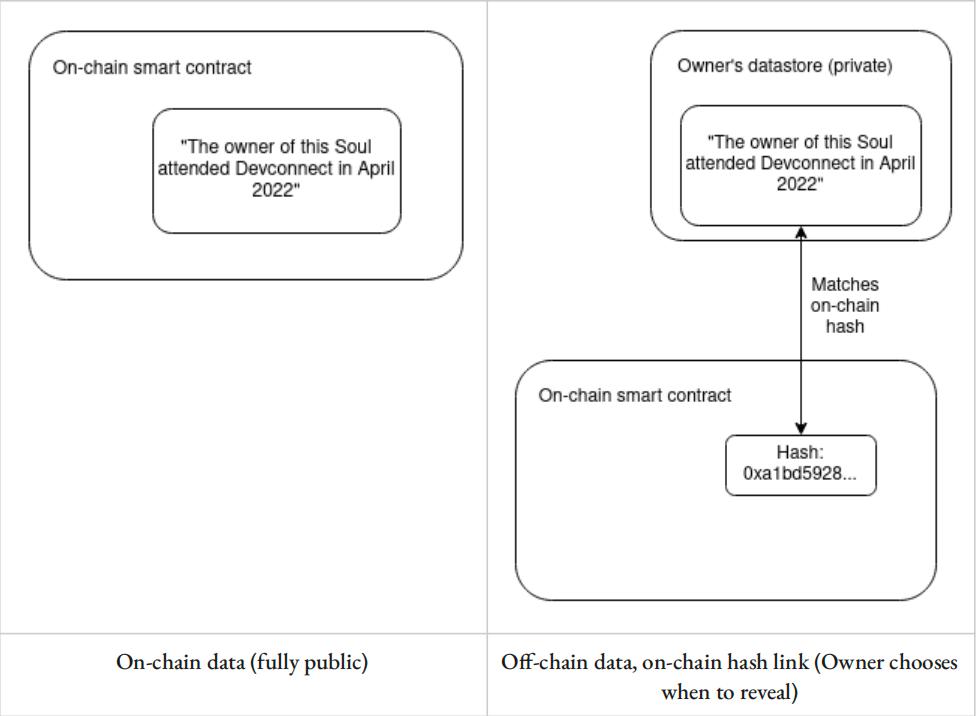
Difficulty of data storage: it is very difficult to store all data on the chain, possible solution: only upload the hash
The problem of information deletion: In social scenarios, users need to change information and delete historical information at any time, which is impossible for blockchain
< br>
Excessive disclosure problem: The data on the chain is open and transparent without privacy, especially the negative reputation involves a lot of sensitive information of users; solution: zk zero-knowledge proof, for example, an SBT can prove that you participated in Gitcoin 14 rounds of donations , but will not disclose the specific donation amount, project, time and other information.
How to motivate data providers to access: Not all traditional web2 institutions are willing to go on the chain, which involves their core competition barriers + user privacy leakage
< p>To sum up, SBT identity data is still stored with a high probability in a mixed way of on-chain + off-chain.
d. Will the Ethereum Foundation do SBT in person? What is the competitive landscape between future SBTs and existing identity protocols?
The off-chain identity track, identity standards such as W3C Verifiable Credential have been promoted for five years, with mature technical solutions and high institutional recognition. A number of identity solutions with excellent performance and cross-chain support have emerged, such as Unipass and Disco; on the identity track on the chain, different projects have also implemented subdivided scenarios and established their own communities, such as Project Galaxy and Poap.
Although there are many new projects on the SBT track, such as Firstbatch, Marry3, the outcome is far from conclusive. The Ethereum Foundation has not yet announced an official solution, and there is a high probability that it will take action, and it is likely to become a market hotspot in the future. However, the foundation has always been slow in doing things, and many problems need to be solved before large-scale implementation, such as storage solutions, institutional cooperation, zk privacy issues...
Even if Ethereum will have its own SBT scheme, and many identity protocols are likely to be the same as the expansion scheme (L2/sub-chain/Appchain coexistence). According to different application scenarios and user needs, social applications can choose the most suitable identity at the current stage solution.
Original Link
Welcome to join the official BlockBeats community:
Telegram Subscription Group: https://t.me/theblockbeats
Telegram Discussion Group: https://t.me/BlockBeats_App
Official Twitter Account: https://twitter.com/BlockBeatsAsia
 Related Articles