Morpho: a lending agreement aggregator led by a16z
Original title: "A detailed explanation of Morpho, a college student entrepreneurial project invested by top VCs who invested $18 million - a lending protocol aggregator that optimizes capital efficiency"
Original author: Lazy Watermelon, Defieye
On July 12, Morpho, a DeFi lending protocol, completed $18 million in financing, led by a16z and Variant. Investors include Nascent, Semantic Ventures, Cherry Crypto, Mechanism Capital, Spark Capital, Standard Crypto and Coinbase Ventures.
The Morpho protocol was co-founded by Paul Frambot, an engineering student at the Paris Telecom and Ecole Polytechnique, together with CNRS Research Director Vincent Danos, to create a more efficient loan agreement. Based on the existing lending agreement, it creates a new peer-to-peer mechanism that can bring higher returns to investors. What are the details? Let's take a look.
1. Current status of peer-to-pool protocol
< /p>
If you want to understand the new lending agreement, you must first understand what the traditional lending agreement looks like. Next, we will introduce the two old lending agreements AAVE and compound. If this is very familiar to you, you can skip to the second section.
The basic principle of AAVE or compound is simple, lenders supply their encrypted assets to the loan pool of the agreement, and get an APY incentive (hereinafter referred to as lender APY); these cryptocurrencies will be sent to the corresponding contract of the pool, and the pool will return their corresponding interest certificates (such as compound's cToken, AAVE's aToken). The borrower needs to provide sufficient collateral first. Under a certain mortgage rate, they can lend assets within the limit from the pool. For this, they need to pay a certain amount of interest (hereafter referred to as the borrower APY).
It can be seen that there are two significant differences between the lending agreement on the chain and the traditional loan: the credit cannot be verified on the chain, so the borrower must first be the lender ( That is, over-collateralization), which reduces capital efficiency and limits usage scenarios. There is no time limit for borrowing (no repayment date), as long as the mortgage rate requirements are met, the borrower only needs to pay interest and can use it indefinitely.
Whether it is a borrower or a lender, the interaction between them and the agreement is "point-to-pool", and the borrower and the lender cannot be directly connected in series. The peer-to-pool model is a major breakthrough in DeFi, and it has many advantages:
Instant liquidity. As long as there is liquidity in the pool, borrowers can borrow at any time, and lenders can get back their assets at any time.
·Stable habitat. Lenders only need to inject funds into the pool to enjoy a stable interest without having to consider whether their assets are actually being lent out.
·Borrowing interest rates are transparent. The interest rates of both borrowers and lenders are defined by the utilization rate of the assets in the pool. If the utilization rate is low, the borrowing rate will become very low to attract borrowing.
· Perpetual loan - no maturity date.
·Allow single person to replace liquidity. Since the lending agreement uses over-collateralization, if users perform lending behaviors at the same time, it is equivalent to replacing liquidity while "calling" the mortgage assets. For example, A has 10 ETH, and thinks that ETH will rise from 1200u to 1600u in three months, so he does not want to spend his ETH; Deposit in the loan agreement and lend 10,000u at a mortgage rate of 120% to meet urgent needs.
Of course, there are some problems in the "peer-to-pool" model:
· Capital efficiency low. Since the "point-to-pool" does not match the loan demand, when the loan demand is insufficient, a large amount of funds are deposited in the pool and have not been effectively utilized; at the same time, the over-collateralization itself has reduced the utilization rate of funds. A large amount of borrowing needs similar to the credit system in the real world cannot be discovered.

AAVE's loan pool on ETH, the capital utilization rate is less than 30%

The lending agreement has locked more than 40% of DeFi liquidity, about 1.5 times that of DEX, but its 30d-ROA is only 1/4 of DEX
< /p>
·Landing spreads are large. The loan APY of most lending agreements is much higher than the loan APY, which is largely due to the low capital utilization rate-since lenders face the loan pool equally, they will be rewarded regardless of whether the funds are idle, and These rewards can only come from an "equal share" of the interest paid by the borrower.
·Lack of market regulation of interest rates. Most of the existing lending agreements use known algorithms to determine the interest rate formula, and adjust it through DAO governance and other methods (such as compound), so that the lending rate cannot correctly match the market supply and demand - there is no competition between lenders, and borrowers no benefit.
Second, the status quo of point-to-point protocol
Before the emergence of the "peer-to-pool" model, ETHLend tried the "peer-to-peer" lending model as early as 2017, but it was not successful until it was integrated into a new company in 2018: AAVE ( And joined the "point-to-pool" army).
So why did "peer-to-peer" fail?
Let’s take a look at the workflow of ETHLend first:
·The borrower is created through the ETHLend interface A smart contract to request an ETH loan within a predefined period and at a predefined interest rate. They will then provide any ERC20 token of their choice as collateral. The collateral amount is defined by the borrower.
Potential lenders can browse all pending offers and accept the ones they want. Once accepted, the borrower will receive the requested ETH and his collateral will be locked.
· At maturity, the borrower will repay the lender with interest and get back the collateral. In case of default, the lender will receive the collateral (instead of ETH).

Source: https://github.com/ETHLend/Documentation/blob/master/ETHLendWhitePaper.md
This model is very close to the original lending market: Borrowers first issue their own borrowing needs and provide collateral to find suitable lenders. As we perceive in our daily life, people who want to borrow money always ask how much money they want to borrow, and in order to make others willing to lend him, give the benefits they can pay and the items they can mortgage .
What are the benefits of this approach?
High capital efficiency. The money lent by the lender is 100% used by the borrower, so the interest rate obtained by the lender is also higher.
· Unauthorized Collateral. Borrowers can mortgage any ERC20 instead of being limited to a few pre-approved in the "peer-to-pool" model. This is because the lender has the active option, and peer-to-peer matching does not require permission from the platform.
·Free matching and full satisfaction of needs. In this model, once the borrower and the lender are matched, it means that their needs are fully met. Lenders are free to rate borrowers, and borrowers can offer different rates based on their urgency.
Similarly, ETHLend's "peer-to-peer" model has many disadvantages:
Term Loan . When the borrower publishes the loan demand, he must set reasonable conditions for the lender to accept. If the borrower requires a permanent loan, it means that it has to offer high interest to attract lenders, which is not realistic.
·If the borrower defaults, the lender cannot get back his own assets and can only use the borrower's collateral as compensation.
· Lack of liquidation mechanism. The setting of collateral requires the lender to be able to predict the price fluctuation of the collateral. If the collateral falls below the loan amount, the borrower has an incentive to default and the lender will suffer losses.
The waiting period for a match. Peer-to-peer matching is a lengthy process, while borrower needs are often immediate.
Generally speaking, 2017, when ETHLend was born, was still in the early days of DeFi. At that time, there was not even a DEX, so it was difficult for many infrastructures to follow up, such as providing price Oracles, such as AMMs that provide liquidity. This makes the failure of ETHLend an anachronistic necessity. It wasn't until the ETHLend team turned to the peer-to-pool model of AAVE that it created today's lending giant.
Third, Morpho Introduction and Core Strengths
Comparing the "peer-to-pool" and "peer-to-peer" models, we can find that both have their own advantages and disadvantages, which are summarized in the following table:

Then there is a mode that can effectively Does it combine the advantages of the "peer-to-pool" and "peer-to-peer" modes?
Finally coming to the point - this is where the Morpho protocol comes into play.
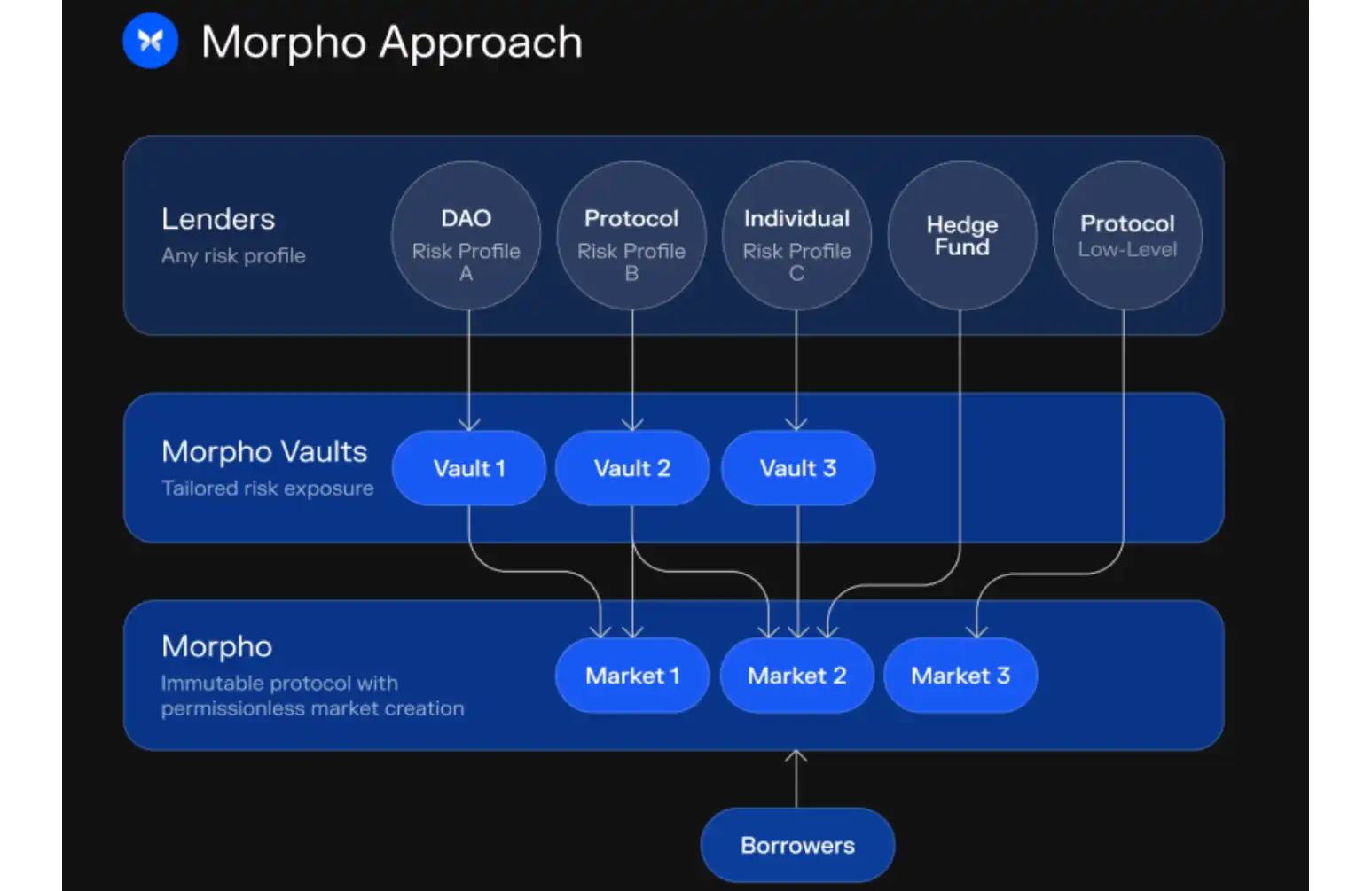
Morpho is actually an aggregator based on the existing lending agreement. It is based on the existing lending pool and provides the same liquidity through The peer-to-peer method seamlessly matches users, improves the capital efficiency of the lending pool position, and also improves the experience of both borrowers and lenders.
Taking compound’s underlying lending pool as an example, no matter whether the user uses Morpho directly or deposits the cToken obtained after depositing assets into compound into Morpho, it will It is normal to get credit APY. At the same time, Morpho will match the borrower for the user. When the borrower is matched, both will get an improved P2P APY, which is higher than the APY of the lender and lower than the APY of the borrower, which is beneficial to both parties. is a better incentive.

Morpho protocol interface. P2P APY becomes an attractive option for both lenders and borrowers

P2P APY can be regarded as the average of debit APY and credit APY
Debt Tracking Mechanism
In order to track all users' debts and deposit balances at the same time, Morpho separates deposit balances and borrowings into two variables: onComp and inP2P. onComp is measured by cToken/aToken, etc., while inP2P is measured by similar mToken to describe debt.
For example, suppose 1ETH=100cETH, A deposits 1ETH to Morpho, and its balance is: onComp: 100cETH; inP2P: 0mETH;
< p>Now B has borrowed 1ETH (matching with A), assuming 1ETH=100mETH, then A’s balance will become: onComp: 0cETH; inP2P: 100mETH;
One year later, if the P2P APY is still at 1.5%, the price of mETH at that time will be 1ETH=98.5mETH.
Matching engine
P2P still cannot fully balance supply and demand, there will always be depositors in the market The case where n is greater than the number of borrowers k. Morpho designed a "matching engine" for this purpose. The matching engine will select k depositors to enjoy P2P APY, while the remaining n-k depositors will still be placed in the underlying lending pool to enjoy the original interest rate. That is to say, even if the user is not matched, Morpho can still guarantee that the interest rate is at least not lower than that of the underlying lending pool such as compound.
Token Economics
The protocol has its own Token MORPHO, currently only Able to understand use cases for MORPHO. MORPHO can be used to participate in protocol governance, influence matching engines, and incentivize certain behaviors that are beneficial to the protocol, such as liquidity mining programs.
Taking the impact on the matching engine as an example, a well-behaved user can obtain a better interest rate experience than ordinary users; ” matching rules, users can pledge their MORPHOToken to have a “bandwidth” proportional to their pledge share, and whenever a borrower initiates a loan, the protocol will select a matching deposit according to the ratio of “bandwidth” people.
Morpho has specified numerous use cases for its token to highlight its utility. Regarding token flow, Token allocation, release, etc., the agreement is still in its early stages, and the official website has not disclosed relevant information yet.
Morpho 's core strengths
Therefore, Morpho builds on its core strengths:
· Instant liquidity. Morpho is built on top of an underlying lending pool that allows borrowers and lenders to enter and exit the protocol at any time, regardless of whether they are peer-to-peer matched.
Stable interest generation, and has a higher expected return than the existing point-to-point pool.
·Lending rates are transparent and determined by the market. In the future version of Morpho, a lender competition mechanism will be introduced, which will reduce the cost of borrowers on the one hand, and promote the improvement of capital efficiency on the other hand.
· Perpetual borrowing. This continues the advantage of the peer-to-pool model.
Convenient. As an aggregator, users can completely avoid the various underlying lending pools, and only need to perform simple operations in Morpho.
High capital efficiency. The lender's funds are either in the lending pool or are matched (fully utilized).
Sufficient liquidity support. This happens with the composition of more lending protocols.
Fourth, the current situation and future of Morpho
Morpho currently only supports the compound underlying lending pool. From the analytics page on Morpho’s official website, it can be seen that since the launch of the Morpho protocol at the end of May, the liquidity absorbed by the Morpho protocol has continued to grow, and has recently exploded. The liquidity provided by lenders has exceeded 100 million US dollars. The loan amount reached 60 million, and the fund utilization rate reached over 60%, far exceeding AAVE's 30%.

Morpho's matching engine also played well The role of the point-to-point matching of the amount of 20 million US dollars has been completed, and the matching efficiency exceeds 90%.

< /p>
On July 14, Morpho's [Epoch1] will end, and 350,000 MORPHO will be distributed to participating users. The Token is in the form of ERC-20 and is currently non-transferable. The governance layer will vote in the next few months Activate its transferability. At the same time [Epoch 2] is open, a total of 1.7 million MORPHO will be distributed to those who deposit and borrow on Morpho.
Morpho is actively tapping into the AAVE lending pool. According to Compound’s official website, the total liquidity provided by lenders has reached 3.6 billion, while AAVE has 6 billion. Judging from the 100 million liquidity that Morpho has absorbed so far, it still has huge room for development (Morpho has no competitive relationship with the underlying lending agreement).
In the first version of the white paper, three steps in the evolution of the protocol were envisioned:
·Flow performance optimizer (Caterpillar). Morpho currently only supports compound, and plans to include more underlying lending pools such as AAVE in the future. After aggregating liquidity, Morpho will provide users with a better instant experience. Users can always find the corresponding underlying pool to propose their own liquidity. For example, users may not be able to withdraw funds on Compound, but they can do it on AAVE.
Competitive interest rate market (Chrysalis). A major change that Morpho brings to the lending market is that lenders will be able to freely compete on rates, rather than being forced to enjoy inefficient existing lending pool interest rates, or intermediate rates. In fact, this has already begun to take shape on the ETHLend product, but at that time there was no basic condition, and Morpho relied on liquidity aggregation to be able to achieve this.
· Ideal order book mode (Butterfly). Butterfly is the long-term vision of the Morpho protocol. At that time, Morpho will get rid of its dependence on the underlying PLF and appear in a more general form of order book. The borrowers and lenders act as buyers and sellers respectively, and propose orders for the underlying assets. Every proposed position is connected by Morpho in an instant, automatic and efficient manner.
Morpho builds an aggregator based on existing PLFs such as compound and AAVE, and is committed to optimizing the capital efficiency of lending agreements. Through the "Pareto improvement" of existing PLF ", attracting more users to the Morpho protocol. Morpho's vision may be to become a key component of the future DeFi Lego building. We will wait and see how far it can go.
Risk Warning
1. Liquidation risk. There is no liquidation risk for loans that have entered peer-to-peer matching. At the same time, even if the borrower cannot repay, the collateral will be used in the underlying lending pool, and the lender can still obtain protection from the liquidity pool. Therefore, Morpho's liquidation risk comes from the underlying lending pool.
2. Agreement risk. At present, the protocol code has been audited by multiple parties (the following are the auditors listed on the official website):

< /p>
References
< a href="https://compound.morpho.xyz/" target="_blank">official website Document
Others:
1.TheDeFi Sector Map
2.Lendingpools: an imperfect breakthrough
3.Peer-to-peerlending: too early to work?—The ETHLend case
4. Morpho: the best of two worlds
Original link
Welcome to join the official BlockBeats community:
Telegram Subscription Group: https://t.me/theblockbeats
Telegram Discussion Group: https://t.me/BlockBeats_App
Official Twitter Account: https://twitter.com/BlockBeatsAsia

 Related Articles