Is the rapidly growing Morpho a potential rival of Aave?

Source: Mint Ventures
Introduction
After experiencing the bull and bear cycles from 2020 to 2023, we have found that in the Web3 business world, the only truly established commercial model in the application layer is still DeFi. Dex, lending, and stablecoins remain the three pillars of DeFi (derivatives have also made significant progress in recent years), and even in a bear market, their business remains strong and resilient.
Mint Ventures has written a large number of research reports and analytical articles on Dex and stablecoins in the past, including Dex projects such as Curve, Trader Joe, Syncswap, Izumi, and Velodrome, as well as stablecoin projects such as MakerDao, Frax, Terra, Liquity, Angle, and Celo. This issue of Clips will return to focus on the lending track, with a particular emphasis on Morpho, a new force that has seen rapid growth in business data over the past year.
The author will review Morpho's existing business and recently announced lending infrastructure service, Morpho Blue, in this article, attempting to answer the following questions:
What is the current market situation in the lending industry?
What businesses does Morpho include, and what problems does it attempt to solve? How is the current development of its business?
The prospects of the newly launched Morpho Blue business, will it have an impact on the leading positions of Aave and Compound? What are the potential impacts?
The following article represents the author's current perspective at the time of publication, and may contain factual errors and biases. It is intended for discussion purposes only, and the author welcomes corrections from other industry professionals.
Decentralized Lending Market Landscape
Organic demand becomes mainstream, Ponzi colors fade
The proportion of funds in decentralized lending has always been among the top, and currently TVL has surpassed Dex to become the largest track for accommodating funds in the Defi field.

Source: https://defillama.com/categories
Decentralized lending is also a rare business category in the Web3 field that has achieved "PMF" (Product-Market Fit). Although many projects have offered high subsidies for lending behavior through tokens during the DeFi summer wave in 2020-2021, such phenomena have greatly reduced in the bear market.
As shown in the figure below, the protocol revenue of Aave, a leading project in the lending field, has exceeded the incentive withdrawal of its token since December 2022, and has far exceeded the incentive withdrawal of the token so far (protocol revenue in September was $1.6 million, while Aave token incentive withdrawal was $230,000). In addition, Aave's token incentives are mainly used to guide token holders to pledge Aave to ensure that the protocol can pay for bad debts and treasury compensation when it is insufficient, rather than to incentivize users' borrowing and lending behavior. Therefore, Aave's current borrowing and lending behavior is completely "organic" and not supported by a Ponzi scheme based on liquidity mining.

Aave's monthly comparison of incentive distribution and protocol revenue. Source: https://tokenterminal.com/
In addition, the top lending protocol Venus on BNBchain has also achieved a benign operation of protocol revenue overtaking incentive collection after March 23 of the 23rd year, and it is currently no longer subsidizing deposit and borrowing behavior.

However, many lending agreements still have high token subsidies behind the supply and demand. The value of the subsidy for lending behavior in the agreement far exceeds the income that can be obtained from it.
For example, Compound V3 still provides Comp token subsidies for deposit and borrowing activities.

Compound V3 provides nearly half of the deposit interest rate for USDC on the Ethereum mainnet through token subsidies. Source: https://app.compound.finance/markets/weth-mainnet

Compound V3 Base provides an 84% deposit rate for USDC on the mainnet, subsidized by tokens. Source: https://app.compound.finance/markets/weth-basemainnet
If Compound maintains its market share through high token subsidies, then another protocol, Radiant, is purely a Ponzi structure.
On the lending market page of Radiant, we can see two unusual phenomena:

Source: https://app.radiant.capital/
One issue is that its asset lending rates are significantly higher than market rates. The lending rates for stablecoins in the mainstream currency market are usually around 3-5%, while Radiant's rates can reach as high as 14-15%. The lending rates for other assets are even 8-10 times higher than those in the mainstream currency market.
The second is that it mainly promotes revolving loans on the product interface, which encourages users to repeatedly cycle the same asset as a deposit collateral: the operation of depositing and borrowing, and enlarges their "total deposit and borrowing" through revolving loans to maximize the mining revenue of the platform token Radiant. Essentially, the Radiant project is indirectly selling its project token RDNT to users by charging them loan fees.
But the problem is that the fee source of Radiant - that is, the user's borrowing behavior - is not from real organic borrowing demand, but to obtain RNDT tokens, which constitutes a "left foot stepping on the right foot" Ponzi economic structure. In this process, the lending platform does not have real "financial consumers". Revolving loans are not a healthy borrowing model because the depositors and borrowers of the same asset are users themselves, and the economic source of RDNT dividends is also users themselves. The only risk-free profit maker is the platform project party that extracts profits from fees (it charges 15% of interest income). Although the project party has delayed the short-term death spiral pressure brought by the decline of RDNT tokens through the dLP pledge mechanism of RDNT, in the long run, unless Radiant can gradually shift its business from Ponzi to normal commercial models in the future, the death spiral will eventually come.
But overall, decentralized lending markets, represented by top projects such as Aave, are gradually moving away from relying on high subsidies to maintain operating income and returning to a healthy business model.
The following chart shows the changes in the active loan volume of the web3 lending market from May 2019 to October 2023, from an initial few hundred thousand US dollars to a peak of 22.5 billion US dollars in November 2021, and then dropping to a low of 3.8 billion US dollars in November 2022. Currently, it is at 5 billion US dollars, and the lending market business volume is slowly bottoming out and recovering, demonstrating good commercial resilience even in a bear market.

Source: https://tokenterminal.com/terminal/markets/lending


The cleverness of this design lies in the composability of the DeFi world. Morpho has attracted users' funds in a way that is seemingly effortless, and the appeal to users lies in this attraction.
1. TA can obtain financial rates equivalent to Aave and Compound at worst in Morpho, and when matching occurs, its returns/costs will be greatly optimized.
Business Data and Token Situation
Source: https://analytics.morpho.org/
Overall, Morpho's various business scales have continued to grow, with a deposit fund matching rate of 33.4% and a loan fund matching rate of 63.9%, which is quite impressive.
Token Situation
Source: Official Documentation
The total supply of Morpho tokens is 1 billion, with 51% owned by the community, 19% sold to investors, and 24% owned by the founders and the development company Morpho Labs and the operating organization Morpho Association. The remaining percentage is allocated to advisors and contributors.
It is worth mentioning that although the Morpho token has been issued and has been used in voting decisions and project incentives, it is in a non-transferable state. Therefore, it does not have a secondary market price, and users and investors who receive the token can participate in voting governance but cannot sell it.
Unlike projects like Curve that hardcode the way tokens are produced and incentivized, Morpho's token incentives are determined in batches, on a quarterly or monthly basis. This allows the governance team to flexibly adjust the strength and specific strategy of incentives based on market changes.
The author believes that this is a more practical approach, which may become the mainstream model for token incentive distribution in Web3 business in the future.
On the incentivized behavior object, Morpho incentivizes deposit and borrowing behaviors simultaneously. However, the current distribution of Morpho tokens in incentives is not high. In the past year, only 30.8 million tokens were distributed, accounting for 3.08% of the total. From the incentive period and corresponding token distribution in the following figure, it can be seen that the official token expenditure on incentives is rapidly decreasing, but the decrease in expenditure has not slowed down the growth rate of Morpho's business.

This is a good signal, indicating that Morpho's PMF is relatively sufficient and users' needs are becoming more organic. The community token share is 51%, and there is still nearly 48% left, which reserves ample budget space for future business incentives in new sections.
However, Morpho currently does not charge for its services.
Team and Financing
The core team of Morpho comes from France, with most members based in Paris. The core members of the team have been identified by name, and all three founders come from the telecommunications and computer industries, with backgrounds in blockchain entrepreneurship and development work.
Morpho has undergone two rounds of financing, including a $1.3 million seed round in October 2021 and an $18 million Series A round led by A16z, Nascent, and Variant in July 2022.
Source: Official Website
If the above financing amount corresponds to a 19% investor share disclosed by the official, then the corresponding project's comprehensive valuation is approximately $100 million.
Morpho Blue and its potential impact
Morpho Blue 是什么?
Morpho Blue is what?
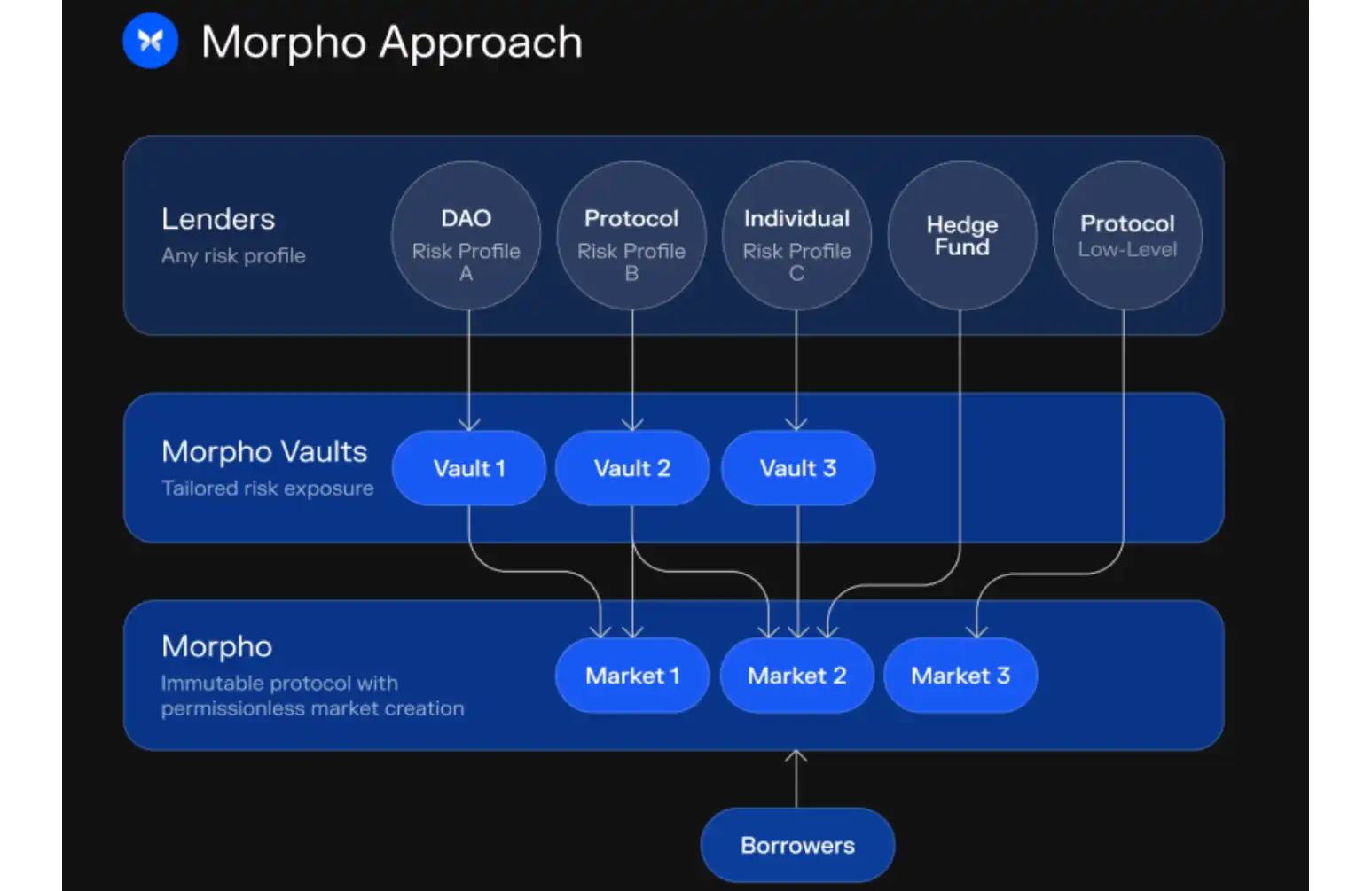
Simply put, Morpho Blue is an unlicensed lending infrastructure. Compared to Aave and Compound, Morpho Blue opens up most of the lending dimensions, so anyone can build a lending market based on Morpho Blue. Builders can choose from a variety of dimensions, including:- What can be used as collateral- What to use as borrowed assets- What oracle is used
- What are the loan-to-value ratio (LTV) and liquidation-to-value ratio (LLTV)?
- What is the interest rate model (IRM)?

Efficient, because users can choose higher LTV and more reasonable interest rates.
The platform does not need to pay third-party audit and risk management service fees.
Developer-friendly: Introducing multiple modern smart contract modes, account management realizes gas-free interaction and account abstraction functions, and free lightning loans allow anyone to access assets in all markets through a single call, as long as they are repaid in the same transaction.
Welcome to join the official BlockBeats community:
Telegram Subscription Group: https://t.me/theblockbeats
Telegram Discussion Group: https://t.me/BlockBeats_App
Official Twitter Account: https://twitter.com/BlockBeatsAsia

 Related Articles