Research | Central bank stability MakerDAO, upending governance paradigm again (2)
Source: CYC Labs
Original author: CryptoYC Tech
When considering whether an agreement is a good agreement, it is a good product first and governance second. There is no doubt that MakerDAO has been very successful in updating the industry paradigm as a "central bank" on Ethereum.Central Bank stabilizes Makerdao, upending Governance Paradigm again (I)This paper discusses The proposal of MakerDAO and the governance of which parts of Makerdao are respectively focused on. This paper will analyze The Endgame Plan, which is the hot blueprint of governance recently. As well as its most important role MetaDAO formation reasons and adaptation of several landing schemes.
MetaDAO reduces the burden of governance process and improves the governance of ecosystem
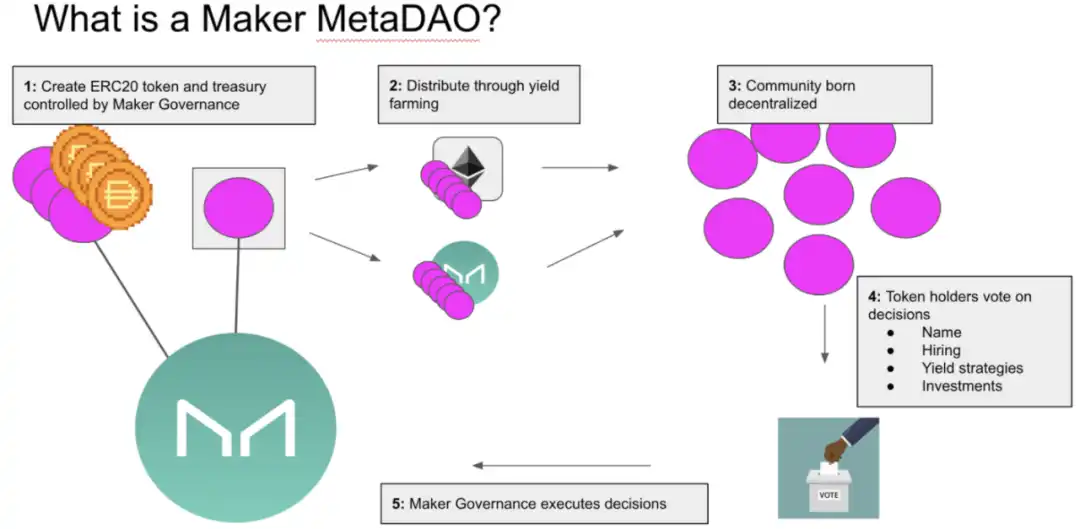
Photo credit: MakerDAO Forum
Before we start, let's take a quick look at what MetaDAO is the most important role proposed by Endgame Plan.
MakerDAO built MetaDAO to facilitate new DAOs that could reduce the governance burden from the core DAO process. However, each MetaDAO still needs to contribute to address the governance issues that exist in the Maker ecosystem.
Each MetaDAO can be viewed as a subdivision of MakerDAO, and it will publish tokens belonging to its own subdivision to bring together a group of maker members that are interested in its particular goal for each unit. Of course, in addition to the fact that each MetaDAO can distribute its own Token to drive the community, MetaDAO is free to organize and disassemble, and can even request external support if necessary.
On this basis, MakerDAO can make choices at any time according to the performance of each business. If the business can promote the development of the agreement in a sustainable way, the key development will be retained. But if MetaDAO's deal does not pay off, cut it outright. In summary, it not only retains the rights of subdao to issue tokens independently to motivate contributors, but also has the flexibility of pods to adjust the organizational structure.
Chaotic governance status quo, governance process is stagnant.
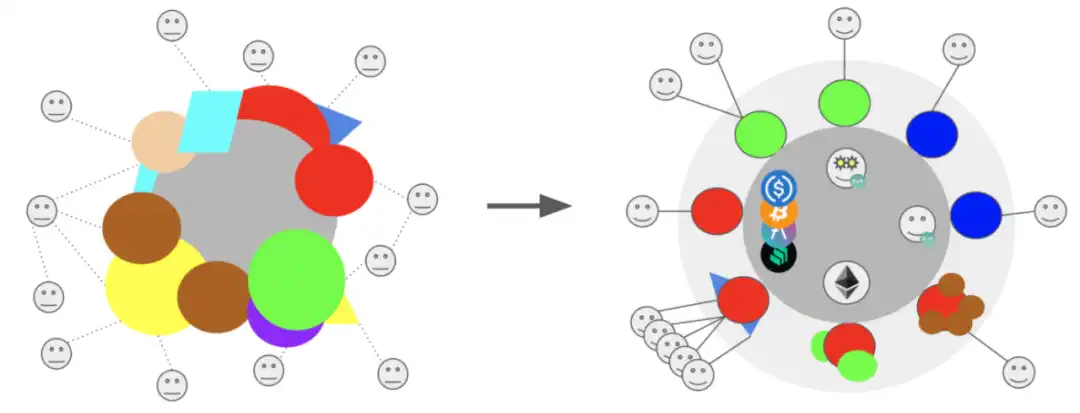
Photo credit: MakerDAO Forum
The whole Endgame Plan is intended to change the existing chaos governance problem of MakerDAO (from the left picture to the right picture) and make the governance process clearer.
Let's take a look at the governance status of MakerDAO and why it is as fuzzy as the left picture above.

Photo credit: MakerDAO Forum
Currently, MakerDAO faces a stagnant governance status quo that leads to governance paralysis. However, we all know that the paralysis of DAO governance is a problem that protocols cannot get around at this stage. So what is it about MakerDAO that leads to governance paralysis?
· Complex governance process. In the process of governance, most departments are intertwined, but there is no clear definition of responsibilities, and the task is difficult to promote sustainably.
· Indifferent governance. The voters are not active in voting, and they are not interested in voting governance participation.
· The core unit (CU) has great power. The core unit determines the priority and importance of proposals submitted and plays a role in whether or not proposals are defunded. Focus Objectives are discussed afterwards.
Having identified the problem, MakerDAO proposes MetaDAO to solve the paralysis of governance. In light of this question, we dug deeper to trace MetaDAO's predecessor, and found that it borrowed its structure from Google's parent company, Alphabet.
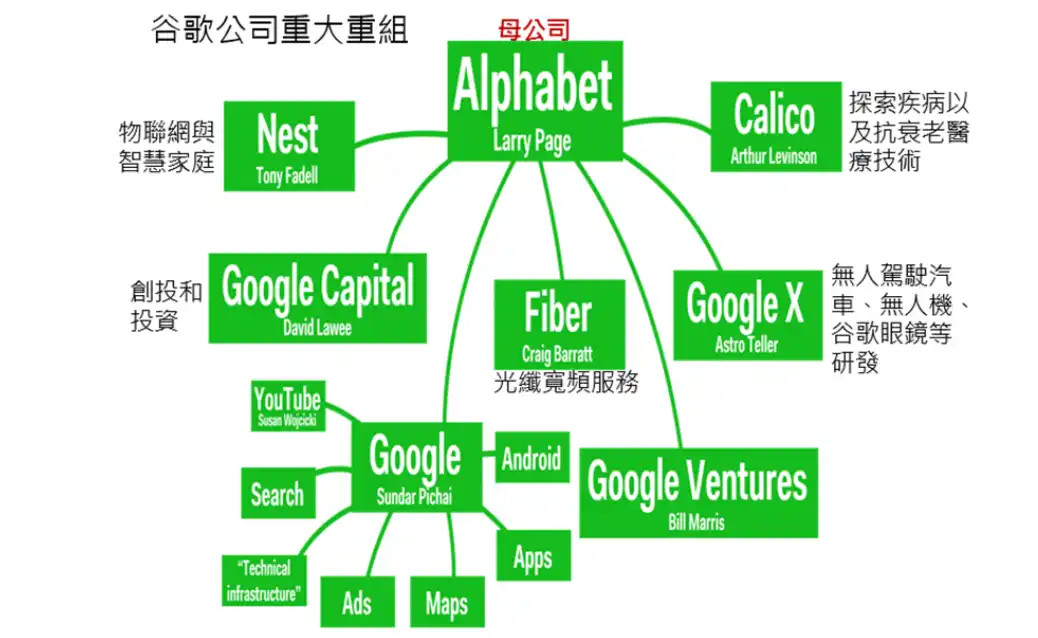
Image credit: google
As the core driving force in Alphabet, Google has complete autonomy and control over its key resources and products. In addition to borrowing from MetaDAO, which enjoys full autonomy and control throughout the protocol, it also incorporates elements of blockchain on top of Alphabet, with each sub-DAO getting its own Token as payment.
Now that we know the MetaDAO structure, how does MakerDAO allocate resources efficiently? MakerDAO's existing resources are allocated using a tool named Focus Objectives.
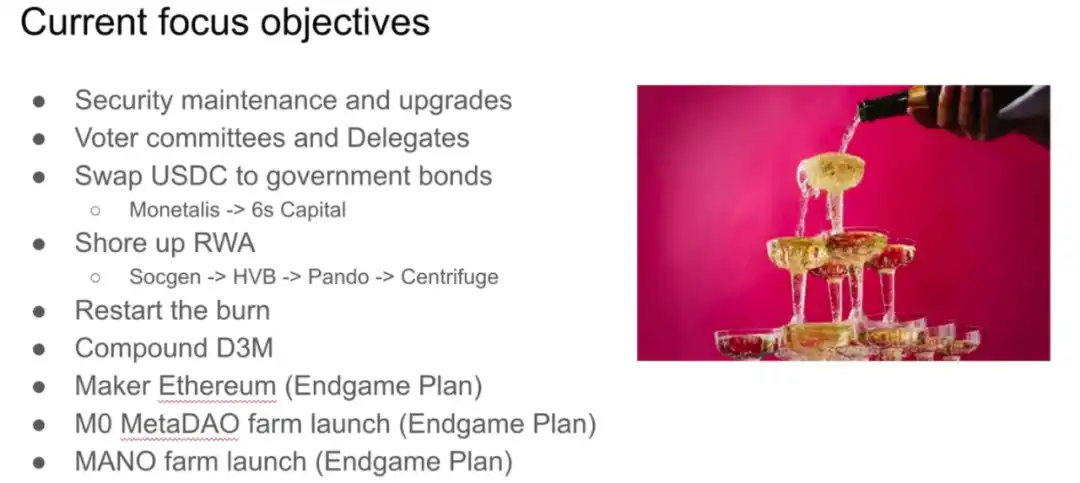
Photo credit : MakerDAO Forum
Focus Objectives, it is like a waterfall of champagne towers. The top and top cups also get the most resources, while the bottom proposals get fewer resources. The internal CU arranges priorities and weights based on whether the protocol has influence. Finally, the core unit gives budget ranges and resource allocations based on priorities and weights. Although this approach allocates the merits and qualities of the proposals, it also allocates the resources in turn in a more efficient way. However, it does not take into account the autonomy and control of the child DAOs, making the governance process cumbersome and slow.
MetaDAO talent incentive system to attract high quality BA to join
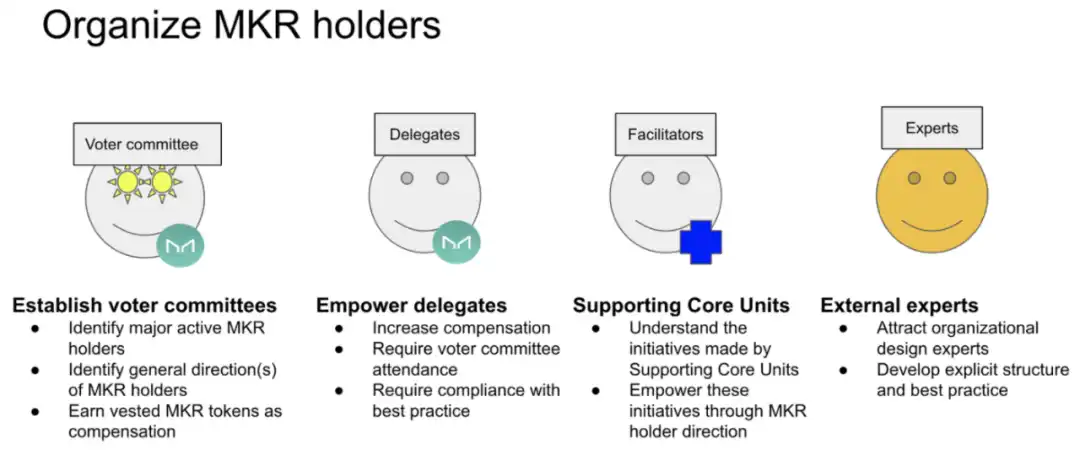
Photo credit: MakerDAO Forum
Review the original MakerDAO's 4 types of Token holders and see how they are motivated to work?
· Create a voter committee: Participation is conditional on the pledge MKR entering and the lock-in MKR gaining incentives
· Empower the entrusted representative: in the representative system, the entrusted person is encouraged to complete the work
· Core unit CU: The problem is that the CU is disconnected from the needs of voter representatives
· External support: attract external experts with tokens in exchange for labor services
Although Makerdao takes into account all the incentives between holders, it can be seen that there is a disconnect between the needs of voters, delegates and core units. So how does MetaDAO optimize the structure of the holder? As a result, it turned the core unit into a service like MetaDAO without worrying about too much power. In addition, a new unit "" budget allocator.
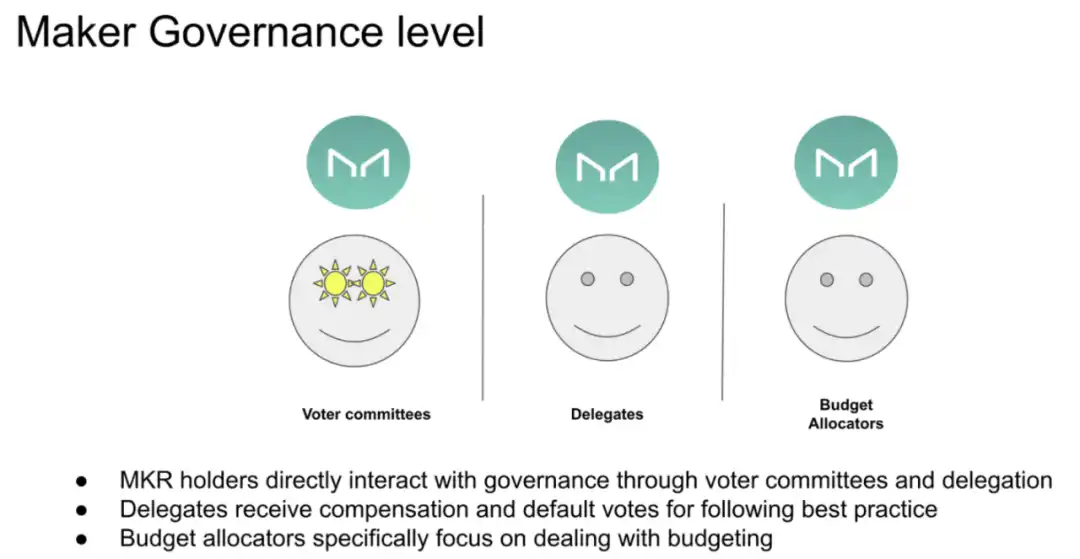
Photo credit: MakerDAO Forum
· Voter Committee
· Entrusted representative
· Budget Allocator: MetaDAO's new role, focusing on protocols for better development. Budget allocator also addresses the shortcomings of Focus Objectives, which are primarily responsible for making marginal adjustments to the core unit's operating budget by modifying it according to performance, plans, and new information. Management fees are charged according to the size of the budget allocation, which is the incentive that BA can get. This will attract excellent talents to BA and form conscientious competition.
New paradigm of budget allocation, bold use of efficient voting and relative global allocation of budget
1. Model for proportionate budget determination based on valid votes
For example, if one group has 70% valid votes and the other group has 30% valid votes, then in the current paradigm, the group with 70% valid votes will be allocated 100% of the budget, but in the budget allocation paradigm, the group with 70% positive votes will be allocated 70% of the budget, The group with 30% active votes will also participate and allocate 30% of the budget.
2. The most effective way to use BA is to use the relative global allocation of the budget
In addition to the fixed budget, there is also a relatively global allocation budget (the budget pool is funded from the surplus of all MakerDAO agreements). This criterion is based on whether MetaDAO's smart contract has an agreement surplus. When there is an agreement surplus, the budget increases. If revenue from the deal starts to dry up, the budget will automatically shrink to reduce governance frictions.
The creation of the budget dispenser brought about a paradigm shift in which the CU was no longer the one who employed and controlled all budget allocations. Instead, it became a service provided to MetaDAO. Thus, a state of checks and balances between rights is formed: MetaDAO appoints the CU, and the talent pool calls the labor force with tokens. When the labor force is saturated, the surplus labor force can continue to look for other MetaDAO, and the Holder finally gets paid according to MetaDAO's influence on the agreement and income.
3 kinds of MetaDAO incentive system practice, applicable to different scenarios
Having discussed the governance issues and the new organizational model described above, MakerDAO practices it according to three different incentive systems (the three most common long-term scenarios) : top-down income distribution, bottom-up income distribution, and D3M model distribution.
1. Top-down (classic, most used) : the current way income is distributed
Budget allocations are made through the CU based on priorities. makerdao set up a department to collect quotes and work estimates. After collecting the information, the agreed budget will be paid.
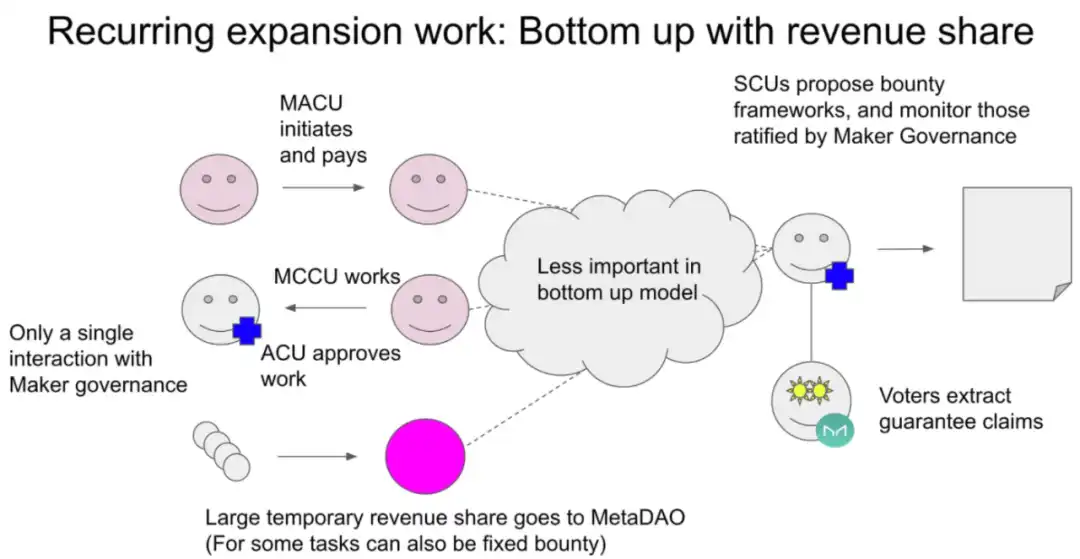
Photo credit: MakerDAO Forum
2. Bottom-up (D2D) : Bounty system
It is approved by Maker Governance and handed over to the core unit for review after completion of the work, and the corresponding reward is paid after passing.
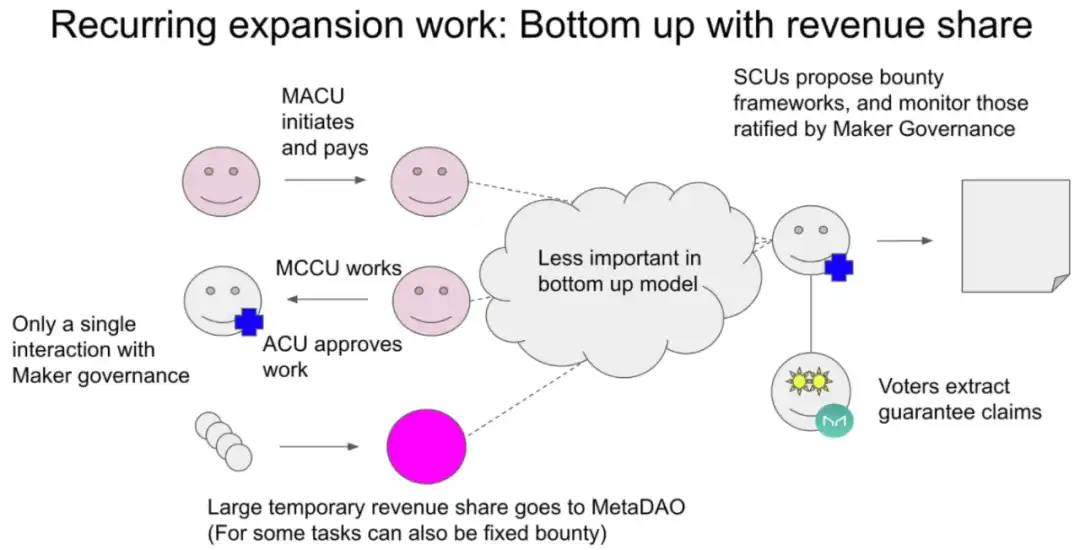
Photo credit: MakerDAO Forum
3. D3M (the most extensible and suitable for MetaDAO)
This means that Maker does not participate in any synchronous steps of activity work, such as touching assets or joining vault collateral. MetaDAO is simply provided with a global debt ceiling by Maker and pays a specific cost of capital, which is then free to decide how to deal with it using its internal resources, following the basic flow of power of the MetaDAO Management Core Unit (MACU) to prioritize and spend the budget, The MetaDAO Contribution Core Unit (MCCU) completes the work, and then the MACU reviews, approves, and submits the final work product to a MetaDAO governance vote.
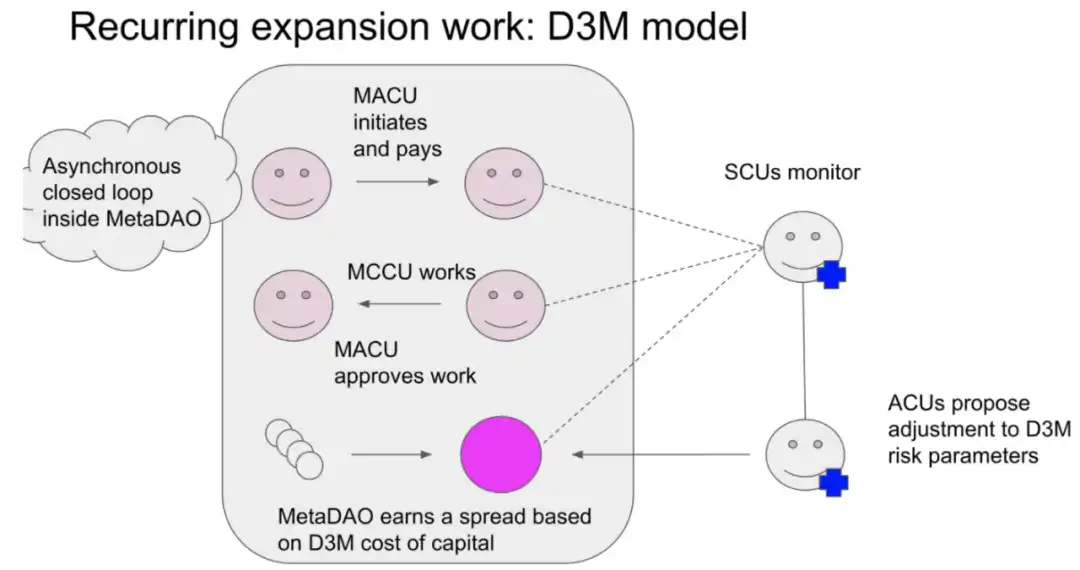
Photo credit: MakerDAO Forum
conclusion
MakerDAO's new idea, MetaDAO, has yet to be voted on, but it has the potential to bring new insights to the industry and change governance paradigms:
Endgame Plan is free to combine, high combinability, and reduces the cost of trial and error.Using a traditional Internet department as an example, I can develop multiple organizations at the same time, let each small department start to roll, and then if I find that the department is not making money or dragging its pace, I can cut it at any time. Of course, doing so can also result in excess returns. As long as I make a profit in one department, I can completely cover all the previous losses.
The degree of specialization is increasing geometrically, compared with the past when the function distribution is not clear.metadao is currently a structurally optimized choice for DAO, separating and combining parts. Helps the protocol focus its capabilities in smaller, more manageable pieces.
High degree of automation, simple and independent operation mechanism.A division of departments or individuals can operate automatically without knowing the operation status of other departments. When an organization needs to understand the context, the governance and operation of the entire organization will appear redundant, procrastination, push the feeling of immobility, so whether to reflect on the close degree of overlap between each organization and department is too high, not well divided.
Input-output ratio is used as an indicator to encourage everyone to participate in governance, and to avoid governance indifference and vote buying as far as possible.The possible causes of voters' apathy in governance are nothing more than useless participation in governance and inadequate incentives in governance. When a governance incentive touches the psychological expectations of voters, then all the actions of the agreement are tied to the reward, and there is a tendency for people to invest their time and energy in the agreement. In addition, it can also effectively avoid the behavior of vote buying. Voters delegate or delegate their votes at will, and vote-buying is not necessarily better than governance apathy.
Instead of the bureaucratic burdensome of the past, there is a free-market subcontracting economy.The realization of subcontracting economy makes the organization no longer assign fixed personnel to participate. The organization increases or decreases the number of employees according to the existing situation, flexibly arranges the use of compensation, and creates a good competitive environment.
Note: As The Endgame Plan has only been updated to Part3, CYC will continue to pay attention to this proposal.
Reference Materials:
https://blog.makerdao.com/makerdao-has-come-full-circle/
https://makerdao.com/zh-CN/whitepaper/
https://twitter.com/n4motto/status/1534642569220706304
https://newsletter.tally.xyz/p/the-tally-newsletter-issue-73
The original link
Welcome to join the official BlockBeats community:
Telegram Subscription Group: https://t.me/theblockbeats
Telegram Discussion Group: https://t.me/BlockBeats_App
Official Twitter Account: https://twitter.com/BlockBeatsAsia
 Related Articles