Research | Central Bank stability MakerDAO, upending governance paradigm again (I)
Source: CYC Labs
Original article by CryptoYC Tech
When considering whether an agreement is a good agreement, it is a good product first and governance second. There is no doubt that MakerDAO has been very successful in updating the industry paradigm as a "central bank" on Ethereum. This article will discuss through the proposal of MakerDAO. What lessons does MakerDAO bring to the industry? Focus on which sectors of governance respectively?
Chain central bank MakerDAO, debt auction mechanism is simple and effective.
MakerDAO is known as the "central bank" on Ethereum because it's easy to understand how it works. Users pledge ETH on MakerDAO and MakerDAO issues a corresponding number of DAI, a process somewhat similar to how central banks in the gold standard era issued fiat money based on their gold reserves. The price of DAI is tied to the dollar price, and MakerDAO regulates supply and demand by controlling the lending rate to maintain the anchor of DAI to the dollar. In order to avoid the risk of price changes, users need to overpledge their DAI when mortgaging ETH, and lend different amounts of DAI according to different mortgage rates. When the mortgage price drops to a certain extent, the mortgage will be cleared at a price slightly lower than the market price to avoid losses on the platform.
MakerDAO and Governance Token MKR:
· Voting governance role: In addition to stablecoin DAI, MakerDAO also provides MKR as equity and governance Token as a DAO project. As long as anyone holds MKR, it is equivalent to join the DAO organization of Maker to some extent, have part of the right to manage MakerDAO, can vote on the maker guide proposal. Of course, anyone can still submit a proposal, but voting requires a governance Token to exercise it.
· Payment as interest: In addition, when users redeem Ethereum from MakerDAO, they are required to pay MKR as interest for borrowing DAI, and when forced liquidation occurs, they are also required to pay MKR as penalty fee. During the debt auction, new MKRS are minted (increasing the amount of MKR in circulation) and sold to those who use Dai to participate in the auction. In the surplus auction, the successful bidder pays MKR to purchase the surplus Dai. The repurchased MKR will be destroyed, thus reducing the total supply of MKR, making the overall Token economy model of MKR a deflationary state.
Debt auction mechanism:
· As collateral > Debt + SETTLEMENT PENALTY: THE COLLATERAL AUCTION PAYS OFF THE DEBT AND SETTLEMENT penalty, and THE REMAINING collateral is returned to its OWNER.
· As collateral < Debt + Liquidation Penalty: The collateral is fully auctioned and the remaining debt will be assumed by maker Agreement buffer Dai. When Dai in an agreement is higher than the buffer pool ceiling, such as a sudden 312, it is sold at a Surplus Auction. During the surplus auction, bidders use MKR to bid for a fixed number of Dai, with the highest bidder winning. Once the surplus auction ends, the Maker protocol automatically destroys the MKR from the auction, reducing the total supply of MKR.
Buffer: Maker buffer can act as a buffer to avoid excessive issuance of MKR due to insufficient collateral auctions and rising Dai deposit rates in the future.
主动和被动治理提案,明确治理内容
The governance framework itself can be divided into two main parts:
· Governance proposal (active), duration 3-7 days: A symbolic vote that surveys community sentiment toward a particular model or data source. (eg. Consider using the new Token as collateral, accepting it and incorporating it into your portfolio, and deploying its risk parameters)
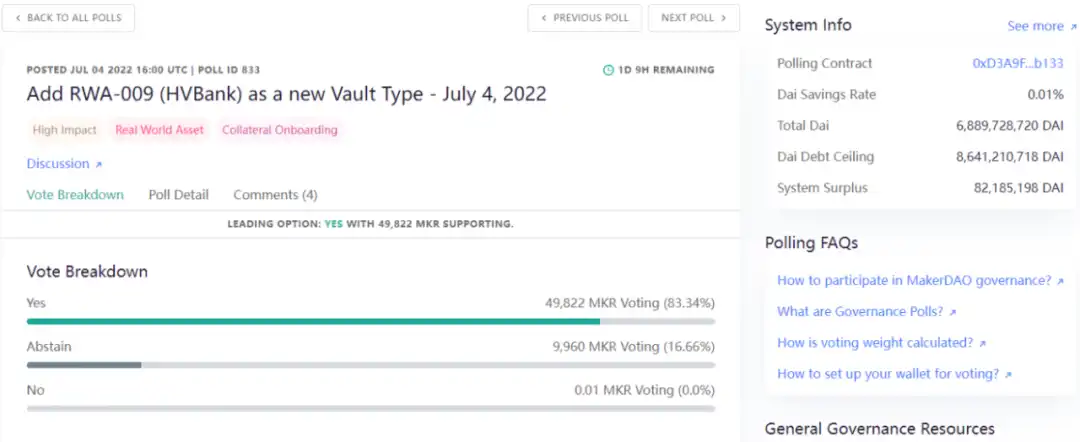
Photo credit: MakerDAO Forum
· 执行提案(被动),持续时间较长: 用于批准由治理提案接受的模型和数据确定的风险参数。执行投票会导致 Dai 信用系统内的状态发生变化,并且每季度都会发生一次。(eg. 对新接受的抵押品类型的风险参数进行投票)
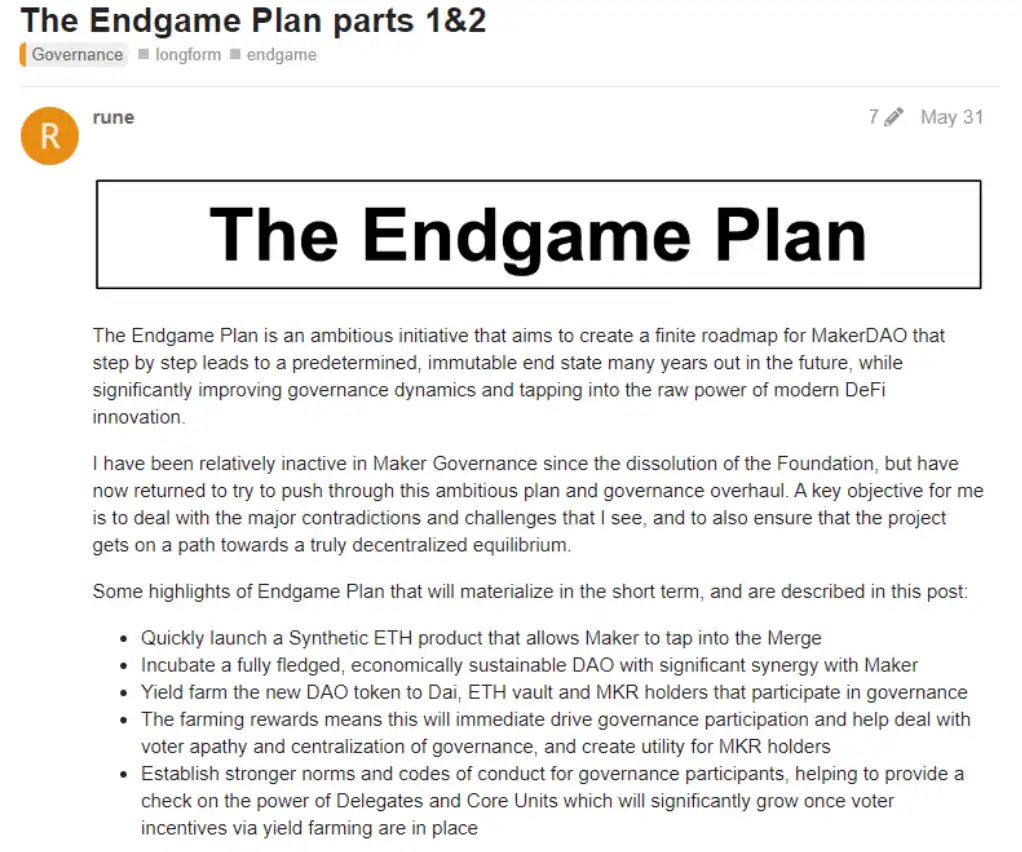
Photo credit: MakerDAO Forum
Iterative governance, more professional business segmentation
1. Early stage: Core Unit takes the lead to manage the small and large affairs of the community.
2. Led by Makerdao foundation: sustainable decentralized governance, further decentralized governance.
3. Community governance: Rune Christensen, CEO of Makerdao foundation, left the company and gradually transitioned to community management and decentralized governance.
4. Monetails sage(RWA) : A company called Monetails used Maker support to finance their lending platform, and the agreement radiates the development of the community to Cefi.
Makerdao Milestones: Makerdao Foundation (2015-2021)
March 26, 2015: MakerDAO and its first stablecoin are unveiled. The original concept for Dai (then called "eDollar") was described in a reddit post.
November 2015: The MakerDAO team attended DevCon1. Nikolai Mushegian, co-founder of MakerDAO, detailed Maker's components. This is an early introduction to bringing organizations and protocols to the broader Ethereum community in the early days of blockchain.
May 2017: ProtoSai goes live. The MakerDAO developers rolled out and started using the first version of Dai, called ProtoSai. This marked the first limited release of the Dai stablecoin system and was a precursor to the public launch of a single collateralized Dai (SAI) a few months later.
Dec 10, 2017: Sai White Paper released. The original ** white paper describing the Dai stablecoin system clarified the final design of the SAI and provided a roadmap for the future - including the ultimate goal of multi-collateralized Dai.
December 19, 2017: Sai is released. Single-mortgage Dai goes online; It will eventually kick off the now popular DeFi movement.
June 21, 2018: The foundation proposal is released. The proposal was later updated to set out the core principles of sustainable decentralized governance.
November 18, 2019: Multi-mortgage Dai went online. The launch of multi-collateralized Dai enables anyone to generate Dai based on digital assets approved by Maker governance.
March 25, 2020: MKR Token contract transferred to Maker governance. Since MKR holders now have full control over MKR contracts, decentralized governance is the only way to change MKR Token authorization.
On May 2, 2020, the MIPs framework was approved. Frameworks including MIP0 and the two MIP set Maker Improvement Proposals (MIPs) are approved.
March 25, 2021: The core unit framework is approved. The core unit framework paves the way for decentralized management of all Maker Protocol teams and activities.
May 3, 2021: The Maker Foundation returns assets held by the Dev Fund to the DAO. Returning the 84,000MKR to the DAO is another critical step toward further decentralization.
June 2, 2021: Liquidations 2.0 module launched. Liquidations 2.0 is available for all Activation of collateral type approved by Maker governance in order to be accepted in Maker protocol.
July 20, 2021: Rune Christensen announces that MakerDAO is fully decentralized. The global Maker community is now responsible for all aspects of the Maker protocol and DAO.
Popular proposals, mainly focusing on tokens, financing, and governance;
The foundation will be dissolved and handed over to the community
Governance Direction:The beginning of decentralization
Time of Proposal:Jul 20, 2021
Proposed by:Rune Christensen, Maker Foundation CEO
Brief introduction:The decentralized autonomous organization MakerDAO is officially moving toward full decentralization. According to Rune Christensen, CEO of the Maker Foundation, MakerDAO has become self-sufficient after years of development. The foundation, which has played a leading role in fulfilling its commitment to the community, will be officially disbanded in the coming months.
Comment on:The beginning of community governance. 312 left Makerdao bleeding blood, leading many disgruntled investors to take it directly to court. And handing over $500 million in development funds to the community.
Clean Money
Governance Direction:MetaDAO, Token project
Time of Proposal:Oct 21, 2021
Proposed by:Rune Christensen, Maker Foundation CEO
Brief introduction:Clean Money promotes the principles of sustainable finance, but the MakerDAO community was born in 2018. It's worth mentioning the sagittarius engine Token model at the end.
Comment on:The biggest problem in Maker governance is the difficulty of governance participation, lack of transparency, governance apathy, which exacerbates the general perception of the wider and less informed MKR holder community. It can be seen that the makerdao governance core unit (CU) is inefficient and even corrupt. So Rune once referred to the concept of clean money, reducing the internal political structure of bureaucracy.
Sagittaruis engine
Governance direction: Tokenengineering
Time of Proposal:Oct 21, 2021
Proposed by:Rune Christensen, Maker Foundation CEO
Brief introduction:It is proposed to learn from the current DeFi model and change the current core unit reward model to attract funds from the market, so as to realize more MKR lock-in and low-interest lending. MKR long-term lock more benefits, users can mortgage the lock MKR to lend DAI, with favorable interest rates and liquidation conditions.
Comment on:The main goal is to provide high real APY for long-term lock-in MKR, directly lock-in liquidity, see the small chart. DAI is borrowed and lent through mortgaged MKR, and the parameters are related to the mortgaged time. However, the community is generally skeptical about the proposal, believing that the SE model is too complex. Did not pass.
gbMKR (governance-boosted MKR)
Governance direction: Tokenengineering
Time of Proposal:Jan 21, 2022
Proposed by:ParaFi Capital
Brief introduction:Currently, any MKR holder can participate in the governance vote. The proposal proposes to lock MKR into governance (gbMKR) for a long time (up to four years), while giving gbMKR holders higher returns.
Comment on:A bit like curve's boost mechanism, use gbMKR to replace MKR in governance voting. Basic incentives are generally considered inadequate, and simpler solutions are sought.
gbMKR holder's Equity:
· Default unlocking will indemnify part of MKR to other gbMKR holders.
· Grant gbMKR holders zero or negative interest rates to lend DAI.
· Part of the agreement income (stabilization fee, liquidation income) shall be given to gbMKR holders.
· Repurchase MKR at stabilization fee and give to gbMKR holders.
· gbMKR is added as MakerDAO collateral with 0% stabilization fee and lower mortgage rate.
sktMKR
Governance direction: Tokenengineering
Time of Proposal:Mar 14, 2022
Proposed by:Risk Core Unit Team
Brief introduction:sktMKR is obtained by MKR pledge, sktMKR has the function of voting, the longer the time, the higher the voting weight. However, the redemption of MKR has its limitations, requiring a certain amount of time to wait for unlocking. The redeemed sktMKR is destroyed directly.
Comment on:This model borrows from the Token model scheme of cosmos. In addition, an additional governance token is added to address the issue of governance attacks.
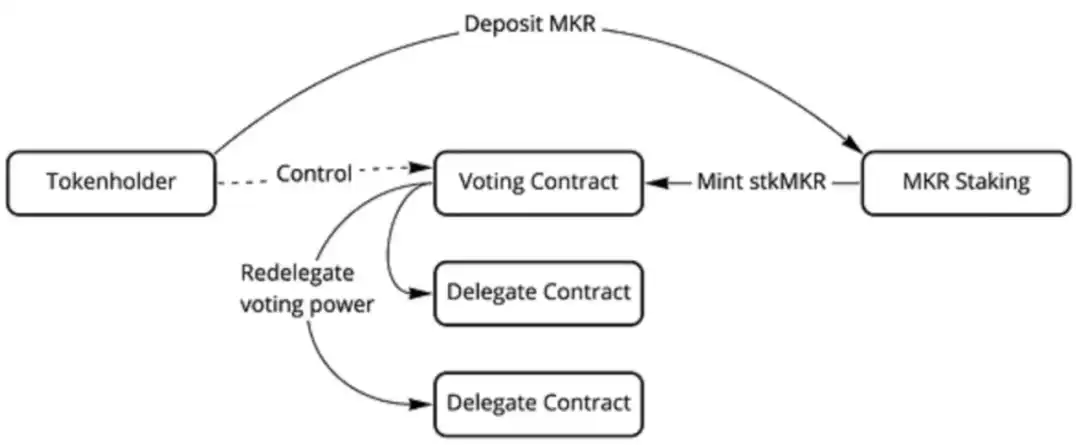
Image credit: MakerDAO Forum, while retrieving MKR, sktMKR directly destroyed. There is an unbinding period, after which it can be formally retrieved
a16z proposal innovates the makerdao Token economy model
Governance Direction:Token engineering
Time of Proposal:Mar 22, 2022
Proposed by:a16z
Brief introduction:The original makerdao proposal was that anyone could submit a proposal, whereas only the voting holder could vote. a16z also identified problems that could easily lead to governance attacks.
Comment on:The proposal is mainly combined with the past proposal collation, enabling more Token, including incentive and governance.
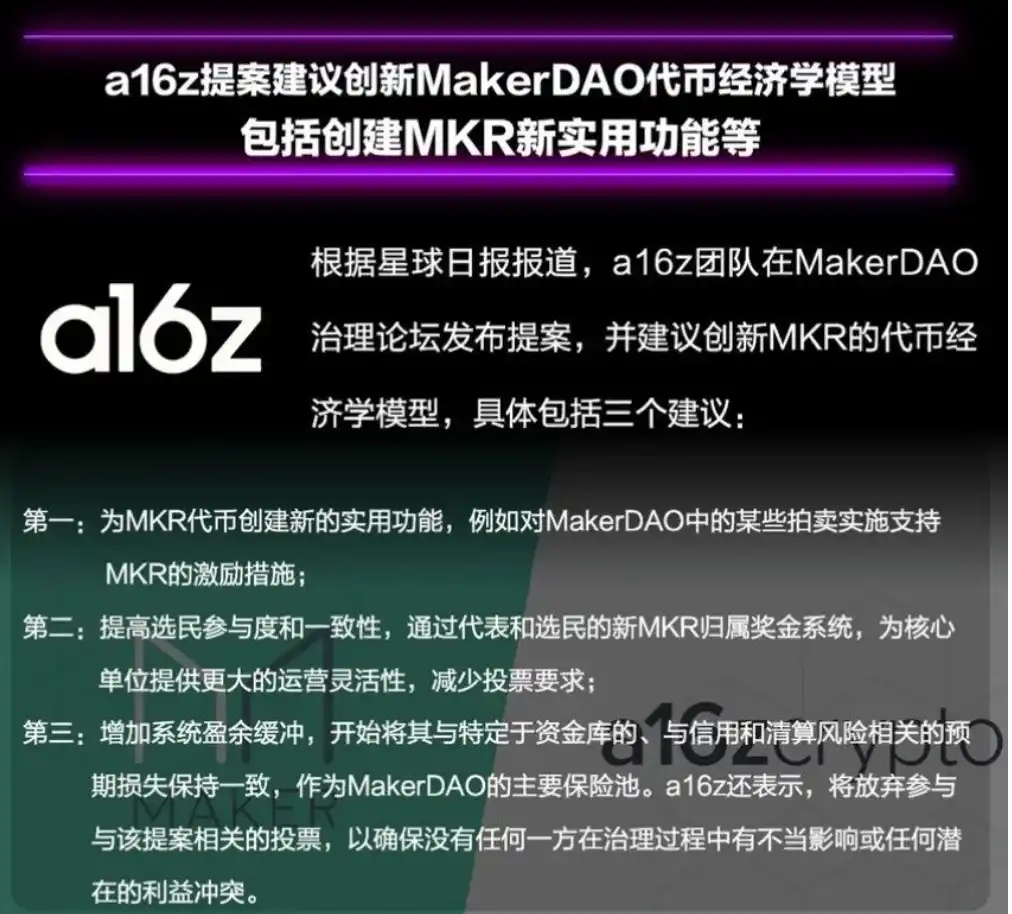
Photo credit: Talkchain
1. Add utility functions for MKR Token
Brief introduction:
• Require Maker tokens as collateral for other RWA pledge vaults.
• Additional distribution proceeds for those willing to pledge Maker tokens.
• Encourage participants to pledge Maker during the Maker DAO liquidation auction so that the interests of participants and DAO are aligned.
Comment on:Token holders are incentivized to pledge to achieve a positive cycle. In addition, access to RWA will help stablecoin expand its application space.
2. Adjust the alignment of interests between governance and Maker holders
Brief introduction:Makerdao sets up a community bonus for ordinary voters and representatives. The entire community, however, will receive the money over a period of 18 to 36 months, depending on the level of contribution.
Comment on:The whole governance incentive mechanism is based on the gbMKR and encourages the community to work together to govern.
3. Increase MakerDAO's surplus buffer reserve
Brief introduction:The surplus buffer reserve can not be fixed, it needs to be adjusted flexibly, currently can be maintained at around $250 million. In addition, set up a retained earnings management system to maximize community growth, such as compensating operational and strategic contributors, or distributing earnings to Token holders in a specific way to serve a specific purpose.
Comment on:Enhance financial resilience through community voting, including the establishment of earnings buffers and retained earnings management systems. Focus on the core pain points of makerdao and avoid large-scale losses of black swan events as much as possible.
Societe Generale proposed to MakerDAO that it refinance $20 million of its bonds
Governance Direction:RWA
Time of Proposal:Oct 21, 2021
Proposed by:Societe Generale-Forge
Brief introduction:Sg-forge, the digital asset arm of French financial services giant Societe Generale Group (SG), made a proposal to the governance forum of the decentralized autonomous organization MakerDAO to use the bank's security Token OFH as collateral for a $20 million DAI loan.
Comment on:Using the RWA example Tradfi and Defi combined case.
Monetalis Clydesdale: Liquid Bond Strategy & Execution
Governance Direction:RWA
Time of Proposal:Feb 11, 2022
Proposed by:Allan Pedersen, Regular
Brief introduction:DAI 500 million was used to buy US Treasury bonds as collateral. The proposal installs an RWA vault, which will acquire USDC through PSM and invest it in an approved bond strategy.
Comment on:Another example of RWA.
Real world Finance
Governance Direction:RWA
Time of Proposal:May 20, 2022
Proposed by:Christian Petersen, Real World Finance Core Unit
Brief introduction:Use RWA to expand CDP (mortgage debt position).
Comment on:The proposal suggests that Defi protocols should be scaled up using real-world assets.
Aggressive Growth Strategy
Governance Direction:RWA
Time of Proposal:Mar 16, 2022
Proposed by:Sam MacPherson, Protocol Engineering Core Unit Team
Brief introduction:The proposal proposes to finance Makerdao:
· Issue debt to increase surplus buffer funds
· Exchange equity for financing and accept investment from big VC
· RWA
Comment on:It can be regarded as a more specific measure to supplement the content of the RWA agreement.
The Endgame(Part 1& 2)
Governance Direction:MetaDAO
Time of Proposal:May 31, 2022
Proposed by:Rune Christensen, Maker Foundation CEO
Brief introduction:MetaDAO and its application scope are introduced.
Comment on:The Endgame Plan was developed by the former CEO of the Makerdao Foundation, who also proposed the clean money proposal. Endgame Plan can be seen as a supplement to clean money. MetaDAO combines the advantages of sub and pods, both issuing coins and organizing governance close to the form of minidao.
The Endgame Decentralized Workforce(Part 3)
Governance Direction:MetaDAO
Time of Proposal:Jun 11, 2022
Proposed by:Rune Christensen, Maker Foundation CEO
Brief introduction:
1. Top-down (classic).
2. Bottom-up (D2D).
3.D3M (Direct Deposit Model) fits Matadao.
Comment on:This paper introduces three budgetary labor force mechanisms, which act on different labor forces.
summary
The MakerDAO governance proposal can be summarized as follows:
Token project:Several key elements of makerdao regarding Token governance rewards can be used for delegation and direct voting. Is it representative? Is it minimal governance? The reward is related to the performance of the agreement. Will it help the long-term development of the Agreement and consolidate its status? Rewards encourage longer term thinking. Are the interests of the protocol and Token holders aligned?
RWA (real world asset) :Financing to issue debt, increase surplus buffer funds access RWA to exchange equity for financing, accept investment from large VC Endgame Plan: MetaDAO governance structure and labor distribution salary settlement.
Note: In the next chapter, CYC will continue to follow up MetaDAO's proposal description and blueprint for the governance of the Great heat. What is MetaDAO?
Reference Materials:
https://blog.makerdao.com/makerdao-has-come-full-circle/
https://makerdao.com/zh-CN/whitepaper/
https://twitter.com/n4motto/status/1534642569220706304
https://newsletter.tally.xyz/p/the-tally-newsletter-issue-73
The original link
Welcome to join the official BlockBeats community:
Telegram Subscription Group: https://t.me/theblockbeats
Telegram Discussion Group: https://t.me/BlockBeats_App
Official Twitter Account: https://twitter.com/BlockBeatsAsia
 Related Articles