Dragonfly investors: Analyzing the narrative of the DeFi cycle, why is it so far behind L1?
Original title: "DeFi's (non)Progress This Cycle"
Original author: Celia Wan, Dragonfly Capital
Original compilation: TechFlow intern
You know it's the end of a cycle when people start questioning everything they believed in during a bull market.
This encryption cycle began when Compound launched COMP and brought the concept of single currency pledge to the public. With the 20% rate of return promised by Anchor and The overblown LUNA kills and it's officially over.
The debacle raises a host of soul-searching questions about the validity of every other DeFi project - even Bitcoin:
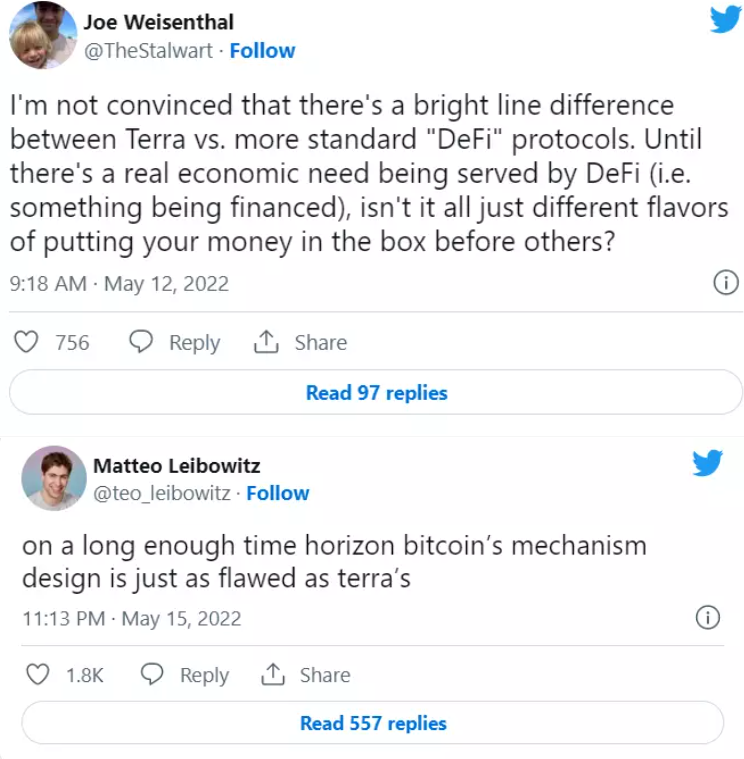
Often, when the trend collapses, the bubble evaporates. Take Terra, once the biggest success story of DeFi and L1, as an example. Its failure means that single currency pledge has lost its luster, expectations have been reassessed, and prices have been adjusted.
Although many tokens are now at all-time lows, the market is now converging on new prices that are less based on hype and more on our A realistic view of what has been achieved in the last cycle, the bear market is a good time to look back at last year and the progress we have actually made.

In order to connect with the previous price cycle, we compare the current prices of some famous DeFi and L1 projects with their all-time highs, and also with the 2020 Compare prices on November 1, 2019. This period was chosen because it was at the beginning of the cycle, during this period (2020/11/1) things started to clear up for DeFi and L1, but the bubble was still small - Uniswap launched two months ago DeFi’s TVL is on the verge of crossing the $10 billion mark, but it has yet to see exponential growth; projects such as Avalanche, Solana, and Terra have yet to launch their respective Liquidity mining is rarely discussed.
These price points can reveal some patterns:
1) Since the beginning of the cycle, investment The maximum possible return that the project can generate;
2) The ability of the project to maintain value at the end of the cycle;
It turns out that DeFi and L1 both underperform Ethereum and Bitcoin in terms of drawdowns. This is not surprising since ETH and BTC have the strongest market consensus and this consensus is less affected by the ebb and flow of the market. For the same reason, Ethereum and Bitcoin have worse max returns compared to most DeFi and L1 tokens.

Meanwhile,L1 is clearly the winner of this cycle in terms of maximum returns. The top two projects, Solana and Polygon, have made a name for themselves this cycle with ample ecosystem funding and liquidity mining incentives. Their maximum returns are all in excess of 5 figures, far exceeding other L1s such as Avalanche and Near.
Overall, L1s outperformed DeFi overall, with DeFi blue chips lagging overall (though still achieved impressive 4-digit returns). COMP and SNX fared worse, but that could be because their price cycles did not match the one in question (SNX was launched in 2018, COMP was running before November 1, 2020).
This rule tells us one thing - In the past cycle, DeFi did not produce much Alpha on top of L1 Beta .
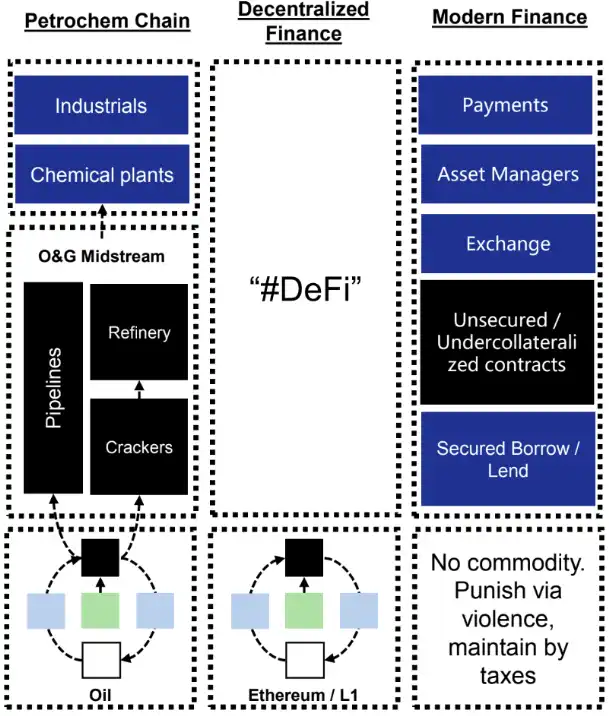
Jason Kam has a good frame of mind to think about this issue. In DeFi Summer 2020, he raised a very meaningful question-if ETH Similar to building petrochemical value chain (DeFi) energy commodities, then "is it better to invest in oil or petrochemical/industrial chain stocks?"
 < /p>
Looking back at what we have achieved in the past cycle, I think the answer to this question is clear-the risk-reward ratio of the underlying token is better than any other token based on it. Apps are better, at least for now. In the past two years, blue-chip DeFi tokens have experienced similar retracements to L1 when the market fell, but showed less upside potential than L1 when the industry took off.
Heuristically, this is easy to understand. So far,most of the hype around DeFi is because it can bring "users" and "liquidity" to L1. However, when users do come to L1s, most of the time they are attracted to staking incentives, which they quickly discover are the only things they can do on the blockchain. Then, when production is low, they move to other higher yielding L1s.
In this relationship, L1 has no value-added effect on DeFi. DeFi exists to make L1 look good - it's a means to achieve TVL and user growth, which causes L1 to appear "adoptive". However, many DeFi projects themselves do not benefit from different blockchains, and some are even hindered by EVM-incompatible chains and poor development documentation.
Therefore, these DeFi projects lack the intrinsic motivation to maintain their market value, not only their growth is highly dependent on the expansion of L1, but their advantages are also affected by The constraints of the ecosystem they belong to.
The most convincing numbers for this vicious growth pattern come from comparing the token prices of these projects now to the prices at the beginning of the cycle. These numbers show how much value DeFi and L1 projects can retain after the LUNA crash wipes out most of the bubble.

The results show that although almost all Tokens have achieved more than double-digit growth during this period (except COMP, 1INCH and SNX), DeFi’s value preservation rate Not more than Ethereum or L1.
Using UNI as an example, its return rate from November 1, 2020 to today is 128.22%, while the return rate of Ethereum is 208.26% (UNI Also recently received additional price increases due to the acquisition of Genie and a new NFT roadmap). In other words, if you have some ETH at the beginning of the cycle and hold on to it, you will outperform DeFi at this point ("Hold" is important because ETH's max return is lower than UNI), many other DeFi The same is true for tokens.
This is a sober view of the value left by these projects at the end of the cycle, the old model of using liquidity incentives and airdrops to attract users to join DeFi is no longer worked. DeFi brings users to L1 without caring what those users actually do. The end result is that, at its core, DeFi is part of a service industry that can only serve itself—users participate in order to participate in DeFi, rather than use it for other activities. This self-serving sometimes degenerates into a Ponzi scheme.
Of course, price is not the only thing that matters. Over the past cycle, DeFi has also seen some real innovation, the progress of which cannot be quantified by token price. For example, the pioneering centralized liquidity feature of Uniswap V3 has opened up a huge design space for the emergence of new applications; the demand for block space has inspired a series of block space financialization protocols, such as Flashbots and Alkimiya.
Finally, there are also some DeFi protocols that launched their tokens late in the cycle and didn't have a chance to reach their full potential. For example, projects such as Lido, Ribbon, and dYdX all have multiple product or industry updates coming soon that will further fuel their growth.
After the Ethereum merger is completed, Lido's TVL will get a huge boost. Ribbon offers a large number of structured products that are well suited for on-chain composable environments, but are currently undeveloped. dYdX and some other derivative protocols still have a huge untapped market to capture, especially when you compare their transaction volume to their off-chain counterparts.

The truth is,although L1 was able to overtake DeFi in the last cycle, if we can't figure out where the new users are coming from, any of them Unable to develop further.
DeFi will get exciting again when new categories emerge that can bring real users to the blockchain, those users There are real financial needs that DeFi can serve. While the rise of NFT and Web3 in the second half of the cycle has shown a different need than over-leveraged Token, these categories will attract new users and reconnect them to DeFi, which will be the story of the next cycle.
Until then, there are still many issues to be resolved and the team It is also necessary to commit to important research in DeFi, and the bear market will provide them with much-needed time to focus on their products, rather than rushing to the listing and promotion of Token.
Original link
Welcome to join the official BlockBeats community:
Telegram Subscription Group: https://t.me/theblockbeats
Telegram Discussion Group: https://t.me/BlockBeats_App
Official Twitter Account: https://twitter.com/BlockBeatsAsia

 Related Articles