BitMEX founder: How did Three Arrows Capital slide from peak to bankruptcy

Arthur Hayes: Three Arrows Capital Crisis: The Hunger Trap
原文作者: Arthur Hayes,BitMEX 创始人
DeFi The way of
The current crypto bear market is my third brush with general market carnage. Although it sometimes feels like a rerun, each episode brings new lessons. Everyone will have an opinion on these lessons -- but if you listen to the mainstream financial media, I can assure you that you have been misinformed. They take every opportunity to mock our economic/social experiments while serving the demon TradFi -- cheerfully proclaiming, "We warned you, cryptocurrencies were worth nothing!" In the name of our Lord Satoshi, I will attempt to correct these malicious invective.
In this article, I will use the saga of Three Arrows Capital (3AC) as a lens through which we can better understand the real insights we should gain from the current bear market. Please note that while I personally know Su Zhu and Kyle Davies (head of 3AC), I have no knowledge of what has happened other than what has been publicly reported. I intend to use my knowledge of cryptocurrencies, financial services, and common sense to figure out what I believe caused the collapse, starting with the implosion of TerraUSD and Luna.
The 3AC crash itself is not remarkable. A hedge fund that had successfully executed a boring but stable arbitrage strategy decided to strap on leverage to accelerate returns, and paid the price. Using borrowed money to play the TerraUSD carry trade is a death sentence for them.
But what makes 3AC's default so consequential is that it blasted a hole the size of a whale shark in many of the biggest centralised crypto lending businesses. As a result of losses on 3AC loans, many of these lending businesses have closed customer funds and are unable to repay their loans. The withdrawal of credit from the crypto ecosystem also contributed to the collapse of bitcoin, Ethereum, and the general market for copycat coins. Not a single coin was spared.
But what much of the media doesn't mention is that both centralized and decentralized lending companies/platforms have 3AC risk, and only one participant in both markets has failed. Centralised lending firms collapsed en masse, while their decentralised counterparts liquidated collateral and thrived. Using the story of 3AC as a canvas, let me paint a picture of why the creations of "God" Satoshi Nakamoto and "Angel" Vitalik have stood the test of time, and what this means for the future of cryptocurrencies.
For the full story of Arthur Hayes' early encounters with Su Zhu and Kyle Davies in Hong Kong, see the original article. This part mainly introduces how these two founders of 3AC carry out arbitrage trading of foreign exchange and derivatives. Arthur Hayes writes: The only way to improve hedge fund performance is to become a directional trader and/or use borrowed money. 3AC does both.)
TerraUSD/Luna
The carry Trade of the century this cycle was sponsored by Do Kwon and TerraUSD.
TerraUSD (UST) is a DeFi algorithm stablecoin. The goal of the code supporting UST is to try to maintain a 1:1 peg to the DOLLAR. I discussed how this hook works in "Luna Brothers, Inc."
The hardest part for any currency that does not derive value from the barrel of a government-owned gun is generating internal demand. In 2010, when 10,000 bitcoins were exchanged for Papa John's Pizza, it marked the first known real-world transaction of bitcoin. This is very important because it means that a real pizza seller believes that Bitcoin is enough to compensate him in the transaction.
So how does TerraUSD convince people to use UST? Very simple... Another Terra ecosystem project, Anchor, provides 20% fixed income to the mortgaged UST. If you pledge your UST to the Anchor agreement, you can earn an ongoing interest rate of 20% annually.
Then how does Anchor generate such a huge income?My trusted research analyst found the answer for readers:
Borrowers pay an annual interest rate of about 10-12%, depending on their agreement. Borrowers receive ANC as a reward for borrowing money, usually around 7%.
Anchor will also pledge collateral funds in order to receive pledge rewards.
None of this is enough to get rid of the incredible imbalance of demand between borrowers and lenders.
Anchor also has a reserve fund, mainly funded by the Luna Foundation, which will help make up the difference between ~ 10-12% and 20%.
The idea was that eventually the Terra ecosystem would grow large enough to support such a high annual interest rate. But the reality is that Terra continues to burn its reserves and (eventually) runs out of money.
Terra is essentially paying for Anchor's growth and adoption. Hopefully the Anchor agreement will have a vibrant savings and loan ecosystem when the subsidy expires in 2024.
A 10% yield deficit is a big hole to fill when hundreds of millions of dollars are pouring into the market for the advertised 20% annual yield. Neither Anchor nor Terra has survived long enough to determine whether the ecosystem can support the removal of subsidies.
Few fund managers stop to think critically about how TMD's Anchor is generating these gains. But it doesn't matter because it paid 20% of APY until the collapse of UST and LUNA. This is the mother of all crypto arbitrage trades.
I'm sorry, but I still want to kill this black horse. I did some analysis of about three million bonds indexed by Bloomberg. I specifically screened for maturities of less than a year and yields of at least Bonds of more than 20%. Out of three million bonds, only 159 met these criteria. For those who like math, that's less than 0.01 percent. The list of high-yielding instruments includes the bonds of Sri Lanka, Ukraine, Argentina and Turkey. To put it bluntly, lending to these sovereign governments has been a road to ruin for investors for centuries. If these are entities paying a 20 per cent yield, what does it mean for Anchor to be able to do the same and ensure repayment of principal?
Any so-called institutional money managers who put their own or clients' money into the TerraUSD carry trade should look for new jobs when they lose all their money and are surprised.
Back to the boys at 3AC.
I've been going on and on about why I met Su Zhu and Kyle Davies in Hong Kong in the early days because I wanted you to understand how these people developed their funds in the first place. Carry trades like UST can't be ignored -- especially when people like Su and Kyle, who have been DeFi stalwart advocates, have made a lot of money by correctly betting on price growth in some of the other protocols. We know 3AC holds a lot of LUNA-- but what we don't know is the depth of their exposure to the UST carry trade.
Davies says 3AC invested over $200 million in LUNA Tokens as part of a $1 billion LUNA Foundation Guard raised in February, since the Terra ecosystem imploded in mid-May, "The Terra-Luna situation caught us off guard," Davies told the Wall Street Journal.
Source: The Wall Street Journal
UST carry trading is very simple.
- Borrow in DOLLARS at less than 20%
- Convert dollars to UST
- Deposit UST into Anchor and earn 20% profit
- Annualized unrealized profit = 20%- borrowing costs
In order to realize profits, they will do it the other way around.
- Extract UST + UST interest from Anchor
- Convert UST to DOLLARS
- Pay off the dollar loan
- The rest is profit
Using your own capital as a hedge fund severely limits the profit potential. A true master of the universe, when confronted with such carry trades, would leverage by borrowing money.
Imagine that you could borrow $1 billion at 10% annual interest, using the copycat coin portfolio you already own (or even nothing at all) as collateral. Then, you convert $1 billion into $1 billion UST and earn 20%. You make $100 million a year, and it takes no effort to manage the position. Again, I don't know how big 3AC's UST position is, but if we believe they had close to $18bn in asset management at one point earlier this year, it makes perfect sense that they borrowed billions to deploy this carry trade.
Your ability to borrow depends on your collateral and your reputation. Our aim is to borrow with as little collateral as possible. The less collateral you are asked to post, the more the borrower will trust you.
3AC has cleverly built an aura of invincibility. This is the result of correctly predicting the market in the past and actively telling people about their trading on social media. At its peak, 3AC was one of the largest dedicated crypto pools in the world. This superior trading reputation, combined with the size of assets under their control, enabled 3AC to borrow on very generous terms. Voyager, for example, a publicly traded company, lent 3AC hundreds of millions of dollars without any collateral. 15,250, to be exact. BTC And 350 million & have spent USDC -- so much so that they ended up completely unable to defend themselves against a default by 3 AC.
Game over
Here are some of my (purely speculative) thoughts on how 3AC started to slide toward bankruptcy.
As I suggested above, I suspect that 3AC not only used its own capital but also borrowed dollars from individuals and funds to play the UST carry trade. For the secured loans, 3AC used Bitcoin, Ethereum and, most importantly, a variety of other illiquid and volatile copycoins as collateral. On paper, 3AC's crypto portfolio looks impressive. But when UST decoupled and the entire $40 billion Terra ecosystem collapsed within a week, what was once such a lucrative carry trade quickly turned into a rotting nightmare -- the demise of 3AC became a matter of when, not if.
When the market goes down, it goes down in a related way. That simple fact has been the bane of 3AC, whose inflated valuation stems in large part from the market value of many of the illiquid shanzhai coins they hold. When the market began to fall, liquidity evaporated and the order book was reduced to quotes. As 3AC continued to sell through rapidly drying up demand, prices fell lower and lower in a non-linear fashion -- eventually making it impossible to recover enough dollars to repay the loan.
3AC suddenly owed a lot of dollars, but it didn't and couldn't repay because the remaining assets it could have cashed in to pay off those loans had fallen by 50 to 75 percent. If the broader crypto market had not fallen, then 3AC might have been able to recoup the capital losses tied to UST and LUNA. Instead, the market sniffed a wounded lion and set about banishing it.
So here's the question.
Who lent the money to 3AC?
How much money is lent to 3AC? How much collateral is there?
What is the collateral?
Does 3AC pledge the same collateral multiple times?
Over time, large, centralized crypto lenders have come under pressure. Some big companies declare bankruptcy and go cap in hand to the few Crypto Ogs that have enough money to restore solvency.
"But how can a default by one fund turn into near-bankruptcy for an entire industry?" That's a good question -- let's take a closer look at how 3AC has brought down many of the biggest and most high-profile centralised crypto lending players.
Centralized crypto lending participants
First, let's familiarize ourselves with the major players in centralized lending. Some of the biggest companies feeling the pressure from the demise of 3 AC include Voyager, Celsius, BlockFi And Babel Finance.
A word of caution: I have no non-public information about these companies. All I have to go on is reasoning and public statements.
The lending business is simple: lenders accept deposits and pay interest to depositors in exchange for the ability to lend out their money. The lender then lends the money out at a higher interest rate than it pays depositors to make a profit.
The simplicity of this model comes with some pitfalls -- one of which is that the lending business inevitably comes under pressure in any financial crisis. Unless you work for a company, savers have no way of knowing whether the company is handling their money in a prudent manner. So at any sign of stress, you rush for the exit, and if lenders take on risk for any period, they will go bankrupt very quickly.
With that in mind, let me take a look at the safest way to run a lending business.
Suppose you have three customers. Mark Karpeles also known as MagicalTux, Do Kwon also known as The King of Korea, and Su Zhu also known as The Sultan of Singapore. They each have one. ETH And they want to get a return on their assets. Everyone has a time preference.
Mark: One month; Do: 3 months; Su: 1 year
We call the lender long-term Cryptocurrency Management (LTCM).
LTCM can be a safe lender or a risky lender.
If LTCM is conservative, it will lend on maturity dates that match everyone's time preferences. Therefore, LTCM releases 1 month ETH and 3 months ETH; 1 year ETH. When Mark, Do or Su ask for their money back, there is no risk because the money is loaned out and cannot be returned to them.
If LTCM is aggressive, it will lend for longer than everyone's time preference. To illustrate this absurdly extreme block, LTCM can lend 3 ETH for 10 years. Clearly, if any depositor asks to get their money back within a period of time they like, that's not going to work. That's why lenders go bust. But LTCM can bet that it will be able to persuade every depositor to roll over their money multiple times, so that LTCM will never go bust.
This analysis relates only to the term of LTCM's loan book. The second aspect of the lending business is the quality of the borrower. As a company, the value of a lender derives primarily from its ability to correctly assess the credit risks of a borrower and to provide the appropriate security or collateral required by these risk assessments before lending.
In cryptocurrencies, the demand for credit comes from three sources:
Carry trades and basic cash and carry trades. The borrower prefers not to post collateral because it wants to have as much cash as possible to use these strategies most effectively. You can read one of my earlier articles, "All Aboard!" For a detailed explanation of the cash and carry trade.
Margin loans used for speculation. These are for directional long and short traders. Usually, they put up some kind of collateral. But failure to understand the volatility and changes in liquidity of the underlying collateral can lead to losses for lenders.
Mining assets secured loans. Miners either pledge hardware (such as ASIC Bitcoin mining machines) or cryptocurrency and receive fiat and/or stablesoin. These borrowers are least at risk because they have strong cryptocurrency cash flows to back their loans. However, if you recover ASIC machines from a defaulting miner, you must have a facility where you can plug in the machines and start mining to make full use of them.
The main use case missing from cryptocurrency credit is commercial lending. The field is so new and risky that lending to crypto companies doesn't make sense. Crypto companies, similar to the underlying coin itself, should be considered call options. . In the event of default, no matter where you are in the capital structure, you are wiped out. Assuming that's the case, it's better to just own equity -- because at least you can participate in the rise.
Borrowers have been willing to pay sky-high interest rates due to the volatility inherent in the crypto market and the alleged profitability of various yield farming, arbitrage and underlying trades. This means lenders can offer extremely high interest rates to retail savers and still have a positive net interest margin (NIM).
I believe the major crypto lenders started with very reasonable loans, but then grew too fast. Crypto deposit rates are very attractive compared to TradFi Bank and sovereign government quotations for fiat currency deposits and bonds. This is the result of the central bank's reckless money printing and zero interest rate policy. Yield-hungry retail investors will not be satisfied with these huge returns for cryptocurrencies and fiat stabocoins.
The billions of dollars pouring into these few firms have exceeded the supply of responsible borrowers. They have to deploy it because they are paying to get it (remember, they are paying interest to everyone). The pressure to lend money forced companies to lower their lending standards, leading them to engage in the same carry trade as 3AC.
BlockFi, for example, was once one of the largest holders of THE US-listed BITCOIN tracker GBTC. BlockFi takes BTC deposits, creates GBTC shares, and then sells GBTC shares in the market for a premium. That was the plan, but it took six months to create GBTC shares. During this six-month period (late 2021 to early 2022), GBTC's premium turned into a discount and they already lost money when they exited the ARB. If you have the Bloomberg app, search GBTC U.S. Stocks HDS. Then, look up BlockFi and you'll see that they sold their 3.6 million GBTC shares sometime in the first quarter of this year.
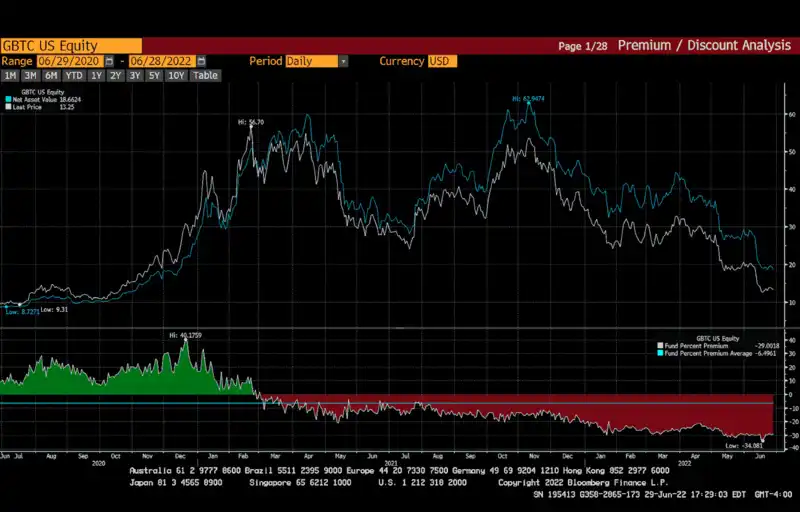
Above is GBTC's premium or discount to its net asset value (NAV). Given the six month lead time and human penchant for unlimited extrapolation of short-term trends, I bet many companies will borrow BTC to create GBTC and hope to make 40% profit after six months. As you can see, this obviously didn't happen as GBTC has been trading at a discount since 2Q2021.
3AC was able to carry out such large arbitrage and directional trades largely because it had a pool of capital it had to invest. There seems to me no other explanation for why a publicly traded company like Voyager would lend them hundreds of millions of dollars in unsecured dollars and Bitcoin. 3AC said they would pay high interest rates, and Voyager believed them -- because, in Voyager's opinion, no other company could absorb the amount of money 3AC needed to ship. As Chuck Prince put it in response to Citibank's involvement in subprime mortgages, "when the music stops, things get complicated in terms of liquidity. But as long as the music is playing, you've got to get up and dance. We're still dancing."
Unfortunately, lenders are all on the same side of the deal. They have the same borrowers. They hold the same collateral. The borrowers all lost money on the same carry trade. The only difference between 3AC and these lenders is their ability to market themselves. As we can see, none of them had proper risk management in place to weather this particular storm.
To make matters worse, these are private companies, which do not have to regularly report the health of their loan books or set aside reserves for expected bad loans, as publicly traded banks do. We can only guess without any basis the size of the potential losses these lenders face. So everyone is trying to pull their money out at the first sign of stress -- and if lenders don't match up for maturity, that's exactly how they go bust. And that's exactly what happened because the market wanted to know how big a hole 3AC had made in these lenders.
This is not a retail exit. These lenders are trading the same risks with each other, which means they are exposed to each other and they don't trust each other. This total loss of confidence in centralised opaque lending institutions was the cause of their near-simultaneous extinction.
Midfielder summary
Quick summary: 3AC blew up because they adopted a boring, stable and predictable arbitrage strategy, applied a lot of leverage, and succumbed to the market after the TerraUSD carry trade collapsed.
Because they are considered to have investment acumen and a large pool of assets, 3AC is allowed to borrow with little collateral from lending companies eager to redeploy retail deposits into high-yield crypto credit vehicles. These lenders, such as BlockFi, Babel Finance, Voyager and Celsius, abandoned prudent risk management policies in order to secure as many loans as possible as quickly as possible. As a result, when 3AC failed to meet margin requirements, the lenders were left with a hole as deep as the Mariana Trench in their balance sheets. Unfortunately, these once-lauded, $1 billion-plus "fintech" startups are now heading for bankruptcy before glue mills (where animals, especially older horses, are said to be sent to make "animal glue" from their bones).
There is nothing new or innovative about how these lenders became insolvent. As long as there has been a centralised lending business, there have been epic failures, such as those experienced by this group of cryptocurrency lenders in this case. The deep technology of cryptocurrencies and DeFi has nothing to do with why 3AC and these lenders are in trouble.
It is now clear that this was an ordinary failure of a financial institution with poor risk management. Below, let's take an in-depth look at how actual cryptocurrency and DeFi applications should handle these market pressures.
The operation of TerraUSD
At the heart of the Terra ecosystem is DeFi. A group of engineers produced a code base that anyone who took the time to investigate could see that these lines of code controlled the UST Algorithm stablecoin & NBSP; Behavior. UST code executes 100% as designed. It works; But investors don't care how it works. Thus, the recursive logic that governs how LUNA and UST cast and destroy to balance the ecosystem erases 100% of the value of the ecosystem when the hook breaks down. This is purely mathematical, more or less inevitable; The fact that many people refuse to read the white paper is not TerraUSD's fault.
DeFi Loan agreement
Another set of entities that borrow money from 3AC and various other addresses in the crypto ecosystem is the DeFi Lending protocol. The main player in this farce is Compound (COMP), Aave (AAVE) and MakerDAO (MKR).
When you borrow in a decentralized way, there is no individual discretion. This means that the agreement cannot factor any trust-related data points into its decisions about whether to lend money and how to keep it safe. Community-managed agreements have several sets of rules that specify the type of collateral required and the amount.
If I wanted to borrow USDC in Bitcoin, the agreement would require the borrower to overpledge in Bitcoin. This is because bitcoin is a more volatile asset than legal stablecoins such as USDC. Typically, the initial margin is 150% of the value of the USDC borrowed. If bitcoin is $100 and I want to borrow 100 USDC, THEN I have to use 1.5 BTC as collateral for a loan of 100 USDC.
如果比特币的价格下降,通常是下降到 USDC 贷款价值的 120% 的设定水平,协议将立即以编程方式清算比特币,因此,在大多数情况下,100 USDC 将返回给贷款人。这些水平是在协议层面建立的,只有在足够多的治理 Token 持有人同意放松或收紧贷款标准时才能改变。
In fact, some lending agreements have changed their policies during the current crisis. These changes must be implemented through a series of community-driven governance votes. Isn't it amazing when decisions can be made quickly, efficiently, digitally and programmatically by self-interested parties? As a simple example, here is a recent proposal to tweak the collateral factor in Compound.Finance, which was approved by the DAO that manages the agreement.
The only information these protocols have about lenders and borrowers is their Ethereum wallet addresses. To them, 3AC is just an address with a balance. It is not a collection of human beings with a pedigree that suggests they can and should be trusted to pay back what is owed, even without the need for collateral up front. Let me repeat: these lending agreements are explicitly designed to remove the need for trust from the lending equation.
These agreements control billions of dollars in loan books. Their lending criteria, borrower/lender address, and their liquidation level are completely transparent as it is all publicly posted on the blockchain. We can assess the health of their loan books in real time. Depositors of these agreements can process all relevant information about their health before depositing funds, in contrast to the opacity of centralised lenders, where depositors have only flashy marketing campaigns to consider.
3AC and Bag Holders, part of Centralized Lending, are heavily involved in these DeFi lending agreements. We know this because using blockchain analytics tools, market participants are able to determine when certain companies' large outstanding loans on these agreements will be cleared. The market is brutal, systematically hunting for levels that force a negotiated sale so that its lenders are compensated. Thankfully, all of these major DeFi lending agreements have survived thanks to conservative margin requirements imposed by the community.
These agreements did not stop any withdrawals.
These agreements continue to make loans.
The protocol has not suffered any downtime.
Rekt almost killed them
When you remove trust from the equation and rely purely on transparent lending standards enforced by impartial computer code, you get a much better result. That's the lesson to be learned. Don't let the media claim that the failures of these centralised companies are evidence of the shortcomings of the good Satoshi nakamoto. Because he saved people who were worth saving.
The question now is, with hundreds of thousands or millions of people rekt due to the contraction of centralised crypto credit, who else can they borrow from? That is what these DeFi lending agreements will grapple with as this bear market marches on.
At some point, the price-to-book ratio of these DeFi lending agreements will become attractive again. For now, they are still trading at inflated prices given the near-term outlook for loan demand. With speculators, large trading houses and centralised lenders going out of business, there will not be so much demand for organic loans. Maybe I'm just being greedy, but I wish the market would give me a chance to own COMP, AAVE and MKR at a lower level before we exit this bear market.
Hunger trap
Water, water, water everywhere,
The deck creases with soaks;
Water, water, water everywhere,
Not a drop is to be inhaled.
Coleridge, The Old Mariner
Centralized crypto lenders are hungry! But should these withered zombies be given the nectar of capital?
For crypto hedge funds like 3AC, their intrinsic value depends entirely on the ability of their portfolio managers (PMS) to take risks wisely and make money consistently over the long term. If a bunch of PMS blow up because of improper use of leverage, what are the funds they control worth? I suspect 3AC is frantically calling CZ and SBF, but what exactly will they buy?
Chaos, that's for sure. And I doubt 3AC and funds in a similar situation will find a saviour.
When it comes to crypto lending companies, their only value lies in their customer lists and a small percentage of good loans. If those customers can be retained and sell more crypto financial products, it might make sense to buy the crippled centralised crypto loan company and assume its debt for the price of a song. Their radioactive loan books may contain suitably insured loans that can be bought at attractive prices. The problem is that the longer these lenders remain dead, the less likely they are to reopen and allow their retail depositors to withdraw their money. The time pressure to conduct due diligence on these opaque entities makes it harder to accurately assess whether the crypto moguls will give up their capital and save the sinners.
Sure, the Fed or other central banks could bail out these hedge funds and companies, but these entities trade cryptocurrencies. These entities are not part of the TBTF club of financial institutions and will therefore die in disgrace. But don't shed too many tears, because we know through these trials and tribulations that the promise of a new decentralised financial system has survived yet another test.
The original link
Welcome to join the official BlockBeats community:
Telegram Subscription Group: https://t.me/theblockbeats
Telegram Discussion Group: https://t.me/BlockBeats_App
Official Twitter Account: https://twitter.com/BlockBeatsAsia